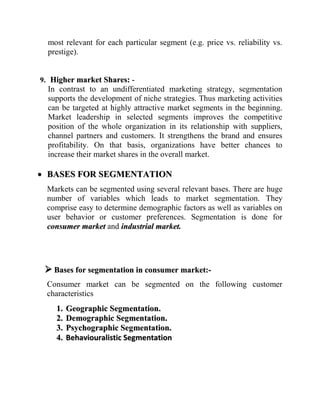
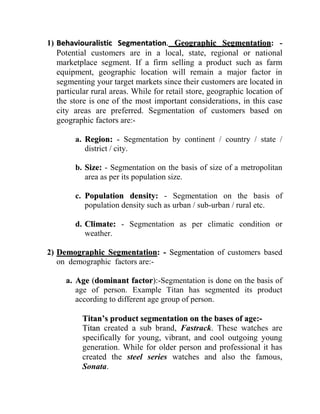
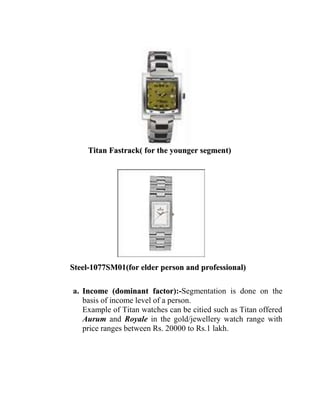
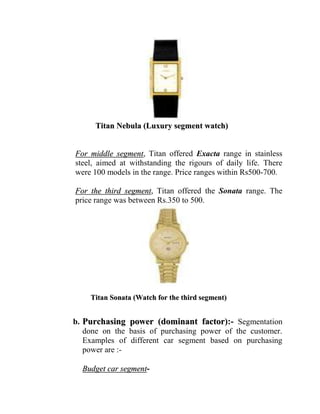
MARKET SEGMENTATIONINTRODUCTION: - The market for any product is normally made up of several segments. A ‘market’ after all is the aggregate of consumers of a given product. And, consumer (the end user), who makes a market, are of varying characteristics and buying behavior. There are different factors contributing for varying mind set of consumers. It is thus natural that many differing segments occur within a market.In order to capture this heterogeneous market for any product, marketers usually divide or disintegrate the market into a number of sub-markets/segments and the process is known as market segmentation.Thus we can say that market segmentation is the segmentation of markets into homogenous groups of customers, each of them reacting differently to promotion, communication, pricing and other variables of the marketing mix. Market segments should be formed in that way that difference between buyers within each segment is as small as possible. Thus, every segment can be addressed with an individually targeted marketing mix. The importance of market segmentation results from the fact that the buyers of a product or a service are no homogenous group. Actually, every buyer has individual needs, preferences, resources and behaviors. Since it is virtually impossible to cater for every customer’s individual characteristics, marketers group customers to market segments by variables they have in common. These common characteristics allow developing a standardized marketing mix for all customers in this segment. Through segmentation, the marketer can look at the differences among the customer groups and decide on appropriate strategies/offers for each group. This is precisely why some marketing gurus/experts have described segmentation as a strategy of dividing the markets for conquering them.REASONS FOR MARKET SEGMENTATIONSegmentation is the basis for developing targeted and effective marketing plans. Furthermore, analysis of market segments enables decisions about intensity of marketing activities in particular segments. A segment-orientated marketing approach generally offers a range of advantages for both, businesses and customers. Facilitates proper choice of target marketing:-
Segmentation helps the marketers to distinguish one customer group from another within a given market and thereby enables him to decide which segment should form his target market.
Higher Profits: -
It is often difficult to increase prices for the whole market. Nevertheless, it is possible to develop premium segments in which customers accept a higher price level. Such segments could be distinguished from the mass market by features like additional services, exclusive points of sale, product variations and the like. A typical segment-based price variation is by region. The generally higher price level in big cities is evidence for this. When differentiating prices by segments, organizations have to take care that there is no chance for cannibalization between high-priced products with high margins and budget offers in different segments. This risk is the higher, the less distinguished the segments are.
Facilitates tapping of the market, adapting the offer to the target:-Segmentation also enables the marketer to crystallize the needs of target buyers. It also helps him to generate an accurate prediction of the likely responses from each segment of the target buyer. Moreover, when buyers are handled after careful segmentation, the responses for each segment will be homogeneous. This in turn, will help the marketer develop marketing offer/programmers that most suited to each groups. He can achieve specialization that is required in product, distribution, promotion and pricing for matching the particular customer group and develop offers and appeals for the segmented group.Example of Ford: - Ford has gained useful insights through segmentation and adapted its offer to suit the Indian target market. For the Indian segment Ford made some changes in its cars in comparison to their European version. Modifications such as: - a. Higher ground clearance to make the car compatible to the rougher road surface in India.b. Stiffer rear springs to enable negotiating the ubiquitous potholes on     Indian roads.c. Changes in cooling requirement, with greater airflow to the rear.d. Higher resistance to dust.e. Compatibility of engine with the quality of fuel available in India.f. Location of horn buttons on the steering wheel. As Indian motorists use horn far more frequently than the European where the horns are located on the lever. Stimulating Innovation: -
An undifferentiated marketing strategy that targets at all customers in the total market necessarily reduces customers’ preferences to the smallest common basis. Segmentations provide information about smaller units in the total market that share particular needs. Only the identification of these needs enables a planned development of new or improved products that better meet the wishes of these customer groups. If a product meets and exceeds a customer’s expectations by adding superior value, the customers normally is willing to pay a higher price for that product. Thus, profit margins and profitability of the innovating organizations increase.
 
Makes the marketing effort more efficient and economic: - Segmentation ensures that the marketing effort is concentrated on well defined and carefully chosen segments. After all, the resources of any firm are limited and no firm can normally afford to attack and tap the entire market without any delimitation whatsoever. It would benefit the firm if the efforts were concentrated on segments that are more profitable and productive ones.
Segmentation also helps the marketer assess as to what extend existing offer from competitors match the needs of different customer segments. The marketer can thus identify the relatively less satisfied segments and succeed by concentrating on them and satisfying their needs.
Benefits the customer as well: -
Segmentation brings benefits not only to the marketer, but to the customer as well. When segmentation attains higher levels of sophistication and perfection, customers and companies can conveniently settle down with each other, as at such a stage, they can safely rely on each other’s discrimination. The firm can anticipate the wants of the customers and the customers can anticipate the capabilities of the firm.
Sustainable customer relationships in all phases of customer life cycle: - Customers change their preferences and patterns of behavior over time. Organizations that serve different segments along a customer’s life cycle can guide their customers from stage to stage by always offering them a special solution for their particular needs. For example, many car manufacturers offer a product range that caters for the needs of all phases of a customer life cycle: first car for early teens, fun-car for young professionals, family car for young families, etc. Skin care cosmetics brands often offer special series for babies, teens, normal skin, and elder skin. 
Targeted communication: -
It is necessary to communicate in a segment-specific way even if product features and brand identity are identical in all market segments. Such a targeted communications allows to stress those criteria that are most relevant for each particular segment (e.g. price vs. reliability vs. prestige).  

Jyoti

  • 1.
    MARKET SEGMENTATIONINTRODUCTION: - The market for any product is normally made up of several segments. A ‘market’ after all is the aggregate of consumers of a given product. And, consumer (the end user), who makes a market, are of varying characteristics and buying behavior. There are different factors contributing for varying mind set of consumers. It is thus natural that many differing segments occur within a market.In order to capture this heterogeneous market for any product, marketers usually divide or disintegrate the market into a number of sub-markets/segments and the process is known as market segmentation.Thus we can say that market segmentation is the segmentation of markets into homogenous groups of customers, each of them reacting differently to promotion, communication, pricing and other variables of the marketing mix. Market segments should be formed in that way that difference between buyers within each segment is as small as possible. Thus, every segment can be addressed with an individually targeted marketing mix. The importance of market segmentation results from the fact that the buyers of a product or a service are no homogenous group. Actually, every buyer has individual needs, preferences, resources and behaviors. Since it is virtually impossible to cater for every customer’s individual characteristics, marketers group customers to market segments by variables they have in common. These common characteristics allow developing a standardized marketing mix for all customers in this segment. Through segmentation, the marketer can look at the differences among the customer groups and decide on appropriate strategies/offers for each group. This is precisely why some marketing gurus/experts have described segmentation as a strategy of dividing the markets for conquering them.REASONS FOR MARKET SEGMENTATIONSegmentation is the basis for developing targeted and effective marketing plans. Furthermore, analysis of market segments enables decisions about intensity of marketing activities in particular segments. A segment-orientated marketing approach generally offers a range of advantages for both, businesses and customers. Facilitates proper choice of target marketing:-
  • 2.
    Segmentation helps themarketers to distinguish one customer group from another within a given market and thereby enables him to decide which segment should form his target market.
  • 3.
  • 4.
    It is oftendifficult to increase prices for the whole market. Nevertheless, it is possible to develop premium segments in which customers accept a higher price level. Such segments could be distinguished from the mass market by features like additional services, exclusive points of sale, product variations and the like. A typical segment-based price variation is by region. The generally higher price level in big cities is evidence for this. When differentiating prices by segments, organizations have to take care that there is no chance for cannibalization between high-priced products with high margins and budget offers in different segments. This risk is the higher, the less distinguished the segments are.
  • 5.
    Facilitates tapping ofthe market, adapting the offer to the target:-Segmentation also enables the marketer to crystallize the needs of target buyers. It also helps him to generate an accurate prediction of the likely responses from each segment of the target buyer. Moreover, when buyers are handled after careful segmentation, the responses for each segment will be homogeneous. This in turn, will help the marketer develop marketing offer/programmers that most suited to each groups. He can achieve specialization that is required in product, distribution, promotion and pricing for matching the particular customer group and develop offers and appeals for the segmented group.Example of Ford: - Ford has gained useful insights through segmentation and adapted its offer to suit the Indian target market. For the Indian segment Ford made some changes in its cars in comparison to their European version. Modifications such as: - a. Higher ground clearance to make the car compatible to the rougher road surface in India.b. Stiffer rear springs to enable negotiating the ubiquitous potholes on Indian roads.c. Changes in cooling requirement, with greater airflow to the rear.d. Higher resistance to dust.e. Compatibility of engine with the quality of fuel available in India.f. Location of horn buttons on the steering wheel. As Indian motorists use horn far more frequently than the European where the horns are located on the lever. Stimulating Innovation: -
  • 6.
    An undifferentiated marketingstrategy that targets at all customers in the total market necessarily reduces customers’ preferences to the smallest common basis. Segmentations provide information about smaller units in the total market that share particular needs. Only the identification of these needs enables a planned development of new or improved products that better meet the wishes of these customer groups. If a product meets and exceeds a customer’s expectations by adding superior value, the customers normally is willing to pay a higher price for that product. Thus, profit margins and profitability of the innovating organizations increase.
  • 7.
  • 8.
    Makes the marketingeffort more efficient and economic: - Segmentation ensures that the marketing effort is concentrated on well defined and carefully chosen segments. After all, the resources of any firm are limited and no firm can normally afford to attack and tap the entire market without any delimitation whatsoever. It would benefit the firm if the efforts were concentrated on segments that are more profitable and productive ones.
  • 9.
    Segmentation also helpsthe marketer assess as to what extend existing offer from competitors match the needs of different customer segments. The marketer can thus identify the relatively less satisfied segments and succeed by concentrating on them and satisfying their needs.
  • 10.
  • 11.
    Segmentation brings benefitsnot only to the marketer, but to the customer as well. When segmentation attains higher levels of sophistication and perfection, customers and companies can conveniently settle down with each other, as at such a stage, they can safely rely on each other’s discrimination. The firm can anticipate the wants of the customers and the customers can anticipate the capabilities of the firm.
  • 12.
    Sustainable customer relationshipsin all phases of customer life cycle: - Customers change their preferences and patterns of behavior over time. Organizations that serve different segments along a customer’s life cycle can guide their customers from stage to stage by always offering them a special solution for their particular needs. For example, many car manufacturers offer a product range that caters for the needs of all phases of a customer life cycle: first car for early teens, fun-car for young professionals, family car for young families, etc. Skin care cosmetics brands often offer special series for babies, teens, normal skin, and elder skin. 
  • 13.
  • 14.
    It is necessaryto communicate in a segment-specific way even if product features and brand identity are identical in all market segments. Such a targeted communications allows to stress those criteria that are most relevant for each particular segment (e.g. price vs. reliability vs. prestige).