MARKETING MANAGEMENT
MARKET SEGMENTATION
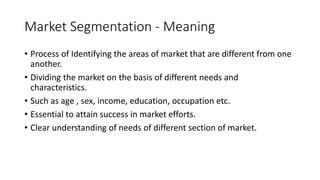
Market Segmentation - Meaning
• Process of Identifying the areas of market that are different from one
another.
• Dividing the market on the basis of different needs and
characteristics.
• Such as age , sex, income, education, occupation etc.
• Essential to attain success in market efforts.
• Clear understanding of needs of different section of market.
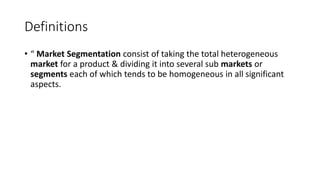
Definitions
• “ Market Segmentation consist of taking the total heterogeneous
market for a product & dividing it into several sub markets or
segments each of which tends to be homogeneous in all significant
aspects.
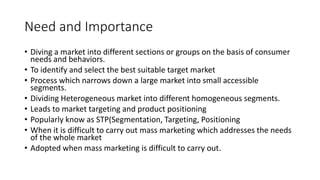
Need and Importance
• Diving a market into different sections or groups on the basis of consumer
needs and behaviors.
• To identify and select the best suitable target market
• Process which narrows down a large market into small accessible
segments.
• Dividing Heterogeneous market into different homogeneous segments.
• Leads to market targeting and product positioning
• Popularly know as STP(Segmentation, Targeting, Positioning
• When it is difficult to carry out mass marketing which addresses the needs
of the whole market
• Adopted when mass marketing is difficult to carry out.
Cont..
• It gives information inputs to marketing mix. – Product, price, place,
and promotion.
• Identifies the segment of people who has purchasing power, need,
willingness and interest etc.
• Studies the nature and degree of competition prevailed in a particular
market
• Helps to concentrate on the special needs of a segmen- ex: family car,
luxury car, economy cars etc
ADVANTAGES
• The principle of segmentation is to “Divide and Conquer”
• Helps in better understanding of the customers needs and wants
• Differentiation of Products and services of customer desires
• Designs and redesign is possible for the firm to meet the market needs
• Good New market opportunities by identifying unexplored segments
• Helps on focusing approachable market segments
• Avoids tough market segments.
• Helps in understanding and focusing on the needs of the best suited
market and help a firm to become a market leader
Cont…
• Helps firms to study the behavior and buying motives of the
consumers.
• Helps classifying btwn most and least profitable segments.
• Helps to avoid unprofitable markets
• Better Positioning compared to competitors is possible.
• Better use of marketing resources .
Disadvantages
• Expensive to conduct a systematic market segmentation
• Consumers behavior and buying practices differences makes
differences.
• Additional Costs and expenses to formulate different marketing mix.
• If buyer are small, then no use of segmentation
• Limited coverage if marketed in small segments.
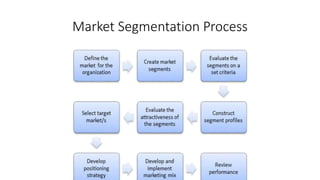
Market Segmentation Process
Market Segmentation
• Requirements for Effective Segmentation
• To be useful, market segments must be:
Measurable Accessible Substantial
Differentiable Actionable
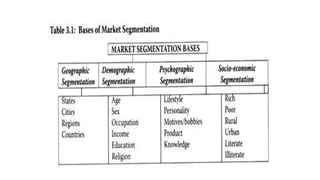
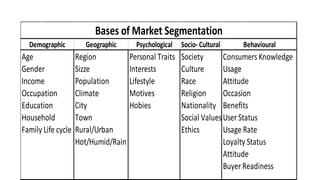
Socio- Cultural
Age Region Personal Traits Society Consumers Knowledge
Gender Sizze Interests Culture Usage
Income Population Lifestyle Race Attitude
Occupation Climate Motives Religion Occasion
Education City Hobies Nationality Benefits
Household Town Social ValuesUser Status
Family Life cycle Rural/Urban Ethics Usage Rate
Hot/Humid/Rain Loyalty Status
Attitude
Buyer Readiness
Demographic Geographic Psychological Behavioural
Bases of Market Segmentation
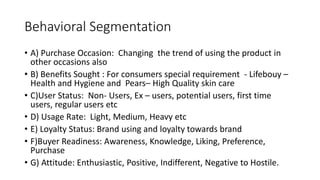
Behavioral Segmentation
• A) Purchase Occasion: Changing the trend of using the product in
other occasions also
• B) Benefits Sought : For consumers special requirement - Lifebouy –
Health and Hygiene and Pears– High Quality skin care
• C)User Status: Non- Users, Ex – users, potential users, first time
users, regular users etc
• D) Usage Rate: Light, Medium, Heavy etc
• E) Loyalty Status: Brand using and loyalty towards brand
• F)Buyer Readiness: Awareness, Knowledge, Liking, Preference,
Purchase
• G) Attitude: Enthusiastic, Positive, Indifferent, Negative to Hostile.
Market Segmentation

Market Segmentation

  • 1.
  • 2.
    Market Segmentation -Meaning • Process of Identifying the areas of market that are different from one another. • Dividing the market on the basis of different needs and characteristics. • Such as age , sex, income, education, occupation etc. • Essential to attain success in market efforts. • Clear understanding of needs of different section of market.
  • 3.
    Definitions • “ MarketSegmentation consist of taking the total heterogeneous market for a product & dividing it into several sub markets or segments each of which tends to be homogeneous in all significant aspects.
  • 4.
    Need and Importance •Diving a market into different sections or groups on the basis of consumer needs and behaviors. • To identify and select the best suitable target market • Process which narrows down a large market into small accessible segments. • Dividing Heterogeneous market into different homogeneous segments. • Leads to market targeting and product positioning • Popularly know as STP(Segmentation, Targeting, Positioning • When it is difficult to carry out mass marketing which addresses the needs of the whole market • Adopted when mass marketing is difficult to carry out.
  • 5.
    Cont.. • It givesinformation inputs to marketing mix. – Product, price, place, and promotion. • Identifies the segment of people who has purchasing power, need, willingness and interest etc. • Studies the nature and degree of competition prevailed in a particular market • Helps to concentrate on the special needs of a segmen- ex: family car, luxury car, economy cars etc
  • 6.
    ADVANTAGES • The principleof segmentation is to “Divide and Conquer” • Helps in better understanding of the customers needs and wants • Differentiation of Products and services of customer desires • Designs and redesign is possible for the firm to meet the market needs • Good New market opportunities by identifying unexplored segments • Helps on focusing approachable market segments • Avoids tough market segments. • Helps in understanding and focusing on the needs of the best suited market and help a firm to become a market leader
  • 7.
    Cont… • Helps firmsto study the behavior and buying motives of the consumers. • Helps classifying btwn most and least profitable segments. • Helps to avoid unprofitable markets • Better Positioning compared to competitors is possible. • Better use of marketing resources .
  • 8.
    Disadvantages • Expensive toconduct a systematic market segmentation • Consumers behavior and buying practices differences makes differences. • Additional Costs and expenses to formulate different marketing mix. • If buyer are small, then no use of segmentation • Limited coverage if marketed in small segments.
  • 9.
  • 11.
    Market Segmentation • Requirementsfor Effective Segmentation • To be useful, market segments must be: Measurable Accessible Substantial Differentiable Actionable
  • 12.
    Socio- Cultural Age RegionPersonal Traits Society Consumers Knowledge Gender Sizze Interests Culture Usage Income Population Lifestyle Race Attitude Occupation Climate Motives Religion Occasion Education City Hobies Nationality Benefits Household Town Social ValuesUser Status Family Life cycle Rural/Urban Ethics Usage Rate Hot/Humid/Rain Loyalty Status Attitude Buyer Readiness Demographic Geographic Psychological Behavioural Bases of Market Segmentation
  • 13.
    Behavioral Segmentation • A)Purchase Occasion: Changing the trend of using the product in other occasions also • B) Benefits Sought : For consumers special requirement - Lifebouy – Health and Hygiene and Pears– High Quality skin care • C)User Status: Non- Users, Ex – users, potential users, first time users, regular users etc • D) Usage Rate: Light, Medium, Heavy etc • E) Loyalty Status: Brand using and loyalty towards brand • F)Buyer Readiness: Awareness, Knowledge, Liking, Preference, Purchase • G) Attitude: Enthusiastic, Positive, Indifferent, Negative to Hostile.