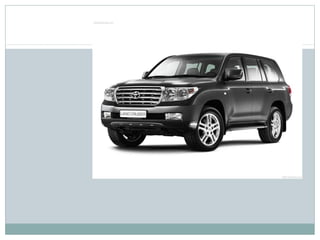
Car maker Toyota Kirloskar Motor plans to expand its
dealership network in the North East targeting
"significant contribution" from this region even as its
total sales in the country has fallen in recent months.
The company, which is planning to set up an area office
in Guwahati to boost sales in the region, will target
smaller towns and open two more outlets by the end
2013.
Right now we are focusing on expanding our dealer
network in the North East with 9 dealer outlets by the
end of 2013," Toyota Kirloskar Motor (TKM) Deputy
Managing Director and COO (Marketing and
Commercial) Sandeep Singh
Market
Segmentation,
Targeting, and
Positioning
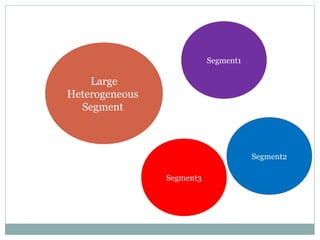
Large
Heterogeneous
Segment
Segment1
Segment2
Segment3
Chapter Objectives
Explain market segmentation and identify
several possible bases for segmenting markets
List and distinguish among the requirements
for effective segmentation
Chapter Objectives
Outline the process of evaluating market
segments
Illustrate the concept of positioning for
competitive advantage
Discuss choosing and implementing a
positioning strategy
Concept of differentiation
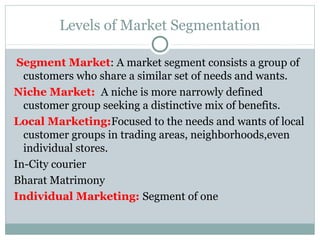
Levels of Market Segmentation
Segment Market: A market segment consists a group of
customers who share a similar set of needs and wants.
Niche Market: A niche is more narrowly defined
customer group seeking a distinctive mix of benefits.
Local Marketing:Focused to the needs and wants of local
customer groups in trading areas, neighborhoods,even
individual stores.
In-City courier
Bharat Matrimony
Individual Marketing: Segment of one
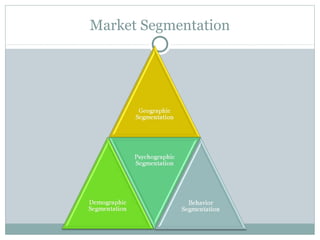
Market Segmentation
Geographic Segmentation
Dividing the market into different
geographic units
 Nations
 States
 Regions
 Counties
 Cities
 Neighborhoods
Demographic Segmentation
Dividing the market into groups based on
demographic variables
 Age
 Gender
 Income
 Occupation
 Education
 Color
 Cast
 Marital Status
Many More
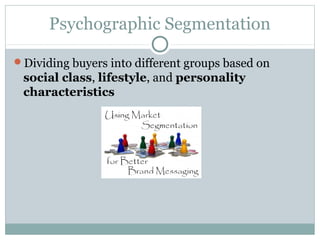
Psychographic Segmentation
Dividing buyers into different groups based on
social class, lifestyle, and personality
characteristics
Behavior Segmentation
 Buyers are divided into groups based on their knowledge,
attitude, and use or response to a product
 The best starting point for building market segments
 Types
 Special occasion segmentation
 Benefits sought
 User status
 Usage rate 80/20 rule
 Loyalty status
 Buyer readiness stage
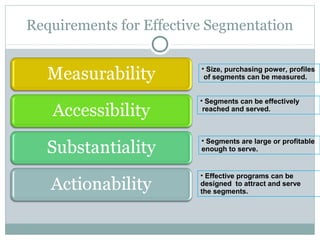
Requirements for Effective Segmentation
• Size, purchasing power, profiles
of segments can be measured.
• Segments can be effectively
reached and served.
• Segments are large or profitable
enough to serve.
• Effective programs can be
designed to attract and serve
the segments.
Targeting
Once the firm has identified its market-
segment opportunities, it has to decide
how many and which ones to target
Decisions relating to segment targeting are
taken on the growth/risk parameters
Market Targeting
Evaluating Market Segments
Selecting Market Segments
Choosing a Market-Coverage Strategy
Evaluating Market Segments
Segment Size and Growth
Segment Structural Attractiveness
Company Objectives and Resources
Selecting Market Segments
Undifferentiated Marketing
Bifurcated Marketing
Differentiate Marketing
Concentrated Marketing
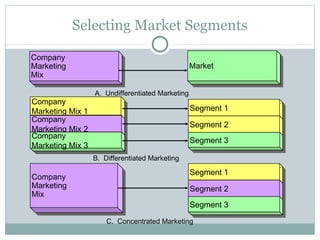
Selecting Market Segments
Segment 1Segment 1
Segment 2Segment 2
Segment 3Segment 3
Segment 1Segment 1
Segment 2Segment 2
Segment 3Segment 3
Company
Marketing
Mix
Company
Marketing
Mix
Company
Marketing
Mix
Company
Marketing
Mix
Company
Marketing Mix 1
Company
Marketing Mix 1
Company
Marketing Mix 2
Company
Marketing Mix 2
Company
Marketing Mix 3
Company
Marketing Mix 3
MarketMarket
A. Undifferentiated Marketing
B. Differentiated Marketing
C. Concentrated Marketing
Choosing a Market – Coverage Strategy
Company resources
Degree of product homogeneity
Market homogeneity
Competitors’ strategies
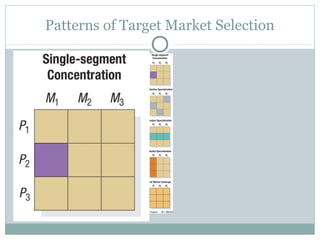
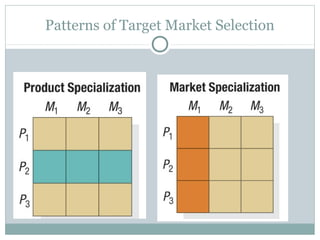
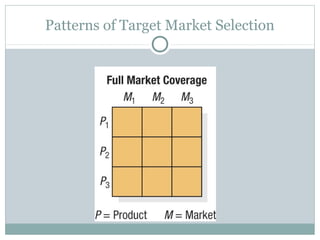
Patterns of Target Market Selection
Product Positioning
Product Positioning
Positioning is how you provide your product or
service brand identification as you go to market. It is
the next step after you have determined how to
differentiate your product or service.
..management videosmarket Positioning.wmv.flv
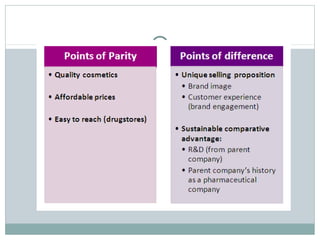
 POD
POP
 Category POP
 Competitive POP
Points-of-difference (POD)
The aspects of the product offering that are
relatively distinct to the offerings of like
competitors.
Points-of-parity (POP)
The aspects of the product offering that are largely
similar to the offerings of like competitors
Positioning Strategies
Products can be positioned on specific attributes or
against another product class
Choosing and Implementing a
Positioning Strategy
1. Identifying a set of possible competitive
advantages upon which to build a position
2. Selecting the right competitive advantages
3. Effectively communicating and delivering the chosen
position to a carefully selected target market
What are the main ways to position a
product?
Brands/products can be positioned in many different
ways in the marketplace.
However, there are several major categories of
positioning approaches, which will help us understand
the range of positioning options available.
The major positioning categories include:
positioning by product attribute (product feature
and/or benefit),
positioning by user,
positioning by product class,
positioning versus competition,
positioning by use/application, and
positioning by quality or value.
Selecting the Right Competitive
Advantages
Avoid:
 Underpositioning
 Overpositioning
 Confused positioning
Selecting the Right Competitive Advantages
Brand differences should meet the following criteria
prior to marketing:
 Important
 Distinctive
 Superior
 Communicable
 Preemptive
 Affordable
 Profitable
Positioning statement
A statement that summarizes
company or brand positioning-
It takes form: to (target
segment and need) our (brand)
is (concept) that POD (point of
difference)
To busy mobile professional who need to
always be in the loop, Black Berry is a
wireless connectivity solution that gives
you an easier ,more reliable way to stay
connected to data ,people and resources
while on the go.
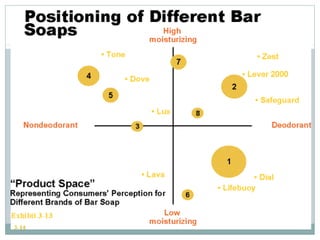
Positioning Measurement
Perceptual mapping is a research tool used to
measure a brand’s position
Product Differentiation
Product differentiation is the incorporation of
attributes, such as quality or price, into a product to
encourage the intended customers to perceive it as
different and desirable.
For example, if your company sells seat belts to
automotive manufacturers, perhaps your unique
value is never-fail, on-time delivery with no rejected
belts. If other seat belt manufacturers are not
meeting these desired goals, you will have a unique
advantage against your competition, and will have
differentiated your seat belts from those of your
competitors
Product Differentiation
 Physical Attribute Differentiation
 Service Differentiation
 Personnel Differentiation
 Location Differentiation
 Image Differentiation
In-class Activity
Choose one of the companies/brands and…
 Identify relevant direct competitors
 Choose the two dimensions that are most important to
consumers
 Develop a perceptual positioning map
 Are there any opportunities in this category?
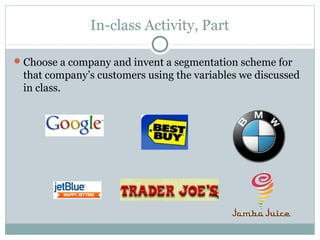
In-class Activity, Part
Choose a company and invent a segmentation scheme for
that company’s customers using the variables we discussed
in class.
In-class Activity –
Developing a Segmentation Scheme
 Develop a PSYCHOGRAPHIC/USAGE segmentation scheme for each
of the following types of consumers.
 Segment the market into three or more substantive groups.
 Be sure to think of the key psychological/usage drivers of consumption.
 Name your segments – the more creative, the better!
Consumers
 Vacationers
 Internet Users
 Restaurant Patrons
 Eco-friendly product consumers
 Smartphone Users
 Grocery Store Shoppers
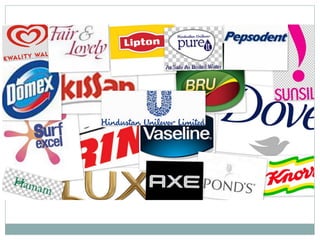
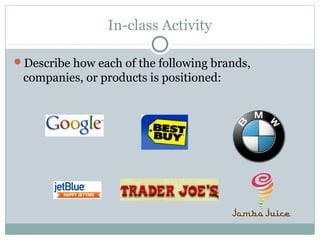
In-class Activity
Describe how each of the following brands,
companies, or products is positioned:

Market Segmentation

  • 1.
    Car maker ToyotaKirloskar Motor plans to expand its dealership network in the North East targeting "significant contribution" from this region even as its total sales in the country has fallen in recent months. The company, which is planning to set up an area office in Guwahati to boost sales in the region, will target smaller towns and open two more outlets by the end 2013. Right now we are focusing on expanding our dealer network in the North East with 9 dealer outlets by the end of 2013," Toyota Kirloskar Motor (TKM) Deputy Managing Director and COO (Marketing and Commercial) Sandeep Singh
  • 2.
  • 3.
  • 4.
    Chapter Objectives Explain marketsegmentation and identify several possible bases for segmenting markets List and distinguish among the requirements for effective segmentation
  • 5.
    Chapter Objectives Outline theprocess of evaluating market segments Illustrate the concept of positioning for competitive advantage Discuss choosing and implementing a positioning strategy Concept of differentiation
  • 6.
    Levels of MarketSegmentation Segment Market: A market segment consists a group of customers who share a similar set of needs and wants. Niche Market: A niche is more narrowly defined customer group seeking a distinctive mix of benefits. Local Marketing:Focused to the needs and wants of local customer groups in trading areas, neighborhoods,even individual stores. In-City courier Bharat Matrimony Individual Marketing: Segment of one
  • 7.
  • 8.
    Geographic Segmentation Dividing themarket into different geographic units  Nations  States  Regions  Counties  Cities  Neighborhoods
  • 9.
    Demographic Segmentation Dividing themarket into groups based on demographic variables  Age  Gender  Income  Occupation  Education  Color  Cast  Marital Status Many More
  • 10.
    Psychographic Segmentation Dividing buyersinto different groups based on social class, lifestyle, and personality characteristics
  • 11.
    Behavior Segmentation  Buyersare divided into groups based on their knowledge, attitude, and use or response to a product  The best starting point for building market segments  Types  Special occasion segmentation  Benefits sought  User status  Usage rate 80/20 rule  Loyalty status  Buyer readiness stage
  • 12.
    Requirements for EffectiveSegmentation • Size, purchasing power, profiles of segments can be measured. • Segments can be effectively reached and served. • Segments are large or profitable enough to serve. • Effective programs can be designed to attract and serve the segments.
  • 13.
    Targeting Once the firmhas identified its market- segment opportunities, it has to decide how many and which ones to target Decisions relating to segment targeting are taken on the growth/risk parameters
  • 14.
    Market Targeting Evaluating MarketSegments Selecting Market Segments Choosing a Market-Coverage Strategy
  • 15.
    Evaluating Market Segments SegmentSize and Growth Segment Structural Attractiveness Company Objectives and Resources
  • 16.
    Selecting Market Segments UndifferentiatedMarketing Bifurcated Marketing Differentiate Marketing Concentrated Marketing
  • 17.
    Selecting Market Segments Segment1Segment 1 Segment 2Segment 2 Segment 3Segment 3 Segment 1Segment 1 Segment 2Segment 2 Segment 3Segment 3 Company Marketing Mix Company Marketing Mix Company Marketing Mix Company Marketing Mix Company Marketing Mix 1 Company Marketing Mix 1 Company Marketing Mix 2 Company Marketing Mix 2 Company Marketing Mix 3 Company Marketing Mix 3 MarketMarket A. Undifferentiated Marketing B. Differentiated Marketing C. Concentrated Marketing
  • 18.
    Choosing a Market– Coverage Strategy Company resources Degree of product homogeneity Market homogeneity Competitors’ strategies
  • 19.
    Patterns of TargetMarket Selection
  • 20.
    Patterns of TargetMarket Selection
  • 21.
    Patterns of TargetMarket Selection
  • 22.
  • 23.
    Product Positioning Positioning ishow you provide your product or service brand identification as you go to market. It is the next step after you have determined how to differentiate your product or service. ..management videosmarket Positioning.wmv.flv  POD POP  Category POP  Competitive POP
  • 24.
    Points-of-difference (POD) The aspectsof the product offering that are relatively distinct to the offerings of like competitors. Points-of-parity (POP) The aspects of the product offering that are largely similar to the offerings of like competitors
  • 26.
    Positioning Strategies Products canbe positioned on specific attributes or against another product class
  • 27.
    Choosing and Implementinga Positioning Strategy 1. Identifying a set of possible competitive advantages upon which to build a position 2. Selecting the right competitive advantages 3. Effectively communicating and delivering the chosen position to a carefully selected target market
  • 28.
    What are themain ways to position a product? Brands/products can be positioned in many different ways in the marketplace. However, there are several major categories of positioning approaches, which will help us understand the range of positioning options available.
  • 30.
    The major positioningcategories include: positioning by product attribute (product feature and/or benefit), positioning by user, positioning by product class, positioning versus competition, positioning by use/application, and positioning by quality or value.
  • 31.
    Selecting the RightCompetitive Advantages Avoid:  Underpositioning  Overpositioning  Confused positioning
  • 32.
    Selecting the RightCompetitive Advantages Brand differences should meet the following criteria prior to marketing:  Important  Distinctive  Superior  Communicable  Preemptive  Affordable  Profitable
  • 33.
    Positioning statement A statementthat summarizes company or brand positioning- It takes form: to (target segment and need) our (brand) is (concept) that POD (point of difference)
  • 34.
    To busy mobileprofessional who need to always be in the loop, Black Berry is a wireless connectivity solution that gives you an easier ,more reliable way to stay connected to data ,people and resources while on the go.
  • 35.
    Positioning Measurement Perceptual mappingis a research tool used to measure a brand’s position
  • 37.
    Product Differentiation Product differentiationis the incorporation of attributes, such as quality or price, into a product to encourage the intended customers to perceive it as different and desirable. For example, if your company sells seat belts to automotive manufacturers, perhaps your unique value is never-fail, on-time delivery with no rejected belts. If other seat belt manufacturers are not meeting these desired goals, you will have a unique advantage against your competition, and will have differentiated your seat belts from those of your competitors
  • 38.
    Product Differentiation  PhysicalAttribute Differentiation  Service Differentiation  Personnel Differentiation  Location Differentiation  Image Differentiation
  • 42.
    In-class Activity Choose oneof the companies/brands and…  Identify relevant direct competitors  Choose the two dimensions that are most important to consumers  Develop a perceptual positioning map  Are there any opportunities in this category?
  • 43.
    In-class Activity, Part Choosea company and invent a segmentation scheme for that company’s customers using the variables we discussed in class.
  • 44.
    In-class Activity – Developinga Segmentation Scheme  Develop a PSYCHOGRAPHIC/USAGE segmentation scheme for each of the following types of consumers.  Segment the market into three or more substantive groups.  Be sure to think of the key psychological/usage drivers of consumption.  Name your segments – the more creative, the better! Consumers  Vacationers  Internet Users  Restaurant Patrons  Eco-friendly product consumers  Smartphone Users  Grocery Store Shoppers
  • 45.
    In-class Activity Describe howeach of the following brands, companies, or products is positioned: