



Agricultural Marketing
Reforms & Marketing
    Infrastructure


                    RABI CONFERENCE-2005
As a Farmer
   I must thank all of you for your efforts and
    concerns
   But what use if I can not be facilitated to sell
    my produce at
   Remunerative Price / Quality linked returns
    Choose my buyer
   Place and time convenient to me
   Escape the fleecing of multiple intermediaries
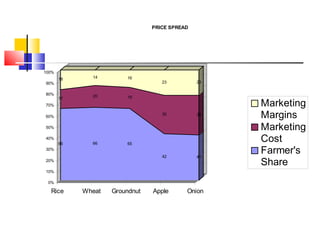
PRICE SPREAD


100%
       18     14        16
90%                                23          23

80%           20
       17               19
70%                                                 Marketing
60%
                                   35          36
                                                    Margins
50%                                                 Marketing
40%
       65     66        65
                                                    Cost
30%
                                   42          41
                                                    Farmer's
20%
                                                    Share
10%

 0%

  Rice      Wheat   Groundnut   Apple      Onion
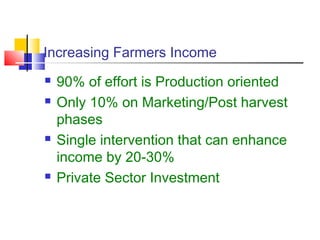
Increasing Farmers Income
   90% of effort is Production oriented
   Only 10% on Marketing/Post harvest
    phases
   Single intervention that can enhance
    income by 20-30%
   Private Sector Investment
Domestic Markets Scenario

o Regulated Markets.


o 7161 of 7310 Wholesale Markets
 Covered Under Regulation.


o Of 27,294 Rural Markets,   15%
 Under Regulation
Domestic Markets Scenario

o Regulated Markets Lack Need Based Infrastructure.


o Development Confined to    Wholesale Markets.
  Rural Markets Remain Out of Development Ambit


o Current Mandi System Has Multiple Intermediaries
  and High Value Loss


o APMC     Regulation Prevents Companies      From
  Directly Sourcing From Farmers
Domestic Markets Scenario

o Fragmented   Industry,    with   no   Large
 Organized Players


o High Wastage between the Farm and the
 Retailer
Present Scenario in Value Chain
o Producer’s Share in Consumer’s Retail Price
   Mere 40% to 60% depending on the commodity

o Only    25% of Produced     Food-grains   Utilise
   Scientific Storage

o Less   Than 2% of Fruits        and   Vegetables
   Production Is Processed

o Post-harvest Losses estimate 10% of Food Grain
   and 25% of Fruits and Vegetables Production
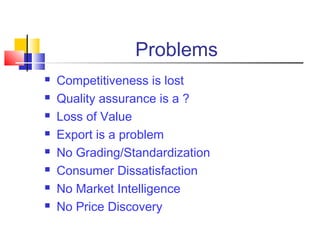
Problems
   Competitiveness is lost
   Quality assurance is a ?
   Loss of Value
   Export is a problem
   No Grading/Standardization
   Consumer Dissatisfaction
   No Market Intelligence
   No Price Discovery
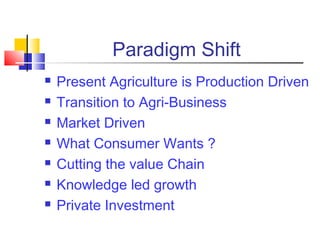
Paradigm Shift
   Present Agriculture is Production Driven
   Transition to Agri-Business
   Market Driven
   What Consumer Wants ?
   Cutting the value Chain
   Knowledge led growth
   Private Investment
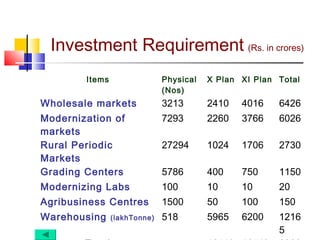
Investment Requirement (Rs. in crores)
        Items                 Physical   X Plan XI Plan Total
                              (Nos)
Wholesale markets             3213       2410   4016    6426
Modernization of              7293       2260   3766    6026
markets
Rural Periodic                27294      1024   1706    2730
Markets
Grading Centers               5786       400    750     1150
Modernizing Labs              100        10     10      20
Agribusiness Centres          1500       50     100     150
Warehousing     (lakhTonne)   518        5965   6200    1216
                                                        5
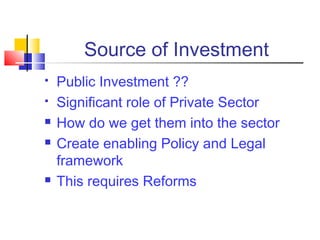
Source of Investment
   Public Investment ??
   Significant role of Private Sector
   How do we get them into the sector
   Create enabling Policy and Legal
    framework
   This requires Reforms
Road Map of Reforms
   Create enabling Legal and Policy
    environment
       Private / Cooperative Markets

    
        Direct Marketing and

    
        Contract Farming Programs

    
        Grading/Standardisation/Quality
Road Map of Reforms
   Establish Effective Linkages Between
    Farm Production And Retail Chains

   Public–Private-Partnership to Promote
    Professionalism in Existing Markets

   Stepping-Up of Pledge Financing and
    Marketing Credit
Road Map of Reforms
    Introduction of Negotiable Warehouse Receipt
    System In Storage Projects

   Link Commodity Exchange with Market Yards for
    Price and Risk Management

   Information Technology to Promote Trade/ Market
    Led Extension Services


    Facilitate Investments
Leaders In Reforms
   Kerala,
   Tamil Nadu
   Madhya Pradesh
   Andhra Pradesh
   Punjab
   Himachal Pradesh
   Sikkim
   Manipur
   Nagaland
   Andaman & Nicobar
Followers
   Many States

   Enabled some components

   Require all Components
Scheme For Development /
Strengthening Of Agricultural
Marketing Infrastructure,
Grading And Standardization
Objectives of the Scheme
o To   Induce Private and Cooperative Sector
  Investments in Market Infrastructure Development
  Projects

o To    Strengthen Existing Agricultural Markets,
  wholesale and rural periodic, to Enhance
  Efficiency

o To Promote Grading, Standardization and Quality
  Certification of Agricultural Produce at Farm/
  Market Level
Coverage of the Scheme
   Agriculture/Horticulture
   Fisheries
   Meat & Poultry
   Minor Forest Produce
   Dairy
   Medicinal plants
   Apiculture
Components of the Scheme
   Functional Infrastructure
   Market user common facilities
   Shortening the Value Chain
       Direct Marketing
       Contract Farming
       E-Trading Infrastructure
   Market extension and market oriented
    production planning
   Input Supply
Functional Infrastructure
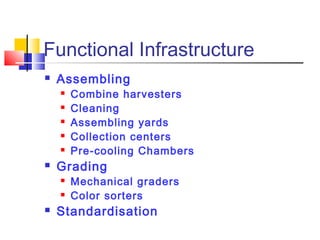
   Assembling
       Combine harvesters
       Cleaning
       Assembling yards
       Collection centers
       Pre-cooling Chambers
   Grading
       Mechanical graders
       Color sorters
   Standardisation
Functional Infrastructure
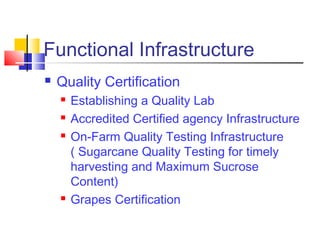
   Quality Certification
       Establishing a Quality Lab
       Accredited Certified agency Infrastructure
       On-Farm Quality Testing Infrastructure
        ( Sugarcane Quality Testing for timely
        harvesting and Maximum Sucrose
        Content)
       Grapes Certification
Functional Infrastructure
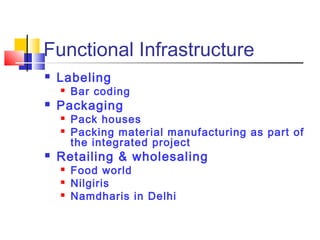
   Labeling
       Bar coding
   Packaging
       Pack houses
       Packing material manufacturing as part of
        the integrated project
   Retailing & wholesaling
       Food world
       Nilgiris
       Namdharis in Delhi
Functional Infrastructure
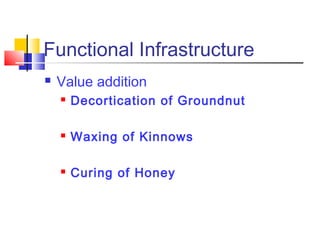
   Value addition
       Decortication of Groundnut

       Waxing of Kinnows

       Curing of Honey
Market user common facilities
o Market yards


o Platforms for loading/ assembling and
 auctioning of the produce etc

o Modern auction Systems


o Weighing and Mechanical Equipment
Shortening the Value Chain
o Infrastructure for Direct marketing from producers
  to consumers/ processing units/ bulk buyers etc

o Infrastructure for supporting Contract farming
  arrangements between processing/ trading units
  and farm producers

o Infrastructure for E-Trading, market extension
  and market oriented production planning.
Scope of Infrastructure Projects
   Infrastructure for supply of production inputs
    and need based services to farmers
       AI infrastructure
       Fertilizer storage units
       Feed storage units
       Marketing Intelligence

   Mobile infrastructure for post-harvest
    operations
   Market extension and market oriented
    production planning
Salient Features of Scheme
o Credit   Linked Back-ended Subsidy on Capital
  Investment for
    Setting up of General or Commodity Specific

     Infrastructure for Marketing of Agricultural
     Commodities; and

      Strengthening and Modernization of Existing
       Agricultural Markets, Wholesale, Rural Periodic
       or in Tribal Areas
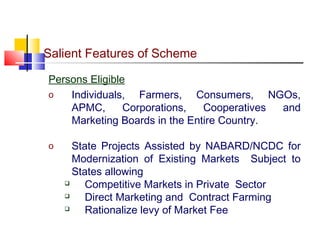
Salient Features of Scheme

Persons Eligible
o   Individuals, Farmers, Consumers, NGOs,
    APMC,       Corporations,  Cooperatives and
    Marketing Boards in the Entire Country.

o     State Projects Assisted by NABARD/NCDC for
      Modernization of Existing Markets Subject to
      States allowing
        Competitive Markets in Private Sector
        Direct Marketing and Contract Farming
        Rationalize levy of Market Fee
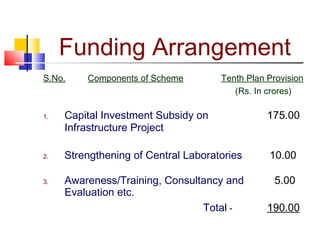
Funding Arrangement
S.No.    Components of Scheme        Tenth Plan Provision
                                        (Rs. In crores)

1.   Capital Investment Subsidy on              175.00
     Infrastructure Project

2.   Strengthening of Central Laboratories      10.00

3.   Awareness/Training, Consultancy and         5.00
     Evaluation etc.
                                Total -         190.00
• Involve Women through SHGs
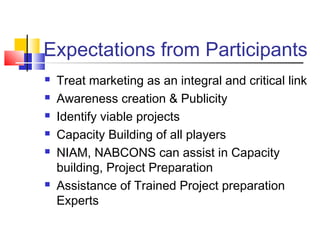
Expectations from Participants
   Treat marketing as an integral and critical link
   Awareness creation & Publicity
   Identify viable projects
   Capacity Building of all players
   NIAM, NABCONS can assist in Capacity
    building, Project Preparation
   Assistance of Trained Project preparation
    Experts
Further Details & Assistance

 www.agmarknet.nic.in
 reddywr@nic.in

   011 23382416
Thank You

Market led extension

  • 1.
    Agricultural Marketing Reforms &Marketing Infrastructure RABI CONFERENCE-2005
  • 2.
    As a Farmer  I must thank all of you for your efforts and concerns  But what use if I can not be facilitated to sell my produce at  Remunerative Price / Quality linked returns  Choose my buyer  Place and time convenient to me  Escape the fleecing of multiple intermediaries
  • 3.
    PRICE SPREAD 100% 18 14 16 90% 23 23 80% 20 17 19 70% Marketing 60% 35 36 Margins 50% Marketing 40% 65 66 65 Cost 30% 42 41 Farmer's 20% Share 10% 0% Rice Wheat Groundnut Apple Onion
  • 4.
    Increasing Farmers Income  90% of effort is Production oriented  Only 10% on Marketing/Post harvest phases  Single intervention that can enhance income by 20-30%  Private Sector Investment
  • 5.
    Domestic Markets Scenario oRegulated Markets. o 7161 of 7310 Wholesale Markets Covered Under Regulation. o Of 27,294 Rural Markets, 15% Under Regulation
  • 6.
    Domestic Markets Scenario oRegulated Markets Lack Need Based Infrastructure. o Development Confined to Wholesale Markets. Rural Markets Remain Out of Development Ambit o Current Mandi System Has Multiple Intermediaries and High Value Loss o APMC Regulation Prevents Companies From Directly Sourcing From Farmers
  • 7.
    Domestic Markets Scenario oFragmented Industry, with no Large Organized Players o High Wastage between the Farm and the Retailer
  • 8.
    Present Scenario inValue Chain o Producer’s Share in Consumer’s Retail Price Mere 40% to 60% depending on the commodity o Only 25% of Produced Food-grains Utilise Scientific Storage o Less Than 2% of Fruits and Vegetables Production Is Processed o Post-harvest Losses estimate 10% of Food Grain and 25% of Fruits and Vegetables Production
  • 9.
    Problems  Competitiveness is lost  Quality assurance is a ?  Loss of Value  Export is a problem  No Grading/Standardization  Consumer Dissatisfaction  No Market Intelligence  No Price Discovery
  • 10.
    Paradigm Shift  Present Agriculture is Production Driven  Transition to Agri-Business  Market Driven  What Consumer Wants ?  Cutting the value Chain  Knowledge led growth  Private Investment
  • 11.
    Investment Requirement (Rs.in crores) Items Physical X Plan XI Plan Total (Nos) Wholesale markets 3213 2410 4016 6426 Modernization of 7293 2260 3766 6026 markets Rural Periodic 27294 1024 1706 2730 Markets Grading Centers 5786 400 750 1150 Modernizing Labs 100 10 10 20 Agribusiness Centres 1500 50 100 150 Warehousing (lakhTonne) 518 5965 6200 1216 5
  • 12.
    Source of Investment  Public Investment ??  Significant role of Private Sector  How do we get them into the sector  Create enabling Policy and Legal framework  This requires Reforms
  • 13.
    Road Map ofReforms  Create enabling Legal and Policy environment  Private / Cooperative Markets  Direct Marketing and  Contract Farming Programs  Grading/Standardisation/Quality
  • 14.
    Road Map ofReforms  Establish Effective Linkages Between Farm Production And Retail Chains  Public–Private-Partnership to Promote Professionalism in Existing Markets  Stepping-Up of Pledge Financing and Marketing Credit
  • 15.
    Road Map ofReforms  Introduction of Negotiable Warehouse Receipt System In Storage Projects  Link Commodity Exchange with Market Yards for Price and Risk Management  Information Technology to Promote Trade/ Market Led Extension Services  Facilitate Investments
  • 16.
    Leaders In Reforms  Kerala,  Tamil Nadu  Madhya Pradesh  Andhra Pradesh  Punjab  Himachal Pradesh  Sikkim  Manipur  Nagaland  Andaman & Nicobar
  • 17.
    Followers  Many States  Enabled some components  Require all Components
  • 18.
    Scheme For Development/ Strengthening Of Agricultural Marketing Infrastructure, Grading And Standardization
  • 19.
    Objectives of theScheme o To Induce Private and Cooperative Sector Investments in Market Infrastructure Development Projects o To Strengthen Existing Agricultural Markets, wholesale and rural periodic, to Enhance Efficiency o To Promote Grading, Standardization and Quality Certification of Agricultural Produce at Farm/ Market Level
  • 20.
    Coverage of theScheme  Agriculture/Horticulture  Fisheries  Meat & Poultry  Minor Forest Produce  Dairy  Medicinal plants  Apiculture
  • 21.
    Components of theScheme  Functional Infrastructure  Market user common facilities  Shortening the Value Chain  Direct Marketing  Contract Farming  E-Trading Infrastructure  Market extension and market oriented production planning  Input Supply
  • 22.
    Functional Infrastructure  Assembling  Combine harvesters  Cleaning  Assembling yards  Collection centers  Pre-cooling Chambers  Grading  Mechanical graders  Color sorters  Standardisation
  • 23.
    Functional Infrastructure  Quality Certification  Establishing a Quality Lab  Accredited Certified agency Infrastructure  On-Farm Quality Testing Infrastructure ( Sugarcane Quality Testing for timely harvesting and Maximum Sucrose Content)  Grapes Certification
  • 24.
    Functional Infrastructure  Labeling  Bar coding  Packaging  Pack houses  Packing material manufacturing as part of the integrated project  Retailing & wholesaling  Food world  Nilgiris  Namdharis in Delhi
  • 25.
    Functional Infrastructure  Value addition  Decortication of Groundnut  Waxing of Kinnows  Curing of Honey
  • 26.
    Market user commonfacilities o Market yards o Platforms for loading/ assembling and auctioning of the produce etc o Modern auction Systems o Weighing and Mechanical Equipment
  • 27.
    Shortening the ValueChain o Infrastructure for Direct marketing from producers to consumers/ processing units/ bulk buyers etc o Infrastructure for supporting Contract farming arrangements between processing/ trading units and farm producers o Infrastructure for E-Trading, market extension and market oriented production planning.
  • 28.
    Scope of InfrastructureProjects  Infrastructure for supply of production inputs and need based services to farmers  AI infrastructure  Fertilizer storage units  Feed storage units  Marketing Intelligence  Mobile infrastructure for post-harvest operations  Market extension and market oriented production planning
  • 29.
    Salient Features ofScheme o Credit Linked Back-ended Subsidy on Capital Investment for  Setting up of General or Commodity Specific Infrastructure for Marketing of Agricultural Commodities; and  Strengthening and Modernization of Existing Agricultural Markets, Wholesale, Rural Periodic or in Tribal Areas
  • 30.
    Salient Features ofScheme Persons Eligible o Individuals, Farmers, Consumers, NGOs, APMC, Corporations, Cooperatives and Marketing Boards in the Entire Country. o State Projects Assisted by NABARD/NCDC for Modernization of Existing Markets Subject to States allowing  Competitive Markets in Private Sector  Direct Marketing and Contract Farming  Rationalize levy of Market Fee
  • 31.
    Funding Arrangement S.No. Components of Scheme Tenth Plan Provision (Rs. In crores) 1. Capital Investment Subsidy on 175.00 Infrastructure Project 2. Strengthening of Central Laboratories 10.00 3. Awareness/Training, Consultancy and 5.00 Evaluation etc. Total - 190.00
  • 32.
    • Involve Womenthrough SHGs
  • 33.
    Expectations from Participants  Treat marketing as an integral and critical link  Awareness creation & Publicity  Identify viable projects  Capacity Building of all players  NIAM, NABCONS can assist in Capacity building, Project Preparation  Assistance of Trained Project preparation Experts
  • 34.
    Further Details &Assistance  www.agmarknet.nic.in  reddywr@nic.in  011 23382416
  • 35.