Founder Institute – March 8 th , 2011 Pix (cc) BY NC SA, Rodrigo SEPÚLVEDA
Summary Why is it important ? Understand your market type How do you estimate it ? Design a market entry strategy
1. Why is it important ? Gives you A potential target for your revenue (therefore also EBIT) A valuation Assessment of market players, hence your competition
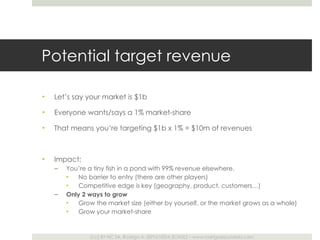
Potential target revenue Let ’s say your market is $1b Everyone wants/says a 1% market-share That means you ’re targeting $1b x 1% = $10m of revenues Impact: You ’re a tiny fish in a pond with 99% revenue elsewhere.  No barrier to entry (there are other players) Competitive edge is key (geography, product, customers…) Only 2 ways to grow Grow the market size (either by yourself, or the market grows as a whole) Grow your market-share
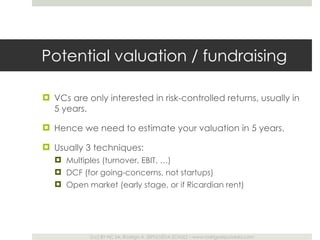
Potential valuation / fundraising VCs are only interested in risk-controlled returns, usually in 5 years. Hence we need to estimate your valuation in 5 years.  Usually 3 techniques: Multiples (turnover, EBIT, …) DCF (for going-concerns, not startups) Open market (early stage, or if Ricardian rent)
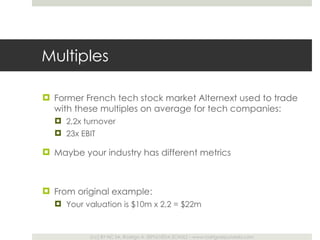
Multiples Former French tech stock market Alternext used to trade with these multiples on average for tech companies: 2,2x turnover 23x EBIT Maybe your industry has different metrics From original example:  Your valuation is $10m x 2,2 = $22m
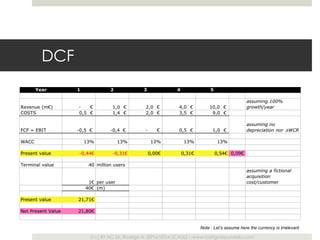
DCF Note : Let’s assume here the currency is irrelevant
 
VC ’s share Valuation bracket at exit = [$ 21,8-22,0m] If series A of $1,5m for 30% equity Then VC ’s value at exit is $22m x 30% = $6,6m That ’s a cash-on-cash return of : 6,6 / 1,5 = 4,4x (excluding tax impact) GREAT, but that ’s only $5,1m made for the VC in 5 years (too small !) cost of opportunity is too high Nota: if you ’re financing the company alone, then it’s a different story : $22m-$1,5m financing = $20,5m profit in 5 years = $4m/year
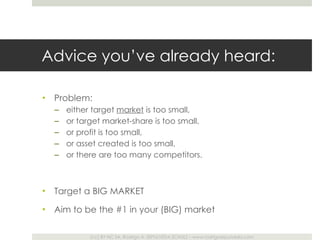
Advice you ’ve already heard: Problem:  either target  market  is too small,  or target market-share is too small,  or profit is too small,  or asset created is too small,  or there are too many competitors. Target a BIG MARKET Aim to be the #1 in your (BIG) market
2. Understand your market type 3 options An existing market A market that doesn ’t exist yet An mature market : an opportunity to re-shape it
Examples of entering an existing market Richard Branson and all Virgin brands in air travel, finance, rail Steve Jobs and Apple : telephony, music, personal computers, feature software Bill Gates on OS, office software, gaming, etc. Mark Zuckerberg (facebook) : social networks, the Internet Google : Android @jack with Square: payments Innovation  and a  differentiating factor  are key


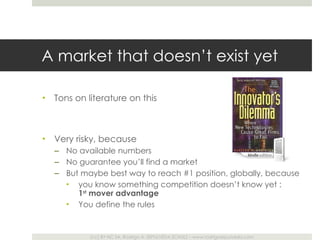
A market that doesn ’t exist yet Tons on literature on this Very risky, because  No available numbers No guarantee you ’ll find a market But maybe best way to reach #1 position, globally, because  you know something competition doesn ’t know yet :  1 st  mover advantage You define the rules
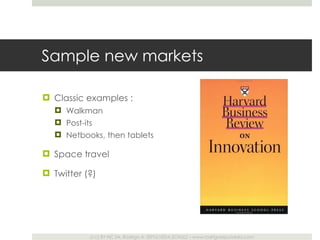
Sample new markets Classic examples : Walkman Post-its Netbooks, then tablets Space travel Twitter (?)
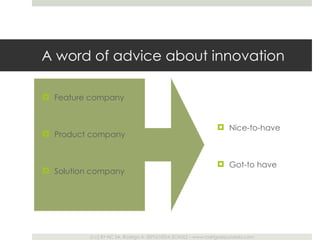
A word of advice about innovation Feature company Product company Solution company Nice-to-have Got-to have
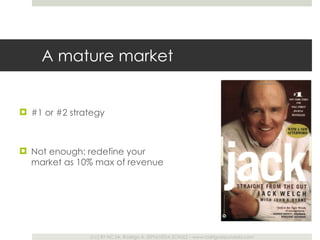
A mature market #1 or #2 strategy Not enough: redefine your market as 10% max of revenue
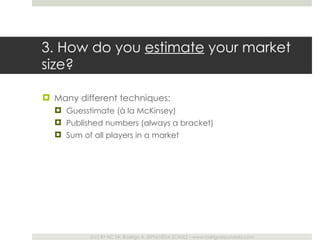
3. How do you  estimate  your market size? Many different techniques: Guesstimate (à la McKinsey) Published numbers (always a bracket) Sum of all players in a market
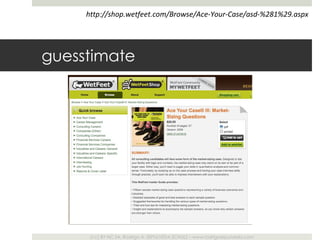
guesstimate http://shop.wetfeet.com/Browse/Ace-Your-Case/asd-%281%29.aspx
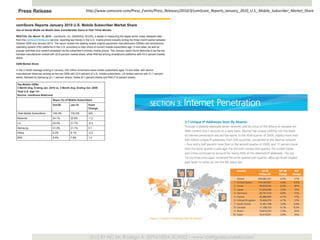
Existing markets Press articles Competitor ’s literature (presentations, website, financial statements) Industry publications Research institutes (IDC, Forrester, eMarketer, comscore, etc.) <  beware  though SlideShare is great !
http://www.comscore.com/Press_Events/Press_Releases/2010/3/comScore_Reports_January_2010_U.S._Mobile_Subscriber_Market_Share
 
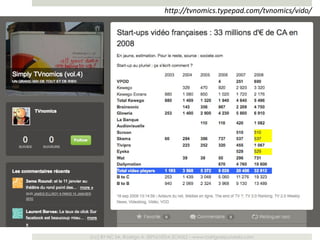
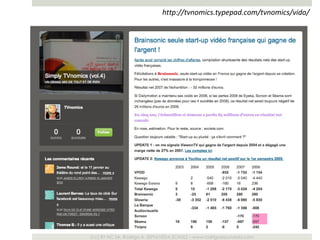
Sum of all players Hard not to compare oranges and apples Take only direct competitors Gives you a current picture, not a projected one
http://tvnomics.typepad.com/tvnomics/vido/
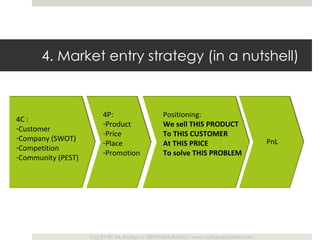
4. Market entry strategy (in a nutshell) 4C : Customer Company (SWOT) Competition Community (PEST) 4P: Product Price Place Promotion Positioning: We sell THIS PRODUCT To THIS CUSTOMER At THIS PRICE To solve THIS PROBLEM PnL
 
How big is your market ? Reality check #1
What problem are you solving ? Reality check #2
Why will someone PAY for your product ? Reality check #3
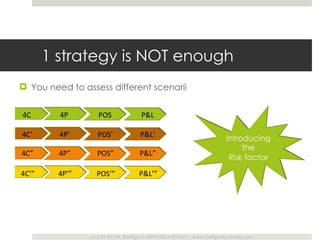
1 strategy is NOT enough You need to assess different scenarii 4C 4P POS P&L 4C ’ 4P ’ POS ’ P&L ’ 4C ” 4P ” POS ” P&L ” 4C ’” 4P ’” POS ’” P&L ’”
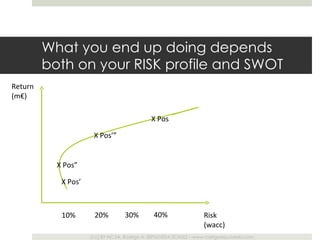
What you end up doing depends both on your RISK profile and SWOT X Pos ” X Pos ’ X Pos ’” X Pos Return (m€) Risk (wacc) 10% 20% 30% 40%
Summary : entering a market Why is it important ? Understand your market type How do you estimate it ? Design a market entry strategy
www.rodrigosepulveda.com twitter: @rodrigo   www.slideshare.com/rodrigo1971 Pix (cc) BY NC SA, Rodrigo SEPÚLVEDA

Market entry strategy - presenter deck

  • 1.
    Founder Institute –March 8 th , 2011 Pix (cc) BY NC SA, Rodrigo SEPÚLVEDA
  • 2.
    Summary Why isit important ? Understand your market type How do you estimate it ? Design a market entry strategy
  • 3.
    1. Why isit important ? Gives you A potential target for your revenue (therefore also EBIT) A valuation Assessment of market players, hence your competition
  • 4.
    Potential target revenueLet ’s say your market is $1b Everyone wants/says a 1% market-share That means you ’re targeting $1b x 1% = $10m of revenues Impact: You ’re a tiny fish in a pond with 99% revenue elsewhere. No barrier to entry (there are other players) Competitive edge is key (geography, product, customers…) Only 2 ways to grow Grow the market size (either by yourself, or the market grows as a whole) Grow your market-share
  • 5.
    Potential valuation /fundraising VCs are only interested in risk-controlled returns, usually in 5 years. Hence we need to estimate your valuation in 5 years. Usually 3 techniques: Multiples (turnover, EBIT, …) DCF (for going-concerns, not startups) Open market (early stage, or if Ricardian rent)
  • 6.
    Multiples Former Frenchtech stock market Alternext used to trade with these multiples on average for tech companies: 2,2x turnover 23x EBIT Maybe your industry has different metrics From original example: Your valuation is $10m x 2,2 = $22m
  • 7.
    DCF Note :Let’s assume here the currency is irrelevant
  • 8.
  • 9.
    VC ’s shareValuation bracket at exit = [$ 21,8-22,0m] If series A of $1,5m for 30% equity Then VC ’s value at exit is $22m x 30% = $6,6m That ’s a cash-on-cash return of : 6,6 / 1,5 = 4,4x (excluding tax impact) GREAT, but that ’s only $5,1m made for the VC in 5 years (too small !) cost of opportunity is too high Nota: if you ’re financing the company alone, then it’s a different story : $22m-$1,5m financing = $20,5m profit in 5 years = $4m/year
  • 10.
    Advice you ’vealready heard: Problem: either target market is too small, or target market-share is too small, or profit is too small, or asset created is too small, or there are too many competitors. Target a BIG MARKET Aim to be the #1 in your (BIG) market
  • 11.
    2. Understand yourmarket type 3 options An existing market A market that doesn ’t exist yet An mature market : an opportunity to re-shape it
  • 12.
    Examples of enteringan existing market Richard Branson and all Virgin brands in air travel, finance, rail Steve Jobs and Apple : telephony, music, personal computers, feature software Bill Gates on OS, office software, gaming, etc. Mark Zuckerberg (facebook) : social networks, the Internet Google : Android @jack with Square: payments Innovation and a differentiating factor are key
  • 13.
  • 14.
  • 15.
  • 16.
    A market thatdoesn ’t exist yet Tons on literature on this Very risky, because No available numbers No guarantee you ’ll find a market But maybe best way to reach #1 position, globally, because you know something competition doesn ’t know yet : 1 st mover advantage You define the rules
  • 17.
    Sample new marketsClassic examples : Walkman Post-its Netbooks, then tablets Space travel Twitter (?)
  • 18.
    A word ofadvice about innovation Feature company Product company Solution company Nice-to-have Got-to have
  • 19.
    A mature market#1 or #2 strategy Not enough: redefine your market as 10% max of revenue
  • 20.
    3. How doyou estimate your market size? Many different techniques: Guesstimate (à la McKinsey) Published numbers (always a bracket) Sum of all players in a market
  • 21.
  • 22.
    Existing markets Pressarticles Competitor ’s literature (presentations, website, financial statements) Industry publications Research institutes (IDC, Forrester, eMarketer, comscore, etc.) < beware though SlideShare is great !
  • 23.
  • 24.
  • 25.
    Sum of allplayers Hard not to compare oranges and apples Take only direct competitors Gives you a current picture, not a projected one
  • 26.
  • 27.
  • 28.
    4. Market entrystrategy (in a nutshell) 4C : Customer Company (SWOT) Competition Community (PEST) 4P: Product Price Place Promotion Positioning: We sell THIS PRODUCT To THIS CUSTOMER At THIS PRICE To solve THIS PROBLEM PnL
  • 29.
  • 30.
    How big isyour market ? Reality check #1
  • 31.
    What problem areyou solving ? Reality check #2
  • 32.
    Why will someonePAY for your product ? Reality check #3
  • 33.
    1 strategy isNOT enough You need to assess different scenarii 4C 4P POS P&L 4C ’ 4P ’ POS ’ P&L ’ 4C ” 4P ” POS ” P&L ” 4C ’” 4P ’” POS ’” P&L ’”
  • 34.
    What you endup doing depends both on your RISK profile and SWOT X Pos ” X Pos ’ X Pos ’” X Pos Return (m€) Risk (wacc) 10% 20% 30% 40%
  • 35.
    Summary : enteringa market Why is it important ? Understand your market type How do you estimate it ? Design a market entry strategy
  • 36.
    www.rodrigosepulveda.com twitter: @rodrigo  www.slideshare.com/rodrigo1971 Pix (cc) BY NC SA, Rodrigo SEPÚLVEDA