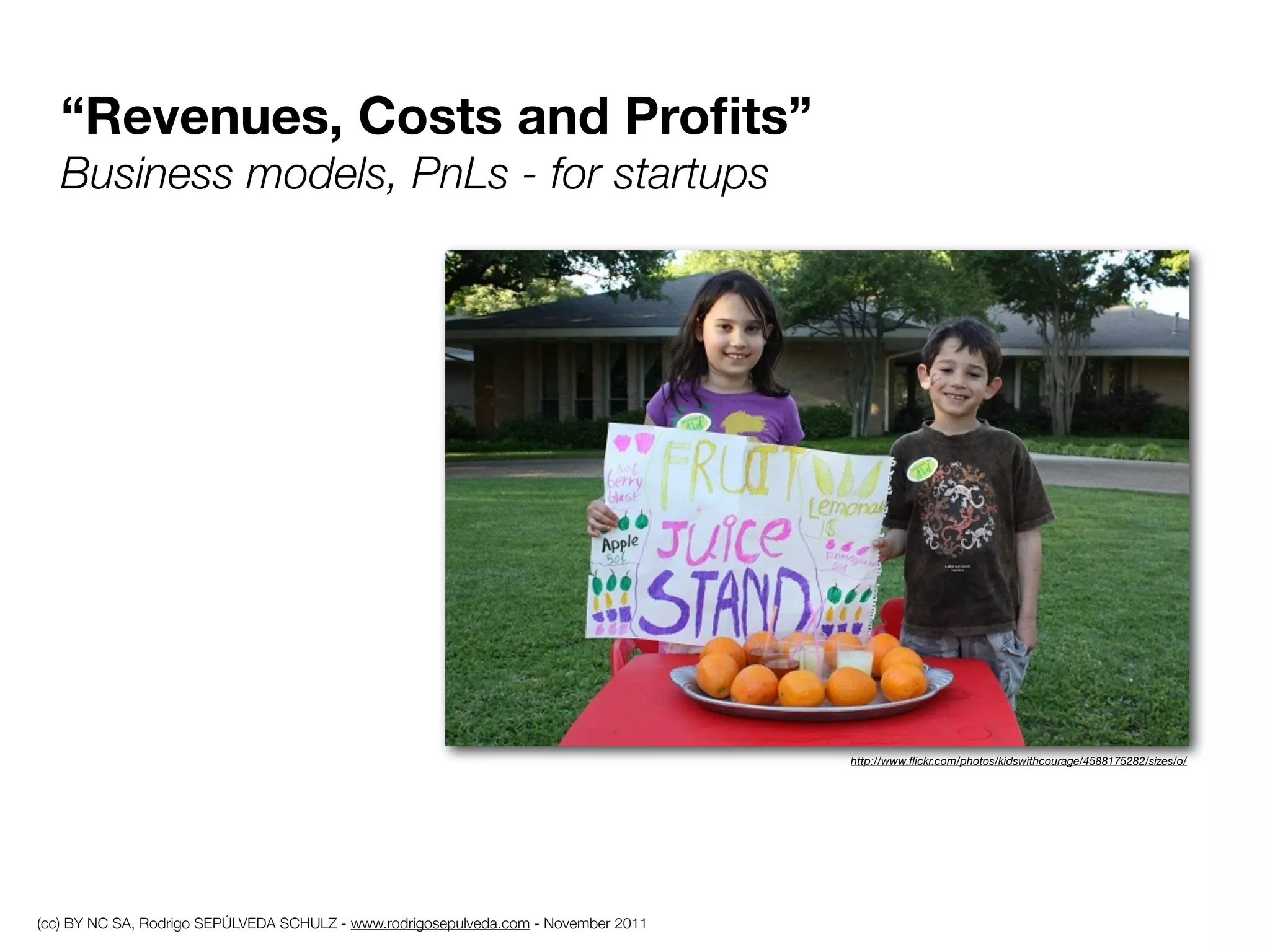
“Revenues, Costs and Profits”
   Business models, PnLs - for startups


                                                                                     http://www.flickr.com/photos/kidswithcourage/4588175282/sizes/o/


(cc) BY NC SA, Rodrigo SEPÚLVEDA SCHULZ - www.rodrigosepulveda.com - November 2011
“how do you plan to make money?”

                                              “how do you build a financial model ?”


“what are the types of expenses, such as fixed expenses, and costs of
                 good sold, and how to they scale ?”


      “How do you know if your model is right ?

                                      What do angel investors and venture capitalists
                                            expect from your financial model?
     How do you identify the key metrics
            for your success ?
Summary

• Business models


• Generic PnL


• Key insights (think KPI!)
1. Business models
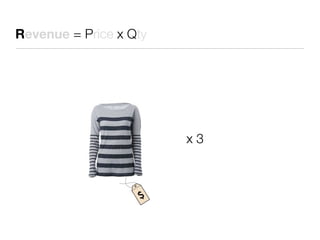
Revenue = Price x Qty


                        x3
R = R1 + R2 + ... = P1 x Q1 + P2 x Q2 + ...
~ ~
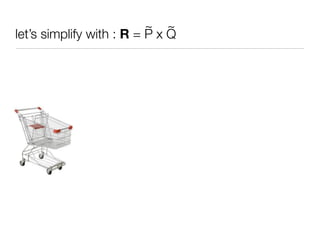
let’s simplify with : R = P x Q
~ ~
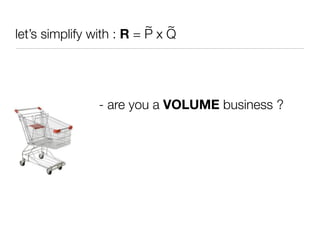
let’s simplify with : R = P x Q


                - are you a VOLUME business ?
~ ~
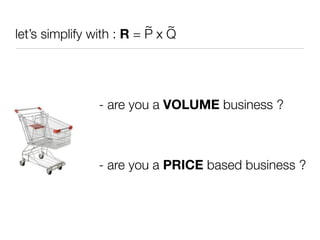
let’s simplify with : R = P x Q


                - are you a VOLUME business ?


                - are you a PRICE based business ?
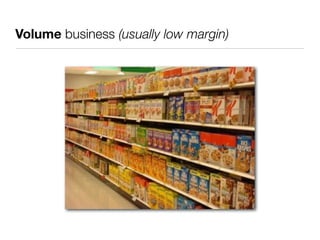
Volume business (usually low margin)
Price-based business (usually high margin)
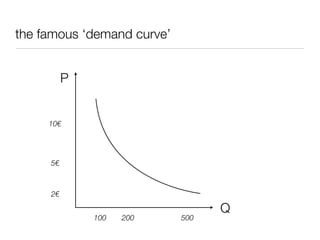
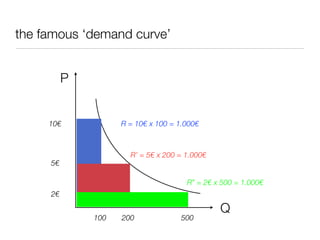
the famous ‘demand curve’


          P


     10€


     5€


     2€

                                  Q
              100   200     500
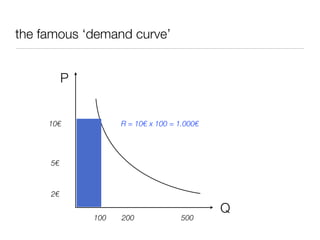
the famous ‘demand curve’


          P


     10€            R = 10€ x 100 = 1.000€


     5€


     2€

                                             Q
              100   200             500
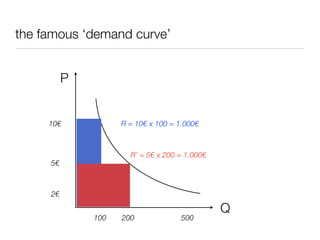
the famous ‘demand curve’


          P


     10€            R = 10€ x 100 = 1.000€


                      R’ = 5€ x 200 = 1.000€
     5€


     2€

                                               Q
              100   200             500
the famous ‘demand curve’


          P


     10€            R = 10€ x 100 = 1.000€


                      R’ = 5€ x 200 = 1.000€
     5€

                                      R” = 2€ x 500 = 1.000€
     2€

                                               Q
              100   200             500
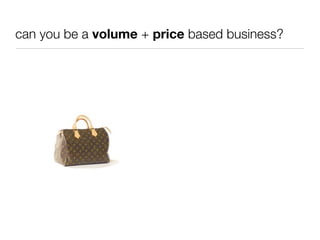
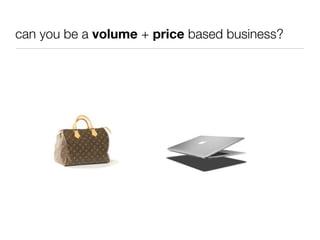
can you be a volume + price based business?
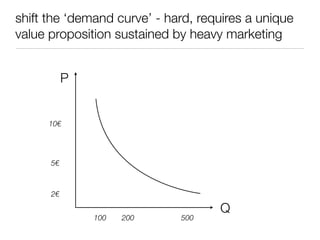
shift the ‘demand curve’ - hard, requires a unique
value proposition sustained by heavy marketing


           P


      10€


      5€


      2€

                                    Q
               100   200     500
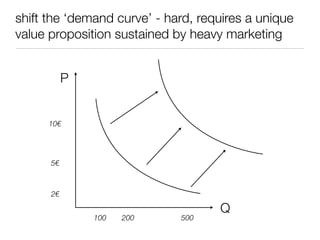
shift the ‘demand curve’ - hard, requires a unique
value proposition sustained by heavy marketing


           P


      10€


      5€


      2€

                                    Q
               100   200     500
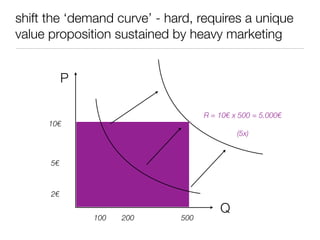
shift the ‘demand curve’ - hard, requires a unique
value proposition sustained by heavy marketing


           P

                                   R = 10€ x 500 = 5.000€
      10€
                                            (5x)


      5€


      2€

                                       Q
               100   200     500
Read more:


             http://www.amazon.com/Microeconomics-7th-Robert-Pindyck/dp/0132080230/ref=sr_1_1?ie=UTF8&qid=1304956318&sr=8-1
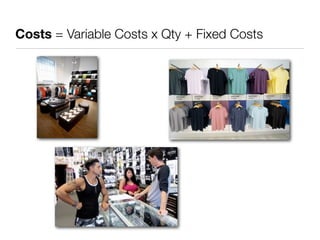
Costs = Variable Costs x Qty + Fixed Costs
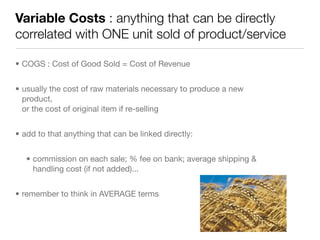
Variable Costs : anything that can be directly
correlated with ONE unit sold of product/service

• COGS : Cost of Good Sold = Cost of Revenue


• usually the cost of raw materials necessary to produce a new
  product,
  or the cost of original item if re-selling


• add to that anything that can be linked directly:


   • commission on each sale; % fee on bank; average shipping &
     handling cost (if not added)...


• remember to think in AVERAGE terms
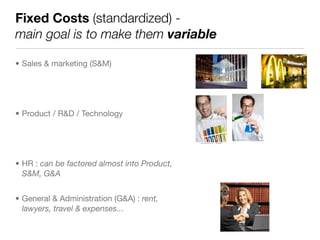
Fixed Costs (standardized) -
main goal is to make them variable

• Sales & marketing (S&M)


• Product / R&D / Technology


• HR : can be factored almost into Product,
  S&M, G&A


• General & Administration (G&A) : rent,
  lawyers, travel & expenses...
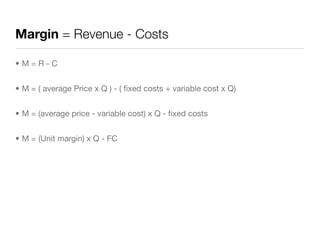
Margin = Revenue - Costs

•M=R-C


• M = ( average Price x Q ) - ( fixed costs + variable cost x Q)


• M = (average price - variable cost) x Q - fixed costs


• M = (Unit margin) x Q - FC
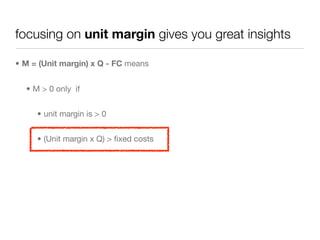
focusing on unit margin gives you great insights

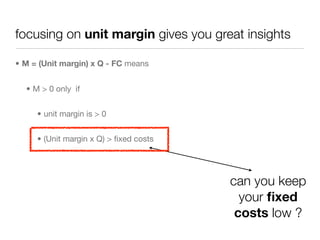
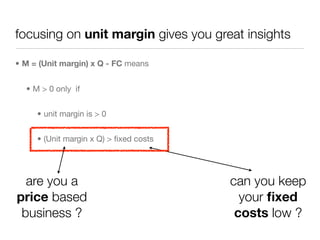
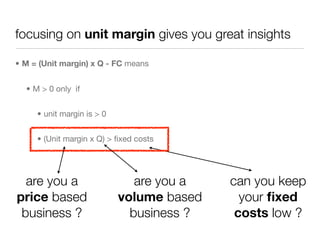
• M = (Unit margin) x Q - FC means


  • M > 0 only if


     • unit margin is > 0


     • (Unit margin x Q) > fixed costs
focusing on unit margin gives you great insights

• M = (Unit margin) x Q - FC means


  • M > 0 only if


     • unit margin is > 0


     • (Unit margin x Q) > fixed costs


                                        can you keep
                                          your fixed
                                         costs low ?
focusing on unit margin gives you great insights

• M = (Unit margin) x Q - FC means


  • M > 0 only if


     • unit margin is > 0


     • (Unit margin x Q) > fixed costs


  are you a                             can you keep
price based                               your fixed
 business ?                              costs low ?
focusing on unit margin gives you great insights

• M = (Unit margin) x Q - FC means


  • M > 0 only if


     • unit margin is > 0


     • (Unit margin x Q) > fixed costs


  are you a                    are you a   can you keep
price based                 volume based     your fixed
 business ?                   business ?    costs low ?
2. Generic PnL
startup finance is like wartime medicine :
ugly but works


                   http://www.olive-drab.com/od_medical_www.php
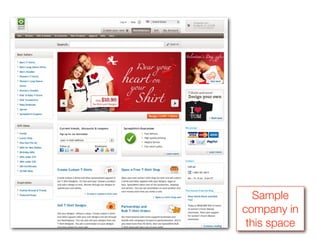
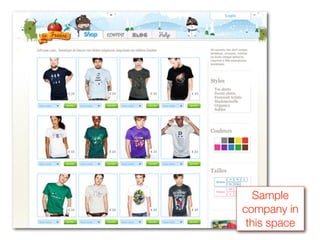
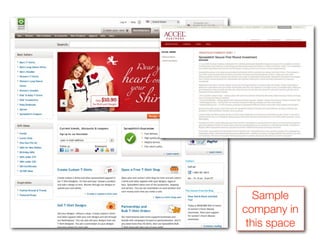
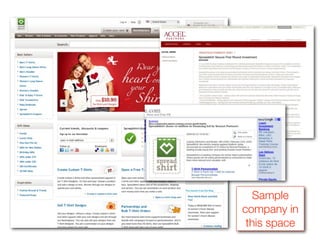
Let’s start a T-shirt business !
Sample
company in
 this space
Sample
company in
 this space
Sample
company in
 this space
Sample
company in
 this space
Sample
company in
 this space
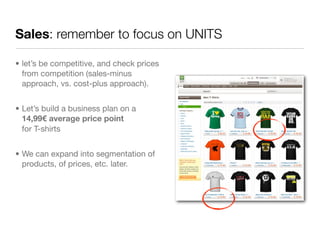
Sales: remember to focus on UNITS

• let’s be competitive, and check prices
  from competition (sales-minus
  approach, vs. cost-plus approach).


• Let’s build a business plan on a
  14,99€ average price point
  for T-shirts


• We can expand into segmentation of
  products, of prices, etc. later.
Sales : let’s assume I sell a few first per day, then
start increasing sales

• Assumptions :


  • 4 T-shirts sold per day


  • biz open online 24/7 = 30 days /month => 120 T-shirts/month


  • 5% growth / month, but decreasing slowly to adjust for linear growth


  • average price: 14,99€ (incl. VAT !)
     (19.6% in France means 12,53€ excl. VAT) -
     checked with market price/competition
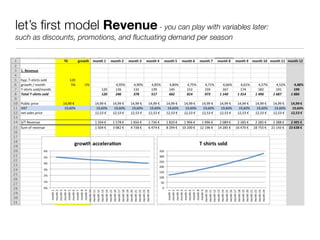
let’s first model Revenue - you can play with variables later:
such as discounts, promotions, and fluctuating demand per season
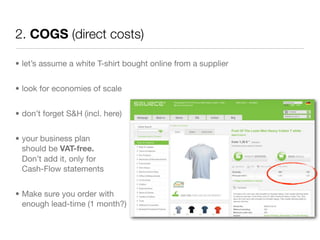
2. COGS (direct costs)

• let’s assume a white T-shirt bought online from a supplier


• look for economies of scale


• don’t forget S&H (incl. here)


• your business plan
  should be VAT-free.
  Don’t add it, only for
  Cash-Flow statements


• Make sure you order with
  enough lead-time (1 month?)
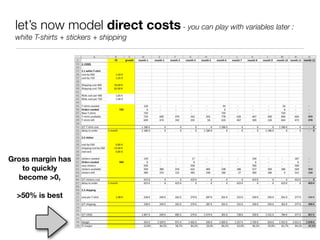
let’s now model direct costs - you can play with variables later :
 white T-shirts + stickers + shipping


Gross margin has
   to quickly
  become >0,

  >50% is best
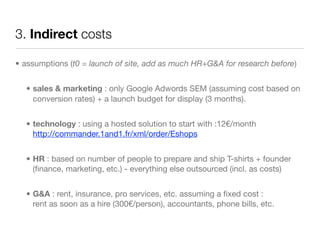
3. Indirect costs

• assumptions (t0 = launch of site, add as much HR+G&A for research before)


  • sales & marketing : only Google Adwords SEM (assuming cost based on
    conversion rates) + a launch budget for display (3 months).


  • technology : using a hosted solution to start with :12€/month
    http://commander.1and1.fr/xml/order/Eshops


  • HR : based on number of people to prepare and ship T-shirts + founder
    (finance, marketing, etc.) - everything else outsourced (incl. as costs)


  • G&A : rent, insurance, pro services, etc. assuming a fixed cost :
    rent as soon as a hire (300€/person), accountants, phone bills, etc.
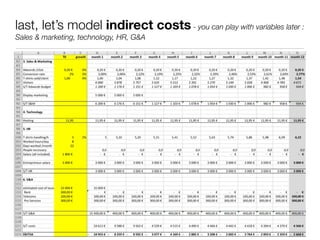
last, let’s model indirect costs - you can play with variables later :
Sales & marketing, technology, HR, G&A
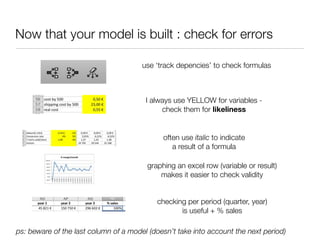
Now that your model is built : check for errors

                                       use ‘track depencies’ to check formulas


                                        I always use YELLOW for variables -
                                             check them for likeliness


                                             often use italic to indicate
                                                a result of a formula

                                        graphing an excel row (variable or result)
                                            makes it easier to check validity


                                           checking per period (quarter, year)
                                                  is useful + % sales

ps: beware of the last column of a model (doesn’t take into account the next period)
good practices

• Put the hypothesis on each month (eg. growth) : it’s then very easy to adjust
  for seasonal fluctuation, or acceleration of growth rate


• Always good to put reality checks in the excel sheet. you can always hide
  them later. I put them in italic.


• always good to number each sections item, makes it very readable


• make sure you document every important cell or formula


• it’s best to put assumptions in a separate sheet afterwards.
Read more:


     http://www.amazon.com/Financial-Modeling-Simon-Benninga/dp/0262026287/ref=sr_1_1?s=books&ie=UTF8&qid=1304957285&sr=1-1
3. Key Insights (KPIs)
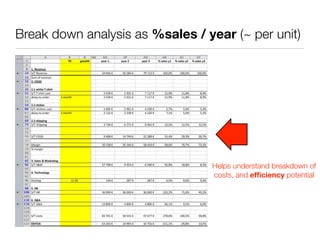
Break down analysis as %sales / year (~ per unit)


                                 Helps understand breakdown of
                                 costs, and efficiency potential
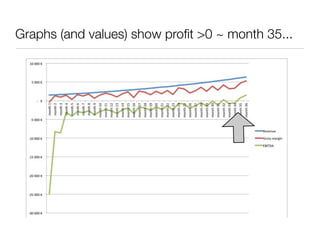
Graphs (and values) show profit >0 ~ month 35...
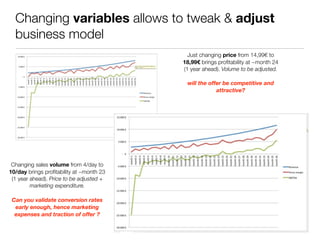
Changing variables allows to tweak & adjust
  business model
                                            Just changing price from 14,99€ to
                                          18,99€ brings profitability at ~month 24
                                          (1 year ahead). Volume to be adjusted.

                                           will the offer be competitive and
                                                       attractive?


 Changing sales volume from 4/day to
10/day brings profitability at ~month 23
 (1 year ahead). Price to be adjusted +
         marketing expenditure.

 Can you validate conversion rates
  early enough, hence marketing
  expenses and traction of offer ?
Summary 1 : building a business model

• Build a model of your business : the algorithm first, with all relevant variables


• Make your spreadsheet easily readable, commented, well formatted : you’ll
  use it to fine-tune your business, and to share with investors later on


• Don’t forget to double-check in all possible ways for errors


• Then, check that your variables are in a realistic range


• Finally, and only then, start testing different scenarios by just changing one
  or two variables.
Summary 2: key insights

• Breakdown in 100% of revenue of ONE unit of sales


• When are you profitable ? (in months?)


• How many units do you need to sell to be profitable ?


• Elasticity of variables (impact of each on target objective;
  examples = profitability, market share, revenue milestone, etc.)


• In upcoming class on fundraising :
  helps assess how much money you need to raise
www.rodrigosepulveda.com

Financial modeling for startups

  • 1.
    “Revenues, Costs andProfits” Business models, PnLs - for startups http://www.flickr.com/photos/kidswithcourage/4588175282/sizes/o/ (cc) BY NC SA, Rodrigo SEPÚLVEDA SCHULZ - www.rodrigosepulveda.com - November 2011
  • 3.
    “how do youplan to make money?” “how do you build a financial model ?” “what are the types of expenses, such as fixed expenses, and costs of good sold, and how to they scale ?” “How do you know if your model is right ? What do angel investors and venture capitalists expect from your financial model? How do you identify the key metrics for your success ?
  • 5.
    Summary • Business models •Generic PnL • Key insights (think KPI!)
  • 6.
  • 7.
  • 8.
    R = R1+ R2 + ... = P1 x Q1 + P2 x Q2 + ...
  • 9.
    ~ ~ let’s simplifywith : R = P x Q
  • 10.
    ~ ~ let’s simplifywith : R = P x Q - are you a VOLUME business ?
  • 11.
    ~ ~ let’s simplifywith : R = P x Q - are you a VOLUME business ? - are you a PRICE based business ?
  • 12.
  • 13.
  • 14.
    the famous ‘demandcurve’ P 10€ 5€ 2€ Q 100 200 500
  • 15.
    the famous ‘demandcurve’ P 10€ R = 10€ x 100 = 1.000€ 5€ 2€ Q 100 200 500
  • 16.
    the famous ‘demandcurve’ P 10€ R = 10€ x 100 = 1.000€ R’ = 5€ x 200 = 1.000€ 5€ 2€ Q 100 200 500
  • 17.
    the famous ‘demandcurve’ P 10€ R = 10€ x 100 = 1.000€ R’ = 5€ x 200 = 1.000€ 5€ R” = 2€ x 500 = 1.000€ 2€ Q 100 200 500
  • 18.
    can you bea volume + price based business?
  • 19.
    can you bea volume + price based business?
  • 20.
    can you bea volume + price based business?
  • 21.
    shift the ‘demandcurve’ - hard, requires a unique value proposition sustained by heavy marketing P 10€ 5€ 2€ Q 100 200 500
  • 22.
    shift the ‘demandcurve’ - hard, requires a unique value proposition sustained by heavy marketing P 10€ 5€ 2€ Q 100 200 500
  • 23.
    shift the ‘demandcurve’ - hard, requires a unique value proposition sustained by heavy marketing P R = 10€ x 500 = 5.000€ 10€ (5x) 5€ 2€ Q 100 200 500
  • 24.
    Read more: http://www.amazon.com/Microeconomics-7th-Robert-Pindyck/dp/0132080230/ref=sr_1_1?ie=UTF8&qid=1304956318&sr=8-1
  • 25.
    Costs = VariableCosts x Qty + Fixed Costs
  • 26.
    Variable Costs :anything that can be directly correlated with ONE unit sold of product/service • COGS : Cost of Good Sold = Cost of Revenue • usually the cost of raw materials necessary to produce a new product, or the cost of original item if re-selling • add to that anything that can be linked directly: • commission on each sale; % fee on bank; average shipping & handling cost (if not added)... • remember to think in AVERAGE terms
  • 27.
    Fixed Costs (standardized)- main goal is to make them variable • Sales & marketing (S&M) • Product / R&D / Technology • HR : can be factored almost into Product, S&M, G&A • General & Administration (G&A) : rent, lawyers, travel & expenses...
  • 28.
    Margin = Revenue- Costs •M=R-C • M = ( average Price x Q ) - ( fixed costs + variable cost x Q) • M = (average price - variable cost) x Q - fixed costs • M = (Unit margin) x Q - FC
  • 29.
    focusing on unitmargin gives you great insights • M = (Unit margin) x Q - FC means • M > 0 only if • unit margin is > 0 • (Unit margin x Q) > fixed costs
  • 30.
    focusing on unitmargin gives you great insights • M = (Unit margin) x Q - FC means • M > 0 only if • unit margin is > 0 • (Unit margin x Q) > fixed costs can you keep your fixed costs low ?
  • 31.
    focusing on unitmargin gives you great insights • M = (Unit margin) x Q - FC means • M > 0 only if • unit margin is > 0 • (Unit margin x Q) > fixed costs are you a can you keep price based your fixed business ? costs low ?
  • 32.
    focusing on unitmargin gives you great insights • M = (Unit margin) x Q - FC means • M > 0 only if • unit margin is > 0 • (Unit margin x Q) > fixed costs are you a are you a can you keep price based volume based your fixed business ? business ? costs low ?
  • 33.
  • 34.
    startup finance islike wartime medicine : ugly but works http://www.olive-drab.com/od_medical_www.php
  • 35.
    Let’s start aT-shirt business !
  • 36.
  • 37.
  • 38.
  • 39.
  • 40.
  • 41.
    Sales: remember tofocus on UNITS • let’s be competitive, and check prices from competition (sales-minus approach, vs. cost-plus approach). • Let’s build a business plan on a 14,99€ average price point for T-shirts • We can expand into segmentation of products, of prices, etc. later.
  • 42.
    Sales : let’sassume I sell a few first per day, then start increasing sales • Assumptions : • 4 T-shirts sold per day • biz open online 24/7 = 30 days /month => 120 T-shirts/month • 5% growth / month, but decreasing slowly to adjust for linear growth • average price: 14,99€ (incl. VAT !) (19.6% in France means 12,53€ excl. VAT) - checked with market price/competition
  • 43.
    let’s first modelRevenue - you can play with variables later: such as discounts, promotions, and fluctuating demand per season
  • 44.
    2. COGS (directcosts) • let’s assume a white T-shirt bought online from a supplier • look for economies of scale • don’t forget S&H (incl. here) • your business plan should be VAT-free. Don’t add it, only for Cash-Flow statements • Make sure you order with enough lead-time (1 month?)
  • 45.
    let’s now modeldirect costs - you can play with variables later : white T-shirts + stickers + shipping Gross margin has to quickly become >0, >50% is best
  • 46.
    3. Indirect costs •assumptions (t0 = launch of site, add as much HR+G&A for research before) • sales & marketing : only Google Adwords SEM (assuming cost based on conversion rates) + a launch budget for display (3 months). • technology : using a hosted solution to start with :12€/month http://commander.1and1.fr/xml/order/Eshops • HR : based on number of people to prepare and ship T-shirts + founder (finance, marketing, etc.) - everything else outsourced (incl. as costs) • G&A : rent, insurance, pro services, etc. assuming a fixed cost : rent as soon as a hire (300€/person), accountants, phone bills, etc.
  • 47.
    last, let’s modelindirect costs - you can play with variables later : Sales & marketing, technology, HR, G&A
  • 48.
    Now that yourmodel is built : check for errors use ‘track depencies’ to check formulas I always use YELLOW for variables - check them for likeliness often use italic to indicate a result of a formula graphing an excel row (variable or result) makes it easier to check validity checking per period (quarter, year) is useful + % sales ps: beware of the last column of a model (doesn’t take into account the next period)
  • 49.
    good practices • Putthe hypothesis on each month (eg. growth) : it’s then very easy to adjust for seasonal fluctuation, or acceleration of growth rate • Always good to put reality checks in the excel sheet. you can always hide them later. I put them in italic. • always good to number each sections item, makes it very readable • make sure you document every important cell or formula • it’s best to put assumptions in a separate sheet afterwards.
  • 50.
    Read more: http://www.amazon.com/Financial-Modeling-Simon-Benninga/dp/0262026287/ref=sr_1_1?s=books&ie=UTF8&qid=1304957285&sr=1-1
  • 51.
  • 52.
    Break down analysisas %sales / year (~ per unit) Helps understand breakdown of costs, and efficiency potential
  • 53.
    Graphs (and values)show profit >0 ~ month 35...
  • 54.
    Changing variables allowsto tweak & adjust business model Just changing price from 14,99€ to 18,99€ brings profitability at ~month 24 (1 year ahead). Volume to be adjusted. will the offer be competitive and attractive? Changing sales volume from 4/day to 10/day brings profitability at ~month 23 (1 year ahead). Price to be adjusted + marketing expenditure. Can you validate conversion rates early enough, hence marketing expenses and traction of offer ?
  • 55.
    Summary 1 :building a business model • Build a model of your business : the algorithm first, with all relevant variables • Make your spreadsheet easily readable, commented, well formatted : you’ll use it to fine-tune your business, and to share with investors later on • Don’t forget to double-check in all possible ways for errors • Then, check that your variables are in a realistic range • Finally, and only then, start testing different scenarios by just changing one or two variables.
  • 56.
    Summary 2: keyinsights • Breakdown in 100% of revenue of ONE unit of sales • When are you profitable ? (in months?) • How many units do you need to sell to be profitable ? • Elasticity of variables (impact of each on target objective; examples = profitability, market share, revenue milestone, etc.) • In upcoming class on fundraising : helps assess how much money you need to raise
  • 57.