Johnson, Whittington and Scholes, Exploring Strategy, 9th Edition, © Pearson Education Limited 2011 
Slide 8.1 
Strategic Choices 
8: International Strategy
Slide 8.2 
Learning outcomes 
• Assess the internationalisation potential of 
different markets. 
• Identify sources of competitive advantage in 
international strategy, through both global sourcing 
and exploitation of local factors. 
• Distinguish between four main types of 
international strategy. 
• Rank markets for entry or expansion, taking into 
account attractiveness, cultural and other forms of 
distance and competitor retaliation threats. 
• Assess the relative merits of different market entry 
modes, including joint ventures, licensing and 
foreign direct investment. 
Johnson, Whittington and Scholes, Exploring Strategy, 9th Edition, © Pearson Education Limited 2011
Slide 8.3 
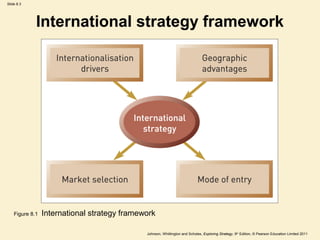
International strategy framework 
Figure 8.1 International strategy framework 
Johnson, Whittington and Scholes, Exploring Strategy, 9th Edition, © Pearson Education Limited 2011
Slide 8.4 
International v global strategy 
• International strategy refers to a range of 
options for operating outside an organisation’s 
country of origin. 
• Global strategy involves high coordination of 
extensive activities dispersed geographically in 
many countries around the world. 
N.B. Global strategy is just one kind of international strategy. 
Johnson, Whittington and Scholes, Exploring Strategy, 9th Edition, © Pearson Education Limited 2011
Slide 8.5 
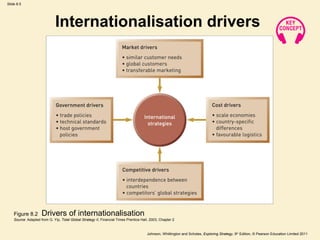
Internationalisation drivers 
Figure 8.2 Drivers of internationalisation 
Source: Adapted from G. Yip, Total Global Strategy II, Financial Times Prentice Hall, 2003, Chapter 2 
Johnson, Whittington and Scholes, Exploring Strategy, 9th Edition, © Pearson Education Limited 2011
Slide 8.6 
Location advantages: 
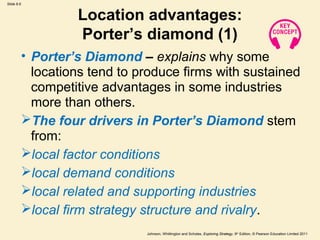
Porter’s diamond (1) 
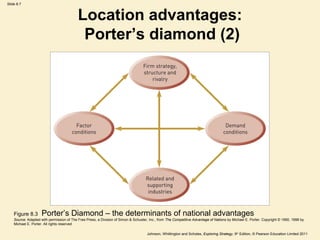
• Porter’s Diamond – explains why some 
locations tend to produce firms with sustained 
competitive advantages in some industries 
more than others. 
The four drivers in Porter’s Diamond stem 
from: 
local factor conditions 
local demand conditions 
local related and supporting industries 
local firm strategy structure and rivalry. 
Johnson, Whittington and Scholes, Exploring Strategy, 9th Edition, © Pearson Education Limited 2011
Slide 8.7 
Location advantages: 
Porter’s diamond (2) 
Figure 8.3 Porter’s Diamond – the determinants of national advantages 
Source: Adapted with permission of The Free Press, a Division of Simon & Schuster, Inc., from The Competitive Advantage of Nations by Michael E. Porter. Copyright © 1990, 1998 by 
Michael E. Porter. All rights reserved 
Johnson, Whittington and Scholes, Exploring Strategy, 9th Edition, © Pearson Education Limited 2011
Slide 8.8 
Global sourcing 
Global sourcing refers to purchasing services 
and components from the most appropriate 
suppliers around the world regardless of their 
location. 
The advantages include: 
Cost advantages include labour costs, 
transportation and communications costs, taxation 
and investment incentives. 
Unique local capabilities. 
National market characteristics and reputation. 
Johnson, Whittington and Scholes, Exploring Strategy, 9th Edition, © Pearson Education Limited 2011
Slide 8.9 
The global–local dilemma 
The global–local dilemma relates to the 
extent to which products and services may be 
standardised across national boundaries or 
need to be adapted to meet the requirements 
of specific national markets. 
Johnson, Whittington and Scholes, Exploring Strategy, 9th Edition, © Pearson Education Limited 2011
Slide 8.10 
International strategies 
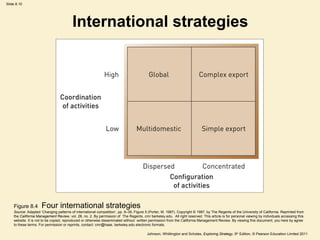
Figure 8.4 Four international strategies 
Source: Adapted ‘Changing patterns of international competition’, pp. 9–39, Figure 5 (Porter, M. 1987). Copyright © 1987, by The Regents of the University of California. Reprinted from 
the California Management Review, vol. 28, no. 2. By permission of The Regents. cmr berkeley.edu. All right reserved. This article is for personal viewing by individuals accessing this 
website. It is not to be copied, reproduced or otherwise disseminated without written permission from the California Management Review. By viewing this document, you here by agree 
to these terms. For permission or reprints, contact: cmr@haas. berkeley.edu electronic formats. 
Johnson, Whittington and Scholes, Exploring Strategy, 9th Edition, © Pearson Education Limited 2011
Slide 8.11 
Market characteristics 
Four elements of the PESTEL framework are 
particularly important in comparing countries for 
entry: 
Political. Political environments vary widely 
between countries and can alter rapidly. 
Economic. Key comparators are levels of Gross 
Domestic Product and disposable income which 
indicate the potential size of the market. 
Social. Factors like population characteristics and 
lifestyle as well as cultural differences. 
Legal. Countries vary widely in their legal regime. 
Johnson, Whittington and Scholes, Exploring Strategy, 9th Edition, © Pearson Education Limited 2011
Slide 8.12 
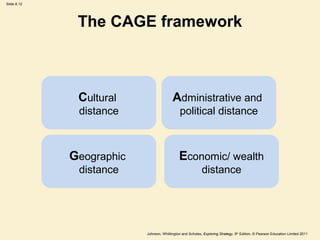
The CAGE framework 
Johnson, Whittington and Scholes, Exploring Strategy, 9th Edition, © Pearson Education Limited 2011 
Cultural 
distance 
Administrative and 
political distance 
Geographic 
distance 
Economic/ wealth 
distance
Slide 8.13 
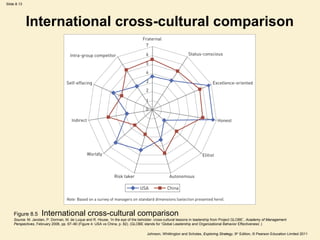
International cross-cultural comparison 
Figure 8.5 International cross-cultural comparison 
Source: M. Javidan, P. Dorman, M. de Luque and R. House, ‘In the eye of the beholder: cross-cultural lessons in leadership from Project GLOBE’, Academy of Management 
Perspectives, February 2006, pp. 67–90 (Figure 4: USA vs China, p. 82). (GLOBE stands for ‘Global Leadership and Organizational Behavior Effectiveness’.) 
Johnson, Whittington and Scholes, Exploring Strategy, 9th Edition, © Pearson Education Limited 2011
Slide 8.14 
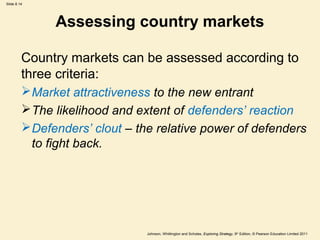
Assessing country markets 
Country markets can be assessed according to 
three criteria: 
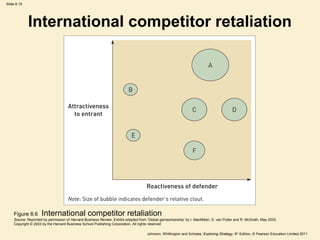
Market attractiveness to the new entrant 
The likelihood and extent of defenders’ reaction 
Defenders’ clout – the relative power of defenders 
to fight back. 
Johnson, Whittington and Scholes, Exploring Strategy, 9th Edition, © Pearson Education Limited 2011
Slide 8.15 
International competitor retaliation 
Figure 8.6 International competitor retaliation 
Source: Reprinted by permission of Harvard Business Review. Exhibit adapted from ‘Global gamesmanship’ by I. MacMillan, S. van Putter and R. McGrath, May 2003. 
Copyright © 2003 by the Harvard Business School Publishing Corporation. All rights reserved 
Johnson, Whittington and Scholes, Exploring Strategy, 9th Edition, © Pearson Education Limited 2011
Slide 8.16 
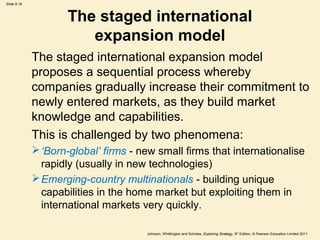
The staged international 
expansion model 
The staged international expansion model 
proposes a sequential process whereby 
companies gradually increase their commitment to 
newly entered markets, as they build market 
knowledge and capabilities. 
This is challenged by two phenomena: 
‘Born-global’ firms - new small firms that internationalise 
rapidly (usually in new technologies) 
Emerging-country multinationals - building unique 
capabilities in the home market but exploiting them in 
international markets very quickly. 
Johnson, Whittington and Scholes, Exploring Strategy, 9th Edition, © Pearson Education Limited 2011
Slide 8.17 
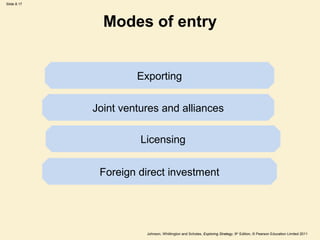
Modes of entry 
Exporting 
Joint ventures and alliances 
Licensing 
Foreign direct investment 
Johnson, Whittington and Scholes, Exploring Strategy, 9th Edition, © Pearson Education Limited 2011
Slide 8.18 
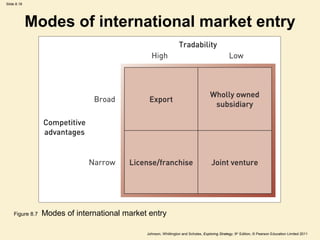
Modes of international market entry 
Figure 8.7 Modes of international market entry 
Johnson, Whittington and Scholes, Exploring Strategy, 9th Edition, © Pearson Education Limited 2011
Slide 8.19 
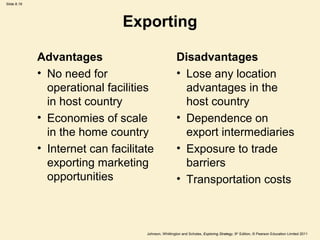
Exporting 
Advantages 
• No need for 
operational facilities 
in host country 
• Economies of scale 
in the home country 
• Internet can facilitate 
exporting marketing 
opportunities 
Disadvantages 
• Lose any location 
advantages in the 
host country 
• Dependence on 
export intermediaries 
• Exposure to trade 
barriers 
• Transportation costs 
Johnson, Whittington and Scholes, Exploring Strategy, 9th Edition, © Pearson Education Limited 2011
Slide 8.20 
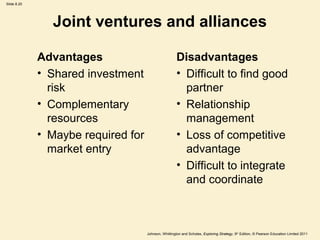
Joint ventures and alliances 
Advantages 
• Shared investment 
risk 
• Complementary 
resources 
• Maybe required for 
market entry 
Disadvantages 
• Difficult to find good 
partner 
• Relationship 
management 
• Loss of competitive 
advantage 
• Difficult to integrate 
and coordinate 
Johnson, Whittington and Scholes, Exploring Strategy, 9th Edition, © Pearson Education Limited 2011
Slide 8.21 
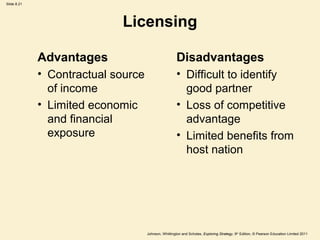
Licensing 
Johnson, Whittington and Scholes, Exploring Strategy, 9th Edition, © Pearson Education Limited 2011 
Advantages 
• Contractual source 
of income 
• Limited economic 
and financial 
exposure 
Disadvantages 
• Difficult to identify 
good partner 
• Loss of competitive 
advantage 
• Limited benefits from 
host nation
Slide 8.22 
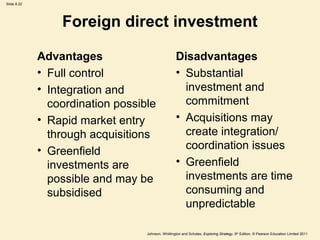
Foreign direct investment 
Advantages 
• Full control 
• Integration and 
coordination possible 
• Rapid market entry 
through acquisitions 
• Greenfield 
investments are 
possible and may be 
subsidised 
Disadvantages 
• Substantial 
investment and 
commitment 
• Acquisitions may 
create integration/ 
coordination issues 
• Greenfield 
investments are time 
consuming and 
unpredictable 
Johnson, Whittington and Scholes, Exploring Strategy, 9th Edition, © Pearson Education Limited 2011
Slide 8.23 
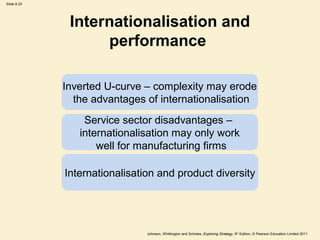
Internationalisation and 
performance 
Inverted U-curve – complexity may erode 
the advantages of internationalisation 
Service sector disadvantages – 
internationalisation may only work 
well for manufacturing firms 
Internationalisation and product diversity 
Johnson, Whittington and Scholes, Exploring Strategy, 9th Edition, © Pearson Education Limited 2011
Slide 8.24 
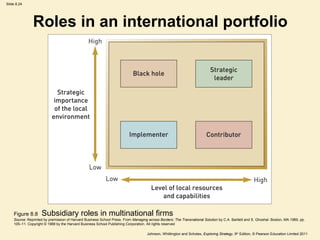
Roles in an international portfolio 
Figure 8.8 Subsidiary roles in multinational firms 
Source: Reprinted by premission of Harvard Business School Press. From Managing across Borders: The Transnational Solution by C.A. Bartlett and S. Ghoshal. Boston, MA 1989, pp. 
105–11. Copyright © 1989 by the Harvard Business School Publishing Corporation. All rights reserved 
Johnson, Whittington and Scholes, Exploring Strategy, 9th Edition, © Pearson Education Limited 2011
Slide 8.25 
Summary (1) 
• Internationalisation potential in any particular market 
is determined by Yip’s four drivers: market, cost, 
government and competitors’ strategies. 
• Sources of advantage in international strategy can 
be drawn from both global sourcing through the 
international value network and national sources of 
advantage, as captured in Porter’s Diamond. 
• There are four main types of international 
strategy, varying according to extent of coordination 
and geographical configuration: simple export, 
complex export, multidomestic and global. 
Johnson, Whittington and Scholes, Exploring Strategy, 9th Edition, © Pearson Education Limited 2011
Slide 8.26 
Summary (2) 
• Market selection for international entry or expansion 
should be based on attractiveness, multidimensional 
measures of distance and expectations of competitor 
retaliation. 
• Modes of entry into new markets include export, 
licensing and franchising, joint ventures and overseas 
subsidiaries. 
• Internationalisation has an uncertain relationship to 
financial performance, with an inverted U-curve 
warning against over-internationalisation. 
• Subsidiaries in an international firm can be managed 
by portfolio methods just like businesses in a diversified 
firm. 
Johnson, Whittington and Scholes, Exploring Strategy, 9th Edition, © Pearson Education Limited 2011

Chapter06

  • 1.
    Johnson, Whittington andScholes, Exploring Strategy, 9th Edition, © Pearson Education Limited 2011 Slide 8.1 Strategic Choices 8: International Strategy
  • 2.
    Slide 8.2 Learningoutcomes • Assess the internationalisation potential of different markets. • Identify sources of competitive advantage in international strategy, through both global sourcing and exploitation of local factors. • Distinguish between four main types of international strategy. • Rank markets for entry or expansion, taking into account attractiveness, cultural and other forms of distance and competitor retaliation threats. • Assess the relative merits of different market entry modes, including joint ventures, licensing and foreign direct investment. Johnson, Whittington and Scholes, Exploring Strategy, 9th Edition, © Pearson Education Limited 2011
  • 3.
    Slide 8.3 Internationalstrategy framework Figure 8.1 International strategy framework Johnson, Whittington and Scholes, Exploring Strategy, 9th Edition, © Pearson Education Limited 2011
  • 4.
    Slide 8.4 Internationalv global strategy • International strategy refers to a range of options for operating outside an organisation’s country of origin. • Global strategy involves high coordination of extensive activities dispersed geographically in many countries around the world. N.B. Global strategy is just one kind of international strategy. Johnson, Whittington and Scholes, Exploring Strategy, 9th Edition, © Pearson Education Limited 2011
  • 5.
    Slide 8.5 Internationalisationdrivers Figure 8.2 Drivers of internationalisation Source: Adapted from G. Yip, Total Global Strategy II, Financial Times Prentice Hall, 2003, Chapter 2 Johnson, Whittington and Scholes, Exploring Strategy, 9th Edition, © Pearson Education Limited 2011
  • 6.
    Slide 8.6 Locationadvantages: Porter’s diamond (1) • Porter’s Diamond – explains why some locations tend to produce firms with sustained competitive advantages in some industries more than others. The four drivers in Porter’s Diamond stem from: local factor conditions local demand conditions local related and supporting industries local firm strategy structure and rivalry. Johnson, Whittington and Scholes, Exploring Strategy, 9th Edition, © Pearson Education Limited 2011
  • 7.
    Slide 8.7 Locationadvantages: Porter’s diamond (2) Figure 8.3 Porter’s Diamond – the determinants of national advantages Source: Adapted with permission of The Free Press, a Division of Simon & Schuster, Inc., from The Competitive Advantage of Nations by Michael E. Porter. Copyright © 1990, 1998 by Michael E. Porter. All rights reserved Johnson, Whittington and Scholes, Exploring Strategy, 9th Edition, © Pearson Education Limited 2011
  • 8.
    Slide 8.8 Globalsourcing Global sourcing refers to purchasing services and components from the most appropriate suppliers around the world regardless of their location. The advantages include: Cost advantages include labour costs, transportation and communications costs, taxation and investment incentives. Unique local capabilities. National market characteristics and reputation. Johnson, Whittington and Scholes, Exploring Strategy, 9th Edition, © Pearson Education Limited 2011
  • 9.
    Slide 8.9 Theglobal–local dilemma The global–local dilemma relates to the extent to which products and services may be standardised across national boundaries or need to be adapted to meet the requirements of specific national markets. Johnson, Whittington and Scholes, Exploring Strategy, 9th Edition, © Pearson Education Limited 2011
  • 10.
    Slide 8.10 Internationalstrategies Figure 8.4 Four international strategies Source: Adapted ‘Changing patterns of international competition’, pp. 9–39, Figure 5 (Porter, M. 1987). Copyright © 1987, by The Regents of the University of California. Reprinted from the California Management Review, vol. 28, no. 2. By permission of The Regents. cmr berkeley.edu. All right reserved. This article is for personal viewing by individuals accessing this website. It is not to be copied, reproduced or otherwise disseminated without written permission from the California Management Review. By viewing this document, you here by agree to these terms. For permission or reprints, contact: cmr@haas. berkeley.edu electronic formats. Johnson, Whittington and Scholes, Exploring Strategy, 9th Edition, © Pearson Education Limited 2011
  • 11.
    Slide 8.11 Marketcharacteristics Four elements of the PESTEL framework are particularly important in comparing countries for entry: Political. Political environments vary widely between countries and can alter rapidly. Economic. Key comparators are levels of Gross Domestic Product and disposable income which indicate the potential size of the market. Social. Factors like population characteristics and lifestyle as well as cultural differences. Legal. Countries vary widely in their legal regime. Johnson, Whittington and Scholes, Exploring Strategy, 9th Edition, © Pearson Education Limited 2011
  • 12.
    Slide 8.12 TheCAGE framework Johnson, Whittington and Scholes, Exploring Strategy, 9th Edition, © Pearson Education Limited 2011 Cultural distance Administrative and political distance Geographic distance Economic/ wealth distance
  • 13.
    Slide 8.13 Internationalcross-cultural comparison Figure 8.5 International cross-cultural comparison Source: M. Javidan, P. Dorman, M. de Luque and R. House, ‘In the eye of the beholder: cross-cultural lessons in leadership from Project GLOBE’, Academy of Management Perspectives, February 2006, pp. 67–90 (Figure 4: USA vs China, p. 82). (GLOBE stands for ‘Global Leadership and Organizational Behavior Effectiveness’.) Johnson, Whittington and Scholes, Exploring Strategy, 9th Edition, © Pearson Education Limited 2011
  • 14.
    Slide 8.14 Assessingcountry markets Country markets can be assessed according to three criteria: Market attractiveness to the new entrant The likelihood and extent of defenders’ reaction Defenders’ clout – the relative power of defenders to fight back. Johnson, Whittington and Scholes, Exploring Strategy, 9th Edition, © Pearson Education Limited 2011
  • 15.
    Slide 8.15 Internationalcompetitor retaliation Figure 8.6 International competitor retaliation Source: Reprinted by permission of Harvard Business Review. Exhibit adapted from ‘Global gamesmanship’ by I. MacMillan, S. van Putter and R. McGrath, May 2003. Copyright © 2003 by the Harvard Business School Publishing Corporation. All rights reserved Johnson, Whittington and Scholes, Exploring Strategy, 9th Edition, © Pearson Education Limited 2011
  • 16.
    Slide 8.16 Thestaged international expansion model The staged international expansion model proposes a sequential process whereby companies gradually increase their commitment to newly entered markets, as they build market knowledge and capabilities. This is challenged by two phenomena: ‘Born-global’ firms - new small firms that internationalise rapidly (usually in new technologies) Emerging-country multinationals - building unique capabilities in the home market but exploiting them in international markets very quickly. Johnson, Whittington and Scholes, Exploring Strategy, 9th Edition, © Pearson Education Limited 2011
  • 17.
    Slide 8.17 Modesof entry Exporting Joint ventures and alliances Licensing Foreign direct investment Johnson, Whittington and Scholes, Exploring Strategy, 9th Edition, © Pearson Education Limited 2011
  • 18.
    Slide 8.18 Modesof international market entry Figure 8.7 Modes of international market entry Johnson, Whittington and Scholes, Exploring Strategy, 9th Edition, © Pearson Education Limited 2011
  • 19.
    Slide 8.19 Exporting Advantages • No need for operational facilities in host country • Economies of scale in the home country • Internet can facilitate exporting marketing opportunities Disadvantages • Lose any location advantages in the host country • Dependence on export intermediaries • Exposure to trade barriers • Transportation costs Johnson, Whittington and Scholes, Exploring Strategy, 9th Edition, © Pearson Education Limited 2011
  • 20.
    Slide 8.20 Jointventures and alliances Advantages • Shared investment risk • Complementary resources • Maybe required for market entry Disadvantages • Difficult to find good partner • Relationship management • Loss of competitive advantage • Difficult to integrate and coordinate Johnson, Whittington and Scholes, Exploring Strategy, 9th Edition, © Pearson Education Limited 2011
  • 21.
    Slide 8.21 Licensing Johnson, Whittington and Scholes, Exploring Strategy, 9th Edition, © Pearson Education Limited 2011 Advantages • Contractual source of income • Limited economic and financial exposure Disadvantages • Difficult to identify good partner • Loss of competitive advantage • Limited benefits from host nation
  • 22.
    Slide 8.22 Foreigndirect investment Advantages • Full control • Integration and coordination possible • Rapid market entry through acquisitions • Greenfield investments are possible and may be subsidised Disadvantages • Substantial investment and commitment • Acquisitions may create integration/ coordination issues • Greenfield investments are time consuming and unpredictable Johnson, Whittington and Scholes, Exploring Strategy, 9th Edition, © Pearson Education Limited 2011
  • 23.
    Slide 8.23 Internationalisationand performance Inverted U-curve – complexity may erode the advantages of internationalisation Service sector disadvantages – internationalisation may only work well for manufacturing firms Internationalisation and product diversity Johnson, Whittington and Scholes, Exploring Strategy, 9th Edition, © Pearson Education Limited 2011
  • 24.
    Slide 8.24 Rolesin an international portfolio Figure 8.8 Subsidiary roles in multinational firms Source: Reprinted by premission of Harvard Business School Press. From Managing across Borders: The Transnational Solution by C.A. Bartlett and S. Ghoshal. Boston, MA 1989, pp. 105–11. Copyright © 1989 by the Harvard Business School Publishing Corporation. All rights reserved Johnson, Whittington and Scholes, Exploring Strategy, 9th Edition, © Pearson Education Limited 2011
  • 25.
    Slide 8.25 Summary(1) • Internationalisation potential in any particular market is determined by Yip’s four drivers: market, cost, government and competitors’ strategies. • Sources of advantage in international strategy can be drawn from both global sourcing through the international value network and national sources of advantage, as captured in Porter’s Diamond. • There are four main types of international strategy, varying according to extent of coordination and geographical configuration: simple export, complex export, multidomestic and global. Johnson, Whittington and Scholes, Exploring Strategy, 9th Edition, © Pearson Education Limited 2011
  • 26.
    Slide 8.26 Summary(2) • Market selection for international entry or expansion should be based on attractiveness, multidimensional measures of distance and expectations of competitor retaliation. • Modes of entry into new markets include export, licensing and franchising, joint ventures and overseas subsidiaries. • Internationalisation has an uncertain relationship to financial performance, with an inverted U-curve warning against over-internationalisation. • Subsidiaries in an international firm can be managed by portfolio methods just like businesses in a diversified firm. Johnson, Whittington and Scholes, Exploring Strategy, 9th Edition, © Pearson Education Limited 2011

Editor's Notes

  • #2 Update slide – 9th edition. Title – Exploring Strategy