

V3. - October 2015 - (CC) BY NC SA
Fundraising for startups
Rodrigo A. Sepúlveda Schulz
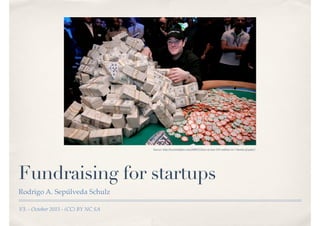
Source: http://twistedsifter.com/2009/11/how-to-lose-193-million-in-7-hands-of-poker/
http://www.RodrigoSepulveda.com
Summary
✤ how much to raise ?
✤ what valuation ?
✤ how a fund works & what VCs look for
✤ risk management
1. how much to raise ?
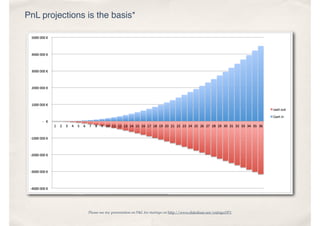
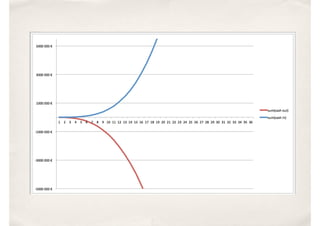
PnL projections is the basis*
Please see my presentation on P&L for startups on http://www.slideshare.net/rodrigo1971
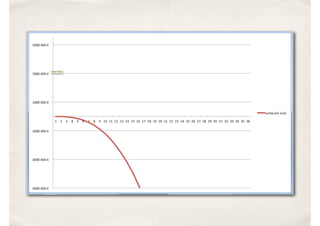
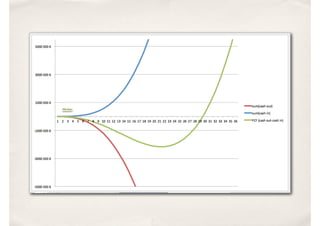
2.2 million
insight 1 = cashflow > 0, around month 21
insight 2 = the business needs about 2.2m
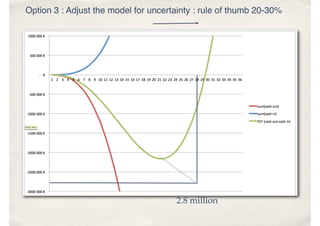
✤ You need to adjust for uncertainty in the assumptions.
3 methods :
✤ Montecarlo simulation : use Crystal Ball (excel plugin)
✤ Create 3 scenarios : min / max / target
✤ Just add a rule of thumb of 20-30%
option 1 : Monte-Carlo simulation on the variables !
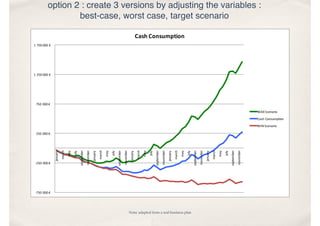
option 2 : create 3 versions by adjusting the variables :

best-case, worst case, target scenario
-750 000	€
-250 000	€
250 000	€
750 000	€
1 250 000	€
1 750 000	€
january
march
may
july
september
november
january
march
may
july
september
november
january
march
may
july
september
november
january
march
may
july
september
november
january
march
may
july
september
november
Cash	Consumption
MAX	Scenario
Cash	Consumption
MIN	Scenario
Nota: adapted from a real business plan
2.8 million
Option 3 : Adjust the model for uncertainty : rule of thumb 20-30%
how much money? key take-aways
✤ careful financial planning is necessary
✤ tells you exactly how much money is required
✤ (adjust for uncertainty with analytical tools)
✤ forces the entrepreneur to test his hypothesis and business logic
✤ gives before-hand many of the answers to investor questions
✤ Allows for scenario building (high, low, target)
2. what valuation ?
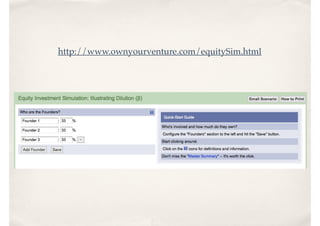
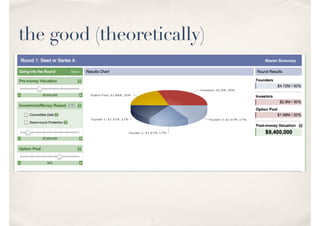
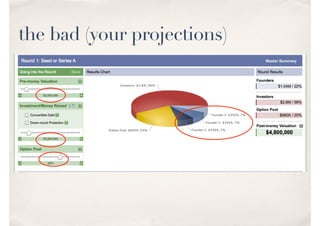
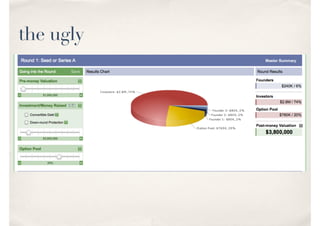
http://www.ownyourventure.com/equitySim.html
the good (theoretically)
the bad (your projections)
the ugly
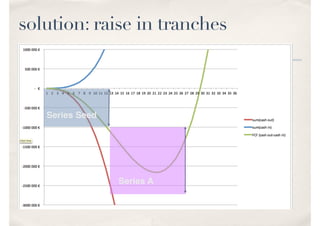
Series Seed
Series A
solution: raise in tranches
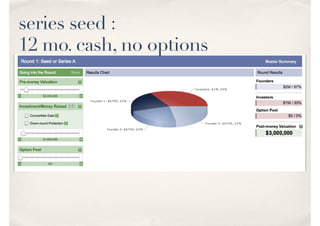
series seed :

12 mo. cash, no options
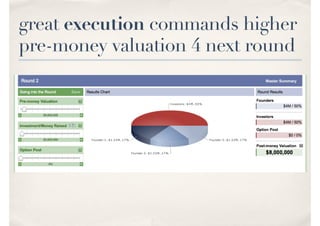
great execution commands higher
pre-money valuation 4 next round
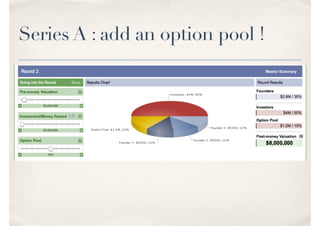
Series A : add an option pool !
example of an exit price
(2x revenues, after 4-5 years)
(fully diluted)
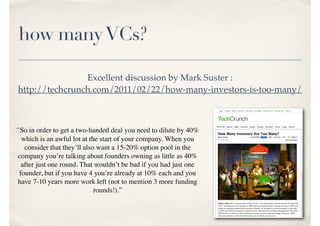
how manyVCs?
Excellent discussion by Mark Suster :
http://techcrunch.com/2011/02/22/how-many-investors-is-too-many/
“So in order to get a two-handed deal you need to dilute by 40%
which is an awful lot at the start of your company. When you
consider that they’ll also want a 15-20% option pool in the
company you’re talking about founders owning as little as 40%
after just one round. That wouldn’t be bad if you had just one
founder, but if you have 4 you’re already at 10% each and you
have 7-10 years more work left (not to mention 3 more funding
rounds!).”
recommended reading : FredWilson
MBA Mondays at http://www.avc.com
(and Brad Feld at http://feld.com)
valuation take-aways
✤ 1st round (seed)
✤ not a real life valuation, it’s only about how much you want to give away for the
amount of money you need > implied valuation
✤ minimize dilution by raising in tranches
✤ 2nd round (series A)
✤ you need to prove execution to raise at a higher valuation
✤ raise enough to reach cash-flow positive status
✤ 3rd round+ : growth (organic or acquisition)
specific clauses affect capital-gains
more than valuation...
✤ liquid preferences
✤ participating or not
✤ multiple or not
✤ http://privateequityblogger.com/2007/06/liquid-preference.html
✤ ratchet
✤ http://www.startupcompanylawyer.com/2007/08/04/what-is-
full-ratchet-anti-dilution-protection
3. how funds work
& whatVCs look for
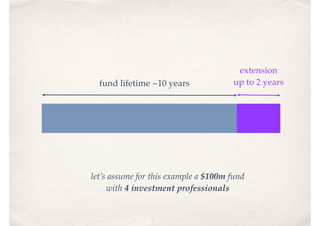
fund lifetime ~10 years
extension
up to 2 years
let’s assume for this example a $100m fund
with 4 investment professionals
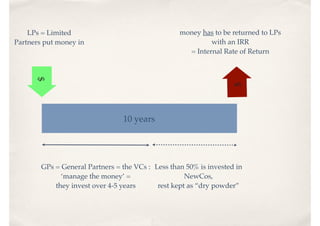
$LPs = Limited
Partners put money in
GPs = General Partners = the VCs :
‘manage the money’ =
they invest over 4-5 years
$
money has to be returned to LPs
with an IRR
= Internal Rate of Return
Less than 50% is invested in
NewCos,
rest kept as “dry powder”
10 years
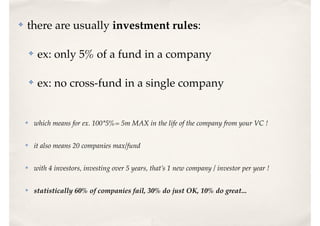
✤ there are usually investment rules:
✤ ex: only 5% of a fund in a company
✤ ex: no cross-fund in a single company
✤ which means for ex. 100*5%= 5m MAX in the life of the company from your VC !
✤ it also means 20 companies max/fund
✤ with 4 investors, investing over 5 years, that’s 1 new company / investor per year !
✤ statistically 60% of companies fail, 30% do just OK, 10% do great...
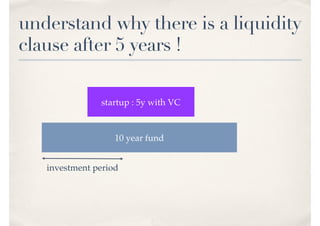
10 year fund
startup : 5y with VC
understand why there is a liquidity
clause after 5 years !
investment period
10 year fund
startup : 5y with VC
understand the age of the fund
investment period
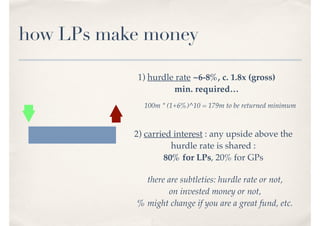
how LPs make money
1) hurdle rate ~6-8%, c. 1.8x (gross)

min. required…
100m * (1+6%)^10 = 179m to be returned minimum
2) carried interest : any upside above the
hurdle rate is shared :
80% for LPs, 20% for GPs
there are subtleties: hurdle rate or not,
on invested money or not,
% might change if you are a great fund, etc.
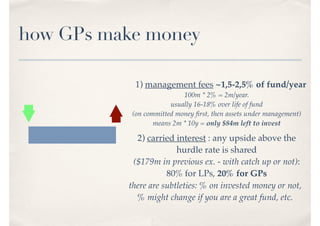
how GPs make money
1) management fees ~1,5-2,5% of fund/year
100m * 2% = 2m/year.
usually 16-18% over life of fund

(on committed money first, then assets under management)
means 2m * 10y = only $84m left to invest
2) carried interest : any upside above the
hurdle rate is shared

($179m in previous ex. - with catch up or not):
80% for LPs, 20% for GPs
there are subtleties: % on invested money or not,
% might change if you are a great fund, etc.
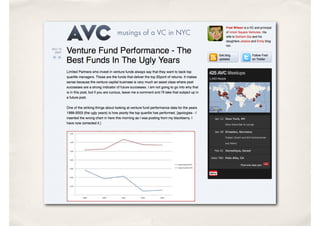
http://www.avc.com/a_vc/2008/08/venture-fund--1.html
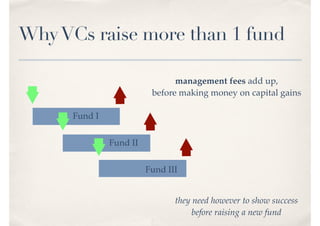
WhyVCs raise more than 1 fund
management fees add up,
before making money on capital gains
Fund I
Fund II
Fund III
they need however to show success
before raising a new fund
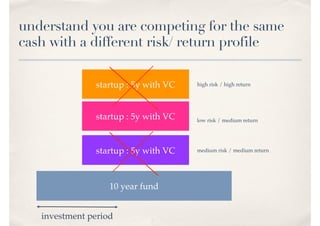
10 year fund
startup : 5y with VC
understand you are competing for the same
cash with a different risk/ return profile
investment period
startup : 5y with VC
low risk / medium return
high risk / high return
medium risk / medium return
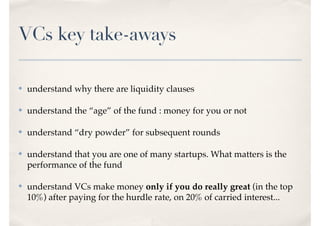
VCs key take-aways
✤ understand why there are liquidity clauses
✤ understand the “age” of the fund : money for you or not
✤ understand “dry powder” for subsequent rounds
✤ understand that you are one of many startups. What matters is the
performance of the fund
✤ understand VCs make money only if you do really great (in the top
10%) after paying for the hurdle rate, on 20% of carried interest...
4. risk management
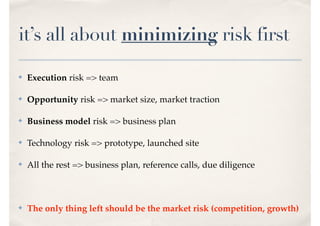
it’s all about minimizing risk first
✤ Execution risk => team
✤ Opportunity risk => market size, market traction
✤ Business model risk => business plan
✤ Technology risk => prototype, launched site
✤ All the rest => business plan, reference calls, due diligence
✤ The only thing left should be the market risk (competition, growth)
Team risk
Market risk and B-model
Technology risk
Legal risk, etc.
Summary
✤ how much to raise ?
✤ valuation & tranches
✤ how a fund works & what VCs look for
✤ risk management
Rodrigo Sepúlveda Schulz
Founding Partner, Expon Capital
rodrigo@exponcapital.com
https://www.linkedin.com/in/rsepulveda
@rodrigo

Fundraising for startups

  • 1.
    V3. - October2015 - (CC) BY NC SA Fundraising for startups Rodrigo A. Sepúlveda Schulz Source: http://twistedsifter.com/2009/11/how-to-lose-193-million-in-7-hands-of-poker/
  • 2.
  • 5.
    Summary ✤ how muchto raise ? ✤ what valuation ? ✤ how a fund works & what VCs look for ✤ risk management
  • 6.
    1. how muchto raise ?
  • 7.
    PnL projections isthe basis* Please see my presentation on P&L for startups on http://www.slideshare.net/rodrigo1971
  • 11.
    2.2 million insight 1= cashflow > 0, around month 21 insight 2 = the business needs about 2.2m
  • 12.
    ✤ You needto adjust for uncertainty in the assumptions. 3 methods : ✤ Montecarlo simulation : use Crystal Ball (excel plugin) ✤ Create 3 scenarios : min / max / target ✤ Just add a rule of thumb of 20-30%
  • 13.
    option 1 :Monte-Carlo simulation on the variables !
  • 16.
    option 2 :create 3 versions by adjusting the variables :
 best-case, worst case, target scenario -750 000 € -250 000 € 250 000 € 750 000 € 1 250 000 € 1 750 000 € january march may july september november january march may july september november january march may july september november january march may july september november january march may july september november Cash Consumption MAX Scenario Cash Consumption MIN Scenario Nota: adapted from a real business plan
  • 17.
    2.8 million Option 3: Adjust the model for uncertainty : rule of thumb 20-30%
  • 18.
    how much money?key take-aways ✤ careful financial planning is necessary ✤ tells you exactly how much money is required ✤ (adjust for uncertainty with analytical tools) ✤ forces the entrepreneur to test his hypothesis and business logic ✤ gives before-hand many of the answers to investor questions ✤ Allows for scenario building (high, low, target)
  • 19.
  • 20.
  • 21.
  • 22.
    the bad (yourprojections)
  • 23.
  • 24.
  • 25.
    series seed :
 12mo. cash, no options
  • 26.
    great execution commandshigher pre-money valuation 4 next round
  • 27.
    Series A :add an option pool !
  • 28.
    example of anexit price (2x revenues, after 4-5 years) (fully diluted)
  • 29.
    how manyVCs? Excellent discussionby Mark Suster : http://techcrunch.com/2011/02/22/how-many-investors-is-too-many/ “So in order to get a two-handed deal you need to dilute by 40% which is an awful lot at the start of your company. When you consider that they’ll also want a 15-20% option pool in the company you’re talking about founders owning as little as 40% after just one round. That wouldn’t be bad if you had just one founder, but if you have 4 you’re already at 10% each and you have 7-10 years more work left (not to mention 3 more funding rounds!).”
  • 30.
    recommended reading :FredWilson MBA Mondays at http://www.avc.com (and Brad Feld at http://feld.com)
  • 31.
    valuation take-aways ✤ 1stround (seed) ✤ not a real life valuation, it’s only about how much you want to give away for the amount of money you need > implied valuation ✤ minimize dilution by raising in tranches ✤ 2nd round (series A) ✤ you need to prove execution to raise at a higher valuation ✤ raise enough to reach cash-flow positive status ✤ 3rd round+ : growth (organic or acquisition)
  • 32.
    specific clauses affectcapital-gains more than valuation... ✤ liquid preferences ✤ participating or not ✤ multiple or not ✤ http://privateequityblogger.com/2007/06/liquid-preference.html ✤ ratchet ✤ http://www.startupcompanylawyer.com/2007/08/04/what-is- full-ratchet-anti-dilution-protection
  • 33.
    3. how fundswork & whatVCs look for
  • 35.
    fund lifetime ~10years extension up to 2 years let’s assume for this example a $100m fund with 4 investment professionals
  • 36.
    $LPs = Limited Partnersput money in GPs = General Partners = the VCs : ‘manage the money’ = they invest over 4-5 years $ money has to be returned to LPs with an IRR = Internal Rate of Return Less than 50% is invested in NewCos, rest kept as “dry powder” 10 years
  • 37.
    ✤ there areusually investment rules: ✤ ex: only 5% of a fund in a company ✤ ex: no cross-fund in a single company ✤ which means for ex. 100*5%= 5m MAX in the life of the company from your VC ! ✤ it also means 20 companies max/fund ✤ with 4 investors, investing over 5 years, that’s 1 new company / investor per year ! ✤ statistically 60% of companies fail, 30% do just OK, 10% do great...
  • 38.
    10 year fund startup: 5y with VC understand why there is a liquidity clause after 5 years ! investment period
  • 39.
    10 year fund startup: 5y with VC understand the age of the fund investment period
  • 40.
    how LPs makemoney 1) hurdle rate ~6-8%, c. 1.8x (gross)
 min. required… 100m * (1+6%)^10 = 179m to be returned minimum 2) carried interest : any upside above the hurdle rate is shared : 80% for LPs, 20% for GPs there are subtleties: hurdle rate or not, on invested money or not, % might change if you are a great fund, etc.
  • 42.
    how GPs makemoney 1) management fees ~1,5-2,5% of fund/year 100m * 2% = 2m/year. usually 16-18% over life of fund
 (on committed money first, then assets under management) means 2m * 10y = only $84m left to invest 2) carried interest : any upside above the hurdle rate is shared
 ($179m in previous ex. - with catch up or not): 80% for LPs, 20% for GPs there are subtleties: % on invested money or not, % might change if you are a great fund, etc.
  • 43.
  • 44.
    WhyVCs raise morethan 1 fund management fees add up, before making money on capital gains Fund I Fund II Fund III they need however to show success before raising a new fund
  • 45.
    10 year fund startup: 5y with VC understand you are competing for the same cash with a different risk/ return profile investment period startup : 5y with VC startup : 5y with VC low risk / medium return high risk / high return medium risk / medium return
  • 46.
    VCs key take-aways ✤understand why there are liquidity clauses ✤ understand the “age” of the fund : money for you or not ✤ understand “dry powder” for subsequent rounds ✤ understand that you are one of many startups. What matters is the performance of the fund ✤ understand VCs make money only if you do really great (in the top 10%) after paying for the hurdle rate, on 20% of carried interest...
  • 47.
  • 48.
    it’s all aboutminimizing risk first ✤ Execution risk => team ✤ Opportunity risk => market size, market traction ✤ Business model risk => business plan ✤ Technology risk => prototype, launched site ✤ All the rest => business plan, reference calls, due diligence ✤ The only thing left should be the market risk (competition, growth)
  • 49.
  • 50.
  • 51.
  • 52.
  • 53.
    Summary ✤ how muchto raise ? ✤ valuation & tranches ✤ how a fund works & what VCs look for ✤ risk management
  • 54.
    Rodrigo Sepúlveda Schulz FoundingPartner, Expon Capital rodrigo@exponcapital.com https://www.linkedin.com/in/rsepulveda @rodrigo