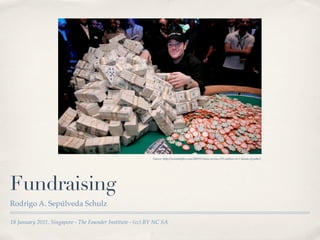
Source: http://twistedsifter.com/2009/11/how-to-lose-193-million-in-7-hands-of-poker/


Fundraising
Rodrigo A. Sepúlveda Schulz

18 January 2011, Singapore - The Founder Institute - (cc) BY NC SA
http://www.RodrigoSepulveda.com
Summary


✤   how much to raise ?

✤   what valuation ?

✤   how a fund works & what VCs look for

✤   risk management
1. how much to raise ?
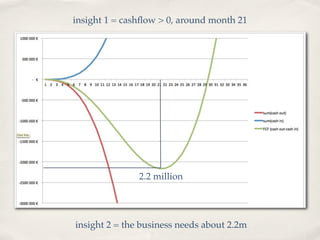
PnL projections is the basis
2.2 million
insight 1 = cashflow > 0, around month 21


               2.2 million
insight 1 = cashflow > 0, around month 21


               2.2 million


insight 2 = the business needs about 2.2m
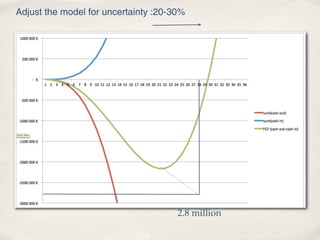
Adjust the model for uncertainty :20-30%


                                      2.8 million
how much money? key take-aways

✤   careful financial planning is necessary

    ✤   tells you exactly how much money is required

        ✤   (adjust for uncertainty with analytical tools)

    ✤   forces the entrepreneur to test his hypothesis and business logic

    ✤   gives before-hand many of the answers to investor questions

✤   Allows for scenario building (high, low, target)
2. what valuation ?
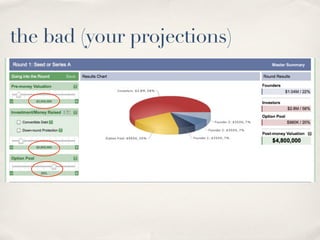
http://www.ownyourventure.com/equitySim.html
the good (theoretically)
the bad (your projections)
the ugly
solution: raise in tranches


    Series A


               Series B
series A : 12 mo. cash, no options
great execution commands higher
pre-money valuation 4 next round
Series B : add an option pool !
example of an exit price
(2x revenues, after 4-5 years)


              (fully diluted)
valuation take-aways

✤   1st round (seed and/or series A)

    ✤   not a real life valuation, it’s only about how much you want to give away for the
        amount of money you need > implied valuation

    ✤   minimize dilution by raising in tranches

✤   2nd round (series B)

    ✤   you need to prove execution to raise at a higher valuation

    ✤   raise enough to reach cash-flow positive status

✤   3rd round+ : growth (organic or acquisition)
3. how funds work
& what VCs look for
fund lifetime ~10 years


let’s assume for this example a $100m fund
     with 4 investment professionals
extension
  fund lifetime ~10 years              up to 2 years


let’s assume for this example a $100m fund
     with 4 investment professionals
10 years
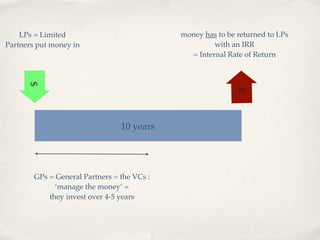
LPs = Limited
Partners put money in
      $


                        10 years
LPs = Limited
Partners put money in
      $


                                 10 years


        GPs = General Partners = the VCs :
              ‘manage the money’ =
            they invest over 4-5 years
LPs = Limited                            money has to be returned to LPs
Partners put money in                                 with an IRR
                                               = Internal Rate of Return
      $


                                                             $
                                 10 years


        GPs = General Partners = the VCs :
              ‘manage the money’ =
            they invest over 4-5 years
LPs = Limited                                 money has to be returned to LPs
Partners put money in                                      with an IRR
                                                    = Internal Rate of Return
      $


                                                                  $
                                 10 years


        GPs = General Partners = the VCs : Only 50-60% is invested in
              ‘manage the money’ =                  NewCos,
            they invest over 4-5 years     rest kept as “dry powder”
✤   there are usually investment rules:

        ✤    ex: only 5% of a fund in a company

        ✤    ex: no cross-fund in a single company


    ✤       which means for ex. 100*5%= 5m MAX in the life of the company from your VC !

    ✤       it also means 20 companies max/fund

    ✤       with 4 investors, investing over 5 years, that’s 1 new company / investor per year !

    ✤       statistically 60% of companies fail, 30% do just OK, 10% do great...
understand why there is a liquidity
clause after 5 years !

               startup : 5y with VC


                   10 year fund


   investment period
understand the age of the fund


                                  startup : 5y with VC


                   10 year fund


   investment period
understand the age of the fund


                                  startup : 5y with VC


                   10 year fund


   investment period
how LPs make money
how LPs make money

           1) hurdle rate ~15%, c. 4x (gross) required...
how LPs make money

           1) hurdle rate ~15%, c. 4x (gross) required...

             100m * (1+15%)^10 = 400m
how LPs make money

           1) hurdle rate ~15%, c. 4x (gross) required...

             100m * (1+15%)^10 = 400m


           2) carried interest : any upside above the
                     hurdle rate is shared :
                   80% for LPs, 20% for GPs
how LPs make money

           1) hurdle rate ~15%, c. 4x (gross) required...

             100m * (1+15%)^10 = 400m


           2) carried interest : any upside above the
                     hurdle rate is shared :
                   80% for LPs, 20% for GPs

             there are subtleties: hurdle rate or not,
                   on invested money or not,
           % might change if you are a great fund, etc.
how GPs make money
how GPs make money

           1) management fees ~1,5-2,5% of fund/year
how GPs make money

           1) management fees ~1,5-2,5% of fund/year

                    100m * 2% = 2m/year.
           means 2m * 10y = only $80m left to invest
how GPs make money

           1) management fees ~1,5-2,5% of fund/year

                    100m * 2% = 2m/year.
           means 2m * 10y = only $80m left to invest

           2) carried interest : any upside above the
                     hurdle rate is shared :
                   80% for LPs, 20% for GPs
how GPs make money

           1) management fees ~1,5-2,5% of fund/year

                     100m * 2% = 2m/year.
            means 2m * 10y = only $80m left to invest

            2) carried interest : any upside above the
                      hurdle rate is shared :
                    80% for LPs, 20% for GPs

          there are subtleties: % on invested money or not,
            % might change if you are a great fund, etc.
http://www.avc.com/a_vc/2008/08/venture-fund--1.html
Why VCs raise more than 1 fund

                                management fees add up,
                          before making money on capital gains

      Fund I


               Fund II


                         Fund III


                                they need however to show success
                                     before raising a new fund
understand you are competing for the same
cash with a different risk/ return profile

               startup : 5y with VC   high risk / high return


               startup : 5y with VC   low risk / medium return


               startup : 5y with VC   medium risk / medium return


                   10 year fund


   investment period
understand you are competing for the same
cash with a different risk/ return profile

               startup : 5y with VC   high risk / high return


               startup : 5y with VC   low risk / medium return


               startup : 5y with VC   medium risk / medium return


                   10 year fund


   investment period
understand you are competing for the same
cash with a different risk/ return profile

               startup : 5y with VC   high risk / high return


               startup : 5y with VC   low risk / medium return


               startup : 5y with VC   medium risk / medium return


                   10 year fund


   investment period
VCs key take-aways

✤   understand why there are liquidity clauses

✤   understand the “age” of the fund : money for you or not

✤   understand “dry powder” for subsequent rounds

✤   understand that you are one of many startups. What matters is the
    performance of the fund

✤   understand VCs make money only if you do really great (in the top
    10%) after paying for the hurdle rate and 80% carried interest...
4. risk management
it’s all about minimizing risk first

✤   Execution risk => team

✤   Opportunity risk => market size, market traction

✤   Business model risk => business plan

✤   Technology risk => prototype, launched site

✤   All the rest => business plan, reference calls, due diligence


✤   The only thing left should be the market risk (competition, growth)
Team
Target market and B-model
Technology
Summary


✤   how much to raise ?

✤   Valuation & tranches

✤   how a fund works & what VCs look for

✤   risk management
Thank you!

110118 Fundraising

  • 1.
    Source: http://twistedsifter.com/2009/11/how-to-lose-193-million-in-7-hands-of-poker/ Fundraising Rodrigo A.Sepúlveda Schulz 18 January 2011, Singapore - The Founder Institute - (cc) BY NC SA
  • 2.
  • 5.
    Summary ✤ how much to raise ? ✤ what valuation ? ✤ how a fund works & what VCs look for ✤ risk management
  • 6.
    1. how muchto raise ?
  • 7.
  • 11.
  • 12.
    insight 1 =cashflow > 0, around month 21 2.2 million
  • 13.
    insight 1 =cashflow > 0, around month 21 2.2 million insight 2 = the business needs about 2.2m
  • 17.
    Adjust the modelfor uncertainty :20-30% 2.8 million
  • 18.
    how much money?key take-aways ✤ careful financial planning is necessary ✤ tells you exactly how much money is required ✤ (adjust for uncertainty with analytical tools) ✤ forces the entrepreneur to test his hypothesis and business logic ✤ gives before-hand many of the answers to investor questions ✤ Allows for scenario building (high, low, target)
  • 19.
  • 20.
  • 21.
  • 22.
    the bad (yourprojections)
  • 23.
    the bad (yourprojections)
  • 24.
    the bad (yourprojections)
  • 25.
    the bad (yourprojections)
  • 26.
    the bad (yourprojections)
  • 27.
  • 28.
    solution: raise intranches Series A Series B
  • 29.
    series A :12 mo. cash, no options
  • 30.
    great execution commandshigher pre-money valuation 4 next round
  • 31.
    Series B :add an option pool !
  • 32.
    example of anexit price (2x revenues, after 4-5 years) (fully diluted)
  • 33.
    valuation take-aways ✤ 1st round (seed and/or series A) ✤ not a real life valuation, it’s only about how much you want to give away for the amount of money you need > implied valuation ✤ minimize dilution by raising in tranches ✤ 2nd round (series B) ✤ you need to prove execution to raise at a higher valuation ✤ raise enough to reach cash-flow positive status ✤ 3rd round+ : growth (organic or acquisition)
  • 34.
    3. how fundswork & what VCs look for
  • 36.
    fund lifetime ~10years let’s assume for this example a $100m fund with 4 investment professionals
  • 37.
    extension fundlifetime ~10 years up to 2 years let’s assume for this example a $100m fund with 4 investment professionals
  • 38.
  • 39.
    LPs = Limited Partnersput money in $ 10 years
  • 40.
    LPs = Limited Partnersput money in $ 10 years GPs = General Partners = the VCs : ‘manage the money’ = they invest over 4-5 years
  • 41.
    LPs = Limited money has to be returned to LPs Partners put money in with an IRR = Internal Rate of Return $ $ 10 years GPs = General Partners = the VCs : ‘manage the money’ = they invest over 4-5 years
  • 42.
    LPs = Limited money has to be returned to LPs Partners put money in with an IRR = Internal Rate of Return $ $ 10 years GPs = General Partners = the VCs : Only 50-60% is invested in ‘manage the money’ = NewCos, they invest over 4-5 years rest kept as “dry powder”
  • 43.
    there are usually investment rules: ✤ ex: only 5% of a fund in a company ✤ ex: no cross-fund in a single company ✤ which means for ex. 100*5%= 5m MAX in the life of the company from your VC ! ✤ it also means 20 companies max/fund ✤ with 4 investors, investing over 5 years, that’s 1 new company / investor per year ! ✤ statistically 60% of companies fail, 30% do just OK, 10% do great...
  • 44.
    understand why thereis a liquidity clause after 5 years ! startup : 5y with VC 10 year fund investment period
  • 45.
    understand the ageof the fund startup : 5y with VC 10 year fund investment period
  • 46.
    understand the ageof the fund startup : 5y with VC 10 year fund investment period
  • 47.
  • 48.
    how LPs makemoney 1) hurdle rate ~15%, c. 4x (gross) required...
  • 49.
    how LPs makemoney 1) hurdle rate ~15%, c. 4x (gross) required... 100m * (1+15%)^10 = 400m
  • 50.
    how LPs makemoney 1) hurdle rate ~15%, c. 4x (gross) required... 100m * (1+15%)^10 = 400m 2) carried interest : any upside above the hurdle rate is shared : 80% for LPs, 20% for GPs
  • 51.
    how LPs makemoney 1) hurdle rate ~15%, c. 4x (gross) required... 100m * (1+15%)^10 = 400m 2) carried interest : any upside above the hurdle rate is shared : 80% for LPs, 20% for GPs there are subtleties: hurdle rate or not, on invested money or not, % might change if you are a great fund, etc.
  • 53.
  • 54.
    how GPs makemoney 1) management fees ~1,5-2,5% of fund/year
  • 55.
    how GPs makemoney 1) management fees ~1,5-2,5% of fund/year 100m * 2% = 2m/year. means 2m * 10y = only $80m left to invest
  • 56.
    how GPs makemoney 1) management fees ~1,5-2,5% of fund/year 100m * 2% = 2m/year. means 2m * 10y = only $80m left to invest 2) carried interest : any upside above the hurdle rate is shared : 80% for LPs, 20% for GPs
  • 57.
    how GPs makemoney 1) management fees ~1,5-2,5% of fund/year 100m * 2% = 2m/year. means 2m * 10y = only $80m left to invest 2) carried interest : any upside above the hurdle rate is shared : 80% for LPs, 20% for GPs there are subtleties: % on invested money or not, % might change if you are a great fund, etc.
  • 58.
  • 59.
    Why VCs raisemore than 1 fund management fees add up, before making money on capital gains Fund I Fund II Fund III they need however to show success before raising a new fund
  • 60.
    understand you arecompeting for the same cash with a different risk/ return profile startup : 5y with VC high risk / high return startup : 5y with VC low risk / medium return startup : 5y with VC medium risk / medium return 10 year fund investment period
  • 61.
    understand you arecompeting for the same cash with a different risk/ return profile startup : 5y with VC high risk / high return startup : 5y with VC low risk / medium return startup : 5y with VC medium risk / medium return 10 year fund investment period
  • 62.
    understand you arecompeting for the same cash with a different risk/ return profile startup : 5y with VC high risk / high return startup : 5y with VC low risk / medium return startup : 5y with VC medium risk / medium return 10 year fund investment period
  • 63.
    VCs key take-aways ✤ understand why there are liquidity clauses ✤ understand the “age” of the fund : money for you or not ✤ understand “dry powder” for subsequent rounds ✤ understand that you are one of many startups. What matters is the performance of the fund ✤ understand VCs make money only if you do really great (in the top 10%) after paying for the hurdle rate and 80% carried interest...
  • 64.
  • 65.
    it’s all aboutminimizing risk first ✤ Execution risk => team ✤ Opportunity risk => market size, market traction ✤ Business model risk => business plan ✤ Technology risk => prototype, launched site ✤ All the rest => business plan, reference calls, due diligence ✤ The only thing left should be the market risk (competition, growth)
  • 66.
  • 67.
  • 68.
  • 69.
    Summary ✤ how much to raise ? ✤ Valuation & tranches ✤ how a fund works & what VCs look for ✤ risk management
  • 70.