SUBJECT : CAREER OPPORTUNITIES AND
ENTERPRENEURSHIP IN BIOTECHNOLOGY
SUBJECT CODE: MCE 713
SUBMITTED TO:
DR. GD RAM GURU
MCE DEPARTMENT
JIBB
SUBMITTED BY:
GAURAV AUGUSTINE
ID: 19MTBT001
M.TECH 2ND SEM.
 Introduction
 Why marker-free transgenic plants?
 Most commonly used marker
 Strategies to develop marker-free transgenics
 Strategies to eliminate marker genes from
transgenic
 Conclusion
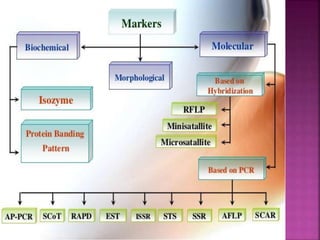
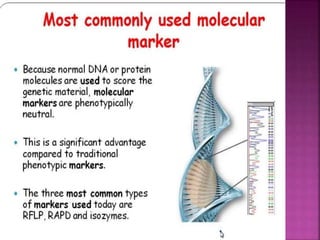
 Molecular Marker :- In genetics, a molecular marker
(identified as genetic marker) is a fragment of DNA
that is associated with a certain location within the
genome. Molecular markers are used in molecular
biology and biotechnology to identify a particular
sequence of DNA in a pool of unknown DNA.
 Molecular markers are effective because they identify
an abundance of genetic linkage between identifiable
locations within a chromosome and are able to be
repeated for verification.
 The use of a marker gene in a transformation process
aims to give a selective advantage to the transformed
cells, allowing them to grow faster and better, and to
kill the non-transformed cells.
 In general, the selective gene is introduced into
the plant genome along with the genes of
interest.
 In some cases, the marker gene is the gene of
interest that will express an agronomic
characteristic, such as herbicide resistance.
 Although no adverse biosafety effects have
been reported for the marker genes that have
been adopted for widespread use, biosafety
concerns should help direct which markers will
be chosen for future crop development.
 Selectable marker genes (SMGs), such as antibiotic or
herbicide resistance genes, are used in nearly every plant
transformation protocol to efficiently distinguish
transformed from non-transformed cells.
 Marker genes generally have little agronomic value after
selection events .
 In situations requiring more transformations into cultivars
the presence of a particular marker gene in a transgenic
plant - use of the same marker in subsequent transformation.
 Use of a different marker system is required for each
transformation round or event.
 For public acceptance of transgenics, keeping in mind
ecological and food safety .
 Marker free transgenics should be developed.
 Positive selection system
 Negative selection system
 Abiotic stress related genes as selection markers
 Avoiding the use of selectable marker genes
Positive selection system :- Identification and
selection of transformed cell without injury or death of
non-transform cell. The selected marker genes code for
enzymes that give the transformed cells a capacity to
metabolize specific nutrient substance not usually
metabolized by normal plants.
Negative selection system :- in this method negative
selectable marker genes next to a positive marker gene
in the same construct and are a powerful means of
creating marker free transgenic plants. Transformed
plants are selected for the absence of negative selection
marker genes under the selection pressure of a negative
selection markers.
Avoiding the use of selectable marker genes :-
The simplest way to eliminate marker genes for
transgenic is to avoid their use in the transformation.
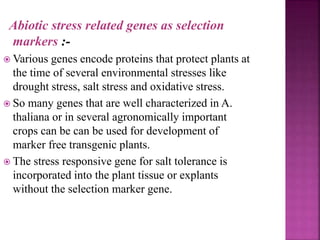
Abiotic stress related genes as selection
markers :-
 Various genes encode proteins that protect plants at
the time of several environmental stresses like
drought stress, salt stress and oxidative stress.
 So many genes that are well characterized in A.
thaliana or in several agronomically important
crops can be can be used for development of
marker free transgenic plants.
 The stress responsive gene for salt tolerance is
incorporated into the plant tissue or explants
without the selection marker gene.
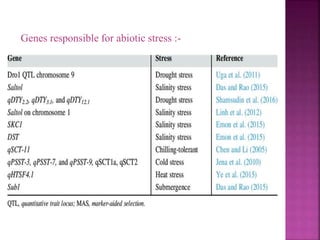
Genes responsible for abiotic stress :-
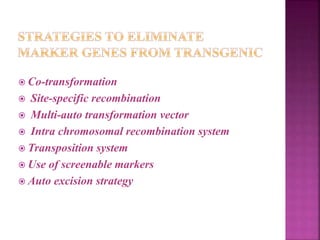
 Co-transformation
 Site-specific recombination
 Multi-auto transformation vector
 Intra chromosomal recombination system
 Transposition system
 Use of screenable markers
 Auto excision strategy
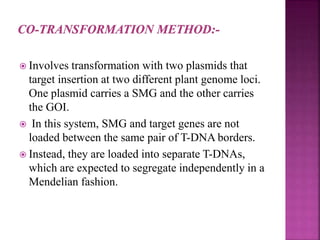
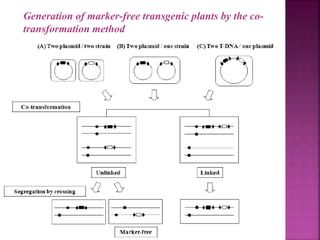
 Involves transformation with two plasmids that
target insertion at two different plant genome loci.
One plasmid carries a SMG and the other carries
the GOI.
 In this system, SMG and target genes are not
loaded between the same pair of T-DNA borders.
 Instead, they are loaded into separate T-DNAs,
which are expected to segregate independently in a
Mendelian fashion.
 It cannot be used for vegetatively propagated
plants. So that, this method is only compatible
only for sexually propagated fertile plants.
 Very time consuming.
 The tight linkage between co-integrated DNAs
may limit the efficiency of co-transformation.
 This method is also not applicable to transgenic
trees with long generation times.
 The progeny selection with the desired genes may
also be very laborious.
Generation of marker-free transgenic plants by the co-
transformation method
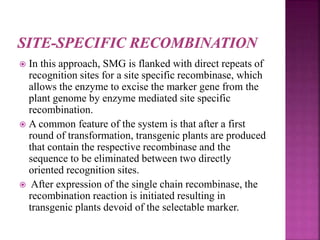
 In this approach, SMG is flanked with direct repeats of
recognition sites for a site specific recombinase, which
allows the enzyme to excise the marker gene from the
plant genome by enzyme mediated site specific
recombination.
 A common feature of the system is that after a first
round of transformation, transgenic plants are produced
that contain the respective recombinase and the
sequence to be eliminated between two directly
oriented recognition sites.
 After expression of the single chain recombinase, the
recombination reaction is initiated resulting in
transgenic plants devoid of the selectable marker.
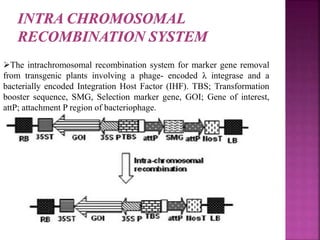
The intrachromosomal recombination system for marker gene removal
from transgenic plants involving a phage- encoded λ integrase and a
bacterially encoded Integration Host Factor (IHF). TBS; Transformation
booster sequence, SMG, Selection marker gene, GOI; Gene of interest,
attP; attachment P region of bacteriophage.
 This process is quite similar to site specific
recombination where transposons or jumping
genes are used instead of a recombination and
recognition sites.
 This method involves Agrobacterium-mediated
transformation followed by intergenomic
replacement after the incorporation of two allied
genes and subsequent separation from the marker
gene in the progeny or straight deletion of marker
gene from the genome.
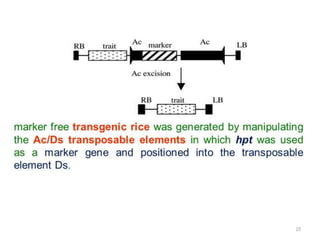
 There are two fundamental individuality possessed by
the autonomous Ac element for transposition that can
be physically separated: a transpossase coding gene
(Ac) and the reversed duplicate termini (Ds elements).
 The approach makes the use of the Ac/Ds transposition
system where Ds is a member of Ac/Ds family, can cut
out itself from its position and transpose to other sites
within a genome only in the existence of the
autonomous Ac element and Ac transposase activity is
vital for the expression of plant promoters
 The advantage of this system is that, the selection
marker gene will be lost in some somatic tissues due to
failure of the Ds element reintegration. This makes the
strategy suitable for removal of marker genes in
vegetatively propagated plants.
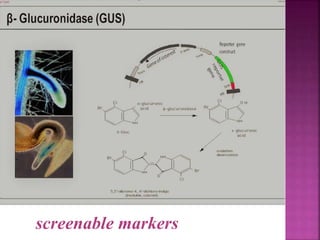
 Screenable markers encode gene products whose
enzyme activity can be easily assayed.
 Can detect transformants
 Also estimation of the levels of foreign gene
expression in transgenic tissue done.
 Ex. β-glucuronidase (GUS), luciferase or β-
galactosidase genes, phytohormone metabolism
isopentenyl transferase (ipt) gene from the T-DNA
of Agrobacterium.
 Can be used to study cell-specific as well as
developmentally regulated gene expression.
screenable markers
 Various approaches for removal of selectable
markers for transgeic have been described here but
appropriate choice depends on ease of use, crop
and methods of transformation and generation
time.
 the marker free methodologies are useful to
overcome the gene flow from the genetic
engineered plants to other living organism.
 The marker gene should be removed after next
generation in order to avoid their toxicity to other
living organisms.
THANK
YOU!

Marker free transgenic

  • 1.
    SUBJECT : CAREEROPPORTUNITIES AND ENTERPRENEURSHIP IN BIOTECHNOLOGY SUBJECT CODE: MCE 713 SUBMITTED TO: DR. GD RAM GURU MCE DEPARTMENT JIBB SUBMITTED BY: GAURAV AUGUSTINE ID: 19MTBT001 M.TECH 2ND SEM.
  • 2.
     Introduction  Whymarker-free transgenic plants?  Most commonly used marker  Strategies to develop marker-free transgenics  Strategies to eliminate marker genes from transgenic  Conclusion
  • 3.
     Molecular Marker:- In genetics, a molecular marker (identified as genetic marker) is a fragment of DNA that is associated with a certain location within the genome. Molecular markers are used in molecular biology and biotechnology to identify a particular sequence of DNA in a pool of unknown DNA.  Molecular markers are effective because they identify an abundance of genetic linkage between identifiable locations within a chromosome and are able to be repeated for verification.  The use of a marker gene in a transformation process aims to give a selective advantage to the transformed cells, allowing them to grow faster and better, and to kill the non-transformed cells.
  • 4.
     In general,the selective gene is introduced into the plant genome along with the genes of interest.  In some cases, the marker gene is the gene of interest that will express an agronomic characteristic, such as herbicide resistance.  Although no adverse biosafety effects have been reported for the marker genes that have been adopted for widespread use, biosafety concerns should help direct which markers will be chosen for future crop development.
  • 7.
     Selectable markergenes (SMGs), such as antibiotic or herbicide resistance genes, are used in nearly every plant transformation protocol to efficiently distinguish transformed from non-transformed cells.  Marker genes generally have little agronomic value after selection events .  In situations requiring more transformations into cultivars the presence of a particular marker gene in a transgenic plant - use of the same marker in subsequent transformation.  Use of a different marker system is required for each transformation round or event.  For public acceptance of transgenics, keeping in mind ecological and food safety .  Marker free transgenics should be developed.
  • 8.
     Positive selectionsystem  Negative selection system  Abiotic stress related genes as selection markers  Avoiding the use of selectable marker genes
  • 9.
    Positive selection system:- Identification and selection of transformed cell without injury or death of non-transform cell. The selected marker genes code for enzymes that give the transformed cells a capacity to metabolize specific nutrient substance not usually metabolized by normal plants. Negative selection system :- in this method negative selectable marker genes next to a positive marker gene in the same construct and are a powerful means of creating marker free transgenic plants. Transformed plants are selected for the absence of negative selection marker genes under the selection pressure of a negative selection markers. Avoiding the use of selectable marker genes :- The simplest way to eliminate marker genes for transgenic is to avoid their use in the transformation.
  • 10.
    Abiotic stress relatedgenes as selection markers :-  Various genes encode proteins that protect plants at the time of several environmental stresses like drought stress, salt stress and oxidative stress.  So many genes that are well characterized in A. thaliana or in several agronomically important crops can be can be used for development of marker free transgenic plants.  The stress responsive gene for salt tolerance is incorporated into the plant tissue or explants without the selection marker gene.
  • 11.
    Genes responsible forabiotic stress :-
  • 12.
     Co-transformation  Site-specificrecombination  Multi-auto transformation vector  Intra chromosomal recombination system  Transposition system  Use of screenable markers  Auto excision strategy
  • 13.
     Involves transformationwith two plasmids that target insertion at two different plant genome loci. One plasmid carries a SMG and the other carries the GOI.  In this system, SMG and target genes are not loaded between the same pair of T-DNA borders.  Instead, they are loaded into separate T-DNAs, which are expected to segregate independently in a Mendelian fashion.
  • 14.
     It cannotbe used for vegetatively propagated plants. So that, this method is only compatible only for sexually propagated fertile plants.  Very time consuming.  The tight linkage between co-integrated DNAs may limit the efficiency of co-transformation.  This method is also not applicable to transgenic trees with long generation times.  The progeny selection with the desired genes may also be very laborious.
  • 15.
    Generation of marker-freetransgenic plants by the co- transformation method
  • 16.
     In thisapproach, SMG is flanked with direct repeats of recognition sites for a site specific recombinase, which allows the enzyme to excise the marker gene from the plant genome by enzyme mediated site specific recombination.  A common feature of the system is that after a first round of transformation, transgenic plants are produced that contain the respective recombinase and the sequence to be eliminated between two directly oriented recognition sites.  After expression of the single chain recombinase, the recombination reaction is initiated resulting in transgenic plants devoid of the selectable marker.
  • 17.
    The intrachromosomal recombinationsystem for marker gene removal from transgenic plants involving a phage- encoded λ integrase and a bacterially encoded Integration Host Factor (IHF). TBS; Transformation booster sequence, SMG, Selection marker gene, GOI; Gene of interest, attP; attachment P region of bacteriophage.
  • 18.
     This processis quite similar to site specific recombination where transposons or jumping genes are used instead of a recombination and recognition sites.  This method involves Agrobacterium-mediated transformation followed by intergenomic replacement after the incorporation of two allied genes and subsequent separation from the marker gene in the progeny or straight deletion of marker gene from the genome.
  • 20.
     There aretwo fundamental individuality possessed by the autonomous Ac element for transposition that can be physically separated: a transpossase coding gene (Ac) and the reversed duplicate termini (Ds elements).  The approach makes the use of the Ac/Ds transposition system where Ds is a member of Ac/Ds family, can cut out itself from its position and transpose to other sites within a genome only in the existence of the autonomous Ac element and Ac transposase activity is vital for the expression of plant promoters  The advantage of this system is that, the selection marker gene will be lost in some somatic tissues due to failure of the Ds element reintegration. This makes the strategy suitable for removal of marker genes in vegetatively propagated plants.
  • 21.
     Screenable markersencode gene products whose enzyme activity can be easily assayed.  Can detect transformants  Also estimation of the levels of foreign gene expression in transgenic tissue done.  Ex. β-glucuronidase (GUS), luciferase or β- galactosidase genes, phytohormone metabolism isopentenyl transferase (ipt) gene from the T-DNA of Agrobacterium.  Can be used to study cell-specific as well as developmentally regulated gene expression.
  • 22.
  • 23.
     Various approachesfor removal of selectable markers for transgeic have been described here but appropriate choice depends on ease of use, crop and methods of transformation and generation time.  the marker free methodologies are useful to overcome the gene flow from the genetic engineered plants to other living organism.  The marker gene should be removed after next generation in order to avoid their toxicity to other living organisms.
  • 24.