ECOLOGY
Core Concepts
  1. Ecology is the scientific study of interactions among organisms
     and between organisms and their environment.
  2. Biotic and abiotic factors influence life in the biosphere, such as
     the distribution of biological communities.
  3. An organism’s niche refers to the conditions in which an
     organism lives and the way in which the organism uses those
     conditions.
  4. Ecosystems constantly change in response to natural or human
     disturbances.
  5. Energy flows through an ecosystem in one direction: from the
     sun or inorganic compounds to autotrophs (producers) and
     then to various heterotrophs (consumers).
Keywords
ecology                     pioneer species
ecosystem                   autotroph
biotic factor               heterotroph
abiotic factor              species
ecological niche            population
ecological succession       community
biome                       biosphere
climax community
ECOLOGY
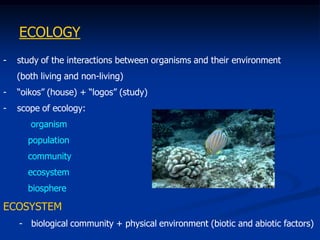
-   study of the interactions between organisms and their environment
    (both living and non-living)
-   “oikos” (house) + “logos” (study)
-   scope of ecology:
       organism
      population
      community
      ecosystem
      biosphere

ECOSYSTEM
    - biological community + physical environment (biotic and abiotic factors)
ECOLOGICAL NICHE
  - the status/role of an organism in its environment
  - Competitive Exclusion Principle:
     a fundamental rule in ecology stating that no two organisms can occupy
     the exact niche for an indefinite amount of time because competition for
     resources would lead to the death of one.

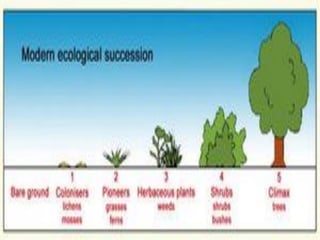
ECOLOGICAL SUCCESSION
  - the sequence of communities that develops in an area from the initial
     stages of colonization until a stable climax community is achieved
  - series of changes in the species composition of living communities, often
     following ecological disturbance of the community
  - pioneer species vs. climax community
  - primary vs. secondary succession
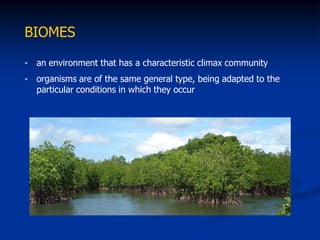
BIOMES

- an environment that has a characteristic climax community
- organisms are of the same general type, being adapted to the
  particular conditions in which they occur
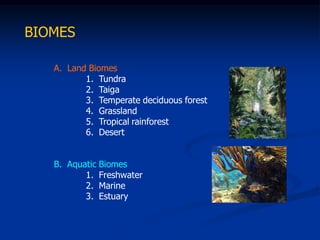
BIOMES

   A. Land Biomes
          1. Tundra
          2. Taiga
          3. Temperate deciduous forest
          4. Grassland
          5. Tropical rainforest
          6. Desert


   B. Aquatic Biomes
          1. Freshwater
          2. Marine
          3. Estuary
Characteristics used to distinguish
Types of Land Biomes/Ecosystems:
   Climatic conditions
     Temperature
     precipitation/rainfall

     location, altitude, topography, etc.

   Climax community
     Vegetation
     Animals

   Adaptations of Flora and Fauna
Matter/Biogeochemical Cycles
   Carbon cycle
   Nitrogen cycle
   Water cycle
   Mineral cycles:
     Phosphorus
     Calcium

     Sulfur

     etc.
Energy Flow
   Trophic levels: producers, consumers
   Feeding relationships: food chains, food webs
   Ecological pyramids:
     Energy pyramid
     Pyramid of Biomass

     Pyramid of Numbers
Terrestrial vs. Aquatic ecosystems
   Evolution and Ecological Succession
       Life originated in water and evolved there for almost
        3Billion years before plants and animals began moving
        onto land.
   Coverage
       Aquatic Biomes occupy the largest part of the biosphere
        covering about 75% of the Earth’s surface
   Aquatic biomes are less affected by climate change
    than land ecosystems. Why?
       Nature of water
Abiotic and Biotic Factors
                  of Aquatic Biomes
   Water Chemistry                       Salinity of Aquatic Biomes:
       Salinity, pH, ions, nutrients,     <1% - 3%
        pollutants                       Freshwater – about <1%
   Temperature                          Estuary – variable (Why?)
   Depth of Water                       Marine – about 3%
       Light penetration
                                          BOD
       Turbidity
       O2 content
                                           Biological Oxygen Demand
            Wind action                  Eutrophication
            Water current/flow rate      Turn-over/Upwelling
            Microbial action
       Water pressure
Zonations and Thermal Stratification
        Affect Interactions
  in Aquatic Ecosystems/Biomes
Standing (Lentic)water :
ponds, lakes

Isolated/land-locked      ;
low   species diversity
Life Zones/Zonations based on:
Light Penetration:
     Photic Zone

     Aphotic Zone

Distance from shoreline, Depth, Sunlight, Temperature:
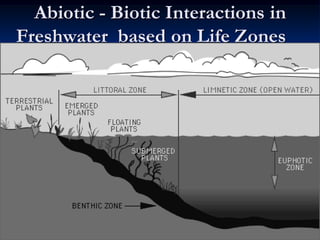
     Littoral Zone:

       near shore; sunlight abundant; photosynthesis high ; high species diversity
     Limnetic Zone:

      near-surface open water ; w/ plankton at the base of food chain
     Profundal Zone:

      deep water ; aphotic; low temp; no photosynthesis; no O2 (only anaerobic
       organisms live here), low species diversity
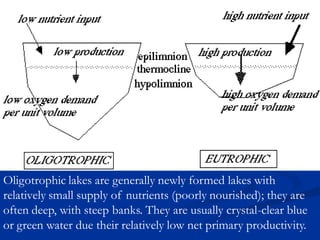
Thermal Stratification: Eutrophic vs. Oligotrophic vs. Mesotrophic Lakes
   Epilimnion
   Thermocline
   Hypolimnion
Abiotic - Biotic Interactions in
Freshwater based on Life Zones
Oligotrophic lakes are generally newly formed lakes with
relatively small supply of nutrients (poorly nourished); they are
often deep, with steep banks. They are usually crystal-clear blue
or green water due their relatively low net primary productivity.
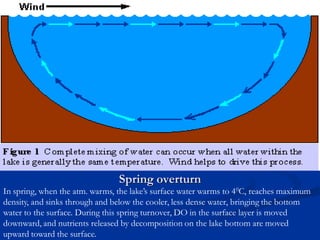
Spring overturn
In spring, when the atm. warms, the lake’s surface water warms to 40C, reaches maximum
density, and sinks through and below the cooler, less dense water, bringing the bottom
water to the surface. During this spring turnover, DO in the surface layer is moved
downward, and nutrients released by decomposition on the lake bottom are moved
upward toward the surface.
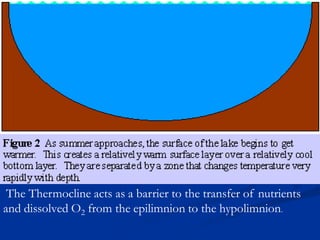
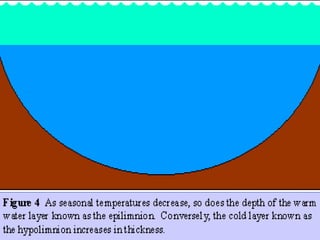
The Thermocline acts as a barrier to the transfer of nutrients
and dissolved O2 from the epilimnion to the hypolimnion.
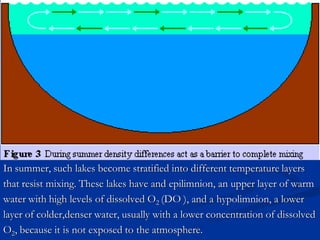
In summer, such lakes become stratified into different temperature layers
that resist mixing. These lakes have and epilimnion, an upper layer of warm
water with high levels of dissolved O2 (DO ), and a hypolimnion, a lower
layer of colder,denser water, usually with a lower concentration of dissolved
O2, because it is not exposed to the atmosphere.
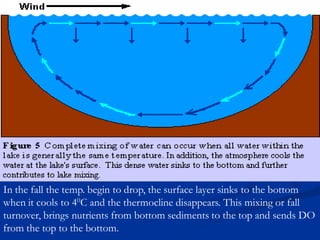
In the fall the temp. begin to drop, the surface layer sinks to the bottom
when it cools to 40C and the thermocline disappears. This mixing or fall
turnover, brings nutrients from bottom sediments to the top and sends DO
from the top to the bottom.
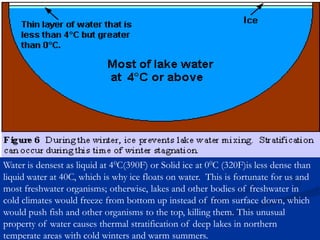
Water is densest as liquid at 40C(390F) or Solid ice at 00C (320F)is less dense than
liquid water at 40C, which is why ice floats on water. This is fortunate for us and
most freshwater organisms; otherwise, lakes and other bodies of freshwater in
cold climates would freeze from bottom up instead of from surface down, which
would push fish and other organisms to the top, killing them. This unusual
property of water causes thermal stratification of deep lakes in northern
temperate areas with cold winters and warm summers.
Flowing (Lotic) water:
    streams, rivers ;conditions at different points
    (headwater, middle reaches, lower reaches) with
    different adaptations of organisms
    depth + width high species diversity
   Slow flow low O2 low species diversity (e.g.,
    catfish, carp)
   slow flow high sediments low light        low
    photosynthesis low species diversity
   fast flow animals w/ hooks, suckers, flattened
    bodies
   Slow flow species similar to pond/lake inhabitants
Marine Biome
  Salinity: >3%
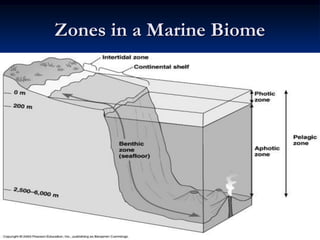
Distance from shoreline, depth, sunlight, temp determine life zones:
 Spray zone: constantly sprayed with salt water by wave action in the intertidal zone

 Intertidal zone: low/high tide area

        constantly changing conditions      constantly changing communities
   high light + highO2 + high nutrients   highly productive ecosystem

   Pelagic zone: open ocean
        producers limited to photic zone
        remains sink to ocean floor low nutrients (unless there is an upwelling)

   Benthic zone: ocean floor
        high remains + decomposers        low nutrients (stuck here)

   Abyssal zone: deep ocean
        Low temp (3oC) + high PH2O + no light very low species diversity
        hydrothermal vents w/ chemosynthetic bacteria (use H 2S)
Zones in a Marine Biome
Estuarine Biome

    Salinity: freshwater < estuarine < marine
    organisms highly tolerant to salt
   Organic material deposited by river/stream; depth:
    relatively shallow compared to marine biome
   High amount of sunlight
   highly productive ecosystem
       spawning & nursing grounds
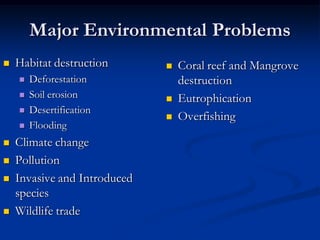
Major Environmental Problems
   Habitat destruction          Coral reef and Mangrove
       Deforestation             destruction
       Soil erosion             Eutrophication
       Desertification
                                 Overfishing
       Flooding
   Climate change
   Pollution
   Invasive and Introduced
    species
   Wildlife trade

Population Ecology

  • 1.
    ECOLOGY Core Concepts 1. Ecology is the scientific study of interactions among organisms and between organisms and their environment. 2. Biotic and abiotic factors influence life in the biosphere, such as the distribution of biological communities. 3. An organism’s niche refers to the conditions in which an organism lives and the way in which the organism uses those conditions. 4. Ecosystems constantly change in response to natural or human disturbances. 5. Energy flows through an ecosystem in one direction: from the sun or inorganic compounds to autotrophs (producers) and then to various heterotrophs (consumers).
  • 2.
    Keywords ecology pioneer species ecosystem autotroph biotic factor heterotroph abiotic factor species ecological niche population ecological succession community biome biosphere climax community
  • 3.
    ECOLOGY - study of the interactions between organisms and their environment (both living and non-living) - “oikos” (house) + “logos” (study) - scope of ecology: organism population community ecosystem biosphere ECOSYSTEM - biological community + physical environment (biotic and abiotic factors)
  • 4.
    ECOLOGICAL NICHE - the status/role of an organism in its environment - Competitive Exclusion Principle: a fundamental rule in ecology stating that no two organisms can occupy the exact niche for an indefinite amount of time because competition for resources would lead to the death of one. ECOLOGICAL SUCCESSION - the sequence of communities that develops in an area from the initial stages of colonization until a stable climax community is achieved - series of changes in the species composition of living communities, often following ecological disturbance of the community - pioneer species vs. climax community - primary vs. secondary succession
  • 6.
    BIOMES - an environmentthat has a characteristic climax community - organisms are of the same general type, being adapted to the particular conditions in which they occur
  • 7.
    BIOMES A. Land Biomes 1. Tundra 2. Taiga 3. Temperate deciduous forest 4. Grassland 5. Tropical rainforest 6. Desert B. Aquatic Biomes 1. Freshwater 2. Marine 3. Estuary
  • 8.
    Characteristics used todistinguish Types of Land Biomes/Ecosystems:  Climatic conditions  Temperature  precipitation/rainfall  location, altitude, topography, etc.  Climax community  Vegetation  Animals  Adaptations of Flora and Fauna
  • 9.
    Matter/Biogeochemical Cycles  Carbon cycle  Nitrogen cycle  Water cycle  Mineral cycles:  Phosphorus  Calcium  Sulfur  etc.
  • 10.
    Energy Flow  Trophic levels: producers, consumers  Feeding relationships: food chains, food webs  Ecological pyramids:  Energy pyramid  Pyramid of Biomass  Pyramid of Numbers
  • 11.
    Terrestrial vs. Aquaticecosystems  Evolution and Ecological Succession  Life originated in water and evolved there for almost 3Billion years before plants and animals began moving onto land.  Coverage  Aquatic Biomes occupy the largest part of the biosphere covering about 75% of the Earth’s surface  Aquatic biomes are less affected by climate change than land ecosystems. Why?  Nature of water
  • 12.
    Abiotic and BioticFactors of Aquatic Biomes  Water Chemistry  Salinity of Aquatic Biomes:  Salinity, pH, ions, nutrients, <1% - 3% pollutants Freshwater – about <1%  Temperature Estuary – variable (Why?)  Depth of Water Marine – about 3%  Light penetration  BOD  Turbidity  O2 content Biological Oxygen Demand  Wind action  Eutrophication  Water current/flow rate  Turn-over/Upwelling  Microbial action  Water pressure
  • 13.
    Zonations and ThermalStratification Affect Interactions in Aquatic Ecosystems/Biomes
  • 14.
    Standing (Lentic)water : ponds,lakes Isolated/land-locked ; low species diversity
  • 15.
    Life Zones/Zonations basedon: Light Penetration:  Photic Zone  Aphotic Zone Distance from shoreline, Depth, Sunlight, Temperature:  Littoral Zone: near shore; sunlight abundant; photosynthesis high ; high species diversity  Limnetic Zone: near-surface open water ; w/ plankton at the base of food chain  Profundal Zone: deep water ; aphotic; low temp; no photosynthesis; no O2 (only anaerobic organisms live here), low species diversity Thermal Stratification: Eutrophic vs. Oligotrophic vs. Mesotrophic Lakes Epilimnion Thermocline Hypolimnion
  • 16.
    Abiotic - BioticInteractions in Freshwater based on Life Zones
  • 17.
    Oligotrophic lakes aregenerally newly formed lakes with relatively small supply of nutrients (poorly nourished); they are often deep, with steep banks. They are usually crystal-clear blue or green water due their relatively low net primary productivity.
  • 18.
    Spring overturn In spring,when the atm. warms, the lake’s surface water warms to 40C, reaches maximum density, and sinks through and below the cooler, less dense water, bringing the bottom water to the surface. During this spring turnover, DO in the surface layer is moved downward, and nutrients released by decomposition on the lake bottom are moved upward toward the surface.
  • 19.
    The Thermocline actsas a barrier to the transfer of nutrients and dissolved O2 from the epilimnion to the hypolimnion.
  • 20.
    In summer, suchlakes become stratified into different temperature layers that resist mixing. These lakes have and epilimnion, an upper layer of warm water with high levels of dissolved O2 (DO ), and a hypolimnion, a lower layer of colder,denser water, usually with a lower concentration of dissolved O2, because it is not exposed to the atmosphere.
  • 22.
    In the fallthe temp. begin to drop, the surface layer sinks to the bottom when it cools to 40C and the thermocline disappears. This mixing or fall turnover, brings nutrients from bottom sediments to the top and sends DO from the top to the bottom.
  • 23.
    Water is densestas liquid at 40C(390F) or Solid ice at 00C (320F)is less dense than liquid water at 40C, which is why ice floats on water. This is fortunate for us and most freshwater organisms; otherwise, lakes and other bodies of freshwater in cold climates would freeze from bottom up instead of from surface down, which would push fish and other organisms to the top, killing them. This unusual property of water causes thermal stratification of deep lakes in northern temperate areas with cold winters and warm summers.
  • 24.
    Flowing (Lotic) water: streams, rivers ;conditions at different points (headwater, middle reaches, lower reaches) with different adaptations of organisms depth + width high species diversity  Slow flow low O2 low species diversity (e.g., catfish, carp)  slow flow high sediments low light low photosynthesis low species diversity  fast flow animals w/ hooks, suckers, flattened bodies  Slow flow species similar to pond/lake inhabitants
  • 25.
    Marine Biome  Salinity: >3% Distance from shoreline, depth, sunlight, temp determine life zones:  Spray zone: constantly sprayed with salt water by wave action in the intertidal zone  Intertidal zone: low/high tide area  constantly changing conditions constantly changing communities  high light + highO2 + high nutrients highly productive ecosystem  Pelagic zone: open ocean  producers limited to photic zone  remains sink to ocean floor low nutrients (unless there is an upwelling)  Benthic zone: ocean floor  high remains + decomposers low nutrients (stuck here)  Abyssal zone: deep ocean  Low temp (3oC) + high PH2O + no light very low species diversity  hydrothermal vents w/ chemosynthetic bacteria (use H 2S)
  • 26.
    Zones in aMarine Biome
  • 27.
    Estuarine Biome  Salinity: freshwater < estuarine < marine organisms highly tolerant to salt  Organic material deposited by river/stream; depth: relatively shallow compared to marine biome  High amount of sunlight  highly productive ecosystem  spawning & nursing grounds
  • 29.
    Major Environmental Problems  Habitat destruction  Coral reef and Mangrove  Deforestation destruction  Soil erosion  Eutrophication  Desertification  Overfishing  Flooding  Climate change  Pollution  Invasive and Introduced species  Wildlife trade