BY VICKI HORTON
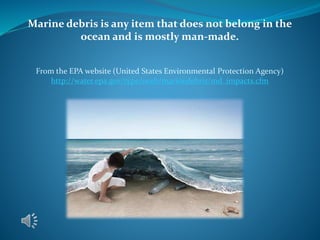
Marine debris is any item that does not belong in the
ocean and is mostly man-made.
From the EPA website (United States Environmental Protection Agency)
http://water.epa.gov/type/oceb/marinedebris/md_impacts.cfm
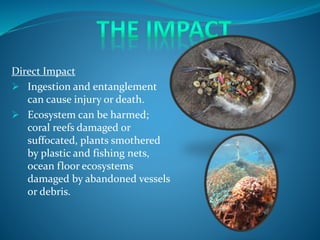
Direct Impact
 Ingestion and entanglement
can cause injury or death.
 Ecosystem can be harmed;
coral reefs damaged or
suffocated, plants smothered
by plastic and fishing nets,
ocean floor ecosystems
damaged by abandoned vessels
or debris.
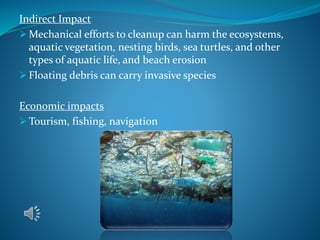
Indirect Impact
 Mechanical efforts to cleanup can harm the ecosystems,
aquatic vegetation, nesting birds, sea turtles, and other
types of aquatic life, and beach erosion
 Floating debris can carry invasive species
Economic impacts
 Tourism, fishing, navigation
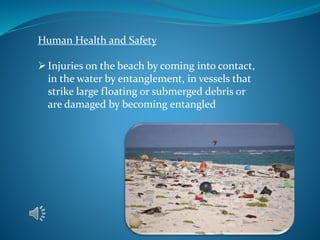
Human Health and Safety
Injuries on the beach by coming into contact,
in the water by entanglement, in vessels that
strike large floating or submerged debris or
are damaged by becoming entangled
Individual-direct dumping at the beach or in the water,
improper inland dumping which finds it’s way to the ocean
through storm drains, rivers, waterways.
Industrial-improperly managed construction and demolition
sites, by-products such as plastic pellets can be lost during
transport or disposal
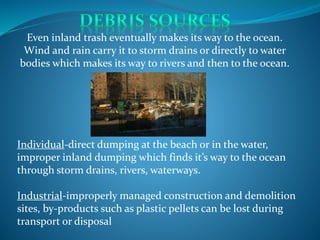
Even inland trash eventually makes its way to the ocean.
Wind and rain carry it to storm drains or directly to water
bodies which makes its way to rivers and then to the ocean.
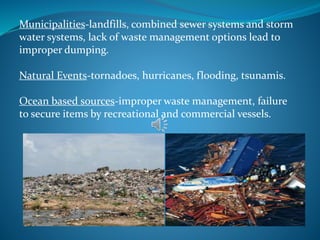
Municipalities-landfills, combined sewer systems and storm
water systems, lack of waste management options lead to
improper dumping.
Natural Events-tornadoes, hurricanes, flooding, tsunamis.
Ocean based sources-improper waste management, failure
to secure items by recreational and commercial vessels.
For all locations-Dispose of trash properly
 At home-reduce, reuse, recycle (see links at the end), secure receptacles, spread
the word.
 At school-reuse old school supplies, pack a waste-free lunch, encourage your
school to become involved.
 At the office-reduce paper consumption, use reusable containers and cups,
purchase recycled and reusable office materials.
 On the go-purchase recycled, reusable, and smart packaging items, use
reusable shopping bags, limit use of disposable items (Packaging and
containers made up the largest portion of trash generated in 2007, nearly 78
million tons!).
 At sea-Properly stow and secure all equipment and trash, Support
environmentally friendly marinas and ports, Participate in fishing gear
incentive programs.
 Events-adopt your watershed, International Coastal Cleanup, Project AWARE
foundation events, United Nations Regional Seas Program .
http://water.epa.gov/type/oceb/marinedebris/what_index.cfm
 BECOME AWARE OF HOW MUCH WASTE YOU HAVE. TAKE STEPS TO
REDUCE/REUSE/RECYCLE
 Buy and use less. Buy items that are made from recycled materials. Buy in bulk.
Buy only what you need. Donate what you don’t need.
 Select products with less or smart packaging to reduce waste.
 Buy reusable products such as containers, bamboo utensils, grocery totes,
diapers, cloth gift wraps, cloth napkins.
 Have or buy from garage sales. Use Craig’s List. Use Free Cycle. Borrow movies,
CD, and books from libraries. Shop from Thrift Stores. Borrow seldom used
items such as tools, party goods, etc.
 Frequent your local farmers markets and businesses. Most produce is package
free so bring your own reusable totes. Cook from scratch.
 Make your own household cleaners to save on toxic chemicals, packaging, and
energy to transport. Use half the amount of commercial detergents and wash full
loads only.
 Learn about herbal or essential oil home remedies for minor health problems to
save on Over-the-Counter medicines.
 Repair broken items or trade with someone that can. Buy durable equipment.
Recycle e-waste properly-search for local places at Earth911.
 Remove yourself from bulk mailing lists such as catalog companies. Use their
online services. Ask the credit bureaus to remove you from the pre-approved
credit offers.
 Immediately dry disposable razors and dip in alcohol to prevent rust. One
razor can last 6 months to a year. If using a reusable safety razor, dry the
disposable razor blades the same way to increase its life.
 Reduce plastic use in the kitchen by switching to glass jars or stainless steel.
Use stainless steel lunch containers or reusable lunch bags for on the go. Use
cloth napkins and towels. Limit the use of paper products. Reuse any plastic as
many times as possible before tossing. Reuse food jars (pickles, jelly, etc .)
 Use online banking. Read the news online. Print only what you really need.
 Get creative with trash. Before you throw away, decide if it can be repurposed
by you or anyone else. Use the internet for ideas.
 Sign up for newsletters, Facebook pages, YouTube channels, or other online
resources that promote conservation, preservation, and going green. It’s a long
process to educate ourselves and change our decade-long habits, so take it one
step at a time.
 Share what you’ve learned. Don’t keep your hard work and efforts to yourself.
We all must work together.
Story of Stuff-educational videos about how we make, use, and throw
away stuff. Has educational and how to get involved resources.
Website http://storyofstuff.org/
Find on Facebook https://www.facebook.com/storyofstuff
Mission Blue-Oceanographer and eco-activist Dr. Sylvia Earl’s exposes
the dire condition of our oceans and what needs to be done.
The Movie on Netflix http://www.netflix.com/WiMovie/70308278
Mission Blue website-get involved http://mission-blue.org/
Find on Facebook https://www.facebook.com/missionblue
Free Cycle-a free service to keep stuff out of landfills. Offer or receive
free items in your community.
Website-https://www.freecycle.org/
Find on Facebook https://www.facebook.com/freecycle
Earth 911-Recycling help. Has guides and local resources to recycle just
about anything.
Website -http://www.earth911.com/
Find on Facebook https://www.facebook.com/Earth911
Quick Search for local recycling places http://search.earth911.com/
Natural Resources Defense Council-Environmental Action
Group combining grassroots power and online activists.
Website- http://www.nrdc.org/
Find on Facebook https://www.facebook.com/nrdc.org
The three R’s-Reduce, Reuse, Recycle links
http://www.nrdc.org/thisgreenlife/0802.asp
Household cleansers information and links-
http://www.nrdc.org/thisgreenlife/0405.asp
Find Local Farmers Markets-buy local to reduce packaging
(cleaner air and water), reduce transportation energy (reduces our
carbon footprint), to keep your money in the community, and find
fresher produce and food.
Website http://www.localharvest.org/farmers-markets/
Zero Waste: The Choice for a Sustainable Community- To
become involved in the bigger problem.
“For every can of garbage at the curb, there are 87 cans worth of
materials that come from the extraction industries—such as
timber, agricultural, mining and petroleum—that manufacture
natural resources into finished products. Source: World Resources
Institute.”
Website http://www.ecocycle.org/zerowaste/
Find on Facebook
https://www.facebook.com/ecocycle.zerowaste/timeline

Marine Debris

  • 1.
  • 2.
    Marine debris isany item that does not belong in the ocean and is mostly man-made. From the EPA website (United States Environmental Protection Agency) http://water.epa.gov/type/oceb/marinedebris/md_impacts.cfm
  • 3.
    Direct Impact  Ingestionand entanglement can cause injury or death.  Ecosystem can be harmed; coral reefs damaged or suffocated, plants smothered by plastic and fishing nets, ocean floor ecosystems damaged by abandoned vessels or debris.
  • 4.
    Indirect Impact  Mechanicalefforts to cleanup can harm the ecosystems, aquatic vegetation, nesting birds, sea turtles, and other types of aquatic life, and beach erosion  Floating debris can carry invasive species Economic impacts  Tourism, fishing, navigation
  • 5.
    Human Health andSafety Injuries on the beach by coming into contact, in the water by entanglement, in vessels that strike large floating or submerged debris or are damaged by becoming entangled
  • 6.
    Individual-direct dumping atthe beach or in the water, improper inland dumping which finds it’s way to the ocean through storm drains, rivers, waterways. Industrial-improperly managed construction and demolition sites, by-products such as plastic pellets can be lost during transport or disposal Even inland trash eventually makes its way to the ocean. Wind and rain carry it to storm drains or directly to water bodies which makes its way to rivers and then to the ocean.
  • 7.
    Municipalities-landfills, combined sewersystems and storm water systems, lack of waste management options lead to improper dumping. Natural Events-tornadoes, hurricanes, flooding, tsunamis. Ocean based sources-improper waste management, failure to secure items by recreational and commercial vessels.
  • 8.
    For all locations-Disposeof trash properly  At home-reduce, reuse, recycle (see links at the end), secure receptacles, spread the word.  At school-reuse old school supplies, pack a waste-free lunch, encourage your school to become involved.  At the office-reduce paper consumption, use reusable containers and cups, purchase recycled and reusable office materials.  On the go-purchase recycled, reusable, and smart packaging items, use reusable shopping bags, limit use of disposable items (Packaging and containers made up the largest portion of trash generated in 2007, nearly 78 million tons!).  At sea-Properly stow and secure all equipment and trash, Support environmentally friendly marinas and ports, Participate in fishing gear incentive programs.  Events-adopt your watershed, International Coastal Cleanup, Project AWARE foundation events, United Nations Regional Seas Program . http://water.epa.gov/type/oceb/marinedebris/what_index.cfm
  • 9.
     BECOME AWAREOF HOW MUCH WASTE YOU HAVE. TAKE STEPS TO REDUCE/REUSE/RECYCLE  Buy and use less. Buy items that are made from recycled materials. Buy in bulk. Buy only what you need. Donate what you don’t need.  Select products with less or smart packaging to reduce waste.  Buy reusable products such as containers, bamboo utensils, grocery totes, diapers, cloth gift wraps, cloth napkins.  Have or buy from garage sales. Use Craig’s List. Use Free Cycle. Borrow movies, CD, and books from libraries. Shop from Thrift Stores. Borrow seldom used items such as tools, party goods, etc.  Frequent your local farmers markets and businesses. Most produce is package free so bring your own reusable totes. Cook from scratch.  Make your own household cleaners to save on toxic chemicals, packaging, and energy to transport. Use half the amount of commercial detergents and wash full loads only.  Learn about herbal or essential oil home remedies for minor health problems to save on Over-the-Counter medicines.
  • 10.
     Repair brokenitems or trade with someone that can. Buy durable equipment. Recycle e-waste properly-search for local places at Earth911.  Remove yourself from bulk mailing lists such as catalog companies. Use their online services. Ask the credit bureaus to remove you from the pre-approved credit offers.  Immediately dry disposable razors and dip in alcohol to prevent rust. One razor can last 6 months to a year. If using a reusable safety razor, dry the disposable razor blades the same way to increase its life.  Reduce plastic use in the kitchen by switching to glass jars or stainless steel. Use stainless steel lunch containers or reusable lunch bags for on the go. Use cloth napkins and towels. Limit the use of paper products. Reuse any plastic as many times as possible before tossing. Reuse food jars (pickles, jelly, etc .)  Use online banking. Read the news online. Print only what you really need.  Get creative with trash. Before you throw away, decide if it can be repurposed by you or anyone else. Use the internet for ideas.  Sign up for newsletters, Facebook pages, YouTube channels, or other online resources that promote conservation, preservation, and going green. It’s a long process to educate ourselves and change our decade-long habits, so take it one step at a time.  Share what you’ve learned. Don’t keep your hard work and efforts to yourself. We all must work together.
  • 11.
    Story of Stuff-educationalvideos about how we make, use, and throw away stuff. Has educational and how to get involved resources. Website http://storyofstuff.org/ Find on Facebook https://www.facebook.com/storyofstuff Mission Blue-Oceanographer and eco-activist Dr. Sylvia Earl’s exposes the dire condition of our oceans and what needs to be done. The Movie on Netflix http://www.netflix.com/WiMovie/70308278 Mission Blue website-get involved http://mission-blue.org/ Find on Facebook https://www.facebook.com/missionblue Free Cycle-a free service to keep stuff out of landfills. Offer or receive free items in your community. Website-https://www.freecycle.org/ Find on Facebook https://www.facebook.com/freecycle
  • 12.
    Earth 911-Recycling help.Has guides and local resources to recycle just about anything. Website -http://www.earth911.com/ Find on Facebook https://www.facebook.com/Earth911 Quick Search for local recycling places http://search.earth911.com/ Natural Resources Defense Council-Environmental Action Group combining grassroots power and online activists. Website- http://www.nrdc.org/ Find on Facebook https://www.facebook.com/nrdc.org The three R’s-Reduce, Reuse, Recycle links http://www.nrdc.org/thisgreenlife/0802.asp Household cleansers information and links- http://www.nrdc.org/thisgreenlife/0405.asp
  • 13.
    Find Local FarmersMarkets-buy local to reduce packaging (cleaner air and water), reduce transportation energy (reduces our carbon footprint), to keep your money in the community, and find fresher produce and food. Website http://www.localharvest.org/farmers-markets/ Zero Waste: The Choice for a Sustainable Community- To become involved in the bigger problem. “For every can of garbage at the curb, there are 87 cans worth of materials that come from the extraction industries—such as timber, agricultural, mining and petroleum—that manufacture natural resources into finished products. Source: World Resources Institute.” Website http://www.ecocycle.org/zerowaste/ Find on Facebook https://www.facebook.com/ecocycle.zerowaste/timeline