Inland Waters
    Rivers
    Lakes
• short;
• most of them flow in eastward direction;
• the water level is always high (due to humid
  climate and abundant rainfall);
• seldom freeze in winter;
• are not navigable for oceans ships;
• form deep estuaries;
• most of the large ports are situated in the
  estuaries.

                                                 back next
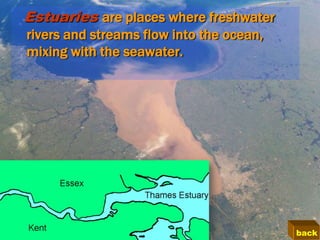
Estuaries are places where freshwater
rivers and streams flow into the ocean,
mixing with the seawater.


                                          back
•   The   Severn
•   The   Thames
•   The   Tyne
•   The   Trent
•   The   Mersey
•   The   Clyde


                   back
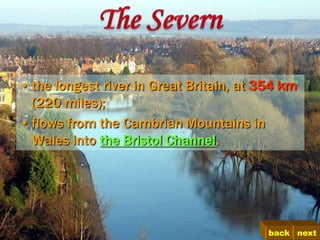
• the longest river in Great Britain, at 354 km
  (220 miles);
• flows from the Cambrian Mountains in
  Wales into the Bristol Channel.


                                          back next
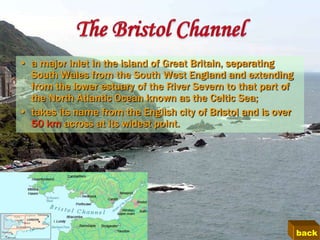
• a major inlet in the island of Great Britain, separating
  South Wales from the South West England and extending
  from the lower estuary of the River Severn to that part of
  the North Atlantic Ocean known as the Celtic Sea;
• takes its name from the English city of Bristol and is over
  50 km across at its widest point.


                                                                back
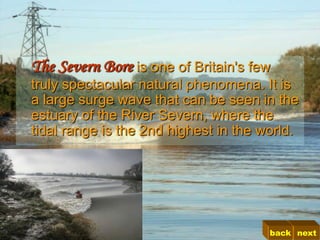
The Severn Bore is one of Britain's few
truly spectacular natural phenomena. It is
a large surge wave that can be seen in the
estuary of the River Severn, where the
tidal range is the 2nd highest in the world.


                                       back next
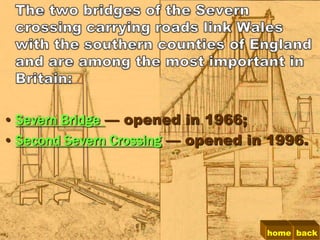
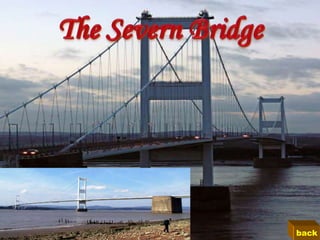
• Severn Bridge — opened in 1966;
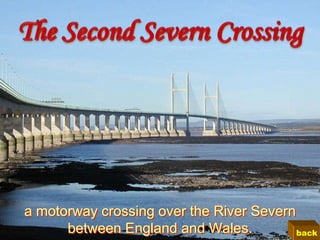
• Second Severn Crossing — opened in 1996.


                                    home back
back
a motorway crossing over the River Severn
      between England and Wales.          back
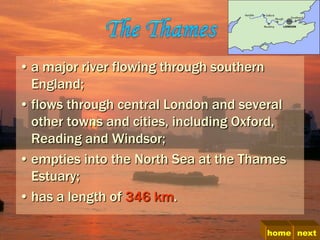
• a major river flowing through southern
  England;
• flows through central London and several
  other towns and cities, including Oxford,
  Reading and Windsor;
• empties into the North Sea at the Thames
  Estuary;
• has a length of 346 km.

                                       home next
Newbridge, Oxfordshire
TheMillennium London
View houses above
Dolls from the Tower with
GravesendwithLondon Eye St
ThamesEyeThames Estuary
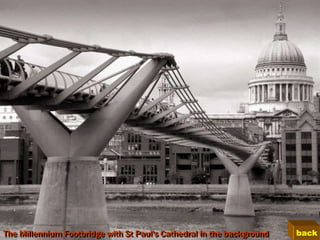
London from FootbridgeBridge Paul's Cathedral in the background
The Towerbarrier                                                  back
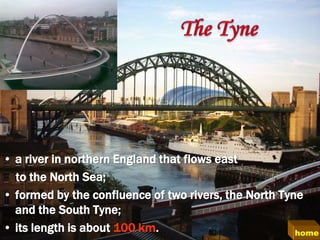
• a river in northern England that flows east
  to the North Sea;
• formed by the confluence of two rivers, the North Tyne
  and the South Tyne;
• its length is about 100 km.                          home
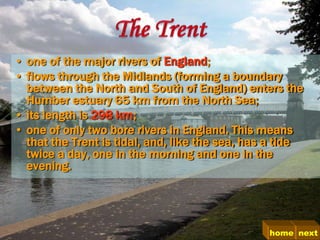
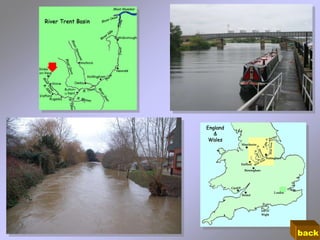
• one of the major rivers of England;
• flows through the Midlands (forming a boundary
  between the North and South of England) enters the
  Humber estuary 65 km from the North Sea;
• its length is 298 km;
• one of only two bore rivers in England. This means
  that the Trent is tidal, and, like the sea, has a tide
  twice a day, one in the morning and one in the
  evening.


                                                 home next
back
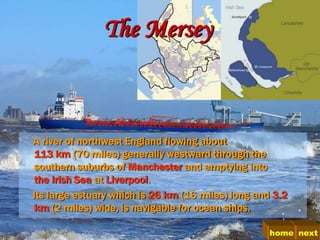
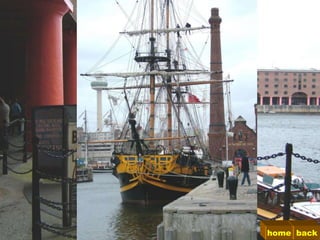
The Mersey


A river of northwest England flowing about
113 km (70 miles) generally westward through the
southern suburbs of Manchester and emptying into
the Irish Sea at Liverpool.
Its large estuary which is 26 km (16 miles) long and 3.2
km (2 miles) wide, is navigable for ocean ships.

                                                    home next
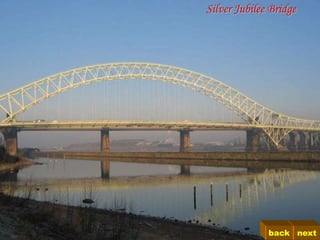
Silver Jubilee Bridge


Manchester Ship Canal
        Old Quay Bridge
             Dock Area
              Liverpool
              back next
Lighthouse on the River Mersey, Liverpool
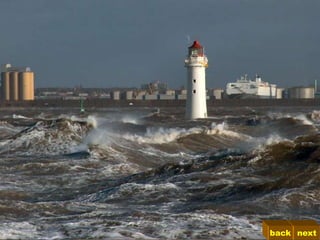
The Lighthouse at New Brighton, also known as the Perch Rock
Lighthouse, is situated where the Mersey Estuary opens out into
Liverpool Bay.
Before the lighthouse was built there was a wooden ’perch’ erected
upon the rock, formerly known as the Black Rock, by the city of
Liverpool in 1683. The rock was a serious hazard to navigation. The
perch was often washed away by gales. In 1821 one of the Liverpool
Pilot Boats crashed into the perch and carried it away.
The construction of the new stone lighthouse started in 1827 and it
took 3 years to complete.
The Lighthouse last shone its light in 1973 as it was no longer needed
on account of the radar system. Now it is being used as a tourist
attraction.


                                                              back next
back next
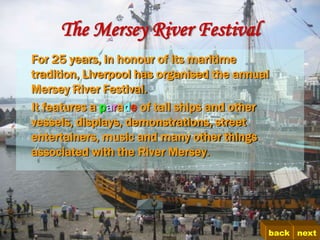
The Mersey River Festival
For 25 years, in honour of its maritime
tradition, Liverpool has organised the annual
Mersey River Festival.
It features a parade of tall ships and other
vessels, displays, demonstrations, street
entertainers, music and many other things
associated with the River Mersey.


                                            back next
home back
• a major river in Scotland;
• 176 km (109 miles) long;
• the eighth longest river in the United Kingdom
• the third longest in Scotland;
• flows west across the Southern Uplands;
• flows through the major city of Glasgow,
• merges into the Firth of Clyde (a wide bay);
• was narrow and shallow until the 1700s when engineers
  widened and deepened the river to make it navigable;
• ships from the Atlantic Ocean can sail up the Clyde to
  Glasgow.


                                                   home next
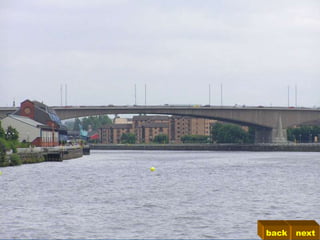
The Clyde flowing through river next
       Millennium Bridge Glasgow
               Dock by the
                        back Clyde
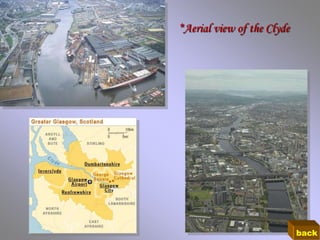
*Aerial view of the Clyde


                            back
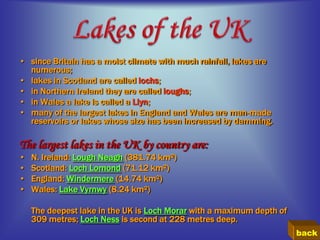
• since Britain has a moist climate with much rainfall, lakes are
  numerous;
• lakes in Scotland are called lochs;
• in Northern Ireland they are called loughs;
• in Wales a lake is called a Llyn;
• many of the largest lakes in England and Wales are man-made
  reservoirs or lakes whose size has been increased by damming.

The largest lakes in the UK by country are:
•   N. Ireland: Lough Neagh (381.74 km²)
•   Scotland: Loch Lomond (71.12 km²)
•   England: Windermere (14.74 km²)
•   Wales: Lake Vyrnwy (8.24 km²)

    The deepest lake in the UK is Loch Morar with a maximum depth of
    309 metres; Loch Ness is second at 228 metres deep.
                                                                       back
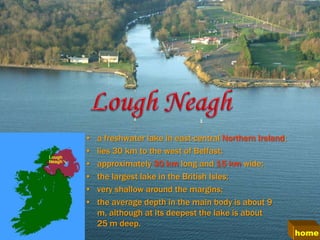
•   a freshwater lake in east-central Northern Ireland;
•   lies 30 km to the west of Belfast;
•   approximately 30 km long and 15 km wide;
•   the largest lake in the British Isles;
•   very shallow around the margins;
•   the average depth in the main body is about 9
    m, although at its deepest the lake is about
    25 m deep.
                                                          home
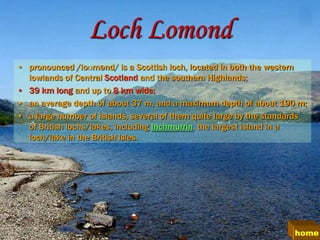
Loch Lomond
• pronounced /loʊmənd/ is a Scottish loch, located in both the western
  lowlands of Central Scotland and the southern Highlands;
• 39 km long and up to 8 km wide;
• an average depth of about 37 m, and a maximum depth of about 190 m;
• a large number of islands, several of them quite large by the standards
  of British lochs/lakes, including Inchmurrin, the largest island in a
  loch/lake in the British Isles.


                                                                     home
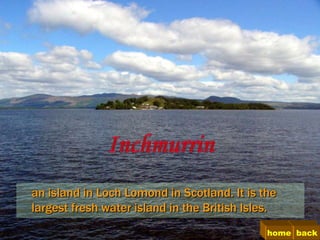
an island in Loch Lomond in Scotland. It is the
largest fresh water island in the British Isles.
                                              home back
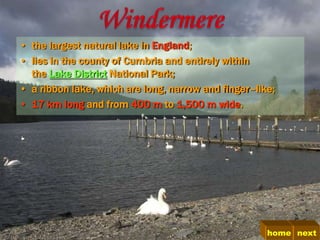
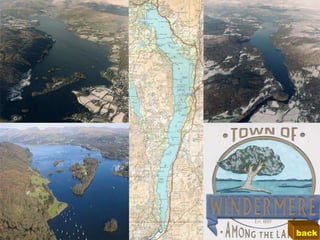
• the largest natural lake in England;
• lies in the county of Cumbria and entirely within
  the Lake District National Park;
• a ribbon lake, which are long, narrow and finger–like;
• 17 km long and from 400 m to 1,500 m wide.


                                                      home next
back
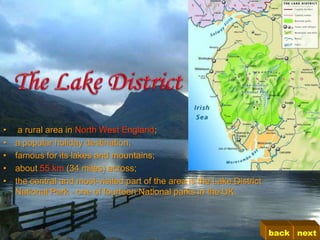
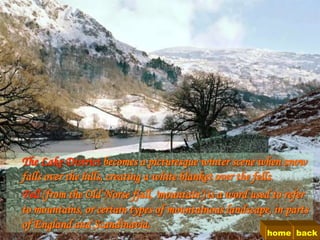
•    a rural area in North West England;
•   a popular holiday destination;
•   famous for its lakes and mountains;
•   about 55 km (34 miles) across;
•   the central and most-visited part of the area is the Lake District
    National Park - one of fourteen National parks in the UK.


                                                                         back next
back   next
home back
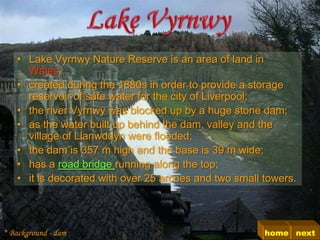
• Lake Vyrnwy Nature Reserve is an area of land in
     Wales,
   • created during the 1880s in order to provide a storage
     reservoir of safe water for the city of Liverpool;
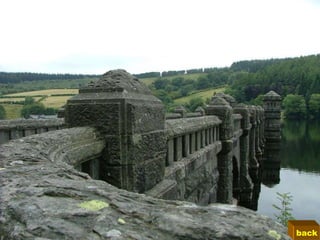
   • the river Vyrnwy was blocked up by a huge stone dam;
   • as the water built up behind the dam, valley and the
     village of Llanwddyn were flooded;
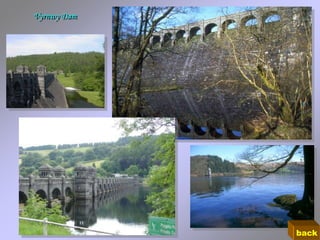
   • the dam is 357 m high and the base is 39 m wide;
   • has a road bridge running along the top;
   • it is decorated with over 25 arches and two small towers.


* Background - dam                                     home next
back
Vyrnwy Dam


             back
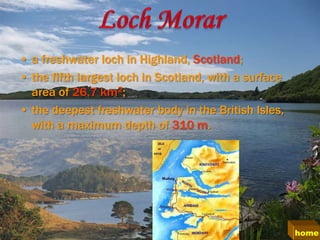
• a freshwater loch in Highland, Scotland;
• the fifth largest loch in Scotland, with a surface
  area of 26.7 km2;
• the deepest freshwater body in the British Isles,
  with a maximum depth of 310 m.


                                                       home
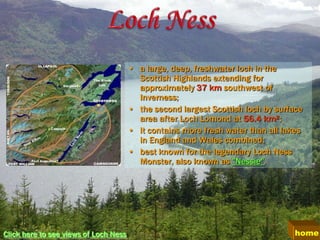
• a large, deep, freshwater loch in the
                                         Scottish Highlands extending for
                                         approximately 37 km southwest of
                                         Inverness;
                                       • the second largest Scottish loch by surface
                                         area after Loch Lomond at 56.4 km²;
                                       • it contains more fresh water than all lakes
                                         in England and Wales combined;
                                       • best known for the legendary Loch Ness
                                         Monster, also known as "Nessie".


Click here to see views of Loch Ness                                              home
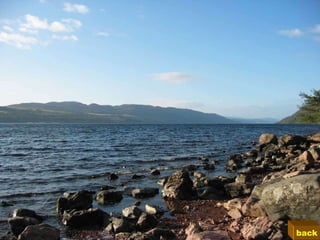
Loch Ness   Urquhart Castle
                     back
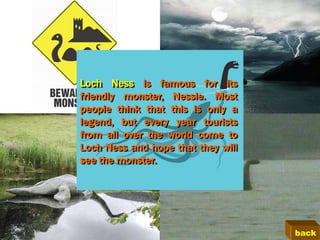
Loch Ness is famous for its
friendly monster, Nessie. Most
people think that this is only a
legend, but every year tourists
from all over the world come to
Loch Ness and hope that they will
see the monster.


                                    back

Inland waters

  • 1.
    Inland Waters Rivers Lakes
  • 2.
    • short; • mostof them flow in eastward direction; • the water level is always high (due to humid climate and abundant rainfall); • seldom freeze in winter; • are not navigable for oceans ships; • form deep estuaries; • most of the large ports are situated in the estuaries. back next
  • 3.
    Estuaries are placeswhere freshwater rivers and streams flow into the ocean, mixing with the seawater. back
  • 4.
    The Severn • The Thames • The Tyne • The Trent • The Mersey • The Clyde back
  • 5.
    • the longestriver in Great Britain, at 354 km (220 miles); • flows from the Cambrian Mountains in Wales into the Bristol Channel. back next
  • 6.
    • a majorinlet in the island of Great Britain, separating South Wales from the South West England and extending from the lower estuary of the River Severn to that part of the North Atlantic Ocean known as the Celtic Sea; • takes its name from the English city of Bristol and is over 50 km across at its widest point. back
  • 7.
    The Severn Boreis one of Britain's few truly spectacular natural phenomena. It is a large surge wave that can be seen in the estuary of the River Severn, where the tidal range is the 2nd highest in the world. back next
  • 8.
    • Severn Bridge— opened in 1966; • Second Severn Crossing — opened in 1996. home back
  • 9.
  • 10.
    a motorway crossingover the River Severn between England and Wales. back
  • 11.
    • a majorriver flowing through southern England; • flows through central London and several other towns and cities, including Oxford, Reading and Windsor; • empties into the North Sea at the Thames Estuary; • has a length of 346 km. home next
  • 12.
    Newbridge, Oxfordshire TheMillennium London Viewhouses above Dolls from the Tower with GravesendwithLondon Eye St ThamesEyeThames Estuary London from FootbridgeBridge Paul's Cathedral in the background The Towerbarrier back
  • 13.
    • a riverin northern England that flows east to the North Sea; • formed by the confluence of two rivers, the North Tyne and the South Tyne; • its length is about 100 km. home
  • 14.
    • one ofthe major rivers of England; • flows through the Midlands (forming a boundary between the North and South of England) enters the Humber estuary 65 km from the North Sea; • its length is 298 km; • one of only two bore rivers in England. This means that the Trent is tidal, and, like the sea, has a tide twice a day, one in the morning and one in the evening. home next
  • 15.
  • 16.
    The Mersey A riverof northwest England flowing about 113 km (70 miles) generally westward through the southern suburbs of Manchester and emptying into the Irish Sea at Liverpool. Its large estuary which is 26 km (16 miles) long and 3.2 km (2 miles) wide, is navigable for ocean ships. home next
  • 17.
    Silver Jubilee Bridge ManchesterShip Canal Old Quay Bridge Dock Area Liverpool back next
  • 18.
    Lighthouse on theRiver Mersey, Liverpool The Lighthouse at New Brighton, also known as the Perch Rock Lighthouse, is situated where the Mersey Estuary opens out into Liverpool Bay. Before the lighthouse was built there was a wooden ’perch’ erected upon the rock, formerly known as the Black Rock, by the city of Liverpool in 1683. The rock was a serious hazard to navigation. The perch was often washed away by gales. In 1821 one of the Liverpool Pilot Boats crashed into the perch and carried it away. The construction of the new stone lighthouse started in 1827 and it took 3 years to complete. The Lighthouse last shone its light in 1973 as it was no longer needed on account of the radar system. Now it is being used as a tourist attraction. back next
  • 19.
  • 20.
    The Mersey RiverFestival For 25 years, in honour of its maritime tradition, Liverpool has organised the annual Mersey River Festival. It features a parade of tall ships and other vessels, displays, demonstrations, street entertainers, music and many other things associated with the River Mersey. back next
  • 21.
  • 22.
    • a majorriver in Scotland; • 176 km (109 miles) long; • the eighth longest river in the United Kingdom • the third longest in Scotland; • flows west across the Southern Uplands; • flows through the major city of Glasgow, • merges into the Firth of Clyde (a wide bay); • was narrow and shallow until the 1700s when engineers widened and deepened the river to make it navigable; • ships from the Atlantic Ocean can sail up the Clyde to Glasgow. home next
  • 23.
    The Clyde flowingthrough river next Millennium Bridge Glasgow Dock by the back Clyde
  • 24.
    *Aerial view ofthe Clyde back
  • 25.
    • since Britainhas a moist climate with much rainfall, lakes are numerous; • lakes in Scotland are called lochs; • in Northern Ireland they are called loughs; • in Wales a lake is called a Llyn; • many of the largest lakes in England and Wales are man-made reservoirs or lakes whose size has been increased by damming. The largest lakes in the UK by country are: • N. Ireland: Lough Neagh (381.74 km²) • Scotland: Loch Lomond (71.12 km²) • England: Windermere (14.74 km²) • Wales: Lake Vyrnwy (8.24 km²) The deepest lake in the UK is Loch Morar with a maximum depth of 309 metres; Loch Ness is second at 228 metres deep. back
  • 26.
    a freshwater lake in east-central Northern Ireland; • lies 30 km to the west of Belfast; • approximately 30 km long and 15 km wide; • the largest lake in the British Isles; • very shallow around the margins; • the average depth in the main body is about 9 m, although at its deepest the lake is about 25 m deep. home
  • 27.
    Loch Lomond • pronounced/loʊmənd/ is a Scottish loch, located in both the western lowlands of Central Scotland and the southern Highlands; • 39 km long and up to 8 km wide; • an average depth of about 37 m, and a maximum depth of about 190 m; • a large number of islands, several of them quite large by the standards of British lochs/lakes, including Inchmurrin, the largest island in a loch/lake in the British Isles. home
  • 28.
    an island inLoch Lomond in Scotland. It is the largest fresh water island in the British Isles. home back
  • 29.
    • the largestnatural lake in England; • lies in the county of Cumbria and entirely within the Lake District National Park; • a ribbon lake, which are long, narrow and finger–like; • 17 km long and from 400 m to 1,500 m wide. home next
  • 30.
  • 31.
    a rural area in North West England; • a popular holiday destination; • famous for its lakes and mountains; • about 55 km (34 miles) across; • the central and most-visited part of the area is the Lake District National Park - one of fourteen National parks in the UK. back next
  • 32.
    back next
  • 33.
  • 34.
    • Lake VyrnwyNature Reserve is an area of land in Wales, • created during the 1880s in order to provide a storage reservoir of safe water for the city of Liverpool; • the river Vyrnwy was blocked up by a huge stone dam; • as the water built up behind the dam, valley and the village of Llanwddyn were flooded; • the dam is 357 m high and the base is 39 m wide; • has a road bridge running along the top; • it is decorated with over 25 arches and two small towers. * Background - dam home next
  • 35.
  • 36.
  • 37.
    • a freshwaterloch in Highland, Scotland; • the fifth largest loch in Scotland, with a surface area of 26.7 km2; • the deepest freshwater body in the British Isles, with a maximum depth of 310 m. home
  • 38.
    • a large,deep, freshwater loch in the Scottish Highlands extending for approximately 37 km southwest of Inverness; • the second largest Scottish loch by surface area after Loch Lomond at 56.4 km²; • it contains more fresh water than all lakes in England and Wales combined; • best known for the legendary Loch Ness Monster, also known as "Nessie". Click here to see views of Loch Ness home
  • 39.
    Loch Ness Urquhart Castle back
  • 40.
    Loch Ness isfamous for its friendly monster, Nessie. Most people think that this is only a legend, but every year tourists from all over the world come to Loch Ness and hope that they will see the monster. back