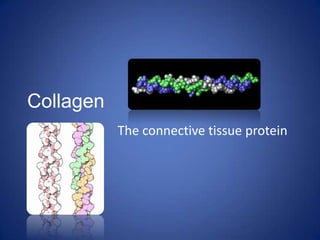
Collagen
The connective tissue protein
Why study tissue proteins?
 To understand normal body functions .
 In development
 In inflammatory states
 Aging process.
 To identify the cause of various genetic and metabolic disorders related
to tissue proteins
 In the spread of cancer cells.
 Several diseases (eg:Osteogenesis imperfecta and a number of
types of the Ehlers-Danlos syndrome) are due to genetic
disturbances of the synthesis of collagen.
 Components of proteoglycans are affected in the group of genetic
disorders known as the mucopolysaccharidoses.
 To use and apply them in the medical, industrial, commercial fields.
 In food products, cosmetic surgery.
 The gelatin used in food and industry is derived from the partial
hydrolysis of collagen.
The Extracellular Matrix
 The space outside the cells of a tissue is filled with a composite material
called extracellular matrix(ECM).
 This ECM is also known as the connective tissue. It is composed of -
a) Gel with interstitial fluid.
b) 3 major classes of biomolecules:
 Structural proteins: collagen, elastin and Keratin(epidermal tissues)
 Specialized proteins: e.g. fibrillin, fibronectin, and laminin.
 Proteoglycans(Mucoproteins) : Conjugated proteins consisting of
 Protein + Carbohydrate(5%-95%)
 Carbohydrate part is in the form of Glycosaminoglycans [GAGs].
 Thus, the extracellular matrix (ECM) is a complex structural entity
surrounding and supporting cells that are found within mammalian tissues.
The Extra cellular matrix
Collagen
 Most abundant insoluble fibrous protein in
the connective tissue of mammals.
 Makes up about 25% to 35% of the
whole-body protein content.
 Scleroprotein secreted from the cells
called fibroblasts.
 In greek ‘kolla’ means ‘glue’.Collagen is
also called as glue-producer.
 Distribution of collagen varies in different
tissues.
 Also found in mucous membranes,
nerves,Blood vessels, and organs.
90%
85%
70%
4%
bones tendons
skin liver
Collagen fibers in
muscle tendons
Functions Of Collagen
 It imparts strength, support, shape
and elasicity to the tissues.
 It accounts for 6% of the weight
of strong, tendinous muscles
 It provides flexibility, support, and
movement to cartilage.
 It encases and protects delicate
organs like kidneys and spleen.
 It fills the sclera of the eye in
crystalline form.
 Teeth(dentin) are made by adding
mineral crystals to collagen.
 Collagen contributes to proper
alignment of cells for cell
proliferation and differentiation.
 When exposed in damaged blood
vessels, it initiates thrombus
formation
Types Of Collagen
 In humans, there are at least 19
distinct types of collagen made up
of 30 distinct polypeptide chains
(each encoded by a separate
gene).
 They are subdivided into a number
of classes based primarily on the
structures they form
 However, 90% of the collagen in
the body are of type I, II, III, and IV.
 These types determine the physical
properties of specific tissues and
perform their specialized function.
Structure Of Collagen
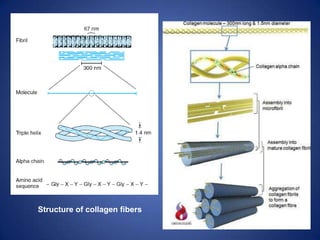
The basic structural unit of a
collagen molecule is a triple helix.
Triple helical structure may occur
throughout the molecule or only in a
part of it.
Structure Of type I mature
Collagen:
 Triple helical structure occurs
throughout the molecule.
 This triple helix is composed
of 3 polypeptide chains twisted
around each other.
 Each polypeptide/alpha chain
is in turn a left handed helix with
3 amino acids per turn totally
containing approximately 1000
amino acids per chain.
Alpha chain Triple Helix
Amino-
acids
Each alpha chain has an unusual
abundance of 3 amino-acids
glycine, proline and hydroxyproline.
 Glycine occurs at every third
position in the amino acid sequence
which can be represented as (Gly-X-
Y)n.
 X and Y are other amino acids of
which proline and hydroxyproline
occupy 100 positions each.
 Glycine occupies the crowded
center of the triple helix as it has a
small side chain[ H atom] where as
Hydroxyproline and proline point
outwards imparting rigidity to the triple
helix.
 The alpha chains are wound
around each other in a right handed
super helix to form a rod like molecule
1.4nm wide and 300nm long
[Gly-X-Y]n
The triple helices are stabilized by
Hydrogen bonds, covalent cross-
links, electrostatic and hydrophobic
interactions and van der waals forces.
The covalent cross links within and
between the helices are formed by
copper dependent enzyme lysyl
oxidase between the lysine and
hydroxylysine residues.
These triple helical molecules pack together
side by side to form elongated fibrils.
Fibrils are displaced longitudinally from each
other by 67 nm [one quatter of its length] to form
a quarter staggered arrangement.
Fibrils bundle up to form fibers making up
tissues.
Cross link formation
Structure of collagen fibers
Biosynthesis of Collagen
 Collagen synthesis occurs in the fibroblasts, osteoblasts in
bone, chondroblasts in cartilage and odontoblasts in teeth.
 First synthesized in precursor form of preprocollagen polypeptide chain
in the ribosomes during translation
 The leader sequence of amino acids[signal peptide] in the
preprocollagen directs it to enter the lumen of E.R
 In the lumen of E.R, the Signal peptide is cleaved to form procollagen.
 The proline and lysine amino acids in the procollagen chain undergo
hydroxylation and glycosylation known as post translational
modifications.
 Disulfide bonds are formed between three procollagen chains which
twist around each other to form a triple helix molecule.This step is called
registration.
 This Procollagen molecule is secreted into the extracellular matrix from
the golgi compartment of the E.R.
 Here, the procollagen aminoproteinase and carboxy proteinase
enzymes remove extra terminal amino acids from the procollagen
molecule to form collagen .
 The collagen molecules assemble into fibrils and inturn fibers being stabilized
by the covalent cross-links.
Biosynthesis of
collagen from
Preprocollagen
Synthesis Of Collagen
Abnormalities associated with collagen
 Collagen-related diseases arise from
 genetic defects
 nutritional deficiencies
 They affect the biosynthesis, assembly, postranslational modification, secretion, or
other processes involved in normal collagen production.
 These include :
 Ehler Danlos syndrome
 Alport syndrome
 Epidermolysis bullosa
 Osteogenesis Imperfecta
 Chondrodysplasias [affects cartilage]
 Scurvy
 Osteolathyrism
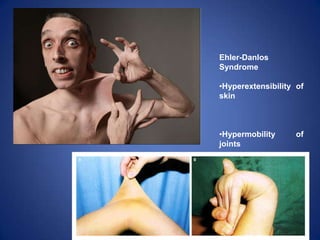
Ehler Danlos Syndrome
 Ehlers-Danlos Syndrome is a group of inherited connective tissue disorders.
 CAUSE
 abnormalities in the synthesis and metabolism of collagen
 Mutations in the collagen genes: COL1A1, COL1A2, COL3A1, COL5A1, COL5A2
 a deficiency of enzyme lysyl hydroxylase.
 A deficiency of procollagenN-proteinase, causing formation of abnormal
thin, irregular collagen fibrils
 EFFECT
 Mutations alter the structure, production, or processing of collagen or proteins
that interact with collagen
 WeakenS connective tissue in the skin, bones, blood vessels, and organs causing-
 Skin hyperextensibility
 Joint dislocations
 Tissue fragility
 Poor wound healing.
Ehler-Danlos
Syndrome
•Hyperextensibility of
skin
•Hypermobility of
joints
Alport Syndrome
 Alport syndrome is a genetic disorder
characterized by
glomerulonephritis, endstage kidney
disease, and hearing loss.
 It also affects the eyes.
 The presence of blood in the
urine[hematuria] is almost always found
in this condition.
 CAUSE
 Mutations in COL4A3,COL4A4,COL4A5
collagen biosynthesis genes.
 These prevent the production or
assembly of the type IV collagen
network in the basement membranes.
 kidneys are scarred and unable to filter
waste products resulting in hematuria
and renal disease.
Alport syndrome affecting eyes
Epidermolysis Bullosa
• Epidermolysis bullosa refers to a group of
inherited disorders that involve the
formation of blisters following trivial
trauma.
• CAUSE
 mutations in COL7A1, affecting the
structure of type VII collagen.
 Type VII collagen forms delicate fibrils
that anchor the basal lamina to
collagen fibrils in the dermis.
 These anchoring fibrils are reduced in
this form of the disease, causing friction
and blistering.
• EFFECT
 Blistering and painful sores like third
degree burns
Blister
formation
Osteogenesis Imperfecta
 Osteogenesis imperfecta or Brittle Bone Disease is a
genetic bone disorder due to decrease dcollagen
formation.
 CAUSE
 Mutations in the COL1A1 andCOL1A2 genes
coding for procollagen chains.
 Replacement of glycine by another bulkier
amino acid resulting in decreased collagen or
improper procollagen structure forming
abnormal fibers.
 Mutations also cause ‘procollagen suicide ‘
 All these cause brittleness.
 EFFECT
 Thin,t ransclucent, blue scleras.
 Affected infants may be born with multiple
fractures and not survive.
 weak muscles, brittle teeth, a curved spine and
hearing loss.
Chondrodysplasias
 Chondrodysplasias are a mixed
group of hereditary disorders
affecting cartilage.
 One example is Stickler
syndrome, manifested by
degeneration of joint cartilage
and of the vitreous body of the
eye.
 CAUSE
 Mutations in the COL2A1
gene, leading to abnormal
forms of type II collagen.
 EFFECT
 shortlimbed dwarfism
 skeletal deformities.
Osteolathyrism
 Osteolathyrism is a collagen cross-linking
deficiency caused by dietary over-
reliance on the seeds of Lathyrus sativus
(kesari dal) in some parts of India.
 CAUSE
 Osteolathyrogenic compounds like Beta-
aminopropionitrile(BAPN) and Beta-
oxalyl aminoalanine [BOAA] found in
Kesari dhal inhibit enzyme lysyl oxidase
required for the formation of cross links
in the triple helices
 EFFECT
 weakness and fragility of
skin, bones, and blood vessels
 Paralysis of the lower extremities
associated with neurolathyrism
Scurvy
 Scurvy is a disease due to deficiency of
vitamin C
 It is not a genetic disease.
 It is related to improper collagen
formation
 CAUSE
 Vitamin C [ascorbic acid ]is
required as a cofactor for
hydroxylase enzymes during the
hydroxylation of proline and lysine
in the synthesis of collagen.
 Deficiency causes impaired
collagen synthesis due to
deficiency of hydroxylases.
 EFFECT
 Bleeding of gums
 Poor wound healing
 Subcutaneous hemorrhages
Uses Of Collagen
 Industrial Uses
 Collagen is used as temporary thermoplastic glues in musical instruments like
violin and guitar .
 Recently used as a fertilizer
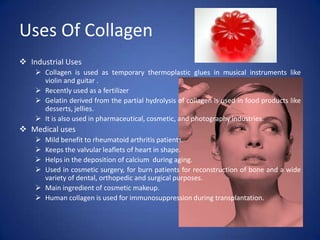
 Gelatin derived from the partial hydrolysis of collagen is used in food products like
desserts, jellies.
 It is also used in pharmaceutical, cosmetic, and photography industries.
 Medical uses
 Mild benefit to rheumatoid arthritis patients.
 Keeps the valvular leaflets of heart in shape.
 Helps in the deposition of calcium during aging.
 Used in cosmetic surgery, for burn patients for reconstruction of bone and a wide
variety of dental, orthopedic and surgical purposes.
 Main ingredient of cosmetic makeup.
 Human collagen is used for immunosuppression during transplantation.

Collagen! - The connective Tissue Protein

  • 1.
  • 2.
    Why study tissueproteins?  To understand normal body functions .  In development  In inflammatory states  Aging process.  To identify the cause of various genetic and metabolic disorders related to tissue proteins  In the spread of cancer cells.  Several diseases (eg:Osteogenesis imperfecta and a number of types of the Ehlers-Danlos syndrome) are due to genetic disturbances of the synthesis of collagen.  Components of proteoglycans are affected in the group of genetic disorders known as the mucopolysaccharidoses.  To use and apply them in the medical, industrial, commercial fields.  In food products, cosmetic surgery.  The gelatin used in food and industry is derived from the partial hydrolysis of collagen.
  • 3.
    The Extracellular Matrix The space outside the cells of a tissue is filled with a composite material called extracellular matrix(ECM).  This ECM is also known as the connective tissue. It is composed of - a) Gel with interstitial fluid. b) 3 major classes of biomolecules:  Structural proteins: collagen, elastin and Keratin(epidermal tissues)  Specialized proteins: e.g. fibrillin, fibronectin, and laminin.  Proteoglycans(Mucoproteins) : Conjugated proteins consisting of  Protein + Carbohydrate(5%-95%)  Carbohydrate part is in the form of Glycosaminoglycans [GAGs].  Thus, the extracellular matrix (ECM) is a complex structural entity surrounding and supporting cells that are found within mammalian tissues.
  • 4.
  • 5.
    Collagen  Most abundantinsoluble fibrous protein in the connective tissue of mammals.  Makes up about 25% to 35% of the whole-body protein content.  Scleroprotein secreted from the cells called fibroblasts.  In greek ‘kolla’ means ‘glue’.Collagen is also called as glue-producer.  Distribution of collagen varies in different tissues.  Also found in mucous membranes, nerves,Blood vessels, and organs. 90% 85% 70% 4% bones tendons skin liver Collagen fibers in muscle tendons
  • 6.
    Functions Of Collagen It imparts strength, support, shape and elasicity to the tissues.  It accounts for 6% of the weight of strong, tendinous muscles  It provides flexibility, support, and movement to cartilage.  It encases and protects delicate organs like kidneys and spleen.  It fills the sclera of the eye in crystalline form.  Teeth(dentin) are made by adding mineral crystals to collagen.  Collagen contributes to proper alignment of cells for cell proliferation and differentiation.  When exposed in damaged blood vessels, it initiates thrombus formation
  • 7.
    Types Of Collagen In humans, there are at least 19 distinct types of collagen made up of 30 distinct polypeptide chains (each encoded by a separate gene).  They are subdivided into a number of classes based primarily on the structures they form  However, 90% of the collagen in the body are of type I, II, III, and IV.  These types determine the physical properties of specific tissues and perform their specialized function.
  • 8.
    Structure Of Collagen Thebasic structural unit of a collagen molecule is a triple helix. Triple helical structure may occur throughout the molecule or only in a part of it. Structure Of type I mature Collagen:  Triple helical structure occurs throughout the molecule.  This triple helix is composed of 3 polypeptide chains twisted around each other.  Each polypeptide/alpha chain is in turn a left handed helix with 3 amino acids per turn totally containing approximately 1000 amino acids per chain. Alpha chain Triple Helix Amino- acids
  • 9.
    Each alpha chainhas an unusual abundance of 3 amino-acids glycine, proline and hydroxyproline.  Glycine occurs at every third position in the amino acid sequence which can be represented as (Gly-X- Y)n.  X and Y are other amino acids of which proline and hydroxyproline occupy 100 positions each.  Glycine occupies the crowded center of the triple helix as it has a small side chain[ H atom] where as Hydroxyproline and proline point outwards imparting rigidity to the triple helix.  The alpha chains are wound around each other in a right handed super helix to form a rod like molecule 1.4nm wide and 300nm long [Gly-X-Y]n
  • 10.
    The triple helicesare stabilized by Hydrogen bonds, covalent cross- links, electrostatic and hydrophobic interactions and van der waals forces. The covalent cross links within and between the helices are formed by copper dependent enzyme lysyl oxidase between the lysine and hydroxylysine residues. These triple helical molecules pack together side by side to form elongated fibrils. Fibrils are displaced longitudinally from each other by 67 nm [one quatter of its length] to form a quarter staggered arrangement. Fibrils bundle up to form fibers making up tissues. Cross link formation
  • 11.
  • 12.
    Biosynthesis of Collagen Collagen synthesis occurs in the fibroblasts, osteoblasts in bone, chondroblasts in cartilage and odontoblasts in teeth.  First synthesized in precursor form of preprocollagen polypeptide chain in the ribosomes during translation  The leader sequence of amino acids[signal peptide] in the preprocollagen directs it to enter the lumen of E.R  In the lumen of E.R, the Signal peptide is cleaved to form procollagen.  The proline and lysine amino acids in the procollagen chain undergo hydroxylation and glycosylation known as post translational modifications.  Disulfide bonds are formed between three procollagen chains which twist around each other to form a triple helix molecule.This step is called registration.  This Procollagen molecule is secreted into the extracellular matrix from the golgi compartment of the E.R.  Here, the procollagen aminoproteinase and carboxy proteinase enzymes remove extra terminal amino acids from the procollagen molecule to form collagen .  The collagen molecules assemble into fibrils and inturn fibers being stabilized by the covalent cross-links.
  • 13.
  • 14.
  • 15.
    Abnormalities associated withcollagen  Collagen-related diseases arise from  genetic defects  nutritional deficiencies  They affect the biosynthesis, assembly, postranslational modification, secretion, or other processes involved in normal collagen production.  These include :  Ehler Danlos syndrome  Alport syndrome  Epidermolysis bullosa  Osteogenesis Imperfecta  Chondrodysplasias [affects cartilage]  Scurvy  Osteolathyrism
  • 16.
    Ehler Danlos Syndrome Ehlers-Danlos Syndrome is a group of inherited connective tissue disorders.  CAUSE  abnormalities in the synthesis and metabolism of collagen  Mutations in the collagen genes: COL1A1, COL1A2, COL3A1, COL5A1, COL5A2  a deficiency of enzyme lysyl hydroxylase.  A deficiency of procollagenN-proteinase, causing formation of abnormal thin, irregular collagen fibrils  EFFECT  Mutations alter the structure, production, or processing of collagen or proteins that interact with collagen  WeakenS connective tissue in the skin, bones, blood vessels, and organs causing-  Skin hyperextensibility  Joint dislocations  Tissue fragility  Poor wound healing.
  • 17.
  • 18.
    Alport Syndrome  Alportsyndrome is a genetic disorder characterized by glomerulonephritis, endstage kidney disease, and hearing loss.  It also affects the eyes.  The presence of blood in the urine[hematuria] is almost always found in this condition.  CAUSE  Mutations in COL4A3,COL4A4,COL4A5 collagen biosynthesis genes.  These prevent the production or assembly of the type IV collagen network in the basement membranes.  kidneys are scarred and unable to filter waste products resulting in hematuria and renal disease. Alport syndrome affecting eyes
  • 19.
    Epidermolysis Bullosa • Epidermolysisbullosa refers to a group of inherited disorders that involve the formation of blisters following trivial trauma. • CAUSE  mutations in COL7A1, affecting the structure of type VII collagen.  Type VII collagen forms delicate fibrils that anchor the basal lamina to collagen fibrils in the dermis.  These anchoring fibrils are reduced in this form of the disease, causing friction and blistering. • EFFECT  Blistering and painful sores like third degree burns Blister formation
  • 20.
    Osteogenesis Imperfecta  Osteogenesisimperfecta or Brittle Bone Disease is a genetic bone disorder due to decrease dcollagen formation.  CAUSE  Mutations in the COL1A1 andCOL1A2 genes coding for procollagen chains.  Replacement of glycine by another bulkier amino acid resulting in decreased collagen or improper procollagen structure forming abnormal fibers.  Mutations also cause ‘procollagen suicide ‘  All these cause brittleness.  EFFECT  Thin,t ransclucent, blue scleras.  Affected infants may be born with multiple fractures and not survive.  weak muscles, brittle teeth, a curved spine and hearing loss.
  • 21.
    Chondrodysplasias  Chondrodysplasias area mixed group of hereditary disorders affecting cartilage.  One example is Stickler syndrome, manifested by degeneration of joint cartilage and of the vitreous body of the eye.  CAUSE  Mutations in the COL2A1 gene, leading to abnormal forms of type II collagen.  EFFECT  shortlimbed dwarfism  skeletal deformities.
  • 22.
    Osteolathyrism  Osteolathyrism isa collagen cross-linking deficiency caused by dietary over- reliance on the seeds of Lathyrus sativus (kesari dal) in some parts of India.  CAUSE  Osteolathyrogenic compounds like Beta- aminopropionitrile(BAPN) and Beta- oxalyl aminoalanine [BOAA] found in Kesari dhal inhibit enzyme lysyl oxidase required for the formation of cross links in the triple helices  EFFECT  weakness and fragility of skin, bones, and blood vessels  Paralysis of the lower extremities associated with neurolathyrism
  • 23.
    Scurvy  Scurvy isa disease due to deficiency of vitamin C  It is not a genetic disease.  It is related to improper collagen formation  CAUSE  Vitamin C [ascorbic acid ]is required as a cofactor for hydroxylase enzymes during the hydroxylation of proline and lysine in the synthesis of collagen.  Deficiency causes impaired collagen synthesis due to deficiency of hydroxylases.  EFFECT  Bleeding of gums  Poor wound healing  Subcutaneous hemorrhages
  • 24.
    Uses Of Collagen Industrial Uses  Collagen is used as temporary thermoplastic glues in musical instruments like violin and guitar .  Recently used as a fertilizer  Gelatin derived from the partial hydrolysis of collagen is used in food products like desserts, jellies.  It is also used in pharmaceutical, cosmetic, and photography industries.  Medical uses  Mild benefit to rheumatoid arthritis patients.  Keeps the valvular leaflets of heart in shape.  Helps in the deposition of calcium during aging.  Used in cosmetic surgery, for burn patients for reconstruction of bone and a wide variety of dental, orthopedic and surgical purposes.  Main ingredient of cosmetic makeup.  Human collagen is used for immunosuppression during transplantation.