Thematic Mapping
with Carto!
Maptime Madison: December 7th, 2016
What is a thematic map?
● A map that shows the variation in one (or sometimes several) geographic
phenomenon across the landscape
○ i.e., numeric attributes across space
○ e.g., Population (numeric attribute) per state (across space)
What is a thematic map?
● Thematic maps show two information types:
○ Individual information-attribute values of individual objects in the landscape
■ Think points: cities, buildings, weather stations
○ Enumerated information-aggregated attribute values of a set of objects in a given region
■ Think polygons: countries, states, counties as enumeration units
Thematic map types
There are multiple thematic map types in cartography including:
● Proportional symbol
● Dot Density
● Isoline
● Choropleth
● Cartograms
● Dasymetric maps
● Flow maps
● Bivariate/multivariate maps
Let’s explore 4 common thematic map types.
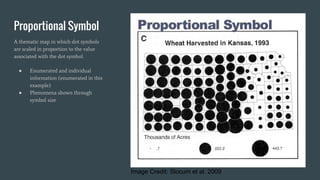
A thematic map in which dot symbols
are scaled in proportion to the value
associated with the dot symbol.
● Enumerated and individual
information (enumerated in this
example)
● Phenomena shown through
symbol size
Proportional Symbol
Image Credit: Slocum et al. 2009
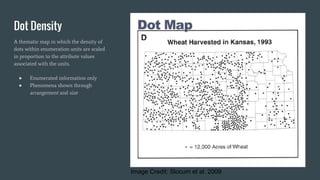
A thematic map in which the density of
dots within enumeration units are scaled
in proportion to the attribute values
associated with the units.
● Enumerated information only
● Phenomena shown through
arrangement and size
Dot Density
Image Credit: Slocum et al. 2009
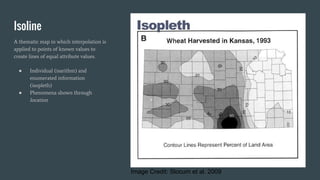
A thematic map in which interpolation is
applied to points of known values to
create lines of equal attribute values.
● Individual (isarithm) and
enumerated information
(isopleth)
● Phenomena shown through
location
Isoline
Image Credit: Slocum et al. 2009
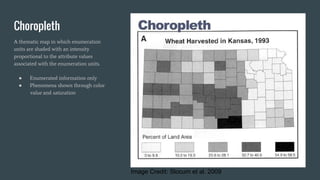
A thematic map in which enumeration
units are shaded with an intensity
proportional to the attribute values
associated with the enumeration units.
● Enumerated information only
● Phenomena shown through color
value and saturation
Choropleth
Image Credit: Slocum et al. 2009
Choropleth Considerations and
Best Practices
Let’s go into more on Choropleths before moving to Carto!
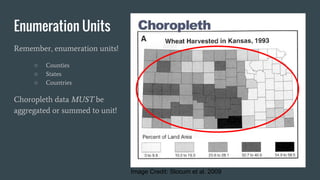
Enumeration Units
Remember, enumeration units!
○ Counties
○ States
○ Countries
Choropleth data MUST be
aggregated or summed to unit!
Image Credit: Slocum et al. 2009
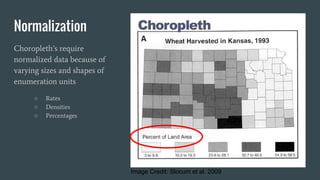
Normalization
Choropleth’s require
normalized data because of
varying sizes and shapes of
enumeration units
○ Rates
○ Densities
○ Percentages
Image Credit: Slocum et al. 2009
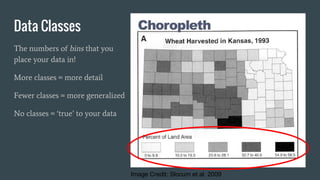
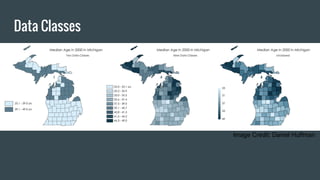
Data Classes
The numbers of bins that you
place your data in!
More classes = more detail
Fewer classes = more generalized
No classes = ‘true’ to your data
Image Credit: Slocum et al. 2009
Data Classes
Image Credit: Daniel Huffman
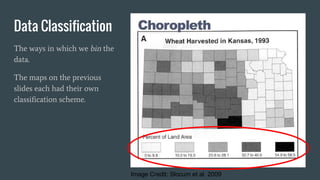
Data Classification
The ways in which we bin the
data.
The maps on the previous
slides each had their own
classification scheme.
Image Credit: Slocum et al. 2009
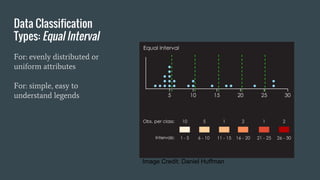
Data Classification
Types: Equal Interval
For: evenly distributed or
uniform attributes
For: simple, easy to
understand legends
Image Credit: Daniel Huffman
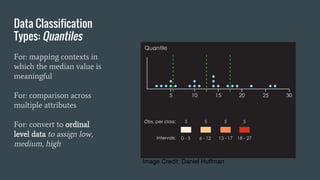
Data Classification
Types: Quantiles
For: mapping contexts in
which the median value is
meaningful
For: comparison across
multiple attributes
For: convert to ordinal
level data to assign low,
medium, high
Image Credit: Daniel Huffman
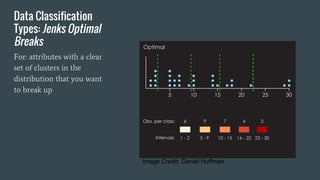
Data Classification
Types: Jenks Optimal
Breaks
For: attributes with a clear
set of clusters in the
distribution that you want
to break up
Image Credit: Daniel Huffman
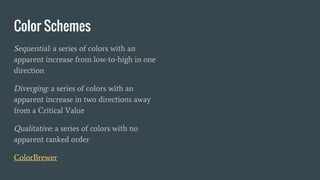
Color Schemes
Sequential: a series of colors with an
apparent increase from low-to-high in one
direction
Diverging: a series of colors with an
apparent increase in two directions away
from a Critical Value
Qualitative: a series of colors with no
apparent ranked order
ColorBrewer
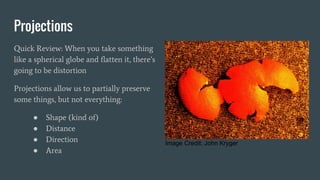
Projections
Quick Review: When you take something
like a spherical globe and flatten it, there’s
going to be distortion
Projections allow us to partially preserve
some things, but not everything:
● Shape (kind of)
● Distance
● Direction
● Area
Image Credit: John Kryger
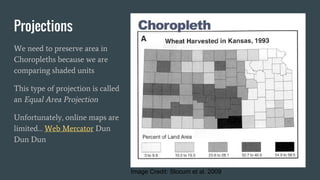
Projections
We need to preserve area in
Choropleths because we are
comparing shaded units
This type of projection is called
an Equal Area Projection
Unfortunately, online maps are
limited… Web Mercator Dun
Dun Dun
Image Credit: Slocum et al. 2009
Let’s Make a Map with Carto!
Now that you know the basics, it’s time to build a choropleth!
Carto Builder (Formerly CartoDB) Activity
www.carto.com
https://carto.com/academy/courses/beginners-course/your-first-ch
oropleth-map/ (Or Google Carto Choropleth Map and click on the first option)
References/Resources
● Slocum et al. (2009) Thematic Cartography & Geovisualization (Chapters 4, 10, & 14)
● colorbrewer2.org

Maptime Madison: December 7th, 2016

  • 1.
    Thematic Mapping with Carto! MaptimeMadison: December 7th, 2016
  • 2.
    What is athematic map? ● A map that shows the variation in one (or sometimes several) geographic phenomenon across the landscape ○ i.e., numeric attributes across space ○ e.g., Population (numeric attribute) per state (across space)
  • 3.
    What is athematic map? ● Thematic maps show two information types: ○ Individual information-attribute values of individual objects in the landscape ■ Think points: cities, buildings, weather stations ○ Enumerated information-aggregated attribute values of a set of objects in a given region ■ Think polygons: countries, states, counties as enumeration units
  • 4.
    Thematic map types Thereare multiple thematic map types in cartography including: ● Proportional symbol ● Dot Density ● Isoline ● Choropleth ● Cartograms ● Dasymetric maps ● Flow maps ● Bivariate/multivariate maps Let’s explore 4 common thematic map types.
  • 5.
    A thematic mapin which dot symbols are scaled in proportion to the value associated with the dot symbol. ● Enumerated and individual information (enumerated in this example) ● Phenomena shown through symbol size Proportional Symbol Image Credit: Slocum et al. 2009
  • 6.
    A thematic mapin which the density of dots within enumeration units are scaled in proportion to the attribute values associated with the units. ● Enumerated information only ● Phenomena shown through arrangement and size Dot Density Image Credit: Slocum et al. 2009
  • 7.
    A thematic mapin which interpolation is applied to points of known values to create lines of equal attribute values. ● Individual (isarithm) and enumerated information (isopleth) ● Phenomena shown through location Isoline Image Credit: Slocum et al. 2009
  • 8.
    A thematic mapin which enumeration units are shaded with an intensity proportional to the attribute values associated with the enumeration units. ● Enumerated information only ● Phenomena shown through color value and saturation Choropleth Image Credit: Slocum et al. 2009
  • 9.
    Choropleth Considerations and BestPractices Let’s go into more on Choropleths before moving to Carto!
  • 10.
    Enumeration Units Remember, enumerationunits! ○ Counties ○ States ○ Countries Choropleth data MUST be aggregated or summed to unit! Image Credit: Slocum et al. 2009
  • 11.
    Normalization Choropleth’s require normalized databecause of varying sizes and shapes of enumeration units ○ Rates ○ Densities ○ Percentages Image Credit: Slocum et al. 2009
  • 12.
    Data Classes The numbersof bins that you place your data in! More classes = more detail Fewer classes = more generalized No classes = ‘true’ to your data Image Credit: Slocum et al. 2009
  • 13.
  • 14.
    Data Classification The waysin which we bin the data. The maps on the previous slides each had their own classification scheme. Image Credit: Slocum et al. 2009
  • 15.
    Data Classification Types: EqualInterval For: evenly distributed or uniform attributes For: simple, easy to understand legends Image Credit: Daniel Huffman
  • 16.
    Data Classification Types: Quantiles For:mapping contexts in which the median value is meaningful For: comparison across multiple attributes For: convert to ordinal level data to assign low, medium, high Image Credit: Daniel Huffman
  • 17.
    Data Classification Types: JenksOptimal Breaks For: attributes with a clear set of clusters in the distribution that you want to break up Image Credit: Daniel Huffman
  • 18.
    Color Schemes Sequential: aseries of colors with an apparent increase from low-to-high in one direction Diverging: a series of colors with an apparent increase in two directions away from a Critical Value Qualitative: a series of colors with no apparent ranked order ColorBrewer
  • 19.
    Projections Quick Review: Whenyou take something like a spherical globe and flatten it, there’s going to be distortion Projections allow us to partially preserve some things, but not everything: ● Shape (kind of) ● Distance ● Direction ● Area Image Credit: John Kryger
  • 20.
    Projections We need topreserve area in Choropleths because we are comparing shaded units This type of projection is called an Equal Area Projection Unfortunately, online maps are limited… Web Mercator Dun Dun Dun Image Credit: Slocum et al. 2009
  • 21.
    Let’s Make aMap with Carto! Now that you know the basics, it’s time to build a choropleth!
  • 22.
    Carto Builder (FormerlyCartoDB) Activity www.carto.com https://carto.com/academy/courses/beginners-course/your-first-ch oropleth-map/ (Or Google Carto Choropleth Map and click on the first option)
  • 23.
    References/Resources ● Slocum etal. (2009) Thematic Cartography & Geovisualization (Chapters 4, 10, & 14) ● colorbrewer2.org