Mapping Your Data Christopher Martin [email_address]
About Me Geography Major Computer Science Minor
Outline Data Types/Models Data Sources Map Types Demos
Tools of the Trade Cartographic Software ArcMap Other (uDig, QGIS, GRASS) “ Mapping” Libraries/Tools Google Earth, Google Maps, OpenLayers
Data Models Two primary data models used when making maps Raster Data Vector Data
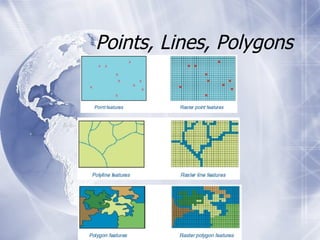
Raster Data Consists of discrete cells (think graph paper)  Each cell has a discrete value Occur in rows and columns Examples Images (all image types) DEM
Vector Data Each position is represented by coordinates Coordinates are connected to form lines or polygons Points, lines and polygons are then used to represent geographic features Examples Shapefile
Points, Lines, Polygons
Data Sources US Census Bureau Not just population data Generalized Boundary Data ESRI TIGER/LINE NED Data FEMA Q3 Flood Data USGS SEAMLESS Distribution
Data Sources (cont’d) NYS GIS Clearing House Membership required Wide variety of data CUGIR NYS and National data Free, huge variety CIGAR Worldwide Elevation Data Columbia University EDS Electronic Data Service
Data Sources (cont’d) Geography Network Aggregates data from different providers Online Map Server Available
Data Quality Meta Data Data about the data All legitimate providers will provide this Available for download or online viewing
Map Types Thematic Maps Not reference maps Four main types Choropleth Map Proportional Map Isarithmic Map (contour) Dot Map
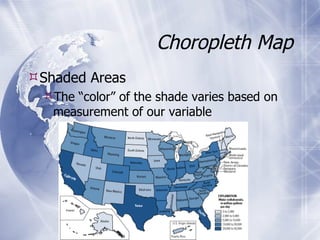
Choropleth Map Shaded Areas The “color” of the shade varies based on measurement of our variable
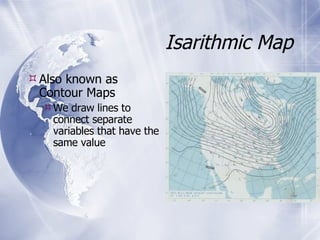
Isarithmic Map Also known as Contour Maps We draw lines to connect separate variables that have the same value
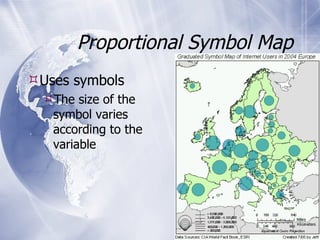
Proportional Symbol Map Uses symbols The size of the symbol varies according to the variable
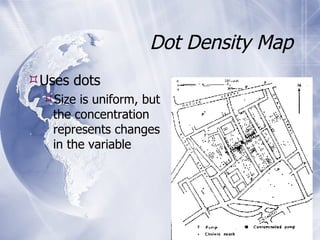
Dot Density Map Uses dots Size is uniform, but the concentration represents changes in the variable
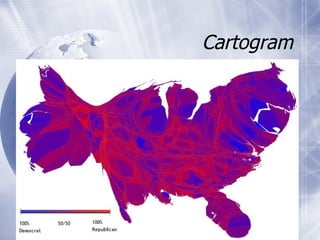
Cartograms Are NOT maps Area is not preserved Area of the geographic regions varies by variable Two primary types Area Area gets larger or smaller depending on the variable Distance Nodes or places can be closer or farther depending on realtive distance
Cartogram
File Formats Shapefile A collection of points, lines and polygons Tabular data values assocated with each DEM Raster data, each cell represents elevation Comes in different resolutions
Demo Time! Gathering Data Converting Data Geocoding Getting Data Into Arc Map Making a Map ArcMap Google Earth Google Maps/OpenLayer

Mapping Your Data 2

  • 1.
    Mapping Your DataChristopher Martin [email_address]
  • 2.
    About Me GeographyMajor Computer Science Minor
  • 3.
    Outline Data Types/ModelsData Sources Map Types Demos
  • 4.
    Tools of theTrade Cartographic Software ArcMap Other (uDig, QGIS, GRASS) “ Mapping” Libraries/Tools Google Earth, Google Maps, OpenLayers
  • 5.
    Data Models Twoprimary data models used when making maps Raster Data Vector Data
  • 6.
    Raster Data Consistsof discrete cells (think graph paper) Each cell has a discrete value Occur in rows and columns Examples Images (all image types) DEM
  • 7.
    Vector Data Eachposition is represented by coordinates Coordinates are connected to form lines or polygons Points, lines and polygons are then used to represent geographic features Examples Shapefile
  • 8.
  • 9.
    Data Sources USCensus Bureau Not just population data Generalized Boundary Data ESRI TIGER/LINE NED Data FEMA Q3 Flood Data USGS SEAMLESS Distribution
  • 10.
    Data Sources (cont’d)NYS GIS Clearing House Membership required Wide variety of data CUGIR NYS and National data Free, huge variety CIGAR Worldwide Elevation Data Columbia University EDS Electronic Data Service
  • 11.
    Data Sources (cont’d)Geography Network Aggregates data from different providers Online Map Server Available
  • 12.
    Data Quality MetaData Data about the data All legitimate providers will provide this Available for download or online viewing
  • 13.
    Map Types ThematicMaps Not reference maps Four main types Choropleth Map Proportional Map Isarithmic Map (contour) Dot Map
  • 14.
    Choropleth Map ShadedAreas The “color” of the shade varies based on measurement of our variable
  • 15.
    Isarithmic Map Alsoknown as Contour Maps We draw lines to connect separate variables that have the same value
  • 16.
    Proportional Symbol MapUses symbols The size of the symbol varies according to the variable
  • 17.
    Dot Density MapUses dots Size is uniform, but the concentration represents changes in the variable
  • 18.
    Cartograms Are NOTmaps Area is not preserved Area of the geographic regions varies by variable Two primary types Area Area gets larger or smaller depending on the variable Distance Nodes or places can be closer or farther depending on realtive distance
  • 19.
  • 20.
    File Formats ShapefileA collection of points, lines and polygons Tabular data values assocated with each DEM Raster data, each cell represents elevation Comes in different resolutions
  • 21.
    Demo Time! GatheringData Converting Data Geocoding Getting Data Into Arc Map Making a Map ArcMap Google Earth Google Maps/OpenLayer