©	
  2014	
  Virtusa Corporation.	
  All	
  rights	
  reserved	
  |	
  1
The Primitive Journey
Map
for a
Unified Human-Centric
Product
ProductCamp Boston
9 April 2016
David Scharn
• Why	
  this?
• A	
  bit	
  on	
  design	
  thinking
• A	
  journey	
  map	
  does…
• Whose	
  journey?	
   – Empathy	
  Map
• Chart	
  the	
  journey	
  collaboratively
• Synthesis	
  and	
  revelation
• Then	
  what?	
  – sample	
  outcomes
• So	
  what?
​Why	
  this	
  activity?
Engage stakeholders:
• Empathy
• Consensus
• Enlightenment
• Unified vision
​A	
  bit	
  about	
  design	
  thinking
Elements of design thinkingin this exercise:
• Human-centered
• Ideation – divergent and convergent
• Collaborative, cross-functional
• Iterative, experimental, embraces uncertainty
​A	
  journey	
  map	
  does…
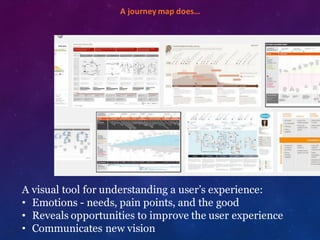
A visual tool for understanding a user’s experience:
• Emotions - needs, pain points, and the good
• Reveals opportunities to improve the user experience
• Communicates new vision
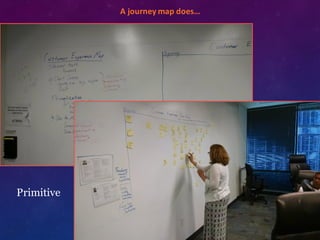
​Primitive
​A	
  journey	
  map	
  does…
​Whose	
  journey?	
  Empathy	
  Map
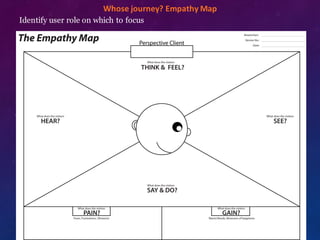
Identify user role on which to focus
Divergent thinking
​Whose	
  journey?	
  Empathy	
  Map
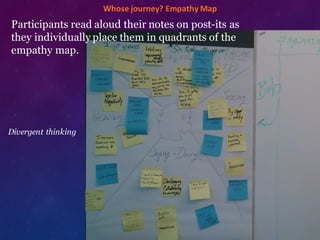
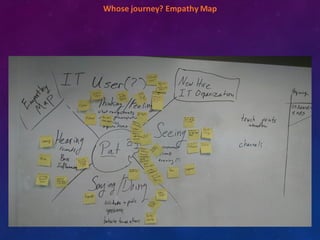
Participants read aloud their notes on post-its as
they individually place them in quadrants of the
empathy map.
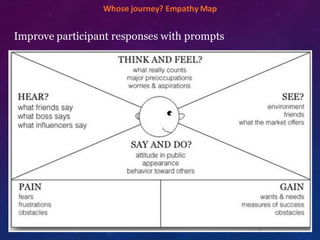
Improve participant responses with prompts
​Whose	
  journey?	
  Empathy	
  Map
​Whose	
  journey?	
  Empathy	
  Map
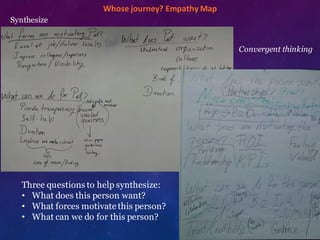
Convergent thinking
Synthesize
​Whose	
  journey?	
  Empathy	
  Map
Three questions to help synthesize:
• What does this person want?
• What forces motivate this person?
• What can we do for this person?
​Chart	
  the	
  journey	
  collaboratively
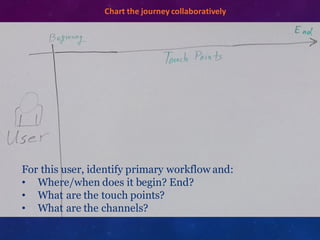
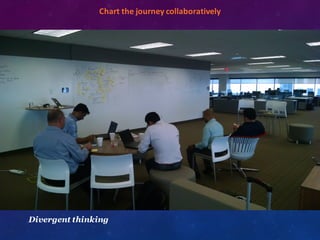
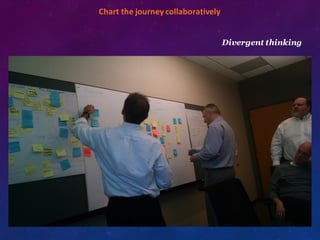
For this user, identify primary workflow and:
• Where/when does it begin? End?
• What are the touch points?
• What are the channels?
Divergent thinking
​Chart	
  the	
  journey	
  collaboratively
For	
  this	
  user,	
  identify	
  primary	
  workflow
• Where/when	
  does	
  it	
  begin?	
  End?
• What	
  are	
  the	
  touch	
  points?
• What	
  are	
  the	
  channels?
Divergent thinking
​Chart	
  the	
  journey	
  collaboratively
​Chart	
  the	
  journey	
  collaboratively
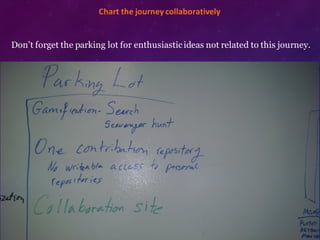
Don’t forget the parking lot for enthusiasticideas not related to this journey.
​Synthesis	
  and	
  revelation
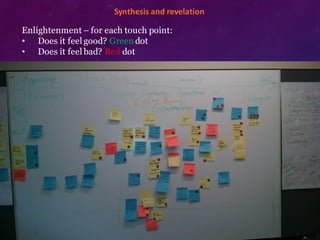
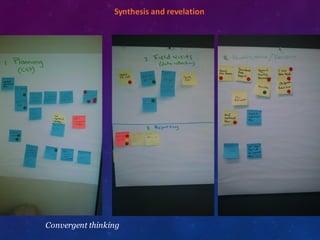
Enlightenment – for each touch point:
• Does it feel good? Green dot
• Does it feel bad? Red dot
Convergent thinking
​Synthesis	
  and	
  revelation
​Synthesis	
  and	
  revelation
Convergent thinking
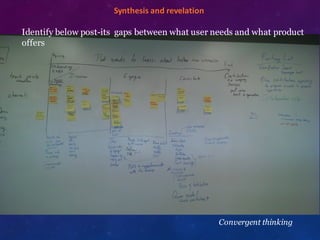
Identify below post-its gaps between what user needs and what product
offers
​Synthesis	
  and	
  revelation
Convergent thinking
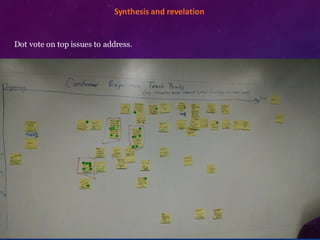
Dot vote on top issues to address.
​Then	
  what?	
  
​(sample	
  session	
  outcomes)
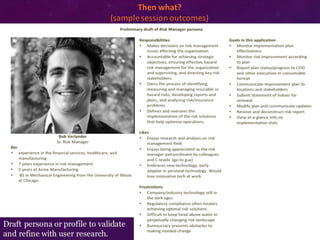
Draft persona or profile to validate
and refine with user research.
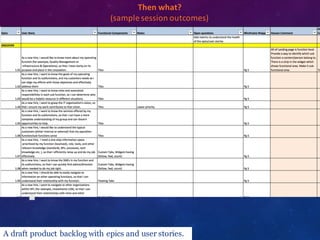
A draft product backlog with epics and user stories.
​Then	
  what?	
  
​(sample	
  session	
  outcomes)
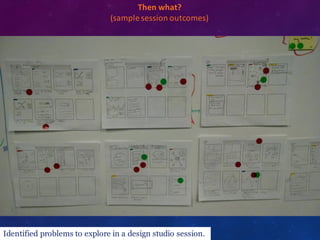
Identified problems to explore in a design studio session.
​Then	
  what?	
  
​(sample	
  session	
  outcomes)
​So	
  what?
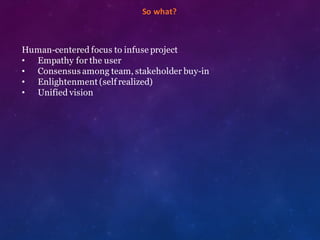
Human-centered focus to infuse project
• Empathy for the user
• Consensus among team, stakeholder buy-in
• Enlightenment (self realized)
• Unified vision
​Useful	
  and	
  convenient	
  resources
Design Thinking: Lead Change in Your Organization
Creating the Journey Map (preview video)
Turi McKinley
Lynda.com
How to Create a Customer Journey Map
Megan Grocki
UXMastery.com
Guide to Experience Mapping
Adaptive Path
Mapping Experiences: A Guide to Creating Value through Journeys,
Blueprints, and Diagrams
O’Reilley Media Webcast
James Kalbach
Mental Models: Aligning Design Strategy with Human Behavior
Indi Young
©	
  2014	
  Virtusa Corporation.	
  All	
  rights	
  reserved	
  |	
  24
Thanks
David Scharn
dgscharn@gmail.com
781.775.6321

Mapping Human-Centric Product Vision (ProductCamp Boston 2016)

  • 1.
    ©  2014  VirtusaCorporation.  All  rights  reserved  |  1 The Primitive Journey Map for a Unified Human-Centric Product ProductCamp Boston 9 April 2016 David Scharn • Why  this? • A  bit  on  design  thinking • A  journey  map  does… • Whose  journey?   – Empathy  Map • Chart  the  journey  collaboratively • Synthesis  and  revelation • Then  what?  – sample  outcomes • So  what?
  • 2.
    ​Why  this  activity? Engagestakeholders: • Empathy • Consensus • Enlightenment • Unified vision
  • 3.
    ​A  bit  about  design  thinking Elements of design thinkingin this exercise: • Human-centered • Ideation – divergent and convergent • Collaborative, cross-functional • Iterative, experimental, embraces uncertainty
  • 4.
    ​A  journey  map  does… A visual tool for understanding a user’s experience: • Emotions - needs, pain points, and the good • Reveals opportunities to improve the user experience • Communicates new vision
  • 5.
  • 6.
    ​Whose  journey?  Empathy  Map Identify user role on which to focus
  • 7.
    Divergent thinking ​Whose  journey?  Empathy  Map Participants read aloud their notes on post-its as they individually place them in quadrants of the empathy map.
  • 8.
    Improve participant responseswith prompts ​Whose  journey?  Empathy  Map
  • 9.
  • 10.
    Convergent thinking Synthesize ​Whose  journey?  Empathy  Map Three questions to help synthesize: • What does this person want? • What forces motivate this person? • What can we do for this person?
  • 11.
    ​Chart  the  journey  collaboratively For this user, identify primary workflow and: • Where/when does it begin? End? • What are the touch points? • What are the channels?
  • 12.
    Divergent thinking ​Chart  the  journey  collaboratively For  this  user,  identify  primary  workflow • Where/when  does  it  begin?  End? • What  are  the  touch  points? • What  are  the  channels?
  • 13.
    Divergent thinking ​Chart  the  journey  collaboratively
  • 14.
    ​Chart  the  journey  collaboratively Don’t forget the parking lot for enthusiasticideas not related to this journey.
  • 15.
    ​Synthesis  and  revelation Enlightenment– for each touch point: • Does it feel good? Green dot • Does it feel bad? Red dot
  • 16.
  • 17.
    ​Synthesis  and  revelation Convergentthinking Identify below post-its gaps between what user needs and what product offers
  • 18.
    ​Synthesis  and  revelation Convergentthinking Dot vote on top issues to address.
  • 19.
    ​Then  what?   ​(sample  session  outcomes) Draft persona or profile to validate and refine with user research.
  • 20.
    A draft productbacklog with epics and user stories. ​Then  what?   ​(sample  session  outcomes)
  • 21.
    Identified problems toexplore in a design studio session. ​Then  what?   ​(sample  session  outcomes)
  • 22.
    ​So  what? Human-centered focusto infuse project • Empathy for the user • Consensus among team, stakeholder buy-in • Enlightenment (self realized) • Unified vision
  • 23.
    ​Useful  and  convenient  resources Design Thinking: Lead Change in Your Organization Creating the Journey Map (preview video) Turi McKinley Lynda.com How to Create a Customer Journey Map Megan Grocki UXMastery.com Guide to Experience Mapping Adaptive Path Mapping Experiences: A Guide to Creating Value through Journeys, Blueprints, and Diagrams O’Reilley Media Webcast James Kalbach Mental Models: Aligning Design Strategy with Human Behavior Indi Young
  • 24.
    ©  2014  VirtusaCorporation.  All  rights  reserved  |  24 Thanks David Scharn dgscharn@gmail.com 781.775.6321