Hi!
Carolann Bonner
Product Designer at Segment.
The Product
Road Map
What would you like
to talk about today?
Common pitfalls
• Strategy and objectives are unclear
• Confusion about current roadmap
• Lack of transparency
• Process for creating roadmaps are not
consistent across the company
What is a roadmap?
The path from where you are now to
where you want to be.
Why have a roadmap?
To maintain focus.
Characteristics of
a good roadmap
• Simple and high-level
• Reflects important objectives
• Clear present, fuzzy future
Before you plan
your roadmap
Feature audit
What are people using right now?
Goal: Focus your resources on what matters.
You need balance.
Improving the existing product and
building new ideas
Where to start
5 inputs to consider:
1. Iteration
Iterate on the product that was just shipped.
2. Common customer issues
Have a system for collecting and categorizing
customer problems and issues.
3. Improve quality
How well is the existing product solving our
customers’ original problem?
4. Sales team feedback
Understand the anxieties of
potential customers.
5. New Ideas
New solutions, creative ideas, whatever
excites you.
Saying “no”
Handling feature
requests
Unnecessary burden
Each feature is like adding a
child to a family.
While it might be wonderful, it also has its own
sets of needs and demands.
Be sure your team is able to take that on
when you start discussing a new feature.
A mile wide but only
an inch deep
It’s easy for features to nudge your product
further away from its core vision. In doing so,
the scope of the problem you’re solving for
your customers is a mile wide but only an inch
deep.
Does it fit your
vision?
Define metrics for
success
Communication
problems
Visualize
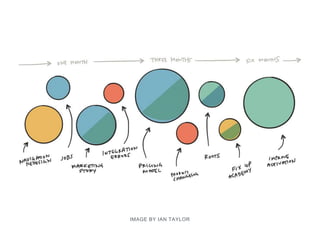
IMAGE BY IAN TAYLOR
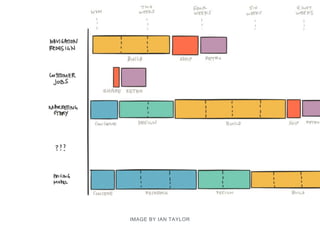
IMAGE BY IAN TAYLOR
Accessible
• Make it easy to understand
• People should be able to see it anytime
• It doesn’t have to be interactive
• Put it up on a wall or circulate it in your team’s chat
tools
Self-driving cars
What first?
Consider the other inputs
Define Success
How might we measure
success?
Thanks!

Product Roadmapping

Editor's Notes

  • #5 Anything to add here?
  • #6 It’s really straightforward. Should describe the path from where you are now, to realizing the vision you have spelled out in your product strategy. Chronological list of the work to be done from the present to the future.
  • #7 Ever team should be aligned on the larger business goals in a company. Every project should push the team toward achieving those goals.
  • #8 Every project should push the team toward the same, larger business goals.
  • #9 Not a detailed breakdown of what every team is working on. Nothing too specific. The purpose is to build common awareness, understanding, and momentum. It should enable the whole team decide whether new features or projects that come up line up with the current trajectory of the roadmap or are a divergence. They should reflect your current thoughts on which objectives are the most important. These may change as you make your way through the roadmap. That’s okay! It’s just important to build the appropriate awareness. Timeframes are just for projections. You can't put a real time on something until it is time to build it. The present should consist of projects more specific in scope while the future should be a representation of where we believe we might be or where we want to be.
  • #10 What can you do in preparation for building a product roadmap?
  • #11 State of the union Have to know where you are to know how to move forward. Features with limited adoption: kill it increase adoption get people use it more often make it better Understand why feature isn’t being used - talk to real customers. Are you hitting the right pain point but just not solving the problem well? Or are you solving a problem that your customers doing actually have? User research
  • #13 We’ll talk about a few good places to start when considering what goes on the roadmap. But first, what do you usually start with at your companies?
  • #15 You never get something right the first time. Factor in the time that you need to improve a product once it is out in the wild. Make sure you have a system in place to track what customers are doing and clearly defined metrics of success. Follow up quantitative research with qualitative. Shipping is just the beginning :)
  • #16 Our success team uses Zendesk. They have a finger on the pulse of what the most common customer requests and issues are. They’re the first resource to go to when deciding considering how you might improve the existing product. The knowledge of customer support teams mixed with customer research and quantitative analysis, it becomes very easy to decide what work to prioritize.
  • #17 Aside from the bugs and the residual customer issues, it’s important that the problem your product originally set out to solve is being solved extremely well. Before you take on new scope, (assuming there is not a competitive threat), you should improve the quality of your existing product. You should ask yourself, “How can my product solve this problem even better? How can I complete the picture for my customers?”
  • #18 Understand the reasons why customers choose not to use your product, why it may be difficult for them to see the value, or why it might be difficult for them to convince their superiors of the value. Then ask yourself, what are the things I we can do to reduce those anxieties? Improved marketing content? Free trial process? A new feature?
  • #19 Exploring new ideas is a great way to expand the product. Making improvements, fixing bugs, iterating on existing products, are all great. But it helps to be let loose from time to time to keep out-of-the-box juices flowing. This is a great place for creativity, intuition about the customer and the product, and a bit of risk-taking to come in to play.
  • #21 https://blog.intercom.io/rarely-say-yes-to-feature-requests/ A product is more than the sum of its features. Features don’t make the product. A cohesive experience that solves a problem well is a product. It’s easy for features to nudge your product further away from its core vision. In doing so, the scope of the problem you’re solving for your customers is a mile wide but only an inch deep.
  • #22 What helps you scale without taking on unnecessary burden.? A word of caution about building new features. Each feature is like adding a child to a family. While it might be wonderful, it also has its own sets of needs and demands. It will generate its own problems. This becomes another portion of your product that requires maintenance, research, analysis, and iteration. Be sure your team is able to take that on when you start discussing a new feature.
  • #24 It’s easy for features to nudge your product further away from its core vision. In doing so, the scope of the problem you’re solving for your customers is a mile wide but only an inch deep.
  • #25 **Throw in the tree diagram here!** Will it grow your business in the direction you to grow?
  • #26 Have a rough idea of what it means for this feature to be successful. What is the current situation? What situation would you like to be in? How will this project get you there? What metrics can you look at? Part of the project should be putting the systems in place to track metrics for measurement. Plan when you’ll
  • #27 What do your teams find hard about this?
  • #28 Worthwhile effort to make the roadmap easily understandable and easy to follow
  • #29 This is what our roadmap looks like for the Customer team at Segment.
  • #30 Sometimes it looks like this :D We haven’t figured it out either
  • #31 Make it easy to understand People should be able to see it anytime It doesn’t have to be interactive Put it up on a wall or circulate it in your team’s chat tools
  • #34 What should we do first?
  • #35 Any technical debt we might have? Any experiences that are okay but should be improved based on customer feedback? What other things might be on the roadmap? How should we prioritize this?
  • #36 What’s the situation we’re in? What situation do you want to be in? How will this project get us there?
  • #37 How might we measure success for this project or feature?