
Personas: Where Product
Meets User Needs
CHRISTINE PERFETTI PERFETTI MEDIA @CPERFETTI
Agenda
• Greet the user
• The five steps for persona
creation
• Planning a persona project
• Running the user research
• Exercise: Conducting a user
interview
• Analyzing the data
• Writing your persona
descriptions
• Integrating personas into your
development process
• Q&A
Prevents grounding
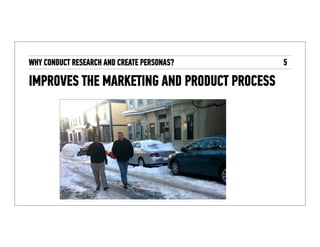
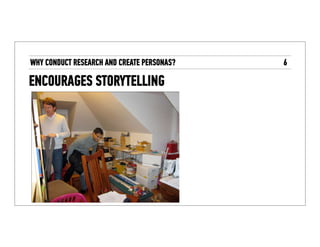
Encourages storytelling
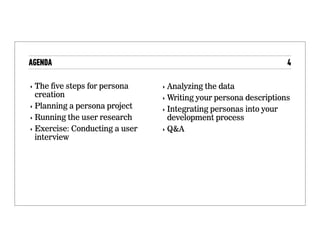
Improves the product and marketing process
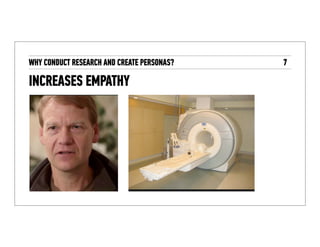
Increases empathy
The five steps for creating your personas
• Step 1: Plan the persona project
• Step 2: Conduct a user research study
• Step 3: Analyze the data
• Step 4: Write persona descriptions
• Step 5: Integrate personas into the development
process
1. PLAN THE PERSONA
PROJECT
Getting Your Team Onboard
The planning meeting
Hold a persona kickoff meeting
• Provide an overview of the research and persona process
• Discuss and finalize research focus questions
• Review product issues and concerns
Who should attend:
• Product and UX
• Engineering
• Marketing
• Sales, Support, Customer Success representation
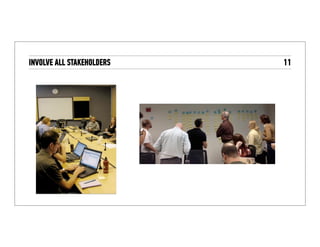
Involve all stakeholders
TODAY’S PROJECT
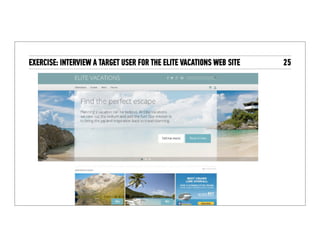
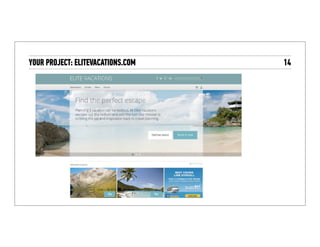
EliteVacation.com
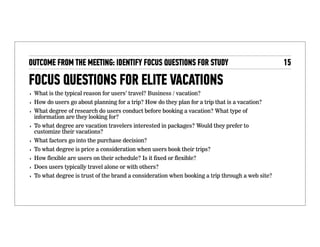
Focus questions for interviews
• What is the typical reason for users’ travel? Business / vacation?
• How do users go about planning for a trip? How do they plan for a
trip that is a vacation?
• What degree of research do users conduct before booking a
vacation? What type of information are they looking for?
• To what degree are vacation travelers interested in packages?
Would they prefer to customize their vacations?
• What factors go into the purchase decision?
• To what degree is price a consideration when users book their
trips?
• How flexible are users on their schedule? Is it fixed or flexible?
• Does users typically travel alone or with others?
• To what degree is trust of the brand a consideration when booking
a trip through a web site?
2. USER RESEARCH
Gathering Insights to Inform the
Product
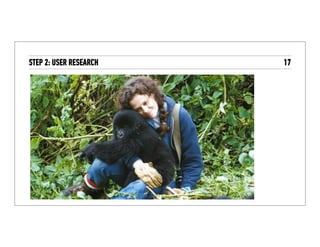
User research
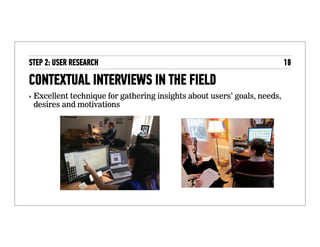
Contextual interviews in the field
‣ Excellent technique for gathering insights about users’
goals, needs, desires and motivations
The interview: What we learn
• User frustration and problems
• How technology fits into users’ life
• Domain knowledge
• Level of technical expertise
• User goals and most important tasks
• User preferences and attitudes
Logistics
• Typically takes 1-2 hours at the users’ site
• If it’s not possible to meet onsite, we use a remote
meeting tool, such as WebEx or GoToMeeting
• Equipment
• Video or audio recorder
• When approaching the interview take the mindset of an
Apprentice
• The user is the expert
The art of the interview
• Use body language and encouragers
• Ask for clarification, when necessary
• Summarize key points
• Use open-ended questions to collect information without
leading the user
• Use close-ended questions to take control of the
interview
Things to avoid
• Avoid leading questions
• Users like to respond with a “yes”
• Beware:
• Do you like this feature? [INSTEAD: What are your
impressions of this feature?]
• Would you be willing to pay more than $500 for this
vacation package?[INSTEAD: What factors go into
your decision making when deciding on a package?
What degree is price a factor?]
EXERCISE
Draft Your Interview Questions
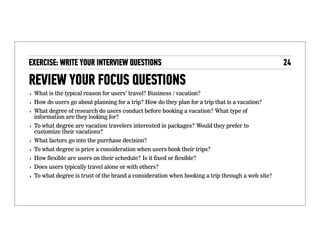
Review your focus questions
• What is the typical reason for users’ travel? Business / vacation?
• How do users go about planning for a trip? How do they plan for a
trip that is a vacation?
• What degree of research do users conduct before booking a
vacation? What type of information are they looking for?
• To what degree are vacation travelers interested in packages?
Would they prefer to customize their vacations?
• What factors go into the purchase decision?
• To what degree is price a consideration when users book their
trips?
• How flexible are users on their schedule? Is it fixed or flexible?
• Does users typically travel alone or with others?
• To what degree is trust of the brand a consideration when booking
a trip through a web site?
Exercise: Write your interview questions
Sample questions to ask
• How frequently do you travel?
• What is the typical reason you travel? [Business / personal].
• How frequently do you take vacations?
• Please tell me about a recent vacation you took. [Delve into the
focus question details.]
• How did you plan for the trip?
• How much research did you conduct before booking the trip, if any?
• What are the two things you liked best about the experience?
• What are the two things you would most like to improved?
• How much flexibility do you typically have when making your
vacation plans? Why?
• What are the most important factors that contribute to your ideal
vacation?
• What factors do you consider before booking a trip?
• To what degree is the ability to customize a trip a consideration for you? To
what degree is price a consideration when you book your vacation?
EXERCISE
Practice Your Interviewing Skills
Exercise instructions
• Break into groups of 2
• Interviewer
• Spend 5-8 minutes interviewing the user
• Take notes
• After 8 minutes, switch roles
The interview template
Source: http://www.jeffgothelf.com/blog/using-personas-for-executive-alignment/
3. ANALYZE THE DATA
Synthesizing What You’ve Learned
Identify key user behaviors and attributes
• Write up summaries of each interview
• Identify behavioral attributes of users
• In what way are the users the same? Different?
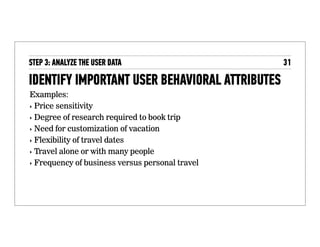
Identify important user behavioral attributes
• Examples:
• Price sensitivity
• Degree of research required to book trip
• Need for customization of vacation
• Flexibility of travel dates
• Travel alone or with many people
• Frequency of business versus personal travel
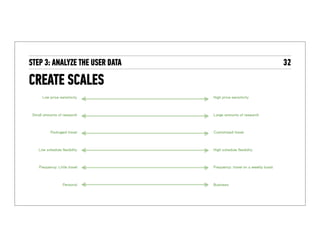
Create scales
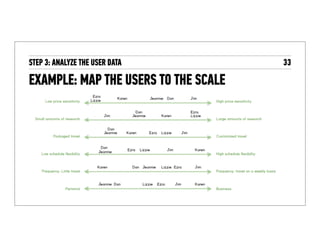
Example: Map the users to the scale
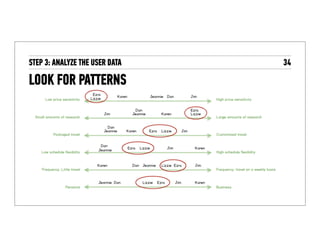
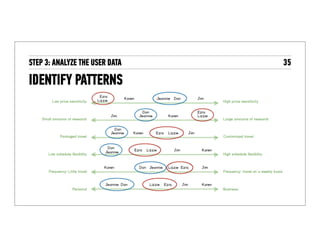
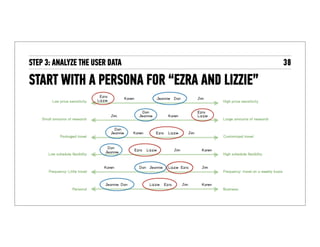
Look for patterns (1)
Look for patterns (2)
4. BUILD YOUR PERSONAS
Write Your Persona Descriptions
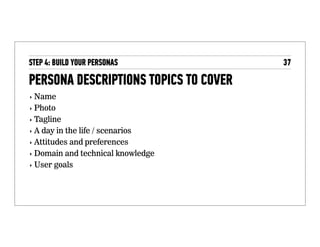
Persona descriptions: Topics to cover
• Name
• Photo
• Tagline
• Attitudes and preferences
• Domain and technical knowledge
• User goals
• A day in the life / scenarios
Scenarios
• Short stories about a person using you
product to accomplish their goals
• Describes what they would do and why they
would do it
• Independent of interface
• Gives the context in which its used
Analyze the date: Start with a persona for
“Ezra and Lizzie”
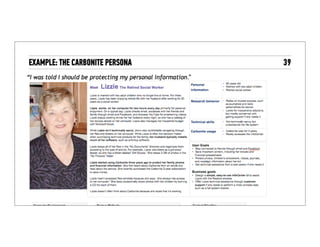
Persona example
5. INTEGRATE YOUR
PERSONAS INTO THE
DEVELOPMENT PROCESS
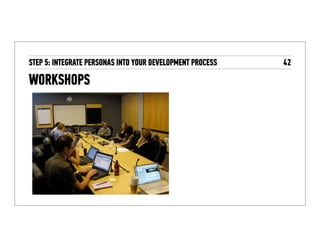
Workshops
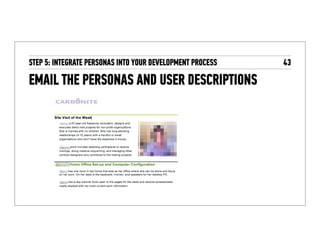
Email the personas and user descriptions
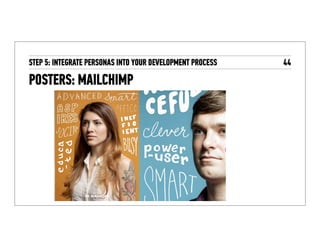
Posters: MailChimp
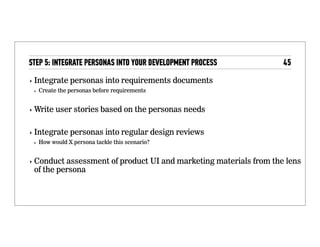
Integrate personas into your development
process
• Integrate personas into requirements documents
• Create the personas before requirements
• Write user stories based on the personas needs
• Integrate personas into regular design reviews
• How would X persona tackle this scenario?
• Conduct assessment of product UI and marketing
materials from the lens of the persona
QUESTIONS
THANK YOU!

Personas: Where Product Meets User Needs

  • 1.
    Personas: Where Product MeetsUser Needs CHRISTINE PERFETTI PERFETTI MEDIA @CPERFETTI
  • 3.
    Agenda • Greet theuser • The five steps for persona creation • Planning a persona project • Running the user research • Exercise: Conducting a user interview • Analyzing the data • Writing your persona descriptions • Integrating personas into your development process • Q&A
  • 4.
  • 5.
  • 6.
    Improves the productand marketing process
  • 7.
  • 8.
    The five stepsfor creating your personas • Step 1: Plan the persona project • Step 2: Conduct a user research study • Step 3: Analyze the data • Step 4: Write persona descriptions • Step 5: Integrate personas into the development process
  • 9.
    1. PLAN THEPERSONA PROJECT Getting Your Team Onboard
  • 10.
    The planning meeting Holda persona kickoff meeting • Provide an overview of the research and persona process • Discuss and finalize research focus questions • Review product issues and concerns Who should attend: • Product and UX • Engineering • Marketing • Sales, Support, Customer Success representation
  • 11.
  • 13.
  • 15.
    Focus questions forinterviews • What is the typical reason for users’ travel? Business / vacation? • How do users go about planning for a trip? How do they plan for a trip that is a vacation? • What degree of research do users conduct before booking a vacation? What type of information are they looking for? • To what degree are vacation travelers interested in packages? Would they prefer to customize their vacations? • What factors go into the purchase decision? • To what degree is price a consideration when users book their trips? • How flexible are users on their schedule? Is it fixed or flexible? • Does users typically travel alone or with others? • To what degree is trust of the brand a consideration when booking a trip through a web site?
  • 16.
    2. USER RESEARCH GatheringInsights to Inform the Product
  • 17.
  • 18.
    Contextual interviews inthe field ‣ Excellent technique for gathering insights about users’ goals, needs, desires and motivations
  • 19.
    The interview: Whatwe learn • User frustration and problems • How technology fits into users’ life • Domain knowledge • Level of technical expertise • User goals and most important tasks • User preferences and attitudes
  • 20.
    Logistics • Typically takes1-2 hours at the users’ site • If it’s not possible to meet onsite, we use a remote meeting tool, such as WebEx or GoToMeeting • Equipment • Video or audio recorder • When approaching the interview take the mindset of an Apprentice • The user is the expert
  • 21.
    The art ofthe interview • Use body language and encouragers • Ask for clarification, when necessary • Summarize key points • Use open-ended questions to collect information without leading the user • Use close-ended questions to take control of the interview
  • 22.
    Things to avoid •Avoid leading questions • Users like to respond with a “yes” • Beware: • Do you like this feature? [INSTEAD: What are your impressions of this feature?] • Would you be willing to pay more than $500 for this vacation package?[INSTEAD: What factors go into your decision making when deciding on a package? What degree is price a factor?]
  • 23.
  • 24.
    Review your focusquestions • What is the typical reason for users’ travel? Business / vacation? • How do users go about planning for a trip? How do they plan for a trip that is a vacation? • What degree of research do users conduct before booking a vacation? What type of information are they looking for? • To what degree are vacation travelers interested in packages? Would they prefer to customize their vacations? • What factors go into the purchase decision? • To what degree is price a consideration when users book their trips? • How flexible are users on their schedule? Is it fixed or flexible? • Does users typically travel alone or with others? • To what degree is trust of the brand a consideration when booking a trip through a web site?
  • 25.
    Exercise: Write yourinterview questions
  • 26.
    Sample questions toask • How frequently do you travel? • What is the typical reason you travel? [Business / personal]. • How frequently do you take vacations? • Please tell me about a recent vacation you took. [Delve into the focus question details.] • How did you plan for the trip? • How much research did you conduct before booking the trip, if any? • What are the two things you liked best about the experience? • What are the two things you would most like to improved? • How much flexibility do you typically have when making your vacation plans? Why? • What are the most important factors that contribute to your ideal vacation? • What factors do you consider before booking a trip? • To what degree is the ability to customize a trip a consideration for you? To what degree is price a consideration when you book your vacation?
  • 27.
  • 28.
    Exercise instructions • Breakinto groups of 2 • Interviewer • Spend 5-8 minutes interviewing the user • Take notes • After 8 minutes, switch roles
  • 29.
    The interview template Source:http://www.jeffgothelf.com/blog/using-personas-for-executive-alignment/
  • 30.
    3. ANALYZE THEDATA Synthesizing What You’ve Learned
  • 31.
    Identify key userbehaviors and attributes • Write up summaries of each interview • Identify behavioral attributes of users • In what way are the users the same? Different?
  • 32.
    Identify important userbehavioral attributes • Examples: • Price sensitivity • Degree of research required to book trip • Need for customization of vacation • Flexibility of travel dates • Travel alone or with many people • Frequency of business versus personal travel
  • 33.
  • 34.
    Example: Map theusers to the scale
  • 35.
  • 36.
  • 37.
    4. BUILD YOURPERSONAS Write Your Persona Descriptions
  • 38.
    Persona descriptions: Topicsto cover • Name • Photo • Tagline • Attitudes and preferences • Domain and technical knowledge • User goals • A day in the life / scenarios
  • 39.
    Scenarios • Short storiesabout a person using you product to accomplish their goals • Describes what they would do and why they would do it • Independent of interface • Gives the context in which its used
  • 40.
    Analyze the date:Start with a persona for “Ezra and Lizzie”
  • 41.
  • 42.
    5. INTEGRATE YOUR PERSONASINTO THE DEVELOPMENT PROCESS
  • 43.
  • 44.
    Email the personasand user descriptions
  • 45.
  • 46.
    Integrate personas intoyour development process • Integrate personas into requirements documents • Create the personas before requirements • Write user stories based on the personas needs • Integrate personas into regular design reviews • How would X persona tackle this scenario? • Conduct assessment of product UI and marketing materials from the lens of the persona
  • 47.
  • 48.