MODULE 5
Introduction
2
 Almost every product we use is produced using some type of
manufacturing process.
 Most of the food we eat is processed. We watch television on
a set that was manufactured.
 Likewise, the vehicle we drive is the product of processing
actions.
 The books and magazines we read
 CDs that bring us music were all manufactured
Definition
3
• Manufacturing is the application of physical and chemical
processes to alter the geometry, properties, and appearance of a
starting material to make parts or products for a given
application
• Production or manufacturing can be simply defined as value
addition processes by which raw materials of low utility and
value due to its inadequate material properties and poor or
irregular size, shape and finish are converted into high utility
and valued products with definite dimensions, forms and finish
imparting some functional ability
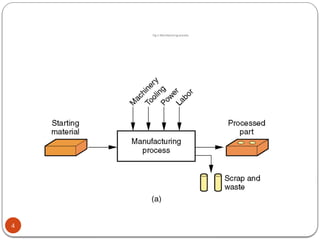
Fig 1 Manufacturing process
4
5
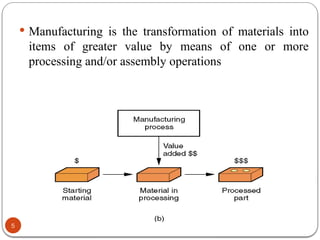
 Manufacturing is the transformation of materials into
items of greater value by means of one or more
processing and/or assembly operations
Example
6
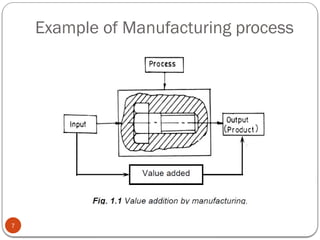
A lump of mild steel of irregular shape, dimensions and
surface, which had almost no use and value, has been
converted into a useful and valuable product like bolt by a
manufacturing process which imparted suitable features,
dimensional accuracy and surface finish, required for
fulfilling some functional requirements.
Example of Manufacturing process
7
Classification of manufacturing process
8
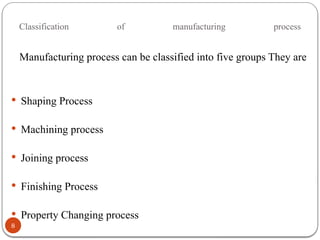
Manufacturing process can be classified into five groups They are
 Shaping Process
 Machining process
 Joining process
 Finishing Process
 Property Changing process
SHAPING PROCESS
9
Shaping is the process in which the shape and size of the material is
changed without the removal of materials.
Common processes under shaping are
 Casting
 Forging
 Rolling
 Extruding
 Drawing ….
Machining Process
10
 Machining process are those processes in which shape and size
of the work piece is changed by removing the material from
unwanted portions of the same
This process is carried out after shaping process
This also requires machines and cutting tools for material removal
Common processes coming under machining are
Surfacing
Turning
Shaping
Drilling
Grinding
Milling …..
Joining process
11
In joining process two or more parts are joined together.
Different joining processes are
 Welding
 Brazing
 Soldering
 Bolting
 Riveting
 Shrink fitting
Finishing process
12
 Finishing processes are those processes by which the
required surface finish or protective coating is provided to
the part.
 It is not considered as material removing process even
though small removal may take place during the operation
Some of the finishing processes are
 Honing
 Lapping
 Electroplating
 Galvanizing…
Property Changing
13
The processes are those processes by which certain properties of
the part is changed to make it suitable for a particular application
Certain processes coming under this category are
Annealing
Normalizing
Hardening
Tempering etc
Selection of manufacturing processes
14
A specific manufacturing process is selected by the
following criteria,
Type and nature of the work piece
Expected quality and quantity of components
Cost of production
15
MOLDING AND CASTING
Reference Books
Production Technology By R.K Jain
Production Technology By O.P Khanna
Basic Mechanical Engg by Benjamin
CASTING
16
 Metal Casting is one of the oldest materials shaping methods
known.
 Casting means pouring molten metal into a mold with a
cavity of the shape to be made, and allowing it to solidify.
 When solidified, the desired metal object is taken out from
the mold either by breaking the mold or taking the mold
apart.
 The solidified object is called the casting
 By this process, intricate parts can be given strength and
rigidity frequently not obtainable by any other
manufacturing process.
Cont…
17
 The mold, into which the metal is poured, is made of
some heat resisting material.
 Sand is most often used as it resists the high temperature
of the molten metal.
 Permanent molds of metal can also be used to cast
products.
18
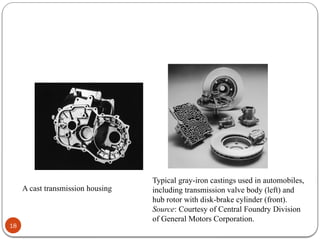
A cast transmission housing
Typical gray-iron castings used in automobiles,
including transmission valve body (left) and
hub rotor with disk-brake cylinder (front).
Source: Courtesy of Central Foundry Division
of General Motors Corporation.
Advantages Of Casting
19
 Molten material can flow into very small sections so that intricate
shapes can be made by this process. As a result, many other operations,
such as machining, forging, and welding, can be minimized or
eliminated
 It is possible to cast practically any material that is ferrous or non-
ferrous.
 As the metal can be placed exactly where it is required, large saving in
weight can be achieved.
 The necessary tools required for casting molds are very simple and
inexpensive. As a result, for production of a small lot, it is the
ideal process.
 There are certain parts made from metals and alloys that can only be
processed this way.
 Size and weight of the product is not a limitation for the casting
process.
Limitations
20
 Dimensional accuracy and surface finish of the castings made
by sand casting processes are a limitation to this technique.
 Many new casting processes have been developed which can
take into consideration the aspects of dimensional accuracy
and surface finish.
 Some of these processes are die casting process, investment
casting process, vacuum-sealed molding process, and shell
molding process.
 The metal casting process is a labor intensive process
CASTING TERMS
21
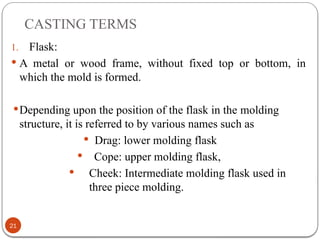
1. Flask:
 A metal or wood frame, without fixed top or bottom, in
which the mold is formed.
Depending upon the position of the flask in the molding
structure, it is referred to by various names such as
 Drag: lower molding flask
 Cope: upper molding flask,
 Cheek: Intermediate molding flask used in
three piece molding.
22
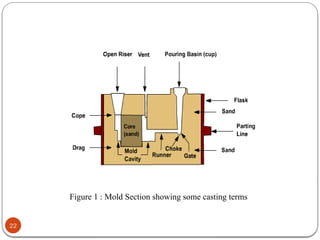
Figure 1 : Mold Section showing some casting terms
23
24
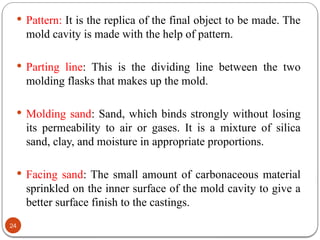
 Pattern: It is the replica of the final object to be made. The
mold cavity is made with the help of pattern.
 Parting line: This is the dividing line between the two
molding flasks that makes up the mold.
 Molding sand: Sand, which binds strongly without losing
its permeability to air or gases. It is a mixture of silica
sand, clay, and moisture in appropriate proportions.
 Facing sand: The small amount of carbonaceous material
sprinkled on the inner surface of the mold cavity to give a
better surface finish to the castings.
25
 Core: A separate part of the mold, made of sand and generally baked,
which is used to create openings and various shaped cavities in the
castings.
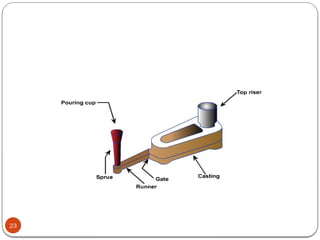
 Pouring basin: A small funnel shaped cavity at the top of the mold
into which the molten metal is poured.
 Sprue: The passage through which the molten metal, from the
pouring basin, reaches the mold cavity. In many cases it controls the
flow of metal into the mold.
 Runner: The channel through which the molten metal is carried from
the sprue to the gate.
 Gate: A channel through which the molten metal enters the mold
cavity.
26
 Chaplets: Chaplets are used to support the cores inside
the mold cavity to take care of its own weight and
overcome the metallostatic force.
 Riser: A column of molten metal placed in the mold to
feed the castings as it shrinks and solidifies. Also known
as feed head. (open riser and blind riser)
 Vent: Small opening in the mold to facilitate escape of air
and gases.
27
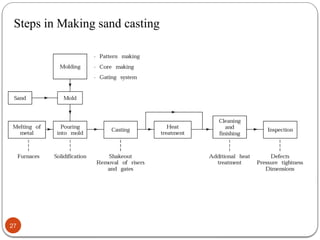
Steps in Making sand casting
28
Properties of Molding sand
 Flowability
Ability of the molding sand to get compacted to a uniform density
 Green strength
It is the strength of the sand in moist condition
 Dry strength
It is the strength of the sand in dry condition
 Permeability
It is the ability of the molding sand to allow the passage of mold gases through them. Mold gases
are formed by the reaction between the molten metal with the binders or moisture
 Refractoriness
It is the ability of the materials to resist high temperature
 Adhesiveness
Ability of the sand to stick on to the mould walls
 Collapsibility
It is the ability of the sand to collapse after the solidification process
29
 Fineness
It is the ability of the sand to produce the smooth
surfaced castings
 Coefficient of expansion
A good molding sand should have good coefficient of
expansion
 Durability
It is the ability of the sand to be used again and again
30
DIE CASTING
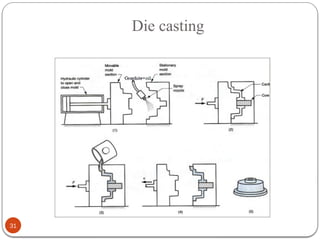
Die casting
31
32
Permanent mold Casting
Permanent casting make use of a mold which can be used again and
again.
It is classified into
Gravity Die casting
Low and High Pressure Die Casting
Gravity Die casting
 Here molten metal is poured into mold under gravity.
No external pressure is applied to force the liquid metal in to
the mould cavity.
Permanent molds are made up of dense, fine grained heat
resistant cast iron.
These molds are called dies ,which can be designed to produce
complex shape with a high degree of accuracy and repeatability.
33
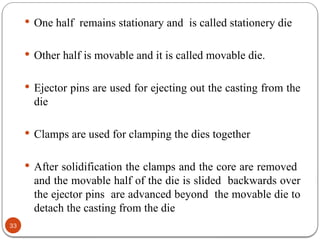
 One half remains stationary and is called stationery die
 Other half is movable and it is called movable die.
 Ejector pins are used for ejecting out the casting from the
die
 Clamps are used for clamping the dies together
 After solidification the clamps and the core are removed
and the movable half of the die is slided backwards over
the ejector pins are advanced beyond the movable die to
detach the casting from the die
34
Pressure Die casting
 In pressure die casting the molten metal is forced in to the mold
cavity under pressure
 The pressure varies from 70 to 5000 Kg/cm2
and is sustained
while the casting solidifies.
 It is used for producing casting having intricate shapes
Steps in pressure die casting
 Closing the two halves of the die
 Holding the 2 halves of the die firmly together during pouring and
solidification
 Forcing the molten metal into the die
 Opening the two halves of the die
 Ejecting the casting
35
There are two types of molten metal injection mechanisms
 Hot Chamber process
 Cold chamber process
Hot chamber process
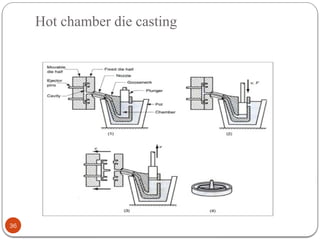
 In hot chamber process a pool of molten metal is
maintained in a metal pot.
 Molten metal fills the cylindrical portions and the curved
passage ways of the cast iron gooseneck
 Plunger is in raised position initially
 During the operation plunger is lowered forcing the molten
metal into the closed die
 Pressure applied to the molten metal is in the order of 30 to
45 Kg/cm2
Hot chamber die casting
36
37
 When the molten metal solidifies the movable die opens
 The casting stays in the die part equipped with the ejectors
 The hot chamber process is used for metals with low melting
points and high fluidity Eg Zinc,Tn,lead
Cold Chamber process
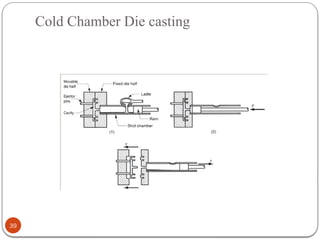
 Cold chamber machine consists of a pressure chamber of
cylindrical shape with a piston operated by the hydraulic
pressure
 Molten metal is brought in a ladle and is poured in to the cold
chamber after the die is closed
 Ram forces the molten metal in to the die
38
 The pressure exerted is in the range of 200 to 2000
Kg/cm2.
 When the molten metal is solidified the movable die with
the ejector pins is opened and the ejector pins remove
the casting from the die.
 Here the molten metal is poured in to the cold chamber
die casting is at a lower temperature compared to the hot
chamber die casting technique.
 This is mainly used for metals like aluminum and copper.
Cold Chamber Die casting
39
40
Advantages of Die casting
 Die casting is an efficient, economical process offering a broader
range of shapes.
 Die casting produces stronger parts with closer tolerances that
have greater stability and durability.
 This produces parts with thinner walls closer to dimensional
limits and smoother surfaces.
 Production is faster and labour cost per casting are lower.
 Finishing costs are also less.
Disadvantage of Die Casting
 Not applicable for high melting point metals and alloys.
 Large parts cannot be cast.
 Cost of Die is high.
 Gases get entrapped causing defects.
41
Casting Defects
Defects may occur due to one or more of the following
reasons:
 Fault in design of casting pattern
 Fault in design on mold and core
 Fault in design of gating system and riser
 Improper choice of molding sand
 Improper metal composition
 Inadequate melting temperature and rate of pouring
42
Classification of Casting Defects
 Surface Defects
Blow, Scar, Blister, Drop, Scab, Penetration,
Buckle
 Internal Defects
Blow holes, Porosity, Pin holes, Inclusions, Dross
 Visible Defects
 Wash, Rat tail, Swell, Mis run, Cold shut, Hot tear,
Shrinkage/Shift
43
Surface Defects
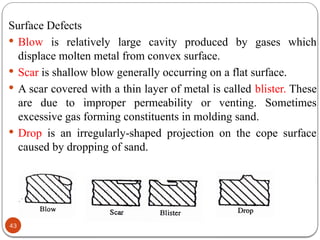
 Blow is relatively large cavity produced by gases which
displace molten metal from convex surface.
 Scar is shallow blow generally occurring on a flat surface.
 A scar covered with a thin layer of metal is called blister. These
are due to improper permeability or venting. Sometimes
excessive gas forming constituents in molding sand.
 Drop is an irregularly-shaped projection on the cope surface
caused by dropping of sand.
44
Surface Defects
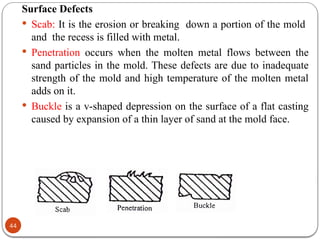
 Scab: It is the erosion or breaking down a portion of the mold
and the recess is filled with metal.
 Penetration occurs when the molten metal flows between the
sand particles in the mold. These defects are due to inadequate
strength of the mold and high temperature of the molten metal
adds on it.
 Buckle is a v-shaped depression on the surface of a flat casting
caused by expansion of a thin layer of sand at the mold face.
45
Internal Defects
 The internal defects found in the castings are mainly
due to trapped gases and dirty metal.
 Gases get trapped due to hard ramming or improper
venting.
 These defects also occur when excessive moisture or
excessive gas forming materials are used for mold
making.
46
Different Internal Defects are
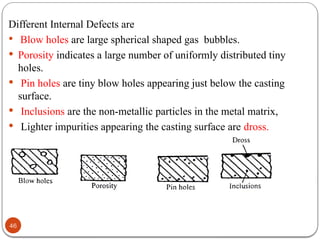
 Blow holes are large spherical shaped gas bubbles.
 Porosity indicates a large number of uniformly distributed tiny
holes.
 Pin holes are tiny blow holes appearing just below the casting
surface.
 Inclusions are the non-metallic particles in the metal matrix,
 Lighter impurities appearing the casting surface are dross.
47
Visible Defects
 Insufficient mold strength, insufficient metal, low pouring
temperature, and bad design of casting are some of the
common causes.
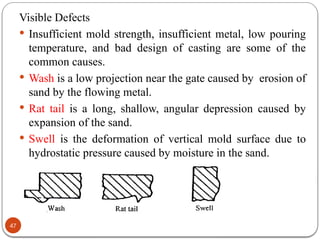
 Wash is a low projection near the gate caused by erosion of
sand by the flowing metal.
 Rat tail is a long, shallow, angular depression caused by
expansion of the sand.
 Swell is the deformation of vertical mold surface due to
hydrostatic pressure caused by moisture in the sand.
48
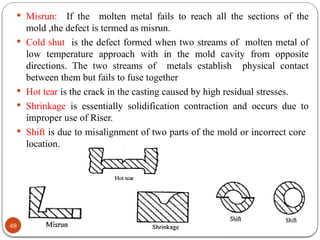
 Misrun: If the molten metal fails to reach all the sections of the
mold ,the defect is termed as misrun.
 Cold shut is the defect formed when two streams of molten metal of
low temperature approach with in the mold cavity from opposite
directions. The two streams of metals establish physical contact
between them but fails to fuse together
 Hot tear is the crack in the casting caused by high residual stresses.
 Shrinkage is essentially solidification contraction and occurs due to
improper use of Riser.
 Shift is due to misalignment of two parts of the mold or incorrect core
location.

production technology casting notes.pptx

  • 1.
  • 2.
    Introduction 2  Almost everyproduct we use is produced using some type of manufacturing process.  Most of the food we eat is processed. We watch television on a set that was manufactured.  Likewise, the vehicle we drive is the product of processing actions.  The books and magazines we read  CDs that bring us music were all manufactured
  • 3.
    Definition 3 • Manufacturing isthe application of physical and chemical processes to alter the geometry, properties, and appearance of a starting material to make parts or products for a given application • Production or manufacturing can be simply defined as value addition processes by which raw materials of low utility and value due to its inadequate material properties and poor or irregular size, shape and finish are converted into high utility and valued products with definite dimensions, forms and finish imparting some functional ability
  • 4.
  • 5.
    5  Manufacturing isthe transformation of materials into items of greater value by means of one or more processing and/or assembly operations
  • 6.
    Example 6 A lump ofmild steel of irregular shape, dimensions and surface, which had almost no use and value, has been converted into a useful and valuable product like bolt by a manufacturing process which imparted suitable features, dimensional accuracy and surface finish, required for fulfilling some functional requirements.
  • 7.
  • 8.
    Classification of manufacturingprocess 8 Manufacturing process can be classified into five groups They are  Shaping Process  Machining process  Joining process  Finishing Process  Property Changing process
  • 9.
    SHAPING PROCESS 9 Shaping isthe process in which the shape and size of the material is changed without the removal of materials. Common processes under shaping are  Casting  Forging  Rolling  Extruding  Drawing ….
  • 10.
    Machining Process 10  Machiningprocess are those processes in which shape and size of the work piece is changed by removing the material from unwanted portions of the same This process is carried out after shaping process This also requires machines and cutting tools for material removal Common processes coming under machining are Surfacing Turning Shaping Drilling Grinding Milling …..
  • 11.
    Joining process 11 In joiningprocess two or more parts are joined together. Different joining processes are  Welding  Brazing  Soldering  Bolting  Riveting  Shrink fitting
  • 12.
    Finishing process 12  Finishingprocesses are those processes by which the required surface finish or protective coating is provided to the part.  It is not considered as material removing process even though small removal may take place during the operation Some of the finishing processes are  Honing  Lapping  Electroplating  Galvanizing…
  • 13.
    Property Changing 13 The processesare those processes by which certain properties of the part is changed to make it suitable for a particular application Certain processes coming under this category are Annealing Normalizing Hardening Tempering etc
  • 14.
    Selection of manufacturingprocesses 14 A specific manufacturing process is selected by the following criteria, Type and nature of the work piece Expected quality and quantity of components Cost of production
  • 15.
    15 MOLDING AND CASTING ReferenceBooks Production Technology By R.K Jain Production Technology By O.P Khanna Basic Mechanical Engg by Benjamin
  • 16.
    CASTING 16  Metal Castingis one of the oldest materials shaping methods known.  Casting means pouring molten metal into a mold with a cavity of the shape to be made, and allowing it to solidify.  When solidified, the desired metal object is taken out from the mold either by breaking the mold or taking the mold apart.  The solidified object is called the casting  By this process, intricate parts can be given strength and rigidity frequently not obtainable by any other manufacturing process.
  • 17.
    Cont… 17  The mold,into which the metal is poured, is made of some heat resisting material.  Sand is most often used as it resists the high temperature of the molten metal.  Permanent molds of metal can also be used to cast products.
  • 18.
    18 A cast transmissionhousing Typical gray-iron castings used in automobiles, including transmission valve body (left) and hub rotor with disk-brake cylinder (front). Source: Courtesy of Central Foundry Division of General Motors Corporation.
  • 19.
    Advantages Of Casting 19 Molten material can flow into very small sections so that intricate shapes can be made by this process. As a result, many other operations, such as machining, forging, and welding, can be minimized or eliminated  It is possible to cast practically any material that is ferrous or non- ferrous.  As the metal can be placed exactly where it is required, large saving in weight can be achieved.  The necessary tools required for casting molds are very simple and inexpensive. As a result, for production of a small lot, it is the ideal process.  There are certain parts made from metals and alloys that can only be processed this way.  Size and weight of the product is not a limitation for the casting process.
  • 20.
    Limitations 20  Dimensional accuracyand surface finish of the castings made by sand casting processes are a limitation to this technique.  Many new casting processes have been developed which can take into consideration the aspects of dimensional accuracy and surface finish.  Some of these processes are die casting process, investment casting process, vacuum-sealed molding process, and shell molding process.  The metal casting process is a labor intensive process
  • 21.
    CASTING TERMS 21 1. Flask: A metal or wood frame, without fixed top or bottom, in which the mold is formed. Depending upon the position of the flask in the molding structure, it is referred to by various names such as  Drag: lower molding flask  Cope: upper molding flask,  Cheek: Intermediate molding flask used in three piece molding.
  • 22.
    22 Figure 1 :Mold Section showing some casting terms
  • 23.
  • 24.
    24  Pattern: Itis the replica of the final object to be made. The mold cavity is made with the help of pattern.  Parting line: This is the dividing line between the two molding flasks that makes up the mold.  Molding sand: Sand, which binds strongly without losing its permeability to air or gases. It is a mixture of silica sand, clay, and moisture in appropriate proportions.  Facing sand: The small amount of carbonaceous material sprinkled on the inner surface of the mold cavity to give a better surface finish to the castings.
  • 25.
    25  Core: Aseparate part of the mold, made of sand and generally baked, which is used to create openings and various shaped cavities in the castings.  Pouring basin: A small funnel shaped cavity at the top of the mold into which the molten metal is poured.  Sprue: The passage through which the molten metal, from the pouring basin, reaches the mold cavity. In many cases it controls the flow of metal into the mold.  Runner: The channel through which the molten metal is carried from the sprue to the gate.  Gate: A channel through which the molten metal enters the mold cavity.
  • 26.
    26  Chaplets: Chapletsare used to support the cores inside the mold cavity to take care of its own weight and overcome the metallostatic force.  Riser: A column of molten metal placed in the mold to feed the castings as it shrinks and solidifies. Also known as feed head. (open riser and blind riser)  Vent: Small opening in the mold to facilitate escape of air and gases.
  • 27.
    27 Steps in Makingsand casting
  • 28.
    28 Properties of Moldingsand  Flowability Ability of the molding sand to get compacted to a uniform density  Green strength It is the strength of the sand in moist condition  Dry strength It is the strength of the sand in dry condition  Permeability It is the ability of the molding sand to allow the passage of mold gases through them. Mold gases are formed by the reaction between the molten metal with the binders or moisture  Refractoriness It is the ability of the materials to resist high temperature  Adhesiveness Ability of the sand to stick on to the mould walls  Collapsibility It is the ability of the sand to collapse after the solidification process
  • 29.
    29  Fineness It isthe ability of the sand to produce the smooth surfaced castings  Coefficient of expansion A good molding sand should have good coefficient of expansion  Durability It is the ability of the sand to be used again and again
  • 30.
  • 31.
  • 32.
    32 Permanent mold Casting Permanentcasting make use of a mold which can be used again and again. It is classified into Gravity Die casting Low and High Pressure Die Casting Gravity Die casting  Here molten metal is poured into mold under gravity. No external pressure is applied to force the liquid metal in to the mould cavity. Permanent molds are made up of dense, fine grained heat resistant cast iron. These molds are called dies ,which can be designed to produce complex shape with a high degree of accuracy and repeatability.
  • 33.
    33  One halfremains stationary and is called stationery die  Other half is movable and it is called movable die.  Ejector pins are used for ejecting out the casting from the die  Clamps are used for clamping the dies together  After solidification the clamps and the core are removed and the movable half of the die is slided backwards over the ejector pins are advanced beyond the movable die to detach the casting from the die
  • 34.
    34 Pressure Die casting In pressure die casting the molten metal is forced in to the mold cavity under pressure  The pressure varies from 70 to 5000 Kg/cm2 and is sustained while the casting solidifies.  It is used for producing casting having intricate shapes Steps in pressure die casting  Closing the two halves of the die  Holding the 2 halves of the die firmly together during pouring and solidification  Forcing the molten metal into the die  Opening the two halves of the die  Ejecting the casting
  • 35.
    35 There are twotypes of molten metal injection mechanisms  Hot Chamber process  Cold chamber process Hot chamber process  In hot chamber process a pool of molten metal is maintained in a metal pot.  Molten metal fills the cylindrical portions and the curved passage ways of the cast iron gooseneck  Plunger is in raised position initially  During the operation plunger is lowered forcing the molten metal into the closed die  Pressure applied to the molten metal is in the order of 30 to 45 Kg/cm2
  • 36.
    Hot chamber diecasting 36
  • 37.
    37  When themolten metal solidifies the movable die opens  The casting stays in the die part equipped with the ejectors  The hot chamber process is used for metals with low melting points and high fluidity Eg Zinc,Tn,lead Cold Chamber process  Cold chamber machine consists of a pressure chamber of cylindrical shape with a piston operated by the hydraulic pressure  Molten metal is brought in a ladle and is poured in to the cold chamber after the die is closed  Ram forces the molten metal in to the die
  • 38.
    38  The pressureexerted is in the range of 200 to 2000 Kg/cm2.  When the molten metal is solidified the movable die with the ejector pins is opened and the ejector pins remove the casting from the die.  Here the molten metal is poured in to the cold chamber die casting is at a lower temperature compared to the hot chamber die casting technique.  This is mainly used for metals like aluminum and copper.
  • 39.
    Cold Chamber Diecasting 39
  • 40.
    40 Advantages of Diecasting  Die casting is an efficient, economical process offering a broader range of shapes.  Die casting produces stronger parts with closer tolerances that have greater stability and durability.  This produces parts with thinner walls closer to dimensional limits and smoother surfaces.  Production is faster and labour cost per casting are lower.  Finishing costs are also less. Disadvantage of Die Casting  Not applicable for high melting point metals and alloys.  Large parts cannot be cast.  Cost of Die is high.  Gases get entrapped causing defects.
  • 41.
    41 Casting Defects Defects mayoccur due to one or more of the following reasons:  Fault in design of casting pattern  Fault in design on mold and core  Fault in design of gating system and riser  Improper choice of molding sand  Improper metal composition  Inadequate melting temperature and rate of pouring
  • 42.
    42 Classification of CastingDefects  Surface Defects Blow, Scar, Blister, Drop, Scab, Penetration, Buckle  Internal Defects Blow holes, Porosity, Pin holes, Inclusions, Dross  Visible Defects  Wash, Rat tail, Swell, Mis run, Cold shut, Hot tear, Shrinkage/Shift
  • 43.
    43 Surface Defects  Blowis relatively large cavity produced by gases which displace molten metal from convex surface.  Scar is shallow blow generally occurring on a flat surface.  A scar covered with a thin layer of metal is called blister. These are due to improper permeability or venting. Sometimes excessive gas forming constituents in molding sand.  Drop is an irregularly-shaped projection on the cope surface caused by dropping of sand.
  • 44.
    44 Surface Defects  Scab:It is the erosion or breaking down a portion of the mold and the recess is filled with metal.  Penetration occurs when the molten metal flows between the sand particles in the mold. These defects are due to inadequate strength of the mold and high temperature of the molten metal adds on it.  Buckle is a v-shaped depression on the surface of a flat casting caused by expansion of a thin layer of sand at the mold face.
  • 45.
    45 Internal Defects  Theinternal defects found in the castings are mainly due to trapped gases and dirty metal.  Gases get trapped due to hard ramming or improper venting.  These defects also occur when excessive moisture or excessive gas forming materials are used for mold making.
  • 46.
    46 Different Internal Defectsare  Blow holes are large spherical shaped gas bubbles.  Porosity indicates a large number of uniformly distributed tiny holes.  Pin holes are tiny blow holes appearing just below the casting surface.  Inclusions are the non-metallic particles in the metal matrix,  Lighter impurities appearing the casting surface are dross.
  • 47.
    47 Visible Defects  Insufficientmold strength, insufficient metal, low pouring temperature, and bad design of casting are some of the common causes.  Wash is a low projection near the gate caused by erosion of sand by the flowing metal.  Rat tail is a long, shallow, angular depression caused by expansion of the sand.  Swell is the deformation of vertical mold surface due to hydrostatic pressure caused by moisture in the sand.
  • 48.
    48  Misrun: Ifthe molten metal fails to reach all the sections of the mold ,the defect is termed as misrun.  Cold shut is the defect formed when two streams of molten metal of low temperature approach with in the mold cavity from opposite directions. The two streams of metals establish physical contact between them but fails to fuse together  Hot tear is the crack in the casting caused by high residual stresses.  Shrinkage is essentially solidification contraction and occurs due to improper use of Riser.  Shift is due to misalignment of two parts of the mold or incorrect core location.