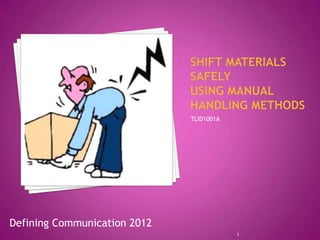
TLID1001A

Defining Communication 2012
1
At the end of this workshop you should
be able to:
 To understand what is meant by the
term “manual tasks” and how they
cause injury
 Identify, assess and control manual
task risks in a systematic manner

Defining Communication

10/10/12 v1

2
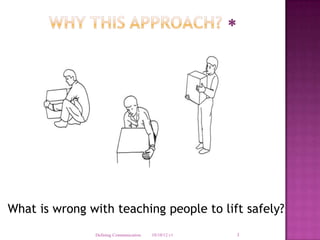
What is wrong with teaching people to lift safely?
Defining Communication

10/10/12 v1

3
REGULATION
Occupational Health and Safety regulation 3.4 states —
 "Manual handling" means any activity requiring the use of force exerted by a
person to lift, lower, push, pull, carry or otherwise move, hold or restrain a
person, animal or thing.
 Without limiting regulation 3.1, a person who, at a workplace, is an
employer, the main contractor or a self-employed person must, as far as
practicable —
 Identify each hazard that is likely to arise from manual handling at the
workplace;
 Assess the risk of injury or harm to a person resulting from each hazard, if
any, identified under paragraph (a); and
 Consider the means by which the risk may be reduced.


PROCEDURE
To control the risks associated with manual handling all staff should ensure that
the correct posture is used when lifting. The correct posture ensures that the
load is held close to the body, that bending forward to pick up loads is not
considered, that twisting is minimised and that the load is not too heavy for the
person concerned. If any of the above need to be considered to enable lifting, do
not attempt to complete the task. Assistance should be obtained.




Defining Communication

10/10/12 v1

4
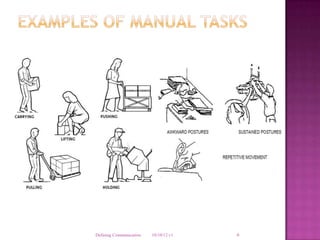
Definition
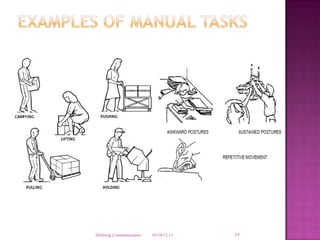
Any activity or sequence of activities
that requires a person to use their
physical body (musculoskeletal
system) to perform work
This Includes:
 Lifting

 Pulling

 Sliding

 Pushing

 Carrying

 Stacking

Defining Communication

10/10/12 v1

5
Defining Communication

10/10/12 v1

6
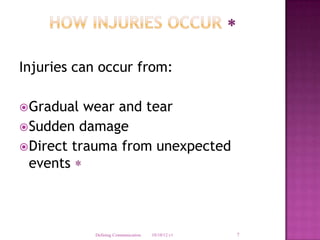
Injuries can occur from:
 Gradual

wear and tear
 Sudden damage
 Direct trauma from unexpected
events

Defining Communication

10/10/12 v1

7
Defining Communication

10/10/12 v1

8
Defining Communication

10/10/12 v1

9
• Sudden

Stress: which can be
caused by slips, falls and lifting;

• Consecutive

Stress: which can be
caused by heavy lifting, high
forces, repetitive movements or
extreme postures;

• Continuous

Stress: which can be
caused by vehicle vibration or poor
posture
Defining Communication

10/10/12 v1

10
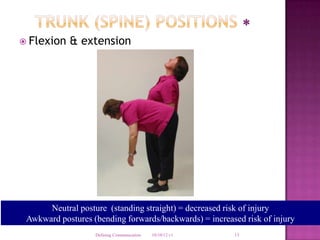
 Flexion

& extension

Neutral posture (standing straight) = decreased risk of injury
Awkward postures (bending forwards/backwards) = increased risk of injury
Defining Communication

10/10/12 v1

11

11
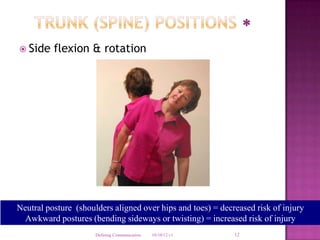
 Side

flexion & rotation

Neutral posture (shoulders aligned over hips and toes) = decreased risk of injury
Awkward postures (bending sideways or twisting) = increased risk of injury
Defining Communication

10/10/12 v1

12
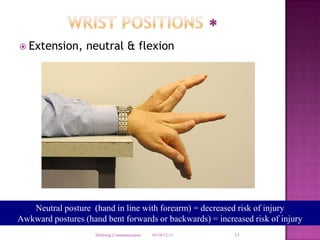
 Extension,

neutral & flexion

Neutral posture (hand in line with forearm) = decreased risk of injury
Awkward postures (hand bent forwards or backwards) = increased risk of injury
Defining Communication

10/10/12 v1

13
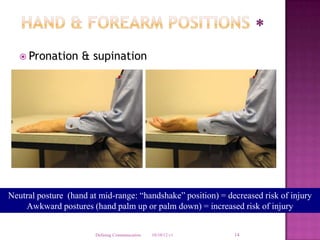
 Pronation

& supination

Neutral posture (hand at mid-range: “handshake” position) = decreased risk of injury
Awkward postures (hand palm up or palm down) = increased risk of injury

Defining Communication

10/10/12 v1

14
 Dynamic

Muscle contraction & movement.
 Static

Muscle contraction & no movement.

Static muscle work (prolonged standing, sitting, holding hand/arm in one position) =
increased risk of injury
REPETITIVE dynamic muscle work over time = increased risk of injury
Defining Communication

10/10/12 v1

15
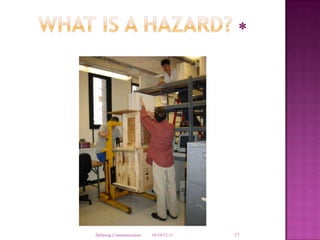
A

source of potential loss or danger

 An

accident waiting to happen.

Everyone is responsible for a safe and
healthy workplace

Defining Communication

10/10/12 v1

16
Defining Communication

10/10/12 v1

17
 Many

things that workers do involve
performing activities that can be
considered to be manual tasks.



The term hazardous manual tasks
is used to describe those that have
the potential to cause injury
Defining Communication

10/10/12 v1

18
Defining Communication

10/10/12 v1

19
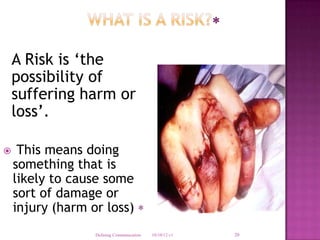
A Risk is „the
possibility of
suffering harm or
loss‟.


This means doing
something that is
likely to cause some
sort of damage or
injury (harm or loss)
Defining Communication

10/10/12 v1

20
What is it?

The process of eliminating or reducing
risk associated with identified and
assessed risk factors
Why do we do it?

To make the job or task safer for
workers and prevent/ reduce injuries
from manual tasks
Defining Communication

10/10/12 v1

21
The risk of injury increases when:
 The

body is using awkward postures, rather
than preferred neutral postures

 Muscles

are involved in static work (contraction
without movement) or in highly repetitive
movements

 The

body is exposed to high/intense (oneoff), cumulative (ongoing) or unexpected forces
Defining Communication

10/10/12 v1

22
The sources of risk that create these body
conditions where injury may occur include:
 Nature

of the item, equipment or tool
 The nature of the load
 The working environment
 Systems of work, work organisation and
work practices
 Work area design and layout
Defining Communication

10/10/12 v1

23
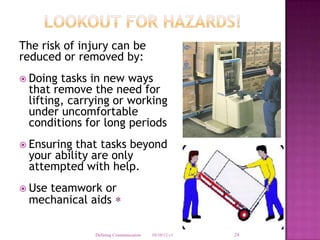
The risk of injury can be
reduced or removed by:
 Doing

tasks in new ways
that remove the need for
lifting, carrying or working
under uncomfortable
conditions for long periods

 Ensuring

that tasks beyond
your ability are only
attempted with help.

 Use

teamwork or
mechanical aids
Defining Communication

10/10/12 v1

24
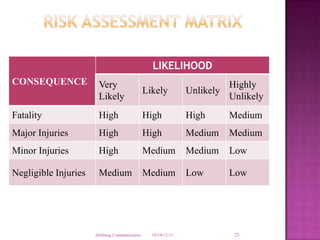
LIKELIHOOD
CONSEQUENCE

Very
Likely

Likely

Unlikely

Highly
Unlikely

Fatality

High

High

High

Medium

Major Injuries

High

High

Medium

Medium

Minor Injuries

High

Medium

Medium

Low

Negligible Injuries

Medium

Medium

Low

Low

Defining Communication

10/10/12 v1

25
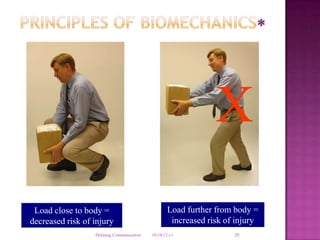
X
Load close to body =
decreased risk of injury
Defining Communication

Load further from body =
increased risk of injury
10/10/12 v1

26


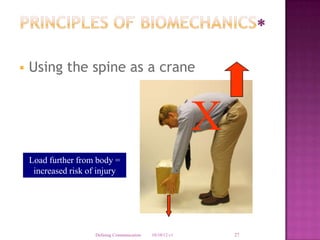
Using the spine as a crane

X
Load further from body =
increased risk of injury

Defining Communication

10/10/12 v1

27
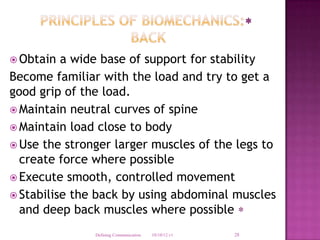
 Obtain

a wide base of support for stability
Become familiar with the load and try to get a
good grip of the load.
 Maintain neutral curves of spine
 Maintain load close to body
 Use the stronger larger muscles of the legs to
create force where possible
 Execute smooth, controlled movement
 Stabilise the back by using abdominal muscles
and deep back muscles where possible
Defining Communication

10/10/12 v1

28
 Avoid

work where the upper arm is away
from the side of the body
 Avoid twisting
 Avoid holding one position for long
periods of time
 Avoid repetitive movement
 Avoid long distance carrying
 Try to maintain the wrist and forearm in
neutral postures
Defining Communication

10/10/12 v1

29
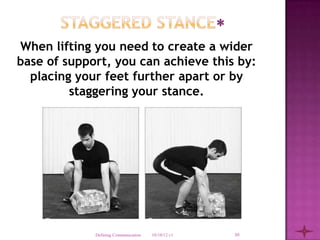
When lifting you need to create a wider
base of support, you can achieve this by:
placing your feet further apart or by
staggering your stance.

Defining Communication

10/10/12 v1

30
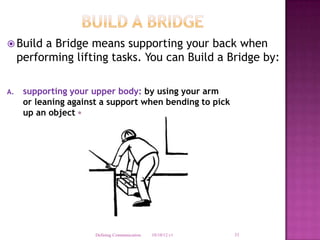
 Build

a Bridge means supporting your back when
performing lifting tasks. You can Build a Bridge by:

A.

supporting your upper body: by using your arm
or leaning against a support when bending to pick
up an object

Defining Communication

10/10/12 v1

31
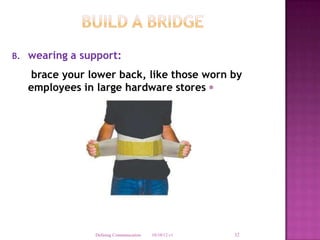
B.

wearing a support:
brace your lower back, like those worn by
employees in large hardware stores

Defining Communication

10/10/12 v1

32
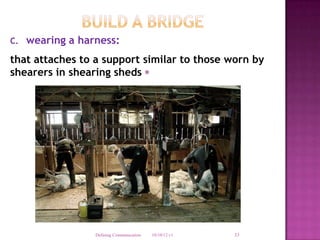
C.

wearing a harness:

that attaches to a support similar to those worn by
shearers in shearing sheds

Defining Communication

10/10/12 v1

33
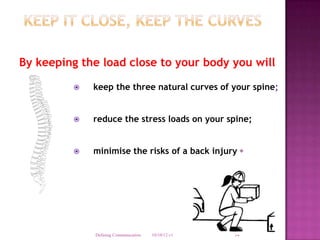
By keeping the load close to your body you will


keep the three natural curves of your spine;



reduce the stress loads on your spine;



minimise the risks of a back injury

Defining Communication

10/10/12 v1

34
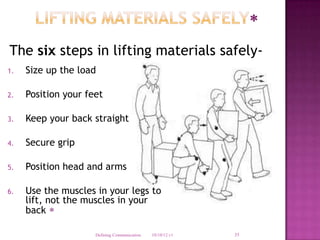
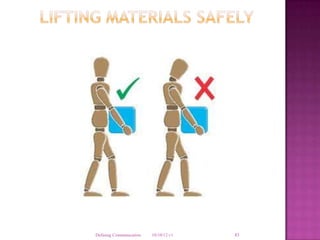
The six steps in lifting materials safely1.

Size up the load

2.

Position your feet

3.

Keep your back straight

4.

Secure grip

5.

Position head and arms

6.

Use the muscles in your legs to
lift, not the muscles in your
back
Defining Communication

10/10/12 v1

35
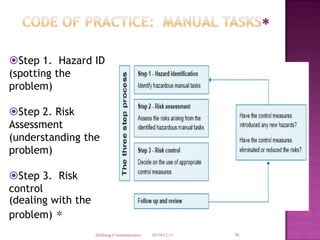
Step 1. Hazard ID
(spotting the
problem)
Step 2. Risk
Assessment
(understanding the
problem)

Step 3. Risk
control
(dealing with the
problem)
Defining Communication

10/10/12 v1

36
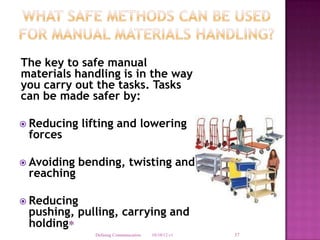
The key to safe manual
materials handling is in the way
you carry out the tasks. Tasks
can be made safer by:
 Reducing

lifting and lowering

 Avoiding

bending, twisting and

forces

reaching

 Reducing

pushing, pulling, carrying and
holding
Defining Communication

10/10/12 v1

37
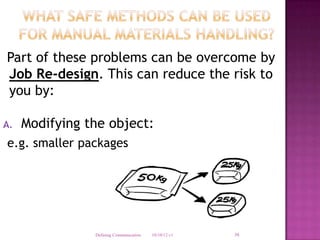
Part of these problems can be overcome by
Job Re-design. This can reduce the risk to
you by:
A.

Modifying the object:

e.g. smaller packages

Defining Communication

10/10/12 v1

38
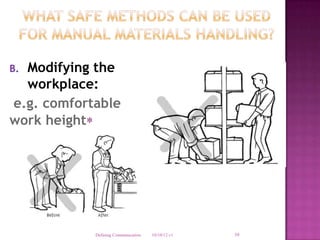
Modifying the
workplace:
e.g. comfortable
work height
B.

Defining Communication

10/10/12 v1

39
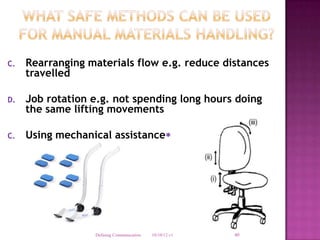
C.

Rearranging materials flow e.g. reduce distances
travelled

D.

Job rotation e.g. not spending long hours doing
the same lifting movements

C.

Using mechanical assistance

Defining Communication

10/10/12 v1

40
You must be able to accurately assess all
the risks involved with a particular load
relocation task.
This includes risks to:
1. yourself
2. the load
3. any other materials
on your relocation route
Defining Communication

10/10/12 v1

41
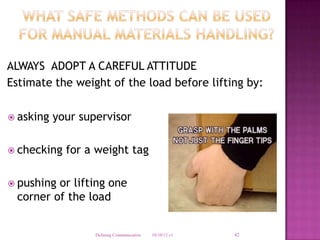
ALWAYS ADOPT A CAREFUL ATTITUDE
Estimate the weight of the load before lifting by:
 asking

your supervisor

 checking

for a weight tag

 pushing

or lifting one
corner of the load

Defining Communication

10/10/12 v1

42
Defining Communication

10/10/12 v1

43
Defining Communication

10/10/12 v1

44
Defining Communication

10/10/12 v1

45
Ask yourself these
questions when you are
planning to relocate a
load:
1.
2.
3.
4.
5.
6.

Where are you relocating stock to?
Which route is the quickest/safest?
How will you place the load in the new location?
Are you adding to an existing load?
How will the existing load be affected?
Can you do the job alone or do you need help?
Defining Communication

10/10/12 v1

46
1.
2.
3.

4.
5.
6.

Take responsibility for the task
Team effort
Task performed with due care
Everybody understands the plan
Talk the team through the plan and
instructions you will be calling to them
After relocation check and consider
pressures and incidents that may affect
relocation- does it comply with workplace
regulations
Defining Communication

10/10/12 v1

47
 Determine

the weight of the load before
attempting to lift
 How far do I have to move it?
 Do I need some help?
 How many times do I have to complete
the lift?
 Do I need help?



Team lift
A lifting device (trolley, forklift, etc)

Remember Correct Lifting Techniques
Defining Communication

10/10/12 v1

48
When you are preparing to lift, let your body know what’s coming.
Prepare:
• perform some simple stretching exercises;
• size up the load to see if it is too heavy, too large or too awkward;
• decide where you will be setting down the load; and
• grip the load firmly before lifting it.
Plan:
• where you are taking the load;
• to keep the curves;

• not to bend or twist during the lift; and
• to lift with your legs and not your back and arms.
Compensate:
• make allowances when you begin to feel fatigued;
• use alternative aids if the load is too heavy; and
• determine if the task is routine or non-routine

Defining Communication

10/10/12 v1

49

Manual Handling - Shift Materials Safely

  • 1.
  • 2.
    At the endof this workshop you should be able to:  To understand what is meant by the term “manual tasks” and how they cause injury  Identify, assess and control manual task risks in a systematic manner Defining Communication 10/10/12 v1 2
  • 3.
    What is wrongwith teaching people to lift safely? Defining Communication 10/10/12 v1 3
  • 4.
    REGULATION Occupational Health andSafety regulation 3.4 states —  "Manual handling" means any activity requiring the use of force exerted by a person to lift, lower, push, pull, carry or otherwise move, hold or restrain a person, animal or thing.  Without limiting regulation 3.1, a person who, at a workplace, is an employer, the main contractor or a self-employed person must, as far as practicable —  Identify each hazard that is likely to arise from manual handling at the workplace;  Assess the risk of injury or harm to a person resulting from each hazard, if any, identified under paragraph (a); and  Consider the means by which the risk may be reduced.  PROCEDURE To control the risks associated with manual handling all staff should ensure that the correct posture is used when lifting. The correct posture ensures that the load is held close to the body, that bending forward to pick up loads is not considered, that twisting is minimised and that the load is not too heavy for the person concerned. If any of the above need to be considered to enable lifting, do not attempt to complete the task. Assistance should be obtained.   Defining Communication 10/10/12 v1 4
  • 5.
    Definition Any activity orsequence of activities that requires a person to use their physical body (musculoskeletal system) to perform work This Includes:  Lifting  Pulling  Sliding  Pushing  Carrying  Stacking Defining Communication 10/10/12 v1 5
  • 6.
  • 7.
    Injuries can occurfrom:  Gradual wear and tear  Sudden damage  Direct trauma from unexpected events Defining Communication 10/10/12 v1 7
  • 8.
  • 9.
  • 10.
    • Sudden Stress: whichcan be caused by slips, falls and lifting; • Consecutive Stress: which can be caused by heavy lifting, high forces, repetitive movements or extreme postures; • Continuous Stress: which can be caused by vehicle vibration or poor posture Defining Communication 10/10/12 v1 10
  • 11.
     Flexion & extension Neutralposture (standing straight) = decreased risk of injury Awkward postures (bending forwards/backwards) = increased risk of injury Defining Communication 10/10/12 v1 11 11
  • 12.
     Side flexion &rotation Neutral posture (shoulders aligned over hips and toes) = decreased risk of injury Awkward postures (bending sideways or twisting) = increased risk of injury Defining Communication 10/10/12 v1 12
  • 13.
     Extension, neutral &flexion Neutral posture (hand in line with forearm) = decreased risk of injury Awkward postures (hand bent forwards or backwards) = increased risk of injury Defining Communication 10/10/12 v1 13
  • 14.
     Pronation & supination Neutralposture (hand at mid-range: “handshake” position) = decreased risk of injury Awkward postures (hand palm up or palm down) = increased risk of injury Defining Communication 10/10/12 v1 14
  • 15.
     Dynamic Muscle contraction& movement.  Static Muscle contraction & no movement. Static muscle work (prolonged standing, sitting, holding hand/arm in one position) = increased risk of injury REPETITIVE dynamic muscle work over time = increased risk of injury Defining Communication 10/10/12 v1 15
  • 16.
    A source of potentialloss or danger  An accident waiting to happen. Everyone is responsible for a safe and healthy workplace Defining Communication 10/10/12 v1 16
  • 17.
  • 18.
     Many things thatworkers do involve performing activities that can be considered to be manual tasks.  The term hazardous manual tasks is used to describe those that have the potential to cause injury Defining Communication 10/10/12 v1 18
  • 19.
  • 20.
    A Risk is„the possibility of suffering harm or loss‟.  This means doing something that is likely to cause some sort of damage or injury (harm or loss) Defining Communication 10/10/12 v1 20
  • 21.
    What is it?  Theprocess of eliminating or reducing risk associated with identified and assessed risk factors Why do we do it?  To make the job or task safer for workers and prevent/ reduce injuries from manual tasks Defining Communication 10/10/12 v1 21
  • 22.
    The risk ofinjury increases when:  The body is using awkward postures, rather than preferred neutral postures  Muscles are involved in static work (contraction without movement) or in highly repetitive movements  The body is exposed to high/intense (oneoff), cumulative (ongoing) or unexpected forces Defining Communication 10/10/12 v1 22
  • 23.
    The sources ofrisk that create these body conditions where injury may occur include:  Nature of the item, equipment or tool  The nature of the load  The working environment  Systems of work, work organisation and work practices  Work area design and layout Defining Communication 10/10/12 v1 23
  • 24.
    The risk ofinjury can be reduced or removed by:  Doing tasks in new ways that remove the need for lifting, carrying or working under uncomfortable conditions for long periods  Ensuring that tasks beyond your ability are only attempted with help.  Use teamwork or mechanical aids Defining Communication 10/10/12 v1 24
  • 25.
  • 26.
    X Load close tobody = decreased risk of injury Defining Communication Load further from body = increased risk of injury 10/10/12 v1 26
  • 27.
     Using the spineas a crane X Load further from body = increased risk of injury Defining Communication 10/10/12 v1 27
  • 28.
     Obtain a widebase of support for stability Become familiar with the load and try to get a good grip of the load.  Maintain neutral curves of spine  Maintain load close to body  Use the stronger larger muscles of the legs to create force where possible  Execute smooth, controlled movement  Stabilise the back by using abdominal muscles and deep back muscles where possible Defining Communication 10/10/12 v1 28
  • 29.
     Avoid work wherethe upper arm is away from the side of the body  Avoid twisting  Avoid holding one position for long periods of time  Avoid repetitive movement  Avoid long distance carrying  Try to maintain the wrist and forearm in neutral postures Defining Communication 10/10/12 v1 29
  • 30.
    When lifting youneed to create a wider base of support, you can achieve this by: placing your feet further apart or by staggering your stance. Defining Communication 10/10/12 v1 30
  • 31.
     Build a Bridgemeans supporting your back when performing lifting tasks. You can Build a Bridge by: A. supporting your upper body: by using your arm or leaning against a support when bending to pick up an object Defining Communication 10/10/12 v1 31
  • 32.
    B. wearing a support: braceyour lower back, like those worn by employees in large hardware stores Defining Communication 10/10/12 v1 32
  • 33.
    C. wearing a harness: thatattaches to a support similar to those worn by shearers in shearing sheds Defining Communication 10/10/12 v1 33
  • 34.
    By keeping theload close to your body you will  keep the three natural curves of your spine;  reduce the stress loads on your spine;  minimise the risks of a back injury Defining Communication 10/10/12 v1 34
  • 35.
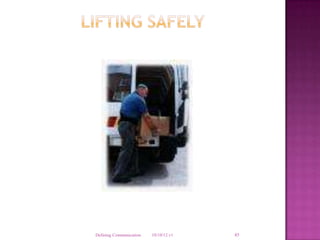
    The six stepsin lifting materials safely1. Size up the load 2. Position your feet 3. Keep your back straight 4. Secure grip 5. Position head and arms 6. Use the muscles in your legs to lift, not the muscles in your back Defining Communication 10/10/12 v1 35
  • 36.
    Step 1. HazardID (spotting the problem) Step 2. Risk Assessment (understanding the problem) Step 3. Risk control (dealing with the problem) Defining Communication 10/10/12 v1 36
  • 37.
    The key tosafe manual materials handling is in the way you carry out the tasks. Tasks can be made safer by:  Reducing lifting and lowering  Avoiding bending, twisting and forces reaching  Reducing pushing, pulling, carrying and holding Defining Communication 10/10/12 v1 37
  • 38.
    Part of theseproblems can be overcome by Job Re-design. This can reduce the risk to you by: A. Modifying the object: e.g. smaller packages Defining Communication 10/10/12 v1 38
  • 39.
    Modifying the workplace: e.g. comfortable workheight B. Defining Communication 10/10/12 v1 39
  • 40.
    C. Rearranging materials flowe.g. reduce distances travelled D. Job rotation e.g. not spending long hours doing the same lifting movements C. Using mechanical assistance Defining Communication 10/10/12 v1 40
  • 41.
    You must beable to accurately assess all the risks involved with a particular load relocation task. This includes risks to: 1. yourself 2. the load 3. any other materials on your relocation route Defining Communication 10/10/12 v1 41
  • 42.
    ALWAYS ADOPT ACAREFUL ATTITUDE Estimate the weight of the load before lifting by:  asking your supervisor  checking for a weight tag  pushing or lifting one corner of the load Defining Communication 10/10/12 v1 42
  • 43.
  • 44.
  • 45.
  • 46.
    Ask yourself these questionswhen you are planning to relocate a load: 1. 2. 3. 4. 5. 6. Where are you relocating stock to? Which route is the quickest/safest? How will you place the load in the new location? Are you adding to an existing load? How will the existing load be affected? Can you do the job alone or do you need help? Defining Communication 10/10/12 v1 46
  • 47.
    1. 2. 3. 4. 5. 6. Take responsibility forthe task Team effort Task performed with due care Everybody understands the plan Talk the team through the plan and instructions you will be calling to them After relocation check and consider pressures and incidents that may affect relocation- does it comply with workplace regulations Defining Communication 10/10/12 v1 47
  • 48.
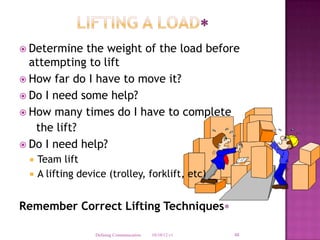
     Determine the weightof the load before attempting to lift  How far do I have to move it?  Do I need some help?  How many times do I have to complete the lift?  Do I need help?   Team lift A lifting device (trolley, forklift, etc) Remember Correct Lifting Techniques Defining Communication 10/10/12 v1 48
  • 49.
    When you arepreparing to lift, let your body know what’s coming. Prepare: • perform some simple stretching exercises; • size up the load to see if it is too heavy, too large or too awkward; • decide where you will be setting down the load; and • grip the load firmly before lifting it. Plan: • where you are taking the load; • to keep the curves; • not to bend or twist during the lift; and • to lift with your legs and not your back and arms. Compensate: • make allowances when you begin to feel fatigued; • use alternative aids if the load is too heavy; and • determine if the task is routine or non-routine Defining Communication 10/10/12 v1 49