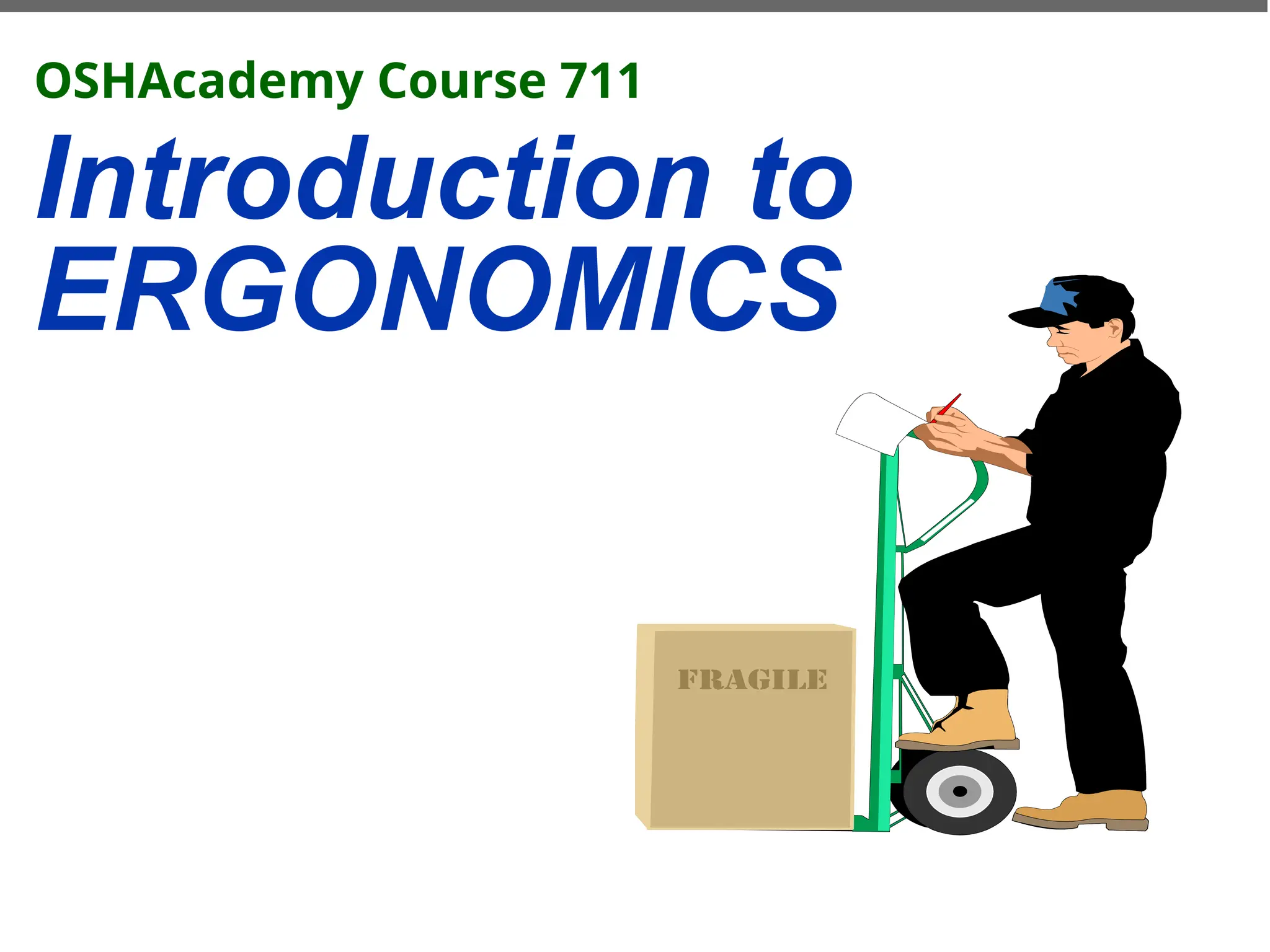
OSHAcademy Course 711
Introduction to
ERGONOMICS
TRAINER NAME
Position
Company
Phone Number
Email Address
Objectives
Given the information and exercises in this workshop, you will be able
to:
1. Identify the costs of ergonomics injuries,
2. Clearly define the activities involved in ergonomics,
3. Apply the concepts of ergonomics modeling to hazard recognition,
4. Recognize the factors that influence ergonomics,
5. Understand and apply the guidelines for safe lifting,
6. Be familiar with back injury reduction strategies.
Form Groups!
Introductions
Elect a leader ______________________
Select a spokesperson ______________________
Name your group ______________________
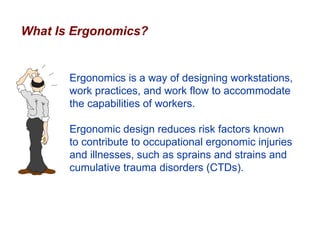
What Is Ergonomics?
Ergonomics is a way of designing workstations,
work practices, and work flow to accommodate
the capabilities of workers.
Ergonomic design reduces risk factors known
to contribute to occupational ergonomic injuries
and illnesses, such as sprains and strains and
cumulative trauma disorders (CTDs).
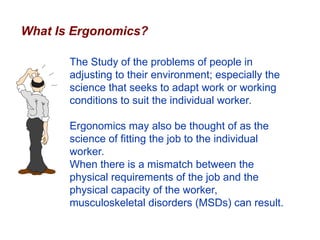
What Is Ergonomics?
The Study of the problems of people in
adjusting to their environment; especially the
science that seeks to adapt work or working
conditions to suit the individual worker.
Ergonomics may also be thought of as the
science of fitting the job to the individual
worker.
When there is a mismatch between the
physical requirements of the job and the
physical capacity of the worker,
musculoskeletal disorders (MSDs) can result.
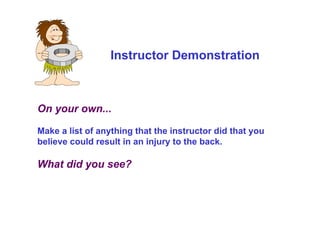
On your own...
Make a list of anything that the instructor did that you
believe could result in an injury to the back.
What did you see?
Instructor Demonstration
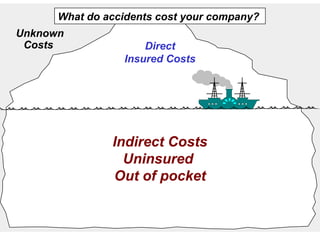
Direct
Insured Costs
Indirect Costs
Uninsured
Out of pocket
What do accidents cost your company?
Unknown
Costs
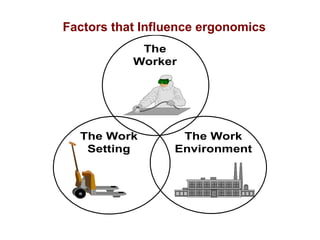
Factors that Influence ergonomics
The
Worker
The Work
Environment
The Work
Setting
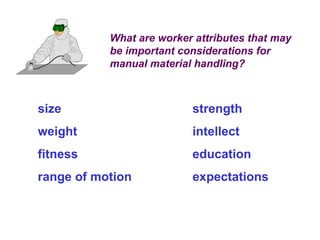
What are worker attributes that may
be important considerations for
manual material handling?
size
weight
fitness
range of motion
strength
intellect
education
expectations
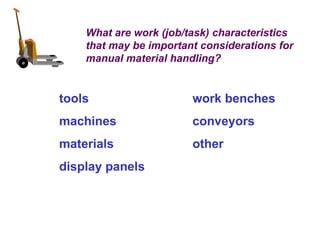
What are work (job/task) characteristics
that may be important considerations for
manual material handling?
tools
machines
materials
display panels
work benches
conveyors
other
What are work environmental characteristics
that may be important considerations for
manual material handling?
noise
lighting
vibration
atmosphere
temperature
humidity
Work Risk Factors
List risk factors associated with the interaction
between worker and the work setting:
posture
force/grip
location
speed
duration
repetition
frequency
exertion
Work Risk Factors
List risk factors associated with the interaction
between the worker and the work environment:
heat stress
cold stress
whole body
vibration
segmental
vibration
stress
workhours
workload
Five Activities Involved in ergonomics
List ways to reduce risk factors associated with...
Lifting/Lowering
Pushing/Pulling
Twisting
Carrying
Holding
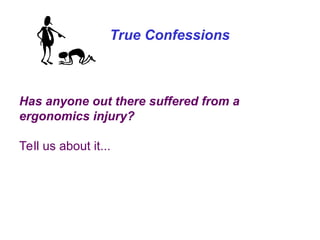
True Confessions
Has anyone out there suffered from a
ergonomics injury?
Tell us about it...
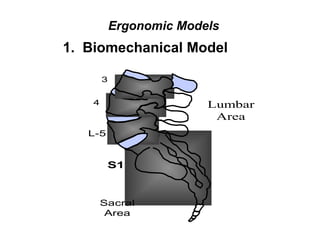
3
4
L-5
S1
Sacral
Area
Lumbar
Area
1. Biomechanical Model
Ergonomic Models
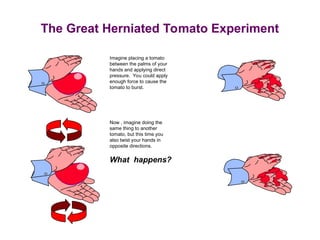
The Great Herniated Tomato Experiment
Imagine placing a tomato
between the palms of your
hands and applying direct
pressure. You could apply
enough force to cause the
tomato to burst.
Now , imagine doing the
same thing to another
tomato, but this time you
also twist your hands in
opposite directions.
What happens?
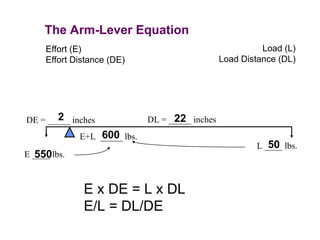
Effort (E)
Effort Distance (DE)
Load (L)
Load Distance (DL)
The Arm-Lever Equation
DE = _____ inches DL = _____ inches
E ____ lbs.
L ____ lbs.
E+L _____ lbs.
E x DE = L x DL
E/L = DL/DE
2 22
550
600
50
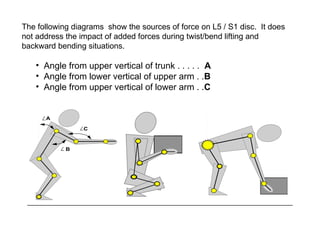
The following diagrams show the sources of force on L5 / S1 disc. It does
not address the impact of added forces during twist/bend lifting and
backward bending situations.
• Angle from upper vertical of trunk . . . . . A
• Angle from lower vertical of upper arm . .B
• Angle from upper vertical of lower arm . .C
A
B
C
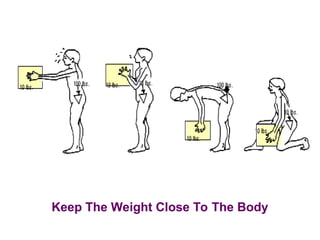
Keep The Weight Close To The Body
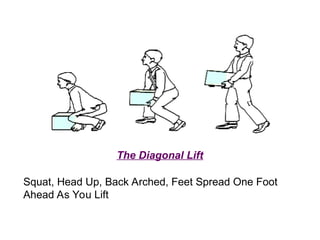
Squat, Head Up, Back Arched, Feet Spread One Foot
Ahead As You Lift
The Diagonal Lift
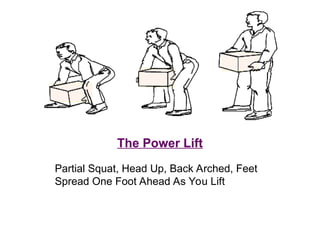
The Power Lift
Partial Squat, Head Up, Back Arched, Feet
Spread One Foot Ahead As You Lift
Body Mechanics
Remember, it’s not how much you lift, but the technique you
use. Remember the four general lifting rules:
* Plan the lift.
* Both squat and stoop lifting is now considered
acceptable for jobs requiring repetitive lifting.
Body Mechanics
The term used to describe this is free form lifting. No matter
what type of lift is used, it is never permissible to exceed the
maximum acceptable load of the worker.
* Keep the load as close to the body as possible.
* Lift the load with a smooth body motion. (Avoid jerking)
* When turning, do not twist. Turn with the feet rather than
twisting of the trunk.
Body Mechanics
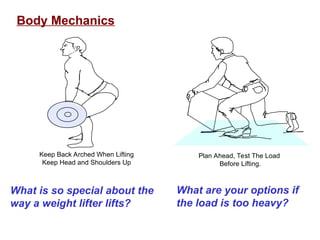
Keep Back Arched When Lifting
Keep Head and Shoulders Up
Plan Ahead, Test The Load
Before Lifting.
What are your options if
the load is too heavy?
What is so special about the
way a weight lifter lifts?
2. Physiological Model
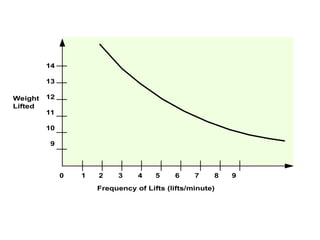
When a task requires more than 3 lifts per minute a
second model must be considered in addition to the
Biomechanical model.
This second approach presumes that the load is within
the physical strength of the worker. Note the following.
• A person’s endurance is primarily limited by the capacity of the
oxygen transport system.
• Increased metabolism demands an increase in the delivery
of oxygen and nutrients
• Energy cost, heart rate, blood pressure and blood lactate
are common physiological responses used to measure
physiological stress
Weight
Lifted
Frequency of Lifts (lifts/minute)
14
13
12
11
10
9
0 1 2 3 4 5 6 7 8 9
Effective Use of Muscles
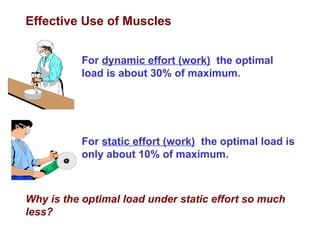
For dynamic effort (work) the optimal
load is about 30% of maximum.
For static effort (work) the optimal load is
only about 10% of maximum.
Why is the optimal load under static effort so much
less?
3. NIOSH Model
The NIOSH guidelines determine what the maximum
load should be, given the following characteristics:
• Weight of the object lifted.
• Position of load with respect to the body; starting and
ending point of horizontal and vertical distances.
• Frequency of lift.
• Duration of lift.
Body Interference
Limit
Hazardous
Lifting
Conditions
Functional Reach
Limit
Maximum
Permissible
Limit
Action
Limit
(cm)
(in.)
Administrative
Controls
Required
Acceptable Lifting Conditions
HORIZONTAL LOCATION OF LOAD
W
E
IG
H
T
L
IF
T
E
D
(lb.) (Kg)
200
150
100
50
0
80
40
20
0
0
60
20 40 60 80
0 10 20 30
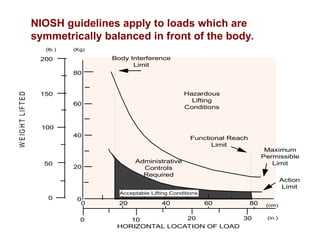
NIOSH guidelines apply to loads which are
symmetrically balanced in front of the body.
(Adapted from: The Saunders Group inc.,
4250 Norex Drive, Chaska, MN 55318)
(Adapted from: The Saunders Group inc.,
4250 Norex Drive, Chaska, MN 55318)
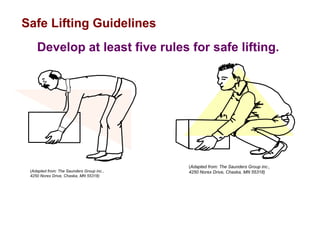
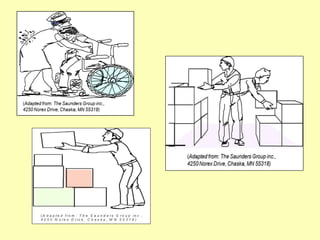
Develop at least five rules for safe lifting.
Safe Lifting Guidelines
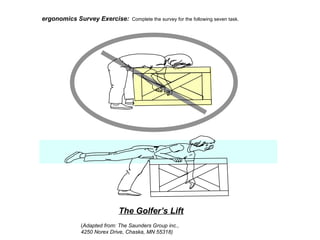
ergonomics Survey Exercise: Complete the survey for the following seven task.
The Golfer’s Lift
(Adapted from: The Saunders Group inc.,
4250 Norex Drive, Chaska, MN 55318)
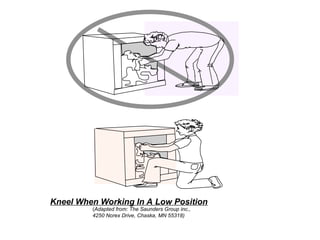
Kneel When Working In A Low Position
(Adapted from: The Saunders Group inc.,
4250 Norex Drive, Chaska, MN 55318)
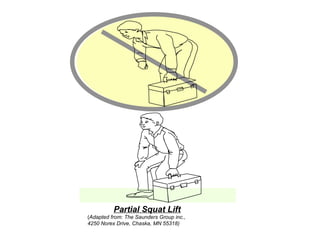
Partial Squat Lift
(Adapted from: The Saunders Group inc.,
4250 Norex Drive, Chaska, MN 55318)
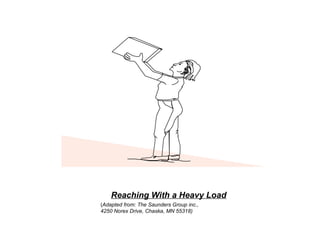
Reaching With a Heavy Load
(Adapted from: The Saunders Group inc.,
4250 Norex Drive, Chaska, MN 55318)
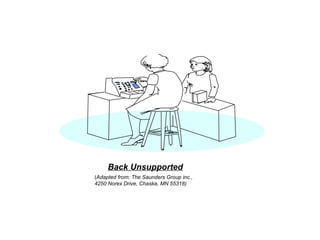
Back Unsupported
(Adapted from: The Saunders Group inc.,
4250 Norex Drive, Chaska, MN 55318)
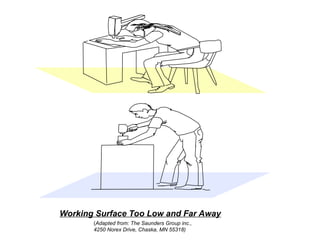
Working Surface Too Low and Far Away
(Adapted from: The Saunders Group inc.,
4250 Norex Drive, Chaska, MN 55318)
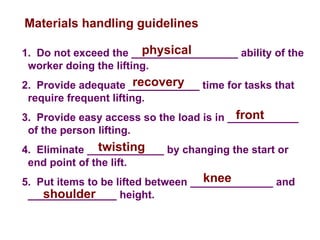
1. Do not exceed the __________________ ability of the
worker doing the lifting.
2. Provide adequate ____________ time for tasks that
require frequent lifting.
3. Provide easy access so the load is in ____________
of the person lifting.
4. Eliminate _____________ by changing the start or
end point of the lift.
5. Put items to be lifted between ______________ and
_______________ height.
Materials handling guidelines
physical
recovery
front
twisting
knee
shoulder
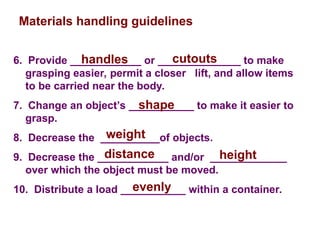
6. Provide ____________ or ______________ to make
grasping easier, permit a closer lift, and allow items
to be carried near the body.
7. Change an object’s ___________ to make it easier to
grasp.
8. Decrease the __________of objects.
9. Decrease the ____________ and/or _____________
over which the object must be moved.
10. Distribute a load ___________ within a container.
Materials handling guidelines
handles cutouts
shape
weight
distance height
evenly
11. Use hand carts or _____________ ____________.
12. Use a ___________- assisted hoist or integrated
conveyors.
13. Use ______________, ______________ and
motorized material __________ to help move loads
that are larger or heavier than one or two people can
safely handle.
Materials handling guidelines
hand carts hand trucks
vacuum
loaders cranes
pallets
Back Injury Reduction Plan
1. Employee Selection. Pre-employment
physical:
- including spinal exam and lift capacity;
- supervisor receives report prior to start of
work.
2. Education and Training. For management and
employees:
- Managers. Ergonomics and new hire policies;
responsibility and accountability; training
techniques; identification.
- Employees. New hire orientation including
body mechanics and proper lifting techniques,
responsibilities and accountability; follow-up
training with supervisor.
3. Ergonomics:
- Worksite ergonomics hazard analysis;
- Classification of physical work intensity:
Level 1. Sedentary
Level 2. Low Activity
Level 3. Active
Level 4. Very Active
4. Injury Management:
- Review injury reports
- Recommend corrective actions
- Early Return to Work Program. Pre-approved
assignments.
That's It.
Thanks for coming!

INTRODUCTION TO EGNOMICS BASIC WORKSTATION .PPT

  • 1.
  • 2.
  • 3.
    Objectives Given the informationand exercises in this workshop, you will be able to: 1. Identify the costs of ergonomics injuries, 2. Clearly define the activities involved in ergonomics, 3. Apply the concepts of ergonomics modeling to hazard recognition, 4. Recognize the factors that influence ergonomics, 5. Understand and apply the guidelines for safe lifting, 6. Be familiar with back injury reduction strategies.
  • 4.
    Form Groups! Introductions Elect aleader ______________________ Select a spokesperson ______________________ Name your group ______________________
  • 5.
    What Is Ergonomics? Ergonomicsis a way of designing workstations, work practices, and work flow to accommodate the capabilities of workers. Ergonomic design reduces risk factors known to contribute to occupational ergonomic injuries and illnesses, such as sprains and strains and cumulative trauma disorders (CTDs).
  • 6.
    What Is Ergonomics? TheStudy of the problems of people in adjusting to their environment; especially the science that seeks to adapt work or working conditions to suit the individual worker. Ergonomics may also be thought of as the science of fitting the job to the individual worker. When there is a mismatch between the physical requirements of the job and the physical capacity of the worker, musculoskeletal disorders (MSDs) can result.
  • 7.
    On your own... Makea list of anything that the instructor did that you believe could result in an injury to the back. What did you see? Instructor Demonstration
  • 8.
    Direct Insured Costs Indirect Costs Uninsured Outof pocket What do accidents cost your company? Unknown Costs
  • 9.
    Factors that Influenceergonomics The Worker The Work Environment The Work Setting
  • 10.
    What are workerattributes that may be important considerations for manual material handling? size weight fitness range of motion strength intellect education expectations
  • 11.
    What are work(job/task) characteristics that may be important considerations for manual material handling? tools machines materials display panels work benches conveyors other
  • 12.
    What are workenvironmental characteristics that may be important considerations for manual material handling? noise lighting vibration atmosphere temperature humidity
  • 13.
    Work Risk Factors Listrisk factors associated with the interaction between worker and the work setting: posture force/grip location speed duration repetition frequency exertion
  • 14.
    Work Risk Factors Listrisk factors associated with the interaction between the worker and the work environment: heat stress cold stress whole body vibration segmental vibration stress workhours workload
  • 15.
    Five Activities Involvedin ergonomics List ways to reduce risk factors associated with... Lifting/Lowering Pushing/Pulling Twisting Carrying Holding
  • 16.
    True Confessions Has anyoneout there suffered from a ergonomics injury? Tell us about it...
  • 17.
  • 19.
    The Great HerniatedTomato Experiment Imagine placing a tomato between the palms of your hands and applying direct pressure. You could apply enough force to cause the tomato to burst. Now , imagine doing the same thing to another tomato, but this time you also twist your hands in opposite directions. What happens?
  • 20.
    Effort (E) Effort Distance(DE) Load (L) Load Distance (DL) The Arm-Lever Equation DE = _____ inches DL = _____ inches E ____ lbs. L ____ lbs. E+L _____ lbs. E x DE = L x DL E/L = DL/DE 2 22 550 600 50
  • 21.
    The following diagramsshow the sources of force on L5 / S1 disc. It does not address the impact of added forces during twist/bend lifting and backward bending situations. • Angle from upper vertical of trunk . . . . . A • Angle from lower vertical of upper arm . .B • Angle from upper vertical of lower arm . .C A B C
  • 22.
    Keep The WeightClose To The Body
  • 23.
    Squat, Head Up,Back Arched, Feet Spread One Foot Ahead As You Lift The Diagonal Lift
  • 24.
    The Power Lift PartialSquat, Head Up, Back Arched, Feet Spread One Foot Ahead As You Lift
  • 25.
    Body Mechanics Remember, it’snot how much you lift, but the technique you use. Remember the four general lifting rules: * Plan the lift. * Both squat and stoop lifting is now considered acceptable for jobs requiring repetitive lifting.
  • 26.
    Body Mechanics The termused to describe this is free form lifting. No matter what type of lift is used, it is never permissible to exceed the maximum acceptable load of the worker. * Keep the load as close to the body as possible. * Lift the load with a smooth body motion. (Avoid jerking) * When turning, do not twist. Turn with the feet rather than twisting of the trunk.
  • 27.
    Body Mechanics Keep BackArched When Lifting Keep Head and Shoulders Up Plan Ahead, Test The Load Before Lifting. What are your options if the load is too heavy? What is so special about the way a weight lifter lifts?
  • 28.
    2. Physiological Model Whena task requires more than 3 lifts per minute a second model must be considered in addition to the Biomechanical model. This second approach presumes that the load is within the physical strength of the worker. Note the following. • A person’s endurance is primarily limited by the capacity of the oxygen transport system. • Increased metabolism demands an increase in the delivery of oxygen and nutrients • Energy cost, heart rate, blood pressure and blood lactate are common physiological responses used to measure physiological stress
  • 29.
    Weight Lifted Frequency of Lifts(lifts/minute) 14 13 12 11 10 9 0 1 2 3 4 5 6 7 8 9
  • 30.
    Effective Use ofMuscles For dynamic effort (work) the optimal load is about 30% of maximum. For static effort (work) the optimal load is only about 10% of maximum. Why is the optimal load under static effort so much less?
  • 31.
    3. NIOSH Model TheNIOSH guidelines determine what the maximum load should be, given the following characteristics: • Weight of the object lifted. • Position of load with respect to the body; starting and ending point of horizontal and vertical distances. • Frequency of lift. • Duration of lift.
  • 32.
    Body Interference Limit Hazardous Lifting Conditions Functional Reach Limit Maximum Permissible Limit Action Limit (cm) (in.) Administrative Controls Required AcceptableLifting Conditions HORIZONTAL LOCATION OF LOAD W E IG H T L IF T E D (lb.) (Kg) 200 150 100 50 0 80 40 20 0 0 60 20 40 60 80 0 10 20 30 NIOSH guidelines apply to loads which are symmetrically balanced in front of the body.
  • 33.
    (Adapted from: TheSaunders Group inc., 4250 Norex Drive, Chaska, MN 55318) (Adapted from: The Saunders Group inc., 4250 Norex Drive, Chaska, MN 55318) Develop at least five rules for safe lifting. Safe Lifting Guidelines
  • 35.
    ergonomics Survey Exercise:Complete the survey for the following seven task. The Golfer’s Lift (Adapted from: The Saunders Group inc., 4250 Norex Drive, Chaska, MN 55318)
  • 36.
    Kneel When WorkingIn A Low Position (Adapted from: The Saunders Group inc., 4250 Norex Drive, Chaska, MN 55318)
  • 37.
    Partial Squat Lift (Adaptedfrom: The Saunders Group inc., 4250 Norex Drive, Chaska, MN 55318)
  • 38.
    Reaching With aHeavy Load (Adapted from: The Saunders Group inc., 4250 Norex Drive, Chaska, MN 55318)
  • 39.
    Back Unsupported (Adapted from:The Saunders Group inc., 4250 Norex Drive, Chaska, MN 55318)
  • 40.
    Working Surface TooLow and Far Away (Adapted from: The Saunders Group inc., 4250 Norex Drive, Chaska, MN 55318)
  • 41.
    1. Do notexceed the __________________ ability of the worker doing the lifting. 2. Provide adequate ____________ time for tasks that require frequent lifting. 3. Provide easy access so the load is in ____________ of the person lifting. 4. Eliminate _____________ by changing the start or end point of the lift. 5. Put items to be lifted between ______________ and _______________ height. Materials handling guidelines physical recovery front twisting knee shoulder
  • 42.
    6. Provide ____________or ______________ to make grasping easier, permit a closer lift, and allow items to be carried near the body. 7. Change an object’s ___________ to make it easier to grasp. 8. Decrease the __________of objects. 9. Decrease the ____________ and/or _____________ over which the object must be moved. 10. Distribute a load ___________ within a container. Materials handling guidelines handles cutouts shape weight distance height evenly
  • 43.
    11. Use handcarts or _____________ ____________. 12. Use a ___________- assisted hoist or integrated conveyors. 13. Use ______________, ______________ and motorized material __________ to help move loads that are larger or heavier than one or two people can safely handle. Materials handling guidelines hand carts hand trucks vacuum loaders cranes pallets
  • 44.
    Back Injury ReductionPlan 1. Employee Selection. Pre-employment physical: - including spinal exam and lift capacity; - supervisor receives report prior to start of work.
  • 45.
    2. Education andTraining. For management and employees: - Managers. Ergonomics and new hire policies; responsibility and accountability; training techniques; identification. - Employees. New hire orientation including body mechanics and proper lifting techniques, responsibilities and accountability; follow-up training with supervisor.
  • 46.
    3. Ergonomics: - Worksiteergonomics hazard analysis; - Classification of physical work intensity: Level 1. Sedentary Level 2. Low Activity Level 3. Active Level 4. Very Active
  • 47.
    4. Injury Management: -Review injury reports - Recommend corrective actions - Early Return to Work Program. Pre-approved assignments.
  • 48.