1
Physical CarePhysical Care
Welcome
MANUAL HANDLING AWARENESS
to
This document is made available on the condition that it is used solely to assist you in the preparation of your own safety training material. Use for
resale or similar commercial activity to third parties is strictly forbidden. This document was produced for our internal use only, and therefore it may not
be suitable or sufficient for your purposes. No guarantees whatsoever can be given as to their legal compliance or comprehensiveness, and you are
responsible for obtaining professional advice and verification as to the correctness or suitability of any training or documents which you produce which
are based wholly or in part on these. No liabilities whatsoever are accepted. It has been made available purely for information to others who may find
them useful when formulating their own safety training and procedures.
© A. Groves & Océ (UK) Ltd
2
You are an animalYou are an animal
You areYou are
an animal !an animal !
3
You are an animalYou are an animal
Humans do
unnatural acts
4
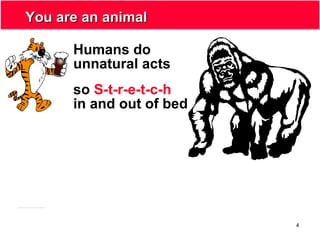
You are an animalYou are an animal
Humans do
unnatural acts
so S-t-r-e-t-c-h
in and out of bed
5
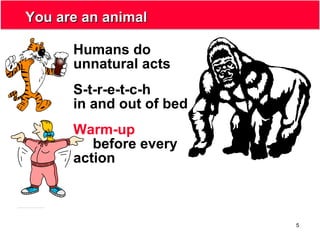
You are an animalYou are an animal
Humans do
unnatural acts
S-t-r-e-t-c-h
in and out of bed
Warm-up
before every
action
6
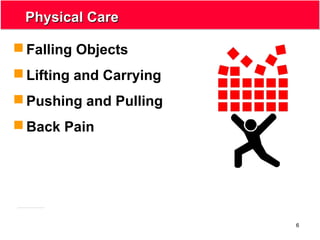
Physical CarePhysical Care
 Falling Objects
 Lifting and Carrying
 Pushing and Pulling
 Back Pain
7
Falling ObjectsFalling Objects
8
Falling ObjectsFalling Objects
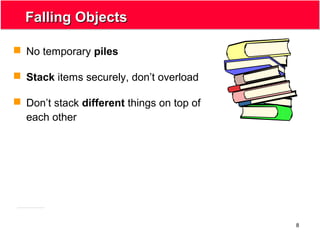
 No temporary piles
 Stack items securely, don’t overload
 Don’t stack different things on top of
each other
9
Falling ObjectsFalling Objects
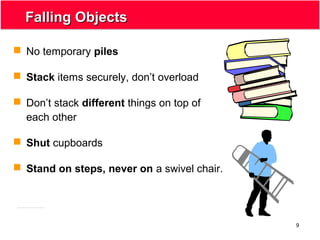
 No temporary piles
 Stack items securely, don’t overload
 Don’t stack different things on top of
each other
 Shut cupboards
 Stand on steps, never on a swivel chair.
10
Falling objectsFalling objects
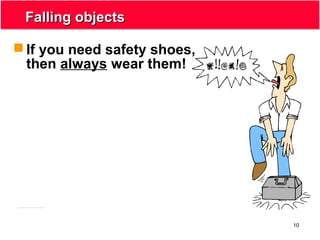
 If you need safety shoes,
then always wear them!
11
LiftingLifting
LiftingLifting
12
LiftingLifting
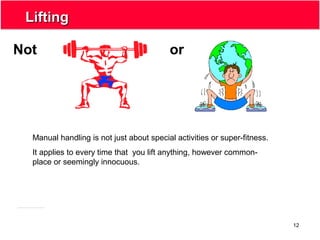
Not or
Manual handling is not just about special activities or super-fitness.
It applies to every time that you lift anything, however common-
place or seemingly innocuous.
13
LiftingLifting
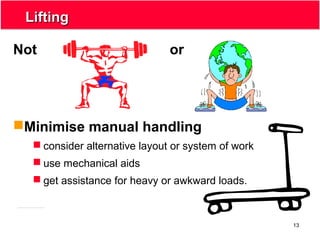
Not or
Minimise manual handling
 consider alternative layout or system of work
 use mechanical aids
 get assistance for heavy or awkward loads.
14
LiftingLifting
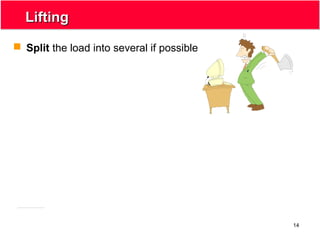
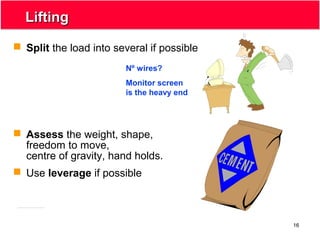
 Split the load into several if possible
15
LiftingLifting
 Split the load into several if possible
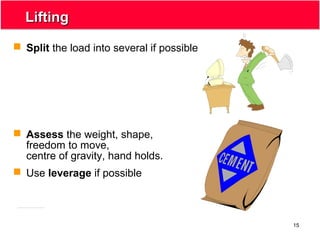
 Assess the weight, shape,
freedom to move,
centre of gravity, hand holds.
 Use leverage if possible
16
LiftingLifting
 Split the load into several if possible
 Assess the weight, shape,
freedom to move,
centre of gravity, hand holds.
 Use leverage if possible
Nº wires?
Monitor screen
is the heavy end
17
You have no backbone!You have no backbone!
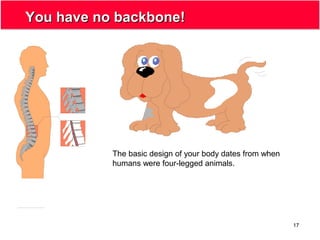
The basic design of your body dates from when
humans were four-legged animals.
18
You have no backbone!You have no backbone!
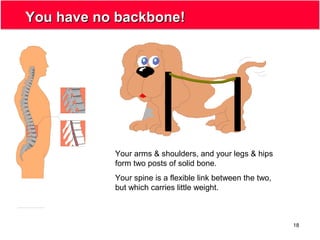
Your arms & shoulders, and your legs & hips
form two posts of solid bone.
Your spine is a flexible link between the two,
but which carries little weight.
19
You have no backbone!You have no backbone!
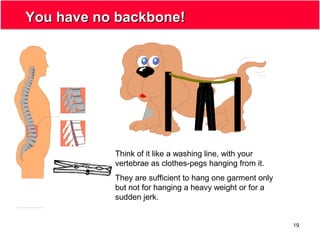
Think of it like a washing line, with your
vertebrae as clothes-pegs hanging from it.
They are sufficient to hang one garment only
but not for hanging a heavy weight or for a
sudden jerk.
20
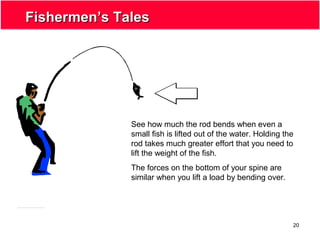
Fishermen’s TalesFishermen’s Tales
See how much the rod bends when even a
small fish is lifted out of the water. Holding the
rod takes much greater effort that you need to
lift the weight of the fish.
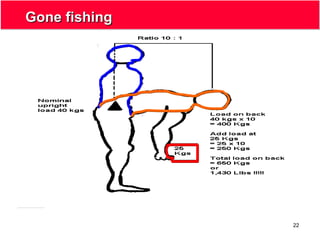
The forces on the bottom of your spine are
similar when you lift a load by bending over.
21
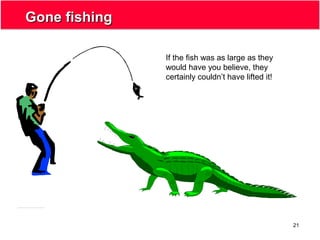
Gone fishingGone fishing
If the fish was as large as they
would have you believe, they
certainly couldn’t have lifted it!
22
Gone fishingGone fishing
23
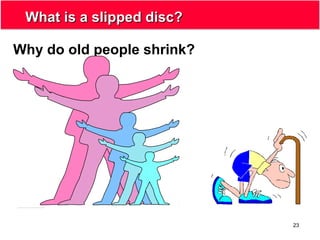
What is a slipped disc?What is a slipped disc?
Why do old people shrink?
24
What is a slipped disc?What is a slipped disc?
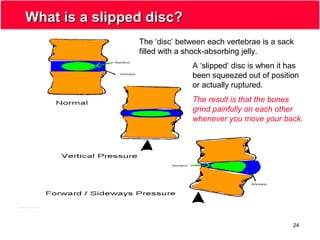
The ‘disc’ between each vertebrae is a sack
filled with a shock-absorbing jelly.
A ‘slipped’ disc is when it has
been squeezed out of position
or actually ruptured.
The result is that the bones
grind painfully on each other
whenever you move your back.
25
What is a slipped disc?What is a slipped disc?
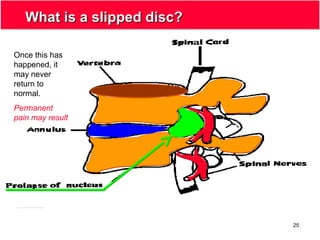
Once this has
happened, it
may never
return to
normal.
Permanent
pain may result
26
PregnantPregnant menmen
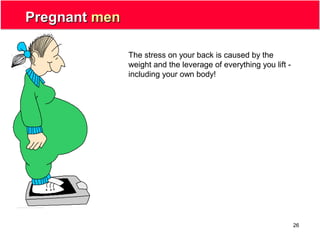
The stress on your back is caused by the
weight and the leverage of everything you lift -
including your own body!
27
PregnantPregnant menmen
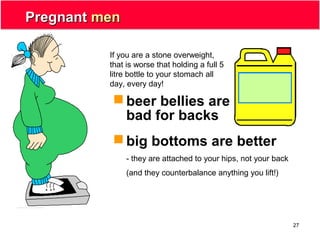
 beer bellies are
bad for backs
 big bottoms are better
- they are attached to your hips, not your back
(and they counterbalance anything you lift!)
If you are a stone overweight,
that is worse that holding a full 5
litre bottle to your stomach all
day, every day!
28
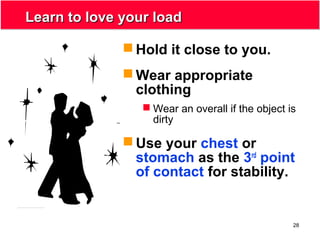
Learn to love your loadLearn to love your load
 Hold it close to you.
 Wear appropriate
clothing
 Wear an overall if the object is
dirty
 Use your chest or
stomach as the 3rd
point
of contact for stability.
29
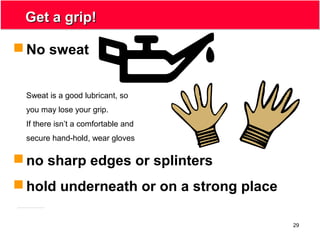
Get a grip!Get a grip!
 No sweat
Sweat is a good lubricant, so
you may lose your grip.
If there isn’t a comfortable and
secure hand-hold, wear gloves
 no sharp edges or splinters
 hold underneath or on a strong place
30
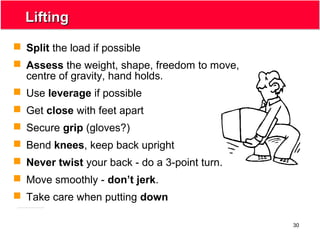
LiftingLifting
 Split the load if possible
 Assess the weight, shape, freedom to move,
centre of gravity, hand holds.
 Use leverage if possible
 Get close with feet apart
 Secure grip (gloves?)
 Bend knees, keep back upright
 Never twist your back - do a 3-point turn.
 Move smoothly - don’t jerk.
 Take care when putting down
31
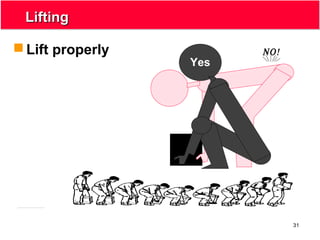
LiftingLifting
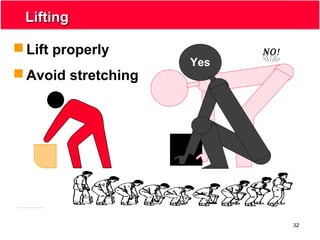
 Lift properly
Yes
ΝΟ!
32
LiftingLifting
 Lift properly
 Avoid stretching
Yes
ΝΟ!
33
CarryingCarrying
CarryingCarrying
34
CarryingCarrying
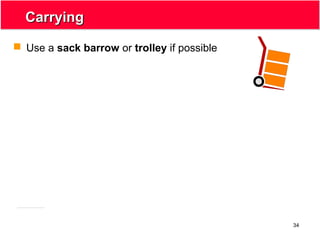
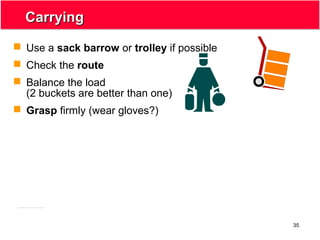
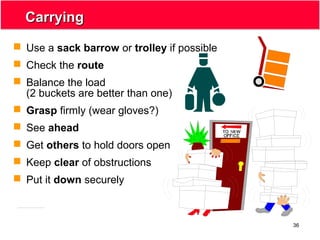
 Use a sack barrow or trolley if possible
35
CarryingCarrying
 Use a sack barrow or trolley if possible
 Check the route
 Balance the load
(2 buckets are better than one)
 Grasp firmly (wear gloves?)
36
CarryingCarrying
 Use a sack barrow or trolley if possible
 Check the route
 Balance the load
(2 buckets are better than one)
 Grasp firmly (wear gloves?)
 See ahead
 Get others to hold doors open
 Keep clear of obstructions
 Put it down securely
37
Pushing and pullingPushing and pulling
Pushing andPushing and
pullingpulling
38
Pushing and pullingPushing and pulling
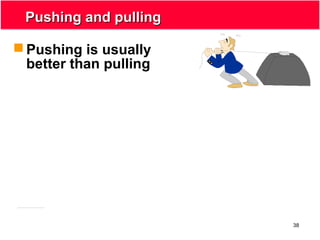
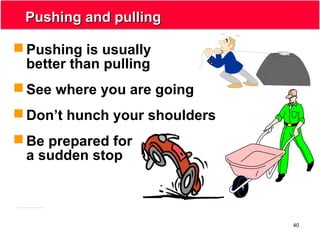
 Pushing is usually
better than pulling
39
Pushing and pullingPushing and pulling
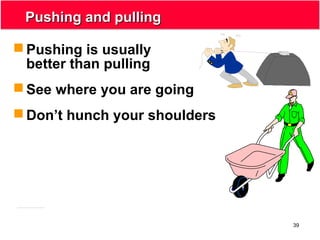
 Pushing is usually
better than pulling
 See where you are going
 Don’t hunch your shoulders
40
Pushing and pullingPushing and pulling
 Pushing is usually
better than pulling
 See where you are going
 Don’t hunch your shoulders
 Be prepared for
a sudden stop
41
CastorsCastors
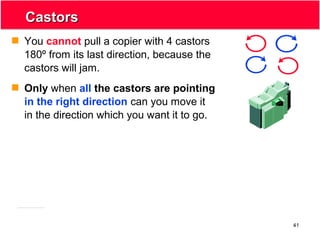
 You cannot pull a copier with 4 castors
180º from its last direction, because the
castors will jam.
 Only when all the castors are pointing
in the right direction can you move it
in the direction which you want it to go.
42
CastorsCastors
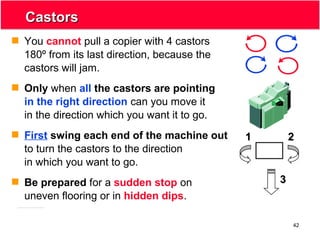
 You cannot pull a copier with 4 castors
180º from its last direction, because the
castors will jam.
 Only when all the castors are pointing
in the right direction can you move it
in the direction which you want it to go.
 First swing each end of the machine out
to turn the castors to the direction
in which you want to go.
 Be prepared for a sudden stop on
uneven flooring or in hidden dips.
11 22
33
43
Push where?Push where?
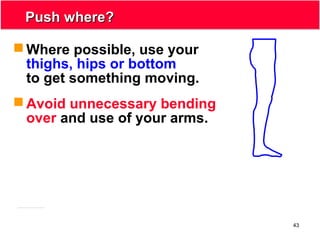
 Where possible, use your
thighs, hips or bottom
to get something moving.
 Avoid unnecessary bending
over and use of your arms.
44
If you do get back painIf you do get back pain
If you do getIf you do get
back painback pain
45
If you do get back painIf you do get back pain
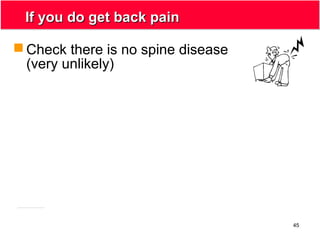
 Check there is no spine disease
(very unlikely)
46
If you do get back painIf you do get back pain
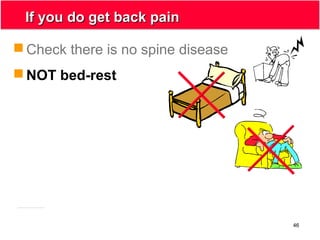
 Check there is no spine disease
 NOT bed-rest
47
If you do get back painIf you do get back pain
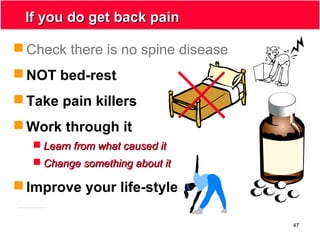
 Check there is no spine disease
 NOT bed-rest
 Take pain killers
 Work through it
 Learn from what caused itLearn from what caused it
 Change something about itChange something about it
 Improve your life-style
48
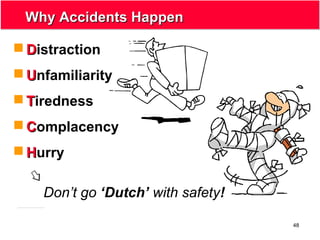
Why Accidents HappenWhy Accidents Happen
 DDistraction
 UUnfamiliarity
 TTiredness
 CComplacency
 HHurry
Don’t go ‘Dutch’ with safety!
49
P.A.U.S.E.P.A.U.S.E.
P.A.U.S.E.
for thought
 PPlan each task
 AAnalyse what might happen
 UUnexpected - be prepared
 SSlipping, tripping & sprains
 EEntanglement
P.A.U.S.E. for thought ... think safety
A millisecond makes all
the difference
50
To concludeTo conclude
 Please think about what you have seen
in this presentation.
 Walk tall
 Shoulders back
 Head held high
 Injuries hurt. Pain isn’t pleasant.
 You have choices about your life.

Backcare5 g

  • 1.
    1 Physical CarePhysical Care Welcome MANUALHANDLING AWARENESS to This document is made available on the condition that it is used solely to assist you in the preparation of your own safety training material. Use for resale or similar commercial activity to third parties is strictly forbidden. This document was produced for our internal use only, and therefore it may not be suitable or sufficient for your purposes. No guarantees whatsoever can be given as to their legal compliance or comprehensiveness, and you are responsible for obtaining professional advice and verification as to the correctness or suitability of any training or documents which you produce which are based wholly or in part on these. No liabilities whatsoever are accepted. It has been made available purely for information to others who may find them useful when formulating their own safety training and procedures. © A. Groves & Océ (UK) Ltd
  • 2.
    2 You are ananimalYou are an animal You areYou are an animal !an animal !
  • 3.
    3 You are ananimalYou are an animal Humans do unnatural acts
  • 4.
    4 You are ananimalYou are an animal Humans do unnatural acts so S-t-r-e-t-c-h in and out of bed
  • 5.
    5 You are ananimalYou are an animal Humans do unnatural acts S-t-r-e-t-c-h in and out of bed Warm-up before every action
  • 6.
    6 Physical CarePhysical Care Falling Objects  Lifting and Carrying  Pushing and Pulling  Back Pain
  • 7.
  • 8.
    8 Falling ObjectsFalling Objects No temporary piles  Stack items securely, don’t overload  Don’t stack different things on top of each other
  • 9.
    9 Falling ObjectsFalling Objects No temporary piles  Stack items securely, don’t overload  Don’t stack different things on top of each other  Shut cupboards  Stand on steps, never on a swivel chair.
  • 10.
    10 Falling objectsFalling objects If you need safety shoes, then always wear them!
  • 11.
  • 12.
    12 LiftingLifting Not or Manual handlingis not just about special activities or super-fitness. It applies to every time that you lift anything, however common- place or seemingly innocuous.
  • 13.
    13 LiftingLifting Not or Minimise manualhandling  consider alternative layout or system of work  use mechanical aids  get assistance for heavy or awkward loads.
  • 14.
    14 LiftingLifting  Split theload into several if possible
  • 15.
    15 LiftingLifting  Split theload into several if possible  Assess the weight, shape, freedom to move, centre of gravity, hand holds.  Use leverage if possible
  • 16.
    16 LiftingLifting  Split theload into several if possible  Assess the weight, shape, freedom to move, centre of gravity, hand holds.  Use leverage if possible Nº wires? Monitor screen is the heavy end
  • 17.
    17 You have nobackbone!You have no backbone! The basic design of your body dates from when humans were four-legged animals.
  • 18.
    18 You have nobackbone!You have no backbone! Your arms & shoulders, and your legs & hips form two posts of solid bone. Your spine is a flexible link between the two, but which carries little weight.
  • 19.
    19 You have nobackbone!You have no backbone! Think of it like a washing line, with your vertebrae as clothes-pegs hanging from it. They are sufficient to hang one garment only but not for hanging a heavy weight or for a sudden jerk.
  • 20.
    20 Fishermen’s TalesFishermen’s Tales Seehow much the rod bends when even a small fish is lifted out of the water. Holding the rod takes much greater effort that you need to lift the weight of the fish. The forces on the bottom of your spine are similar when you lift a load by bending over.
  • 21.
    21 Gone fishingGone fishing Ifthe fish was as large as they would have you believe, they certainly couldn’t have lifted it!
  • 22.
  • 23.
    23 What is aslipped disc?What is a slipped disc? Why do old people shrink?
  • 24.
    24 What is aslipped disc?What is a slipped disc? The ‘disc’ between each vertebrae is a sack filled with a shock-absorbing jelly. A ‘slipped’ disc is when it has been squeezed out of position or actually ruptured. The result is that the bones grind painfully on each other whenever you move your back.
  • 25.
    25 What is aslipped disc?What is a slipped disc? Once this has happened, it may never return to normal. Permanent pain may result
  • 26.
    26 PregnantPregnant menmen The stresson your back is caused by the weight and the leverage of everything you lift - including your own body!
  • 27.
    27 PregnantPregnant menmen  beerbellies are bad for backs  big bottoms are better - they are attached to your hips, not your back (and they counterbalance anything you lift!) If you are a stone overweight, that is worse that holding a full 5 litre bottle to your stomach all day, every day!
  • 28.
    28 Learn to loveyour loadLearn to love your load  Hold it close to you.  Wear appropriate clothing  Wear an overall if the object is dirty  Use your chest or stomach as the 3rd point of contact for stability.
  • 29.
    29 Get a grip!Geta grip!  No sweat Sweat is a good lubricant, so you may lose your grip. If there isn’t a comfortable and secure hand-hold, wear gloves  no sharp edges or splinters  hold underneath or on a strong place
  • 30.
    30 LiftingLifting  Split theload if possible  Assess the weight, shape, freedom to move, centre of gravity, hand holds.  Use leverage if possible  Get close with feet apart  Secure grip (gloves?)  Bend knees, keep back upright  Never twist your back - do a 3-point turn.  Move smoothly - don’t jerk.  Take care when putting down
  • 31.
  • 32.
    32 LiftingLifting  Lift properly Avoid stretching Yes ΝΟ!
  • 33.
  • 34.
    34 CarryingCarrying  Use asack barrow or trolley if possible
  • 35.
    35 CarryingCarrying  Use asack barrow or trolley if possible  Check the route  Balance the load (2 buckets are better than one)  Grasp firmly (wear gloves?)
  • 36.
    36 CarryingCarrying  Use asack barrow or trolley if possible  Check the route  Balance the load (2 buckets are better than one)  Grasp firmly (wear gloves?)  See ahead  Get others to hold doors open  Keep clear of obstructions  Put it down securely
  • 37.
    37 Pushing and pullingPushingand pulling Pushing andPushing and pullingpulling
  • 38.
    38 Pushing and pullingPushingand pulling  Pushing is usually better than pulling
  • 39.
    39 Pushing and pullingPushingand pulling  Pushing is usually better than pulling  See where you are going  Don’t hunch your shoulders
  • 40.
    40 Pushing and pullingPushingand pulling  Pushing is usually better than pulling  See where you are going  Don’t hunch your shoulders  Be prepared for a sudden stop
  • 41.
    41 CastorsCastors  You cannotpull a copier with 4 castors 180º from its last direction, because the castors will jam.  Only when all the castors are pointing in the right direction can you move it in the direction which you want it to go.
  • 42.
    42 CastorsCastors  You cannotpull a copier with 4 castors 180º from its last direction, because the castors will jam.  Only when all the castors are pointing in the right direction can you move it in the direction which you want it to go.  First swing each end of the machine out to turn the castors to the direction in which you want to go.  Be prepared for a sudden stop on uneven flooring or in hidden dips. 11 22 33
  • 43.
    43 Push where?Push where? Where possible, use your thighs, hips or bottom to get something moving.  Avoid unnecessary bending over and use of your arms.
  • 44.
    44 If you doget back painIf you do get back pain If you do getIf you do get back painback pain
  • 45.
    45 If you doget back painIf you do get back pain  Check there is no spine disease (very unlikely)
  • 46.
    46 If you doget back painIf you do get back pain  Check there is no spine disease  NOT bed-rest
  • 47.
    47 If you doget back painIf you do get back pain  Check there is no spine disease  NOT bed-rest  Take pain killers  Work through it  Learn from what caused itLearn from what caused it  Change something about itChange something about it  Improve your life-style
  • 48.
    48 Why Accidents HappenWhyAccidents Happen  DDistraction  UUnfamiliarity  TTiredness  CComplacency  HHurry Don’t go ‘Dutch’ with safety!
  • 49.
    49 P.A.U.S.E.P.A.U.S.E. P.A.U.S.E. for thought  PPlaneach task  AAnalyse what might happen  UUnexpected - be prepared  SSlipping, tripping & sprains  EEntanglement P.A.U.S.E. for thought ... think safety A millisecond makes all the difference
  • 50.
    50 To concludeTo conclude Please think about what you have seen in this presentation.  Walk tall  Shoulders back  Head held high  Injuries hurt. Pain isn’t pleasant.  You have choices about your life.

Editor's Notes

  • #32 13
  • #33 13
  • #50 Every time that you do anything, pausing for a millisecond or two prevents complacency and ensures neither you nor anyone else gets injured – and that the job is done right first time.