Manual Handling Awareness Training
Outline
• What is manual handling?
What is manual handling?
• What are the risks of manual handling?
What are the risks of manual handling?
• What makes manual handling hazardous?
What makes manual handling hazardous?
• How can the risks be managed?
How can the risks be managed?
o S.M.A.R.T lifting
o Team lifting
o Pushing and pulling
o Manual handling of people
o Safe storage
• Available supports and resources
Available supports and resources
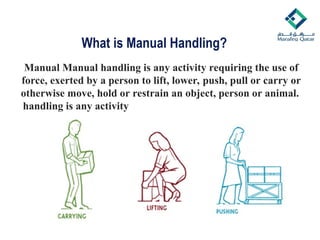
What is Manual Handling?
Manual Manual handling is any activity requiring the use of
force, exerted by a person to lift, lower, push, pull or carry or
otherwise move, hold or restrain an object, person or animal.
handling is any activity requiring the use of force, exerted by
a person to lift, lower, push, pull or carry or otherwise move,
hold or restrain an object, person or animal.
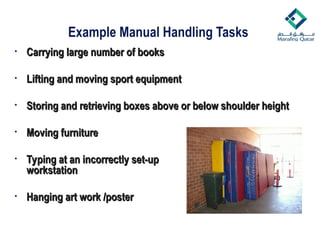
Example Manual Handling Tasks
• Carrying large number of books
Carrying large number of books
• Lifting and moving sport equipment
Lifting and moving sport equipment
• Storing and retrieving boxes above or below shoulder height
Storing and retrieving boxes above or below shoulder height
• Moving furniture
Moving furniture
• Typing at an incorrectly set-up
Typing at an incorrectly set-up
workstation
workstation
• Hanging art work /poster
Hanging art work /poster
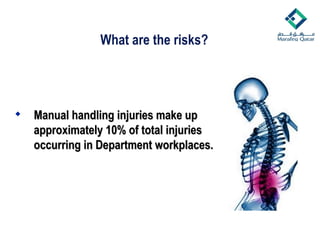
What are the risks?
 Manual handling injuries make up
Manual handling injuries make up
approximately 10% of total injuries
occurring in Department workplaces.
What are the risks?
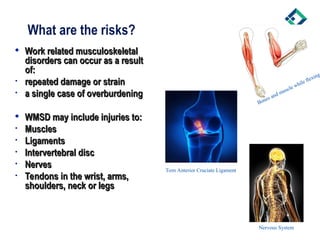
 Work related musculoskeletal
Work related musculoskeletal
disorders can occur as a result
of:
of:
• repeated damage or strain
repeated damage or strain
• a single case of overburdening
a single case of overburdening
 WMSD may include injuries to:
WMSD may include injuries to:
• Muscles
Muscles
• Ligaments
Ligaments
• Intervertebral disc
Intervertebral disc
• Nerves
Nerves
• Tendons in the wrist, arms,
Tendons in the wrist, arms,
shoulders, neck or legs
Bones and muscle while flexing
Torn Anterior Cruciate Ligament
Nervous System
What are the risks?
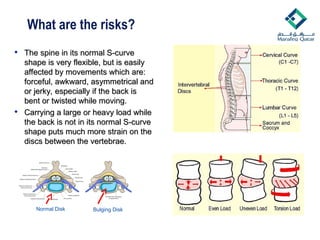
 The spine in its normal S-curve
The spine in its normal S-curve
shape is very flexible, but is easily
affected by movements which are:
forceful, awkward, asymmetrical and
or jerky, especially if the back is
bent or twisted while moving.
 Carrying a large or heavy load while
Carrying a large or heavy load while
the back is not in its normal S-curve
shape puts much more strain on the
discs between the vertebrae.
Normal Disk Bulging Disk
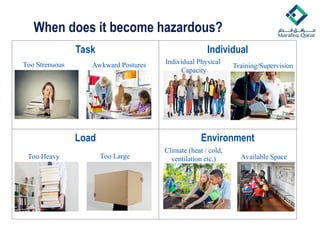
When does it become hazardous?
Task Individual
Load Environment
Too Strenuous Awkward Postures
Too Heavy Too Large
Individual Physical
Capacity
Training/Supervision
Climate (heat / cold,
ventilation etc.) Available Space
1.
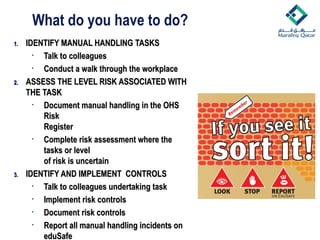
1. IDENTIFY MANUAL HANDLING TASKS
IDENTIFY MANUAL HANDLING TASKS
• Talk to colleagues
Talk to colleagues
• Conduct a walk through the workplace
Conduct a walk through the workplace
2.
2. ASSESS THE LEVEL RISK ASSOCIATED WITH
ASSESS THE LEVEL RISK ASSOCIATED WITH
THE TASK
THE TASK
• Document manual handling in the OHS
Document manual handling in the OHS
Risk
Risk
Register
Register
• Complete risk assessment where the
Complete risk assessment where the
tasks or level
tasks or level
of risk is uncertain
3.
3. IDENTIFY AND IMPLEMENT CONTROLS
IDENTIFY AND IMPLEMENT CONTROLS
• Talk to colleagues undertaking task
Talk to colleagues undertaking task
• Implement risk controls
Implement risk controls
• Document risk controls
Document risk controls
• Report all manual handling incidents on
Report all manual handling incidents on
eduSafe
eduSafe
What do you have to do?
Example Risk Controls
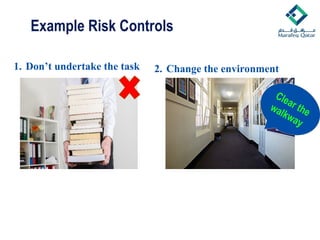
Clear the
walkway
1. Don’t undertake the task 2. Change the environment
Example Risk Controls
. Change the nature of the work 4. Change the object
Example Risk Controls
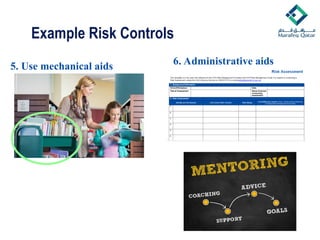
5. Use mechanical aids 6. Administrative aids
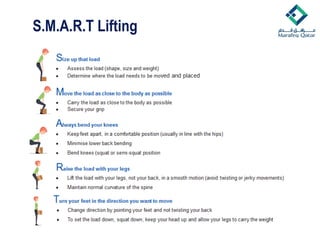
S.M.A.R.T Lifting
S.M.A.R.T Lifting
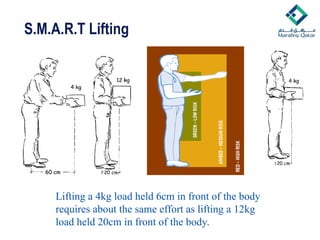
Lifting a 4kg load held 6cm in front of the body
requires about the same effort as lifting a 12kg
load held 20cm in front of the body.
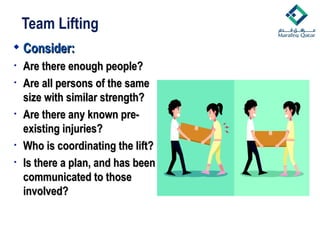
Team Lifting
 Consider:
Consider:
• Are there enough people?
Are there enough people?
• Are all persons of the same
Are all persons of the same
size with similar strength?
• Are there any known pre-
Are there any known pre-
existing injuries?
existing injuries?
• Who is coordinating the lift?
Who is coordinating the lift?
• Is there a plan, and has been
Is there a plan, and has been
communicated to those
involved?
involved?
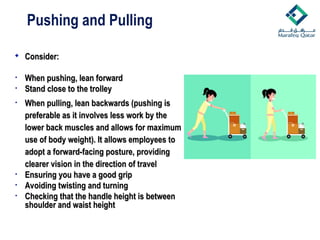
Pushing and Pulling
 Consider:
Consider:
• When pushing, lean forward
When pushing, lean forward
• Stand close to the trolley
Stand close to the trolley
• When pulling, lean backwards (pushing is
When pulling, lean backwards (pushing is
preferable as it involves less work by the
lower back muscles and allows for maximum
use of body weight). It allows employees to
adopt a forward-facing posture, providing
clearer vision in the direction of travel
• Ensuring you have a good grip
Ensuring you have a good grip
• Avoiding twisting and turning
Avoiding twisting and turning
• Checking that the handle height is between
Checking that the handle height is between
shoulder and waist height
Manual Handling of People
No lift policy is best, use equipment and the
student’s own ability to avoid unnecessary
manual handling. Always follow Behaviour
Support Plans for individuals who cannot assist
with their own movement.
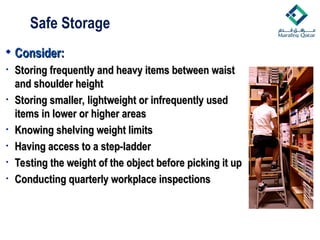
 Consider:
Consider:
• Storing frequently and heavy items between waist
Storing frequently and heavy items between waist
and shoulder height
and shoulder height
• Storing smaller, lightweight or infrequently used
Storing smaller, lightweight or infrequently used
items in lower or higher areas
• Knowing shelving weight limits
Knowing shelving weight limits
• Having access to a step-ladder
Having access to a step-ladder
• Testing the weight of the object before picking it up
Testing the weight of the object before picking it up
• Conducting quarterly workplace inspections
Conducting quarterly workplace inspections
Safe Storage
QUESTION??????
Manual Handling- Training sfwqsafSlide.ppt

Manual Handling- Training sfwqsafSlide.ppt

  • 1.
  • 2.
    Outline • What ismanual handling? What is manual handling? • What are the risks of manual handling? What are the risks of manual handling? • What makes manual handling hazardous? What makes manual handling hazardous? • How can the risks be managed? How can the risks be managed? o S.M.A.R.T lifting o Team lifting o Pushing and pulling o Manual handling of people o Safe storage • Available supports and resources Available supports and resources
  • 3.
    What is ManualHandling? Manual Manual handling is any activity requiring the use of force, exerted by a person to lift, lower, push, pull or carry or otherwise move, hold or restrain an object, person or animal. handling is any activity requiring the use of force, exerted by a person to lift, lower, push, pull or carry or otherwise move, hold or restrain an object, person or animal.
  • 4.
    Example Manual HandlingTasks • Carrying large number of books Carrying large number of books • Lifting and moving sport equipment Lifting and moving sport equipment • Storing and retrieving boxes above or below shoulder height Storing and retrieving boxes above or below shoulder height • Moving furniture Moving furniture • Typing at an incorrectly set-up Typing at an incorrectly set-up workstation workstation • Hanging art work /poster Hanging art work /poster
  • 5.
    What are therisks?  Manual handling injuries make up Manual handling injuries make up approximately 10% of total injuries approximately 10% of total injuries occurring in Department workplaces. occurring in Department workplaces.
  • 6.
    What are therisks?  Work related musculoskeletal Work related musculoskeletal disorders can occur as a result disorders can occur as a result of: of: • repeated damage or strain repeated damage or strain • a single case of overburdening a single case of overburdening  WMSD may include injuries to: WMSD may include injuries to: • Muscles Muscles • Ligaments Ligaments • Intervertebral disc Intervertebral disc • Nerves Nerves • Tendons in the wrist, arms, Tendons in the wrist, arms, shoulders, neck or legs shoulders, neck or legs Bones and muscle while flexing Torn Anterior Cruciate Ligament Nervous System
  • 7.
    What are therisks?  The spine in its normal S-curve The spine in its normal S-curve shape is very flexible, but is easily shape is very flexible, but is easily affected by movements which are: affected by movements which are: forceful, awkward, asymmetrical and forceful, awkward, asymmetrical and or jerky, especially if the back is or jerky, especially if the back is bent or twisted while moving. bent or twisted while moving.  Carrying a large or heavy load while Carrying a large or heavy load while the back is not in its normal S-curve the back is not in its normal S-curve shape puts much more strain on the shape puts much more strain on the discs between the vertebrae. discs between the vertebrae. Normal Disk Bulging Disk
  • 8.
    When does itbecome hazardous? Task Individual Load Environment Too Strenuous Awkward Postures Too Heavy Too Large Individual Physical Capacity Training/Supervision Climate (heat / cold, ventilation etc.) Available Space
  • 9.
    1. 1. IDENTIFY MANUALHANDLING TASKS IDENTIFY MANUAL HANDLING TASKS • Talk to colleagues Talk to colleagues • Conduct a walk through the workplace Conduct a walk through the workplace 2. 2. ASSESS THE LEVEL RISK ASSOCIATED WITH ASSESS THE LEVEL RISK ASSOCIATED WITH THE TASK THE TASK • Document manual handling in the OHS Document manual handling in the OHS Risk Risk Register Register • Complete risk assessment where the Complete risk assessment where the tasks or level tasks or level of risk is uncertain of risk is uncertain 3. 3. IDENTIFY AND IMPLEMENT CONTROLS IDENTIFY AND IMPLEMENT CONTROLS • Talk to colleagues undertaking task Talk to colleagues undertaking task • Implement risk controls Implement risk controls • Document risk controls Document risk controls • Report all manual handling incidents on Report all manual handling incidents on eduSafe eduSafe What do you have to do?
  • 10.
    Example Risk Controls Clearthe walkway 1. Don’t undertake the task 2. Change the environment
  • 11.
    Example Risk Controls .Change the nature of the work 4. Change the object
  • 12.
    Example Risk Controls 5.Use mechanical aids 6. Administrative aids
  • 13.
  • 14.
    S.M.A.R.T Lifting Lifting a4kg load held 6cm in front of the body requires about the same effort as lifting a 12kg load held 20cm in front of the body.
  • 15.
    Team Lifting  Consider: Consider: •Are there enough people? Are there enough people? • Are all persons of the same Are all persons of the same size with similar strength? size with similar strength? • Are there any known pre- Are there any known pre- existing injuries? existing injuries? • Who is coordinating the lift? Who is coordinating the lift? • Is there a plan, and has been Is there a plan, and has been communicated to those communicated to those involved? involved?
  • 16.
    Pushing and Pulling Consider: Consider: • When pushing, lean forward When pushing, lean forward • Stand close to the trolley Stand close to the trolley • When pulling, lean backwards (pushing is When pulling, lean backwards (pushing is preferable as it involves less work by the preferable as it involves less work by the lower back muscles and allows for maximum lower back muscles and allows for maximum use of body weight). It allows employees to use of body weight). It allows employees to adopt a forward-facing posture, providing adopt a forward-facing posture, providing clearer vision in the direction of travel clearer vision in the direction of travel • Ensuring you have a good grip Ensuring you have a good grip • Avoiding twisting and turning Avoiding twisting and turning • Checking that the handle height is between Checking that the handle height is between shoulder and waist height shoulder and waist height
  • 17.
    Manual Handling ofPeople No lift policy is best, use equipment and the student’s own ability to avoid unnecessary manual handling. Always follow Behaviour Support Plans for individuals who cannot assist with their own movement.
  • 18.
     Consider: Consider: • Storingfrequently and heavy items between waist Storing frequently and heavy items between waist and shoulder height and shoulder height • Storing smaller, lightweight or infrequently used Storing smaller, lightweight or infrequently used items in lower or higher areas items in lower or higher areas • Knowing shelving weight limits Knowing shelving weight limits • Having access to a step-ladder Having access to a step-ladder • Testing the weight of the object before picking it up Testing the weight of the object before picking it up • Conducting quarterly workplace inspections Conducting quarterly workplace inspections Safe Storage
  • 19.