Health And Safety AtWork
Course Content
Introduction
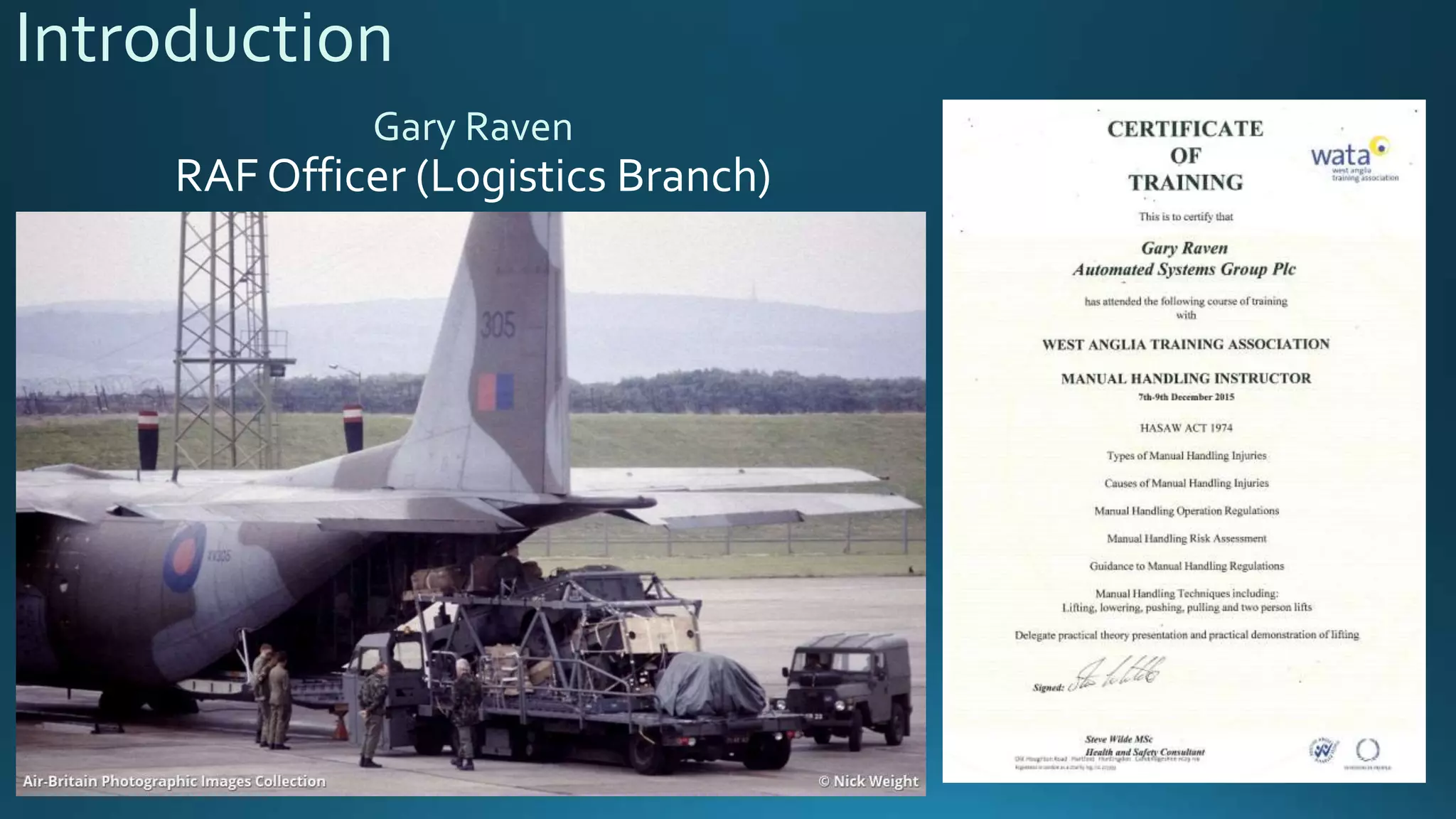
Gary Raven
RAF Officer (Logistics Branch)
Course Introduction
• Course Aim
• Course Objectives
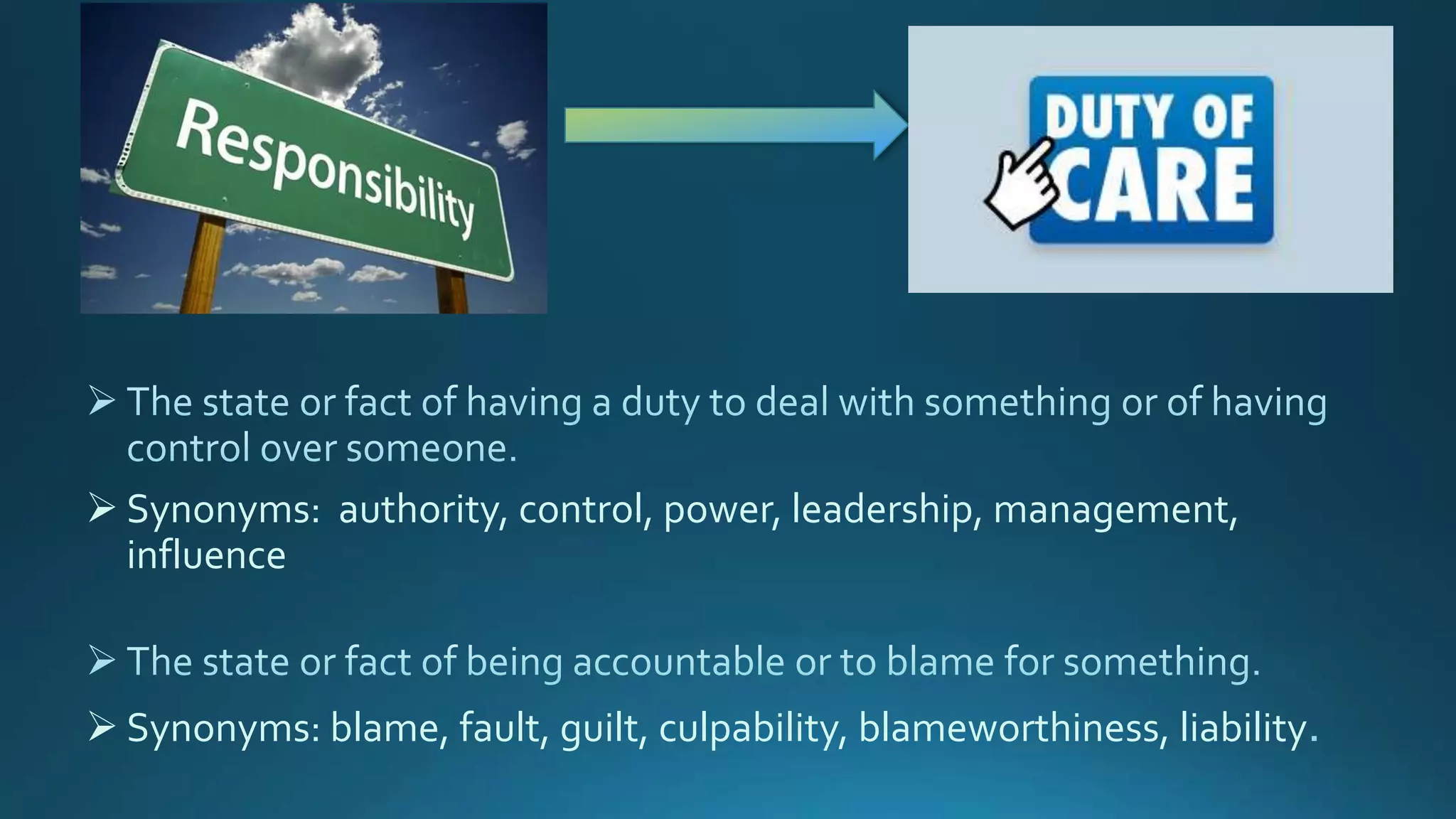
 Synonyms: authority, control, power, leadership, management,
influence
 Synonyms: blame, fault, guilt, culpability, blameworthiness, liability
Legal Issues
CommonLaw
case law precedent
Common Law
CommonLaw‘DutyofCare’
 Tell someone
CommonLaw‘DutyofCare’
reasonably practicable
Health And Safety AtWork Act 1974
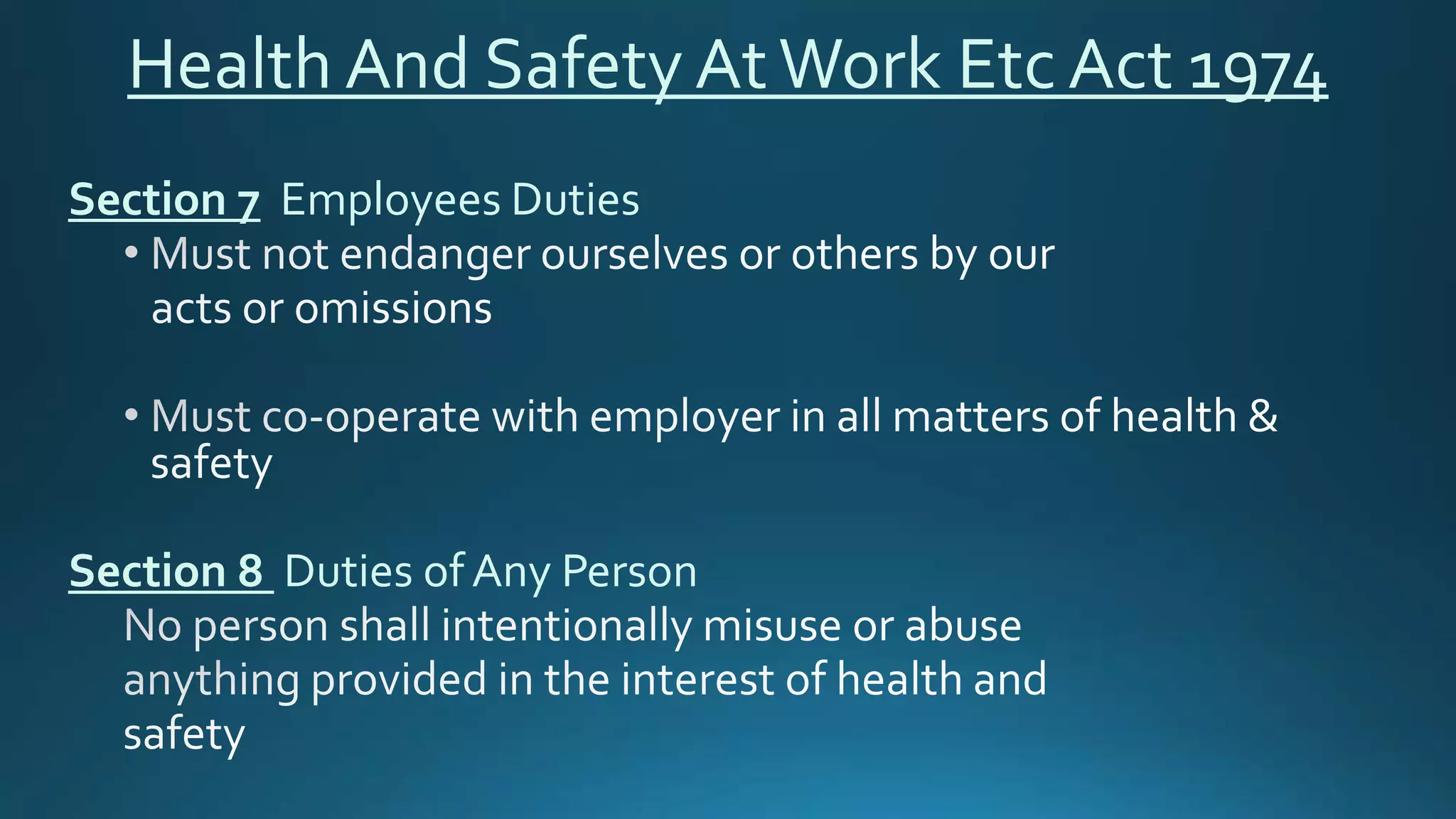
Health And Safety AtWork Etc Act 1974
Section 7 Employees Duties
Section 8 Duties of Any Person
Health And Safety AtWork Etc Act 1974
Section 9
Consequences?
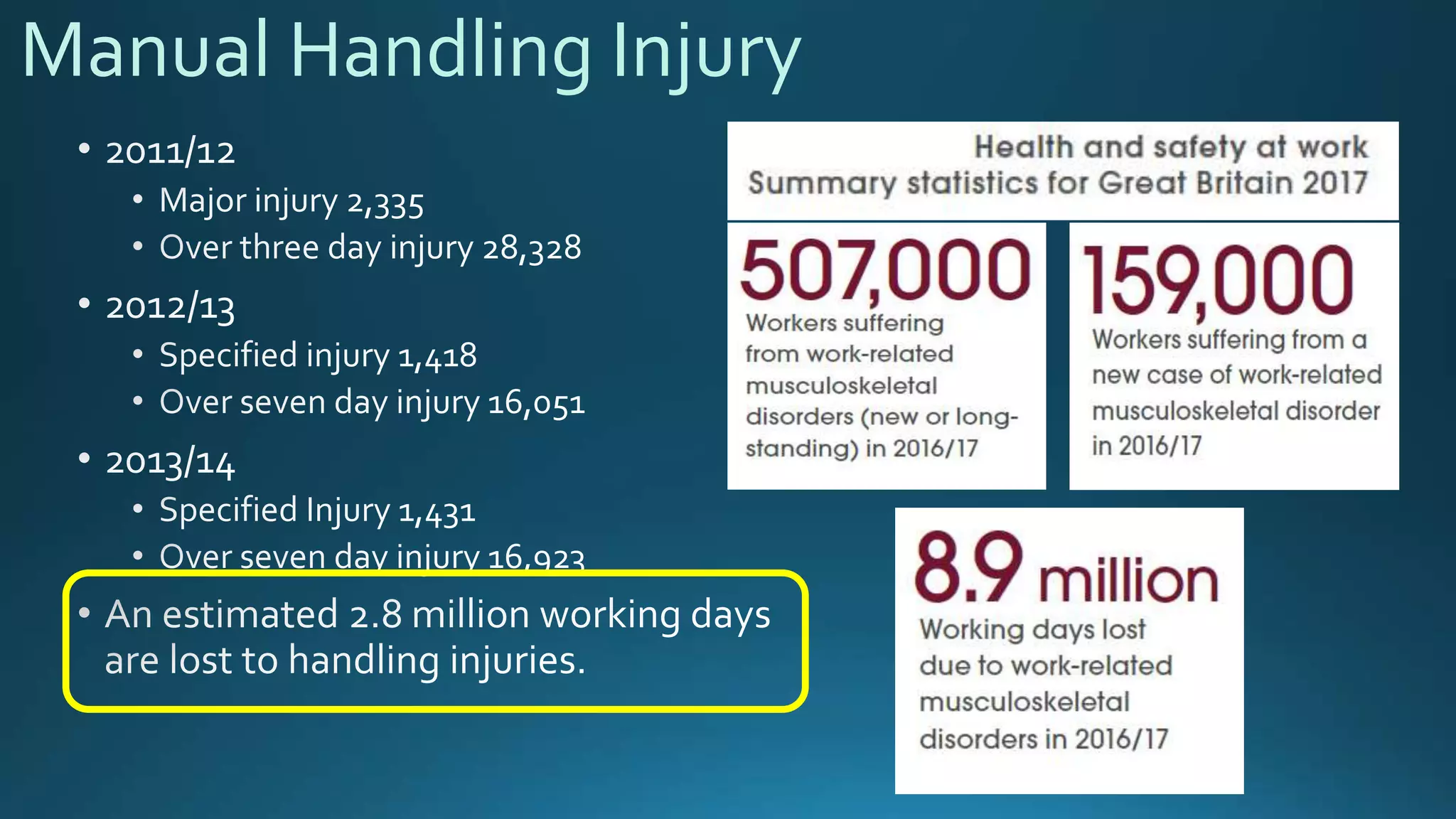
Manual Handling Injury
Accident Statistics
38%
20%
4%
23%
2%
13%
handling
Other
Falls
Trips
Hit by Vehicle
Hit by falling
object
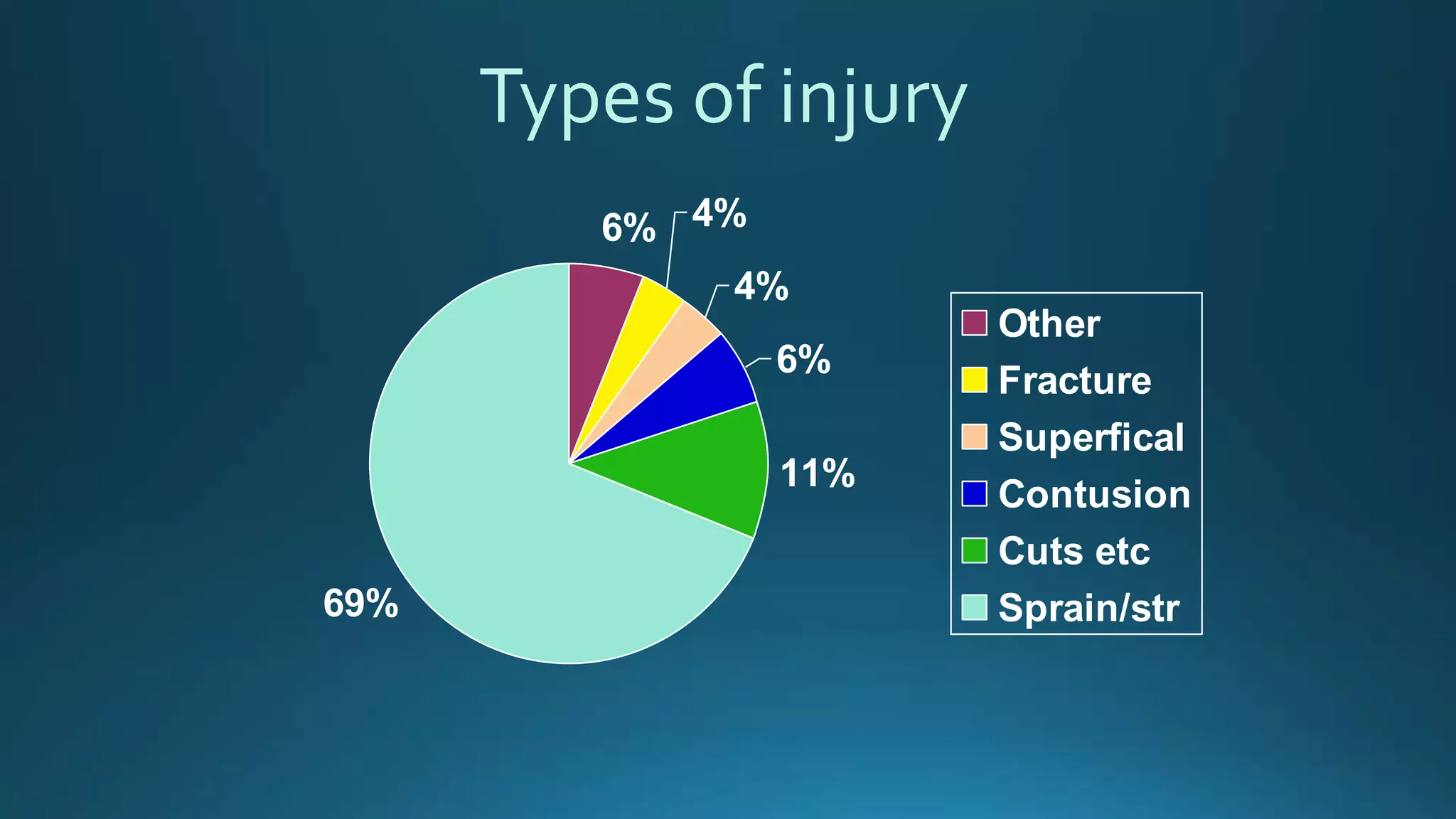
Types of injury
6% 4%
4%
6%
11%
69%
Other
Fracture
Superfical
Contusion
Cuts etc
Sprain/str
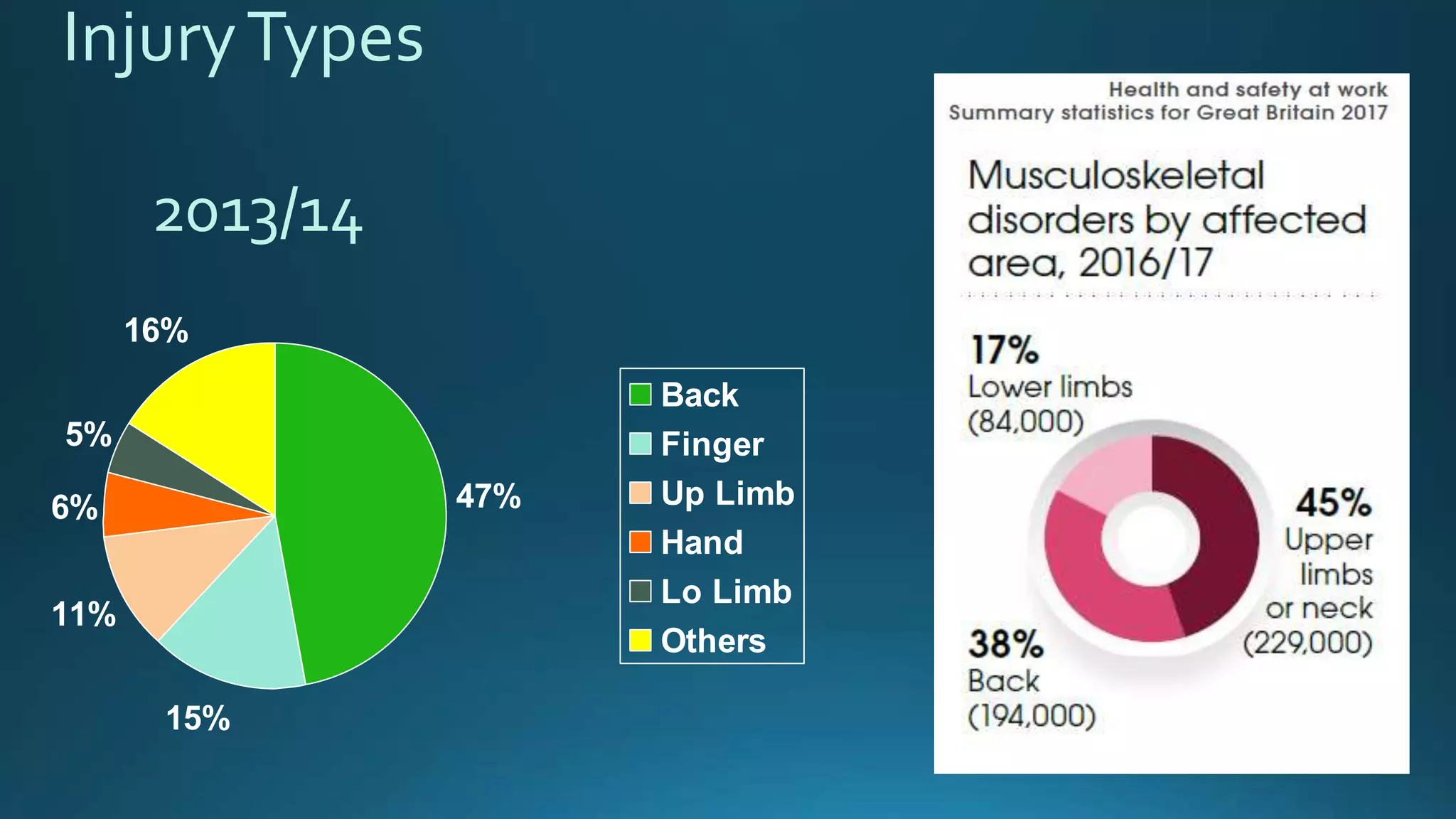
InjuryTypes
47%
15%
11%
6%
5%
16%
Back
Finger
Up Limb
Hand
Lo Limb
Others
2013/14
Types of Injury
Can occur to the limbs,
ribs or spine and are
usually caused by
accidents such as slips,
trips, falls and dropped
objects
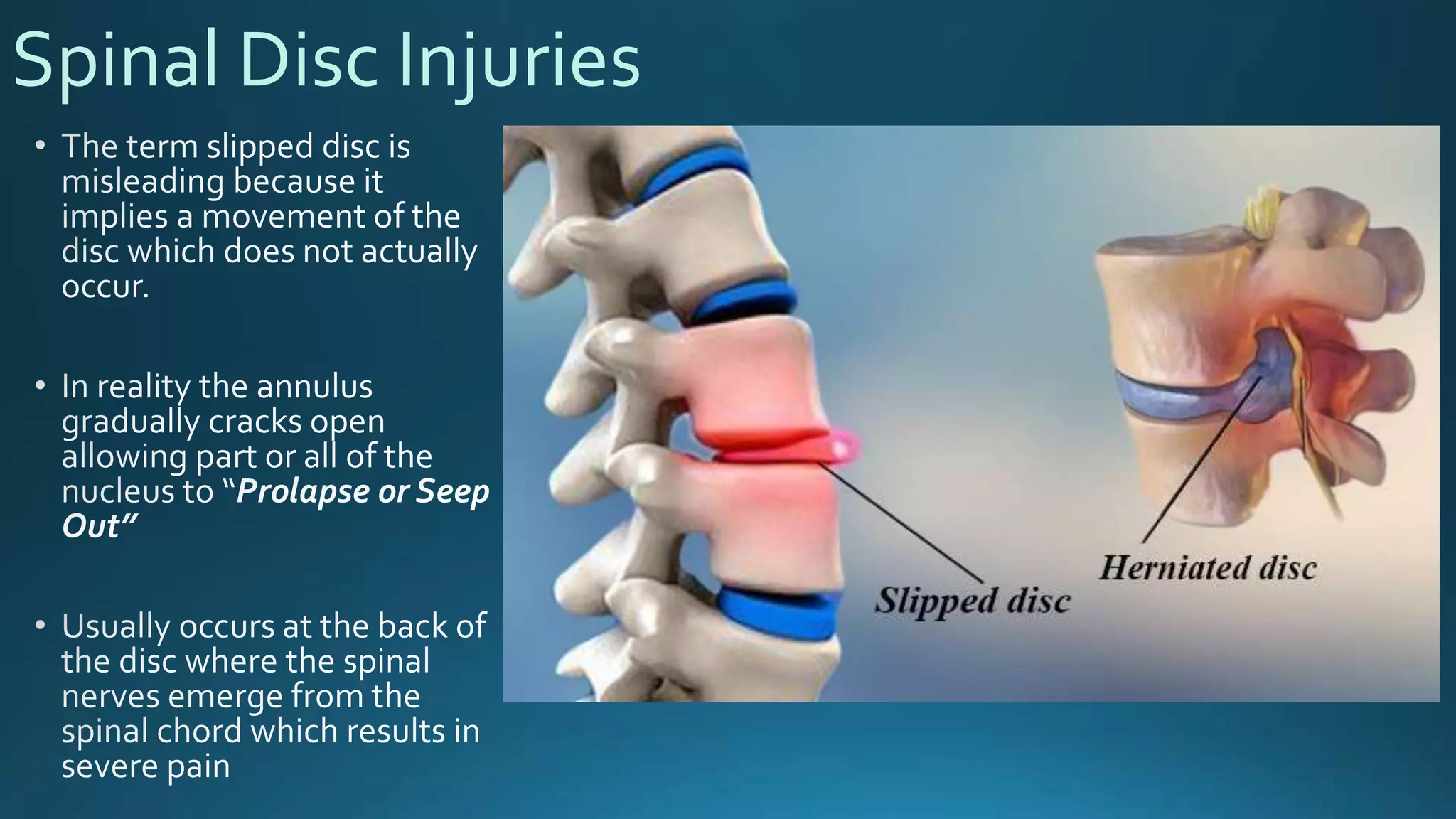
Spinal Disc Injuries
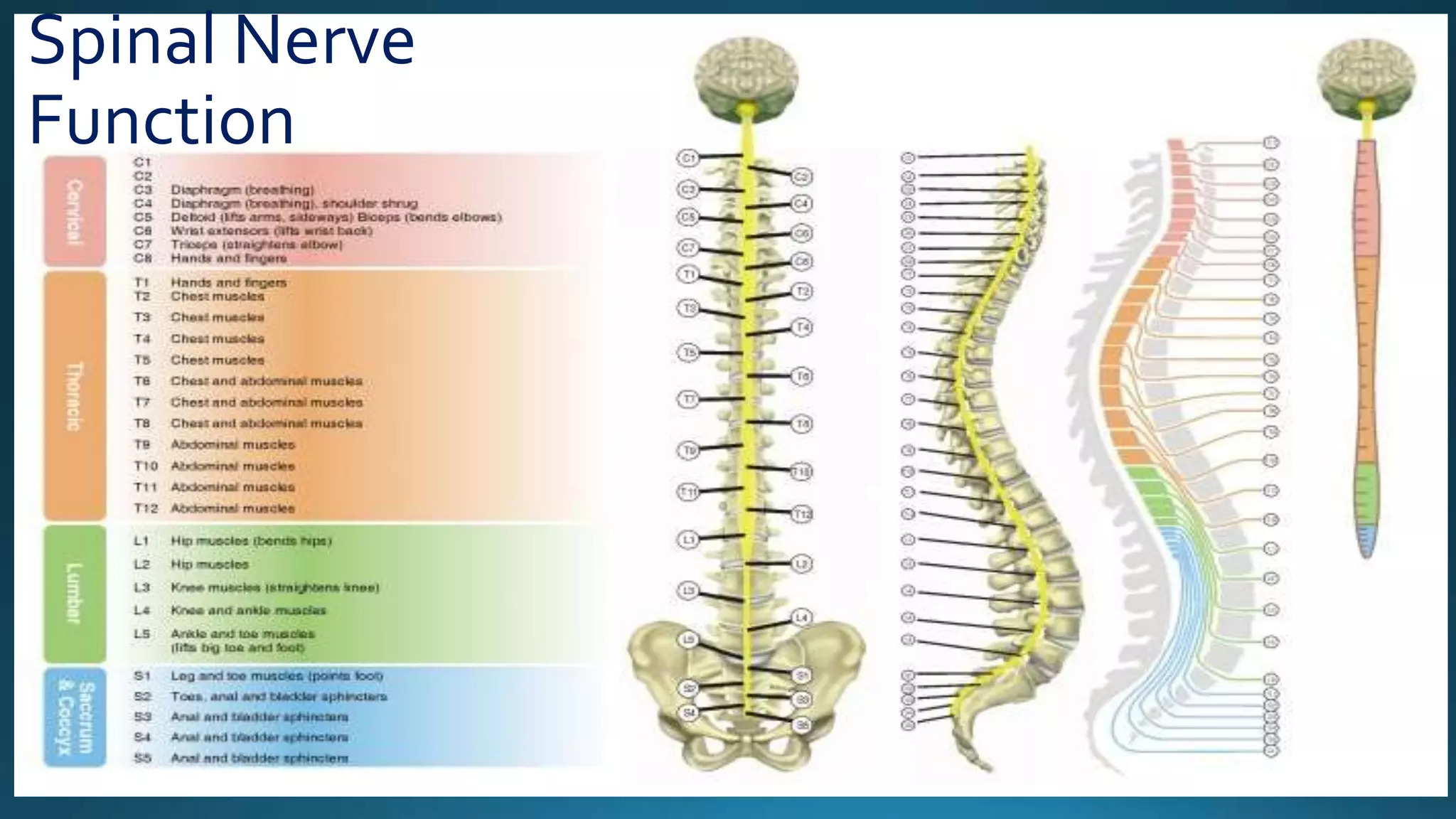
Spinal Nerve
Function
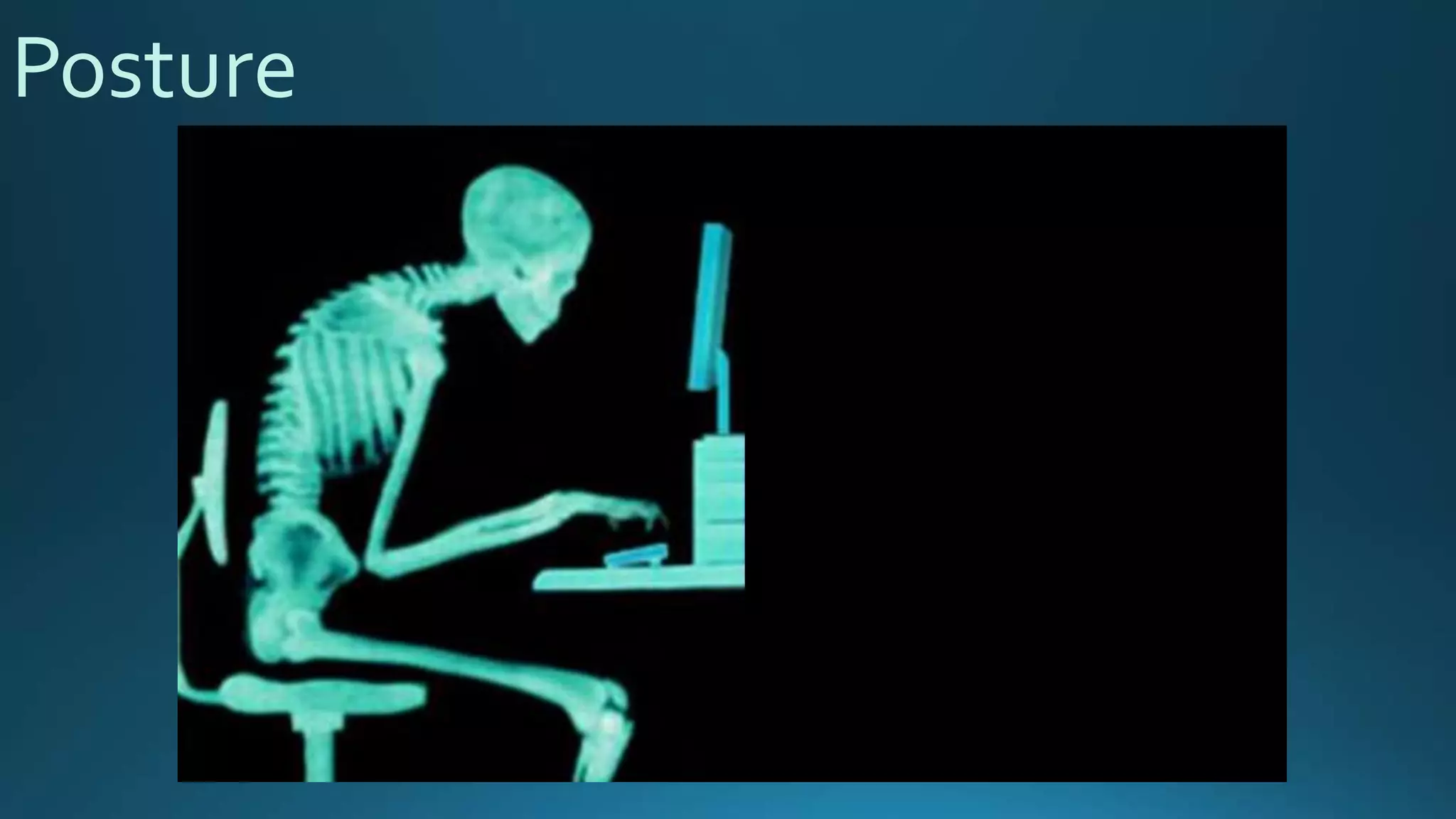
Posture
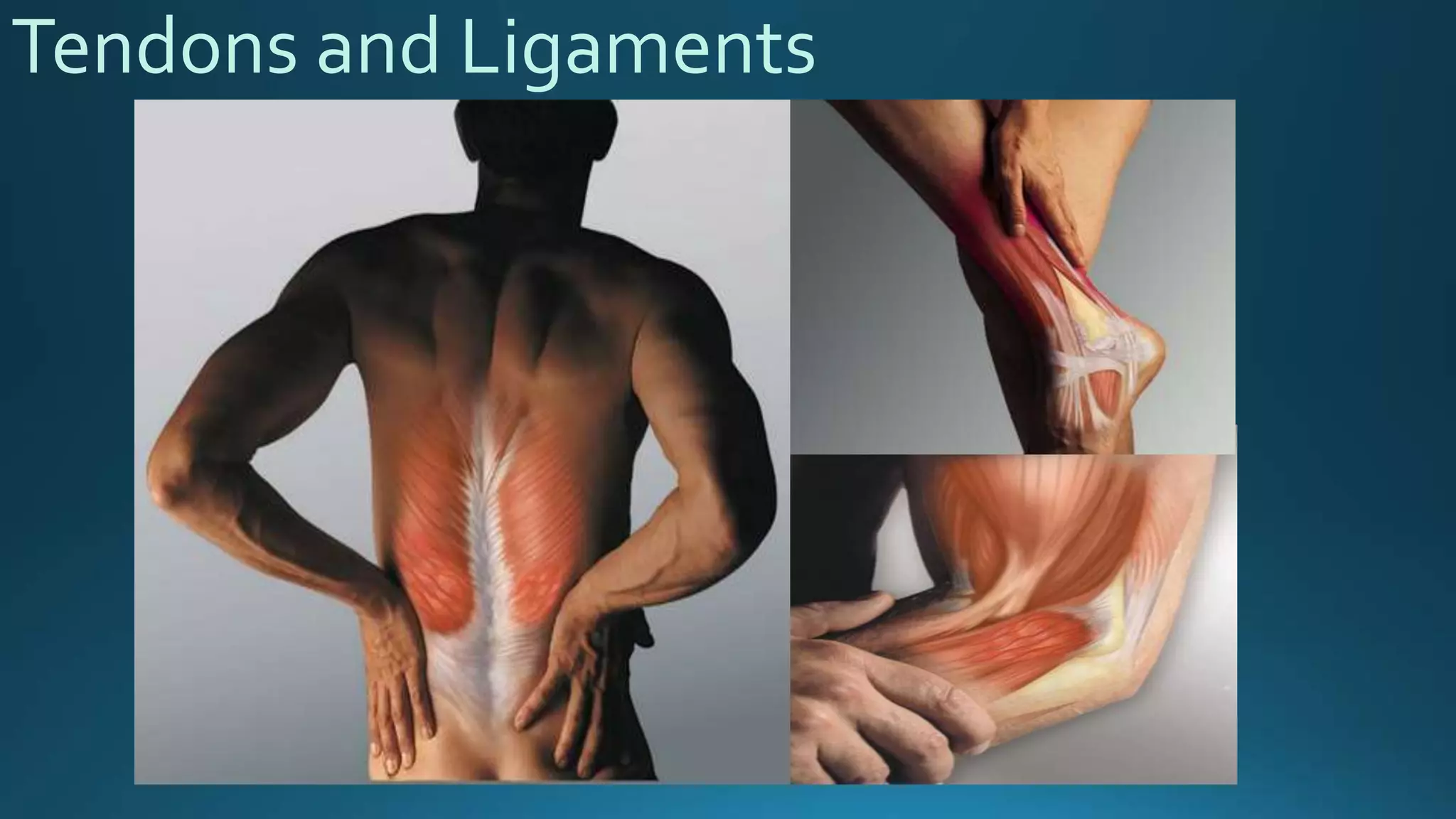
Tendons and Ligaments
Types of Injury
These can become damaged due to being over-stretched or torn
by unnatural or sudden movement or inflamed due to repetitive
action
is a stretch and/or tear of a
ligament (a band of fibrous tissue
that connects two or more bones at a
joint). One or more ligaments can be
injured at the same time.The severity
of the injury will depend on the
extent of injury (whether a tear is
partial or complete) and the number
of ligaments involved.
Types of Injury
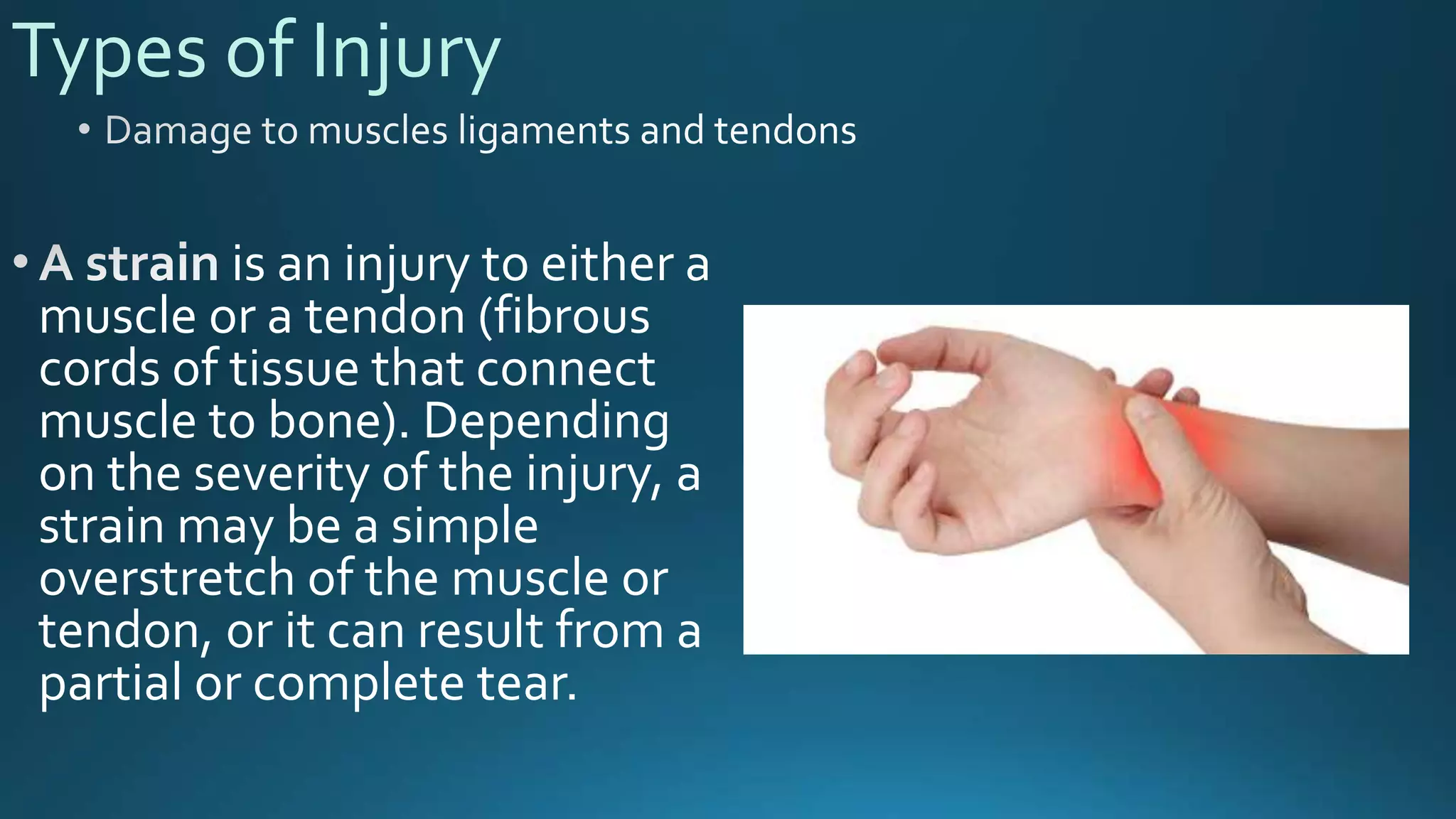
is an injury to either a
muscle or a tendon (fibrous
cords of tissue that connect
muscle to bone). Depending
on the severity of the injury, a
strain may be a simple
overstretch of the muscle or
tendon, or it can result from a
partial or complete tear.
The Knee
Types of Injury
Are often the result of another injury e.g. as a result of harm to a
disc or limb
Are often caused by inappropriate handling of sharp objects
Are caused by compression of internal body parts due to poor
posture
Anytime you bend or lean over to pick something up, you put
tremendous pressure on your lower back.
To demonstrate this, think of your
back as a lever. With the fulcrum
in the center of the lever, how
many pounds would it take to lift
a ten pound object? With the fulcrum in the center, it
takes 10 pounds to lift the 10-
pound object. However, if you
shift the fulcrum to one side, it will
change... If you think about it,
when you bend over to pick
something up, your waist acts as
the fulcrum point in a lever
system; and it is certainly not
centered.
With the fulcrum shifted away from the object, it takes more
force to lift the object. In fact, the human back operates on a
10:1 ratio.
 Bending over to lift a
ten pound object
actually puts 100
pounds of pressure on
your lower back.
Lifting from the Floor
 When you add in the 105
pounds of the average
human upper torso, you
see that lifting a ten pound
object actually puts 1,150
pounds of pressure on the
lower back.
 If you were 25 pounds
overweight, it would add
an additional 250 pounds
of pressure on your back
every time you bend over.
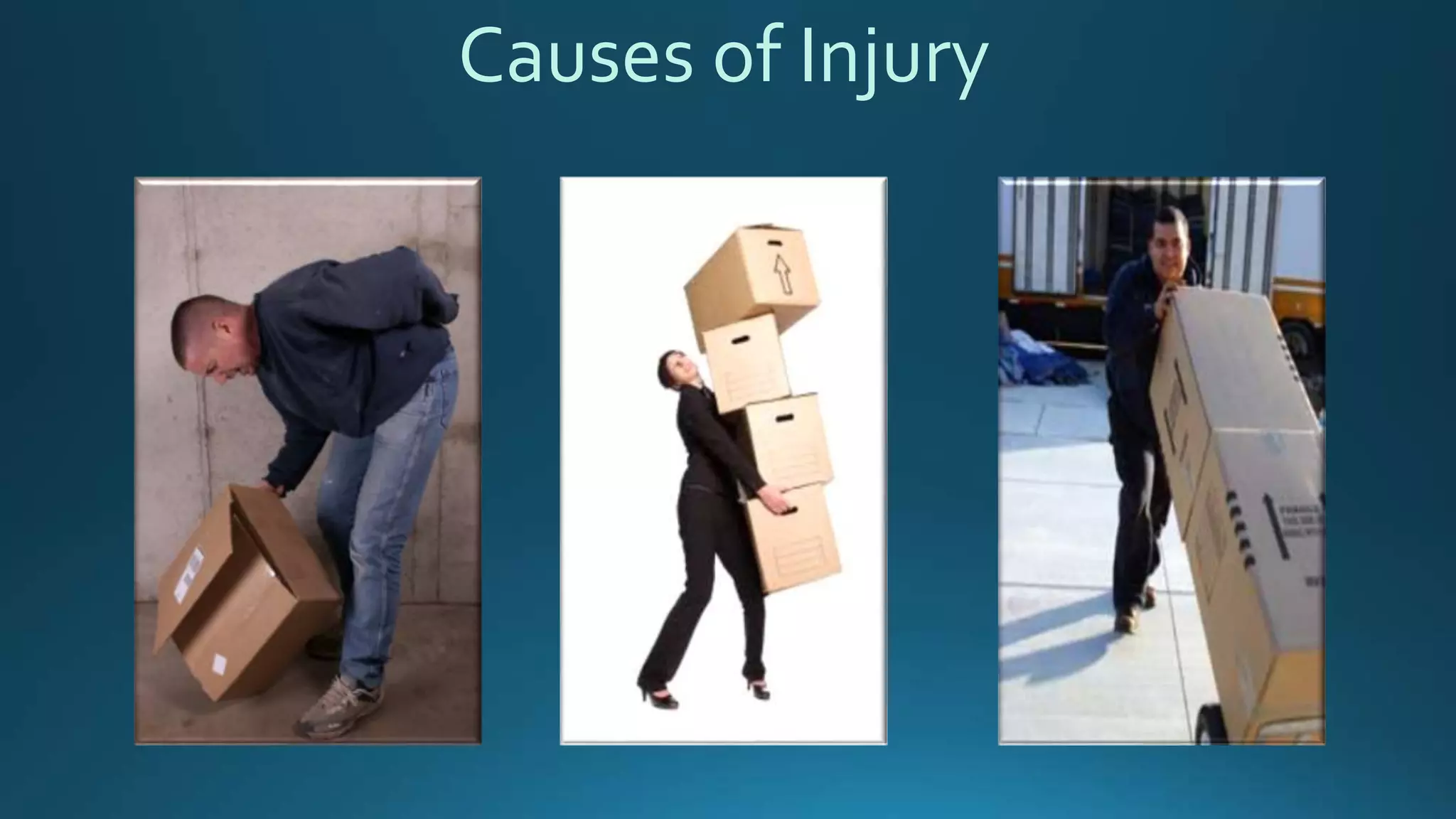
Causes of Injury
Manual Handling Operations
Accumulative movement (over a period of time)
Twisting
Stretching
Reaching
Stooping
Sudden movement
Slip or jerk etc
Causes of Manual Handling Injuries
or
Causes of Manual Handling Injuries
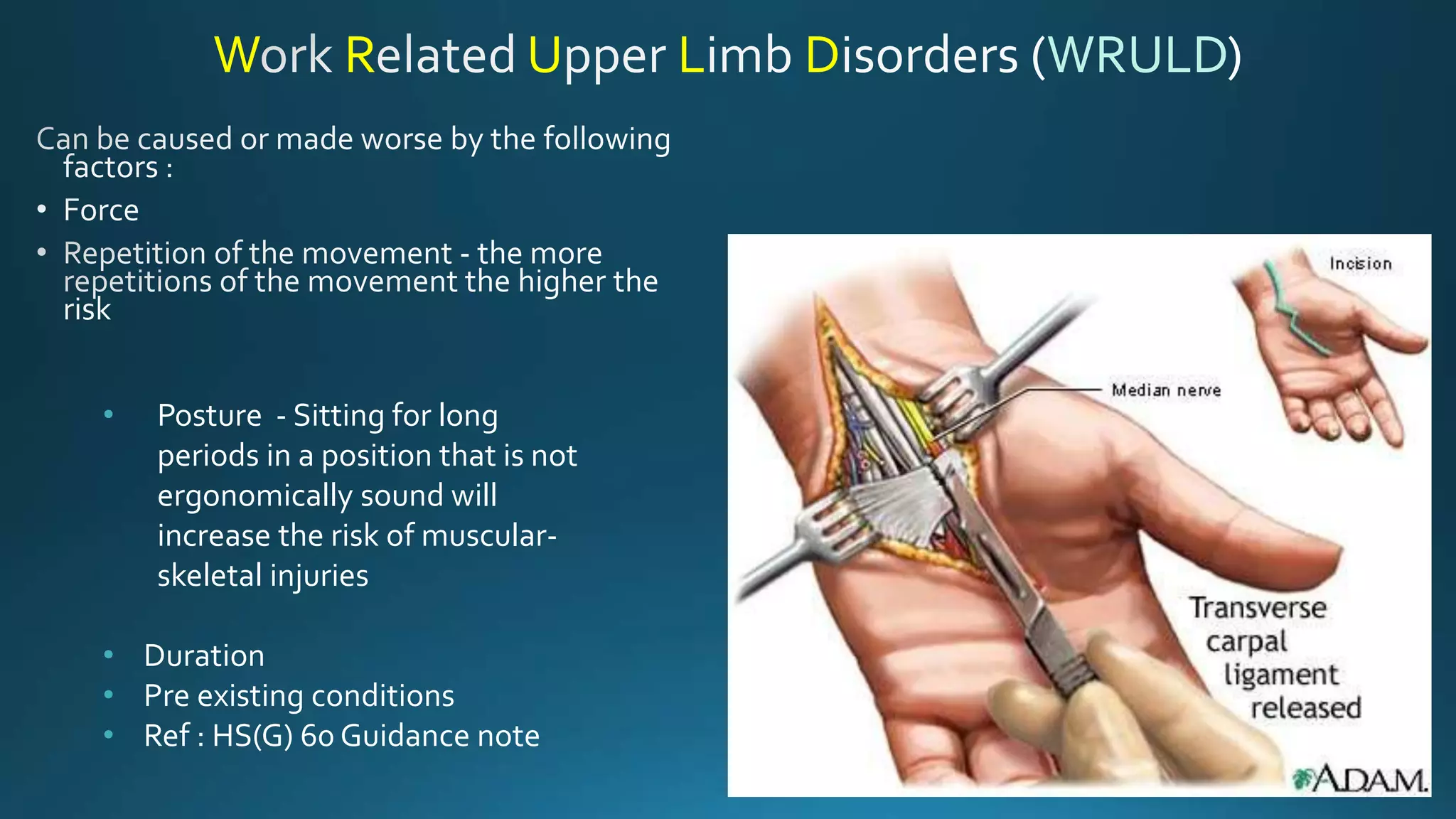
W R U L D WRULD
• Posture - Sitting for long
periods in a position that is not
ergonomically sound will
increase the risk of muscular-
skeletal injuries
• Duration
• Pre existing conditions
• Ref : HS(G) 60 Guidance note
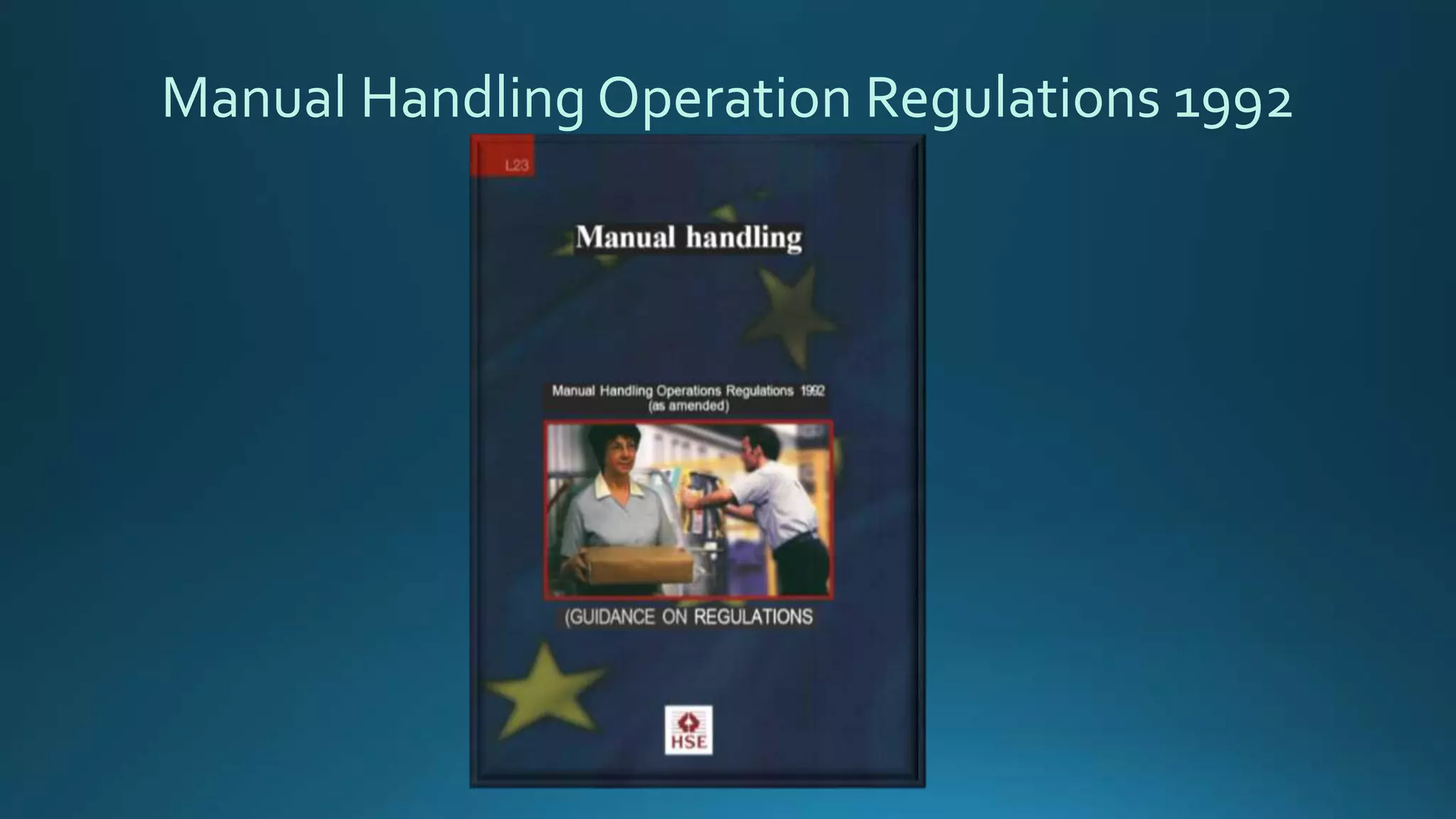
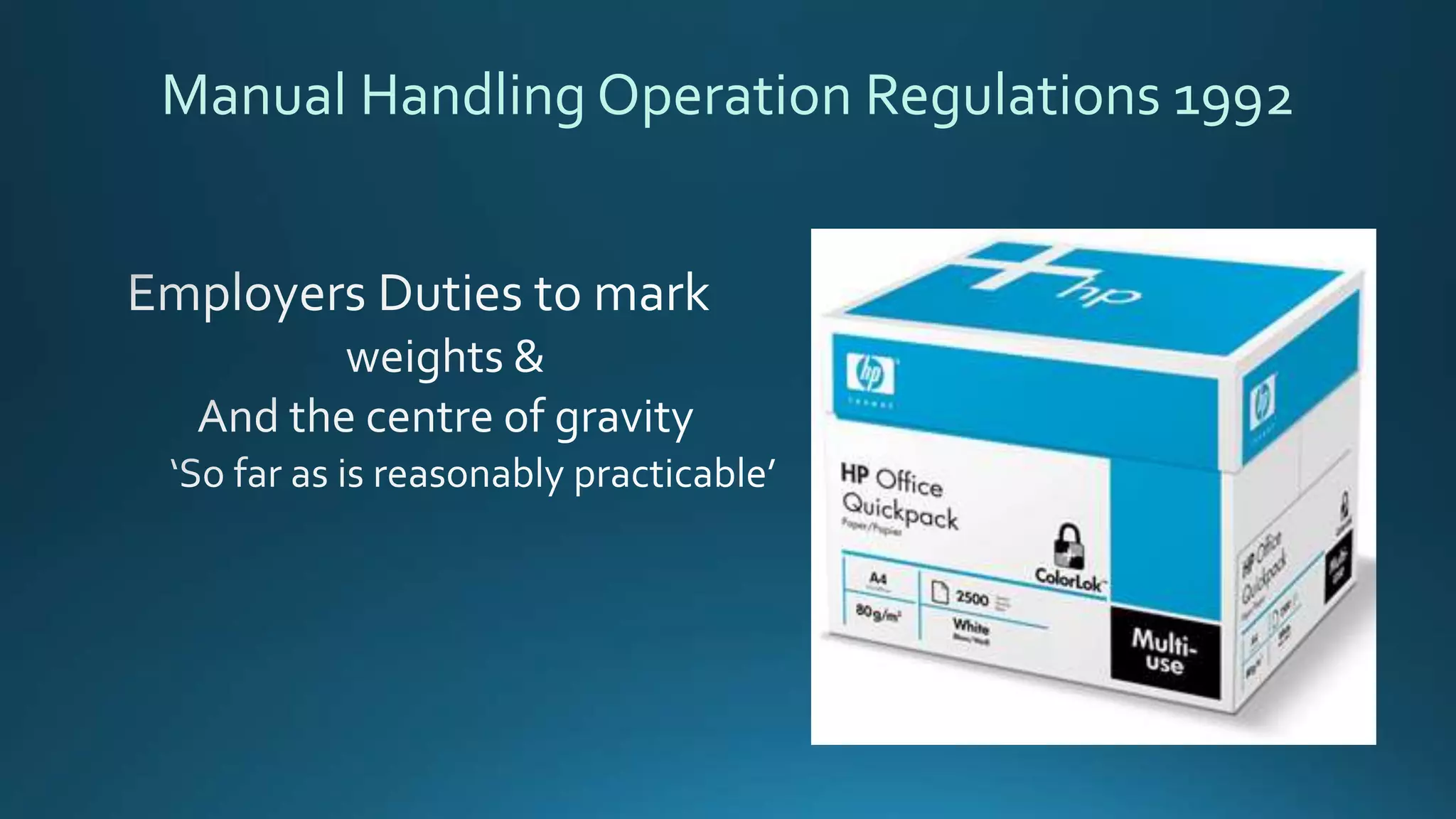
Manual Handling Operation Regulations 1992
Manual Handling Operation
Regulations 1992
Definitions
Manual Handling Operation Regulations 1992
Practical
Demonstration
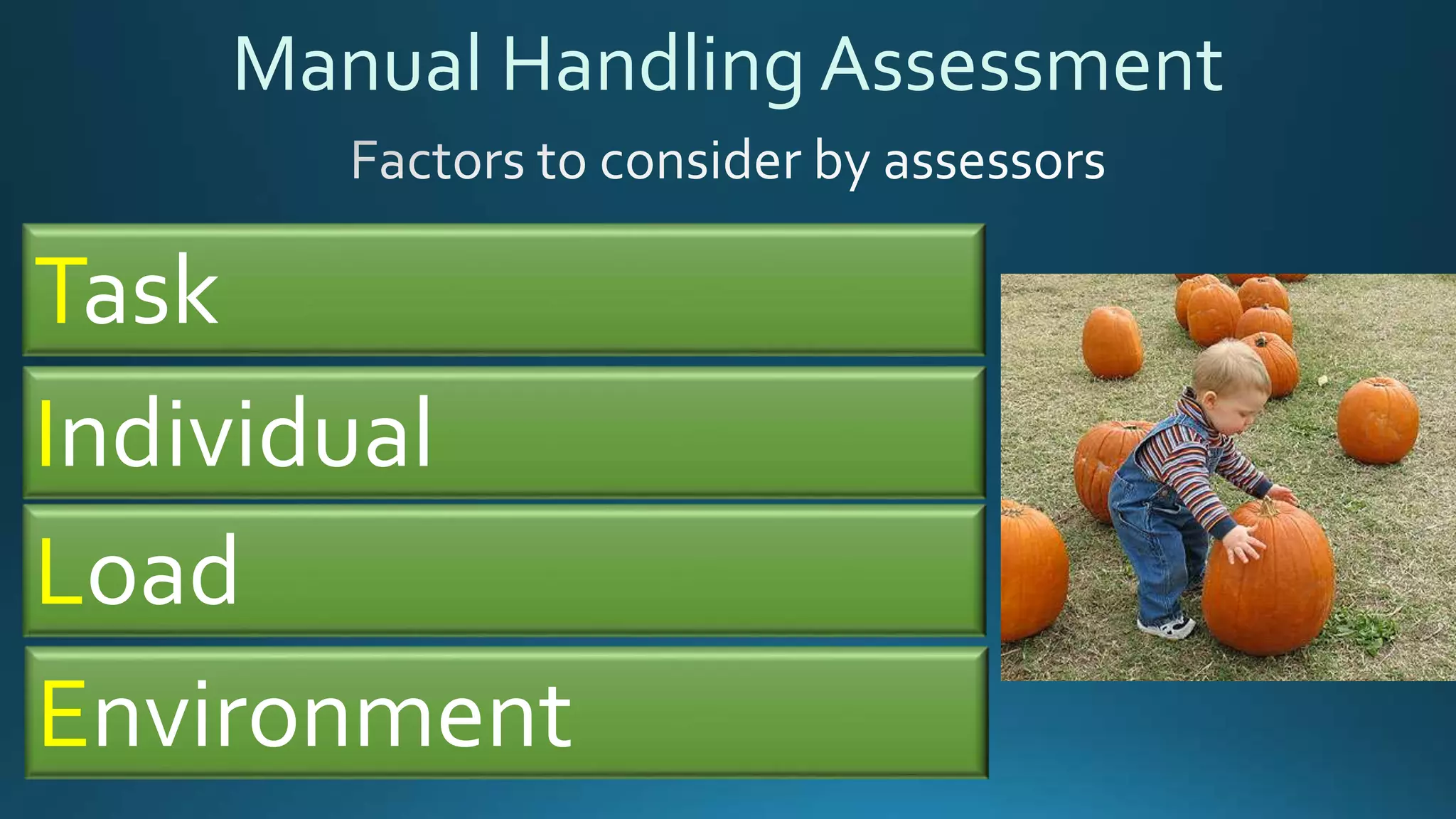
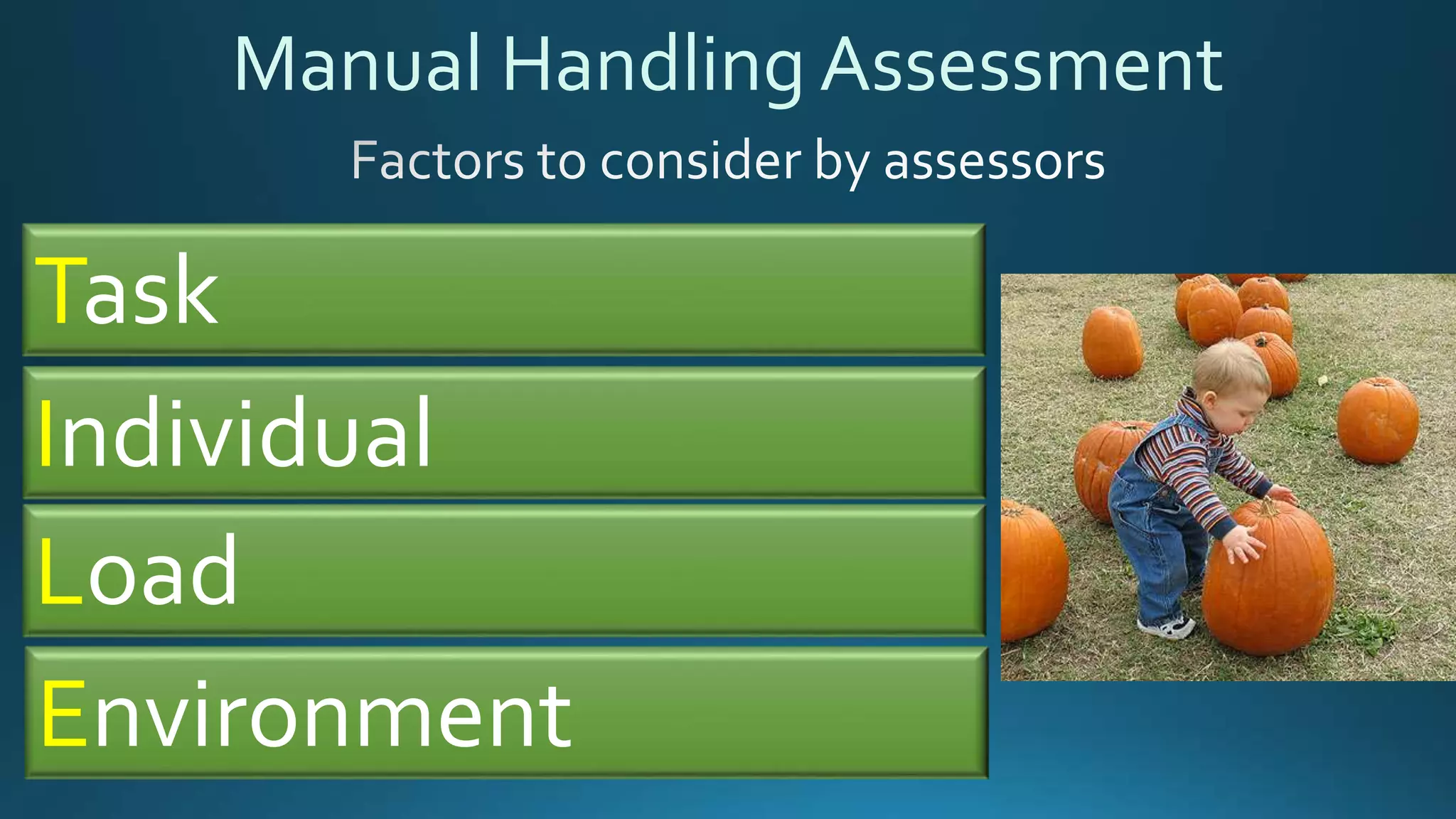
Manual Handling Assessment
Task
Individual
Load
Environment
Task Hazards
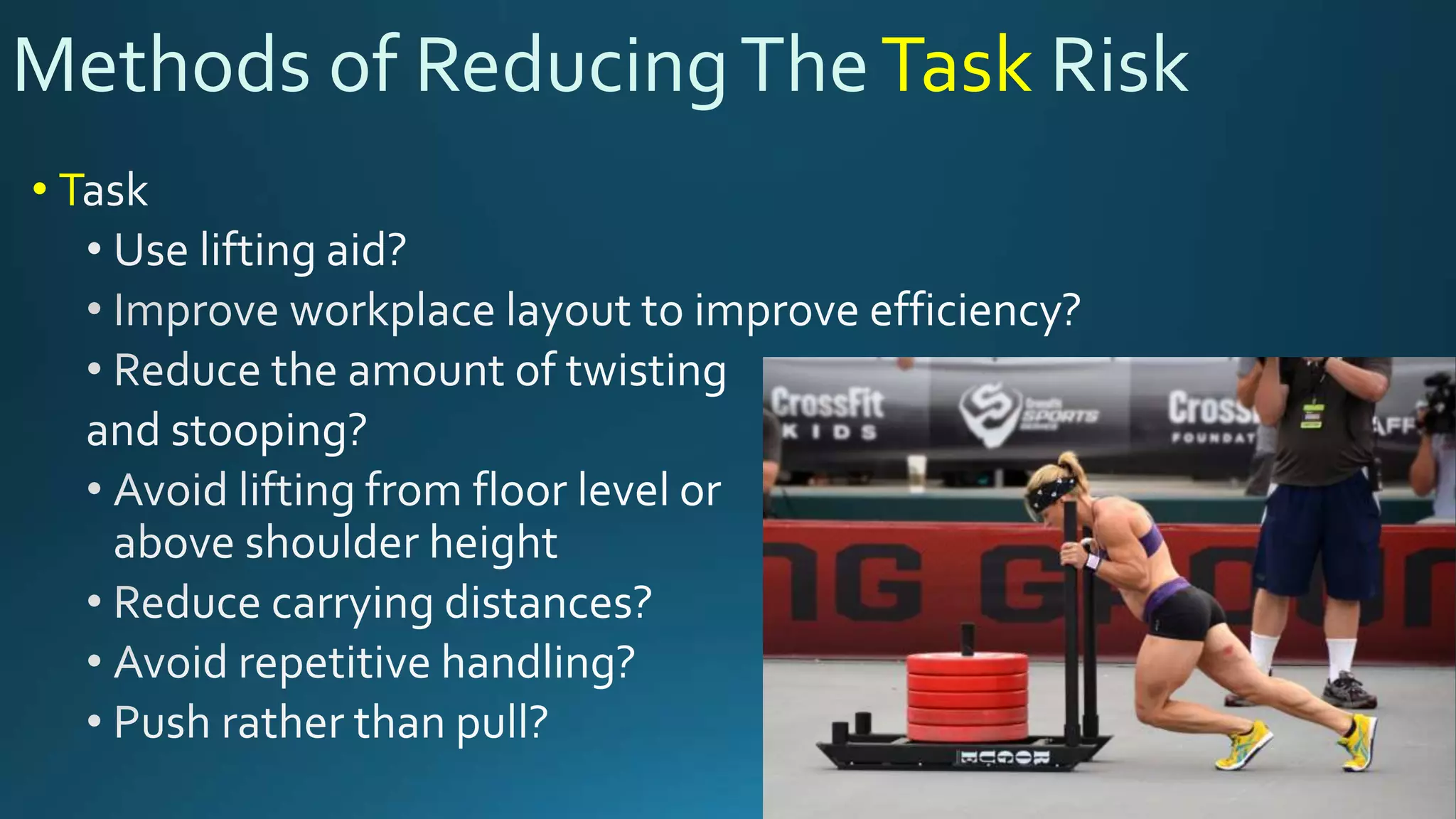
Methods of ReducingTheTask Risk
• T
Individual Hazards
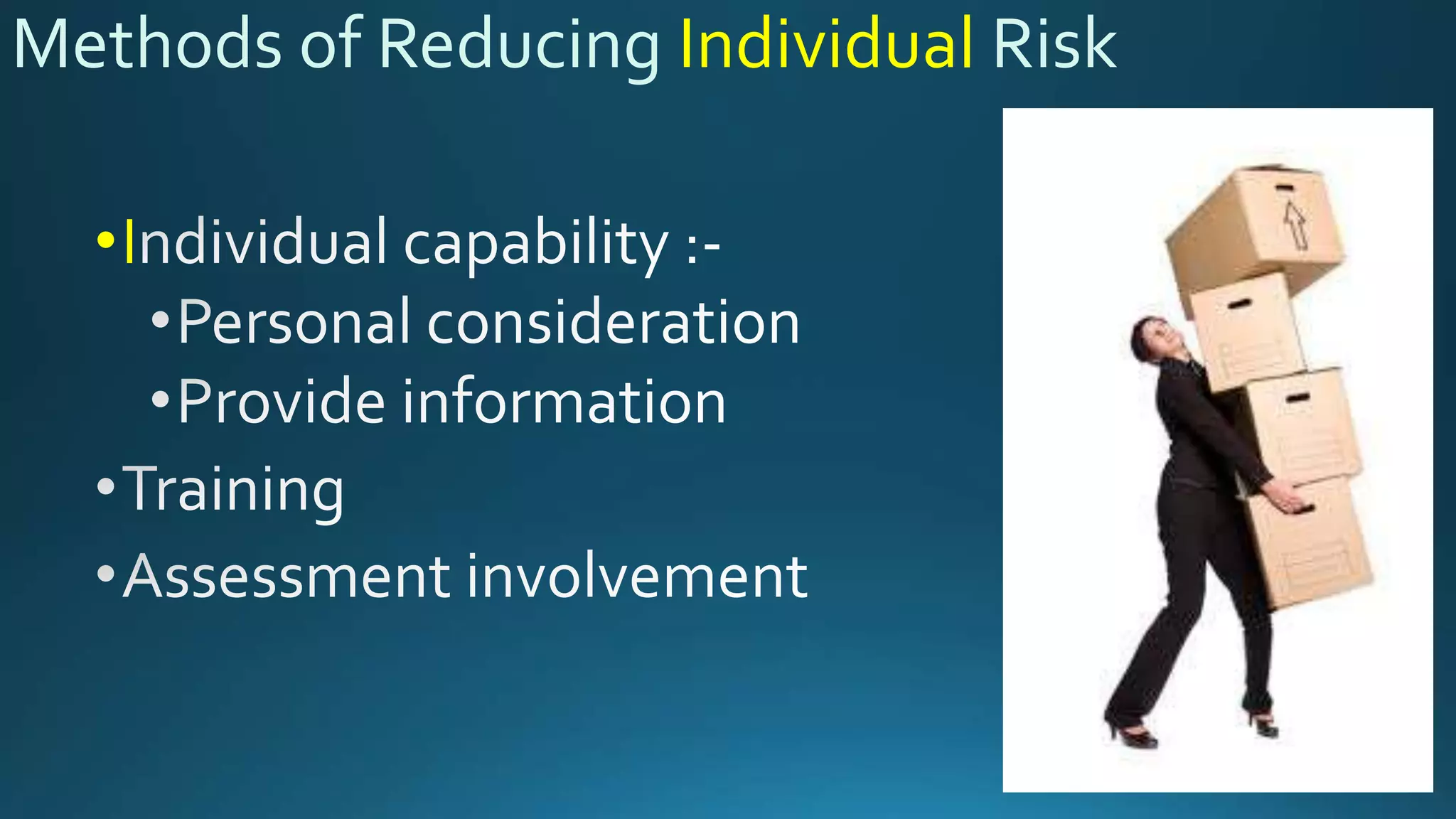
Methods of Reducing Individual Risk
•I
Load Hazards
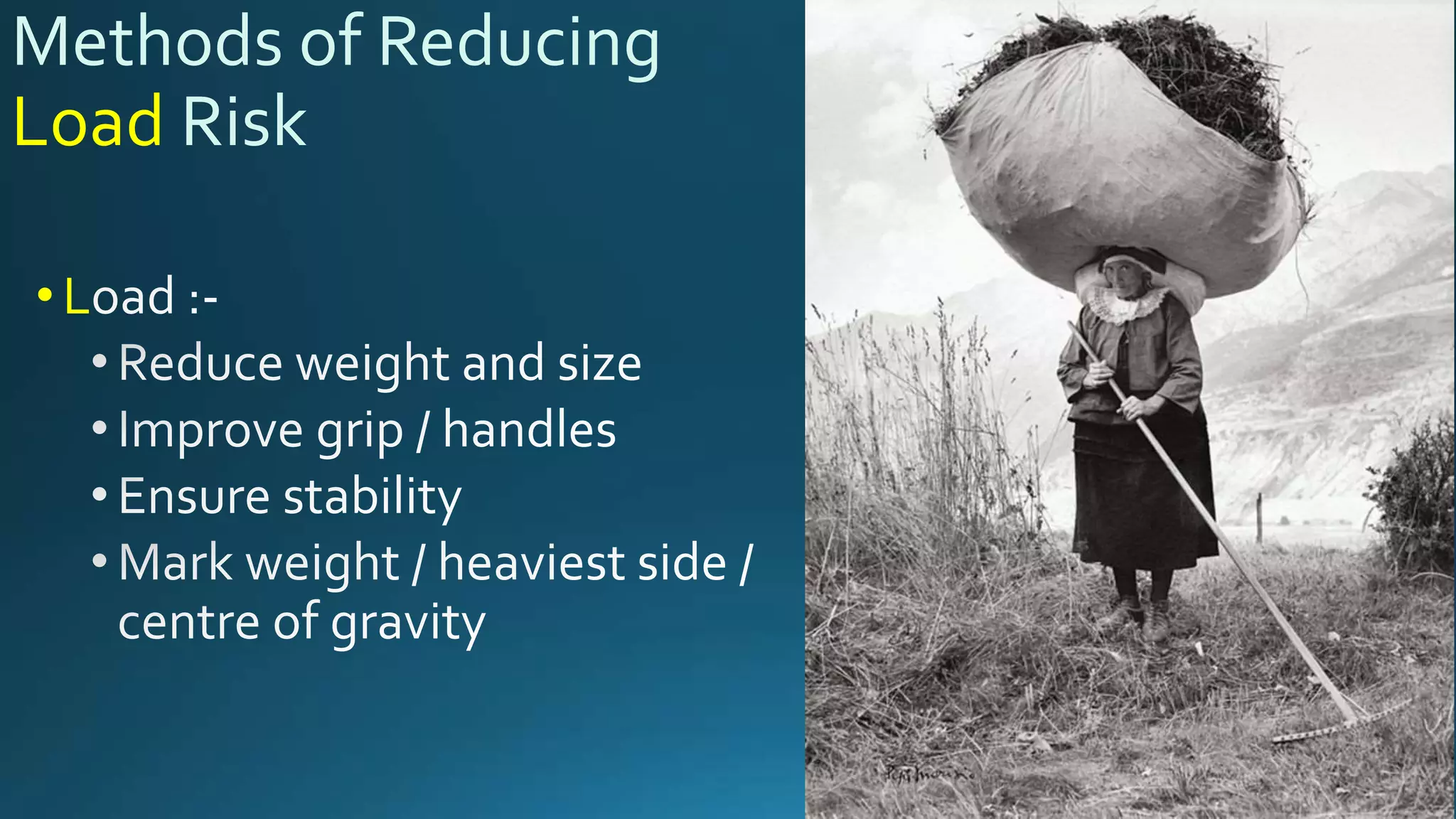
Methods of Reducing
Load Risk
• L
Environmental Hazards
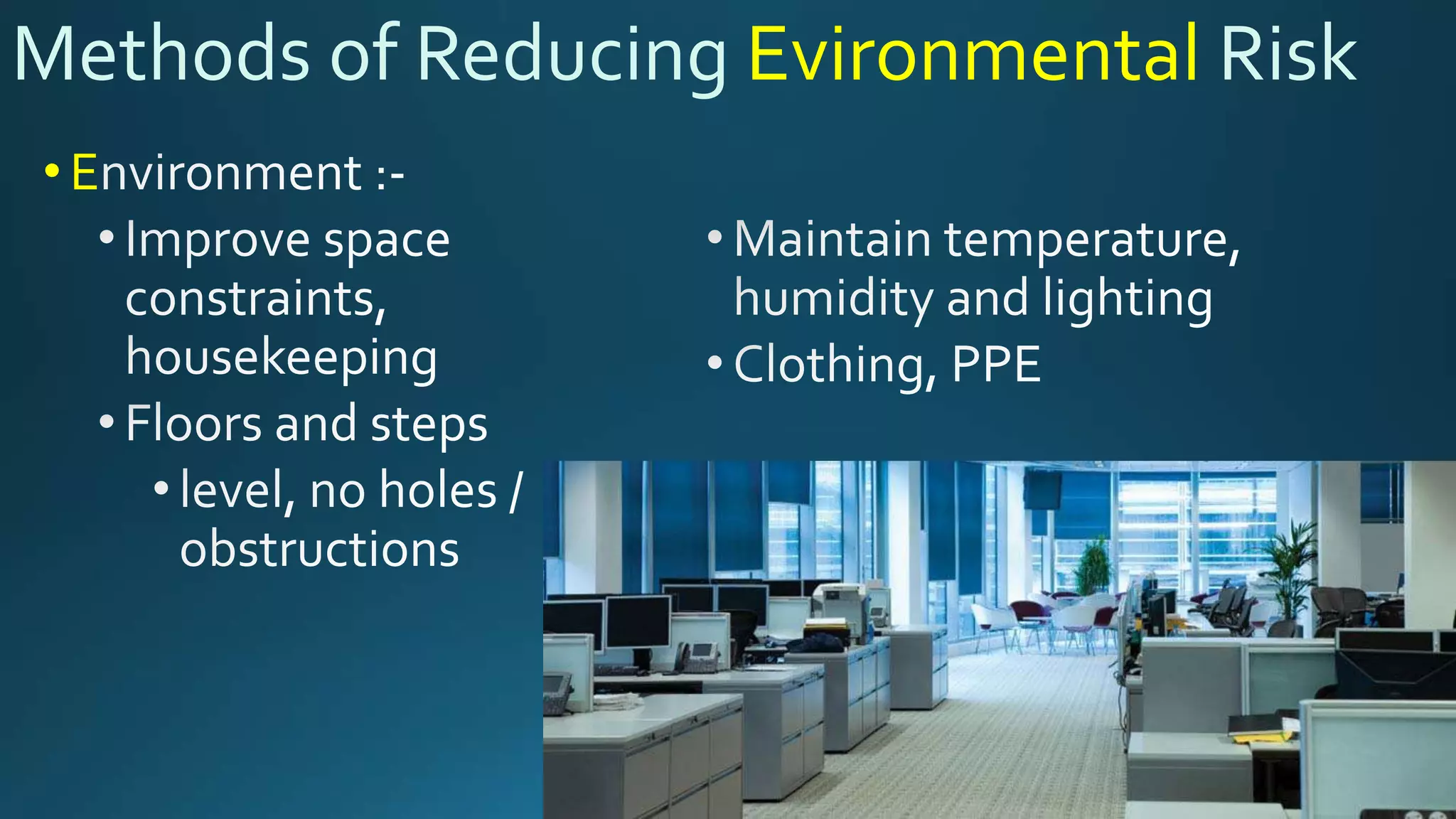
Methods of Reducing Evironmental Risk
•E
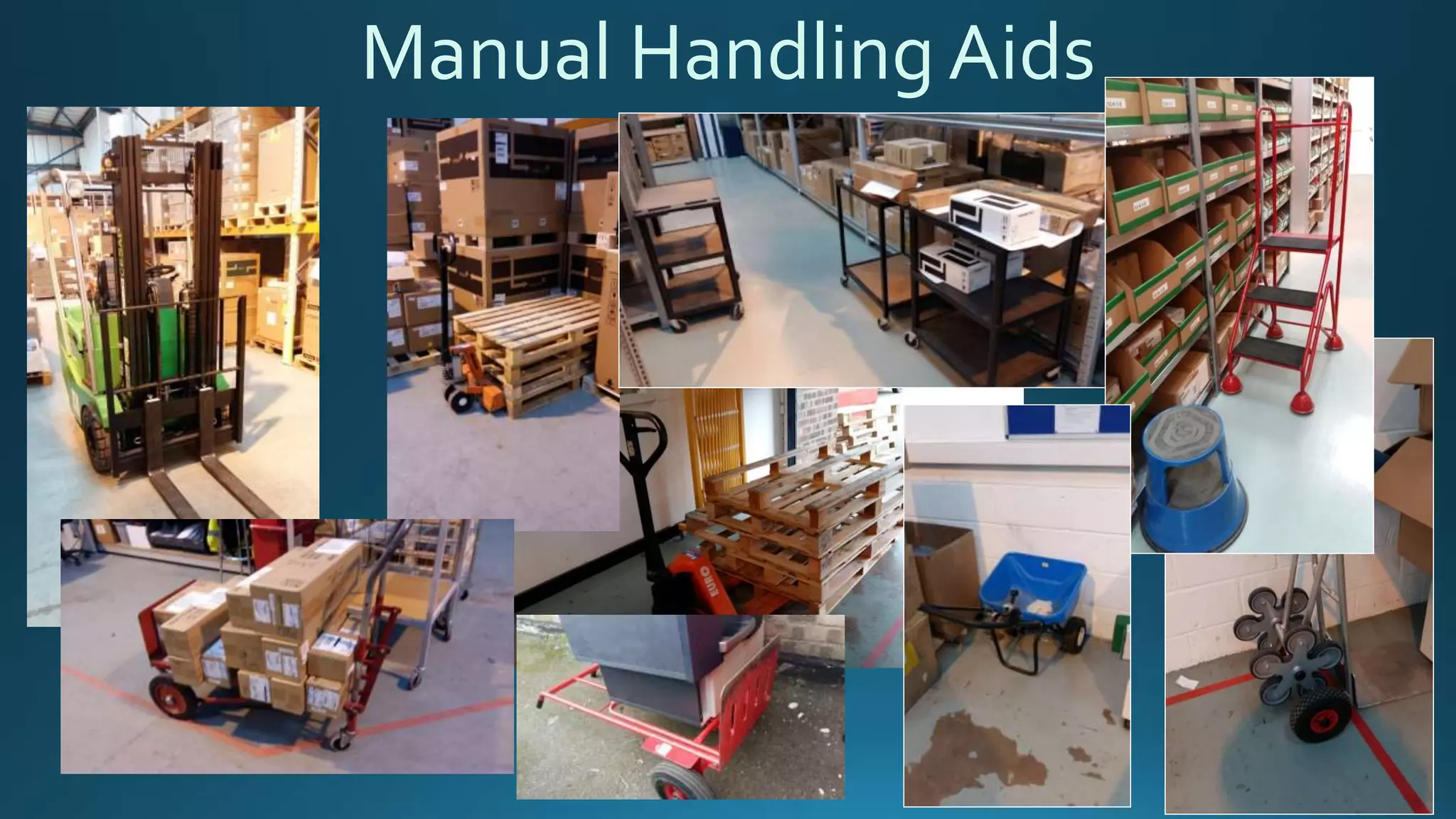
Manual Handling Aids
Regulations Guidance
“there is no safe threshold”
Guide to LoadWeight Reduction
Pulling and Pushing Guidance
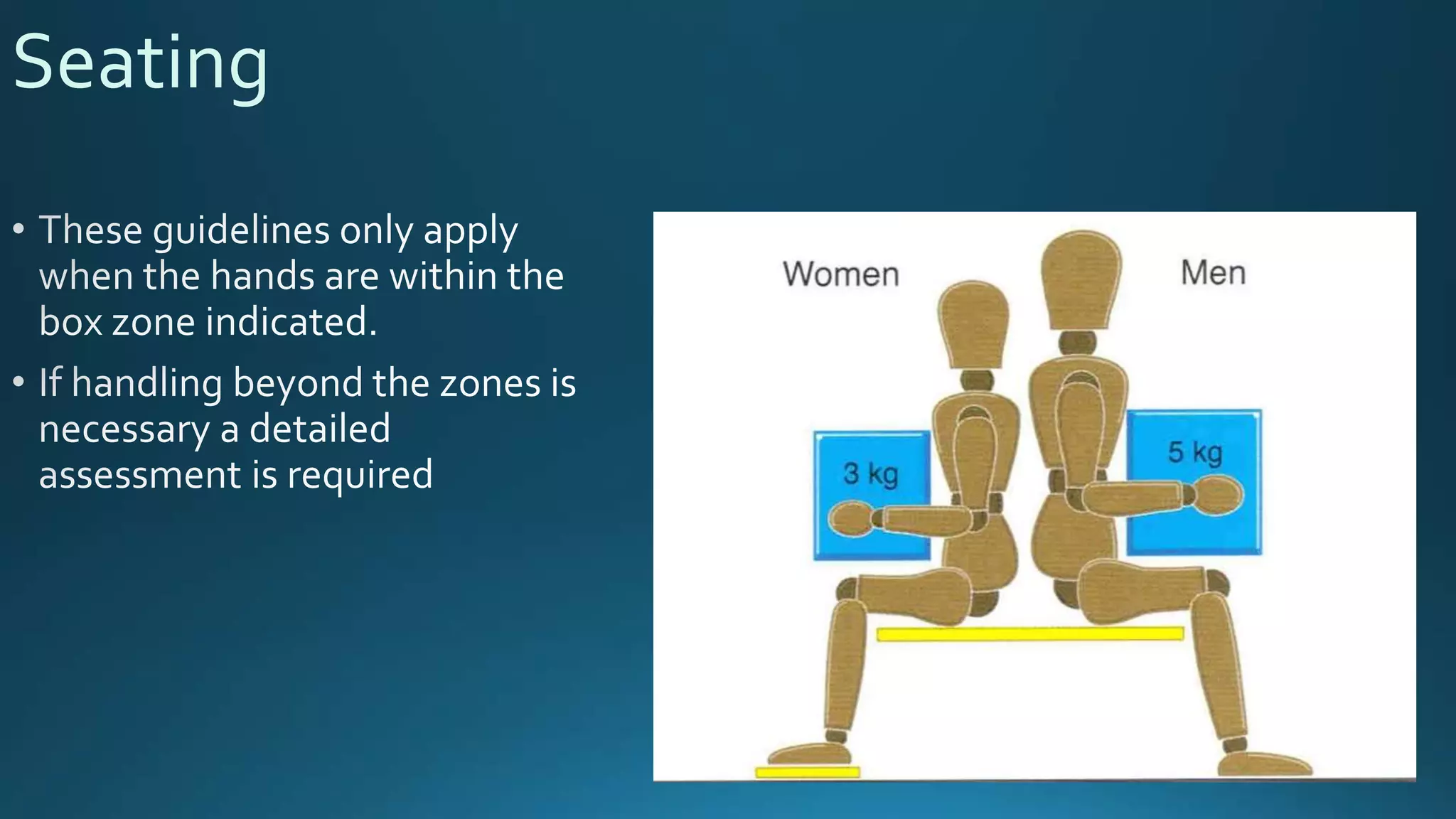
Seating
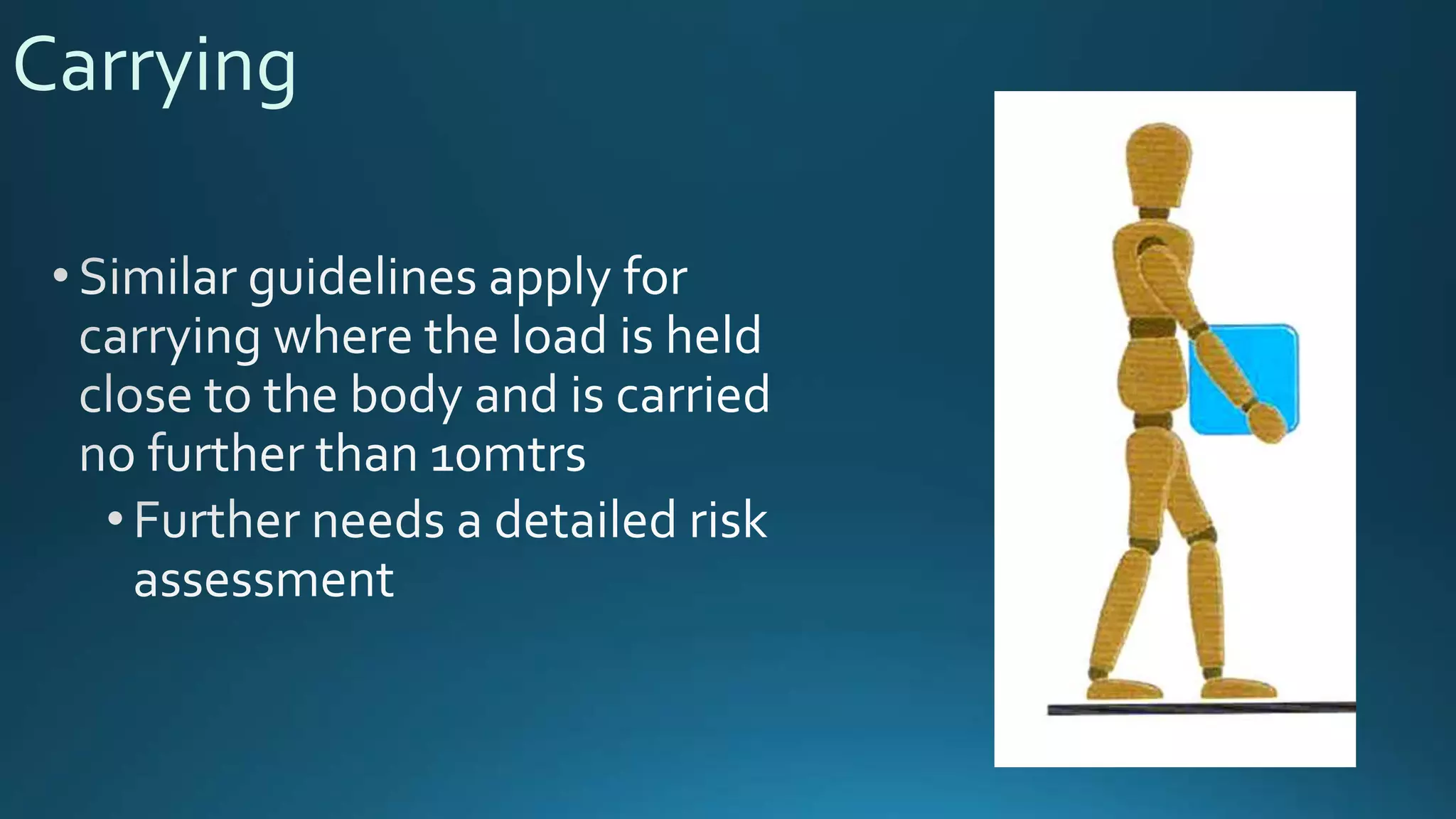
Carrying
Good HandlingTechnique
Plan the lift
Keep the load close to the waist
Good HandlingTechnique
The feet should be apart with one leg slightly forward to maintain balance
(alongside the load, if it is on the ground)
Get a good hold
Start in a good posture
Good HandlingTechnique
. Avoid twisting the back or leaning sideways especially while the back is bent
Keep the head up when handling
Move smoothly
Don’t lift or handle more than can be easily managed
Put down, then adjust
Team Lifting
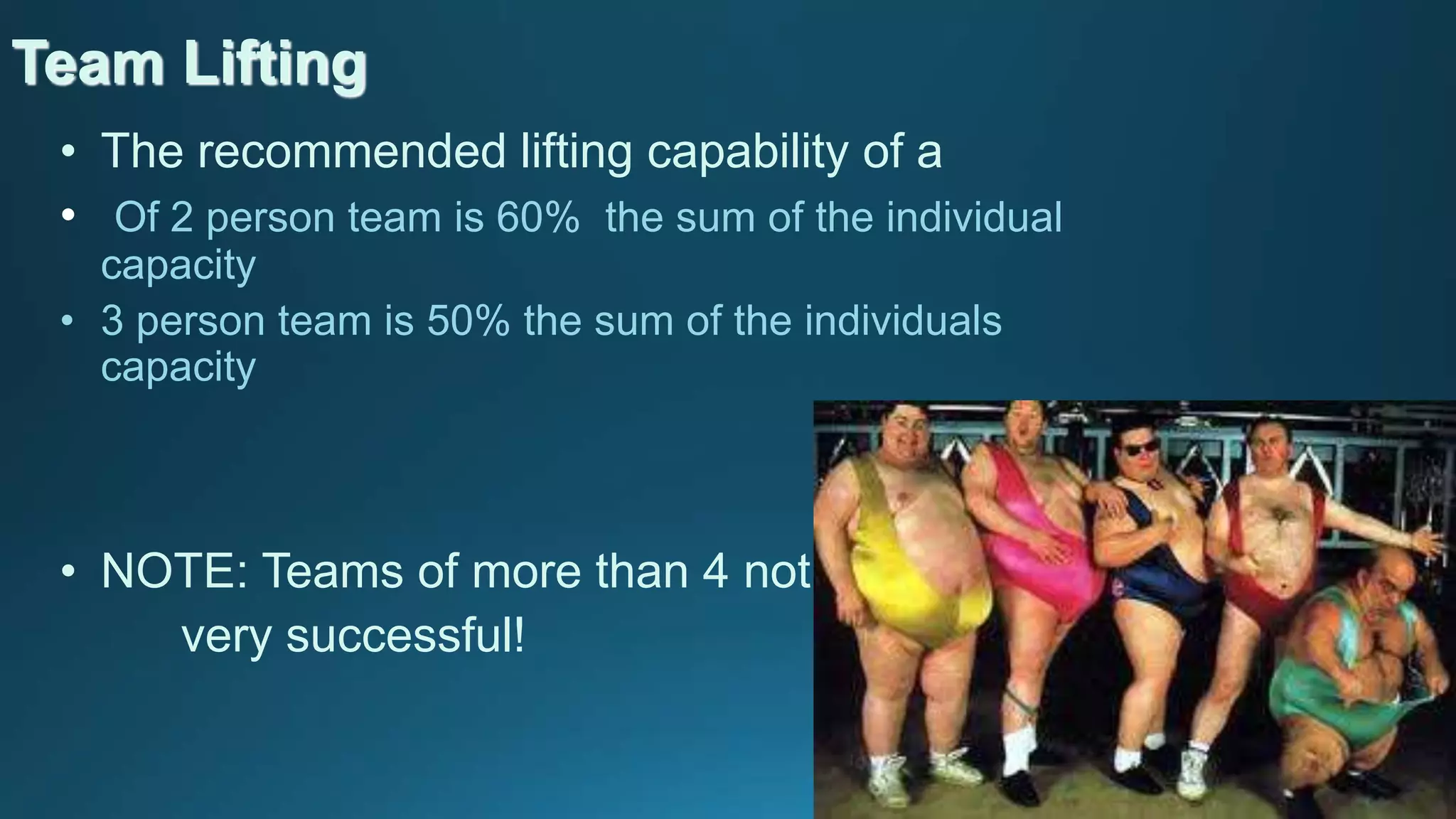
• The recommended lifting capability of a
• Of 2 person team is 60% the sum of the individual
capacity
• 3 person team is 50% the sum of the individuals
capacity
• NOTE: Teams of more than 4 not
very successful!
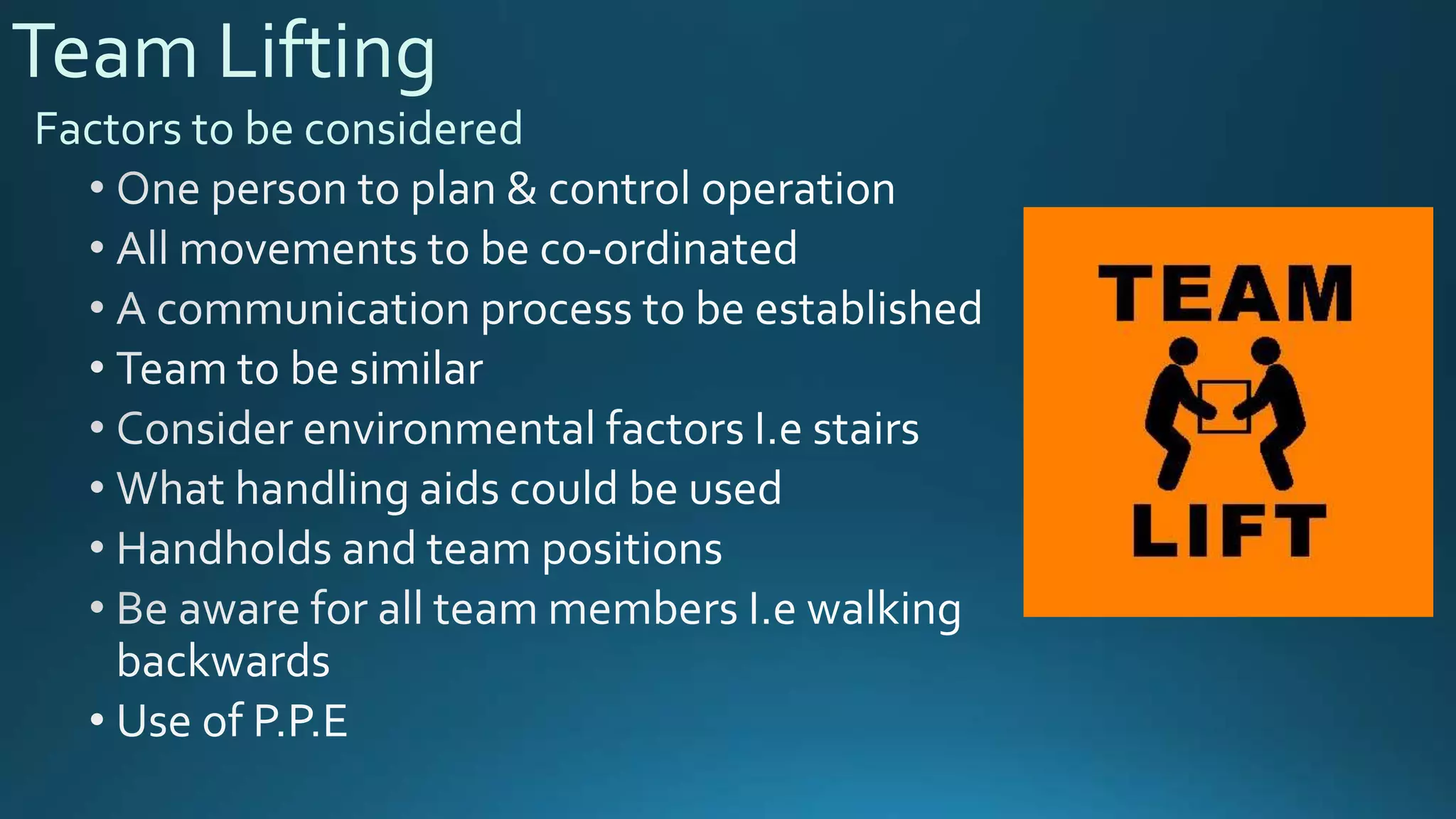
Team Lifting
Factors to be considered
Course Recap
• Course Aim
• Course Objectives
Manual Handling Assessment
Task
Individual
Load
Environment
Health And Safety AtWork

Manual Handling