Manual Handling
One Day Course
Welcome
Course Introduction
Course Overview
1. Introduction to Manual Handling
2. Spinal Awareness, Risk Factors for Back
Pain and Injuries
3. Health and Safety Legislation
4. Dynamic Assessment
5. Efficient Movement Principles and
Practical Workshop
Introduction to
Manual Handling
Session 1
Introduction to Manual Handling
Learning Outcomes
• State examples of manual handling in the
workplace.
• Identify the impact of poor manual handling
on the business and on a worker’s personal
life.
Introduction to
Manual Handling
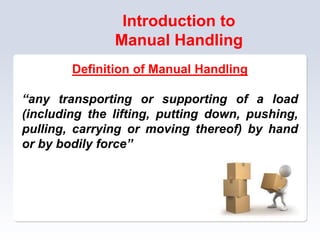
Definition of Manual Handling
“any transporting or supporting of a load
(including the lifting, putting down, pushing,
pulling, carrying or moving thereof) by hand
or by bodily force”
Introduction to
Manual Handling
A third of all workplace injuries which include
work related Musculoskeletal Disorders
(MSDs) such as upper and lower limb
pain/disorders, joint and repetitive strain
injuries are caused by manual handling.
Introduction to
Manual Handling
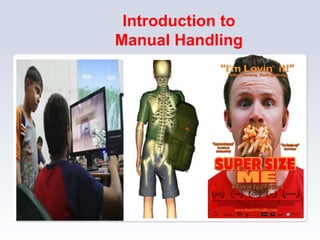
Increasing prevalence of back pain in 16-24
year olds
Source 2013 - www.backcare.org.uk
Introduction to
Manual Handling
Manual Handling in the
Workplace
Delegate Exercise
List the manual handling you carry out in
your workplace.
What happens if things go wrong
Delegate Exercise
List the potential Impact to the business if
things go wrong.
What happens if things go wrong
Delegate Exercise
List the potential Impact to a worker’s
personal life if things go wrong.
Spinal Awareness
Risk Factors for Back Pain and Injuries
Session 2
Spinal Awareness
Risk Factors for Back Pain and
Injuries
Learning Outcomes
• Identify components of the spine.
• Describe how the spine can become injured.
• Identify work related risk factors for back
pain.
• Recognise individual risk factors for back
pain.
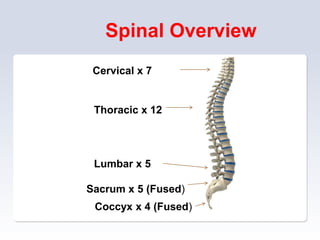
Cervical x 7
Thoracic x 12
Lumbar x 5
Sacrum x 5 (Fused)
Coccyx x 4 (Fused)
Spinal Overview
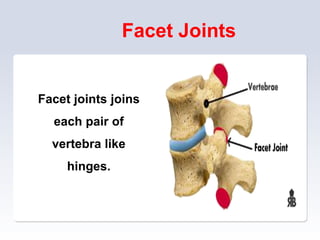
Facet Joints
Facet joints joins
each pair of
vertebra like
hinges.
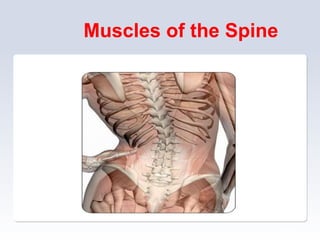
Muscles of the Spine
16
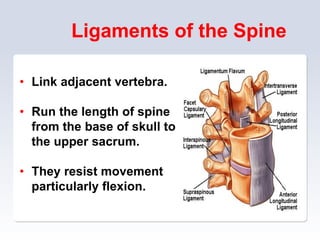
Ligaments of the Spine
• Link adjacent vertebra.
• Run the length of spine
from the base of skull to
the upper sacrum.
• They resist movement
particularly flexion.
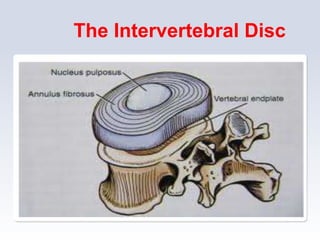
The Intervertebral Disc
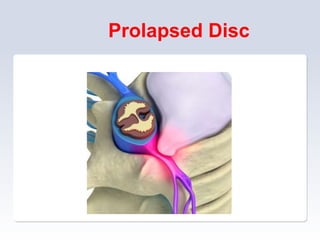
Prolapsed Disc
Back Pain
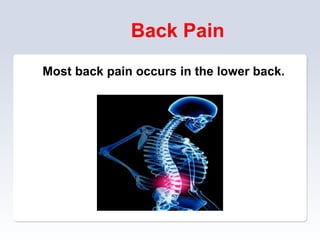
Most back pain occurs in the lower back.
Types of Lower Back Pain
The types and causes of lower back pain are
numerous but roughly fall into either
• Sudden (traumatic)
• Sustained overstress injuries
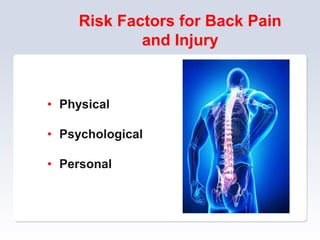
Risk Factors for Back Pain
and Injury
• Physical
• Psychological
• Personal
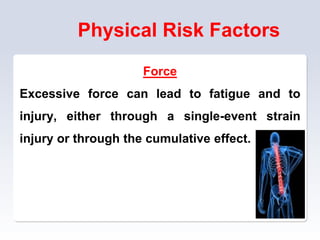
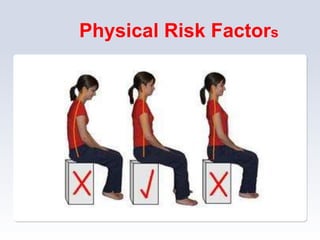
Physical Risk Factors
Force
Excessive force can lead to fatigue and to
injury, either through a single-event strain
injury or through the cumulative effect.
Physical Risk Factors
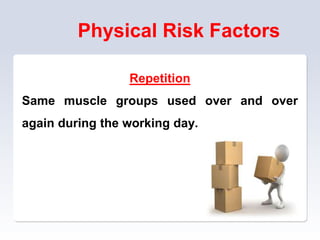
Repetition
Same muscle groups used over and over
again during the working day.
Physical Risk Factors
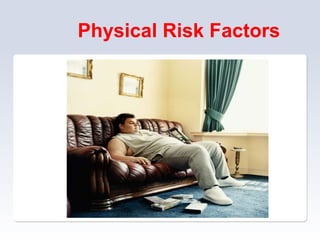
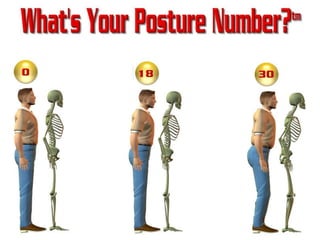
Posture
• It is the position our bodies adopt in
response to the effects of gravity.
• It is the way we hold ourselves, in sitting,
standing or even lying down.
Physical Risk Factors
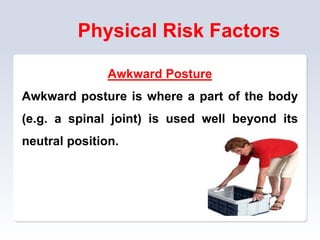
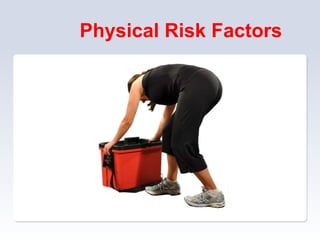
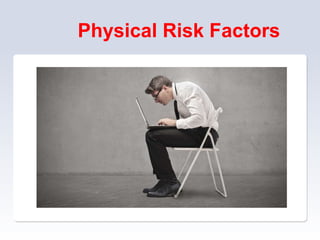
Awkward Posture
Awkward posture is where a part of the body
(e.g. a spinal joint) is used well beyond its
neutral position.
Physical Risk Factors
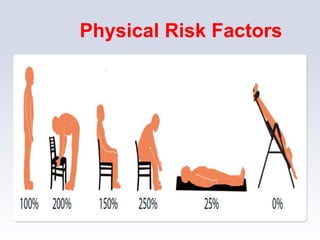
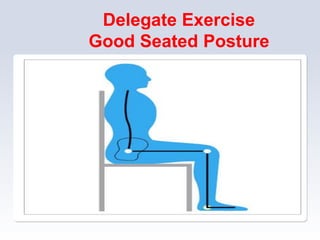
Delegate Exercise
Good Seated Posture
Discs
Delegate Exercise
Good Standing Posture
1. Bear your weight primarily on the balls of your
feet.
2. Keep your knees slightly bent.
3. Keep your feet about shoulder-width apart.
4. Let your arms hang naturally down the sides of the
body.
5. Stand straight and tall with your shoulders pulled
backward.
6. Tuck your abdomen in.
7. Keep your head level - earlobes should be in line
with your shoulders. (Do not push your head
forward, backward, or sideways to the side.)
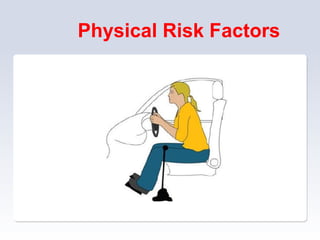
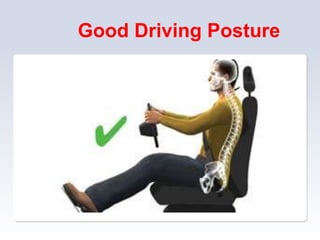
Good Driving Posture
• Keep your back against the seat and head rest.
• Adjust your seat to maintain a proper distance from
the pedals and steering wheel.
• Adjust the head rest so the middle of your head
rests against it.
• Tilt the head rest, as needed, to maintain a distance
of no more than four inches (10cm) between the
back of your head and the head rest.
Good Driving Posture
Physical Risk Factors
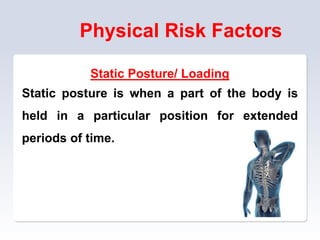
Static Posture/ Loading
Static posture is when a part of the body is
held in a particular position for extended
periods of time.
Physical Risk Factors
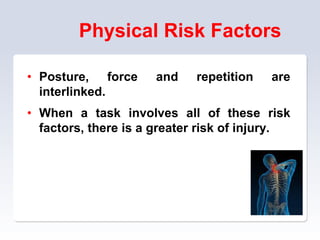
• Posture, force and repetition are
interlinked.
• When a task involves all of these risk
factors, there is a greater risk of injury.
Key Learning Points
• Heavy repetitive lifting may cause damage
to muscles, ligaments and discs.
• Poor posture may cause disc damage and
strain soft tissues
• Asymmetric lifting damages facet joints.
• A sudden trauma to the spine may cause
muscle damage.
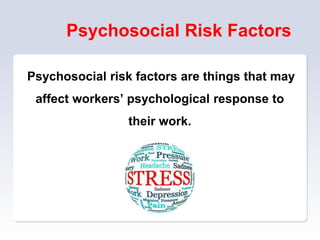
Psychosocial Risk Factors
Psychosocial risk factors are things that may
affect workers’ psychological response to
their work.
Psychosocial Risk Factors
• Workers are unable to make full use of their
skills.
• Workers, as a rule, are not involved in
making decisions that affect them.
• Workers are expected to only carry out
repetitive, monotonous tasks.
Psychosocial Risk Factors
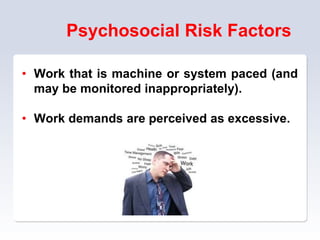
• Work that is machine or system paced (and
may be monitored inappropriately).
• Work demands are perceived as excessive.
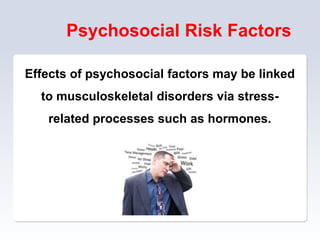
Psychosocial Risk Factors
Effects of psychosocial factors may be linked
to musculoskeletal disorders via stress-
related processes such as hormones.
Personal Risk Factors
• Age
• Low level of fitness
• Previous injury
• Over-weight
Health and Safety Legislation
Session 3
Health and Safety Legislation
Learning Outcomes
• State the employer’s duties in relation to
manual handling.
• State the employee’s duties in relation to
manual handling.
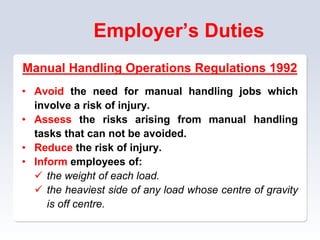
Employer’s Duties
Manual Handling Operations Regulations 1992
• Avoid the need for manual handling jobs which
involve a risk of injury.
• Assess the risks arising from manual handling
tasks that can not be avoided.
• Reduce the risk of injury.
• Inform employees of:
 the weight of each load.
 the heaviest side of any load whose centre of gravity
is off centre.
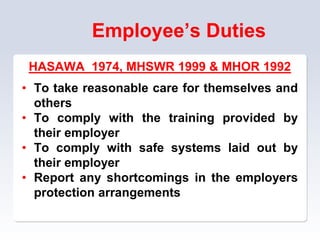
Employee’s Duties
HASAWA 1974, MHSWR 1999 & MHOR 1992
• To take reasonable care for themselves and
others
• To comply with the training provided by
their employer
• To comply with safe systems laid out by
their employer
• Report any shortcomings in the employers
protection arrangements
Dynamic Assessment
Session 4
Dynamic Assessment
Learning Outcomes
• Be able to conduct a dynamic assessment
based on TILE
Dynamic Risk Assessment
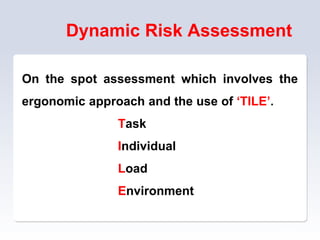
On the spot assessment which involves the
ergonomic approach and the use of ‘TILE’.
Task
Individual
Load
Environment
52
Dynamic Risk Assessment
Task
Twisting - increases stress on the spine
Stooping - increases the stress due to weight
of the body being added to weight of the load
Reaching upwards - increases stress on arms
and the back
Dynamic Risk Assessment
Task
Long carrying distances - physically demanding
and may require a change of hold
Load held away from the trunk - the further the
load is held from the body the greater the spinal
stress
Repetition - muscles become fatigued and a
corresponding reduction in muscular efficiency
will occur
Pre-transfer Assessment /
Dynamic Risk Assessment
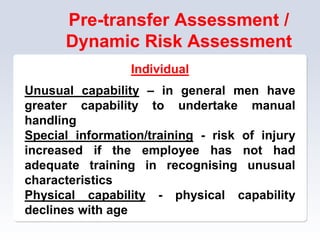
Individual
Unusual capability – in general men have
greater capability to undertake manual
handling
Special information/training - risk of injury
increased if the employee has not had
adequate training in recognising unusual
characteristics
Physical capability - physical capability
declines with age
Pre-Transfer Assessment /
Dynamic Risk Assessment
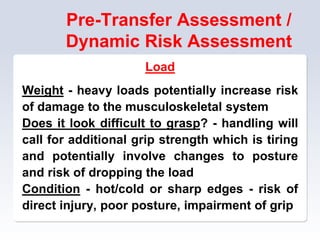
Load
Weight - heavy loads potentially increase risk
of damage to the musculoskeletal system
Does it look difficult to grasp? - handling will
call for additional grip strength which is tiring
and potentially involve changes to posture
and risk of dropping the load
Condition - hot/cold or sharp edges - risk of
direct injury, poor posture, impairment of grip
Pre-Transfer Assessment /
Dynamic Risk Assessment
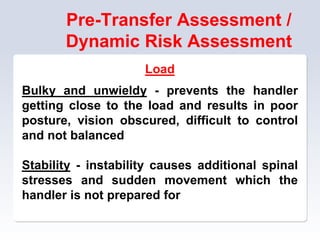
Load
Bulky and unwieldy - prevents the handler
getting close to the load and results in poor
posture, vision obscured, difficult to control
and not balanced
Stability - instability causes additional spinal
stresses and sudden movement which the
handler is not prepared for
Pre-Transfer Assessment /
Dynamic Risk Assessment
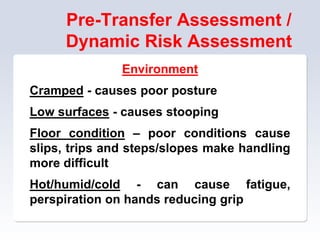
Environment
Cramped - causes poor posture
Low surfaces - causes stooping
Floor condition – poor conditions cause
slips, trips and steps/slopes make handling
more difficult
Hot/humid/cold - can cause fatigue,
perspiration on hands reducing grip
Delegate Exercise
Identify factors relating to the task and load
from the video.
http://www.hse.gov.uk/Msd/mac/carryvid1.htm
Efficient Movement Principles
and Practical Work
Session 5
Efficient Movement Principles
Practical Work
Learning Outcomes
• Be able to demonstrate the application of
efficient movement principles and conduct
a dynamic assessment for:
 Lifting and lowering symmetrical objects
 Awkward loads
 Pushing and pulling
 Team Handling
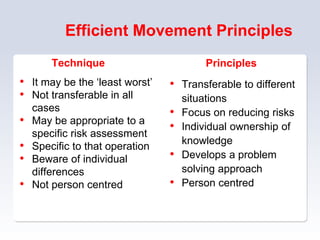
Efficient Movement Principles
Technique
• It may be the ‘least worst’
• Not transferable in all
cases
• May be appropriate to a
specific risk assessment
• Specific to that operation
• Beware of individual
differences
• Not person centred
Principles
• Transferable to different
situations
• Focus on reducing risks
• Individual ownership of
knowledge
• Develops a problem
solving approach
• Person centred
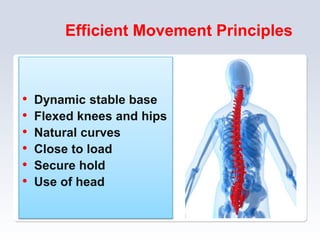
Efficient Movement Principles
• Dynamic stable base
• Flexed knees and hips
• Natural curves
• Close to load
• Secure hold
• Use of head
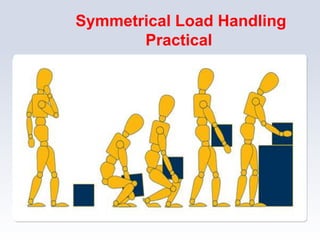
Symmetrical Load Handling
Practical
Awkward and Non-Routine
Load Handling
Research recognises that it is not always
possible to apply the efficient movement
principles and guidance suggests:
• Plan the task
• Minimise the horizontal distance of the
object from the trunk
• Get a secure hold
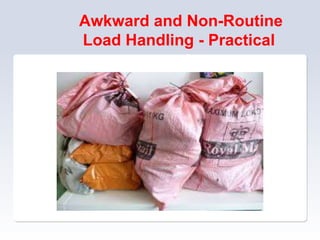
Awkward and Non-Routine
Load Handling - Practical
Pushing and Pulling
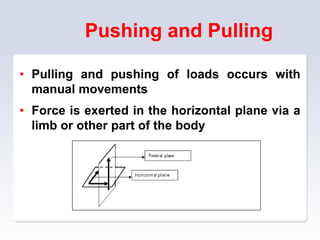
• Pulling and pushing of loads occurs with
manual movements
• Force is exerted in the horizontal plane via a
limb or other part of the body
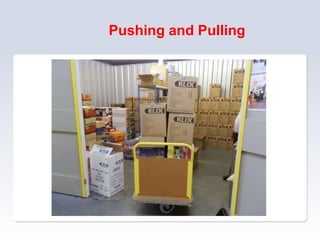
Pushing and Pulling
Risk Factors for Pushing and Pulling
• Pushing and pulling over long distances
• Insufficient rest/recovery time
• Obstacles on the route
• Repetition
• Poor handle position
• Excessive and unstable load
• Unstable posture
Pushing and Pulling
Pre-User Equipment Checks
70
Problems to look for when making an assessment
• Correct device for the job?
• Well maintained?
• Suitable wheels?
• Free running wheels?
• Suitable handle height? (between waist and
shoulders)
• Comfortable handle grips?
• Effective brakes?
Pushing and Pulling Loads
Practical
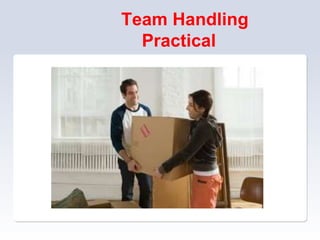
Team Handling
Handling by two or more people may achieve a lifting
operation or task that is beyond the capability of one
person and/or reduce the risk of injury to a single
handler
Team Handling
• Handlers should have adequate access to the load
• Load should provide sufficient handholds
Team Handling
Essential Components:
Communication
Co-operation
Co-ordination
Team Handling
Practical
THANK YOU

Manual handling

  • 1.
  • 2.
    Welcome Course Introduction Course Overview 1.Introduction to Manual Handling 2. Spinal Awareness, Risk Factors for Back Pain and Injuries 3. Health and Safety Legislation 4. Dynamic Assessment 5. Efficient Movement Principles and Practical Workshop
  • 3.
    Introduction to Manual Handling Session1 Introduction to Manual Handling
  • 4.
    Learning Outcomes • Stateexamples of manual handling in the workplace. • Identify the impact of poor manual handling on the business and on a worker’s personal life.
  • 5.
    Introduction to Manual Handling Definitionof Manual Handling “any transporting or supporting of a load (including the lifting, putting down, pushing, pulling, carrying or moving thereof) by hand or by bodily force”
  • 6.
    Introduction to Manual Handling Athird of all workplace injuries which include work related Musculoskeletal Disorders (MSDs) such as upper and lower limb pain/disorders, joint and repetitive strain injuries are caused by manual handling.
  • 7.
    Introduction to Manual Handling Increasingprevalence of back pain in 16-24 year olds Source 2013 - www.backcare.org.uk
  • 8.
  • 9.
    Manual Handling inthe Workplace Delegate Exercise List the manual handling you carry out in your workplace.
  • 10.
    What happens ifthings go wrong Delegate Exercise List the potential Impact to the business if things go wrong.
  • 11.
    What happens ifthings go wrong Delegate Exercise List the potential Impact to a worker’s personal life if things go wrong.
  • 12.
    Spinal Awareness Risk Factorsfor Back Pain and Injuries Session 2 Spinal Awareness Risk Factors for Back Pain and Injuries
  • 13.
    Learning Outcomes • Identifycomponents of the spine. • Describe how the spine can become injured. • Identify work related risk factors for back pain. • Recognise individual risk factors for back pain.
  • 14.
    Cervical x 7 Thoracicx 12 Lumbar x 5 Sacrum x 5 (Fused) Coccyx x 4 (Fused) Spinal Overview
  • 15.
    Facet Joints Facet jointsjoins each pair of vertebra like hinges.
  • 16.
  • 17.
    Ligaments of theSpine • Link adjacent vertebra. • Run the length of spine from the base of skull to the upper sacrum. • They resist movement particularly flexion.
  • 18.
  • 19.
  • 20.
    Back Pain Most backpain occurs in the lower back.
  • 21.
    Types of LowerBack Pain The types and causes of lower back pain are numerous but roughly fall into either • Sudden (traumatic) • Sustained overstress injuries
  • 22.
    Risk Factors forBack Pain and Injury • Physical • Psychological • Personal
  • 23.
    Physical Risk Factors Force Excessiveforce can lead to fatigue and to injury, either through a single-event strain injury or through the cumulative effect.
  • 24.
    Physical Risk Factors Repetition Samemuscle groups used over and over again during the working day.
  • 25.
    Physical Risk Factors Posture •It is the position our bodies adopt in response to the effects of gravity. • It is the way we hold ourselves, in sitting, standing or even lying down.
  • 26.
    Physical Risk Factors AwkwardPosture Awkward posture is where a part of the body (e.g. a spinal joint) is used well beyond its neutral position.
  • 27.
  • 28.
  • 29.
  • 30.
  • 31.
  • 32.
  • 33.
  • 34.
  • 35.
    Delegate Exercise Good StandingPosture 1. Bear your weight primarily on the balls of your feet. 2. Keep your knees slightly bent. 3. Keep your feet about shoulder-width apart. 4. Let your arms hang naturally down the sides of the body. 5. Stand straight and tall with your shoulders pulled backward. 6. Tuck your abdomen in. 7. Keep your head level - earlobes should be in line with your shoulders. (Do not push your head forward, backward, or sideways to the side.)
  • 36.
    Good Driving Posture •Keep your back against the seat and head rest. • Adjust your seat to maintain a proper distance from the pedals and steering wheel. • Adjust the head rest so the middle of your head rests against it. • Tilt the head rest, as needed, to maintain a distance of no more than four inches (10cm) between the back of your head and the head rest.
  • 37.
  • 38.
    Physical Risk Factors StaticPosture/ Loading Static posture is when a part of the body is held in a particular position for extended periods of time.
  • 39.
    Physical Risk Factors •Posture, force and repetition are interlinked. • When a task involves all of these risk factors, there is a greater risk of injury.
  • 40.
    Key Learning Points •Heavy repetitive lifting may cause damage to muscles, ligaments and discs. • Poor posture may cause disc damage and strain soft tissues • Asymmetric lifting damages facet joints. • A sudden trauma to the spine may cause muscle damage.
  • 41.
    Psychosocial Risk Factors Psychosocialrisk factors are things that may affect workers’ psychological response to their work.
  • 42.
    Psychosocial Risk Factors •Workers are unable to make full use of their skills. • Workers, as a rule, are not involved in making decisions that affect them. • Workers are expected to only carry out repetitive, monotonous tasks.
  • 43.
    Psychosocial Risk Factors •Work that is machine or system paced (and may be monitored inappropriately). • Work demands are perceived as excessive.
  • 44.
    Psychosocial Risk Factors Effectsof psychosocial factors may be linked to musculoskeletal disorders via stress- related processes such as hormones.
  • 45.
    Personal Risk Factors •Age • Low level of fitness • Previous injury • Over-weight
  • 46.
    Health and SafetyLegislation Session 3 Health and Safety Legislation
  • 47.
    Learning Outcomes • Statethe employer’s duties in relation to manual handling. • State the employee’s duties in relation to manual handling.
  • 48.
    Employer’s Duties Manual HandlingOperations Regulations 1992 • Avoid the need for manual handling jobs which involve a risk of injury. • Assess the risks arising from manual handling tasks that can not be avoided. • Reduce the risk of injury. • Inform employees of:  the weight of each load.  the heaviest side of any load whose centre of gravity is off centre.
  • 49.
    Employee’s Duties HASAWA 1974,MHSWR 1999 & MHOR 1992 • To take reasonable care for themselves and others • To comply with the training provided by their employer • To comply with safe systems laid out by their employer • Report any shortcomings in the employers protection arrangements
  • 50.
  • 51.
    Learning Outcomes • Beable to conduct a dynamic assessment based on TILE
  • 52.
    Dynamic Risk Assessment Onthe spot assessment which involves the ergonomic approach and the use of ‘TILE’. Task Individual Load Environment 52
  • 53.
    Dynamic Risk Assessment Task Twisting- increases stress on the spine Stooping - increases the stress due to weight of the body being added to weight of the load Reaching upwards - increases stress on arms and the back
  • 54.
    Dynamic Risk Assessment Task Longcarrying distances - physically demanding and may require a change of hold Load held away from the trunk - the further the load is held from the body the greater the spinal stress Repetition - muscles become fatigued and a corresponding reduction in muscular efficiency will occur
  • 55.
    Pre-transfer Assessment / DynamicRisk Assessment Individual Unusual capability – in general men have greater capability to undertake manual handling Special information/training - risk of injury increased if the employee has not had adequate training in recognising unusual characteristics Physical capability - physical capability declines with age
  • 56.
    Pre-Transfer Assessment / DynamicRisk Assessment Load Weight - heavy loads potentially increase risk of damage to the musculoskeletal system Does it look difficult to grasp? - handling will call for additional grip strength which is tiring and potentially involve changes to posture and risk of dropping the load Condition - hot/cold or sharp edges - risk of direct injury, poor posture, impairment of grip
  • 57.
    Pre-Transfer Assessment / DynamicRisk Assessment Load Bulky and unwieldy - prevents the handler getting close to the load and results in poor posture, vision obscured, difficult to control and not balanced Stability - instability causes additional spinal stresses and sudden movement which the handler is not prepared for
  • 58.
    Pre-Transfer Assessment / DynamicRisk Assessment Environment Cramped - causes poor posture Low surfaces - causes stooping Floor condition – poor conditions cause slips, trips and steps/slopes make handling more difficult Hot/humid/cold - can cause fatigue, perspiration on hands reducing grip
  • 59.
    Delegate Exercise Identify factorsrelating to the task and load from the video. http://www.hse.gov.uk/Msd/mac/carryvid1.htm
  • 60.
    Efficient Movement Principles andPractical Work Session 5 Efficient Movement Principles Practical Work
  • 61.
    Learning Outcomes • Beable to demonstrate the application of efficient movement principles and conduct a dynamic assessment for:  Lifting and lowering symmetrical objects  Awkward loads  Pushing and pulling  Team Handling
  • 62.
    Efficient Movement Principles Technique •It may be the ‘least worst’ • Not transferable in all cases • May be appropriate to a specific risk assessment • Specific to that operation • Beware of individual differences • Not person centred Principles • Transferable to different situations • Focus on reducing risks • Individual ownership of knowledge • Develops a problem solving approach • Person centred
  • 63.
    Efficient Movement Principles •Dynamic stable base • Flexed knees and hips • Natural curves • Close to load • Secure hold • Use of head
  • 64.
  • 65.
    Awkward and Non-Routine LoadHandling Research recognises that it is not always possible to apply the efficient movement principles and guidance suggests: • Plan the task • Minimise the horizontal distance of the object from the trunk • Get a secure hold
  • 66.
    Awkward and Non-Routine LoadHandling - Practical
  • 67.
    Pushing and Pulling •Pulling and pushing of loads occurs with manual movements • Force is exerted in the horizontal plane via a limb or other part of the body
  • 68.
    Pushing and Pulling RiskFactors for Pushing and Pulling • Pushing and pulling over long distances • Insufficient rest/recovery time • Obstacles on the route • Repetition • Poor handle position • Excessive and unstable load • Unstable posture
  • 69.
  • 70.
    Pre-User Equipment Checks 70 Problemsto look for when making an assessment • Correct device for the job? • Well maintained? • Suitable wheels? • Free running wheels? • Suitable handle height? (between waist and shoulders) • Comfortable handle grips? • Effective brakes?
  • 71.
    Pushing and PullingLoads Practical
  • 72.
    Team Handling Handling bytwo or more people may achieve a lifting operation or task that is beyond the capability of one person and/or reduce the risk of injury to a single handler
  • 73.
    Team Handling • Handlersshould have adequate access to the load • Load should provide sufficient handholds
  • 74.
  • 75.
  • 76.