SUBMITTED TO :CO-ORDINATOR P.K. TIWARI
SUBMITTED BY : MANISHA SINGHAI
(MSC I SEM MOLECULAR HUMAN GENETICS)
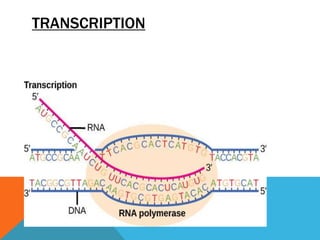
TRANSCRIPTION
INTRODUCTION
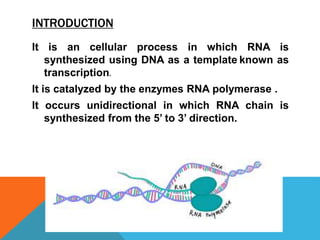
It is an cellular process in which RNA is
synthesized using DNA as a template known as
transcription.
It is catalyzed by the enzymes RNA polymerase .
It occurs unidirectional in which RNA chain is
synthesized from the 5’ to 3’ direction.
TRANSCRIPTION UNIT
Transcription is a selective process.
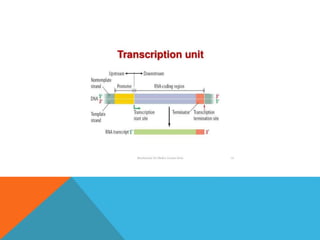
Each transcribed segment of DNA is called transcription
unit.
It starts from transcription starts site and terminates at
transcription termination site.
Transcription stars from the first base pair that is called a
transcription start site from this site RNA polymerase
moves along the template synthesizing RNA until it
reaches a termination site.
RNA POLYMERASE
DNA dependent RNA synthesized is catalyzed by the
enzyme DNA dependent RNA polymerase.
It was discovered by Samuel B. Weiss and Jerard
Hurwitz in 1960.
In prokaryotes single type of RNA polymerase appears
to be responsible for the synthesis of all different
types of RNA such as mRNA, rRNA and tRNA.
RNA polymerase in E.Coli is a multi subunit enzyme
made up of five different polypeptides α β β’ ώ σ.
(α,α β β’ ω σ) – holoenzyme molecular weight 465
KDA.
(α β β’ω) –core enzyme .
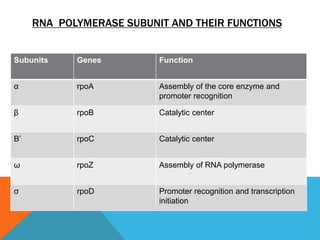
RNA POLYMERASE SUBUNIT AND THEIR FUNCTIONS
Subunits Genes Function
α rpoA Assembly of the core enzyme and
promoter recognition
β rpoB Catalytic center
Β’ rpoC Catalytic center
ω rpoZ Assembly of RNA polymerase
σ rpoD Promoter recognition and transcription
initiation
PROKARYOTIC TRANSCRIPTION
Process of transcription in E.Coli.
Bacterial transcription or prokaryotic transcription is
the process in which RNA transcript.
Transcription process is divided into three stages:
Initiation
Elongation
Termination
INITIATION
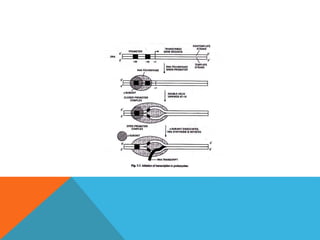
RNA polymerase binds to one of specific factor σ , to form a
holoenzyme in this form it can recognize and bind to
specific promoter regions in the DNA.
The -35 region and the -10 region ,comprise the core
prokaryotic promoter and T stands for the terminator.
The DNA on the template strand between the + 1 site and
the terminator is transcribed into RNA.
At this stage DNA is double stranded (“closed”).
This holoenzyme bound the DNA structure is referred to as
the closed complex.
The DNA is unbound and becomes single stranded (“open”)
in the vicinity of the initiation site defines as +1 . This
holoenzyme unbound DNA structure is called the open
complex.
ELONGATION
Once the promoter regions has been recognized by σfactor
of holoenzyme.
The enzyme begins to synthesis RNA sequence, σfactor is
released.
This enzyme has no exo /endo nuclease activity and cannot
repair the mistakes as DNA polymerase in replication.
RNA polymerase ad complementary base to the template
strand of DNA. It adds :
Thiamine for adenine (T=A).
Cytosine for Guanine (C≡G).
Guanine for cytosine(G≡C).
Adenine for Uracil(A=U).
Most transcripts originates using adenosine 5’ triphosphate
(ATP) and to a lesser extent ,guano sine 5’triphosphate
TERMINATION
RNA synthesis will continue along the DNA template strand
until the polymerase encounter a signal that tells it to
stop or terminate transcription. In prokaryotes this signal
can take forms RHO dependent or independent.
Two termination Mechanism are well known :-
Intrinsic Termination:- Also called RHO Independent
termination involves terminator sequence within the RNA
that signal the RNA polymerase to stop.
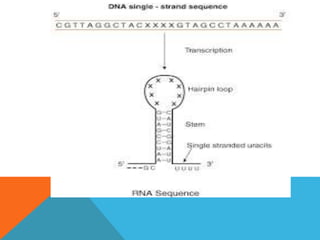
The terminator sequence is usually a sequence that forms a
stem Loop Hairpin structure that leads to the dissociation
of the RNAP from the Template:
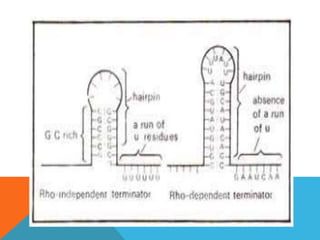
Features:-(a)A Strong G≡C RICH stem and loop.
(b) a sequence of 4-6u residues in the RNA ,which are
transcribed from a corresponding stretch as in the
template.
RHO Dependent Termination:- It uses a
termination factor called a RHO factor which is a
protein to stop RNA synthesis at the specific site .
This protein binds at a RHO utilization site on the
nascent RNA strand and runs along the mRNA
towards the RNAP . A stem loop structure upstream
of the terminator region pauses RNAP .when RHO
factor reaches the RNAP it causes RNAP to
dissociates from the DNA terminating transcription.
TRANSCRIPTION IN EUKARYOTES
Transcription by RNA polymerase proceeds through a
series of well defined steps which are grouped into 3
phases .
INITIATION
ELONGATION
TERMINATION
TRANSCRIPTION IN EUKARYOTES IS UNDERTAKEN BY
DIFFERENT RNA POLYMERASES
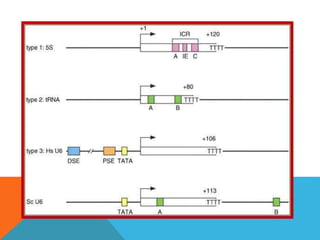
Eukaryotes have 3 polymerases :- RNA POLYMERASE1:-
28S,18S,5.5S, Rrna .
RNA polymerase 2:Mrna ,snRNA ,miRNA,LINE ,SINE
RNA polymerase 3 :-tRNA, 5s RNA U6snRNA
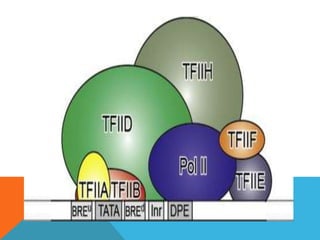
Several initiation factors are required for efficient and
promoter specific initiation in eukaryotes and are called
as general transcription factors.
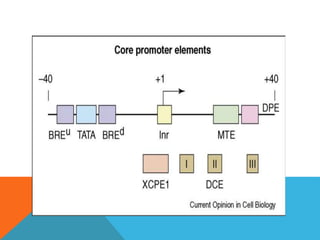
In eukaryotes the term promoter is used to describe all the
sequences that are important in the initiation of
transcription of a transcription unit.
For some transcription unit the sequence not only include
the core promoter which is the site at which the initiation
complex is assembled but also one of more upstream
regulatory promoter element.
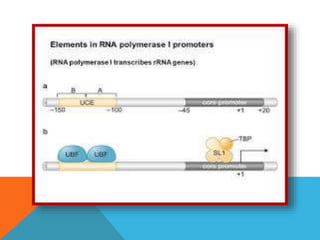
A core promoter is typically 40 to 60 base pair long,
extending either upstream or downstream from the
transcription start site.
INITIATION
Initiation of transcription in eukaryotes requires the
enzyme RNA polymerase and transcription factor.
The transcription factor rather than the RNA
polymerase are principally responsible for
recognizing the promoter.
This is different from the bacterial RNA polymerase
where it is the RNA polymerase that recognize the
promoter sequences:- The transcription factor create
a structure at the promoter to provide the target that
is recognized by the RNA polymerase.
ELONGATION
Once polymerase has initiated transcription, it shifts
into the elongation phase.
Elongation requires another set of factors such as
TFIIS &hSPT5,known as elongation factors.
This factors stimulate elongation and also required for
RNA processing.
These factors also favor he phosphorylated form of
CTD. The phospholyration of CTD leads to an
exchange of initiation factors with elongation
factors.
Various proteins are thought to stimulate elongation
by Pol II.
The proteins P-TEFb stimulates elongation in 3
separate steps.
This protein bound to Pol II and phosphorylates the
TERMINATION
In eukaryotes termination of transcription occurs by
different process, depending on the types of RNA
polymerase involved.
For polymerase I genes :- Transcription is stopped using
a termination factor, through a mechanism similar to
RHO dependent termination in bacteria.
Transcription of polymerase III genes ends after
transcribing a termination sequence that includes a
polyuracil stretch, by a mechanism resembling rho
independent termination in bacteria.
Termination of polymerase II catalyst transcription is more
complex . There are two prevailing hypothesis for how
poly II terminates transcription :-
Allosteric
Torpedo Models
Allosteric model as elongating poly II encounter a poly (A)
signal, a conformational change in elongation complex is
trigred that provokes termination.
REFERNCES
Molecular biology of the gene 6th Ed watson et al,
2008, 1987.
Genomes 3, TA Brown , Garland , 2007.
Manisha ppt 3

Manisha ppt 3

  • 1.
    SUBMITTED TO :CO-ORDINATORP.K. TIWARI SUBMITTED BY : MANISHA SINGHAI (MSC I SEM MOLECULAR HUMAN GENETICS)
  • 2.
  • 3.
    INTRODUCTION It is ancellular process in which RNA is synthesized using DNA as a template known as transcription. It is catalyzed by the enzymes RNA polymerase . It occurs unidirectional in which RNA chain is synthesized from the 5’ to 3’ direction.
  • 4.
    TRANSCRIPTION UNIT Transcription isa selective process. Each transcribed segment of DNA is called transcription unit. It starts from transcription starts site and terminates at transcription termination site. Transcription stars from the first base pair that is called a transcription start site from this site RNA polymerase moves along the template synthesizing RNA until it reaches a termination site.
  • 6.
    RNA POLYMERASE DNA dependentRNA synthesized is catalyzed by the enzyme DNA dependent RNA polymerase. It was discovered by Samuel B. Weiss and Jerard Hurwitz in 1960. In prokaryotes single type of RNA polymerase appears to be responsible for the synthesis of all different types of RNA such as mRNA, rRNA and tRNA. RNA polymerase in E.Coli is a multi subunit enzyme made up of five different polypeptides α β β’ ώ σ. (α,α β β’ ω σ) – holoenzyme molecular weight 465 KDA. (α β β’ω) –core enzyme .
  • 7.
    RNA POLYMERASE SUBUNITAND THEIR FUNCTIONS Subunits Genes Function α rpoA Assembly of the core enzyme and promoter recognition β rpoB Catalytic center Β’ rpoC Catalytic center ω rpoZ Assembly of RNA polymerase σ rpoD Promoter recognition and transcription initiation
  • 8.
    PROKARYOTIC TRANSCRIPTION Process oftranscription in E.Coli. Bacterial transcription or prokaryotic transcription is the process in which RNA transcript. Transcription process is divided into three stages: Initiation Elongation Termination
  • 9.
    INITIATION RNA polymerase bindsto one of specific factor σ , to form a holoenzyme in this form it can recognize and bind to specific promoter regions in the DNA. The -35 region and the -10 region ,comprise the core prokaryotic promoter and T stands for the terminator. The DNA on the template strand between the + 1 site and the terminator is transcribed into RNA. At this stage DNA is double stranded (“closed”). This holoenzyme bound the DNA structure is referred to as the closed complex. The DNA is unbound and becomes single stranded (“open”) in the vicinity of the initiation site defines as +1 . This holoenzyme unbound DNA structure is called the open complex.
  • 11.
    ELONGATION Once the promoterregions has been recognized by σfactor of holoenzyme. The enzyme begins to synthesis RNA sequence, σfactor is released. This enzyme has no exo /endo nuclease activity and cannot repair the mistakes as DNA polymerase in replication. RNA polymerase ad complementary base to the template strand of DNA. It adds : Thiamine for adenine (T=A). Cytosine for Guanine (C≡G). Guanine for cytosine(G≡C). Adenine for Uracil(A=U). Most transcripts originates using adenosine 5’ triphosphate (ATP) and to a lesser extent ,guano sine 5’triphosphate
  • 12.
    TERMINATION RNA synthesis willcontinue along the DNA template strand until the polymerase encounter a signal that tells it to stop or terminate transcription. In prokaryotes this signal can take forms RHO dependent or independent. Two termination Mechanism are well known :- Intrinsic Termination:- Also called RHO Independent termination involves terminator sequence within the RNA that signal the RNA polymerase to stop. The terminator sequence is usually a sequence that forms a stem Loop Hairpin structure that leads to the dissociation of the RNAP from the Template: Features:-(a)A Strong G≡C RICH stem and loop. (b) a sequence of 4-6u residues in the RNA ,which are transcribed from a corresponding stretch as in the template.
  • 14.
    RHO Dependent Termination:-It uses a termination factor called a RHO factor which is a protein to stop RNA synthesis at the specific site . This protein binds at a RHO utilization site on the nascent RNA strand and runs along the mRNA towards the RNAP . A stem loop structure upstream of the terminator region pauses RNAP .when RHO factor reaches the RNAP it causes RNAP to dissociates from the DNA terminating transcription.
  • 16.
    TRANSCRIPTION IN EUKARYOTES Transcriptionby RNA polymerase proceeds through a series of well defined steps which are grouped into 3 phases . INITIATION ELONGATION TERMINATION TRANSCRIPTION IN EUKARYOTES IS UNDERTAKEN BY DIFFERENT RNA POLYMERASES Eukaryotes have 3 polymerases :- RNA POLYMERASE1:- 28S,18S,5.5S, Rrna . RNA polymerase 2:Mrna ,snRNA ,miRNA,LINE ,SINE RNA polymerase 3 :-tRNA, 5s RNA U6snRNA
  • 17.
    Several initiation factorsare required for efficient and promoter specific initiation in eukaryotes and are called as general transcription factors. In eukaryotes the term promoter is used to describe all the sequences that are important in the initiation of transcription of a transcription unit. For some transcription unit the sequence not only include the core promoter which is the site at which the initiation complex is assembled but also one of more upstream regulatory promoter element. A core promoter is typically 40 to 60 base pair long, extending either upstream or downstream from the transcription start site.
  • 18.
    INITIATION Initiation of transcriptionin eukaryotes requires the enzyme RNA polymerase and transcription factor. The transcription factor rather than the RNA polymerase are principally responsible for recognizing the promoter. This is different from the bacterial RNA polymerase where it is the RNA polymerase that recognize the promoter sequences:- The transcription factor create a structure at the promoter to provide the target that is recognized by the RNA polymerase.
  • 23.
    ELONGATION Once polymerase hasinitiated transcription, it shifts into the elongation phase. Elongation requires another set of factors such as TFIIS &hSPT5,known as elongation factors. This factors stimulate elongation and also required for RNA processing. These factors also favor he phosphorylated form of CTD. The phospholyration of CTD leads to an exchange of initiation factors with elongation factors. Various proteins are thought to stimulate elongation by Pol II. The proteins P-TEFb stimulates elongation in 3 separate steps. This protein bound to Pol II and phosphorylates the
  • 24.
    TERMINATION In eukaryotes terminationof transcription occurs by different process, depending on the types of RNA polymerase involved. For polymerase I genes :- Transcription is stopped using a termination factor, through a mechanism similar to RHO dependent termination in bacteria. Transcription of polymerase III genes ends after transcribing a termination sequence that includes a polyuracil stretch, by a mechanism resembling rho independent termination in bacteria. Termination of polymerase II catalyst transcription is more complex . There are two prevailing hypothesis for how poly II terminates transcription :- Allosteric Torpedo Models Allosteric model as elongating poly II encounter a poly (A) signal, a conformational change in elongation complex is trigred that provokes termination.
  • 25.
    REFERNCES Molecular biology ofthe gene 6th Ed watson et al, 2008, 1987. Genomes 3, TA Brown , Garland , 2007.