JIWAJI UNIVERSITY
SUBMITTED BY :
MANISHA SINGHAI
M.Sc. MHG 4TH SEM
CENTRE FOR GENOMICS
TOPIC : LIGHT MICROSCOPY
CONTENTS
• INTRODUCTION
• COMPONENTS OF LIGHT MICROSCOPY
• PRINCIPLE AND FUNCTION
• TYPES OF LIGHT MICROSCOPY
• REFERENCES
INTRODUCTION
• Light microscope often referred to as the optical microscope .it is an type
of microscope which uses visible light and a system of lens to magnify
image of small samples.
• It is an oldest design of microscope and possibly designed in their present
compound forming in the 17th century
Bio science .com
• Historically light microscope where easy to develop and are popular
because they use visible light so that sample may be directly observed by
eye
• A light microscope work on a lot like a refracting telescope except that the
object is very close to objective lens .
• Light microscope may simple or compound
Components of light microscope
• There is a body tube with an ocular or eye piece mounted at its upper end
& objective lens of different magnifying power
• Arms hold the movable body tube in front & is fixed in the base
• There are two focusing knob one for coarse focusing & other for the fine
focusing
• Object stage is rigid platform with an aperture through which light rays
can pass
• Light sources a reflecting mirror is placed below the stage which reflect
sun light on objective
• Mechanical stage is equipped with scale which permit accurate mechanical
positioning of slide
• Lens system the compound microscope comprises three kind of lenses
• The condenser is located below the stage & above the mirror . It collected
and focus the light rays into the plane of objects that take no part in image
formation
• The objective this are mounted on revolving nose pieces. 10X ,40X, &
100X are magnification of objective lenses . It collect light rays from object
& from magnified real images.
• Ocular of eye piece at top of body tube . A monocular microscope consist
of one ocular ,while binocular microscope have two ocular of similar
magnification generally , ocular with 5x, 12.5x &15x lenses are available
the ocular magnifies the image formed by objective
Microscope international.com
Working principle
• Illumination light microscope with built in illumination use kohler or
kohler type illumination . In this type of illumination there are adjustable
collector lens in front of the source of light
• Image formation occurs in two stages the first is formed by the objective .
It is real , invert and magnified. The second is formed by ocular . It is
virtual inverted & more magnified
• Three principle is main for microscope
A. Magnification
B. Resolution
C. contrast
Slide share.com
Types of light microscope
 Bright field microscope
 Phase contrast microscope
 Dark field microscope
Bright field microscope
• Brightfield microscopy is the most elementary form of microscope
illumination techniques and is generally used with compound microscope
• The name “brightfield” is derived from the fact that the specimen is dark
and contrasted by the surrounding bright viewing field . Simple light
microscope sometimes referred to as brightfield microscopes.
Medical dictionary .com
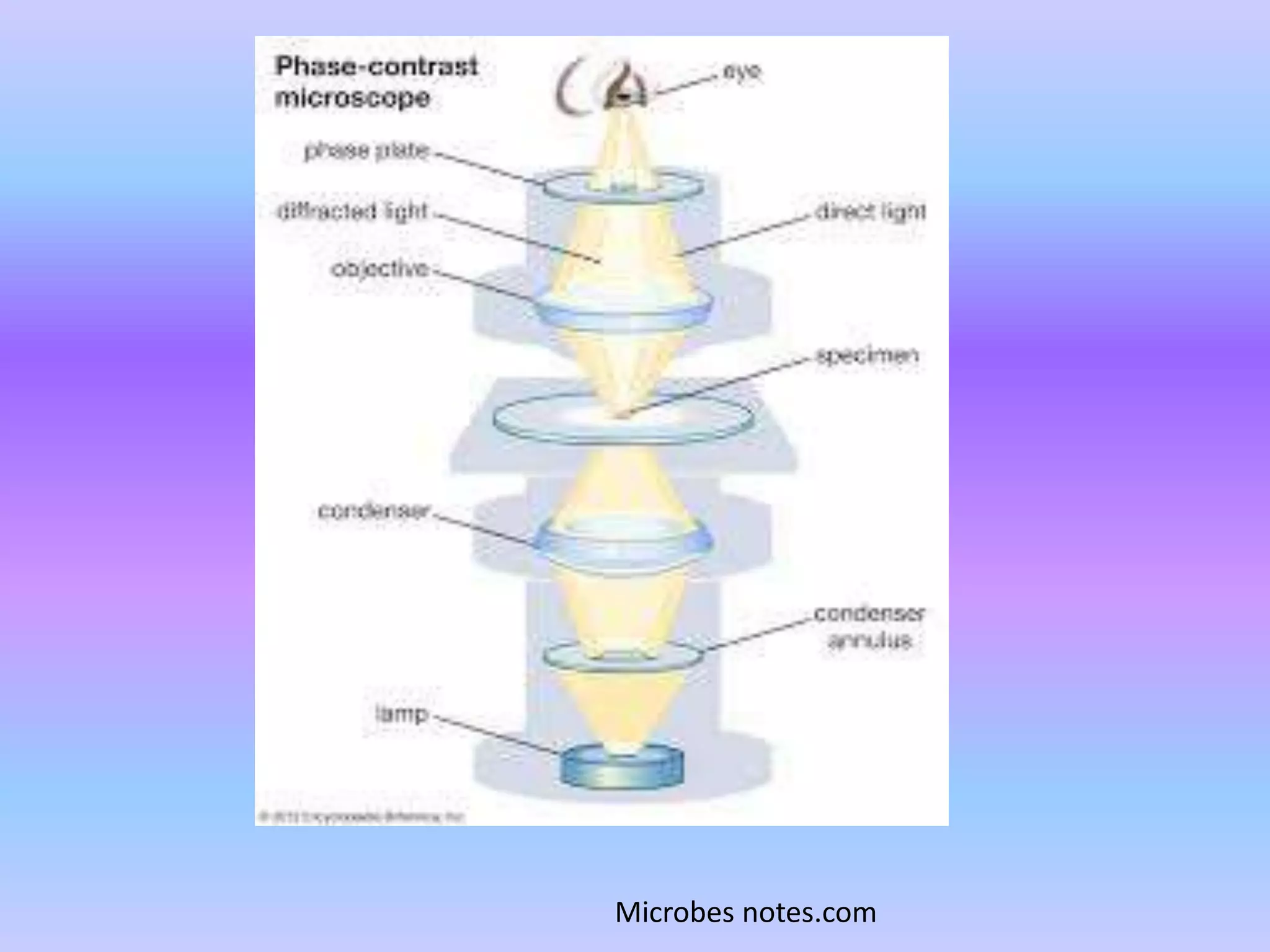
Phase contrast microscope
• The basic principle to making phase changes visible in phase- contrast
microscopy is to separate the illuminating ( background light) from the
specimen – scattered light and to manipulate these differently .
• Ring shaped illuminating light that passes the condenser annulus is focused
on the specimen by the condenser . some of the illuminating light is
scattered by the specimen and form the background light
• When observing unstained biological specimen , the scattered light weak
and typically phase- shifted by -90 relative to background light . This leads
to foreground and background having nearly same intensity , resulting in
low image contrast
Microbes notes.com
Dark field microscope
• A dark field microscope is used to examine live microorganism that either
invisible in the ordinary light microscope , cant be stained by standard
methods , or are so distorted by staining that their characteristics then
cannot be identified
• Instead of normal condenser , dark field microscope uses a dark field
condenser that contain a opaque disc .
• Disc blocks light that would enter the lens directly , only the light is
reflected off the specimen would enter the objective lens .
Serc.carlton.edu
Advantages
• Brightfield microscope –it is very simple to use with fewer
adjustments needed to be made to view specimens
• Some specimens can be viewed without staining and optics used in the
brightfield technique don’t alter the color of specimen.
• Phase contrast microscope- unstained paraffin, resin & frozen
sections.
• Living cells and their behavior
• Cell organelles ,esp. mitochondria
• Capsules of microorganism
• Dark field microscopy- it allows researcher to identify various
different molecules in targeted specimen.
• a dark field microscope is ideal for viewing objects that are unstained,
transparent and absorbs little or no light
• It is more useful in examining external details, such as outlines , edges ,
grain boundaries and surface defects
• Use of this microscopy to study about marines organism such as algae and
plankton , insects, thin polymers and some ceramics .
REFERENCES
• The principle and practice of light microscopy( Cambridge university
press)
• Classification of microscope( JR BLUEFORD)
Presentation1 4

Presentation1 4

  • 1.
    JIWAJI UNIVERSITY SUBMITTED BY: MANISHA SINGHAI M.Sc. MHG 4TH SEM CENTRE FOR GENOMICS TOPIC : LIGHT MICROSCOPY
  • 2.
    CONTENTS • INTRODUCTION • COMPONENTSOF LIGHT MICROSCOPY • PRINCIPLE AND FUNCTION • TYPES OF LIGHT MICROSCOPY • REFERENCES
  • 3.
    INTRODUCTION • Light microscopeoften referred to as the optical microscope .it is an type of microscope which uses visible light and a system of lens to magnify image of small samples. • It is an oldest design of microscope and possibly designed in their present compound forming in the 17th century Bio science .com
  • 4.
    • Historically lightmicroscope where easy to develop and are popular because they use visible light so that sample may be directly observed by eye • A light microscope work on a lot like a refracting telescope except that the object is very close to objective lens . • Light microscope may simple or compound
  • 5.
    Components of lightmicroscope • There is a body tube with an ocular or eye piece mounted at its upper end & objective lens of different magnifying power • Arms hold the movable body tube in front & is fixed in the base • There are two focusing knob one for coarse focusing & other for the fine focusing • Object stage is rigid platform with an aperture through which light rays can pass • Light sources a reflecting mirror is placed below the stage which reflect sun light on objective • Mechanical stage is equipped with scale which permit accurate mechanical positioning of slide • Lens system the compound microscope comprises three kind of lenses
  • 6.
    • The condenseris located below the stage & above the mirror . It collected and focus the light rays into the plane of objects that take no part in image formation • The objective this are mounted on revolving nose pieces. 10X ,40X, & 100X are magnification of objective lenses . It collect light rays from object & from magnified real images. • Ocular of eye piece at top of body tube . A monocular microscope consist of one ocular ,while binocular microscope have two ocular of similar magnification generally , ocular with 5x, 12.5x &15x lenses are available the ocular magnifies the image formed by objective
  • 7.
  • 8.
    Working principle • Illuminationlight microscope with built in illumination use kohler or kohler type illumination . In this type of illumination there are adjustable collector lens in front of the source of light • Image formation occurs in two stages the first is formed by the objective . It is real , invert and magnified. The second is formed by ocular . It is virtual inverted & more magnified • Three principle is main for microscope A. Magnification B. Resolution C. contrast Slide share.com
  • 9.
    Types of lightmicroscope  Bright field microscope  Phase contrast microscope  Dark field microscope
  • 10.
    Bright field microscope •Brightfield microscopy is the most elementary form of microscope illumination techniques and is generally used with compound microscope • The name “brightfield” is derived from the fact that the specimen is dark and contrasted by the surrounding bright viewing field . Simple light microscope sometimes referred to as brightfield microscopes.
  • 11.
  • 12.
    Phase contrast microscope •The basic principle to making phase changes visible in phase- contrast microscopy is to separate the illuminating ( background light) from the specimen – scattered light and to manipulate these differently . • Ring shaped illuminating light that passes the condenser annulus is focused on the specimen by the condenser . some of the illuminating light is scattered by the specimen and form the background light • When observing unstained biological specimen , the scattered light weak and typically phase- shifted by -90 relative to background light . This leads to foreground and background having nearly same intensity , resulting in low image contrast
  • 13.
  • 14.
    Dark field microscope •A dark field microscope is used to examine live microorganism that either invisible in the ordinary light microscope , cant be stained by standard methods , or are so distorted by staining that their characteristics then cannot be identified • Instead of normal condenser , dark field microscope uses a dark field condenser that contain a opaque disc . • Disc blocks light that would enter the lens directly , only the light is reflected off the specimen would enter the objective lens .
  • 15.
  • 16.
    Advantages • Brightfield microscope–it is very simple to use with fewer adjustments needed to be made to view specimens • Some specimens can be viewed without staining and optics used in the brightfield technique don’t alter the color of specimen. • Phase contrast microscope- unstained paraffin, resin & frozen sections. • Living cells and their behavior • Cell organelles ,esp. mitochondria • Capsules of microorganism
  • 17.
    • Dark fieldmicroscopy- it allows researcher to identify various different molecules in targeted specimen. • a dark field microscope is ideal for viewing objects that are unstained, transparent and absorbs little or no light • It is more useful in examining external details, such as outlines , edges , grain boundaries and surface defects • Use of this microscopy to study about marines organism such as algae and plankton , insects, thin polymers and some ceramics .
  • 18.
    REFERENCES • The principleand practice of light microscopy( Cambridge university press) • Classification of microscope( JR BLUEFORD)