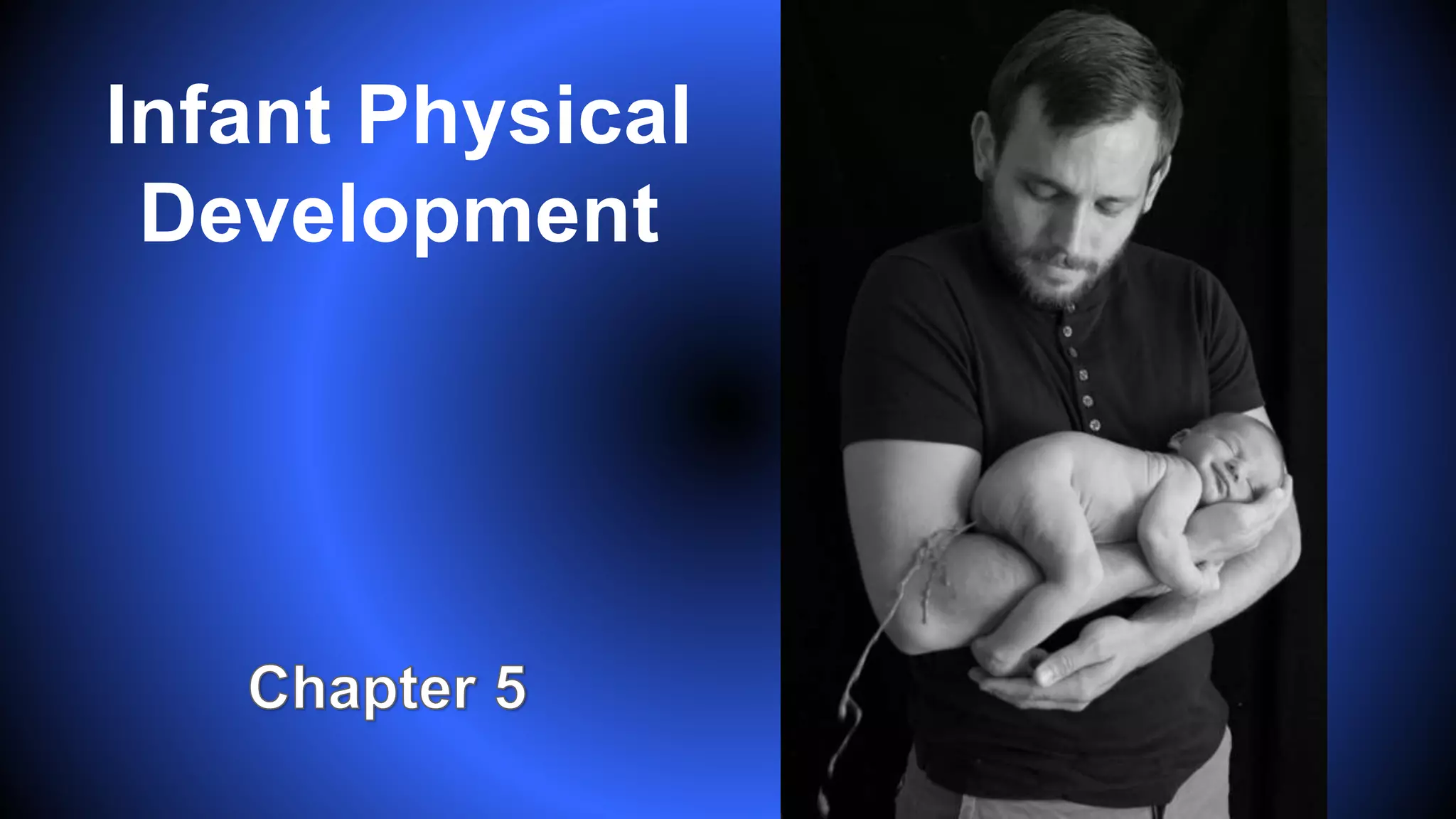
Infant Physical
Development
Copyright © 2017 Pearson, Inc. All Rights Reserved
Sensory and Perceptual Development
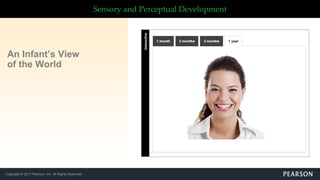
An Infant’s View
of the World
Biology of Health: Physical, Motor, and Perceptual
Development
Children grow more within the first 24 months of life
than at any other point across the life span.
Body weight nearly quadruples.
Height doubles.
Head circumference increases by 1/3.
Physical Growth over the First Two Years
The average birth weight for a term infant is 7½ pounds.
Birth weight doubles by 5 months.
Birth weight triples by 1 year.
The average length of a newborn is 20 inches.
Length increases about 30% by 5 months.
Length increases about 50% by 1 year.
Motor Development
Refers to advances in functional motor ability and changes in
the quality of motor skills
Gross motor skills: motor skills that involve use of the large
muscles of the legs, arms, back, and shoulders, which are used in
sitting, walking, running, jumping, and climbing
Fine motor skills: motor skills that involve use of the small muscles
of the fingers and hands, for activities such as grasping objects,
holding, cutting, drawing, buttoning, and writing
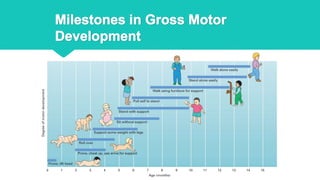
Gross Motor Skills
⦿Milestones for large muscle activities
●Development of posture
●Learning to walk; locomotion, balance, and practice (crawling to
walking)
●Development in second year
●Skilled and mobile: pull toys, climb stairs
●Natural exercise: walk quickly, run stiffly
Copyright © 2017 Pearson, Inc. All Rights Reserved
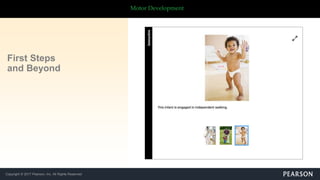
Motor Development
First Steps
and Beyond
Fine Motor Skills
⦿Finely tuned (coordinated) movements
• Perceptual-motor coupling necessary
• Finger dexterity (thumb and forefinger)
• Two types of grasps: Palmar and Pincer
• Wrists and hands turn and rotate more
• Experience and exercise have impact
Copyright © 2017 Pearson, Inc. All Rights Reserved
Physical Growth and Brain Development
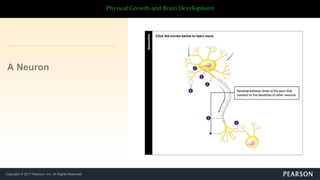
A Neuron
Copyright © 2017 Pearson, Inc. All Rights Reserved
Physical Growth and Brain Development
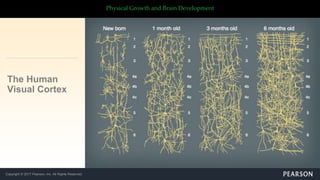
The Human
Visual Cortex
Copyright © 2017 Pearson, Inc. All Rights Reserved
Module 4.2 Physical Growth and Brain Development
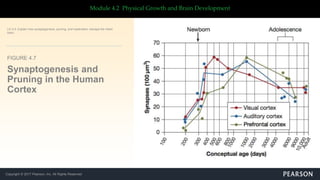
FIGURE 4.7
Synaptogenesis and
Pruning in the Human
Cortex
LO 4.5: Explain how synaptogenesis, pruning, and myelination reshape the infant
brain.
Copyright © 2017 Pearson, Inc. All Rights Reserved
Physical Growth and Brain Development
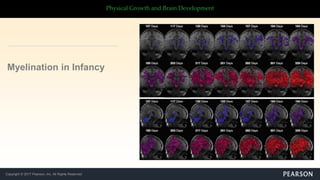
Myelination in Infancy
Copyright © 2017 Pearson, Inc. All Rights Reserved
Module 4.2 Physical Growth and Brain Development
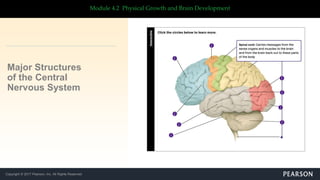
Major Structures
of the Central
Nervous System
Early Experience and the Brain
⦿Early experiences affect development
●Enriched environment makes brain
●Heavier in weight with thicker layers
●Develop more neural connections
●Produces higher neurochemical activity
●Impoverished environment
●Depression is common
Nutritional Needs
● Weight and Height grow at phenomenal rate Nutrition needed to promote
this
●50 calories a day for each pound the infant weighs
●More that 2x the amount for an adult
●Introduce solid foods at about 6 months (although milk still main source of
nutrition)
●Infant Cereal first because of high iron content
●Should be continued until at least 18 months
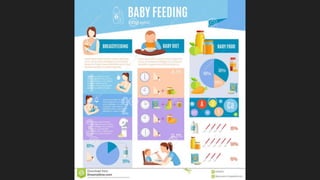
Nutrition and Health
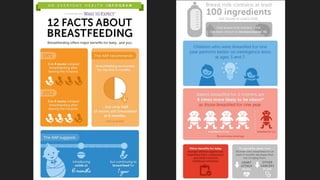
Birth to 6 to months: Breast milk and formula
Breast milk is recommended for the first 6 months due to its
high cholesterol and fat content, which is needed to support
brain development.
Reduced risk of obesity later in life with breastfeeding as
compared to formula feeding.
Between 4 and 6 months, baby cereal mixed with breast milk or
formula may be introduced.
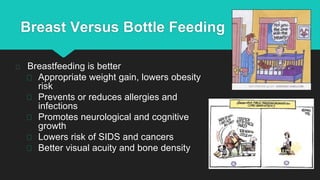
Breast Versus Bottle Feeding
Breastfeeding is better
Appropriate weight gain, lowers obesity
risk
Prevents or reduces allergies and
infections
Promotes neurological and cognitive
growth
Lowers risk of SIDS and cancers
Better visual acuity and bone density
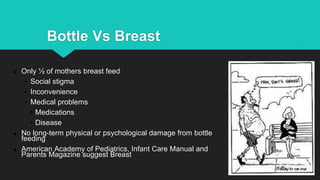
Bottle Vs Breast
● Only ½ of mothers breast feed
• Social stigma
• Inconvenience
• Medical problems
• Medications
• Disease
● No long-term physical or psychological damage from bottle
feeding
● American Academy of Pediatrics, Infant Care Manual and
Parents Magazine suggest Breast
Solid Food
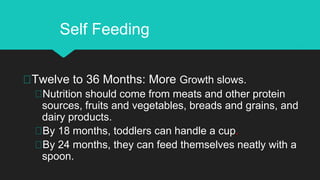
Twelve to 36 Months: More Growth slows.
Nutrition should come from meats and other protein
sources, fruits and vegetables, breads and grains, and
dairy products.
By 18 months, toddlers can handle a cup.
By 24 months, they can feed themselves neatly with a
spoon.
Self Feeding
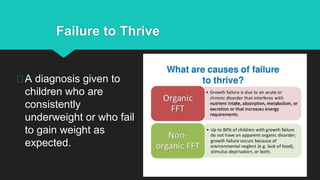
Failure to Thrive
A diagnosis given to
children who are
consistently
underweight or who fail
to gain weight as
expected.
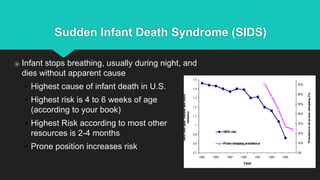
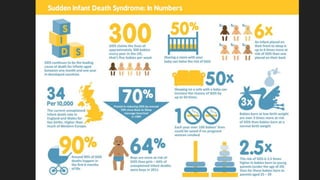
Sudden Infant Death Syndrome (SIDS)
⦿ Infant stops breathing, usually during night, and
dies without apparent cause
• Highest cause of infant death in U.S.
• Highest risk is 4 to 6 weeks of age
(according to your book)
• Highest Risk according to most other
resources is 2-4 months
• Prone position increases risk
Co-Sleeping
Many feel that Co-sleeping
Helps breastfeeding
Bonding
However, the U.S. Consumer Product Safety Commission (CPSC) warns parents
not to place their infants to sleep in adult beds, stating that the practice puts babies
at risk of suffocation and strangulation.
And the American Academy of Pediatrics (AAP) agrees.
Any drugs or alcohol consumption makes co-sleeping dangerous
Search for co-sleeping on Google and see what you get
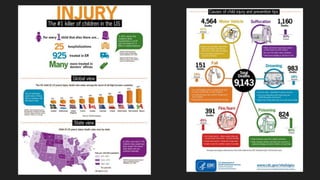
Safety Issues in Infancy
Accidents are the leading cause of injury and death in
children between 1 and 4 years of age.
Baby walkers are responsible for more injuries than any
other product designed for them.
Child safety seats lower the risk of death 70% for infants
and 55% for toddlers.
Manis 2017   ch 4 no vid

Manis 2017 ch 4 no vid

  • 1.
  • 2.
    Copyright © 2017Pearson, Inc. All Rights Reserved Sensory and Perceptual Development An Infant’s View of the World
  • 3.
    Biology of Health:Physical, Motor, and Perceptual Development Children grow more within the first 24 months of life than at any other point across the life span. Body weight nearly quadruples. Height doubles. Head circumference increases by 1/3.
  • 4.
    Physical Growth overthe First Two Years The average birth weight for a term infant is 7½ pounds. Birth weight doubles by 5 months. Birth weight triples by 1 year. The average length of a newborn is 20 inches. Length increases about 30% by 5 months. Length increases about 50% by 1 year.
  • 5.
    Motor Development Refers toadvances in functional motor ability and changes in the quality of motor skills Gross motor skills: motor skills that involve use of the large muscles of the legs, arms, back, and shoulders, which are used in sitting, walking, running, jumping, and climbing Fine motor skills: motor skills that involve use of the small muscles of the fingers and hands, for activities such as grasping objects, holding, cutting, drawing, buttoning, and writing
  • 6.
    Gross Motor Skills ⦿Milestonesfor large muscle activities ●Development of posture ●Learning to walk; locomotion, balance, and practice (crawling to walking) ●Development in second year ●Skilled and mobile: pull toys, climb stairs ●Natural exercise: walk quickly, run stiffly
  • 9.
    Copyright © 2017Pearson, Inc. All Rights Reserved Motor Development First Steps and Beyond
  • 10.
    Fine Motor Skills ⦿Finelytuned (coordinated) movements • Perceptual-motor coupling necessary • Finger dexterity (thumb and forefinger) • Two types of grasps: Palmar and Pincer • Wrists and hands turn and rotate more • Experience and exercise have impact
  • 11.
    Copyright © 2017Pearson, Inc. All Rights Reserved Physical Growth and Brain Development A Neuron
  • 12.
    Copyright © 2017Pearson, Inc. All Rights Reserved Physical Growth and Brain Development The Human Visual Cortex
  • 13.
    Copyright © 2017Pearson, Inc. All Rights Reserved Module 4.2 Physical Growth and Brain Development FIGURE 4.7 Synaptogenesis and Pruning in the Human Cortex LO 4.5: Explain how synaptogenesis, pruning, and myelination reshape the infant brain.
  • 15.
    Copyright © 2017Pearson, Inc. All Rights Reserved Physical Growth and Brain Development Myelination in Infancy
  • 16.
    Copyright © 2017Pearson, Inc. All Rights Reserved Module 4.2 Physical Growth and Brain Development Major Structures of the Central Nervous System
  • 17.
    Early Experience andthe Brain ⦿Early experiences affect development ●Enriched environment makes brain ●Heavier in weight with thicker layers ●Develop more neural connections ●Produces higher neurochemical activity ●Impoverished environment ●Depression is common
  • 18.
    Nutritional Needs ● Weightand Height grow at phenomenal rate Nutrition needed to promote this ●50 calories a day for each pound the infant weighs ●More that 2x the amount for an adult ●Introduce solid foods at about 6 months (although milk still main source of nutrition) ●Infant Cereal first because of high iron content ●Should be continued until at least 18 months
  • 19.
    Nutrition and Health Birthto 6 to months: Breast milk and formula Breast milk is recommended for the first 6 months due to its high cholesterol and fat content, which is needed to support brain development. Reduced risk of obesity later in life with breastfeeding as compared to formula feeding. Between 4 and 6 months, baby cereal mixed with breast milk or formula may be introduced.
  • 21.
    Breast Versus BottleFeeding Breastfeeding is better Appropriate weight gain, lowers obesity risk Prevents or reduces allergies and infections Promotes neurological and cognitive growth Lowers risk of SIDS and cancers Better visual acuity and bone density
  • 23.
    Bottle Vs Breast ●Only ½ of mothers breast feed • Social stigma • Inconvenience • Medical problems • Medications • Disease ● No long-term physical or psychological damage from bottle feeding ● American Academy of Pediatrics, Infant Care Manual and Parents Magazine suggest Breast
  • 24.
  • 25.
    Twelve to 36Months: More Growth slows. Nutrition should come from meats and other protein sources, fruits and vegetables, breads and grains, and dairy products. By 18 months, toddlers can handle a cup. By 24 months, they can feed themselves neatly with a spoon. Self Feeding
  • 26.
    Failure to Thrive Adiagnosis given to children who are consistently underweight or who fail to gain weight as expected.
  • 27.
    Sudden Infant DeathSyndrome (SIDS) ⦿ Infant stops breathing, usually during night, and dies without apparent cause • Highest cause of infant death in U.S. • Highest risk is 4 to 6 weeks of age (according to your book) • Highest Risk according to most other resources is 2-4 months • Prone position increases risk
  • 31.
    Co-Sleeping Many feel thatCo-sleeping Helps breastfeeding Bonding However, the U.S. Consumer Product Safety Commission (CPSC) warns parents not to place their infants to sleep in adult beds, stating that the practice puts babies at risk of suffocation and strangulation. And the American Academy of Pediatrics (AAP) agrees. Any drugs or alcohol consumption makes co-sleeping dangerous Search for co-sleeping on Google and see what you get
  • 36.
    Safety Issues inInfancy Accidents are the leading cause of injury and death in children between 1 and 4 years of age. Baby walkers are responsible for more injuries than any other product designed for them. Child safety seats lower the risk of death 70% for infants and 55% for toddlers.

Editor's Notes

  • #3 LO 4.13: Describe how visual perception develops in infancy. An Infant’s View of the World Students click through a series of images that reveal an infant’s view of a human face at 1 month, 2 months, 3 months, and 1 year of age.
  • #4 Key question 2: In what ways are the first years of life a period of rapid physical, motor, and perceptual development?
  • #10 LO 4.10: Explain how infants acquire the specific motor skills of reaching and grasping, crawling, and walking. First Steps and Beyond This interactive experience contains three photos that explore infants cruising, walking with assistance, and walking independently.
  • #12 LO 4.5: Explain how synaptogenesis, pruning, and myelination reshape the infant brain. Neurons have three basic parts: dendrites, a cell body, and an axon. To communicate with one another, neurotransmitters (chemical messengers) cross the synapse (gap between two neurons) to the receiving neuron. In the first six months of development, dendrites grow quickly and synapses form rapidly through synaptogenesis. The environment plays an important role in synapse activation. Synapses that are not used are pruned. Myelination occurs rapidly during the first year of brain development. Myelination speeds up neural conduction, allowing for faster neural communication. Figure 4.5: A Neuron Students examine an illustration of a neuron with pop-up labels that identify and define each part.
  • #13 LO 4.5: Explain how synaptogenesis, pruning, and myelination reshape the infant brain. In the first six months of development, dendrites grow quickly and synapses form rapidly through synaptogenesis. The environment plays an important role in synapse activation. Synapses that are not used are pruned. Myelination occurs rapidly during the first year of brain development. Myelination speeds up neural conduction, allowing for faster neural communication. Figure 4.6 The Human Visual Cortex The 2-D drawing of the human visual cortex was prepared with Golgi stains and adapted from Conel (1939–1967).
  • #14 LO 4.5: Explain how synaptogenesis, pruning, and myelination reshape the infant brain. In the first six months of development, dendrites grow quickly and synapses form rapidly through synaptogenesis. The environment plays an important role in synapse activation. Synapses that are not used are pruned. Myelination occurs rapidly during the first year of brain development. Myelination speeds up neural conduction, allowing for faster neural communication. Figure 4.7: Synaptogenesis and Pruning in the Human Cortex The graph is fairly complex and well worth going over in class. Walk students through the X-axis values and point out the overall trends in the three graph lines as well as the differences in age of peak synaptogenesis between visual and auditory cortex relative to prefrontal cortex.
  • #16 LO 4.5: Explain how synaptogenesis, pruning, and myelination reshape the infant brain. Myelination occurs rapidly during the first year of brain development. Myelination speeds up neural conduction, allowing for faster neural communication. Figure 4.8: Myelination in Infancy The images are fairly complicated to interpret and well worth going over in class. Point out trends in myelin growth, such as earlier development in lower, deeper, and rear parts of the brain, and the increased whole brain connectivity that would occur as the myelin networks expand to include most of the brain by 329 days (about 11 months) of age. Degree of myelination is indicated by the extent and coloration of fibers (red = thicker myelin). Myelination begins first in lower and deeper regions of the brain, such as the brain stem and cerebellum, and spreads upward and outward to the occipital and parietal lobes by 5 to 6 months and the temporal and frontal lobes by 8 to 9 months of age.
  • #17 LO 4.6: Describe the development of major areas of the cerebral cortex in infancy. Figure 4.9: The Major Structures of the Central Nervous System Students examine an illustration of the major structures of the central nervous system. Pop-up labels explain the function of each structure.
  • #20 Key Question 4: What are some important nutrition concerns regarding infants and toddlers?