Copyright © 2018, 2015, 2012 Pearson Education, Inc. All Rights Reserved
Development Across the Life Span
Chapter 4
Physical Development
During Infancy
Eighth Edition
Copyright © 2018, 2015, 2012 Pearson Education, Inc. All Rights Reserved
Growth and
Stability
PHYSICAL DEVELOPMENT IN INFANCY
Copyright © 2018, 2015, 2012 Pearson Education, Inc. All Rights Reserved
What physical changes occur
during infancy?
Newborn (neonate) 1 year old
Copyright © 2018, 2015, 2012 Pearson Education, Inc. All Rights Reserved
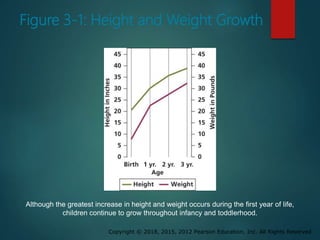
Figure 3-1: Height and Weight Growth
Although the greatest increase in height and weight occurs during the first year of life,
children continue to grow throughout infancy and toddlerhood.
Copyright © 2018, 2015, 2012 Pearson Education, Inc. All Rights Reserved
Birthweight
Newborn
Birthweight 7.5 lbs
(average)
5 months
Birthweight 15 lbs
(doubles)
1 year
Birthweight 22.5 lbs
(triples)
Copyright © 2018, 2015, 2012 Pearson Education, Inc. All Rights Reserved
Physical Growth
•Four principles of growth
– Cephalocaudal principle
– Proximodistal principle
– Principle of hierarchical integration
– Principle of the independence of systems
Copyright © 2018, 2015, 2012 Pearson Education, Inc. All Rights Reserved
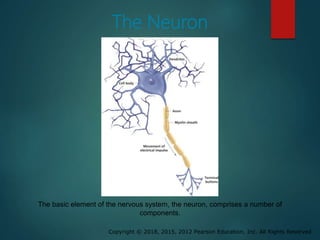
The Neuron
The basic element of the nervous system, the neuron, comprises a number of
components.
Copyright © 2018, 2015, 2012 Pearson Education, Inc. All Rights Reserved
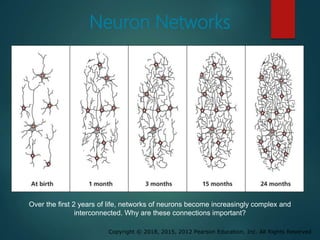
Neuron Networks
Over the first 2 years of life, networks of neurons become increasingly complex and
interconnected. Why are these connections important?
Copyright © 2018, 2015, 2012 Pearson Education, Inc. All Rights Reserved
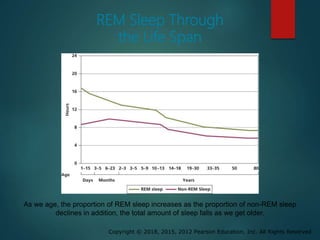
REM Sleep Through
the Life Span
As we age, the proportion of REM sleep increases as the proportion of non-REM sleep
declines in addition, the total amount of sleep falls as we get older.
Copyright © 2018, 2015, 2012 Pearson Education, Inc. All Rights Reserved
Declining Rates of SIDS
In the United States, SIDS rates have dropped dramatically as parents have become
more informed and put babies to sleep on their backs instead of their stomachs.
Copyright © 2018, 2015, 2012 Pearson Education, Inc. All Rights Reserved
Motor
Development
Copyright © 2018, 2015, 2012 Pearson Education, Inc. All Rights Reserved
Reflexes
Infants showing (a) the rooting reflex, (b) the startle reflex, and (c) the Moro reflex.
Copyright © 2018, 2015, 2012 Pearson Education, Inc. All Rights Reserved
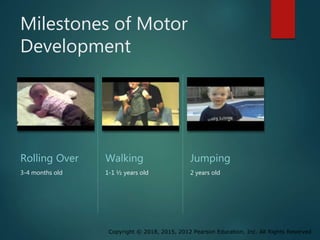
Milestones of Motor
Development
Rolling Over
3-4 months old
Walking
1-1 ½ years old
Jumping
2 years old
Copyright © 2018, 2015, 2012 Pearson Education, Inc. All Rights Reserved
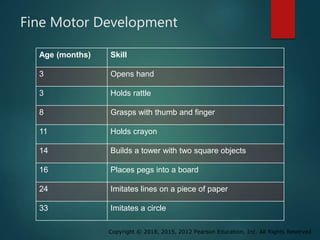
Fine Motor Development
Age (months) Skill
3 Opens hand
3 Holds rattle
8 Grasps with thumb and finger
11 Holds crayon
14 Builds a tower with two square objects
16 Places pegs into a board
24 Imitates lines on a piece of paper
33 Imitates a circle
Copyright © 2018, 2015, 2012 Pearson Education, Inc. All Rights Reserved
The
Development
of the Senses
Copyright © 2018, 2015, 2012 Pearson Education, Inc. All Rights Reserved
The Visual Cliff
The “visual cliff” experiment examines the depth perception of infants. Most infants in the
age range of 6 to 14 months cannot be coaxed to cross the cliff, apparently responding to
the fact that the patterned area drops several feet.
Copyright © 2018, 2015, 2012 Pearson Education, Inc. All Rights Reserved
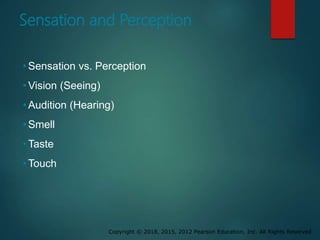
Sensation and Perception
• Sensation vs. Perception
• Vision (Seeing)
• Audition (Hearing)
• Smell
• Taste
• Touch

Physical Development During Infancy

  • 1.
    Copyright © 2018,2015, 2012 Pearson Education, Inc. All Rights Reserved Development Across the Life Span Chapter 4 Physical Development During Infancy Eighth Edition
  • 2.
    Copyright © 2018,2015, 2012 Pearson Education, Inc. All Rights Reserved Growth and Stability PHYSICAL DEVELOPMENT IN INFANCY
  • 3.
    Copyright © 2018,2015, 2012 Pearson Education, Inc. All Rights Reserved What physical changes occur during infancy? Newborn (neonate) 1 year old
  • 4.
    Copyright © 2018,2015, 2012 Pearson Education, Inc. All Rights Reserved Figure 3-1: Height and Weight Growth Although the greatest increase in height and weight occurs during the first year of life, children continue to grow throughout infancy and toddlerhood.
  • 5.
    Copyright © 2018,2015, 2012 Pearson Education, Inc. All Rights Reserved Birthweight Newborn Birthweight 7.5 lbs (average) 5 months Birthweight 15 lbs (doubles) 1 year Birthweight 22.5 lbs (triples)
  • 6.
    Copyright © 2018,2015, 2012 Pearson Education, Inc. All Rights Reserved Physical Growth •Four principles of growth – Cephalocaudal principle – Proximodistal principle – Principle of hierarchical integration – Principle of the independence of systems
  • 7.
    Copyright © 2018,2015, 2012 Pearson Education, Inc. All Rights Reserved The Neuron The basic element of the nervous system, the neuron, comprises a number of components.
  • 8.
    Copyright © 2018,2015, 2012 Pearson Education, Inc. All Rights Reserved Neuron Networks Over the first 2 years of life, networks of neurons become increasingly complex and interconnected. Why are these connections important?
  • 9.
    Copyright © 2018,2015, 2012 Pearson Education, Inc. All Rights Reserved REM Sleep Through the Life Span As we age, the proportion of REM sleep increases as the proportion of non-REM sleep declines in addition, the total amount of sleep falls as we get older.
  • 10.
    Copyright © 2018,2015, 2012 Pearson Education, Inc. All Rights Reserved Declining Rates of SIDS In the United States, SIDS rates have dropped dramatically as parents have become more informed and put babies to sleep on their backs instead of their stomachs.
  • 11.
    Copyright © 2018,2015, 2012 Pearson Education, Inc. All Rights Reserved Motor Development
  • 12.
    Copyright © 2018,2015, 2012 Pearson Education, Inc. All Rights Reserved Reflexes Infants showing (a) the rooting reflex, (b) the startle reflex, and (c) the Moro reflex.
  • 13.
    Copyright © 2018,2015, 2012 Pearson Education, Inc. All Rights Reserved Milestones of Motor Development Rolling Over 3-4 months old Walking 1-1 ½ years old Jumping 2 years old
  • 14.
    Copyright © 2018,2015, 2012 Pearson Education, Inc. All Rights Reserved Fine Motor Development Age (months) Skill 3 Opens hand 3 Holds rattle 8 Grasps with thumb and finger 11 Holds crayon 14 Builds a tower with two square objects 16 Places pegs into a board 24 Imitates lines on a piece of paper 33 Imitates a circle
  • 15.
    Copyright © 2018,2015, 2012 Pearson Education, Inc. All Rights Reserved The Development of the Senses
  • 16.
    Copyright © 2018,2015, 2012 Pearson Education, Inc. All Rights Reserved The Visual Cliff The “visual cliff” experiment examines the depth perception of infants. Most infants in the age range of 6 to 14 months cannot be coaxed to cross the cliff, apparently responding to the fact that the patterned area drops several feet.
  • 17.
    Copyright © 2018,2015, 2012 Pearson Education, Inc. All Rights Reserved Sensation and Perception • Sensation vs. Perception • Vision (Seeing) • Audition (Hearing) • Smell • Taste • Touch

Editor's Notes

  • #5 Infants grow rapidly in the first 2 years, with the greatest amount of growth occurring during the first year. Birthweight By 5 months, birthweight has doubled By 1 year, birthweight has tripled By end of second year, birthweight has quadrupled Length By end of year 1, average baby is 30 inches tall By end of year 2, child is 3 feet tall Not all parts grow at same rate (head)
  • #6 Length of a newborn is 19” (average). By the end of 1st year, baby is 30” tall (average). By the end of 2nd year, baby is 3 feet tall! (average).
  • #7 • The cephalocaudal principle states that growth follows a direction and pattern that begins with the head and upper body parts and then proceeds to the rest of the body. • The proximodistal principle states that development proceeds from the center of the body outward. • The principle of hierarchical integration states that simple skills typically develop separately and independently, but that these simple skills are integrated into more complex ones. • The principle of the independence of systems suggests that different body systems grow at different rates.
  • #8 Nervous system is brain and nerves Neurons Infants born with 100 and 200 billion neurons Dendrites receive messages; Axons: Send messages to other neurons Communication between cells is chemical and uses neurotransmitters through synapse
  • #9 Synaptic Pruning: Cells that are not needed die off Neurons increase in size Axons become coated with myelin Myelin: Fatty substance that protects and speeds transmission of nerve impulses Brain triples its weight in the first 2 years of life Neurons become arranged by function Some move to cerebral cortex, the upper layer of brain Some go to subcortical levels, where they regulate basic function Plasticity, sensitive period
  • #10 Rhythms and States Rhythms: Repetitive, cyclical patterns of behavior States: The degree of awareness an infant displays to both internal and external stimulation Sleep: Perchance to Dream? Newborns sleep 16 to 17 hours daily (10-20) Sleep stages are fitful and “out of sync” during early infancy Most do not sleep through the night for several months Rapid eye movement (REM) is associated with dreaming Infant brain waves are different than the dreaming sleep of adults This active REM-like sleep takes up half of infant’s sleep Autostimulation is the brain stimulating itself
  • #11 SIDS: The Unanticipated Killer Sudden infant death syndrome (SIDS): Unexplained death of a seemingly healthy baby Affects about 2,500 infants in the United States every year No cause has been found Leading cause of death in the first year of life “Back-to-sleep” guidelines have decreased incidence of SIDS
  • #13 The Basic Reflexes Reflexes are unlearned, organized, involuntary responses that occur automatically in the presence of certain stimuli. Swimming reflex Eye-blink reflex Some reflexes stay throughout life, others disappear Babinski, Moro, rooting, grasping, startle
  • #14 By 6 months, infants can move by themselves Crawling between 8 and 10 months Support themselves on furniture and walking by 9 months Walk alone by 1 year Most sit unsupported by 6 months
  • #15 Fine Motor Skills By 3 months, infants coordinate movements of limbs Grasp objects by 11 months By age 2, drink from cup without spilling Motor skill development follows a sequential pattern Simple skills are added to more sophisticated ones As infants get older, they use pincer grasp: thumb and index finer meet to form a circle
  • #17 Sensation: The stimulation of sense organs Perception: Our interpretation and analysis of a sensory stimulus Visual Perception Newborns can’t see beyond 20 feet By 6 months, the average infant’s vision is 20/20 Depth perception develops at 6 months Infants prefer patterns and complex stimuli Infants prefer to look at faces Auditory – begins prenatally, sensitive high and low pitch, sound localization compares to adults at 1 yr Smell/Taste – react to unpleasant taste/smell from birth, recognize mothers smell when breastfed, prefer sweet Pain – sensitive at birth (circumcision?) Touch/tactile – most highly developed sense