The Birth
Process
Chapter 4
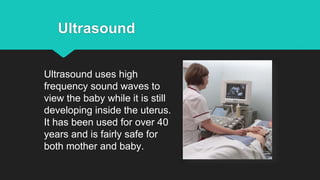
Ultrasound uses high
frequency sound waves to
view the baby while it is still
developing inside the uterus.
It has been used for over 40
years and is fairly safe for
both mother and baby.
Ultrasound
Copyright © 2017 Pearson, Inc. All Rights Reserved
Prenatal Care
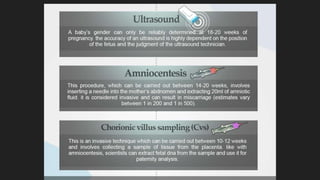
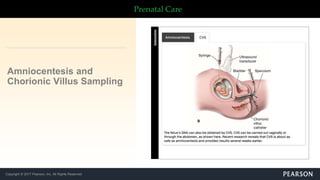
Amniocentesis and
Chorionic Villus Sampling
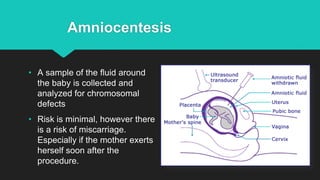
Amniocentesis
• A sample of the fluid around
the baby is collected and
analyzed for chromosomal
defects
• Risk is minimal, however there
is a risk of miscarriage.
Especially if the mother exerts
herself soon after the
procedure.
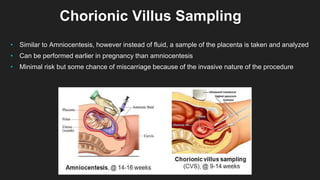
Chorionic Villus Sampling
• Similar to Amniocentesis, however instead of fluid, a sample of the placenta is taken and analyzed
• Can be performed earlier in pregnancy than amniocentesis
• Minimal risk but some chance of miscarriage because of the invasive nature of the procedure
Birth
Birth preparation classes: courses designed to
increase the confidence of women in their ability to
give birth and to educate them on coping strategies
for childbirth
Birth plan: a written outline of parents’ wishes for
labor and birth, intended to help health care
providers know what parents want and expect
The Place of Childbirth: Home or Hospital?
Birth center: facilities typically
established in or near conventional labor
wards for the care of pregnant women
who require little or no medical
intervention during birth
Homelike environment
Staffed by midwives or nurse-midwives
Natural Childbirth and the Role of the Doula
Natural childbirth: childbirth that takes place without
the use of anesthetics or other interventions
Water birth: method in which the mother sits in a tub
of warm water and gives birth; believed to be less
painful and more relaxing
Doula: a nonmedical professional who provides
women with physical and emotional assistance before,
during, or after childbirth
Copyright © 2017 Pearson, Inc. All Rights Reserved
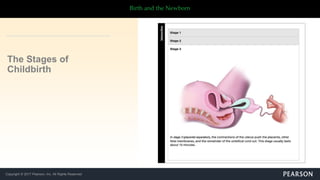
Birth and the Newborn
The Stages of
Childbirth
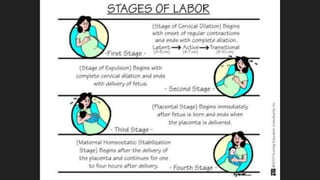
Stages of Labor
Oxytocin: a hormome secreted by the pituitary gland
that stimulates the uterus to contract
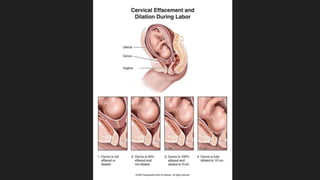
Stage 1 - Dilation: begins with the start of regular
contractions and ends when the cervix is completely
open
Lasts about 6 – 12 hours for first births and 6 – 7 hours for
subsequent births
Transition: the most painful phase of stage 1 labor lasting
between 30 minutes to an hour or two
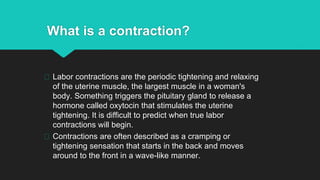
What is a contraction?
Labor contractions are the periodic tightening and relaxing
of the uterine muscle, the largest muscle in a woman's
body. Something triggers the pituitary gland to release a
hormone called oxytocin that stimulates the uterine
tightening. It is difficult to predict when true labor
contractions will begin.
Contractions are often described as a cramping or
tightening sensation that starts in the back and moves
around to the front in a wave-like manner.
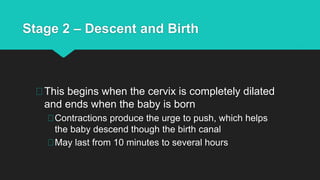
Stage 2 – Descent and Birth
This begins when the cervix is completely dilated
and ends when the baby is born
Contractions produce the urge to push, which helps
the baby descend though the birth canal
May last from 10 minutes to several hours
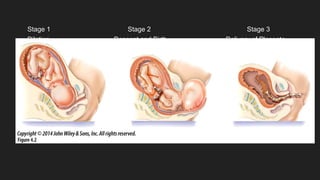
Stage 1 Stage 2 Stage 3
Dilation Descent and Birth Delivery of Placenta
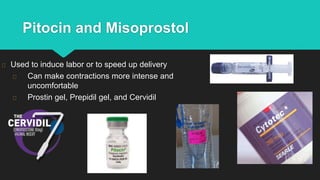
Used to induce labor or to speed up delivery
Can make contractions more intense and
uncomfortable
Prostin gel, Prepidil gel, and Cervidil
Pitocin and Misoprostol
Pain Medications
Analgesics: drugs used to relieve pain and
promote relaxation
Anesthetics: drugs that block sensation
General anesthetics: drugs causing total loss of
both sensation and consciousness; are rarely used
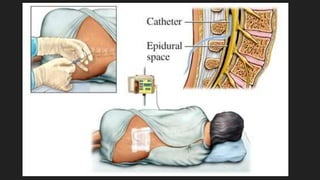
Epidural anesthesia: local anesthetic that blocks
sensation to only part of the body
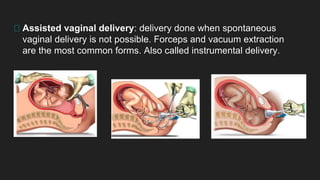
Assisted vaginal delivery: delivery done when spontaneous
vaginal delivery is not possible. Forceps and vacuum extraction
are the most common forms. Also called instrumental delivery.
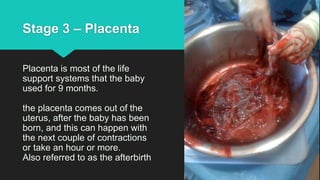
Stage 3 – Placenta
Placenta is most of the life
support systems that the baby
used for 9 months.
the placenta comes out of the
uterus, after the baby has been
born, and this can happen with
the next couple of contractions
or take an hour or more.
Also referred to as the afterbirth
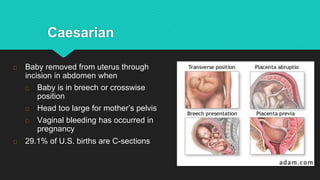
Caesarian
Baby removed from uterus through
incision in abdomen when
Baby is in breech or crosswise
position
Head too large for mother’s pelvis
Vaginal bleeding has occurred in
pregnancy
29.1% of U.S. births are C-sections

Manis 2017 ch 3 pt 3 no vid

  • 1.
  • 5.
    Ultrasound uses high frequencysound waves to view the baby while it is still developing inside the uterus. It has been used for over 40 years and is fairly safe for both mother and baby. Ultrasound
  • 6.
    Copyright © 2017Pearson, Inc. All Rights Reserved Prenatal Care Amniocentesis and Chorionic Villus Sampling
  • 7.
    Amniocentesis • A sampleof the fluid around the baby is collected and analyzed for chromosomal defects • Risk is minimal, however there is a risk of miscarriage. Especially if the mother exerts herself soon after the procedure.
  • 8.
    Chorionic Villus Sampling •Similar to Amniocentesis, however instead of fluid, a sample of the placenta is taken and analyzed • Can be performed earlier in pregnancy than amniocentesis • Minimal risk but some chance of miscarriage because of the invasive nature of the procedure
  • 9.
    Birth Birth preparation classes:courses designed to increase the confidence of women in their ability to give birth and to educate them on coping strategies for childbirth Birth plan: a written outline of parents’ wishes for labor and birth, intended to help health care providers know what parents want and expect
  • 11.
    The Place ofChildbirth: Home or Hospital? Birth center: facilities typically established in or near conventional labor wards for the care of pregnant women who require little or no medical intervention during birth Homelike environment Staffed by midwives or nurse-midwives
  • 12.
    Natural Childbirth andthe Role of the Doula Natural childbirth: childbirth that takes place without the use of anesthetics or other interventions Water birth: method in which the mother sits in a tub of warm water and gives birth; believed to be less painful and more relaxing Doula: a nonmedical professional who provides women with physical and emotional assistance before, during, or after childbirth
  • 16.
    Copyright © 2017Pearson, Inc. All Rights Reserved Birth and the Newborn The Stages of Childbirth
  • 17.
    Stages of Labor Oxytocin:a hormome secreted by the pituitary gland that stimulates the uterus to contract Stage 1 - Dilation: begins with the start of regular contractions and ends when the cervix is completely open Lasts about 6 – 12 hours for first births and 6 – 7 hours for subsequent births Transition: the most painful phase of stage 1 labor lasting between 30 minutes to an hour or two
  • 18.
    What is acontraction? Labor contractions are the periodic tightening and relaxing of the uterine muscle, the largest muscle in a woman's body. Something triggers the pituitary gland to release a hormone called oxytocin that stimulates the uterine tightening. It is difficult to predict when true labor contractions will begin. Contractions are often described as a cramping or tightening sensation that starts in the back and moves around to the front in a wave-like manner.
  • 20.
    Stage 2 –Descent and Birth This begins when the cervix is completely dilated and ends when the baby is born Contractions produce the urge to push, which helps the baby descend though the birth canal May last from 10 minutes to several hours
  • 21.
    Stage 1 Stage2 Stage 3 Dilation Descent and Birth Delivery of Placenta
  • 22.
    Used to inducelabor or to speed up delivery Can make contractions more intense and uncomfortable Prostin gel, Prepidil gel, and Cervidil Pitocin and Misoprostol
  • 23.
    Pain Medications Analgesics: drugsused to relieve pain and promote relaxation Anesthetics: drugs that block sensation General anesthetics: drugs causing total loss of both sensation and consciousness; are rarely used Epidural anesthesia: local anesthetic that blocks sensation to only part of the body
  • 25.
    Assisted vaginal delivery:delivery done when spontaneous vaginal delivery is not possible. Forceps and vacuum extraction are the most common forms. Also called instrumental delivery.
  • 26.
    Stage 3 –Placenta Placenta is most of the life support systems that the baby used for 9 months. the placenta comes out of the uterus, after the baby has been born, and this can happen with the next couple of contractions or take an hour or more. Also referred to as the afterbirth
  • 27.
    Caesarian Baby removed fromuterus through incision in abdomen when Baby is in breech or crosswise position Head too large for mother’s pelvis Vaginal bleeding has occurred in pregnancy 29.1% of U.S. births are C-sections

Editor's Notes

  • #7 LO 3.13: Describe the most common techniques for monitoring the health of the fetus.
  • #10 Key question 1: What happens during labor and delivery, and how do the different approaches to childbirth affect these processes?
  • #17 LO 3.15: Describe the stages of childbirth. Figure 3.11: The Stages of Childbirth Students click accordion tabs to reveal the three stages of childbirth in this diagram.