“Breastfeeding is an unequalled way of providing
ideal food for the healthy growth and development
of infants; it is also an integral part of there
productive process with important implications for
the health of mothers.As a global public health
recommendation, infants should be
exclusivelybreastfed for the first six months of life
to achieve optimal growth,development and health.
Thereafter, to meet their evolving nutritional
requirements, infants should receive nutritionally
adequate and safe complementary foods while
breastfeeding continues for upto two years of age
or beyond” – WHO, 2002.
Correct Norms for Infant and
Young Child Feeding
• Initiation of breastfeeding immediately after
birth,
preferably
within one hour.
• Exclusive breastfeeding for the first six
months
i.e., the infants
receives only breast milk and nothing else, no other milk. Food, drink or water.
• Appropriate and adequate complementary
feeding
from six
months of age while continuing breastfeeding.
• Continued breastfeeding upto the age of
two years or
Modern science and technology
has not been able to produce a
better food for young infants
than mother’s milk.
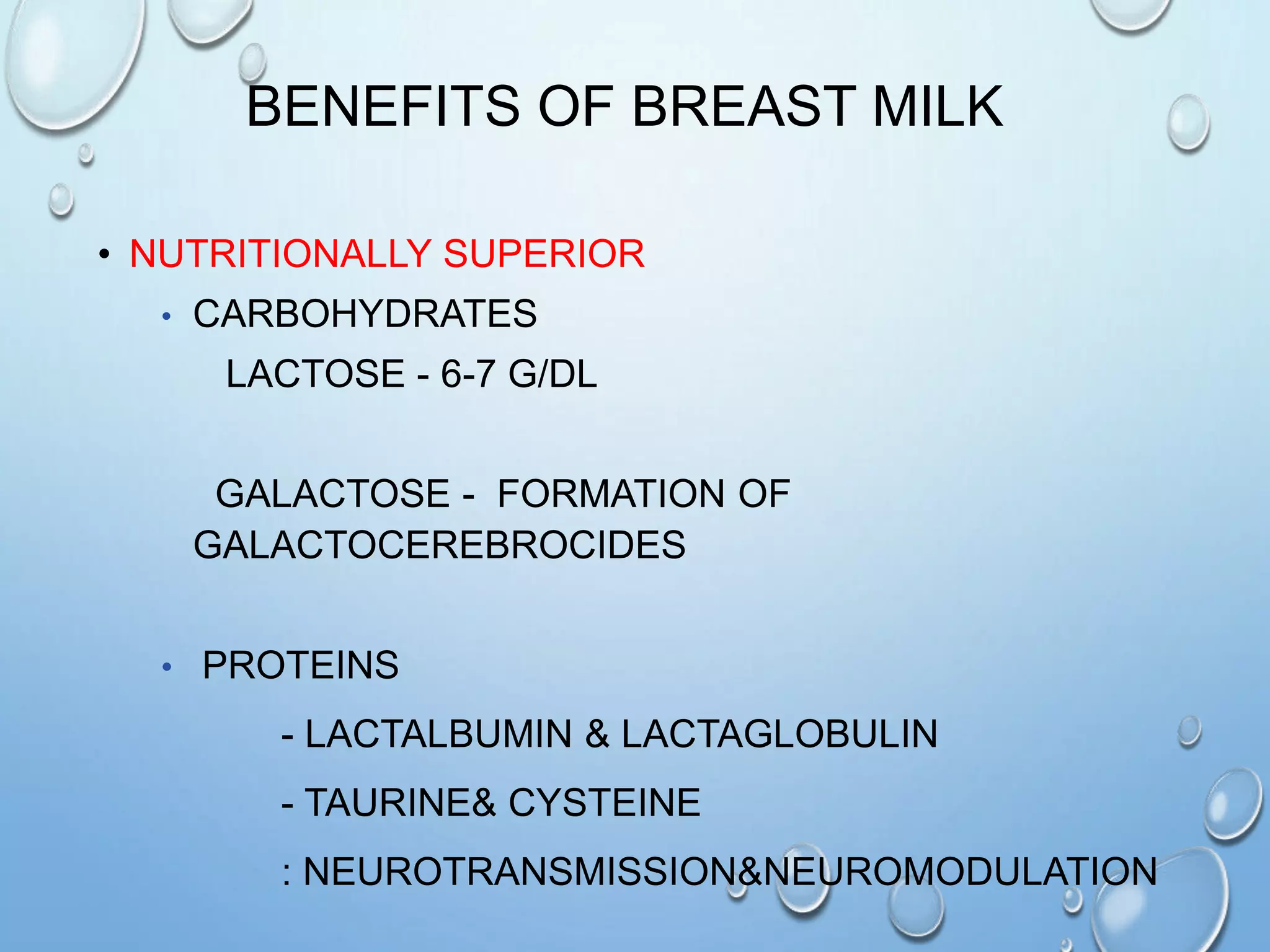
BENEFITS OF BREAST MILK
• NUTRITIONALLY SUPERIOR
• CARBOHYDRATES
LACTOSE - 6-7 G/DL
GALACTOSE - FORMATION OF
GALACTOCEREBROCIDES
• PROTEINS
- LACTALBUMIN & LACTAGLOBULIN
- TAURINE& CYSTEINE
: NEUROTRANSMISSION&NEUROMODULATION
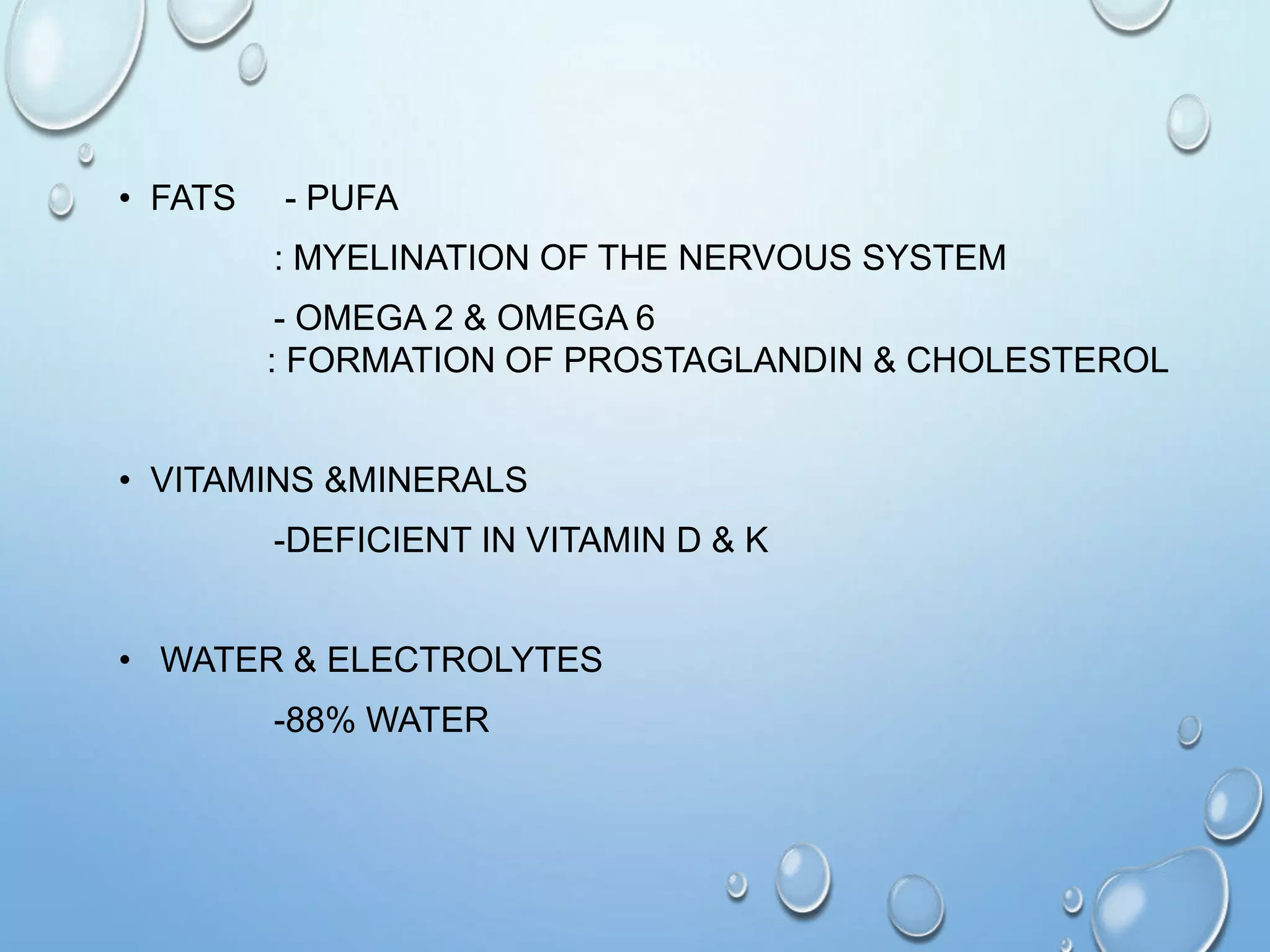
• FATS - PUFA
: MYELINATION OF THE NERVOUS SYSTEM
- OMEGA 2 & OMEGA 6
: FORMATION OF PROSTAGLANDIN & CHOLESTEROL
• VITAMINS &MINERALS
-DEFICIENT IN VITAMIN D & K
• WATER & ELECTROLYTES
-88% WATER
The exceptional nutritional
quality of human milk has been
recognised for a long time.
Mother’s milk is designed for easy
digestion and assimilation.
Protein in mother’s milk is in a more soluble
form which is easily digested and absorbed
by the baby.
Same is the case with regard to fat and
calcium in human milk which are also easily
absorbable
. The milk sugar – lactose in mother’s milk provides
ready energy.
In addition, a part of it is converted into lactic acid
in the intestines which destroys harmful bacteria
present there and helps in absorption of calcium
and other minerals.
The amount of vitamins such as
thiamine, vitamin A and vitamin C found
in mother’s milk depends on the diet of
the mother. Under normal conditions,
breast milk provides reasonable
amounts of these vitamins.
. Breastfeeding is the best way to satisfy
psychological needs of the baby.
The human milk has inherent anti-
infective properties which no other
milk has.
This protective function of human
milk is particularly important in
developing countries where there is
much exposure to infection.
• Breast milk is the best natural food for babies.
• Breast milk is always clean.
• Breast milk protects the baby from diseases.
• Breast milk makes the child more intelligent.
• Breast milk is available 24 hours a day and requires no special
preparation.
• Breast milk is nature’s gift to the infant and does not need to be
purchased.
• Breastfeeding makes a special relationship between mother and
baby.
• Breastfeeding helps parents to space their children.
• Breastfeeding helps a mother to shed extra weight gained during
pregnancy
Correct Norms for Infant and
Young Child Feeding
• Initiation of breastfeeding immediately after
birth,
preferably
within one hour.
• Exclusive breastfeeding for the first six
months
i.e., the infants
receives only breast milk and nothing else, no other milk. Food, drink or water.
• Appropriate and adequate complementary
feeding
from six
months of age while continuing breastfeeding.
• Continued breastfeeding upto the age of
two years or
Early Initiation of Breastfeeding
Early initiation of breastfeeding is
extremely important for
establishing successful lactation
as well as for providing
‘Colostrum’ (mother’s first milk) to
the baby.
 .The new born baby is very active during the
first half an hour and if the baby is kept with the
mother and effort is made to breastfeed, the infant
learns sucking very fast.
 This early suckling by the
infant starts
the process of milk
formation in the mother and
helps in early secretion of
breast milk.
Successful lactation……
It is essential that the baby gets the first
breast-milk called colostrum which is
thicker and yellowish than later milk and
comes only in small amounts in the first
few
days. Colostrum is all the food and fluid
needed at this time – no supplements
are
necessary, not even water.
Colostrum
Initial 3-4 days after delivery
Small quantity ,yellow , thick
Antibodies
Immune competent cells
Vitamin A ,D ,E, K
Correct Norms for Infant and
Young Child Feeding
• Initiation of breastfeeding immediately after
birth,
preferably
within one hour.
• Exclusive breastfeeding for the first six
months
i.e., the infants
receives only breast milk and nothing else, no other milk. Food, drink or water.
• Appropriate and adequate complementary
feeding
from six
months of age while continuing breastfeeding.
• Continued breastfeeding upto the age of
two years or
Breast milk provides best and
complete nourishment to the baby during
the first six months.-no other food
Breast milk alone is adequate to meet
the hydration requirements even under
the extremely hot and dry summer
conditions prevailing in the country.- no
waterIt also helps in reducing specially the
ear infections and
risk of attacks of asthma and allergies.
Exclusive breastfeeding provides
babies with the best start in life. It
makes them
smarter with higher intelligence and
helps in optimal development.
Addition of even a single feed of the
animal or powder milk, any other food or
even water has two disadvantages,
• firstly it depresses lactation as child
will suck less- less breast milk
• increases the chances of infections
particularly the diarrhoea.
It must be remembered that
benefits of breastfeeding are
reduced if it is not exclusive
breastfeeding.
Correct Norms for Infant and
Young Child Feeding
• Initiation of breastfeeding immediately after
birth,
preferably
within one hour.
• Exclusive breastfeeding for the first six
months
i.e., the infants
receives only breast milk and nothing else, no other milk. Food, drink or water.
• Appropriate and adequate complementary
feeding
from six
months of age while continuing breastfeeding.
• Continued breastfeeding upto the age of
two years or
COMPLEMENTARY FEEDING
The infant is growing in size
and its activities are also
increasing. As a result the
nutritional needs of the infant
increase significantly at this
age.
The staple cereal of the family should be
used to make the first food for an
infant. Porridge can be made with suji
(semolina), broken wheat, atta (wheat
flour)
Adding sugar or jaggery and ghee or
oil is important as it increases the
energy value of the food.
In the beginning the porridge
could be made a little thinner
but as the child grows older the
consistency has to be thicker
Fruits like banana, papaya, chikoo,
mango etc could be given at this
age in a mashed form.
 Amount of feed-
initially small amounts given
quantity gradually increased
 Consistency of feed-
pureed, mashed ,semisolid food-at
6 months
most infants can have finger foods at
8 months
by 12 months have same food of
family
NEW
ICMR
protein energy
0-6 MONTHS 1.16g/kg 92 kcal/kg
6 MONTHS-
1YEAR
1.65g/kg 79kcal/kg
1,2,3 YEARS 15.7g 1036kcal
4,5,6YEARS 20.3g 1350kcal
7,8,9YEARS 29.3 g 1690kcal
10,11,12(male) 39.3 g 2189kcal
(female) 40.4 g 2008kcal
make feeding an active engaging and
interactive affair
And hygienic…………
Correct Norms for Infant and
Young Child Feeding
• Initiation of breastfeeding immediately after
birth,
preferably
within one hour.
• Exclusive breastfeeding for the first six
months
i.e., the infants
receives only breast milk and nothing else, no other milk. Food, drink or water.
• Appropriate and adequate complementary
feeding
from six
months of age while continuing breastfeeding.
• Continued breastfeeding upto the age of
two years or
Infant and young child nutrition

Infant and young child nutrition

  • 3.
    “Breastfeeding is anunequalled way of providing ideal food for the healthy growth and development of infants; it is also an integral part of there productive process with important implications for the health of mothers.As a global public health recommendation, infants should be exclusivelybreastfed for the first six months of life to achieve optimal growth,development and health. Thereafter, to meet their evolving nutritional requirements, infants should receive nutritionally adequate and safe complementary foods while breastfeeding continues for upto two years of age or beyond” – WHO, 2002.
  • 4.
    Correct Norms forInfant and Young Child Feeding • Initiation of breastfeeding immediately after birth, preferably within one hour. • Exclusive breastfeeding for the first six months i.e., the infants receives only breast milk and nothing else, no other milk. Food, drink or water. • Appropriate and adequate complementary feeding from six months of age while continuing breastfeeding. • Continued breastfeeding upto the age of two years or
  • 5.
    Modern science andtechnology has not been able to produce a better food for young infants than mother’s milk.
  • 6.
    BENEFITS OF BREASTMILK • NUTRITIONALLY SUPERIOR • CARBOHYDRATES LACTOSE - 6-7 G/DL GALACTOSE - FORMATION OF GALACTOCEREBROCIDES • PROTEINS - LACTALBUMIN & LACTAGLOBULIN - TAURINE& CYSTEINE : NEUROTRANSMISSION&NEUROMODULATION
  • 7.
    • FATS -PUFA : MYELINATION OF THE NERVOUS SYSTEM - OMEGA 2 & OMEGA 6 : FORMATION OF PROSTAGLANDIN & CHOLESTEROL • VITAMINS &MINERALS -DEFICIENT IN VITAMIN D & K • WATER & ELECTROLYTES -88% WATER
  • 8.
    The exceptional nutritional qualityof human milk has been recognised for a long time.
  • 9.
    Mother’s milk isdesigned for easy digestion and assimilation. Protein in mother’s milk is in a more soluble form which is easily digested and absorbed by the baby. Same is the case with regard to fat and calcium in human milk which are also easily absorbable
  • 10.
    . The milksugar – lactose in mother’s milk provides ready energy. In addition, a part of it is converted into lactic acid in the intestines which destroys harmful bacteria present there and helps in absorption of calcium and other minerals.
  • 11.
    The amount ofvitamins such as thiamine, vitamin A and vitamin C found in mother’s milk depends on the diet of the mother. Under normal conditions, breast milk provides reasonable amounts of these vitamins.
  • 12.
    . Breastfeeding isthe best way to satisfy psychological needs of the baby.
  • 13.
    The human milkhas inherent anti- infective properties which no other milk has. This protective function of human milk is particularly important in developing countries where there is much exposure to infection.
  • 14.
    • Breast milkis the best natural food for babies. • Breast milk is always clean. • Breast milk protects the baby from diseases. • Breast milk makes the child more intelligent. • Breast milk is available 24 hours a day and requires no special preparation. • Breast milk is nature’s gift to the infant and does not need to be purchased. • Breastfeeding makes a special relationship between mother and baby. • Breastfeeding helps parents to space their children. • Breastfeeding helps a mother to shed extra weight gained during pregnancy
  • 16.
    Correct Norms forInfant and Young Child Feeding • Initiation of breastfeeding immediately after birth, preferably within one hour. • Exclusive breastfeeding for the first six months i.e., the infants receives only breast milk and nothing else, no other milk. Food, drink or water. • Appropriate and adequate complementary feeding from six months of age while continuing breastfeeding. • Continued breastfeeding upto the age of two years or
  • 17.
    Early Initiation ofBreastfeeding Early initiation of breastfeeding is extremely important for establishing successful lactation as well as for providing ‘Colostrum’ (mother’s first milk) to the baby.
  • 18.
     .The newborn baby is very active during the first half an hour and if the baby is kept with the mother and effort is made to breastfeed, the infant learns sucking very fast.  This early suckling by the infant starts the process of milk formation in the mother and helps in early secretion of breast milk. Successful lactation……
  • 19.
    It is essentialthat the baby gets the first breast-milk called colostrum which is thicker and yellowish than later milk and comes only in small amounts in the first few days. Colostrum is all the food and fluid needed at this time – no supplements are necessary, not even water. Colostrum Initial 3-4 days after delivery Small quantity ,yellow , thick Antibodies Immune competent cells Vitamin A ,D ,E, K
  • 20.
    Correct Norms forInfant and Young Child Feeding • Initiation of breastfeeding immediately after birth, preferably within one hour. • Exclusive breastfeeding for the first six months i.e., the infants receives only breast milk and nothing else, no other milk. Food, drink or water. • Appropriate and adequate complementary feeding from six months of age while continuing breastfeeding. • Continued breastfeeding upto the age of two years or
  • 21.
    Breast milk providesbest and complete nourishment to the baby during the first six months.-no other food Breast milk alone is adequate to meet the hydration requirements even under the extremely hot and dry summer conditions prevailing in the country.- no waterIt also helps in reducing specially the ear infections and risk of attacks of asthma and allergies.
  • 22.
    Exclusive breastfeeding provides babieswith the best start in life. It makes them smarter with higher intelligence and helps in optimal development.
  • 23.
    Addition of evena single feed of the animal or powder milk, any other food or even water has two disadvantages, • firstly it depresses lactation as child will suck less- less breast milk • increases the chances of infections particularly the diarrhoea.
  • 24.
    It must beremembered that benefits of breastfeeding are reduced if it is not exclusive breastfeeding.
  • 25.
    Correct Norms forInfant and Young Child Feeding • Initiation of breastfeeding immediately after birth, preferably within one hour. • Exclusive breastfeeding for the first six months i.e., the infants receives only breast milk and nothing else, no other milk. Food, drink or water. • Appropriate and adequate complementary feeding from six months of age while continuing breastfeeding. • Continued breastfeeding upto the age of two years or
  • 26.
    COMPLEMENTARY FEEDING The infantis growing in size and its activities are also increasing. As a result the nutritional needs of the infant increase significantly at this age.
  • 27.
    The staple cerealof the family should be used to make the first food for an infant. Porridge can be made with suji (semolina), broken wheat, atta (wheat flour)
  • 29.
    Adding sugar orjaggery and ghee or oil is important as it increases the energy value of the food.
  • 30.
    In the beginningthe porridge could be made a little thinner but as the child grows older the consistency has to be thicker
  • 31.
    Fruits like banana,papaya, chikoo, mango etc could be given at this age in a mashed form.
  • 32.
     Amount offeed- initially small amounts given quantity gradually increased  Consistency of feed- pureed, mashed ,semisolid food-at 6 months most infants can have finger foods at 8 months by 12 months have same food of family
  • 34.
    NEW ICMR protein energy 0-6 MONTHS1.16g/kg 92 kcal/kg 6 MONTHS- 1YEAR 1.65g/kg 79kcal/kg 1,2,3 YEARS 15.7g 1036kcal 4,5,6YEARS 20.3g 1350kcal 7,8,9YEARS 29.3 g 1690kcal 10,11,12(male) 39.3 g 2189kcal (female) 40.4 g 2008kcal
  • 35.
    make feeding anactive engaging and interactive affair And hygienic…………
  • 36.
    Correct Norms forInfant and Young Child Feeding • Initiation of breastfeeding immediately after birth, preferably within one hour. • Exclusive breastfeeding for the first six months i.e., the infants receives only breast milk and nothing else, no other milk. Food, drink or water. • Appropriate and adequate complementary feeding from six months of age while continuing breastfeeding. • Continued breastfeeding upto the age of two years or