Dental Anatomy
Lecture 4
Permanent Incisors
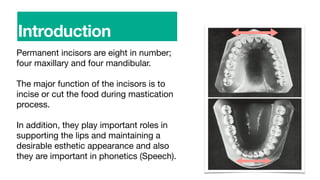
Permanent incisors are eight in number;
four maxillary and four mandibular.
The major function of the incisors is to
incise or cut the food during mastication
process.
In addition, they play important roles in
supporting the lips and maintaining a
desirable esthetic appearance and also
they are important in phonetics (Speech).
Introduction
Characteristic features of incisor’s crown
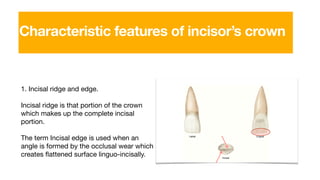
1. Incisal ridge and edge.
Incisal ridge is that portion of the crown
which makes up the complete incisal
portion.
The term Incisal edge is used when an
angle is formed by the occlusal wear which
creates
fl
attened surface linguo-incisally.
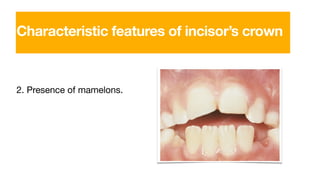
2. Presence of mamelons.
Characteristic features of incisor’s crown
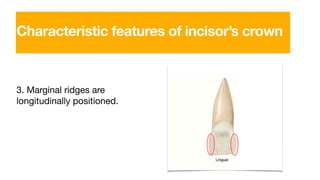
3. Marginal ridges are
longitudinally positioned.
Characteristic features of incisor’s crown
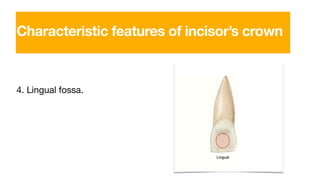
4. Lingual fossa.
Characteristic features of incisor’s crown
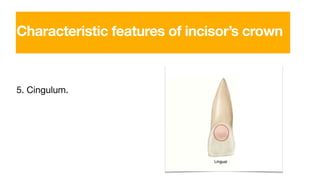
5. Cingulum.
Characteristic features of incisor’s crown
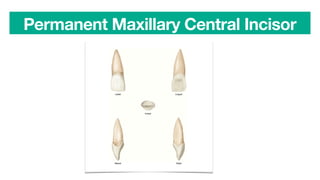
Permanent Maxillary Central Incisor
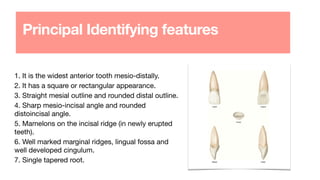
1. It is the widest anterior tooth mesio-distally.
2. It has a square or rectangular appearance.
3. Straight mesial outline and rounded distal outline.
4. Sharp mesio-incisal angle and rounded
distoincisal angle.
5. Mamelons on the incisal ridge (in newly erupted
teeth).
6. Well marked marginal ridges, lingual fossa and
well developed cingulum.
7. Single tapered root.
Principal Identifying features
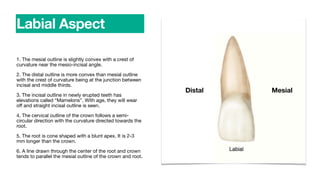
1. The mesial outline is slightly convex with a crest of
curvature near the mesio-incisal angle.
2. The distal outline is more convex than mesial outline
with the crest of curvature being at the junction between
incisal and middle thirds.
3. The incisal outline in newly erupted teeth has
elevations called “Mamelons”. With age, they will wear
o
ff
and straight incisal outline is seen.
4. The cervical outline of the crown follows a semi-
circular direction with the curvature directed towards the
root.
5. The root is cone shaped with a blunt apex. It is 2-3
mm longer than the crown.
6. A line drawn through the center of the root and crown
tends to parallel the mesial outline of the crown and root.
Labial Aspect
Distal Mesial
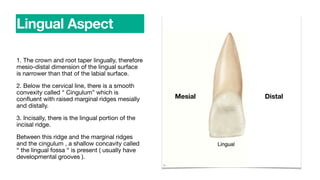
1. The crown and root taper lingually, therefore
mesio-distal dimension of the lingual surface
is narrower than that of the labial surface.
2. Below the cervical line, there is a smooth
convexity called “ Cingulum” which is
con
fl
uent with raised marginal ridges mesially
and distally.
3. Incisally, there is the lingual portion of the
incisal ridge.
Between this ridge and the marginal ridges
and the cingulum , a shallow concavity called
“ the lingual fossa “ is present ( usually have
developmental grooves ).
Lingual Aspect
Distal
Mesial
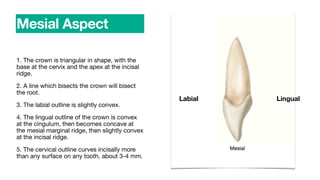
1. The crown is triangular in shape, with the
base at the cervix and the apex at the incisal
ridge.
2. A line which bisects the crown will bisect
the root.
3. The labial outline is slightly convex.
4. The lingual outline of the crown is convex
at the cingulum, then becomes concave at
the mesial marginal ridge, then slightly convex
at the incisal ridge.
5. The cervical outline curves incisally more
than any surface on any tooth, about 3-4 mm.
Mesial Aspect
Labial Lingual
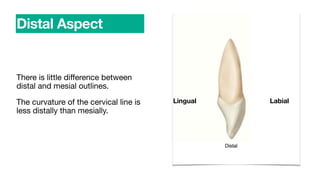
There is little di
ff
erence between
distal and mesial outlines.
The curvature of the cervical line is
less distally than mesially.
Distal Aspect
Labial
Lingual
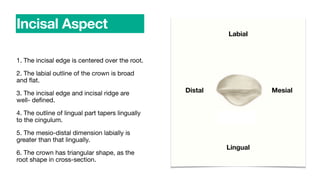
1. The incisal edge is centered over the root.
2. The labial outline of the crown is broad
and
fl
at.
3. The incisal edge and incisal ridge are
well- de
fi
ned.
4. The outline of lingual part tapers lingually
to the cingulum.
5. The mesio-distal dimension labially is
greater than that lingually.
6. The crown has triangular shape, as the
root shape in cross-section.
Incisal Aspect
Labial
Lingual
Distal Mesial
END

Tutorial, Lecture 4.pdf

  • 1.
  • 2.
    Permanent incisors areeight in number; four maxillary and four mandibular. The major function of the incisors is to incise or cut the food during mastication process. In addition, they play important roles in supporting the lips and maintaining a desirable esthetic appearance and also they are important in phonetics (Speech). Introduction
  • 3.
    Characteristic features ofincisor’s crown 1. Incisal ridge and edge. Incisal ridge is that portion of the crown which makes up the complete incisal portion. The term Incisal edge is used when an angle is formed by the occlusal wear which creates fl attened surface linguo-incisally.
  • 4.
    2. Presence ofmamelons. Characteristic features of incisor’s crown
  • 5.
    3. Marginal ridgesare longitudinally positioned. Characteristic features of incisor’s crown
  • 6.
    4. Lingual fossa. Characteristicfeatures of incisor’s crown
  • 7.
    5. Cingulum. Characteristic featuresof incisor’s crown
  • 8.
  • 9.
    1. It isthe widest anterior tooth mesio-distally. 2. It has a square or rectangular appearance. 3. Straight mesial outline and rounded distal outline. 4. Sharp mesio-incisal angle and rounded distoincisal angle. 5. Mamelons on the incisal ridge (in newly erupted teeth). 6. Well marked marginal ridges, lingual fossa and well developed cingulum. 7. Single tapered root. Principal Identifying features
  • 10.
    1. The mesialoutline is slightly convex with a crest of curvature near the mesio-incisal angle. 2. The distal outline is more convex than mesial outline with the crest of curvature being at the junction between incisal and middle thirds. 3. The incisal outline in newly erupted teeth has elevations called “Mamelons”. With age, they will wear o ff and straight incisal outline is seen. 4. The cervical outline of the crown follows a semi- circular direction with the curvature directed towards the root. 5. The root is cone shaped with a blunt apex. It is 2-3 mm longer than the crown. 6. A line drawn through the center of the root and crown tends to parallel the mesial outline of the crown and root. Labial Aspect Distal Mesial
  • 11.
    1. The crownand root taper lingually, therefore mesio-distal dimension of the lingual surface is narrower than that of the labial surface. 2. Below the cervical line, there is a smooth convexity called “ Cingulum” which is con fl uent with raised marginal ridges mesially and distally. 3. Incisally, there is the lingual portion of the incisal ridge. Between this ridge and the marginal ridges and the cingulum , a shallow concavity called “ the lingual fossa “ is present ( usually have developmental grooves ). Lingual Aspect Distal Mesial
  • 12.
    1. The crownis triangular in shape, with the base at the cervix and the apex at the incisal ridge. 2. A line which bisects the crown will bisect the root. 3. The labial outline is slightly convex. 4. The lingual outline of the crown is convex at the cingulum, then becomes concave at the mesial marginal ridge, then slightly convex at the incisal ridge. 5. The cervical outline curves incisally more than any surface on any tooth, about 3-4 mm. Mesial Aspect Labial Lingual
  • 13.
    There is littledi ff erence between distal and mesial outlines. The curvature of the cervical line is less distally than mesially. Distal Aspect Labial Lingual
  • 14.
    1. The incisaledge is centered over the root. 2. The labial outline of the crown is broad and fl at. 3. The incisal edge and incisal ridge are well- de fi ned. 4. The outline of lingual part tapers lingually to the cingulum. 5. The mesio-distal dimension labially is greater than that lingually. 6. The crown has triangular shape, as the root shape in cross-section. Incisal Aspect Labial Lingual Distal Mesial
  • 15.