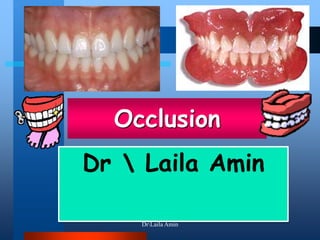



Occlusion
Dr  Laila Amin
DrLaila Amin
Objectives:
 Define centric occlusionfunction
 Illustrate supporting/guiding cusps
 Enumerate key of occlusion
DrLaila Amin
Objectives :
 Enumerate angles classification
 Relate importance of proper
occlusion with the clinical practice
 Classify mandibular movement
DrLaila Amin
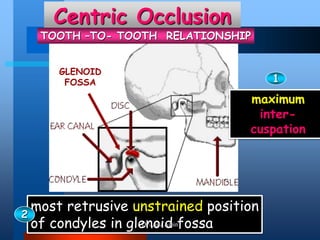
Centric Occlusion
maximum
inter-
cuspation
most retrusive unstrained position
of condyles in glenoid fossa
GLENOID
FOSSA
TOOTH –TO- TOOTH RELATIONSHIP
1
DrLaila Amin
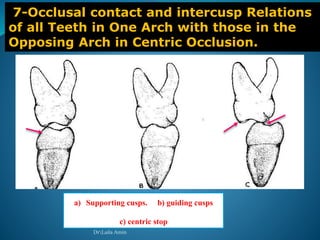
7-Occlusal contact and intercusp Relations
of all Teeth in One Arch with those in the
Opposing Arch in Centric Occlusion.
a
b
c
a) Supporting cusps. b) guiding cusps
c) centric stop
DrLaila Amin
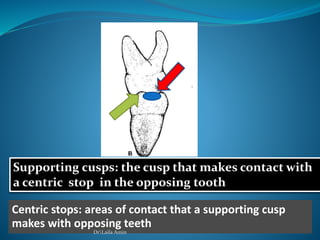
Supporting cusps: the cusp that makes contact with
a centric stop in the opposing tooth
Centric stops: areas of contact that a supporting cusp
makes with opposing teeth
DrLaila Amin
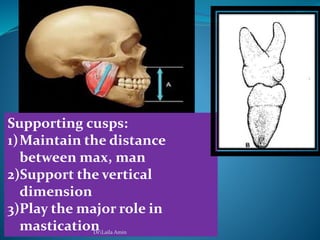
Supporting cusps:
1)Maintain the distance
between max, man
2)Support the vertical
dimension
3)Play the major role in
masticationDrLaila Amin
DrLaila Amin
DrLaila Amin
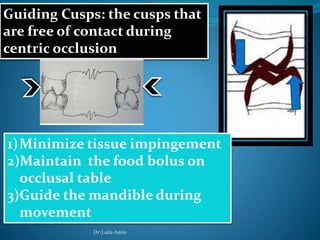
Guiding Cusps: the cusps that
are free of contact during
centric occlusion
1)Minimize tissue impingement
2)Maintain the food bolus on
occlusal table
3)Guide the mandible during
movement
DrLaila Amin
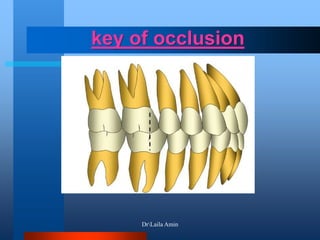
key of occlusion
DrLaila Amin
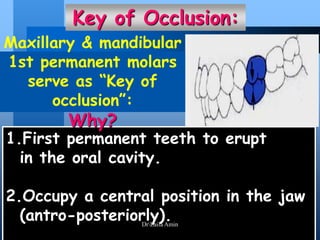
1.First permanent teeth to erupt
in the oral cavity.
2.Occupy a central position in the jaw
(antro-posteriorly).
Key of Occlusion:
Maxillary & mandibular
1st permanent molars
serve as “Key of
occlusion”:
Why?
DrLaila Amin
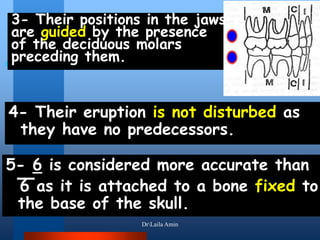
3- Their positions in the jaws
are guided by the presence
of the deciduous molars
preceding them.
4- Their eruption is not disturbed as
they have no predecessors.
5- 6 is considered more accurate than
6 as it is attached to a bone fixed to
the base of the skull.
DrLaila Amin
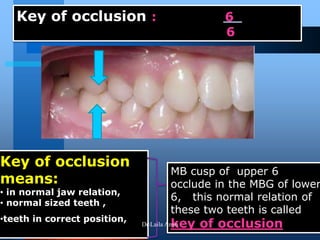
Key of occlusion : 6
6
Key of occlusion
means:
• in normal jaw relation,
• normal sized teeth ,
•teeth in correct position,
MB cusp of upper 6
occlude in the MBG of lower
6, this normal relation of
these two teeth is called
key of occlusionDrLaila Amin
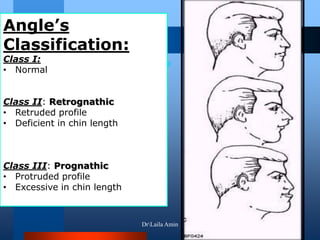
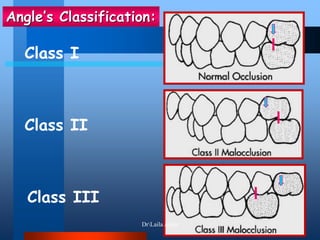
Angle’s
Classification:
Class I:
• Normal
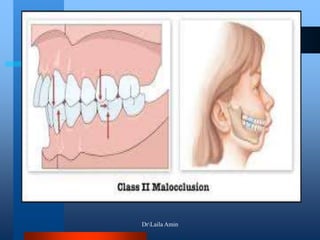
Class II: Retrognathic
• Retruded profile
• Deficient in chin length
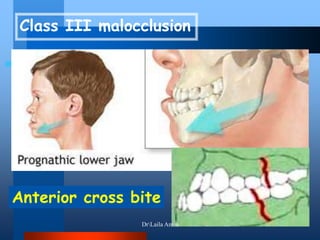
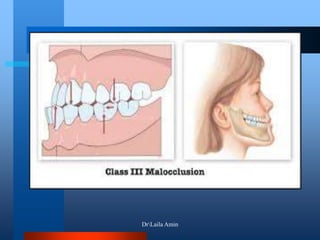
Class III: Prognathic
• Protruded profile
• Excessive in chin length
DrLaila Amin
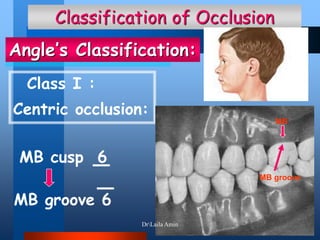
MB cusp 6
MB groove 6
Classification of Occlusion
Class I :
Centric occlusion:
Angle’s Classification:
MB
MB groove
DrLaila Amin
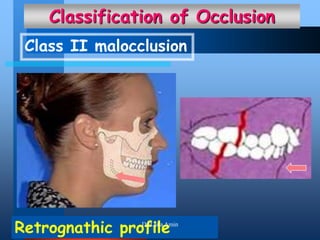
Class II malocclusion
Retrognathic profile
Classification of Occlusion
DrLaila Amin
DrLaila Amin
Class III malocclusion
Anterior cross bite
DrLaila Amin
DrLaila Amin
Class I
Class II
Class III
Angle’s Classification:
DrLaila Amin
The centric relation of the teeth in
centric occlusion
DrLaila Amin
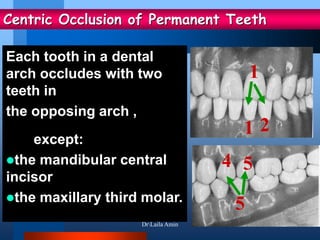
Centric Occlusion of Permanent Teeth
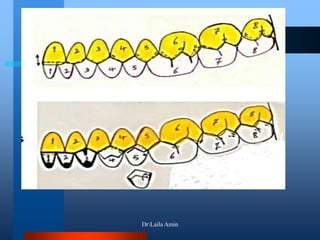
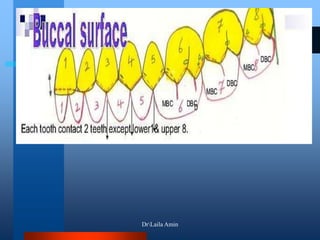
Each tooth in a dental
arch occludes with two
teeth in
the opposing arch ,
except:
the mandibular central
incisor
the maxillary third molar.
1
1 2
5
5
4
DrLaila Amin
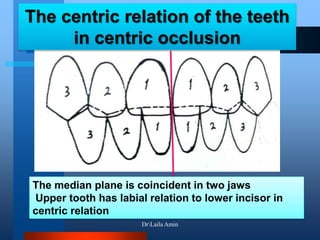
The centric relation of the teeth
in centric occlusion
The median plane is coincident in two jaws
Upper tooth has labial relation to lower incisor in
centric relation
DrLaila Amin
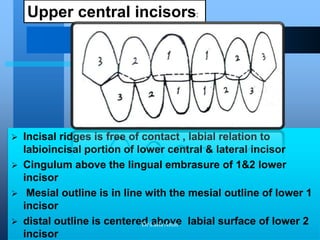
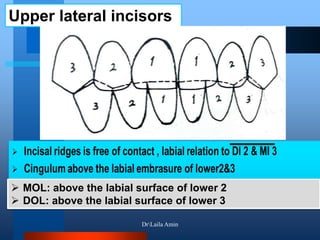
 Incisal ridges is free of contact , labial relation to
labioincisal portion of lower central & lateral incisor
 Cingulum above the lingual embrasure of 1&2 lower
incisor
 Mesial outline is in line with the mesial outline of lower 1
incisor
 distal outline is centered above labial surface of lower 2
incisor
Upper central incisors:
DrLaila Amin
Upper lateral incisors
 MOL: above the labial surface of lower 2
 DOL: above the labial surface of lower 3
DrLaila Amin
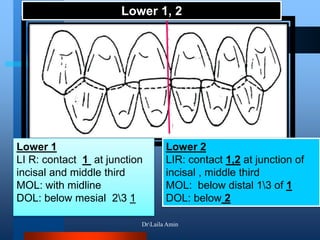
Lower 1, 2
Lower 1
LI R: contact 1 at junction
incisal and middle third
MOL: with midline
DOL: below mesial 23 1
Lower 2
LIR: contact 1,2 at junction of
incisal , middle third
MOL: below distal 13 of 1
DOL: below 2
DrLaila Amin
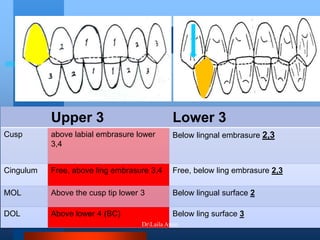
Lower 3Upper 3
Below lingnal embrasure 2,3above labial embrasure lower
3,4
Cusp
Free, below ling embrasure 2,3Free, above ling embrasure 3,4Cingulum
Below lingual surface 2Above the cusp tip lower 3MOL
Below ling surface 3Above lower 4 (BC)DOL
DrLaila Amin
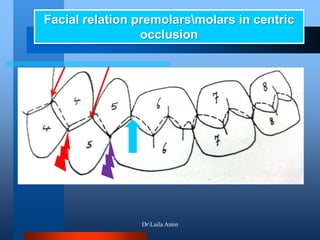
Facial relation premolarsmolars in centric
occlusion
DrLaila Amin
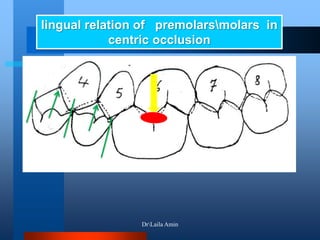
lingual relation of premolarsmolars in
centric occlusion
DrLaila Amin
DrLaila Amin
DrLaila Amin
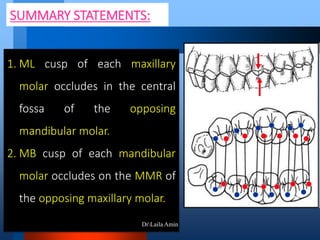
SUMMARY STATEMENTS:
1. ML cusp of each maxillary
molar occludes in the central
fossa of the opposing
mandibular molar.
2. MB cusp of each mandibular
molar occludes on the MMR of
the opposing maxillary molar.
DrLaila Amin
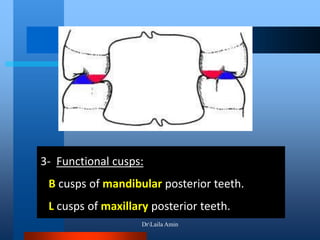
3- Functional cusps:
B cusps of mandibular posterior teeth.
L cusps of maxillary posterior teeth.
DrLaila Amin
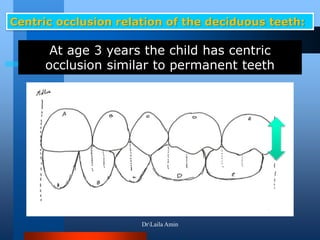
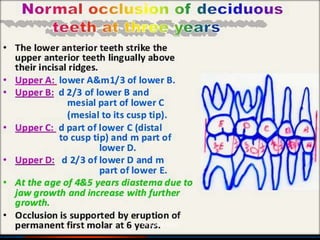
Centric occlusion relation of the deciduous teeth:
At age 3 years the child has centric
occlusion similar to permanent teeth
DrLaila Amin
DrLaila Amin
8-The Occlusal Contact and Intercusp
Relations of all the Teeth During the Various
Functional mandibular movements.
Mandibular movements are: (rotating movement )
A.Symmetrical bilateral movements:
• Depression.
• Elevation.
• Protrusion.
• Retrusion.
B.Asymmetrical bilateral movements:
• Right lateral movements.
• Left lateral movements.
DrLaila Amin
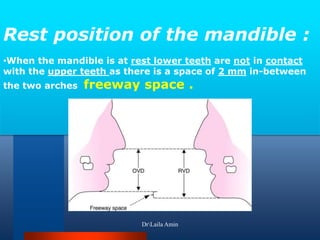
Rest position of the mandible :
•When the mandible is at rest lower teeth are not in contact
with the upper teeth as there is a space of 2 mm in-between
the two arches freeway space .
DrLaila Amin
functional relations of mandibular
movements:
Protrusive occlusal relation.
Retrusive occlusal relation.
Right occlusal relation.
Left occlusal relation
DrLaila Amin
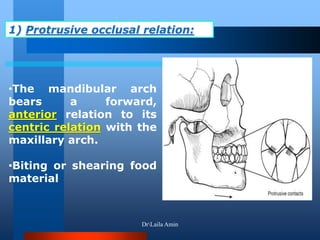
•The mandibular arch
bears a forward,
anterior relation to its
centric relation with the
maxillary arch.
•Biting or shearing food
material
1) Protrusive occlusal relation:
DrLaila Amin
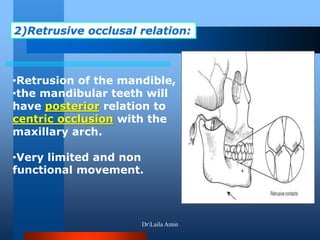
•Retrusion of the mandible,
•the mandibular teeth will
have posterior relation to
centric occlusion with the
maxillary arch.
•Very limited and non
functional movement.
2)Retrusive occlusal relation:
DrLaila Amin
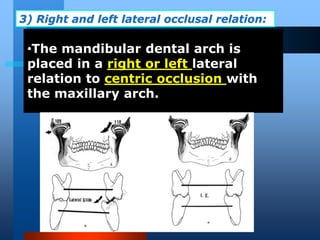
•The mandibular dental arch is
placed in a right or left lateral
relation to centric occlusion with
the maxillary arch.
3) Right and left lateral occlusal relation:
DrLaila Amin
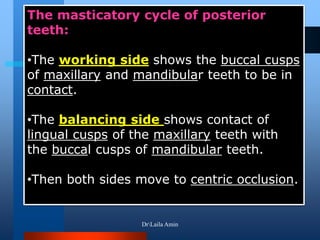
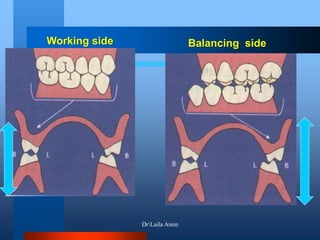
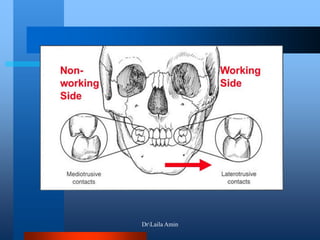
The masticatory cycle of posterior
teeth:
•The working side shows the buccal cusps
of maxillary and mandibular teeth to be in
contact.
•The balancing side shows contact of
lingual cusps of the maxillary teeth with
the buccal cusps of mandibular teeth.
•Then both sides move to centric occlusion.
DrLaila Amin
Working side Balancing side
DrLaila Amin
DrLaila Amin
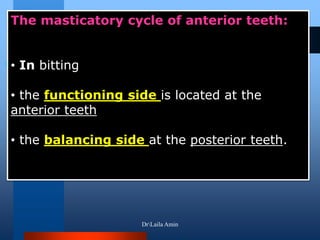
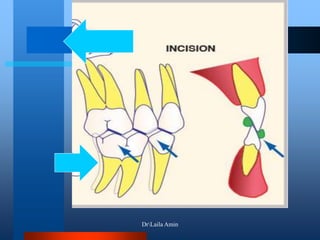
The masticatory cycle of anterior teeth:
• In bitting
• the functioning side is located at the
anterior teeth
• the balancing side at the posterior teeth.
DrLaila Amin
DrLaila Amin
DrLaila Amin
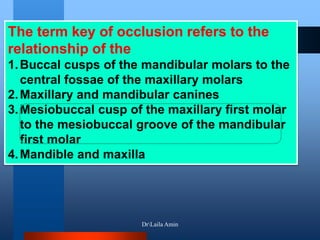
The term key of occlusion refers to the
relationship of the
1.Buccal cusps of the mandibular molars to the
central fossae of the maxillary molars
2.Maxillary and mandibular canines
3.Mesiobuccal cusp of the maxillary first molar
to the mesiobuccal groove of the mandibular
first molar
4.Mandible and maxilla
DrLaila Amin
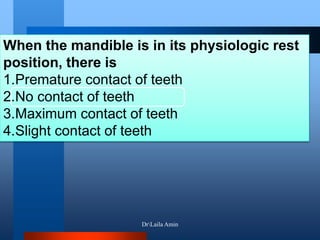
When the mandible is in its physiologic rest
position, there is
1.Premature contact of teeth
2.No contact of teeth
3.Maximum contact of teeth
4.Slight contact of teeth
DrLaila Amin
When a permanent mandibular canine is
located distal to the maxillary canine during
full closure of the mandible, this is regarded
as a
1.Class I occlusion
2.Class II occlusion
3.Class II occlusion
DrLaila Amin
Class III malocclusion is very often when
1.The maxillary arch is larger than the mandibular
arch
2.Maxillary and mandibular arches are proportion to
each other
3.The maxillary arch is smaller than the mandibular
arch
DrLaila Amin
DrLaila Amin

Dr laila Amin (occlusion2)

  • 1.
    Occlusion Dr LailaAmin DrLaila Amin
  • 2.
    Objectives:  Define centricocclusionfunction  Illustrate supporting/guiding cusps  Enumerate key of occlusion DrLaila Amin
  • 3.
    Objectives :  Enumerateangles classification  Relate importance of proper occlusion with the clinical practice  Classify mandibular movement DrLaila Amin
  • 4.
    Centric Occlusion maximum inter- cuspation most retrusiveunstrained position of condyles in glenoid fossa GLENOID FOSSA TOOTH –TO- TOOTH RELATIONSHIP 1 DrLaila Amin
  • 5.
    7-Occlusal contact andintercusp Relations of all Teeth in One Arch with those in the Opposing Arch in Centric Occlusion. a b c a) Supporting cusps. b) guiding cusps c) centric stop DrLaila Amin
  • 6.
    Supporting cusps: thecusp that makes contact with a centric stop in the opposing tooth Centric stops: areas of contact that a supporting cusp makes with opposing teeth DrLaila Amin
  • 7.
    Supporting cusps: 1)Maintain thedistance between max, man 2)Support the vertical dimension 3)Play the major role in masticationDrLaila Amin
  • 8.
  • 9.
  • 10.
    Guiding Cusps: thecusps that are free of contact during centric occlusion 1)Minimize tissue impingement 2)Maintain the food bolus on occlusal table 3)Guide the mandible during movement DrLaila Amin
  • 11.
  • 12.
    1.First permanent teethto erupt in the oral cavity. 2.Occupy a central position in the jaw (antro-posteriorly). Key of Occlusion: Maxillary & mandibular 1st permanent molars serve as “Key of occlusion”: Why? DrLaila Amin
  • 13.
    3- Their positionsin the jaws are guided by the presence of the deciduous molars preceding them. 4- Their eruption is not disturbed as they have no predecessors. 5- 6 is considered more accurate than 6 as it is attached to a bone fixed to the base of the skull. DrLaila Amin
  • 14.
    Key of occlusion: 6 6 Key of occlusion means: • in normal jaw relation, • normal sized teeth , •teeth in correct position, MB cusp of upper 6 occlude in the MBG of lower 6, this normal relation of these two teeth is called key of occlusionDrLaila Amin
  • 15.
    Angle’s Classification: Class I: • Normal ClassII: Retrognathic • Retruded profile • Deficient in chin length Class III: Prognathic • Protruded profile • Excessive in chin length DrLaila Amin
  • 16.
    MB cusp 6 MBgroove 6 Classification of Occlusion Class I : Centric occlusion: Angle’s Classification: MB MB groove DrLaila Amin
  • 17.
    Class II malocclusion Retrognathicprofile Classification of Occlusion DrLaila Amin
  • 18.
  • 19.
    Class III malocclusion Anteriorcross bite DrLaila Amin
  • 20.
  • 21.
    Class I Class II ClassIII Angle’s Classification: DrLaila Amin
  • 22.
    The centric relationof the teeth in centric occlusion DrLaila Amin
  • 23.
    Centric Occlusion ofPermanent Teeth Each tooth in a dental arch occludes with two teeth in the opposing arch , except: the mandibular central incisor the maxillary third molar. 1 1 2 5 5 4 DrLaila Amin
  • 24.
    The centric relationof the teeth in centric occlusion The median plane is coincident in two jaws Upper tooth has labial relation to lower incisor in centric relation DrLaila Amin
  • 25.
     Incisal ridgesis free of contact , labial relation to labioincisal portion of lower central & lateral incisor  Cingulum above the lingual embrasure of 1&2 lower incisor  Mesial outline is in line with the mesial outline of lower 1 incisor  distal outline is centered above labial surface of lower 2 incisor Upper central incisors: DrLaila Amin
  • 26.
    Upper lateral incisors MOL: above the labial surface of lower 2  DOL: above the labial surface of lower 3 DrLaila Amin
  • 27.
    Lower 1, 2 Lower1 LI R: contact 1 at junction incisal and middle third MOL: with midline DOL: below mesial 23 1 Lower 2 LIR: contact 1,2 at junction of incisal , middle third MOL: below distal 13 of 1 DOL: below 2 DrLaila Amin
  • 28.
    Lower 3Upper 3 Belowlingnal embrasure 2,3above labial embrasure lower 3,4 Cusp Free, below ling embrasure 2,3Free, above ling embrasure 3,4Cingulum Below lingual surface 2Above the cusp tip lower 3MOL Below ling surface 3Above lower 4 (BC)DOL DrLaila Amin
  • 29.
    Facial relation premolarsmolarsin centric occlusion DrLaila Amin
  • 30.
    lingual relation ofpremolarsmolars in centric occlusion DrLaila Amin
  • 31.
  • 32.
  • 33.
    SUMMARY STATEMENTS: 1. MLcusp of each maxillary molar occludes in the central fossa of the opposing mandibular molar. 2. MB cusp of each mandibular molar occludes on the MMR of the opposing maxillary molar. DrLaila Amin
  • 34.
    3- Functional cusps: Bcusps of mandibular posterior teeth. L cusps of maxillary posterior teeth. DrLaila Amin
  • 35.
    Centric occlusion relationof the deciduous teeth: At age 3 years the child has centric occlusion similar to permanent teeth DrLaila Amin
  • 36.
  • 37.
    8-The Occlusal Contactand Intercusp Relations of all the Teeth During the Various Functional mandibular movements. Mandibular movements are: (rotating movement ) A.Symmetrical bilateral movements: • Depression. • Elevation. • Protrusion. • Retrusion. B.Asymmetrical bilateral movements: • Right lateral movements. • Left lateral movements. DrLaila Amin
  • 38.
    Rest position ofthe mandible : •When the mandible is at rest lower teeth are not in contact with the upper teeth as there is a space of 2 mm in-between the two arches freeway space . DrLaila Amin
  • 39.
    functional relations ofmandibular movements: Protrusive occlusal relation. Retrusive occlusal relation. Right occlusal relation. Left occlusal relation DrLaila Amin
  • 40.
    •The mandibular arch bearsa forward, anterior relation to its centric relation with the maxillary arch. •Biting or shearing food material 1) Protrusive occlusal relation: DrLaila Amin
  • 41.
    •Retrusion of themandible, •the mandibular teeth will have posterior relation to centric occlusion with the maxillary arch. •Very limited and non functional movement. 2)Retrusive occlusal relation: DrLaila Amin
  • 42.
    •The mandibular dentalarch is placed in a right or left lateral relation to centric occlusion with the maxillary arch. 3) Right and left lateral occlusal relation: DrLaila Amin
  • 43.
    The masticatory cycleof posterior teeth: •The working side shows the buccal cusps of maxillary and mandibular teeth to be in contact. •The balancing side shows contact of lingual cusps of the maxillary teeth with the buccal cusps of mandibular teeth. •Then both sides move to centric occlusion. DrLaila Amin
  • 44.
    Working side Balancingside DrLaila Amin
  • 45.
  • 46.
    The masticatory cycleof anterior teeth: • In bitting • the functioning side is located at the anterior teeth • the balancing side at the posterior teeth. DrLaila Amin
  • 47.
  • 48.
  • 49.
    The term keyof occlusion refers to the relationship of the 1.Buccal cusps of the mandibular molars to the central fossae of the maxillary molars 2.Maxillary and mandibular canines 3.Mesiobuccal cusp of the maxillary first molar to the mesiobuccal groove of the mandibular first molar 4.Mandible and maxilla DrLaila Amin
  • 50.
    When the mandibleis in its physiologic rest position, there is 1.Premature contact of teeth 2.No contact of teeth 3.Maximum contact of teeth 4.Slight contact of teeth DrLaila Amin
  • 51.
    When a permanentmandibular canine is located distal to the maxillary canine during full closure of the mandible, this is regarded as a 1.Class I occlusion 2.Class II occlusion 3.Class II occlusion DrLaila Amin
  • 52.
    Class III malocclusionis very often when 1.The maxillary arch is larger than the mandibular arch 2.Maxillary and mandibular arches are proportion to each other 3.The maxillary arch is smaller than the mandibular arch DrLaila Amin
  • 53.