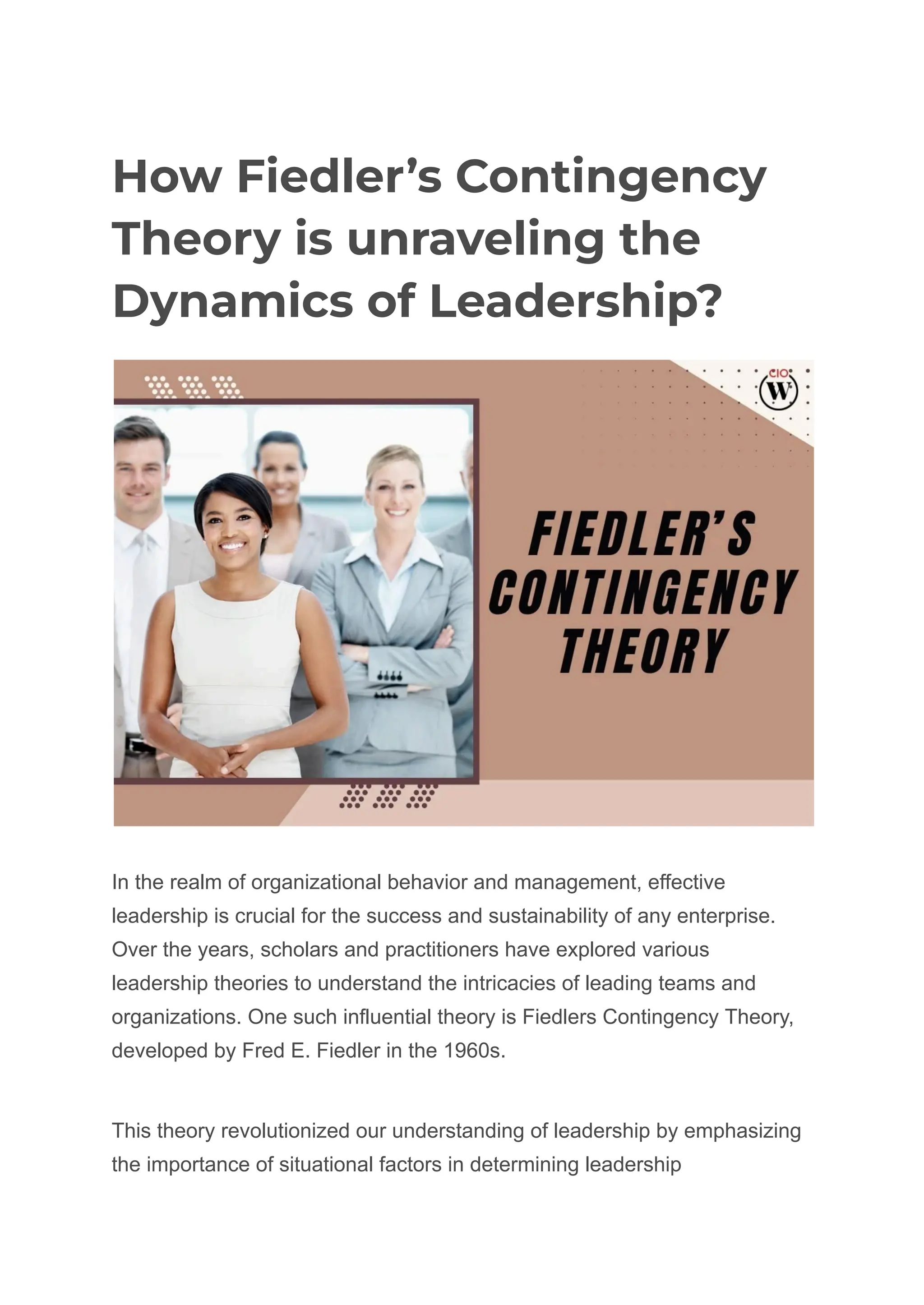
How Fiedler’s Contingency
Theory is unraveling the
Dynamics of Leadership?
In the realm of organizational behavior and management, effective
leadership is crucial for the success and sustainability of any enterprise.
Over the years, scholars and practitioners have explored various
leadership theories to understand the intricacies of leading teams and
organizations. One such influential theory is Fiedlers Contingency Theory,
developed by Fred E. Fiedler in the 1960s.
This theory revolutionized our understanding of leadership by emphasizing
the importance of situational factors in determining leadership
effectiveness. In this article, we delve into the nuances of Fiedlers
Contingency Theory, exploring its key principles, applications, and
implications for contemporary leadership.
Understanding Fiedlers Contingency Theory
Fiedler’s Contingency Theory is rooted in the idea that there is no
one-size-fits-all approach to leadership. Fiedler argued that effective
leadership depends on the interplay between the leader’s personal
characteristics and the situational context in which they operate. At the core
of the theory is the concept of leadership style and situational
favorableness, factors that determine the success or failure of a leader in a
given situation.
Leadership Styles
Fiedler proposed that individuals possess inherent leadership styles that
are relatively stable over time. These styles are classified into two
categories: task-oriented and relationship-oriented. Task-oriented leaders
focus on achieving goals and objectives, emphasizing task completion and
performance. On the other hand, relationship-oriented leaders prioritize
building positive interpersonal relationships within the team, fostering
collaboration and communication.
Situational Favorableness
The cornerstone of Fiedlers Contingency Theory is the notion of situational
favorableness, also referred to as situational control. Situational
favorableness is determined by three key factors:
● Leader-Member Relations: The degree of trust and confidence that
exists between the leader and the team members.
● Task Structure: The clarity and structure of the tasks being
performed.
● Position Power: The level of authority and influence the leader
possesses.
These three factors collectively shape the situational context, and the
leader’s effectiveness is contingent upon how well their leadership style
aligns with the situational favorableness.
The LPC Scale
To identify a leader’s inherent style, Fiedler introduced the Least Preferred
Co-worker (LPC) scale. Leaders rate their least preferred co-worker on a
scale ranging from friendly to unfriendly, creating a numerical index that
indicates the leader’s orientation towards task or relationship. A high LPC
score suggests a relationship-oriented leader, while a low LPC score
indicates a task-oriented leader.
Applications of Fiedler’s Contingency Theory
1. Leadership Training and Development:
Understanding Fiedler’s Contingency Theory is instrumental in designing
effective leadership training programs. Organizations can tailor their
leadership development initiatives based on the situational factors that
influence leadership effectiveness. By identifying and nurturing leaders with
the right fit for specific contexts, companies can enhance overall
performance.
2. Team Composition:
Fiedlers Contingency Theory has implications for team composition.
Leaders can strategically assemble teams based on the situational
favorableness of a given task. For instance, in highly structured tasks, a
task-oriented leader may be more effective, while relationship-oriented
leaders may excel in situations with ambiguous or unstructured tasks.
3. Performance Evaluation:
Organizations can use Fiedler’s Contingency Theory as a framework for
evaluating leadership performance. Instead of relying solely on generic
leadership competencies, companies can consider the fit between a
leader’s style and the situational demands. This nuanced approach
provides a more accurate assessment of leadership effectiveness.
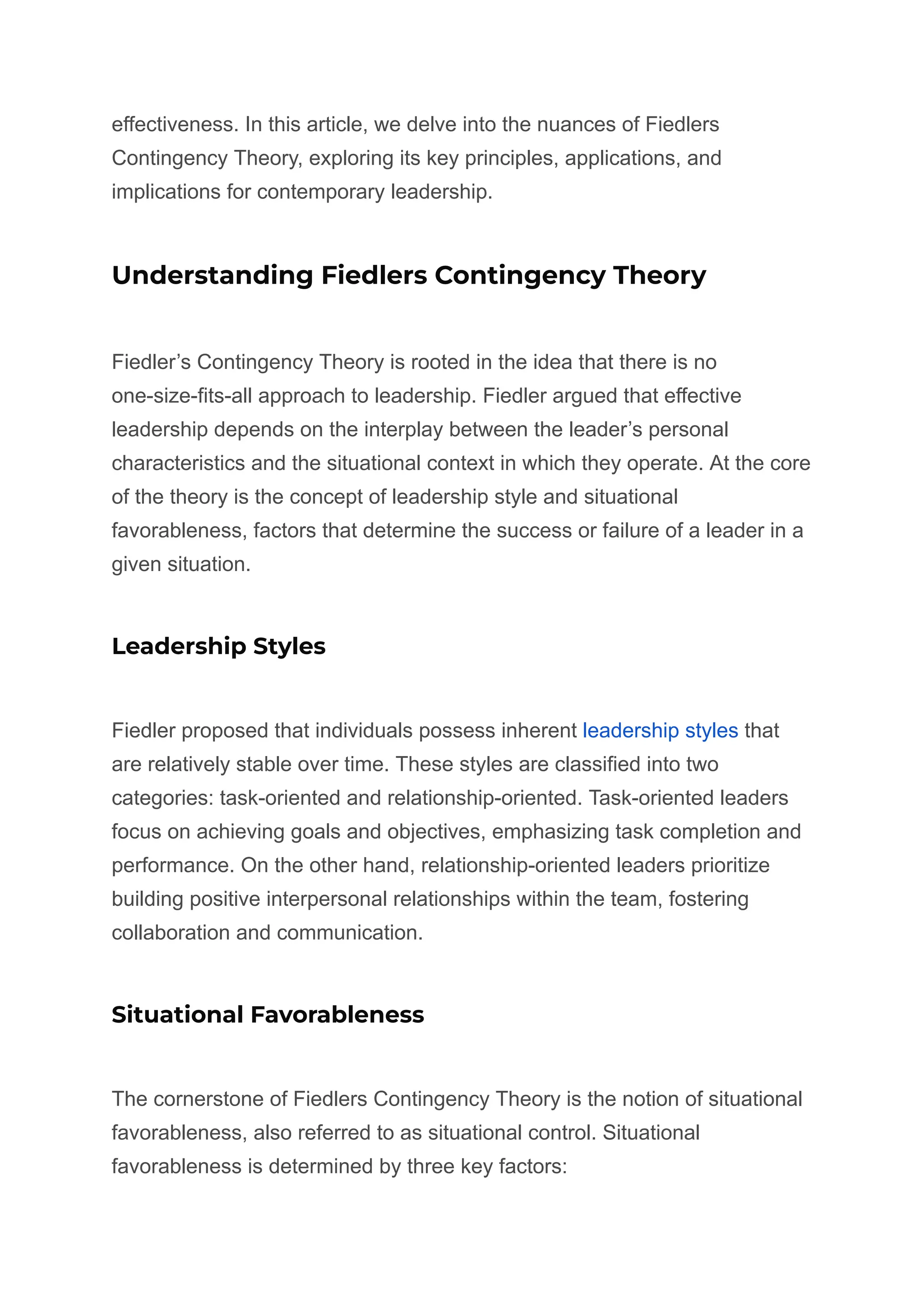
4. Strategic Leadership Selection:
When selecting leaders for key roles, organizations can leverage Fiedlers
Contingency Theory to match leaders with the right level of situational
favorableness. This strategic approach ensures that leaders are placed in
contexts where their inherent styles align with the demands of the role,
increasing the likelihood of success.
Challenges and Criticisms
While Fiedler’s Contingency Theory has significantly contributed to the
understanding of leadership dynamics, it is not without its challenges and
criticisms.
1. Simplicity vs. Complexity:
Critics argue that the LPC scale oversimplifies the complexity of leadership.
The binary classification into relationship-oriented and task-oriented may
not capture the multifaceted nature of leadership styles, limiting the
practical applicability of the theory.
2. Inflexibility:
Fiedlers Contingency Theory has been criticized for its inflexibility in
adapting to changing circumstances. The assumption that a leader’s style
is fixed and unchanging may not align with the dynamic nature of
leadership in today’s fast-paced and evolving business environment.
3. Limited Prescription for Change:
The theory provides limited guidance on how leaders can adapt or change
their styles in response to situational demands. This lack of prescriptive
advice may limit its practical utility for leaders seeking to enhance their
effectiveness in different contexts.
4. Neglect of Other Variables:
Fiedler’s focus on the LPC scale and situational favorableness has led to
the neglect of other important variables that influence leadership
effectiveness. Factors such as emotional intelligence, cultural intelligence,
and adaptability are not explicitly addressed in the theory.
Implications for Contemporary Leadership
Despite its criticisms, Fiedlers Contingency Theory continues to offer
valuable insights into leadership dynamics. In the contemporary business
landscape, where agility and adaptability are prized qualities, leaders can
leverage the principles of the theory to navigate complex and
ever-changing environments.
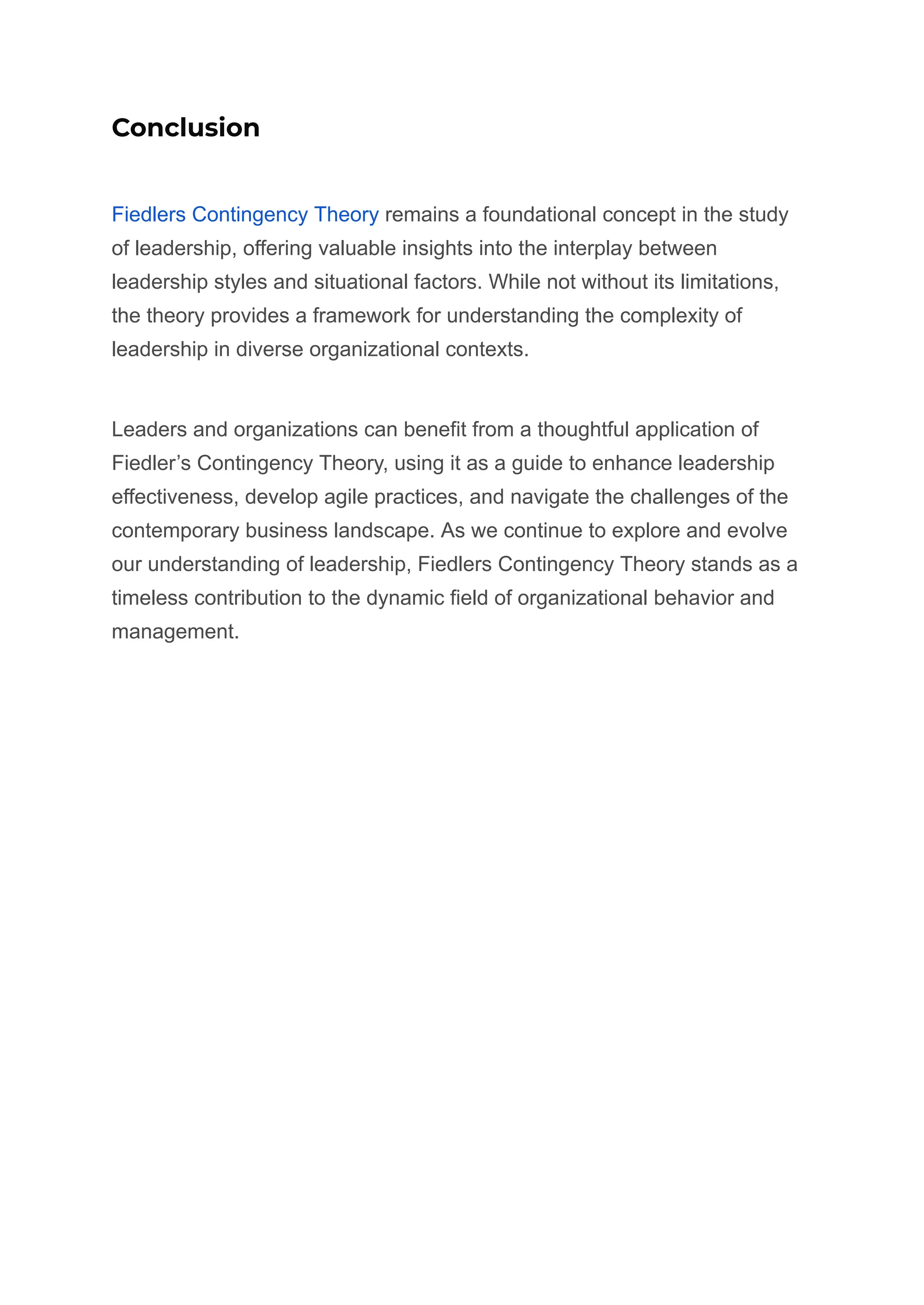
1. Agile Leadership:
Leaders can use Fiedlers Contingency Theory as a foundation for
developing agile leadership practices. By acknowledging the dynamic
nature of leadership styles, leaders can cultivate the ability to flexibly adapt
their approaches based on the evolving demands of the situation.
2. Integration with Other Theories:
While Fiedlers Contingency Theory provides a valuable framework, it is
essential to integrate it with other leadership theories to create a more
comprehensive understanding. Combining contingency theory with
transformational or situational leadership models can offer a more nuanced
and adaptable approach to leadership.
3. Continuous Learning and Development:
Contemporary leaders should embrace a mindset of continuous learning
and development. Rather than adhering strictly to a predefined leadership
style, leaders can proactively seek opportunities to enhance their skills and
adapt to emerging challenges.
4. Technology and Globalization:
The advent of technology and increased globalization has altered the
nature of work and leadership. Leaders must consider the impact of virtual
teams, diverse cultural contexts, and rapid technological advancements.
Fiedlers Contingency Theory can be a valuable tool for leaders navigating
these complexities by helping them align their styles with the unique
demands of the globalized and tech-driven workplace.
Conclusion
Fiedlers Contingency Theory remains a foundational concept in the study
of leadership, offering valuable insights into the interplay between
leadership styles and situational factors. While not without its limitations,
the theory provides a framework for understanding the complexity of
leadership in diverse organizational contexts.
Leaders and organizations can benefit from a thoughtful application of
Fiedler’s Contingency Theory, using it as a guide to enhance leadership
effectiveness, develop agile practices, and navigate the challenges of the
contemporary business landscape. As we continue to explore and evolve
our understanding of leadership, Fiedlers Contingency Theory stands as a
timeless contribution to the dynamic field of organizational behavior and
management.

How Fiedler’s Contingency Theory is unraveling the Dynamics of Leadership.pdf

  • 1.
    How Fiedler’s Contingency Theoryis unraveling the Dynamics of Leadership? In the realm of organizational behavior and management, effective leadership is crucial for the success and sustainability of any enterprise. Over the years, scholars and practitioners have explored various leadership theories to understand the intricacies of leading teams and organizations. One such influential theory is Fiedlers Contingency Theory, developed by Fred E. Fiedler in the 1960s. This theory revolutionized our understanding of leadership by emphasizing the importance of situational factors in determining leadership
  • 2.
    effectiveness. In thisarticle, we delve into the nuances of Fiedlers Contingency Theory, exploring its key principles, applications, and implications for contemporary leadership. Understanding Fiedlers Contingency Theory Fiedler’s Contingency Theory is rooted in the idea that there is no one-size-fits-all approach to leadership. Fiedler argued that effective leadership depends on the interplay between the leader’s personal characteristics and the situational context in which they operate. At the core of the theory is the concept of leadership style and situational favorableness, factors that determine the success or failure of a leader in a given situation. Leadership Styles Fiedler proposed that individuals possess inherent leadership styles that are relatively stable over time. These styles are classified into two categories: task-oriented and relationship-oriented. Task-oriented leaders focus on achieving goals and objectives, emphasizing task completion and performance. On the other hand, relationship-oriented leaders prioritize building positive interpersonal relationships within the team, fostering collaboration and communication. Situational Favorableness The cornerstone of Fiedlers Contingency Theory is the notion of situational favorableness, also referred to as situational control. Situational favorableness is determined by three key factors:
  • 3.
    ● Leader-Member Relations:The degree of trust and confidence that exists between the leader and the team members. ● Task Structure: The clarity and structure of the tasks being performed. ● Position Power: The level of authority and influence the leader possesses. These three factors collectively shape the situational context, and the leader’s effectiveness is contingent upon how well their leadership style aligns with the situational favorableness. The LPC Scale To identify a leader’s inherent style, Fiedler introduced the Least Preferred Co-worker (LPC) scale. Leaders rate their least preferred co-worker on a scale ranging from friendly to unfriendly, creating a numerical index that indicates the leader’s orientation towards task or relationship. A high LPC
  • 4.
    score suggests arelationship-oriented leader, while a low LPC score indicates a task-oriented leader. Applications of Fiedler’s Contingency Theory 1. Leadership Training and Development: Understanding Fiedler’s Contingency Theory is instrumental in designing effective leadership training programs. Organizations can tailor their leadership development initiatives based on the situational factors that influence leadership effectiveness. By identifying and nurturing leaders with the right fit for specific contexts, companies can enhance overall performance. 2. Team Composition: Fiedlers Contingency Theory has implications for team composition. Leaders can strategically assemble teams based on the situational favorableness of a given task. For instance, in highly structured tasks, a task-oriented leader may be more effective, while relationship-oriented leaders may excel in situations with ambiguous or unstructured tasks. 3. Performance Evaluation: Organizations can use Fiedler’s Contingency Theory as a framework for evaluating leadership performance. Instead of relying solely on generic leadership competencies, companies can consider the fit between a
  • 5.
    leader’s style andthe situational demands. This nuanced approach provides a more accurate assessment of leadership effectiveness. 4. Strategic Leadership Selection: When selecting leaders for key roles, organizations can leverage Fiedlers Contingency Theory to match leaders with the right level of situational favorableness. This strategic approach ensures that leaders are placed in contexts where their inherent styles align with the demands of the role, increasing the likelihood of success. Challenges and Criticisms
  • 6.
    While Fiedler’s ContingencyTheory has significantly contributed to the understanding of leadership dynamics, it is not without its challenges and criticisms. 1. Simplicity vs. Complexity: Critics argue that the LPC scale oversimplifies the complexity of leadership. The binary classification into relationship-oriented and task-oriented may not capture the multifaceted nature of leadership styles, limiting the practical applicability of the theory. 2. Inflexibility: Fiedlers Contingency Theory has been criticized for its inflexibility in adapting to changing circumstances. The assumption that a leader’s style is fixed and unchanging may not align with the dynamic nature of leadership in today’s fast-paced and evolving business environment. 3. Limited Prescription for Change: The theory provides limited guidance on how leaders can adapt or change their styles in response to situational demands. This lack of prescriptive advice may limit its practical utility for leaders seeking to enhance their effectiveness in different contexts. 4. Neglect of Other Variables:
  • 7.
    Fiedler’s focus onthe LPC scale and situational favorableness has led to the neglect of other important variables that influence leadership effectiveness. Factors such as emotional intelligence, cultural intelligence, and adaptability are not explicitly addressed in the theory. Implications for Contemporary Leadership Despite its criticisms, Fiedlers Contingency Theory continues to offer valuable insights into leadership dynamics. In the contemporary business landscape, where agility and adaptability are prized qualities, leaders can leverage the principles of the theory to navigate complex and ever-changing environments. 1. Agile Leadership:
  • 8.
    Leaders can useFiedlers Contingency Theory as a foundation for developing agile leadership practices. By acknowledging the dynamic nature of leadership styles, leaders can cultivate the ability to flexibly adapt their approaches based on the evolving demands of the situation. 2. Integration with Other Theories: While Fiedlers Contingency Theory provides a valuable framework, it is essential to integrate it with other leadership theories to create a more comprehensive understanding. Combining contingency theory with transformational or situational leadership models can offer a more nuanced and adaptable approach to leadership. 3. Continuous Learning and Development: Contemporary leaders should embrace a mindset of continuous learning and development. Rather than adhering strictly to a predefined leadership style, leaders can proactively seek opportunities to enhance their skills and adapt to emerging challenges. 4. Technology and Globalization: The advent of technology and increased globalization has altered the nature of work and leadership. Leaders must consider the impact of virtual teams, diverse cultural contexts, and rapid technological advancements. Fiedlers Contingency Theory can be a valuable tool for leaders navigating these complexities by helping them align their styles with the unique demands of the globalized and tech-driven workplace.
  • 9.
    Conclusion Fiedlers Contingency Theoryremains a foundational concept in the study of leadership, offering valuable insights into the interplay between leadership styles and situational factors. While not without its limitations, the theory provides a framework for understanding the complexity of leadership in diverse organizational contexts. Leaders and organizations can benefit from a thoughtful application of Fiedler’s Contingency Theory, using it as a guide to enhance leadership effectiveness, develop agile practices, and navigate the challenges of the contemporary business landscape. As we continue to explore and evolve our understanding of leadership, Fiedlers Contingency Theory stands as a timeless contribution to the dynamic field of organizational behavior and management.