Managing Stress at Work McKesson Lunch and Learn Series 1/26/09 Presenter: Sonya Lewis,  American Heart Association Volunteer
Today’s presentation covers four topics: Understanding the link between stress and heart disease Identifying and addressing worksite stressors Learning and applying stress management strategies Identifying available resources for managing stress
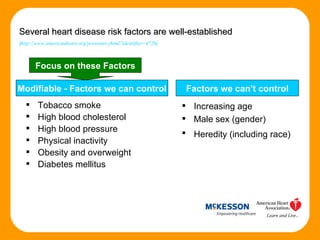
Increasing age Male sex (gender) Heredity (including race)   Tobacco smoke High blood cholesterol  High blood pressure Physical inactivity  Obesity and overweight  Diabetes mellitus Several heart disease risk factors are well-established ( http://www.americanheart.org/presenter.jhtml?identifier=4726 ) Factors we can’t control Modifiable - Factors we can control Focus on these Factors
According to the American Heart Association, stress is a potential contributor to heart disease. “ Individual response to  stress  may be a contributing factor.  Some scientists have noted a relationship between coronary heart disease risk and stress in a person's life, their health behaviors and socioeconomic status.” The American Heart Association recognizes a  potential  link between stress and the development of heart disease ( http://www.americanheart.org/presenter.jhtml?identifier=4726 )
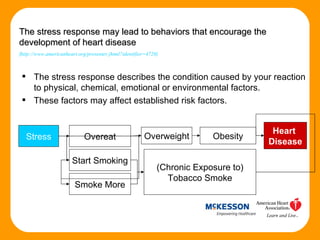
The stress response describes the condition caused by your reaction to physical, chemical, emotional or environmental factors. These factors may affect established risk factors.  The stress response may lead to behaviors that encourage the development of heart disease ( http://www.americanheart.org/presenter.jhtml?identifier=4726 ) Stress Overeat Heart  Disease Start Smoking Smoke More Overweight Obesity (Chronic Exposure to) Tobacco Smoke
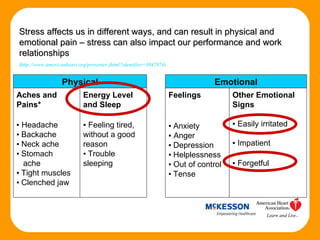
Stress affects us in different ways, and can result in physical and emotional pain – stress can also impact our performance and work relationships ( http://www.americanheart.org/presenter.jhtml?identifier=3047874) Physical Emotional Aches and Pains* ▪  Headache ▪  Backache ▪  Neck ache ▪  Stomach    ache ▪  Tight muscles ▪  Clenched jaw  Energy Level and Sleep ▪  Feeling tired, without a good reason ▪  Trouble sleeping Other Emotional Signs ▪  Easily irritated ▪  Impatient ▪  Forgetful   Feelings ▪  Anxiety ▪ Anger ▪  Depression ▪  Helplessness ▪  Out of control ▪  Tense   
Identifying stressors is the first step to dealing with stress at work What Stresses You at Work? Take stock, so you can take control
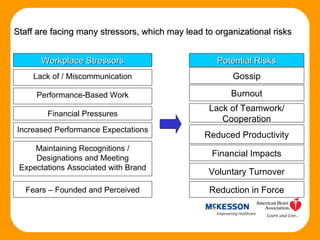
Staff are facing many stressors, which may lead to organizational risks Workplace Stressors Gossip Voluntary Turnover Reduction in Force Financial Impacts Reduced Productivity Burnout Lack of Teamwork/ Cooperation Potential Risks Fears – Founded and Perceived Maintaining Recognitions / Designations and Meeting Expectations Associated with Brand Increased Performance Expectations Financial Pressures Lack of / Miscommunication Performance-Based Work
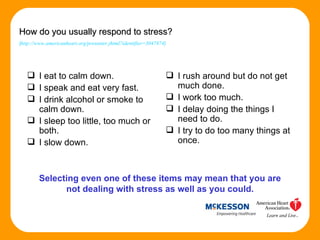
I eat to calm down. I speak and eat very fast. I drink alcohol or smoke to calm down. I sleep too little, too much or both. I slow down. I rush around but do not get much done. I work too much. I delay doing the things I need to do. I try to do too many things at once. How do you usually respond to stress? ( http://www.americanheart.org/presenter.jhtml?identifier=3047874 ) Selecting even one of these items may mean that you are not dealing with stress as well as you could.
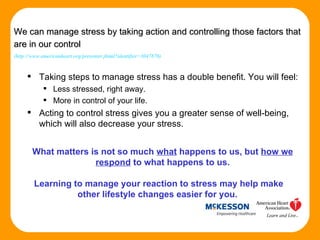
Taking steps to manage stress has a double benefit. You will feel: Less stressed, right away.  More in control of your life. Acting to control stress gives you a greater sense of well-being, which will also decrease your stress. Headline   (Source) We can manage stress by taking action and controlling those factors that are in our control   (http://www.americanheart.org/presenter.jhtml?identifier=3047876) What matters is not so much  what  happens to us, but  how we respond  to what happens to us. Learning to manage your reaction to stress may help make other lifestyle changes easier for you.
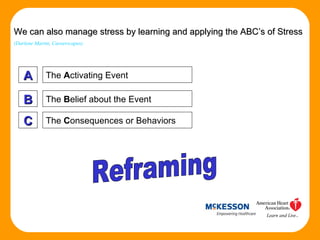
We can also manage stress by learning and applying the ABC’s of Stress (Darlene Martin, Careerscapes) A B C The  A ctivating Event The  B elief about the Event The  C onsequences or Behaviors Reframing
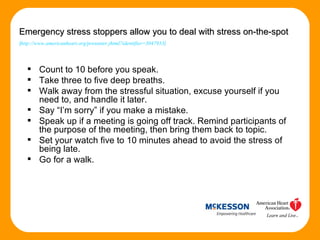
Count to 10 before you speak.  Take three to five deep breaths.  Walk away from the stressful situation, excuse yourself if you need to, and handle it later.  Say “I’m sorry” if you make a mistake.  Speak up if a meeting is going off track. Remind participants of the purpose of the meeting, then bring them back to topic. Set your watch five to 10 minutes ahead to avoid the stress of being late. Go for a walk. Emergency stress stoppers allow you to deal with stress on-the-spot ( http://www.americanheart.org/presenter.jhtml?identifier=3047933 )
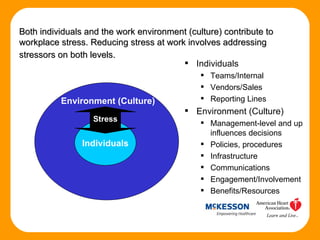
Individuals Teams/Internal  Vendors/Sales Reporting Lines Environment (Culture) Management-level and up influences decisions Policies, procedures Infrastructure Communications Engagement/Involvement Benefits/Resources Both individuals and the work environment (culture) contribute to workplace stress. Reducing stress at work involves addressing stressors on both levels.   Individuals Environment (Culture) Stress
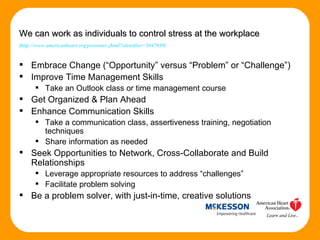
Embrace Change (“Opportunity” versus “Problem” or “Challenge”) Improve Time Management Skills Take an Outlook class or time management course Get Organized & Plan Ahead Enhance Communication Skills Take a communication class, assertiveness training, negotiation techniques Share information as needed Seek Opportunities to Network, Cross-Collaborate and Build Relationships Leverage appropriate resources to address “challenges” Facilitate problem solving Be a problem solver, with just-in-time, creative solutions We can work as individuals to control stress at the workplace   ( http://www.americanheart.org/presenter.jhtml?identifier=3047939 )
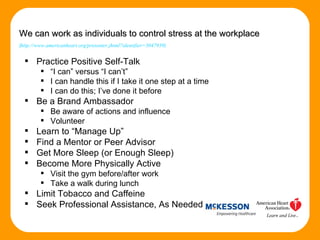
Practice Positive Self-Talk “ I can” versus “I can’t” I can handle this if I take it one step at a time I can do this; I’ve done it before Be a Brand Ambassador Be aware of actions and influence Volunteer Learn to “Manage Up” Find a Mentor or Peer Advisor Get More Sleep (or Enough Sleep) Become More Physically Active Visit the gym before/after work  Take a walk during lunch Limit Tobacco and Caffeine Seek Professional Assistance, As Needed We can work as individuals to control stress at the workplace   ( http://www.americanheart.org/presenter.jhtml?identifier=3047939 )
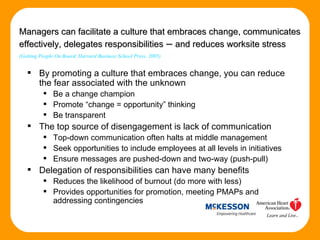
By promoting a culture that embraces change, you can reduce the fear associated with the unknown Be a change champion Promote “change = opportunity” thinking Be transparent The top source of disengagement is lack of communication Top-down communication often halts at middle management Seek opportunities to include employees at all levels in initiatives Ensure messages are pushed-down and two-way (push-pull) Delegation of responsibilities can have many benefits Reduces the likelihood of burnout (do more with less) Provides opportunities for promotion, meeting PMAPs and addressing contingencies Managers can facilitate a culture that embraces change, communicates effectively, delegates responsibilities  –  and reduces worksite stress   (Getting People On Board, Harvard Business School Press, 2005)
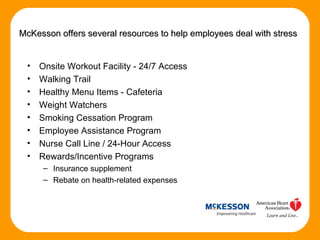
Onsite Workout Facility - 24/7 Access Walking Trail Healthy Menu Items - Cafeteria Weight Watchers Smoking Cessation Program Employee Assistance Program Nurse Call Line / 24-Hour Access  Rewards/Incentive Programs  Insurance supplement Rebate on health-related expenses McKesson offers several resources to help employees deal with stress
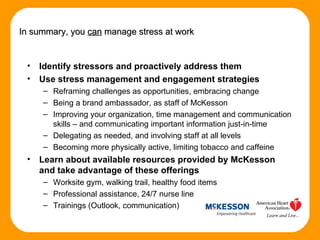
Identify stressors and proactively address them  Use stress management and engagement strategies Reframing challenges as opportunities, embracing change Being a brand ambassador, as staff of McKesson Improving your organization, time management and communication skills – and communicating important information just-in-time Delegating as needed, and involving staff at all levels  Becoming more physically active, limiting tobacco and caffeine Learn about available resources provided by McKesson and take advantage of these offerings Worksite gym, walking trail, healthy food items Professional assistance, 24/7 nurse line Trainings (Outlook, communication) In summary, you  can  manage stress at work
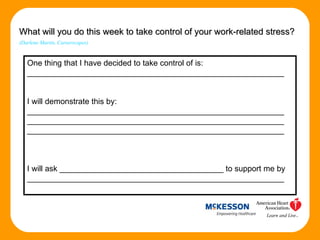
What will you do this week to take control of your work-related stress? (Darlene Martin, Careerscapes) One thing that I have decided to take control of is: __________________________________________________________ I will demonstrate this by:  __________________________________________________________ __________________________________________________________ __________________________________________________________ I will ask _____________________________________ to support me by  __________________________________________________________
Thank you for attending today’s presentation! For More Information: www.heart.org

Managing Stress At Work

  • 1.
    Managing Stress atWork McKesson Lunch and Learn Series 1/26/09 Presenter: Sonya Lewis, American Heart Association Volunteer
  • 2.
    Today’s presentation coversfour topics: Understanding the link between stress and heart disease Identifying and addressing worksite stressors Learning and applying stress management strategies Identifying available resources for managing stress
  • 3.
    Increasing age Malesex (gender) Heredity (including race) Tobacco smoke High blood cholesterol High blood pressure Physical inactivity Obesity and overweight Diabetes mellitus Several heart disease risk factors are well-established ( http://www.americanheart.org/presenter.jhtml?identifier=4726 ) Factors we can’t control Modifiable - Factors we can control Focus on these Factors
  • 4.
    According to theAmerican Heart Association, stress is a potential contributor to heart disease. “ Individual response to stress may be a contributing factor. Some scientists have noted a relationship between coronary heart disease risk and stress in a person's life, their health behaviors and socioeconomic status.” The American Heart Association recognizes a potential link between stress and the development of heart disease ( http://www.americanheart.org/presenter.jhtml?identifier=4726 )
  • 5.
    The stress responsedescribes the condition caused by your reaction to physical, chemical, emotional or environmental factors. These factors may affect established risk factors. The stress response may lead to behaviors that encourage the development of heart disease ( http://www.americanheart.org/presenter.jhtml?identifier=4726 ) Stress Overeat Heart Disease Start Smoking Smoke More Overweight Obesity (Chronic Exposure to) Tobacco Smoke
  • 6.
    Stress affects usin different ways, and can result in physical and emotional pain – stress can also impact our performance and work relationships ( http://www.americanheart.org/presenter.jhtml?identifier=3047874) Physical Emotional Aches and Pains* ▪ Headache ▪ Backache ▪ Neck ache ▪ Stomach ache ▪ Tight muscles ▪ Clenched jaw Energy Level and Sleep ▪ Feeling tired, without a good reason ▪ Trouble sleeping Other Emotional Signs ▪ Easily irritated ▪ Impatient ▪ Forgetful Feelings ▪ Anxiety ▪ Anger ▪ Depression ▪ Helplessness ▪ Out of control ▪ Tense   
  • 7.
    Identifying stressors isthe first step to dealing with stress at work What Stresses You at Work? Take stock, so you can take control
  • 8.
    Staff are facingmany stressors, which may lead to organizational risks Workplace Stressors Gossip Voluntary Turnover Reduction in Force Financial Impacts Reduced Productivity Burnout Lack of Teamwork/ Cooperation Potential Risks Fears – Founded and Perceived Maintaining Recognitions / Designations and Meeting Expectations Associated with Brand Increased Performance Expectations Financial Pressures Lack of / Miscommunication Performance-Based Work
  • 9.
    I eat tocalm down. I speak and eat very fast. I drink alcohol or smoke to calm down. I sleep too little, too much or both. I slow down. I rush around but do not get much done. I work too much. I delay doing the things I need to do. I try to do too many things at once. How do you usually respond to stress? ( http://www.americanheart.org/presenter.jhtml?identifier=3047874 ) Selecting even one of these items may mean that you are not dealing with stress as well as you could.
  • 10.
    Taking steps tomanage stress has a double benefit. You will feel: Less stressed, right away. More in control of your life. Acting to control stress gives you a greater sense of well-being, which will also decrease your stress. Headline (Source) We can manage stress by taking action and controlling those factors that are in our control (http://www.americanheart.org/presenter.jhtml?identifier=3047876) What matters is not so much what happens to us, but how we respond to what happens to us. Learning to manage your reaction to stress may help make other lifestyle changes easier for you.
  • 11.
    We can alsomanage stress by learning and applying the ABC’s of Stress (Darlene Martin, Careerscapes) A B C The A ctivating Event The B elief about the Event The C onsequences or Behaviors Reframing
  • 12.
    Count to 10before you speak. Take three to five deep breaths. Walk away from the stressful situation, excuse yourself if you need to, and handle it later. Say “I’m sorry” if you make a mistake. Speak up if a meeting is going off track. Remind participants of the purpose of the meeting, then bring them back to topic. Set your watch five to 10 minutes ahead to avoid the stress of being late. Go for a walk. Emergency stress stoppers allow you to deal with stress on-the-spot ( http://www.americanheart.org/presenter.jhtml?identifier=3047933 )
  • 13.
    Individuals Teams/Internal Vendors/Sales Reporting Lines Environment (Culture) Management-level and up influences decisions Policies, procedures Infrastructure Communications Engagement/Involvement Benefits/Resources Both individuals and the work environment (culture) contribute to workplace stress. Reducing stress at work involves addressing stressors on both levels. Individuals Environment (Culture) Stress
  • 14.
    Embrace Change (“Opportunity”versus “Problem” or “Challenge”) Improve Time Management Skills Take an Outlook class or time management course Get Organized & Plan Ahead Enhance Communication Skills Take a communication class, assertiveness training, negotiation techniques Share information as needed Seek Opportunities to Network, Cross-Collaborate and Build Relationships Leverage appropriate resources to address “challenges” Facilitate problem solving Be a problem solver, with just-in-time, creative solutions We can work as individuals to control stress at the workplace ( http://www.americanheart.org/presenter.jhtml?identifier=3047939 )
  • 15.
    Practice Positive Self-Talk“ I can” versus “I can’t” I can handle this if I take it one step at a time I can do this; I’ve done it before Be a Brand Ambassador Be aware of actions and influence Volunteer Learn to “Manage Up” Find a Mentor or Peer Advisor Get More Sleep (or Enough Sleep) Become More Physically Active Visit the gym before/after work Take a walk during lunch Limit Tobacco and Caffeine Seek Professional Assistance, As Needed We can work as individuals to control stress at the workplace ( http://www.americanheart.org/presenter.jhtml?identifier=3047939 )
  • 16.
    By promoting aculture that embraces change, you can reduce the fear associated with the unknown Be a change champion Promote “change = opportunity” thinking Be transparent The top source of disengagement is lack of communication Top-down communication often halts at middle management Seek opportunities to include employees at all levels in initiatives Ensure messages are pushed-down and two-way (push-pull) Delegation of responsibilities can have many benefits Reduces the likelihood of burnout (do more with less) Provides opportunities for promotion, meeting PMAPs and addressing contingencies Managers can facilitate a culture that embraces change, communicates effectively, delegates responsibilities – and reduces worksite stress (Getting People On Board, Harvard Business School Press, 2005)
  • 17.
    Onsite Workout Facility- 24/7 Access Walking Trail Healthy Menu Items - Cafeteria Weight Watchers Smoking Cessation Program Employee Assistance Program Nurse Call Line / 24-Hour Access Rewards/Incentive Programs Insurance supplement Rebate on health-related expenses McKesson offers several resources to help employees deal with stress
  • 18.
    Identify stressors andproactively address them Use stress management and engagement strategies Reframing challenges as opportunities, embracing change Being a brand ambassador, as staff of McKesson Improving your organization, time management and communication skills – and communicating important information just-in-time Delegating as needed, and involving staff at all levels Becoming more physically active, limiting tobacco and caffeine Learn about available resources provided by McKesson and take advantage of these offerings Worksite gym, walking trail, healthy food items Professional assistance, 24/7 nurse line Trainings (Outlook, communication) In summary, you can manage stress at work
  • 19.
    What will youdo this week to take control of your work-related stress? (Darlene Martin, Careerscapes) One thing that I have decided to take control of is: __________________________________________________________ I will demonstrate this by: __________________________________________________________ __________________________________________________________ __________________________________________________________ I will ask _____________________________________ to support me by __________________________________________________________
  • 20.
    Thank you forattending today’s presentation! For More Information: www.heart.org