Managing Strategic Change
A framework for managing Strategic
Change:
1. Diagnosing the change situation
2. management styles and roles.
3. Levers for managing change
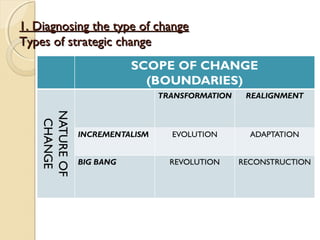
1. Diagnosing the type of change
Types of strategic change
Adaptation : change which is accommodated within
the current paradigm and occur incrementally. It is the
most common form of change in organizations ,
e.g. Herbal skin care products from HUL
implementing ERP in organizations
Evolution : Evolution is a change in strategy which
requires paradigm change, but over time,
e.g., Dabur’s foray into beauty care products with
the acquisition of FEM
Revolution : Revolution is change which requires
rapid and major strategic and paradigm change,
e.g. GE’s Focus from being a manufacturing to a
service oriented company.
Marico’s foray into skin care- kaya (service)
Reconstruction :Reconstruction is the type of change
which could be rapid and could involve a good deal of
upheaval in the organization, but which does not
fundamentally change the paradigm.,
e.g. Acquisition of JLR by Tata Motors.
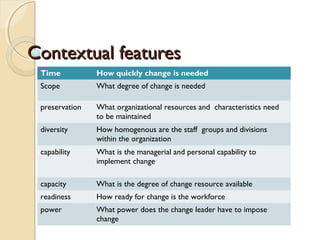
Contextual features
Time

How quickly change is needed

Scope

What degree of change is needed

preservation

What organizational resources and characteristics need
to be maintained

diversity

How homogenous are the staff groups and divisions
within the organization

capability

What is the managerial and personal capability to
implement change

capacity

What is the degree of change resource available

readiness

How ready for change is the workforce

power

What power does the change leader have to impose
change
Organization culture as context
Many aspects of the culture of the organization work
to shape and guide strategy, and how it influences can
result in strategic drift. The cultural web is therefore a
useful way of considering the cultural context for
change
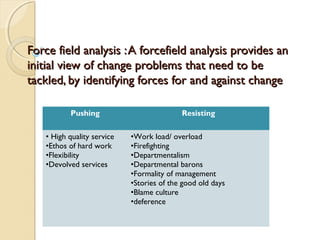
Force field analysis : A forcefield analysis provides an
initial view of change problems that need to be
tackled, by identifying forces for and against change
Pushing
• High quality service
•Ethos of hard work
•Flexibility
•Devolved services

Resisting
•Work load/ overload
•Firefighting
•Departmentalism
•Departmental barons
•Formality of management
•Stories of the good old days
•Blame culture
•deference
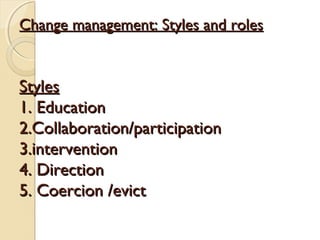
Change management: Styles and roles

Styles
1. Education
2.Collaboration/participation
3.intervention
4. Direction
5. Coercion /evict
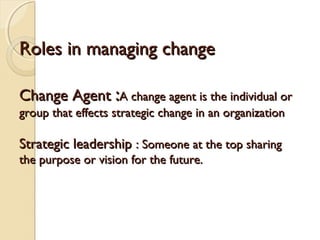
Roles in managing change
Change Agent :A change agent is the individual or
group that effects strategic change in an organization

Strategic leadership : Someone at the top sharing
the purpose or vision for the future.
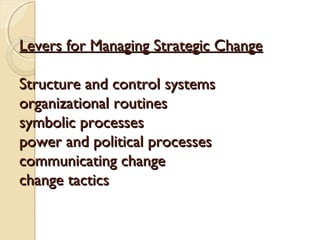
Levers for Managing Strategic Change
Structure and control systems
organizational routines
symbolic processes
power and political processes
communicating change
change tactics

Managing strategic change

  • 1.
  • 2.
    A framework formanaging Strategic Change: 1. Diagnosing the change situation 2. management styles and roles. 3. Levers for managing change
  • 3.
    1. Diagnosing thetype of change Types of strategic change
  • 4.
    Adaptation : changewhich is accommodated within the current paradigm and occur incrementally. It is the most common form of change in organizations , e.g. Herbal skin care products from HUL implementing ERP in organizations Evolution : Evolution is a change in strategy which requires paradigm change, but over time, e.g., Dabur’s foray into beauty care products with the acquisition of FEM
  • 5.
    Revolution : Revolutionis change which requires rapid and major strategic and paradigm change, e.g. GE’s Focus from being a manufacturing to a service oriented company. Marico’s foray into skin care- kaya (service) Reconstruction :Reconstruction is the type of change which could be rapid and could involve a good deal of upheaval in the organization, but which does not fundamentally change the paradigm., e.g. Acquisition of JLR by Tata Motors.
  • 6.
    Contextual features Time How quicklychange is needed Scope What degree of change is needed preservation What organizational resources and characteristics need to be maintained diversity How homogenous are the staff groups and divisions within the organization capability What is the managerial and personal capability to implement change capacity What is the degree of change resource available readiness How ready for change is the workforce power What power does the change leader have to impose change
  • 7.
    Organization culture ascontext Many aspects of the culture of the organization work to shape and guide strategy, and how it influences can result in strategic drift. The cultural web is therefore a useful way of considering the cultural context for change
  • 8.
    Force field analysis: A forcefield analysis provides an initial view of change problems that need to be tackled, by identifying forces for and against change Pushing • High quality service •Ethos of hard work •Flexibility •Devolved services Resisting •Work load/ overload •Firefighting •Departmentalism •Departmental barons •Formality of management •Stories of the good old days •Blame culture •deference
  • 9.
    Change management: Stylesand roles Styles 1. Education 2.Collaboration/participation 3.intervention 4. Direction 5. Coercion /evict
  • 10.
    Roles in managingchange Change Agent :A change agent is the individual or group that effects strategic change in an organization Strategic leadership : Someone at the top sharing the purpose or vision for the future.
  • 11.
    Levers for ManagingStrategic Change Structure and control systems organizational routines symbolic processes power and political processes communicating change change tactics