BALANCED SCORECARD
By-
Josphin
Sminu
Archana
Suma Latha
What is balanced score card..?
• The balanced scorecard is a strategic
planning and management system that is
used extensively in business and industry,
government and nonprofit organizations
worldwide to align business activities to
the vision and strategy of the organization,
improve internal and external
communications, and monitor organization
performance against strategic goals.
Origin
• It was originated by Dr. Robert Kaplan
(Harvard Business School) and David
Norton as a performance measurement
framework.
• That added strategic non-financial
performance measures to traditional
financial metrics to give managers and
executives a more 'balanced' view of
organizational performance.
• Provides method for organisation to
systematically develop a comprehensive
system of planning and control.
• Performance measurement system that
translates organisation strategy into
objective measures, targets and initiatives.
How is the Balanced Score card
Used?
• Translating the vision: helping all employees
understand how their day-to-day work
contributes to long-term goals.
• Communicating and linking: disseminating
long-term goals both up and down an
organizational hierarchy, ensuring that both
departmental and individuals objectives are in
alignment.
• Business planning: taking long-term strategy
and using it as the basis for how resources and
capital are allocated.
• Feedback and learning: the scorecard enables
strategic and real-time learning because it
measures daily performance and spending in
the context of overarching goals, allowing
organizations to make necessary changes.
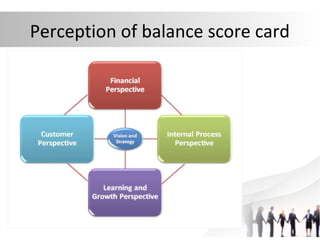
Perception of balance score card
• The Financial Perspective covers the financial
objectives of an organisation and allows
managers to track financial success and
shareholder value.
• The Customer Perspective covers the
customer objectives such as customer
satisfaction, market share goals as well as
product and service attributes.
• The Internal Process Perspective covers
internal operational goals and outlines the key
processes necessary to deliver the customer
objectives.
• The Learning and Growth Perspective covers
the intangible drivers of future success such as
human capital, organisational capital and
information capital including skills, training,
organisational culture, leadership, systems
and databases
Corporate examples
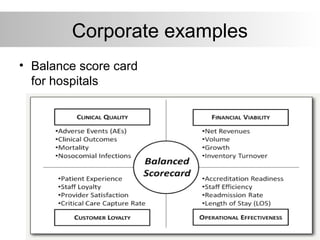
• Balance score card
for hospitals
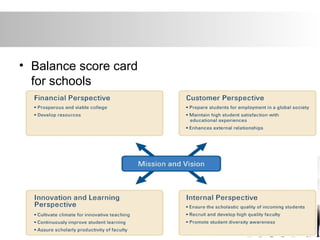
• Balance score card
for schools
Balanced scorecard

Balanced scorecard

  • 1.
  • 2.
    What is balancedscore card..? • The balanced scorecard is a strategic planning and management system that is used extensively in business and industry, government and nonprofit organizations worldwide to align business activities to the vision and strategy of the organization, improve internal and external communications, and monitor organization performance against strategic goals.
  • 3.
    Origin • It wasoriginated by Dr. Robert Kaplan (Harvard Business School) and David Norton as a performance measurement framework. • That added strategic non-financial performance measures to traditional financial metrics to give managers and executives a more 'balanced' view of organizational performance.
  • 4.
    • Provides methodfor organisation to systematically develop a comprehensive system of planning and control. • Performance measurement system that translates organisation strategy into objective measures, targets and initiatives.
  • 5.
    How is theBalanced Score card Used? • Translating the vision: helping all employees understand how their day-to-day work contributes to long-term goals. • Communicating and linking: disseminating long-term goals both up and down an organizational hierarchy, ensuring that both departmental and individuals objectives are in alignment.
  • 6.
    • Business planning:taking long-term strategy and using it as the basis for how resources and capital are allocated. • Feedback and learning: the scorecard enables strategic and real-time learning because it measures daily performance and spending in the context of overarching goals, allowing organizations to make necessary changes.
  • 7.
  • 8.
    • The FinancialPerspective covers the financial objectives of an organisation and allows managers to track financial success and shareholder value. • The Customer Perspective covers the customer objectives such as customer satisfaction, market share goals as well as product and service attributes.
  • 9.
    • The InternalProcess Perspective covers internal operational goals and outlines the key processes necessary to deliver the customer objectives. • The Learning and Growth Perspective covers the intangible drivers of future success such as human capital, organisational capital and information capital including skills, training, organisational culture, leadership, systems and databases
  • 10.
    Corporate examples • Balancescore card for hospitals
  • 11.
    • Balance scorecard for schools