Leading Strategic Change
Business environment is dynamic in nature.
Strategies are formulated and implemented to cope
with the environmental dynamism.
When current strategy loses relevancy in terms of
addressing the environmental issues strategic
change is needed.
Strategic change is a way of changing the objectives
and vision of the company.
1.Understanding the Forces of Change
Both external and internal forces of the environment demand
strategic change.
a) External Forces:
 Political forces
 Economic forces
 Socio-cultural forces
 Technological forces
 Legal forces
 Global forces
b) Internal Forces:
They are within the organization.
They are controllable in long run.
They are:
 Organizational Objectives and policies
 Organizational Culture
 Organizational Resources
 Organizational Structure
2. Diagnosing the Change situation
In the process of managing strategic change, the change situation
should be diagnosed.
It involves the following steps:
a)Types of Strategic Change
b)The importance of Context
c)Organizational Culture
d)Force-field Analysis
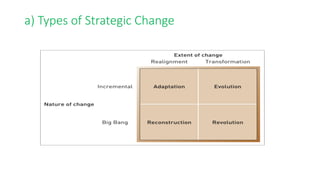
a) Types of Strategic Change
There is a no only way, or one best way, to change strategies.
The nature of change may be incremental or big bang.
Four types of strategic change:
Adaptation – can be accommodated with the existing culture and
can occur incrementally.
Reconstruction – rapid change but without fundamentally
changing the culture.
Revolution – fundamental changes in both strategy and culture.
Evolution – cultural change is required but this can be
accomplished over time.
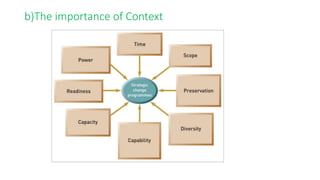
b)The importance of Context
• Time - is there time for longer term strategic development or does the firm
have to react quickly to a crisis?
• Scope - how much of the organization will be affected? Is the change best
described as realignment or transformation?
• Preservation - which aspects of working, culture, competences and people
need to be retained?
• Diversity - the need to recognize that different departments (e.g.,
marketing and R&D) may have different sub-cultures.
• Capability - whether abilities exist to cope with the change. These can be
on an individual, managerial or organizational level.
• Capacity - are resources (e.g. money, managerial time) available to invest
in the change process?
• Readiness - are staff aware of the need for change and are they committed
to that change?
• Power - how much authority and autonomy do change agents have to
make proposed changes?
c)Organizational Culture
For change to be effective an organization will often have to change
its culture.
 The extent of the change required will be influenced by the type of
change that is planned.
For example, revolution is likely to require a greater cultural change
than adaptation.
Very often the existing culture can be one reason for resistance to
change - the culture becomes "embedded".
Culture is the set of values, guiding beliefs, understandings and ways
of thinking that are shared by the members of an organization and is
taught to new members as correct.
It is reflected by:
 Common interest of the stakeholders
 Teamwork and collaboration
 Autonomy and power at work
 Centralization and decentralization
 Innovation and risk taking
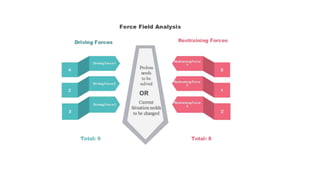
d)Force-field Analysis
Force Field Analysis was created by Kurt Lewin in the 1940s.
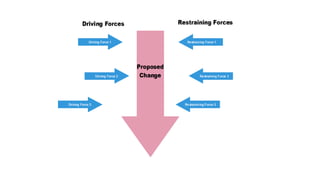
The idea behind Force Field Analysis is that situations are maintained
by an equilibrium between forces that drive change and others that
resist change.
For change to happen, the driving forces must be strengthened or the
resisting forces weakened.
Managers should consider any change situation in terms of:
 The factors encouraging and facilitating the change (the driving
forces)
 The factors that hinder change (the restraining forces).
If we want to bring about change we must disturb the equilibrium by:
 strengthening the driving forces
 weakening the restraining forces
 or both.
How to Use Force Field Analysis
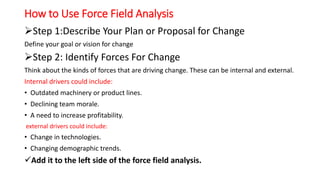
Step 1:Describe Your Plan or Proposal for Change
Define your goal or vision for change
Step 2: Identify Forces For Change
Think about the kinds of forces that are driving change. These can be internal and external.
Internal drivers could include:
• Outdated machinery or product lines.
• Declining team morale.
• A need to increase profitability.
external drivers could include:
• Change in technologies.
• Changing demographic trends.
Add it to the left side of the force field analysis.
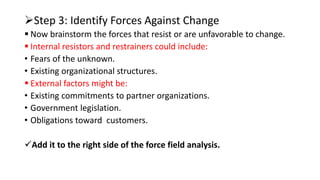
Step 3: Identify Forces Against Change
 Now brainstorm the forces that resist or are unfavorable to change.
 Internal resistors and restrainers could include:
• Fears of the unknown.
• Existing organizational structures.
 External factors might be:
• Existing commitments to partner organizations.
• Government legislation.
• Obligations toward customers.
Add it to the right side of the force field analysis.
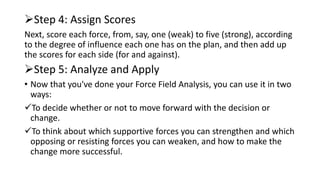
Step 4: Assign Scores
Next, score each force, from, say, one (weak) to five (strong), according
to the degree of influence each one has on the plan, and then add up
the scores for each side (for and against).
Step 5: Analyze and Apply
• Now that you've done your Force Field Analysis, you can use it in two
ways:
To decide whether or not to move forward with the decision or
change.
To think about which supportive forces you can strengthen and which
opposing or resisting forces you can weaken, and how to make the
change more successful.
Styles and Roles in Change Management
a) Styles Of Managing Change
1. Education and communication
Persuading people towards the strategic change and informing change to the stakeholders.
2. Collaboration and participation
It is the involvement of those who will be affected by strategic change , it builds readiness.
3. Intervention
intervention is the coordination of the change process
4. Direction
It is the use of personal managerial authority to establish a clear future strategy.
b) Roles in Managing Change
There are different individuals and groups within an organization who
play active role in strategic change process.
1.Strategic leadership
Strategic leadership means having the ability to anticipate, prepare
and get positioned for the future.
Strategic leaders are individuals upon whom strategy development
and change are seen to be dependent.
They are individuals personally identified with and central to the
strategy of their organization.
In some organizations an individual may be central because he or she
was its owner or founder; often the case in small businesses.
2. Middle Managers
Middle managers are the linking pin between the senior
management team and the rest of the organization.
They have responsibility for helping their staff through the change
process while simultaneously undertaking change themselves.
3. Outsiders
Outsiders are also equally important as managers.
i. New Chief Executive: From outside, to enhance the capacity for
change.
ii. New management: from outside, to increase diversity of ideas and
break down cultural barriers for change.
iii. Consultants: Consultants may bring an innovative view to the
process.
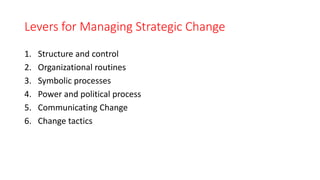
Levers for Managing Strategic Change
1. Structure and control
2. Organizational routines
3. Symbolic processes
4. Power and political process
5. Communicating Change
6. Change tactics

Leading strategic change

  • 1.
    Leading Strategic Change Businessenvironment is dynamic in nature. Strategies are formulated and implemented to cope with the environmental dynamism. When current strategy loses relevancy in terms of addressing the environmental issues strategic change is needed. Strategic change is a way of changing the objectives and vision of the company.
  • 2.
    1.Understanding the Forcesof Change Both external and internal forces of the environment demand strategic change. a) External Forces:  Political forces  Economic forces  Socio-cultural forces  Technological forces  Legal forces  Global forces
  • 3.
    b) Internal Forces: Theyare within the organization. They are controllable in long run. They are:  Organizational Objectives and policies  Organizational Culture  Organizational Resources  Organizational Structure
  • 4.
    2. Diagnosing theChange situation In the process of managing strategic change, the change situation should be diagnosed. It involves the following steps: a)Types of Strategic Change b)The importance of Context c)Organizational Culture d)Force-field Analysis
  • 5.
    a) Types ofStrategic Change
  • 6.
    a) Types ofStrategic Change There is a no only way, or one best way, to change strategies. The nature of change may be incremental or big bang. Four types of strategic change: Adaptation – can be accommodated with the existing culture and can occur incrementally. Reconstruction – rapid change but without fundamentally changing the culture. Revolution – fundamental changes in both strategy and culture. Evolution – cultural change is required but this can be accomplished over time.
  • 7.
  • 8.
    • Time -is there time for longer term strategic development or does the firm have to react quickly to a crisis? • Scope - how much of the organization will be affected? Is the change best described as realignment or transformation? • Preservation - which aspects of working, culture, competences and people need to be retained? • Diversity - the need to recognize that different departments (e.g., marketing and R&D) may have different sub-cultures. • Capability - whether abilities exist to cope with the change. These can be on an individual, managerial or organizational level. • Capacity - are resources (e.g. money, managerial time) available to invest in the change process? • Readiness - are staff aware of the need for change and are they committed to that change? • Power - how much authority and autonomy do change agents have to make proposed changes?
  • 9.
    c)Organizational Culture For changeto be effective an organization will often have to change its culture.  The extent of the change required will be influenced by the type of change that is planned. For example, revolution is likely to require a greater cultural change than adaptation. Very often the existing culture can be one reason for resistance to change - the culture becomes "embedded".
  • 10.
    Culture is theset of values, guiding beliefs, understandings and ways of thinking that are shared by the members of an organization and is taught to new members as correct. It is reflected by:  Common interest of the stakeholders  Teamwork and collaboration  Autonomy and power at work  Centralization and decentralization  Innovation and risk taking
  • 11.
    d)Force-field Analysis Force FieldAnalysis was created by Kurt Lewin in the 1940s. The idea behind Force Field Analysis is that situations are maintained by an equilibrium between forces that drive change and others that resist change. For change to happen, the driving forces must be strengthened or the resisting forces weakened.
  • 12.
    Managers should considerany change situation in terms of:  The factors encouraging and facilitating the change (the driving forces)  The factors that hinder change (the restraining forces). If we want to bring about change we must disturb the equilibrium by:  strengthening the driving forces  weakening the restraining forces  or both.
  • 14.
    How to UseForce Field Analysis Step 1:Describe Your Plan or Proposal for Change Define your goal or vision for change Step 2: Identify Forces For Change Think about the kinds of forces that are driving change. These can be internal and external. Internal drivers could include: • Outdated machinery or product lines. • Declining team morale. • A need to increase profitability. external drivers could include: • Change in technologies. • Changing demographic trends. Add it to the left side of the force field analysis.
  • 15.
    Step 3: IdentifyForces Against Change  Now brainstorm the forces that resist or are unfavorable to change.  Internal resistors and restrainers could include: • Fears of the unknown. • Existing organizational structures.  External factors might be: • Existing commitments to partner organizations. • Government legislation. • Obligations toward customers. Add it to the right side of the force field analysis.
  • 16.
    Step 4: AssignScores Next, score each force, from, say, one (weak) to five (strong), according to the degree of influence each one has on the plan, and then add up the scores for each side (for and against). Step 5: Analyze and Apply • Now that you've done your Force Field Analysis, you can use it in two ways: To decide whether or not to move forward with the decision or change. To think about which supportive forces you can strengthen and which opposing or resisting forces you can weaken, and how to make the change more successful.
  • 18.
    Styles and Rolesin Change Management a) Styles Of Managing Change 1. Education and communication Persuading people towards the strategic change and informing change to the stakeholders. 2. Collaboration and participation It is the involvement of those who will be affected by strategic change , it builds readiness. 3. Intervention intervention is the coordination of the change process 4. Direction It is the use of personal managerial authority to establish a clear future strategy.
  • 19.
    b) Roles inManaging Change There are different individuals and groups within an organization who play active role in strategic change process. 1.Strategic leadership Strategic leadership means having the ability to anticipate, prepare and get positioned for the future. Strategic leaders are individuals upon whom strategy development and change are seen to be dependent. They are individuals personally identified with and central to the strategy of their organization. In some organizations an individual may be central because he or she was its owner or founder; often the case in small businesses.
  • 20.
    2. Middle Managers Middlemanagers are the linking pin between the senior management team and the rest of the organization. They have responsibility for helping their staff through the change process while simultaneously undertaking change themselves. 3. Outsiders Outsiders are also equally important as managers. i. New Chief Executive: From outside, to enhance the capacity for change. ii. New management: from outside, to increase diversity of ideas and break down cultural barriers for change. iii. Consultants: Consultants may bring an innovative view to the process.
  • 21.
    Levers for ManagingStrategic Change 1. Structure and control 2. Organizational routines 3. Symbolic processes 4. Power and political process 5. Communicating Change 6. Change tactics