The five components of supply chain management are planning, sourcing/developing, making, delivering, and returning. Planning involves developing strategies to satisfy customer demands profitably. Sourcing involves selecting reliable suppliers and establishing pricing, delivery, and payment processes. Making refers to manufacturing products according to customer demands. Delivering involves logistics to ship products to customers. Returning addresses dealing with defective or damaged goods returned by customers.
Why companies usedsupply chain component
• Supply chain management is a process used
by companies to ensure that their supply
chain is efficient and cost-effective. A
supply chain is the collection of steps that a
company takes to transform raw materials
into a final product.
3.
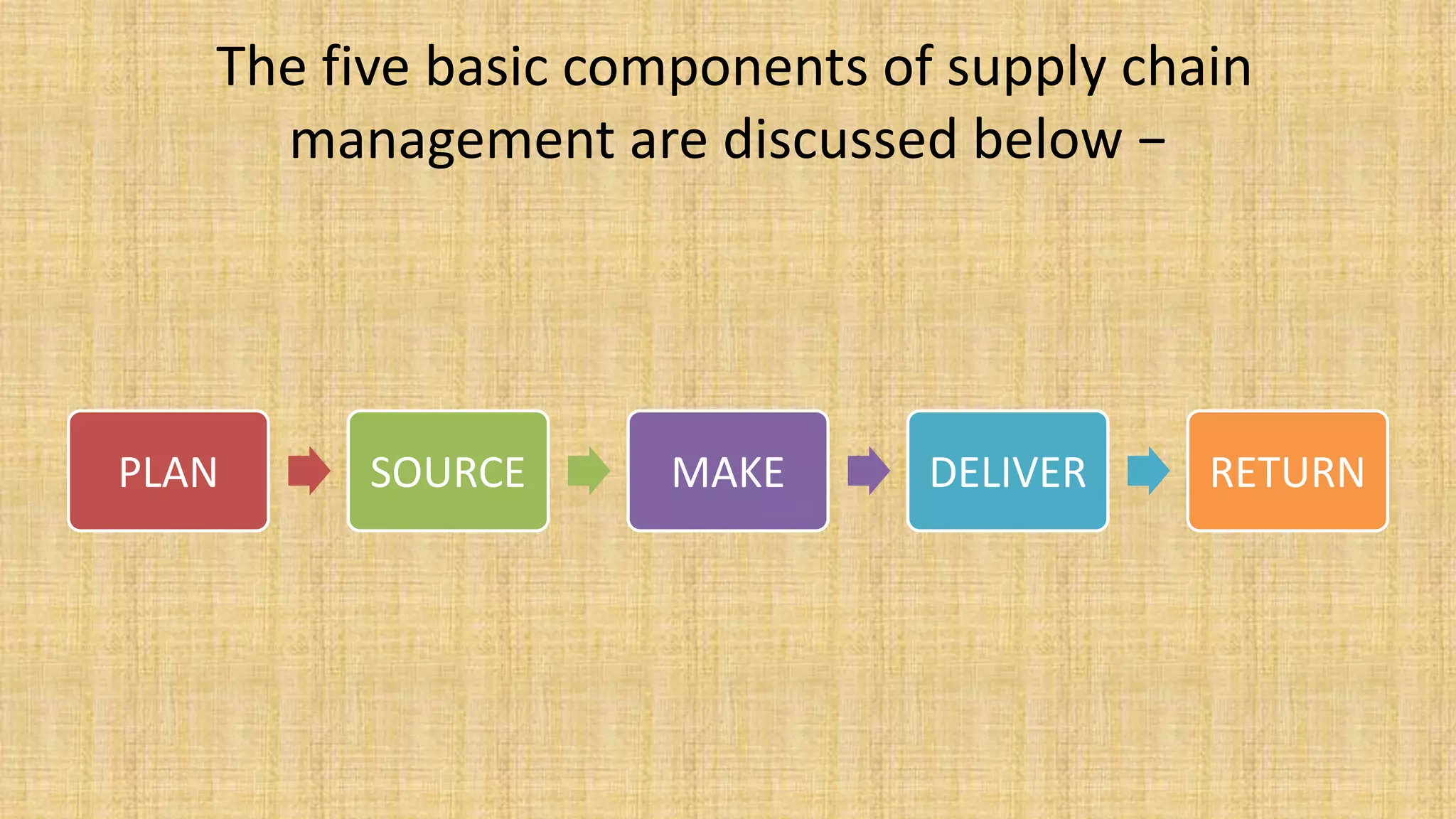
The five basiccomponents of supply chain
management are discussed below −
PLAN SOURCE MAKE DELIVER RETURN
4.
PLAN
• The initialstage of the supply chain process is the
planning stage. We need to develop a plan or
strategy in order to address how the products and
services will satisfy the demands and necessities
of the customers. In this stage, the planning
should mainly focus on designing a strategy that
yields maximum profit.
5.
• For managingall the resources required for
designing products and providing services,
a strategy has to be designed by the
companies. Supply chain management
mainly focuses on planning and developing
a set of metrics.
6.
SOURCE/DEVELOP
• After planning,the next step involves developing or
sourcing. In this stage, we mainly concentrate on
building a strong relationship with suppliers of the raw
materials required for production. This involves not only
identifying dependable suppliers but also determining
different planning methods for shipping, delivery, and
payment of the product.
7.
• Companies needto select suppliers to
deliver the items and services they require
to develop their product. So in this stage,
the supply chain managers need to
construct a set of pricing, delivery and
payment processes with suppliers and also
create the metrics for controlling and
improving the relationships.
8.
• Finally, thesupply chain managers can
combine all these processes for handling
their goods and services inventory. This
handling comprises receiving and
examining shipments, transferring them to
the manufacturing facilities and authorizing
supplier payments.
9.
MAKE
• The thirdstep in the supply chain
management process is the manufacturing or
making of products that were demanded by
the customer. In this stage, the products are
designed, produced, tested, packaged, and
synchronized for delivery.
10.
• Here, thetask of the supply chain manager
is to schedule all the activities required for
manufacturing, testing, packaging and
preparation for delivery. This stage is
considered as the most metric-intensive
unit of the supply chain, where firms can
gauge the quality levels, production output
and worker productivity.
11.
DELIVER
• The fourthstage is the delivery stage. Here the products
are delivered to the customer at the destined location by
the supplier. This stage is basically the logistics phase,
where customer orders are accepted and delivery of the
goods is planned. The delivery stage is often referred as
logistics, where firms collaborate for the receipt of orders
from customers, establish a network of warehouses, pick
carriers to deliver products to customers and set up an
invoicing system to receive payments.
12.
RETURN
• The lastand final stage of supply chain management is referred
as the return. In the stage, defective or damaged goods are
returned to the supplier by the customer. Here, the companies
need to deal with customer queries and respond to their
complaints etc.
13.
• This stageoften tends to be a problematic section of the
supply chain for many companies. The planners of supply
chain need to discover a responsive and flexible network for
accepting damaged, defective and extra products back from
their customers and facilitating the return process for
customers who have issues with delivered products.