MANAGING PERSONAL FINANCES
(Personal Finance Planning- PFP)
By
Prof. Waswa Balunywa
Paper Objective
1. Enable participants understand the need for
Personal Finance Planning(PFP)
2. Learn the steps in PFP
3. Describe the steps in PFP
4. Challenges in PFP
2By Prof. Waswa Balunywa
Paper Structure
1. What is personal financial planning?
2. What to Plan?
3. Steps in Planning
4. Challenges of Financial Planning
3By Prof. Waswa Balunywa
Outcomes
• Awareness of the need for PFP
• Describe individual assets and liabilities
• Able to draw and review PFP
• Awareness of challenges in Personal Financial
Management
4By Prof. Waswa Balunywa
What is Personal Financial Planning?
Personal finance management is how you earn
income and how the income is spent.
• Involves ascertaining sources
• Where does my money come from?
• Involves understanding your expenditures.
• Where do I spend it?
5By Prof. Waswa Balunywa
Objectives of PFP
• Enable you live a happy life
• Enable you look for income
• Enable you plan your life
• Enable you plan and control your expenditure.
• Enable your plan for unforeseen
• Grow your wealth
6By Prof. Waswa Balunywa
Importance of Financial Planning
• Enables you know your limits
• Enables you schedule your activities
• Enables you pursue your goals
• Reduces stress
• Enables you pursue your mission
• Prepare yourself for emergencies
7By Prof. Waswa Balunywa
Problems in Personal Financial Management
• Lack of discipline
• Lack of planning
• Not taking future into account
• Not controlling expenditures
• Abuse ATM/Credit card
• Arrogance
• Gambling
8By Prof. Waswa Balunywa
What to Plan?
• Income
• Expenditure
• Assets
• Liabilities
• Surplus/deficit
9By Prof. Waswa Balunywa
Assets
Are what you own
• Cash
• Land
• House (s)
• Stock (s)
• Vehicles
• Household durable items
10By Prof. Waswa Balunywa
Liabilities
What you owe to others e.g.
• Bank loans
• Loan from friends
• Credit card balance (s)
• Unpaid bills e.g. electricity
11By Prof. Waswa Balunywa
Income
What you earn
• Salary and allowances
• Dividends
• Rent income
• Profit for ventures
• Proceeds from sale of assets
12By Prof. Waswa Balunywa
Expenditure
What you spend money on i.e.
• House rent
• Food
• Electricity, water, time changes
• Interest on loans
• School fees
• Holiday costs
13By Prof. Waswa Balunywa
Balance Sheet
• A stalement that compares your assets and
liabilities.
• The difference is your net worth
14By Prof. Waswa Balunywa
Steps in Financial Planning
• Assess your current position
• Determine your goals
• Establish your sources of income
• Determine your expenditures
• Evolve strategies to increase income or
contain expenditure
• Indicate timing for receipts and disbursement.
15By Prof. Waswa Balunywa
Assess your current position
• What is your net worth
• What are your current incomes
• What are your current expenditures
• What is your current employment
• What challenges do you have?
– Children
– Parents
– Spouse
16By Prof. Waswa Balunywa
Determine your goals
• What is your mission in life?
• What do you want to achieve and when?
– Property
– Education
– Health
– Vocation
– Family
– Insurance
• Do the reality check
• Put the frame or the goals
17By Prof. Waswa Balunywa
Develop Your Source of Income
• What is my current employment?
• Can I do something else?
• Can I take another job?
• What are my current skills?
• Do I have any income generating assets?
• Can I borrow money and from where?
• What can I invest in?
• What are the investment opportunities
available?
18By Prof. Waswa Balunywa
Determine Your Expenditures
What am I currently spending on?
• Home maintenance
• Utility charges
– Insurance
– Retirement
• Internet payments
• Rental charges
• School fees
• Medical fees
• Leisure
19By Prof. Waswa Balunywa
Determine Your Expenditures- Cont’d
• Family unique expenditures
– Vacation
– Extended family
20By Prof. Waswa Balunywa
…..Strategies
• Do I get another job?
• Do I start a business?
• Do I invest in stocks?
• Do I borrow?
• Do I build/buy property?
• Do I send children abroad to study?
• Do I buy a generator?
• Do I buy a car?
21By Prof. Waswa Balunywa
What to Plan?
1. Cash budget
2. Debt management
3. Insurance planning
4. Retirement planning
5. Investment planning
22By Prof. Waswa Balunywa
What to Plan? – Cont’d
6. Estate planning
7. Tax planning
8. Other special situations
23By Prof. Waswa Balunywa
Consequences of Not Planning
The outcome of not planning your finances can
effect your life in the short and long term in many
ways such as:
• Not knowing what happened to your money,
• Just getting by instead of enjoying life,
• Family conflicts over money,
•Never discovering or realizing your mission in life,
•Always being caught off guard when unexpected
challenges arise
24By Prof. Waswa Balunywa
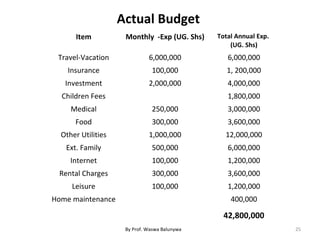
Actual Budget
Item Monthly -Exp (UG. Shs) Total Annual Exp.
(UG. Shs)
Travel-Vacation 6,000,000 6,000,000
Insurance 100,000 1, 200,000
Investment 2,000,000 4,000,000
Children Fees 1,800,000
Medical 250,000 3,000,000
Food 300,000 3,600,000
Other Utilities 1,000,000 12,000,000
Ext. Family 500,000 6,000,000
Internet 100,000 1,200,000
Rental Charges 300,000 3,600,000
Leisure 100,000 1,200,000
Home maintenance 400,000
42,800,000
25By Prof. Waswa Balunywa
Recommended Reading
1. Rich Dad Poor Dad
26By Prof. Waswa Balunywa
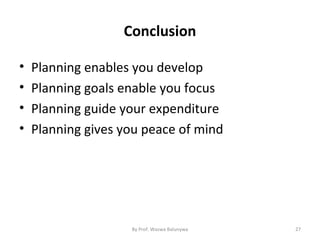
Conclusion
• Planning enables you develop
• Planning goals enable you focus
• Planning guide your expenditure
• Planning gives you peace of mind
27By Prof. Waswa Balunywa

Managing personal finances

  • 1.
    MANAGING PERSONAL FINANCES (PersonalFinance Planning- PFP) By Prof. Waswa Balunywa
  • 2.
    Paper Objective 1. Enableparticipants understand the need for Personal Finance Planning(PFP) 2. Learn the steps in PFP 3. Describe the steps in PFP 4. Challenges in PFP 2By Prof. Waswa Balunywa
  • 3.
    Paper Structure 1. Whatis personal financial planning? 2. What to Plan? 3. Steps in Planning 4. Challenges of Financial Planning 3By Prof. Waswa Balunywa
  • 4.
    Outcomes • Awareness ofthe need for PFP • Describe individual assets and liabilities • Able to draw and review PFP • Awareness of challenges in Personal Financial Management 4By Prof. Waswa Balunywa
  • 5.
    What is PersonalFinancial Planning? Personal finance management is how you earn income and how the income is spent. • Involves ascertaining sources • Where does my money come from? • Involves understanding your expenditures. • Where do I spend it? 5By Prof. Waswa Balunywa
  • 6.
    Objectives of PFP •Enable you live a happy life • Enable you look for income • Enable you plan your life • Enable you plan and control your expenditure. • Enable your plan for unforeseen • Grow your wealth 6By Prof. Waswa Balunywa
  • 7.
    Importance of FinancialPlanning • Enables you know your limits • Enables you schedule your activities • Enables you pursue your goals • Reduces stress • Enables you pursue your mission • Prepare yourself for emergencies 7By Prof. Waswa Balunywa
  • 8.
    Problems in PersonalFinancial Management • Lack of discipline • Lack of planning • Not taking future into account • Not controlling expenditures • Abuse ATM/Credit card • Arrogance • Gambling 8By Prof. Waswa Balunywa
  • 9.
    What to Plan? •Income • Expenditure • Assets • Liabilities • Surplus/deficit 9By Prof. Waswa Balunywa
  • 10.
    Assets Are what youown • Cash • Land • House (s) • Stock (s) • Vehicles • Household durable items 10By Prof. Waswa Balunywa
  • 11.
    Liabilities What you oweto others e.g. • Bank loans • Loan from friends • Credit card balance (s) • Unpaid bills e.g. electricity 11By Prof. Waswa Balunywa
  • 12.
    Income What you earn •Salary and allowances • Dividends • Rent income • Profit for ventures • Proceeds from sale of assets 12By Prof. Waswa Balunywa
  • 13.
    Expenditure What you spendmoney on i.e. • House rent • Food • Electricity, water, time changes • Interest on loans • School fees • Holiday costs 13By Prof. Waswa Balunywa
  • 14.
    Balance Sheet • Astalement that compares your assets and liabilities. • The difference is your net worth 14By Prof. Waswa Balunywa
  • 15.
    Steps in FinancialPlanning • Assess your current position • Determine your goals • Establish your sources of income • Determine your expenditures • Evolve strategies to increase income or contain expenditure • Indicate timing for receipts and disbursement. 15By Prof. Waswa Balunywa
  • 16.
    Assess your currentposition • What is your net worth • What are your current incomes • What are your current expenditures • What is your current employment • What challenges do you have? – Children – Parents – Spouse 16By Prof. Waswa Balunywa
  • 17.
    Determine your goals •What is your mission in life? • What do you want to achieve and when? – Property – Education – Health – Vocation – Family – Insurance • Do the reality check • Put the frame or the goals 17By Prof. Waswa Balunywa
  • 18.
    Develop Your Sourceof Income • What is my current employment? • Can I do something else? • Can I take another job? • What are my current skills? • Do I have any income generating assets? • Can I borrow money and from where? • What can I invest in? • What are the investment opportunities available? 18By Prof. Waswa Balunywa
  • 19.
    Determine Your Expenditures Whatam I currently spending on? • Home maintenance • Utility charges – Insurance – Retirement • Internet payments • Rental charges • School fees • Medical fees • Leisure 19By Prof. Waswa Balunywa
  • 20.
    Determine Your Expenditures-Cont’d • Family unique expenditures – Vacation – Extended family 20By Prof. Waswa Balunywa
  • 21.
    …..Strategies • Do Iget another job? • Do I start a business? • Do I invest in stocks? • Do I borrow? • Do I build/buy property? • Do I send children abroad to study? • Do I buy a generator? • Do I buy a car? 21By Prof. Waswa Balunywa
  • 22.
    What to Plan? 1.Cash budget 2. Debt management 3. Insurance planning 4. Retirement planning 5. Investment planning 22By Prof. Waswa Balunywa
  • 23.
    What to Plan?– Cont’d 6. Estate planning 7. Tax planning 8. Other special situations 23By Prof. Waswa Balunywa
  • 24.
    Consequences of NotPlanning The outcome of not planning your finances can effect your life in the short and long term in many ways such as: • Not knowing what happened to your money, • Just getting by instead of enjoying life, • Family conflicts over money, •Never discovering or realizing your mission in life, •Always being caught off guard when unexpected challenges arise 24By Prof. Waswa Balunywa
  • 25.
    Actual Budget Item Monthly-Exp (UG. Shs) Total Annual Exp. (UG. Shs) Travel-Vacation 6,000,000 6,000,000 Insurance 100,000 1, 200,000 Investment 2,000,000 4,000,000 Children Fees 1,800,000 Medical 250,000 3,000,000 Food 300,000 3,600,000 Other Utilities 1,000,000 12,000,000 Ext. Family 500,000 6,000,000 Internet 100,000 1,200,000 Rental Charges 300,000 3,600,000 Leisure 100,000 1,200,000 Home maintenance 400,000 42,800,000 25By Prof. Waswa Balunywa
  • 26.
    Recommended Reading 1. RichDad Poor Dad 26By Prof. Waswa Balunywa
  • 27.
    Conclusion • Planning enablesyou develop • Planning goals enable you focus • Planning guide your expenditure • Planning gives you peace of mind 27By Prof. Waswa Balunywa