HOW-TO GUIDE
TO IMPROVING YOUR
PERSONAL FINANCES
IN 5 EASY STEPS
Francine Acuña Moyer
1. Write a Personal Financial Statement
• Clarify where you stand financially and start from
wherever that is.
– Your current financial position does not have to
dictate your future.
“Your present circumstances don’t determine
where you can go; they merely
determine where you start.”
—Nido Qubein
• Gather all evidence of your personal
– Assets (cash, securities, receivables,
retirement funds, property, and real estate)
– Liabilities (current debt, mortgage and
taxes due)
Downloadable ExcelWorksheets
are available at
http://www.getexceltemplates.com/
personal-financial-statement-template.html
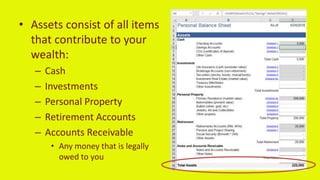
• Assets consist of all items
that contribute to your
wealth:
– Cash
– Investments
– Personal Property
– Retirement Accounts
– Accounts Receivable
• Any money that is legally
owed to you
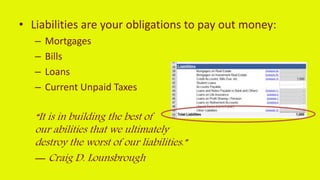
• Liabilities are your obligations to pay out money:
– Mortgages
– Bills
– Loans
– Current Unpaid Taxes
“It is in building the best of
our abilities that we ultimately
destroy the worst of our liabilities.”
― Craig D. Lounsbrough
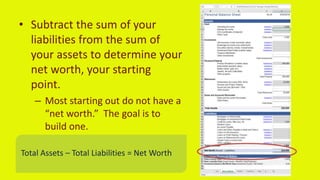
• Subtract the sum of your
liabilities from the sum of
your assets to determine your
net worth, your starting
point.
– Most starting out do not have a
“net worth.” The goal is to
build one.
Total Assets – Total Liabilities = Net Worth
2. Establish Your Financial Goals
• Your ultimate goal is to increase your list of assets and
decrease your liabilities.
• If you aspire to travel or buy an expensive car,
the power to do so is within your grasp.
– You simply need to reprioritize your
spending and saving habits.
“You can’t be in debt and win.
It doesn’t work.”
—Dave Ramsey
3. Create a Plan of Action
• Develop a budget that focuses on eliminating your
liabilities.
– Two common strategies are to
1. Pay off your smallest debts first
(Irby, 2018; Ramsey, 2017), or
2. Focus higher payments
on those with the highest
interest rates
(Steinberg, 2017).
• Regardless of which strategy you choose, pay more than your
minimum balance whenever possible to decrease interest
expense.
– You may even find that creditors
are willing to reduce interest rates or offer
discounts for early payoff. Talk to them.
• Change your spending habits.
– Curtail frivolous spending; if you
don’t really need it, don’t buy it.
– Once your debts are paid, save and
invest. When in doubt, seek the
advice of a trusted financial
advisor.
4. Follow Your Plan
• Sometimes, it’s easier to know what to do than it is
to do it.
– Take on one new habit at a time, if necessary.
Once you reap the benefits of more mindful
practices, it will become easier to
take on more financial
responsibility.
You may even find
it enjoyable!
5. Adjust Your Plan as Necessary
• Life’s events can be unpredictable. Changes in
income, marital status, and health are just some of
the things that warrant reevaluation of your financial
situation.
– When this happens, return to the
first step of this process to
determine, once again,
where you stand.
• If a change results in greater income,
keeping with the same plan can be a great
disservice to your financial health.
• On the other hand, if you’ve been laid off,
or you’ve recently been hit heavily with
medical bills, cutting back on your
savings may be necessary.
– Remember that it’s just a
temporary setback. Once you clear
the hurdle, reevaluate and adjust
accordingly. You can do this!
Excel Templates. (2018, June 19). 8+ personal financial statement templates. Retrieved
from http://www.getexceltemplates.com/personal-financial-statement-template.html
Goodreads, Inc. (2018). Liabilities Quotes (8 quotes). Retrieved from
https://www.goodreads.com/quotes/tag/liabilities
Irby, L. (2018, June 18). How to pay off high interest rate debts. Retrieved from
https://www.thebalance.com/how-to-pay-off-high-interest-rate-debts-960842
Qubein, N. (2018). Nido Qubein Quotes - BrainyQuote. Retrieved from
https://www.brainyquote.com/authors/nido_qubein
Ramsey, D. (2017, November 15). How the debt snowball method works. Retrieved
from https://www.daveramsey.com/blog/how-the-debt-snowball-method-works
Ramsey, D. (2018). Dave Ramsey Quotes - BrainyQuote. Retrieved from
https://www.brainyquote.com/quotes/dave_ramsey_520282
Steinberg, S. (2017, May 10). 10 easy way to pay off debt. Retrieved from
https://money.usnews.com/money/personal-finance/slideshows/10-easy-ways-to-pay-off-debt
References

How-to Guide to Improving Your Personal Finances in 5 Easy Steps

  • 1.
    HOW-TO GUIDE TO IMPROVINGYOUR PERSONAL FINANCES IN 5 EASY STEPS Francine Acuña Moyer
  • 2.
    1. Write aPersonal Financial Statement • Clarify where you stand financially and start from wherever that is. – Your current financial position does not have to dictate your future. “Your present circumstances don’t determine where you can go; they merely determine where you start.” —Nido Qubein
  • 3.
    • Gather allevidence of your personal – Assets (cash, securities, receivables, retirement funds, property, and real estate) – Liabilities (current debt, mortgage and taxes due) Downloadable ExcelWorksheets are available at http://www.getexceltemplates.com/ personal-financial-statement-template.html
  • 4.
    • Assets consistof all items that contribute to your wealth: – Cash – Investments – Personal Property – Retirement Accounts – Accounts Receivable • Any money that is legally owed to you
  • 5.
    • Liabilities areyour obligations to pay out money: – Mortgages – Bills – Loans – Current Unpaid Taxes “It is in building the best of our abilities that we ultimately destroy the worst of our liabilities.” ― Craig D. Lounsbrough
  • 6.
    • Subtract thesum of your liabilities from the sum of your assets to determine your net worth, your starting point. – Most starting out do not have a “net worth.” The goal is to build one. Total Assets – Total Liabilities = Net Worth
  • 7.
    2. Establish YourFinancial Goals • Your ultimate goal is to increase your list of assets and decrease your liabilities. • If you aspire to travel or buy an expensive car, the power to do so is within your grasp. – You simply need to reprioritize your spending and saving habits. “You can’t be in debt and win. It doesn’t work.” —Dave Ramsey
  • 8.
    3. Create aPlan of Action • Develop a budget that focuses on eliminating your liabilities. – Two common strategies are to 1. Pay off your smallest debts first (Irby, 2018; Ramsey, 2017), or 2. Focus higher payments on those with the highest interest rates (Steinberg, 2017).
  • 9.
    • Regardless ofwhich strategy you choose, pay more than your minimum balance whenever possible to decrease interest expense. – You may even find that creditors are willing to reduce interest rates or offer discounts for early payoff. Talk to them. • Change your spending habits. – Curtail frivolous spending; if you don’t really need it, don’t buy it. – Once your debts are paid, save and invest. When in doubt, seek the advice of a trusted financial advisor.
  • 10.
    4. Follow YourPlan • Sometimes, it’s easier to know what to do than it is to do it. – Take on one new habit at a time, if necessary. Once you reap the benefits of more mindful practices, it will become easier to take on more financial responsibility. You may even find it enjoyable!
  • 11.
    5. Adjust YourPlan as Necessary • Life’s events can be unpredictable. Changes in income, marital status, and health are just some of the things that warrant reevaluation of your financial situation. – When this happens, return to the first step of this process to determine, once again, where you stand.
  • 12.
    • If achange results in greater income, keeping with the same plan can be a great disservice to your financial health. • On the other hand, if you’ve been laid off, or you’ve recently been hit heavily with medical bills, cutting back on your savings may be necessary. – Remember that it’s just a temporary setback. Once you clear the hurdle, reevaluate and adjust accordingly. You can do this!
  • 13.
    Excel Templates. (2018,June 19). 8+ personal financial statement templates. Retrieved from http://www.getexceltemplates.com/personal-financial-statement-template.html Goodreads, Inc. (2018). Liabilities Quotes (8 quotes). Retrieved from https://www.goodreads.com/quotes/tag/liabilities Irby, L. (2018, June 18). How to pay off high interest rate debts. Retrieved from https://www.thebalance.com/how-to-pay-off-high-interest-rate-debts-960842 Qubein, N. (2018). Nido Qubein Quotes - BrainyQuote. Retrieved from https://www.brainyquote.com/authors/nido_qubein Ramsey, D. (2017, November 15). How the debt snowball method works. Retrieved from https://www.daveramsey.com/blog/how-the-debt-snowball-method-works Ramsey, D. (2018). Dave Ramsey Quotes - BrainyQuote. Retrieved from https://www.brainyquote.com/quotes/dave_ramsey_520282 Steinberg, S. (2017, May 10). 10 easy way to pay off debt. Retrieved from https://money.usnews.com/money/personal-finance/slideshows/10-easy-ways-to-pay-off-debt References