Speaker: Dr. Dibbendhu Khanra
Chairperson: Dr. A.K. Banerjee
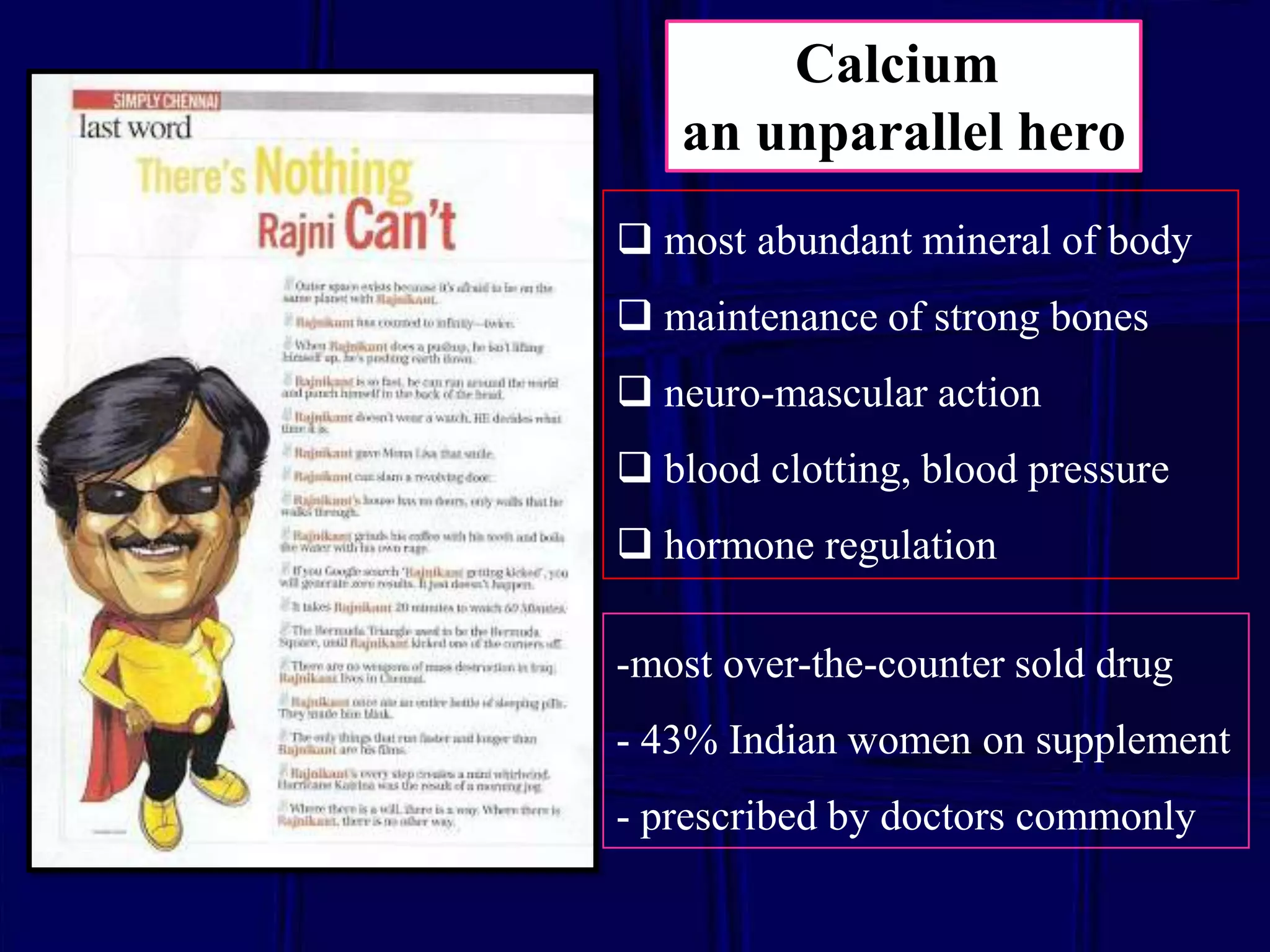
Calcium
an unparallel hero
 most abundant mineral of body
 maintenance of strong bones
 neuro-mascular action
 blood clotting, blood pressure

 hormone regulation
-most over-the-counter sold drug
- 43% Indian women on supplement
- prescribed by doctors commonly
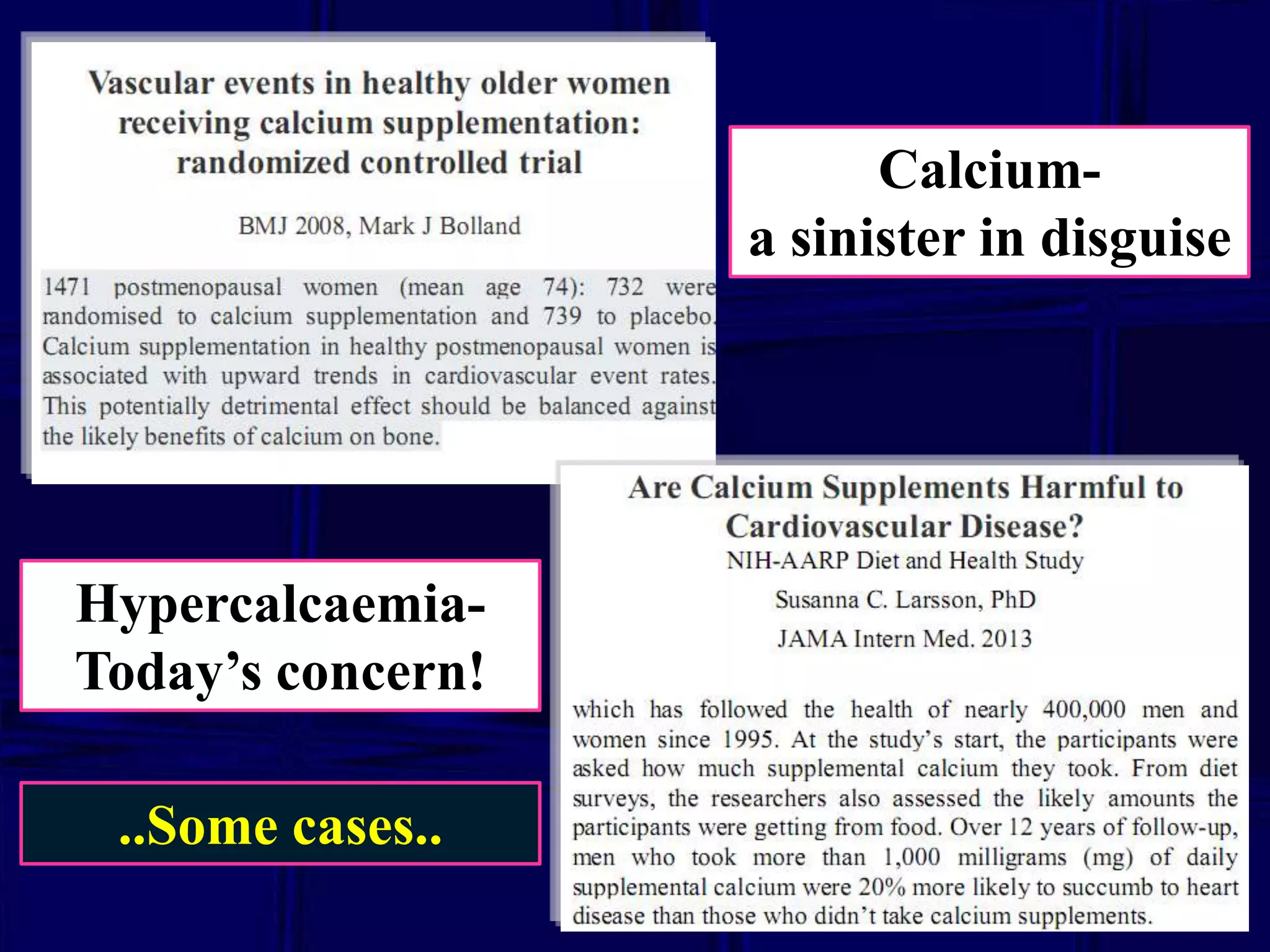
Calciuma sinister in disguise

HypercalcaemiaToday’s concern!
..Some cases..
3
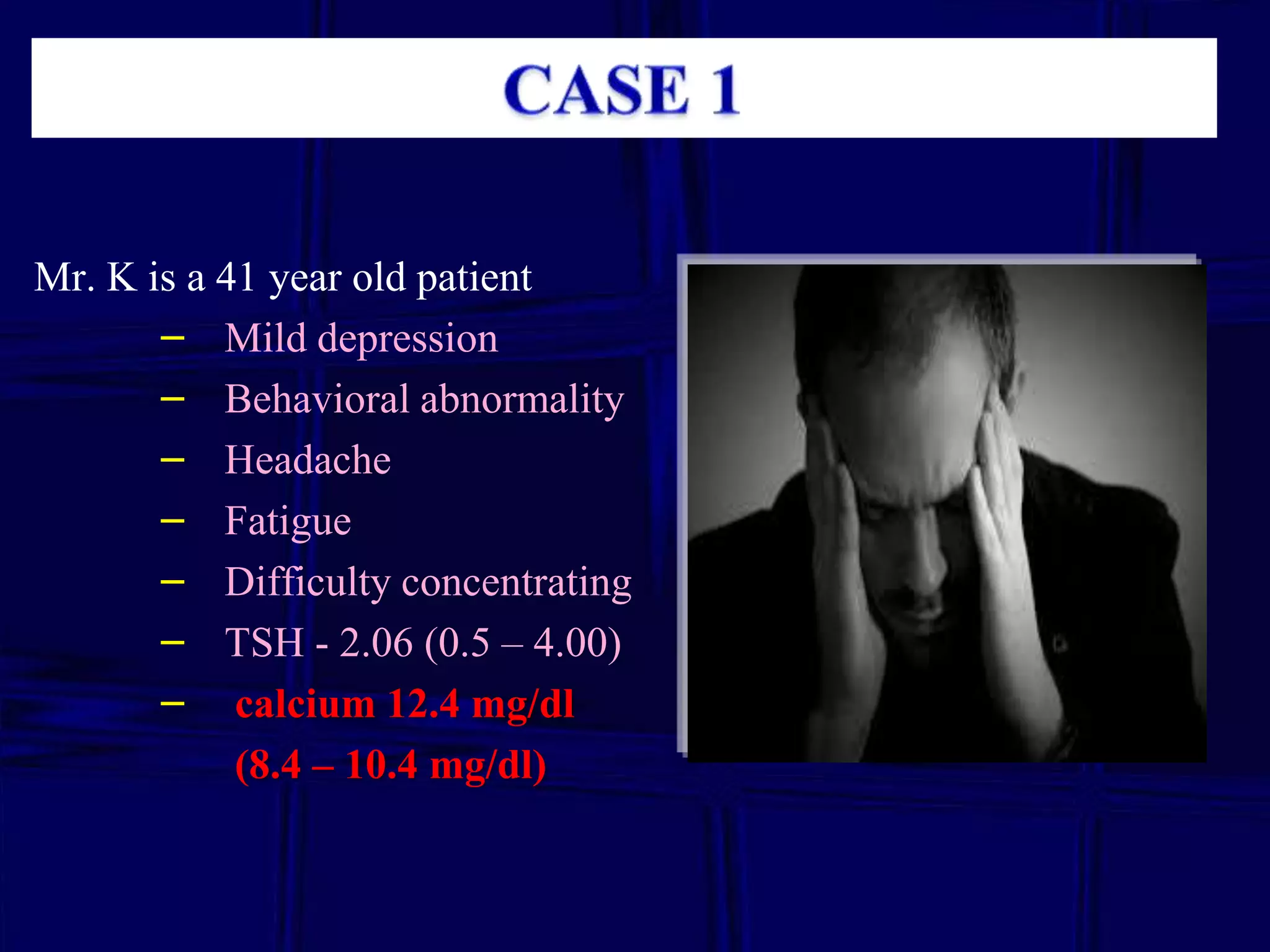
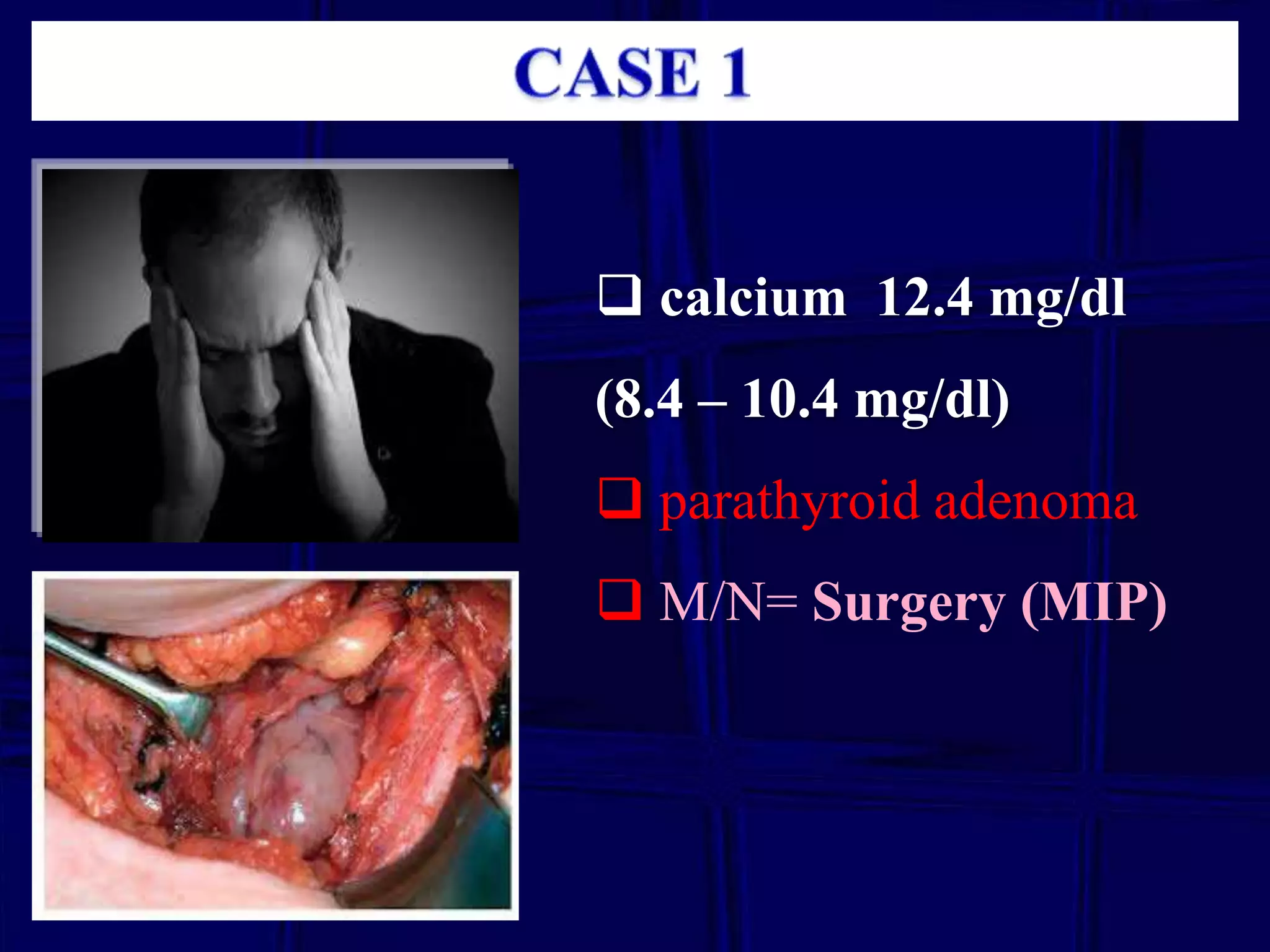
Mr. K is a 41 year old patient
– Mild depression
– Behavioral abnormality
– Headache
– Fatigue
– Difficulty concentrating
– TSH - 2.06 (0.5 – 4.00)
– calcium 12.4 mg/dl
(8.4 – 10.4 mg/dl)


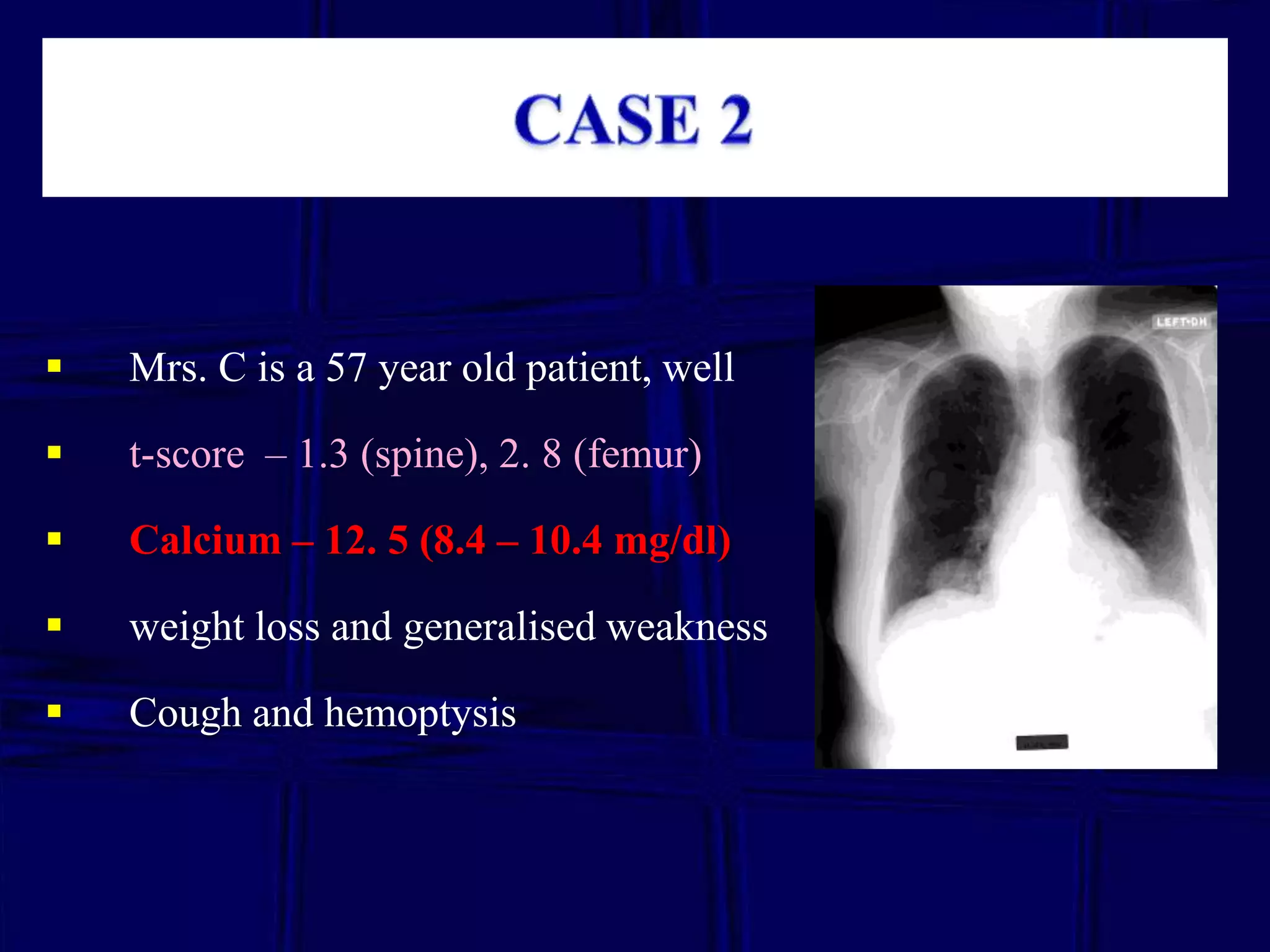
Mrs. C is a 57 year old patient, well


t-score – 1.3 (spine), 2. 8 (femur)


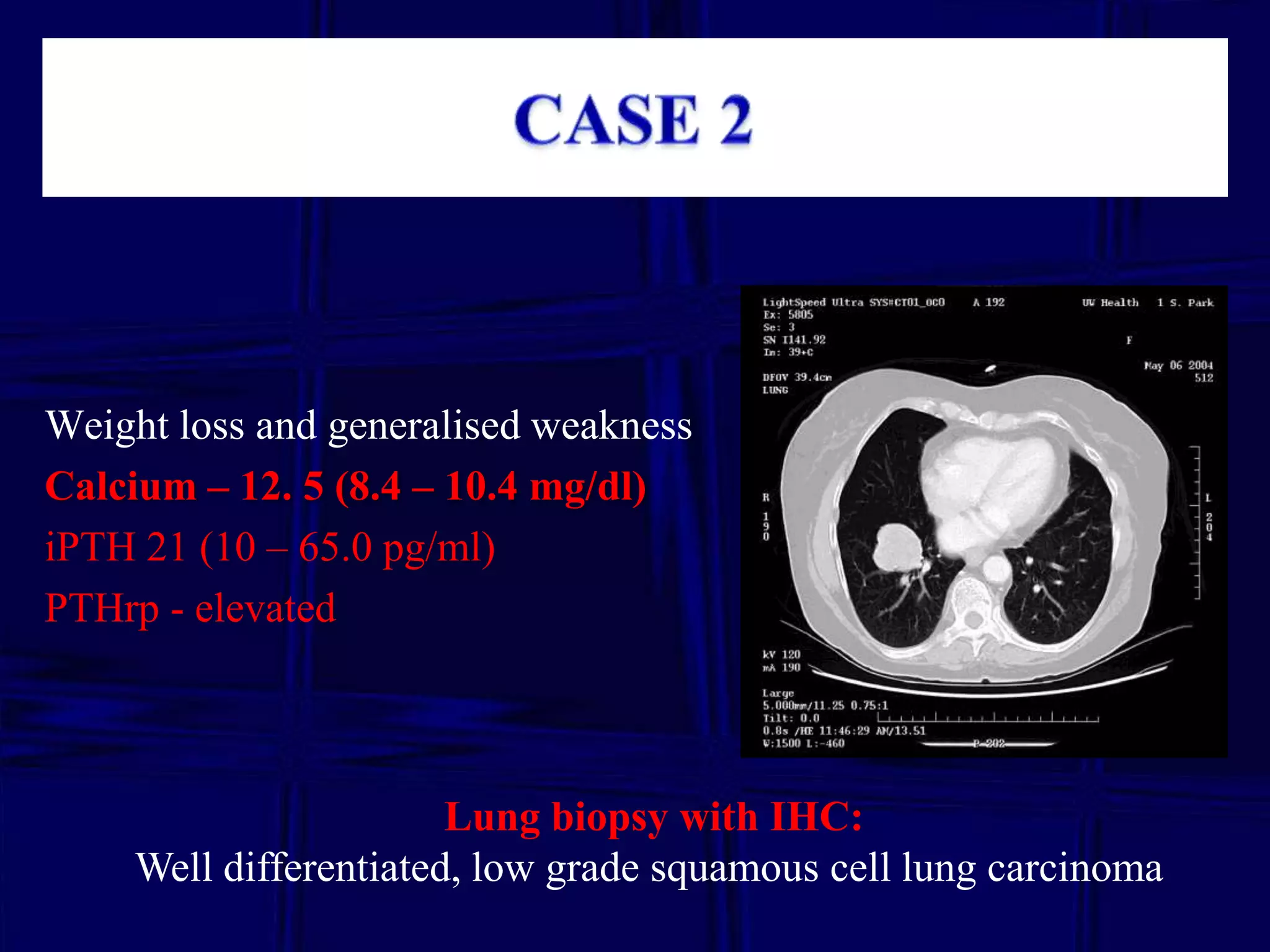
Calcium – 12. 5 (8.4 – 10.4 mg/dl)



weight loss and generalised weakness



Cough and hemoptysis
•
•
•
•
•
•
•
•

A 58-year-woman presented to ER
progressive Multiple sclerosis
Osteoporosis
calcium, 600 mg, 3 times daily
5000-IU cholecalciferol supplement OD
tremors
Altered sensorium
serum calcium 15.2 mg/dL
•
•
•
•
•
•

30-year-old female
Fever, cough
Polyuria, polydypsia, GI upset
constipation, confusion, headache
CECT chest – hilar lympahedenopathy
serum calcium, 13.8 mg/d
•
•
•
•
•

50-year-old male
Diabetic for 10 years
Poorly controlled with OHA
HTN, anasarca, anaemia
serum calcium 14.8 mg/d







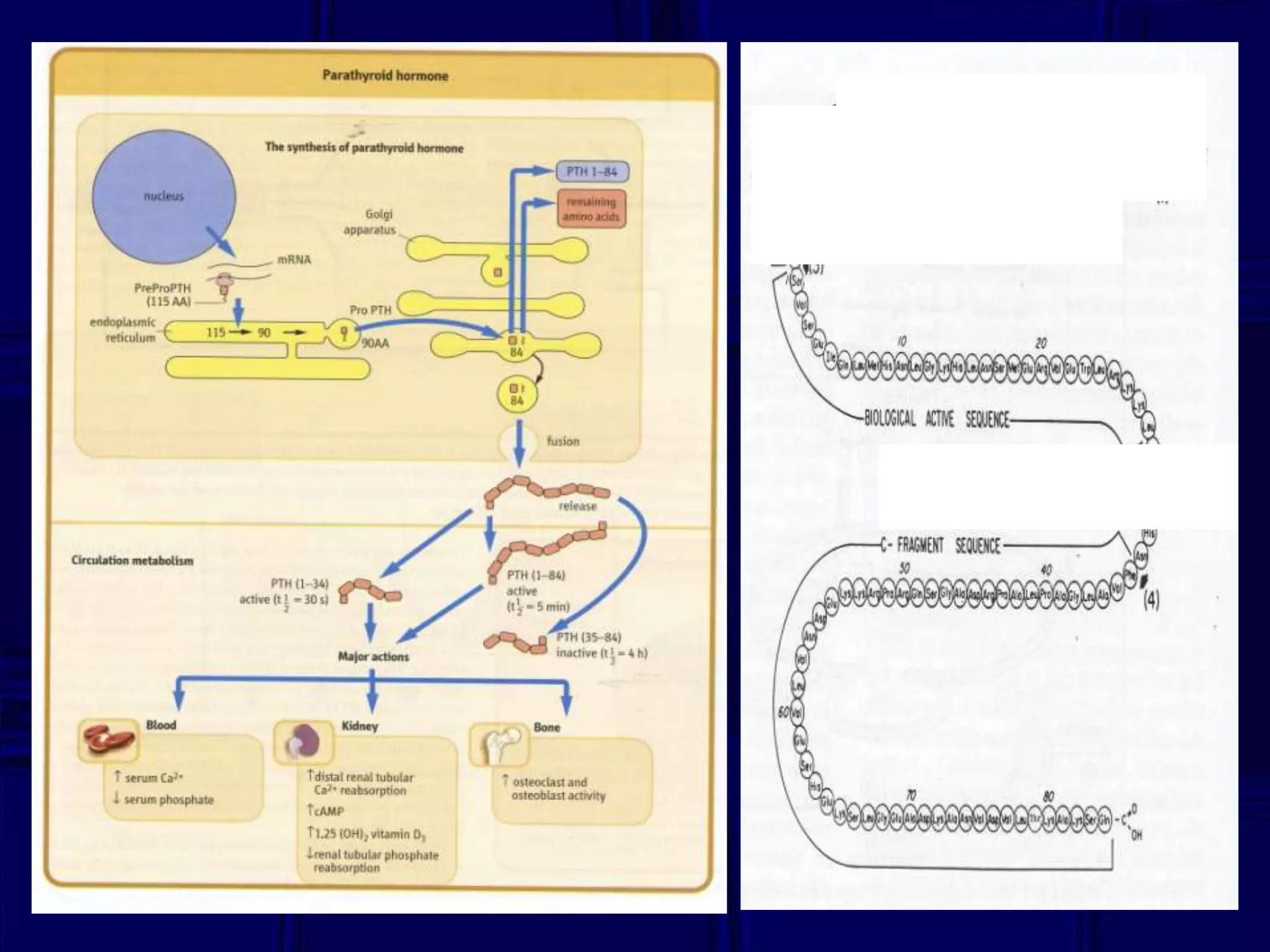
Calcium metabolism
Defining hypercalcaemia
Causes of hypercalcaemia
Cl/f of hypercalceimia
Diagnosis to hypercalcaemia
Management
10
11
13
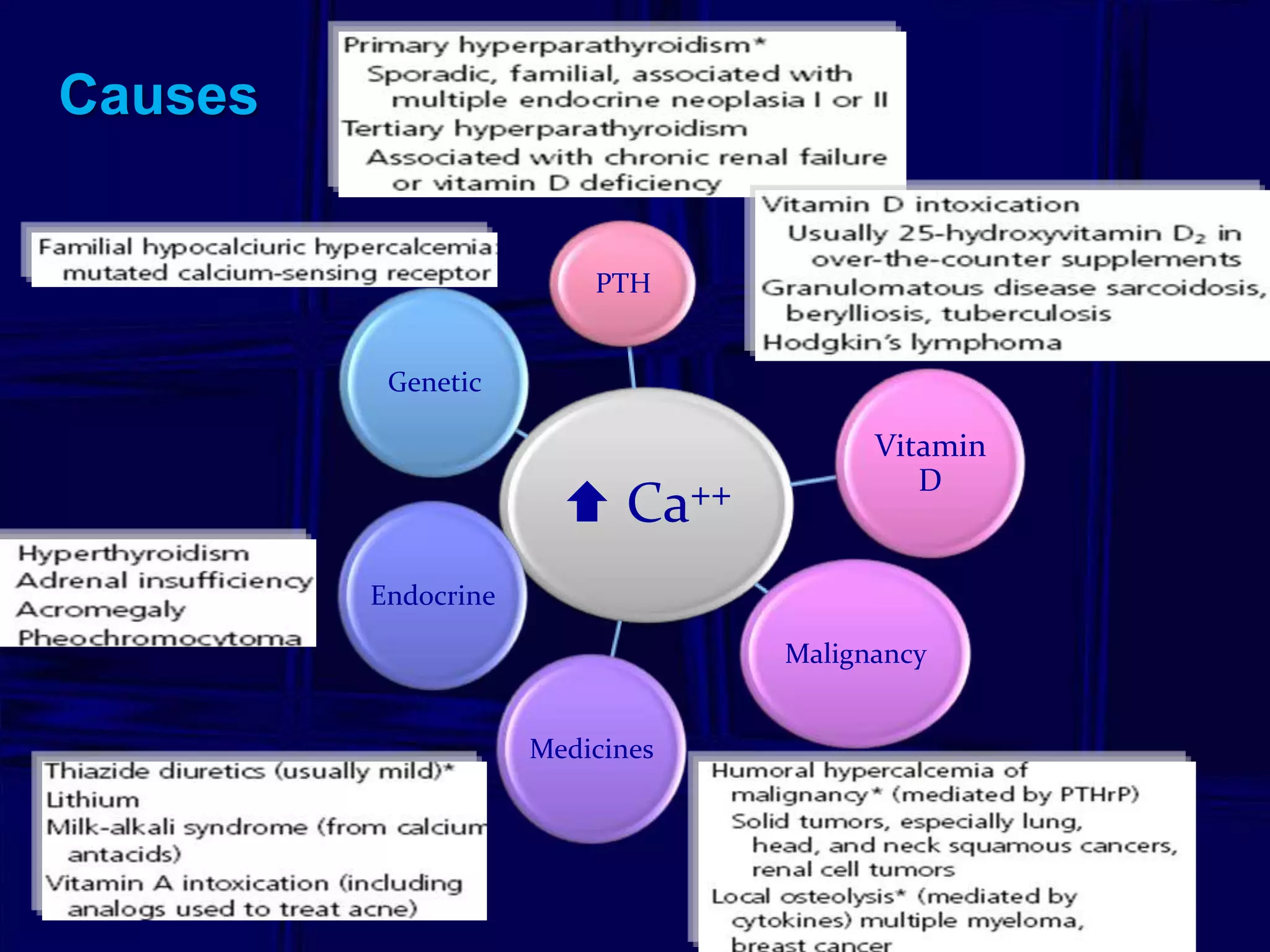
Causes

PTH

Genetic

 Ca++

Vitamin
D

Endocrine
Malignancy
Medicines
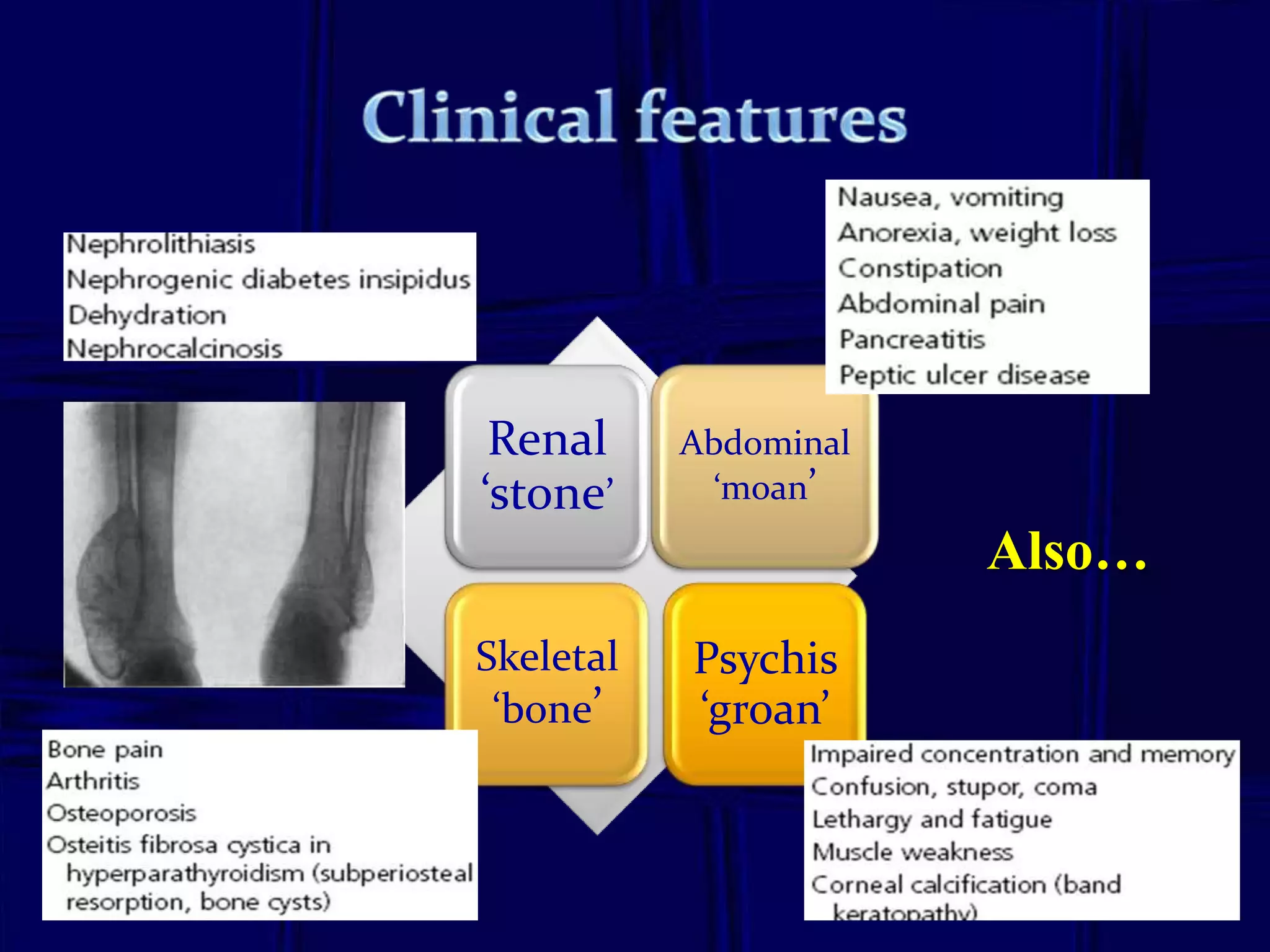
Renal
‘stone’

Abdominal
‘moan’

Skeletal
‘bone’

Psychis
‘groan’

Also…

15
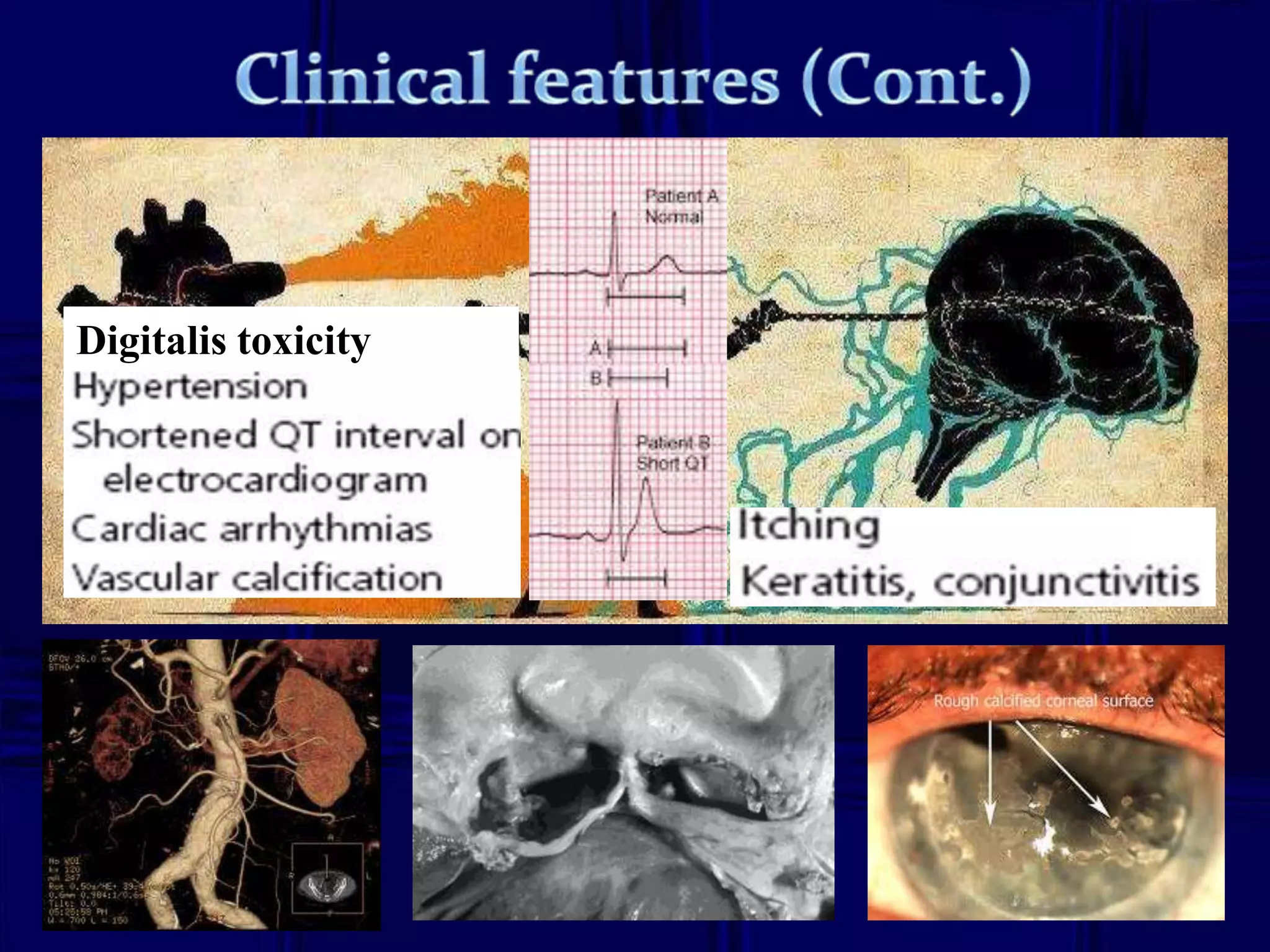
Digitalis toxicity
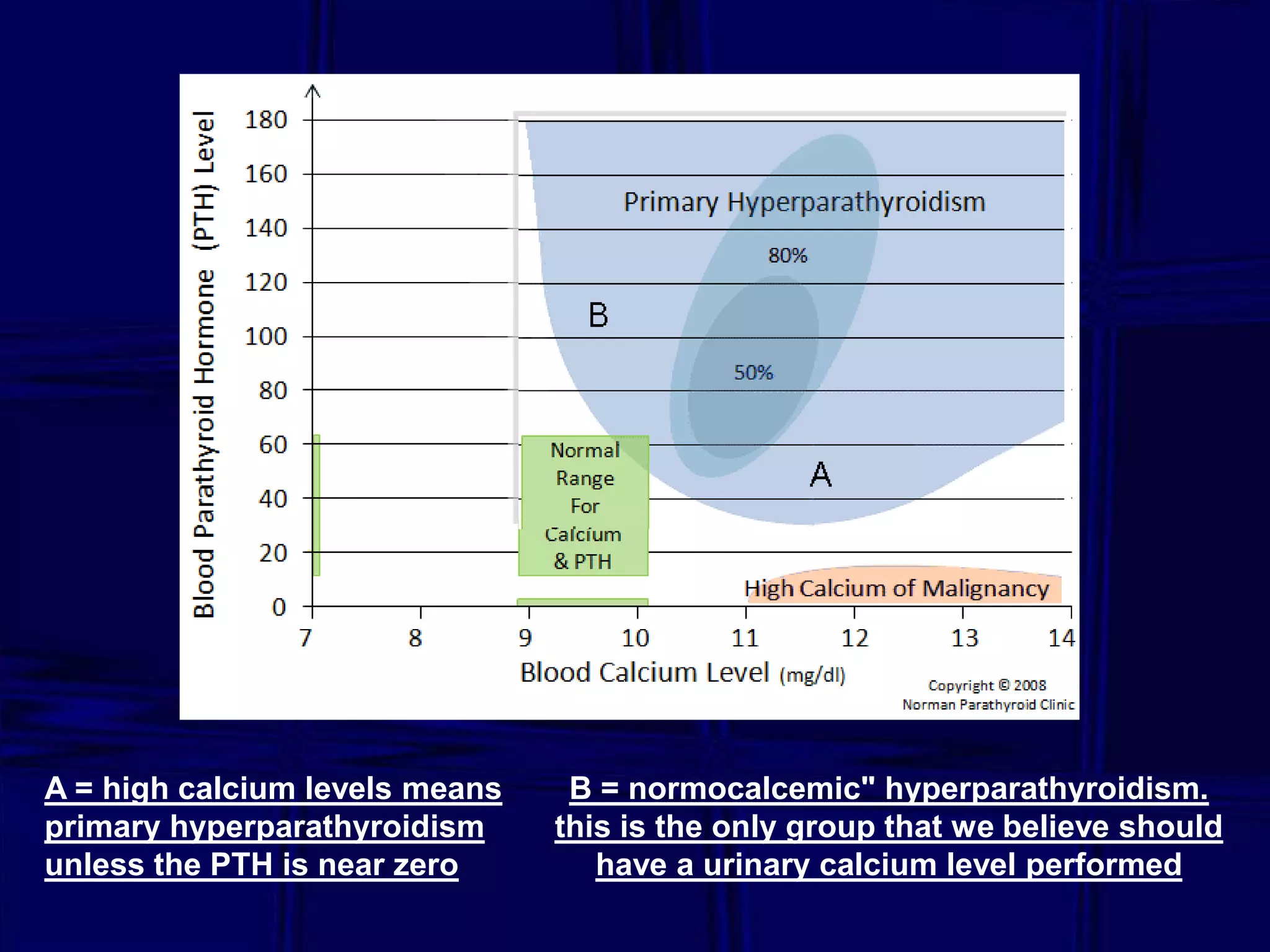
A = high calcium levels means
primary hyperparathyroidism
unless the PTH is near zero

B = normocalcemic" hyperparathyroidism.
this is the only group that we believe should
have a urinary calcium level performed
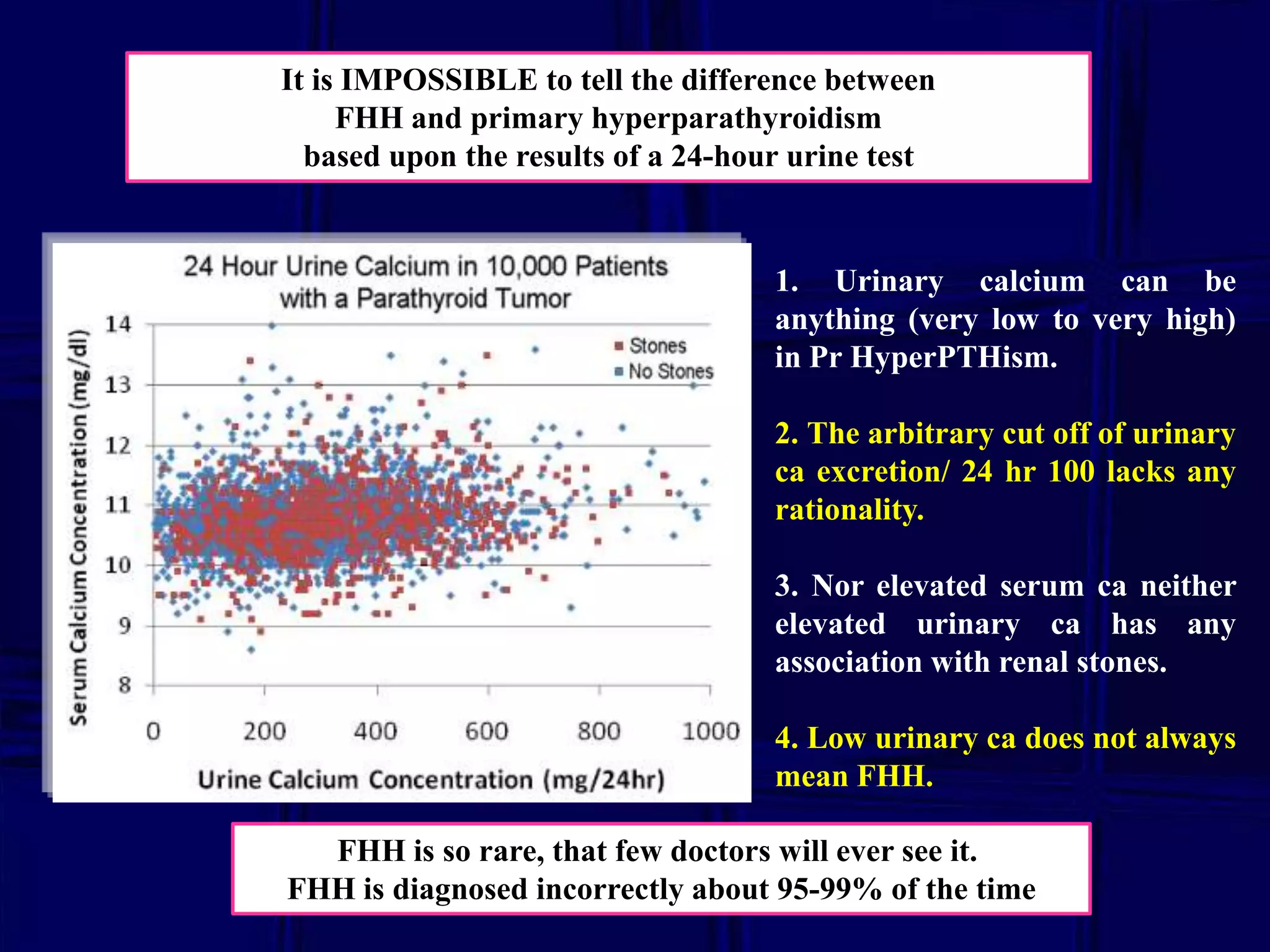
It is IMPOSSIBLE to tell the difference between
FHH and primary hyperparathyroidism
based upon the results of a 24-hour urine test

1. Urinary calcium can be
anything (very low to very high)
in Pr HyperPTHism.
2. The arbitrary cut off of urinary
ca excretion/ 24 hr 100 lacks any
rationality.
3. Nor elevated serum ca neither
elevated urinary ca has any
association with renal stones.
4. Low urinary ca does not always
mean FHH.
FHH is so rare, that few doctors will ever see it.
FHH is diagnosed incorrectly about 95-99% of the time
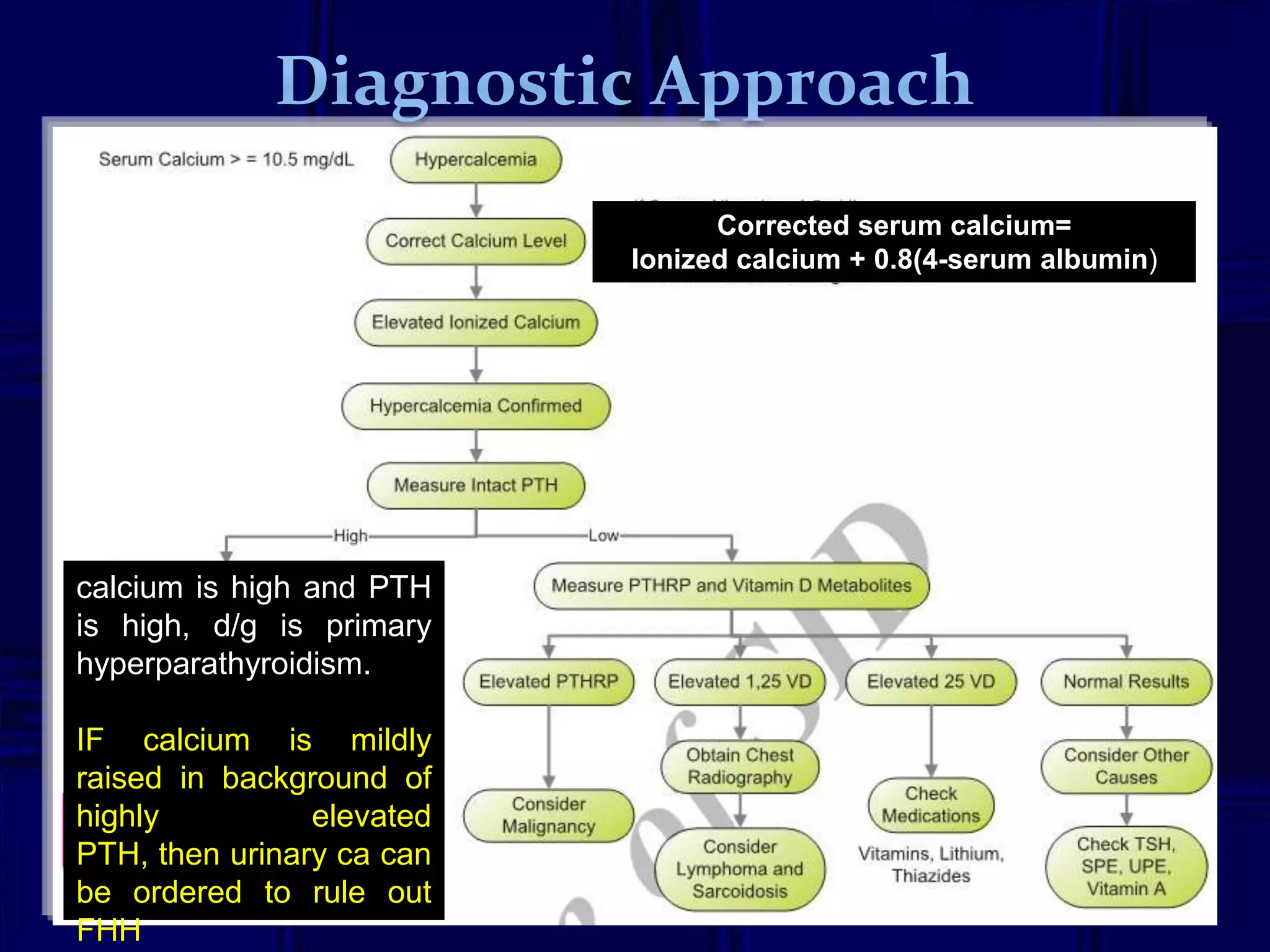
Corrected serum calcium=
Ionized calcium + 0.8(4-serum albumin)

calcium is high and PTH
is high, d/g is primary
hyperparathyroidism.
IF calcium Familial
is mildly
Hypocalciuric
raised in background of
Hypercalcemia
Sestamibi
highly
elevated
N-scan
PTH, then urinary ca can
be ordered to rule out
FHH

19
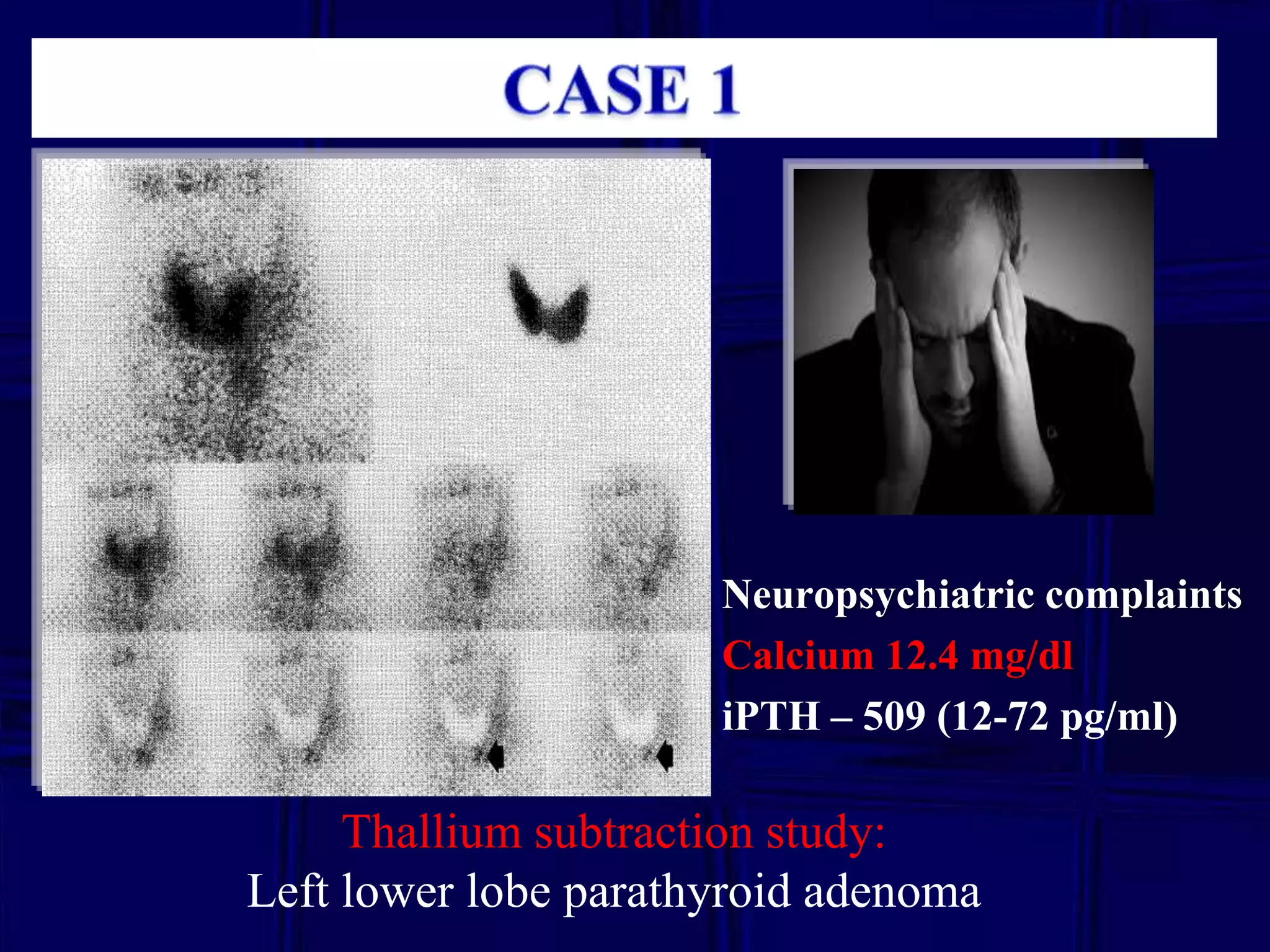
Neuropsychiatric complaints
Calcium 12.4 mg/dl
iPTH – 509 (12-72 pg/ml)

Thallium subtraction study:
Left lower lobe parathyroid adenoma
Weight loss and generalised weakness
Calcium – 12. 5 (8.4 – 10.4 mg/dl)
iPTH 21 (10 – 65.0 pg/ml)
PTHrp - elevated

Lung biopsy with IHC:
Well differentiated, low grade squamous cell lung carcinoma
•
•
•
•

calcium, cholecalciferol supplement
serum calcium14.6 mg/dL (15.2 mg/dL)
iPTH - 4 pg/mL (N12-65 pg/mL
25-OH D level 103 ng/mL (N>30 ng/ml)

Vit D overdose
22
•
•
•
•
•

CECT chest – hilar lympahedenopathy
serum calcium, 13.8 mg/d
iPTH - 4 pg/mL (N12-65 pg/mL
1, 25-OH D level elevated
Serum ACEase – highly raised

Hilar LN Bx – non caseating granulomas
Sarcoidosis
23
•
•
•
•

T2DM
CKD
serum calcium 14.8 mg/d
iPTH – 209 (12-72 pg/ml)

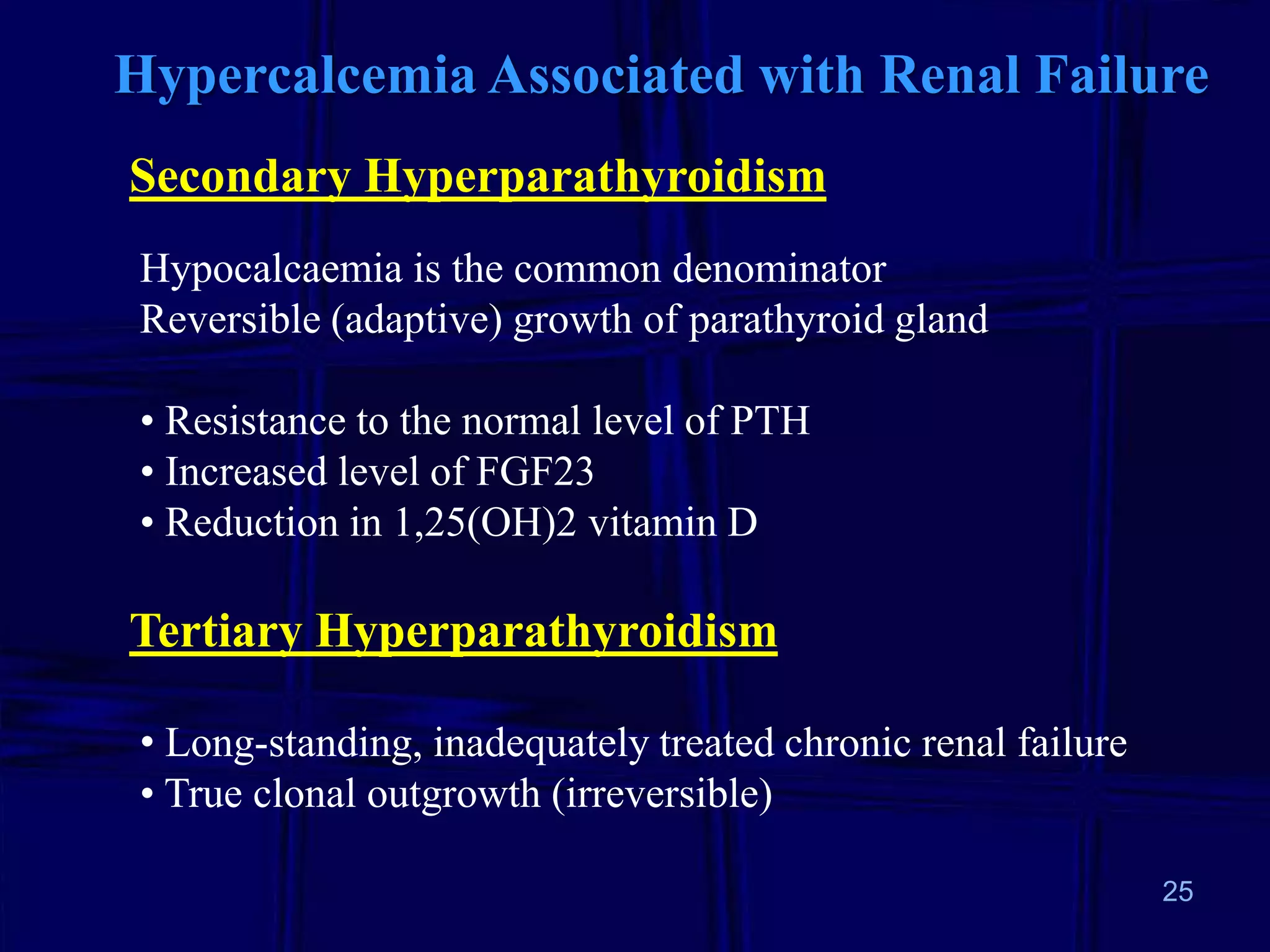
Hypercalcemia Associated with Renal Failure
Secondary Hyperparathyroidism
Hypocalcaemia is the common denominator
Reversible (adaptive) growth of parathyroid gland
• Resistance to the normal level of PTH
• Increased level of FGF23
• Reduction in 1,25(OH)2 vitamin D

Tertiary Hyperparathyroidism
• Long-standing, inadequately treated chronic renal failure
• True clonal outgrowth (irreversible)
25
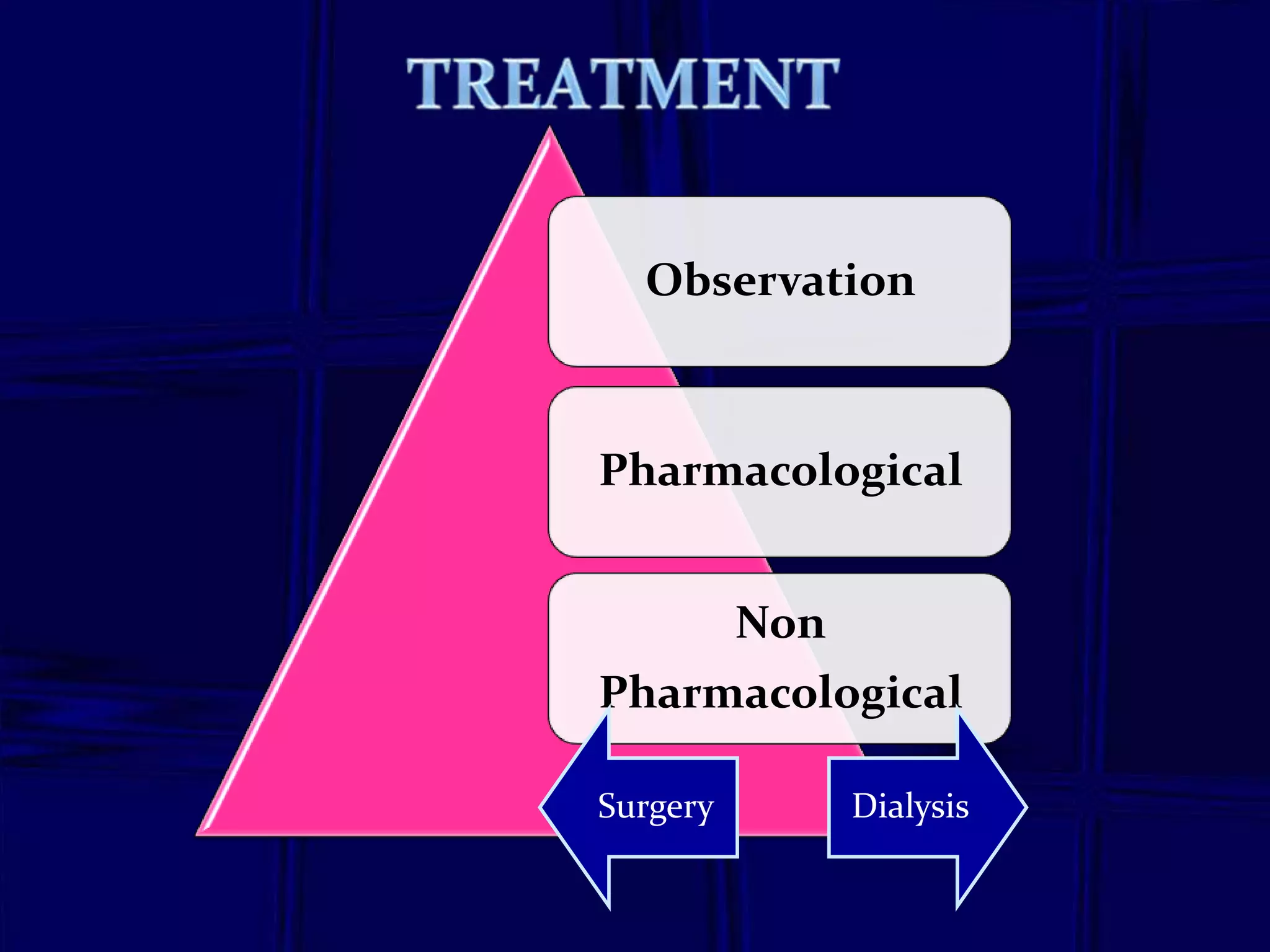
Observation

Pharmacological
Non
Pharmacological
Surgery

Dialysis
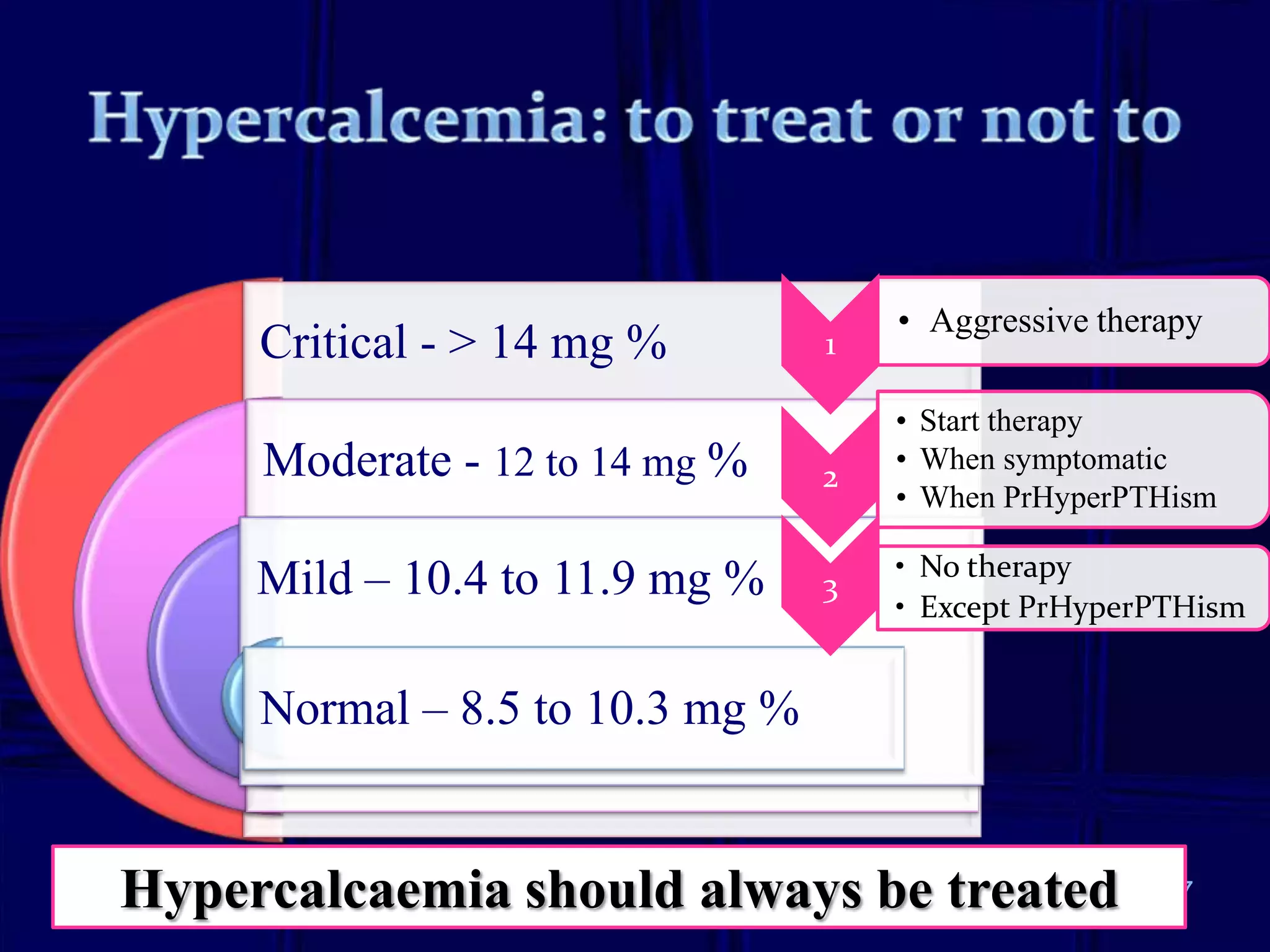
Critical - > 14 mg %

1

Moderate - 12 to 14 mg %

2

Mild – 10.4 to 11.9 mg %

3

• Aggressive therapy
• Start therapy
• When symptomatic
• When PrHyperPTHism
• No therapy
• Except PrHyperPTHism

Normal – 8.5 to 10.3 mg %

Hypercalcaemia should always be treated

27
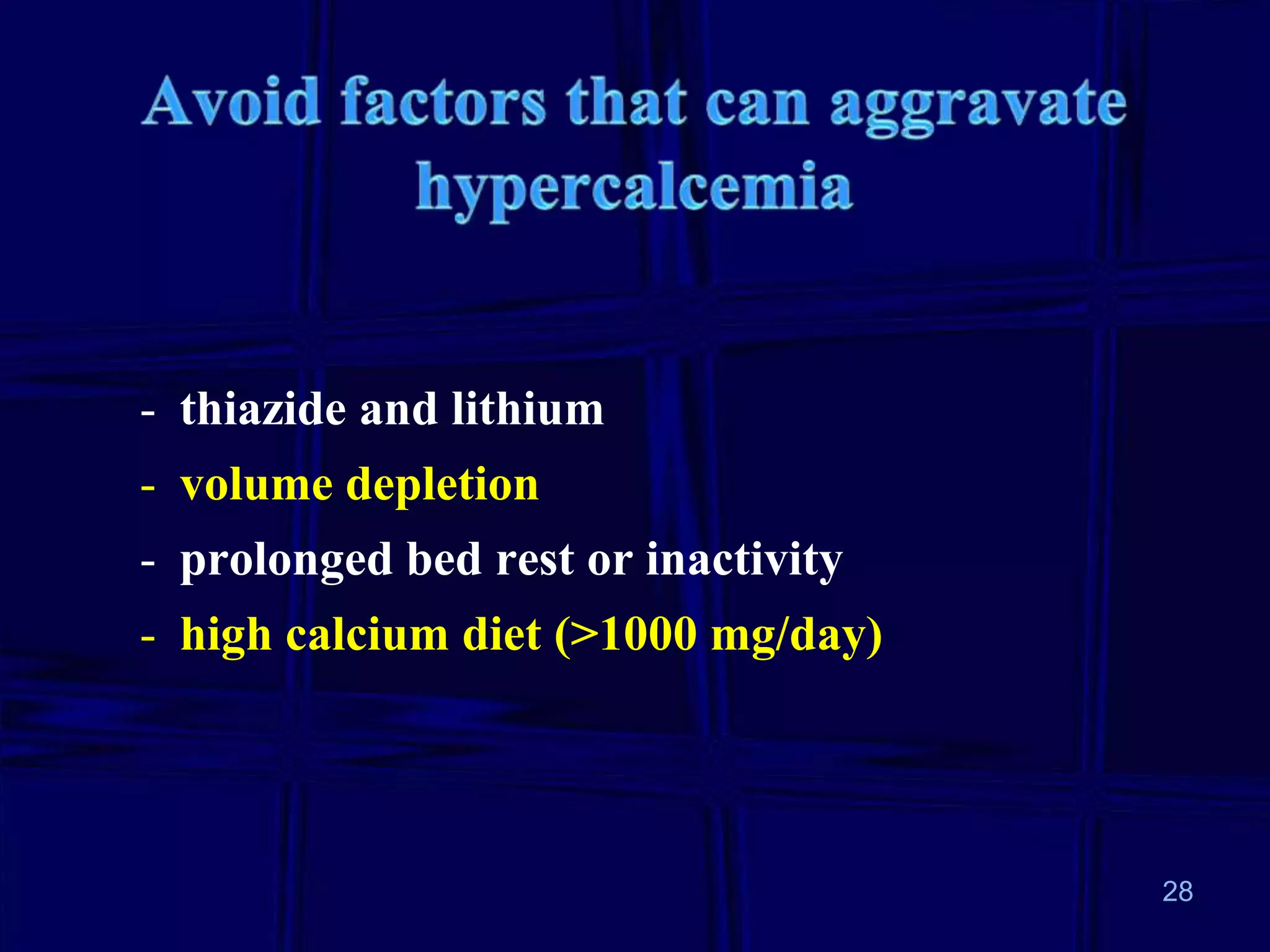
- thiazide and lithium
- volume depletion

- prolonged bed rest or inactivity
- high calcium diet (>1000 mg/day)

28
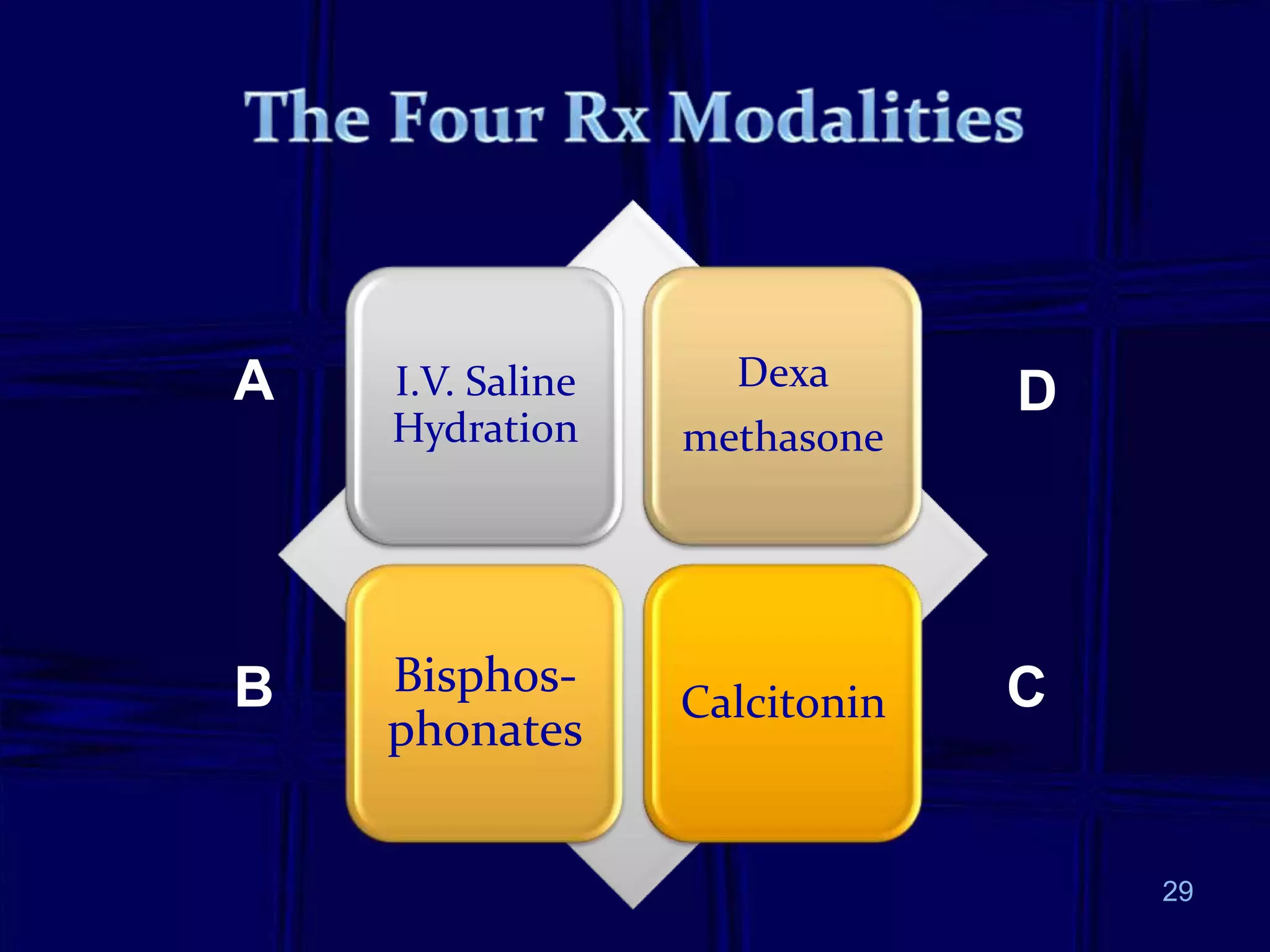
A

B

I.V. Saline
Hydration

Bisphosphonates

Dexa
methasone

Calcitonin

D

C

29
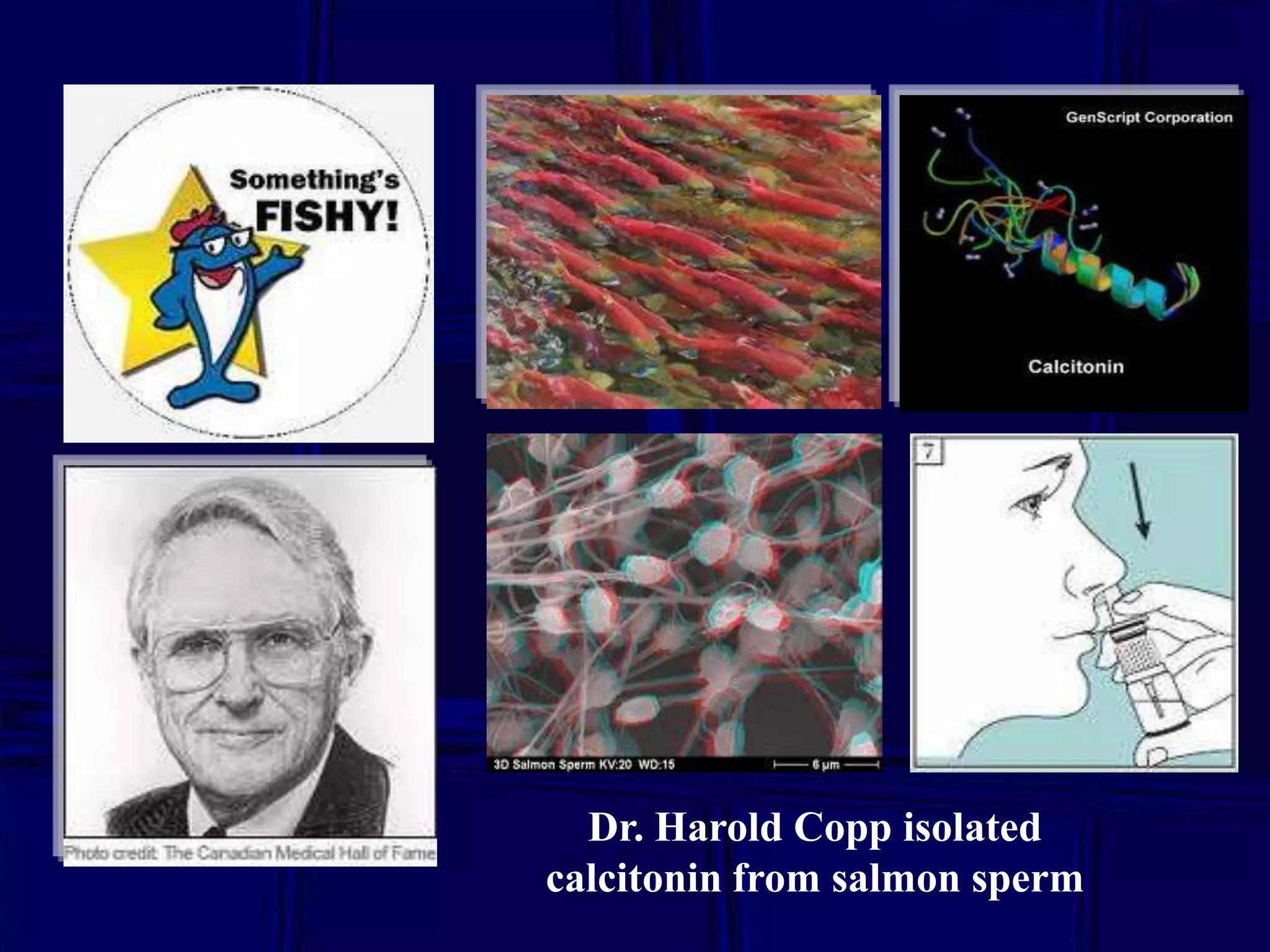
Dr. Harold Copp isolated
calcitonin from salmon sperm
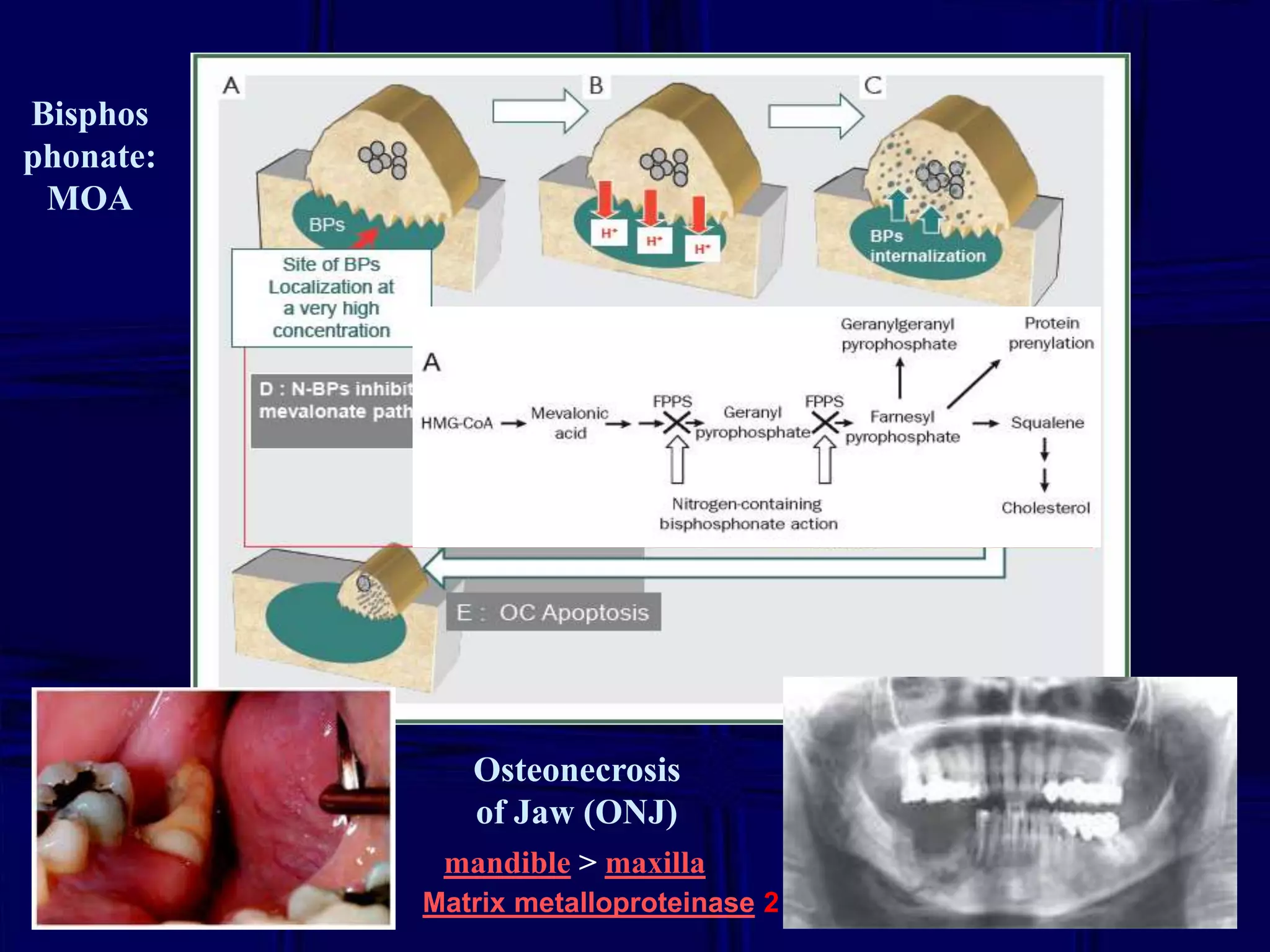
Bisphos
phonate:
MOA

Osteonecrosis
of Jaw (ONJ)
mandible > maxilla
Matrix metalloproteinase 2
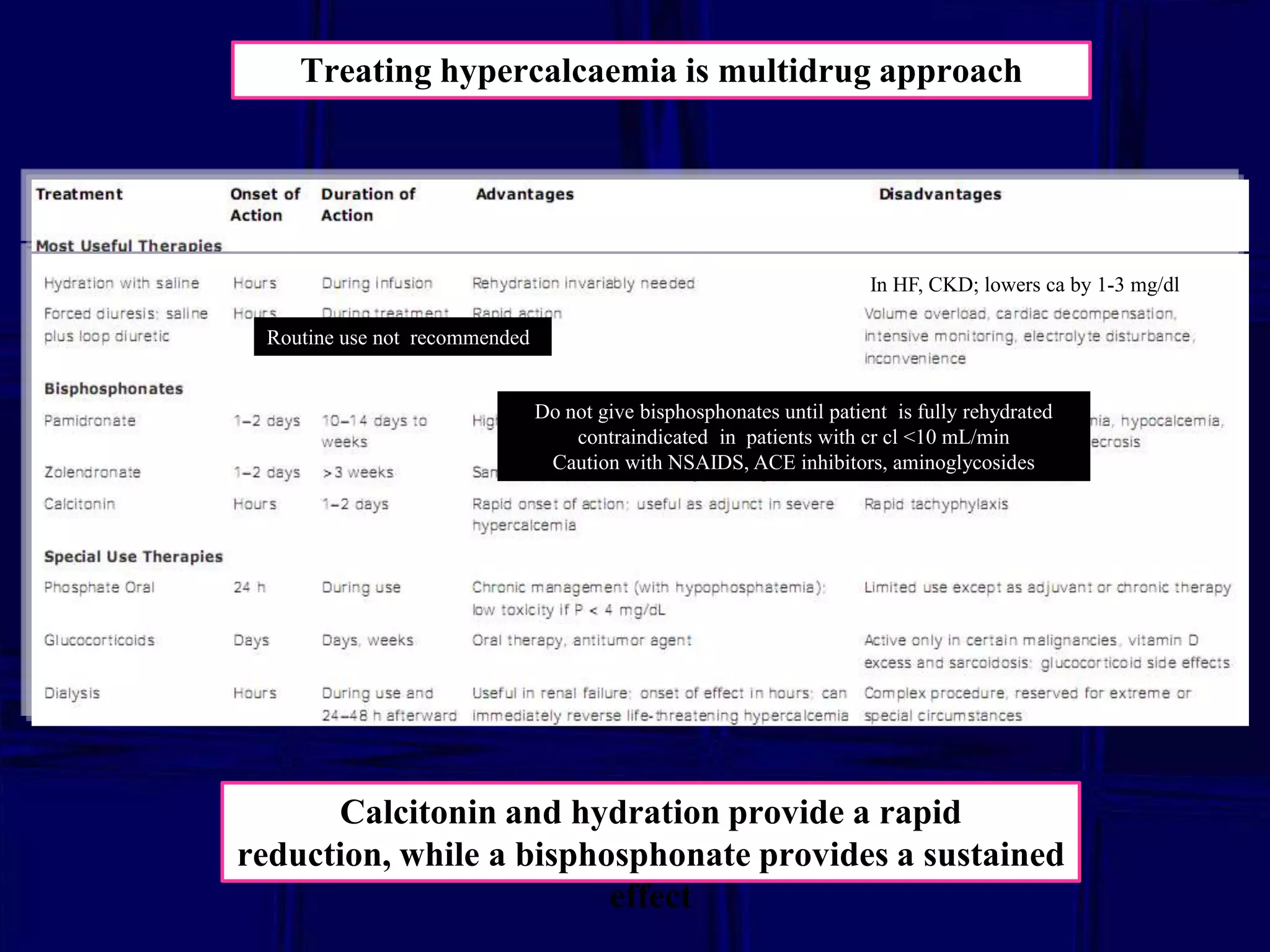
Treating hypercalcaemia is multidrug approach

In HF, CKD; lowers ca by 1-3 mg/dl
Routine use not recommended

Do not give bisphosphonates until patient is fully rehydrated
contraindicated in patients with cr cl <10 mL/min
Caution with NSAIDS, ACE inhibitors, aminoglycosides

Calcitonin and hydration provide a rapid
reduction, while a bisphosphonate provides a sustained
effect
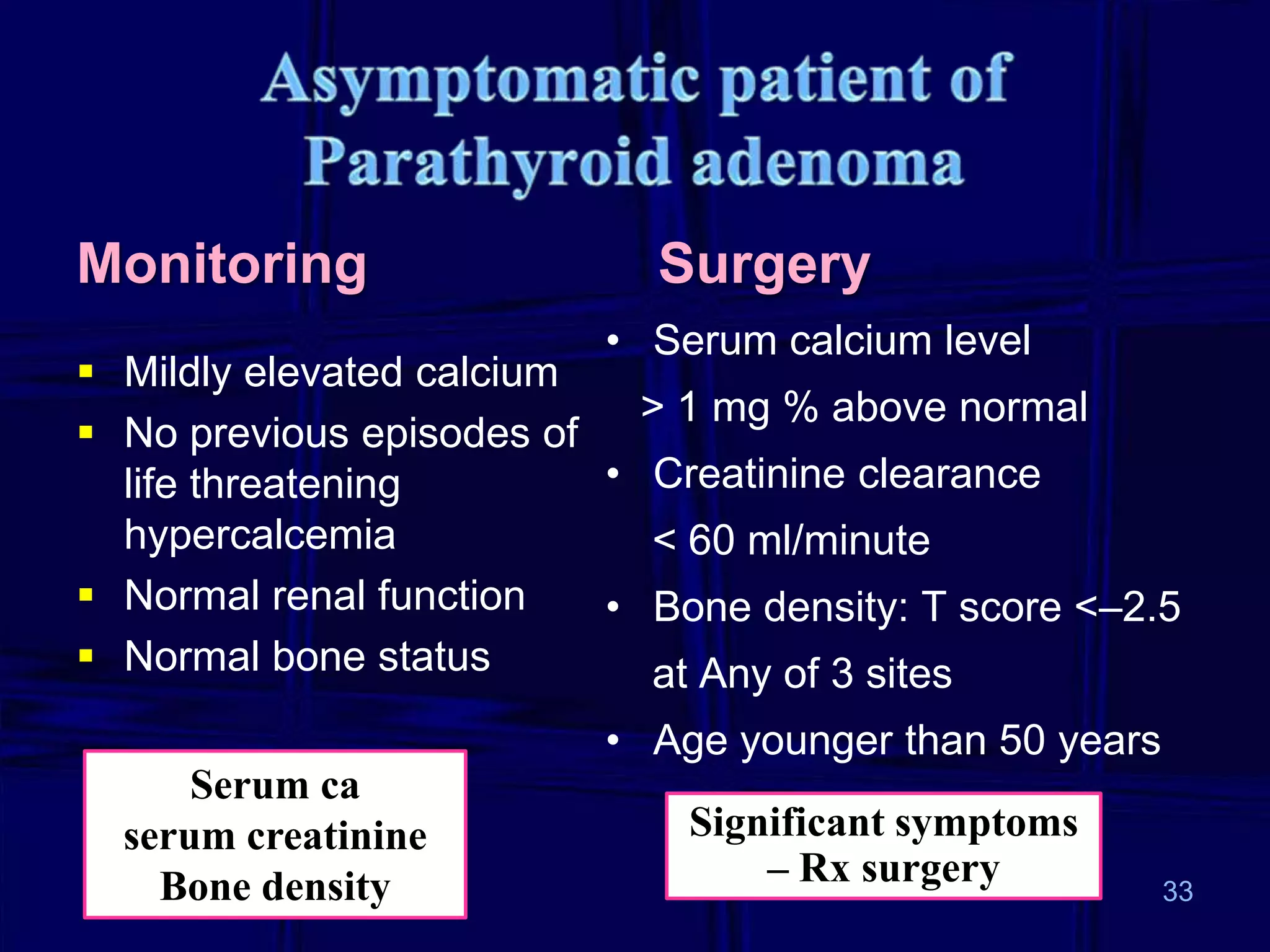
Monitoring

Surgery
• Serum calcium level

 Mildly elevated calcium
> 1 mg % above normal
 No previous episodes of
• Creatinine clearance
life threatening
hypercalcemia
< 60 ml/minute
 Normal renal function
• Bone density: T score <–2.5
 Normal bone status
at Any of 3 sites
• Age younger than 50 years
Serum ca
serum creatinine
Bone density

Significant symptoms
– Rx surgery

33
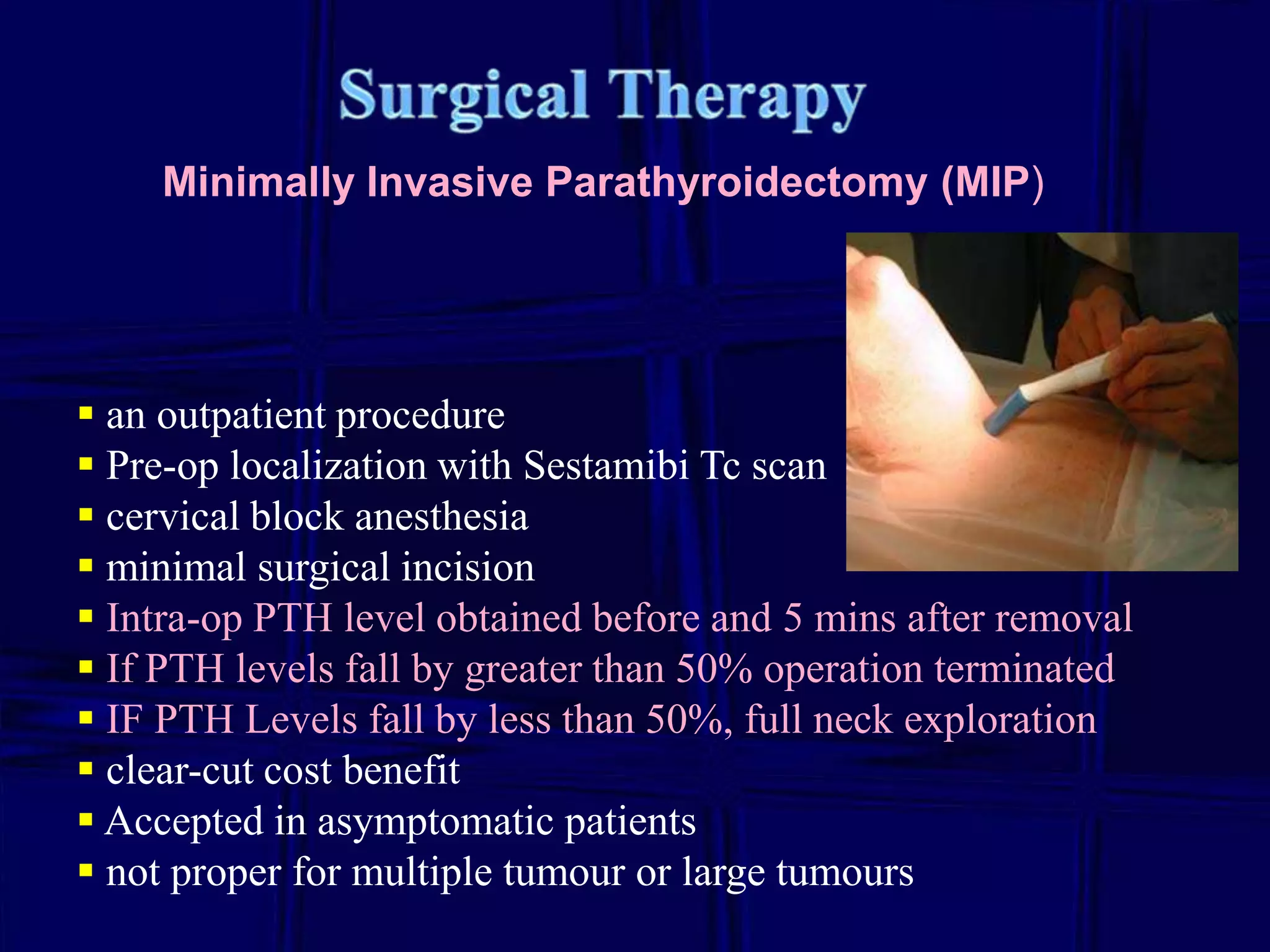
Minimally Invasive Parathyroidectomy (MIP)

 an outpatient procedure
 Pre-op localization with Sestamibi Tc scan
 cervical block anesthesia
 minimal surgical incision
 Intra-op PTH level obtained before and 5 mins after removal
 If PTH levels fall by greater than 50% operation terminated
 IF PTH Levels fall by less than 50%, full neck exploration
 clear-cut cost benefit
 Accepted in asymptomatic patients
 not proper for multiple tumour or large tumours
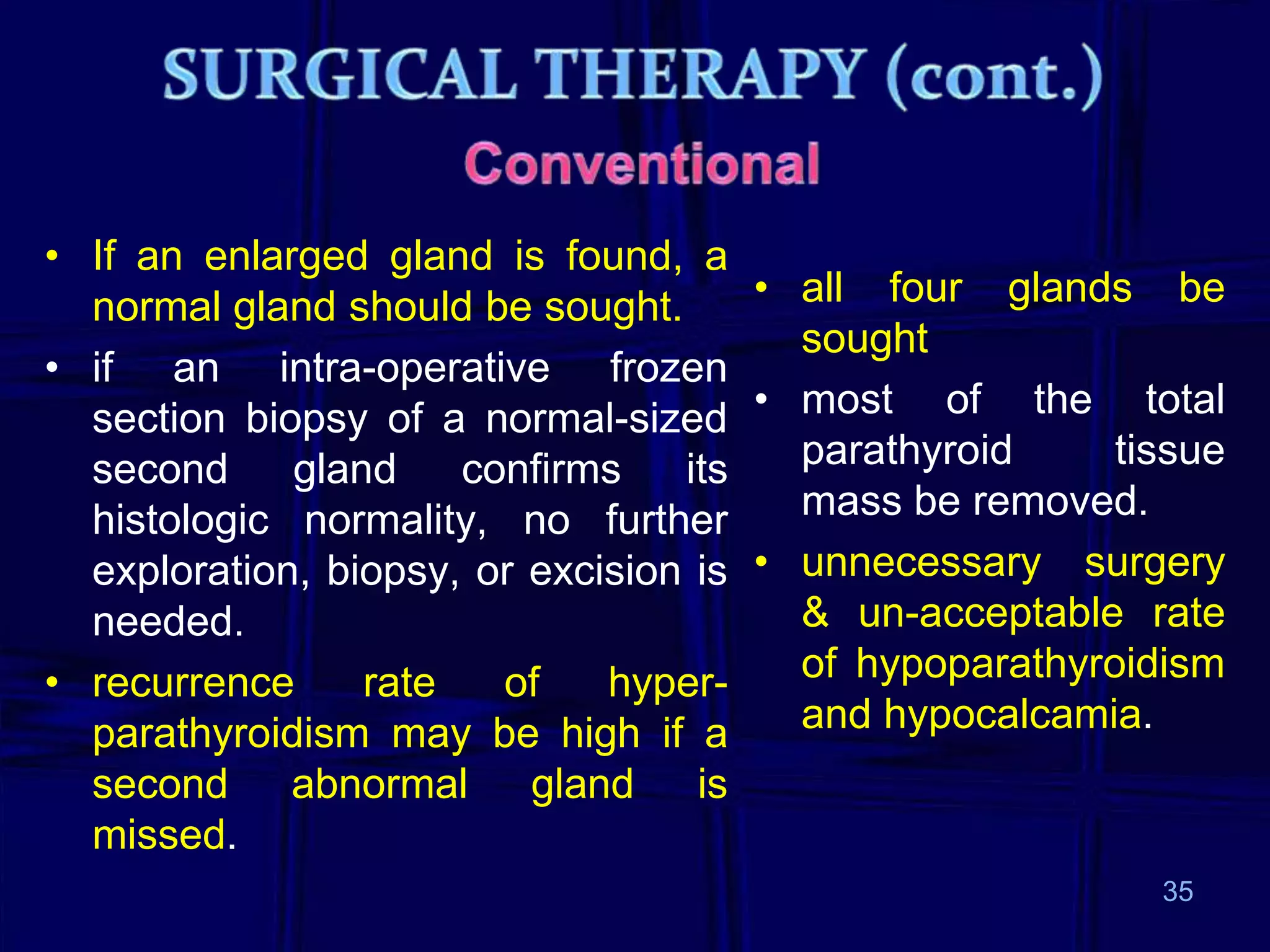
• If an enlarged gland is found, a
• all four glands be
normal gland should be sought.
sought
• if an intra-operative frozen
section biopsy of a normal-sized • most of the total
parathyroid
tissue
second
gland
confirms
its
mass be removed.
histologic normality, no further
exploration, biopsy, or excision is • unnecessary surgery
& un-acceptable rate
needed.
of hypoparathyroidism
• recurrence
rate
of
hyperand hypocalcamia.
parathyroidism may be high if a
second abnormal gland is
missed.
35
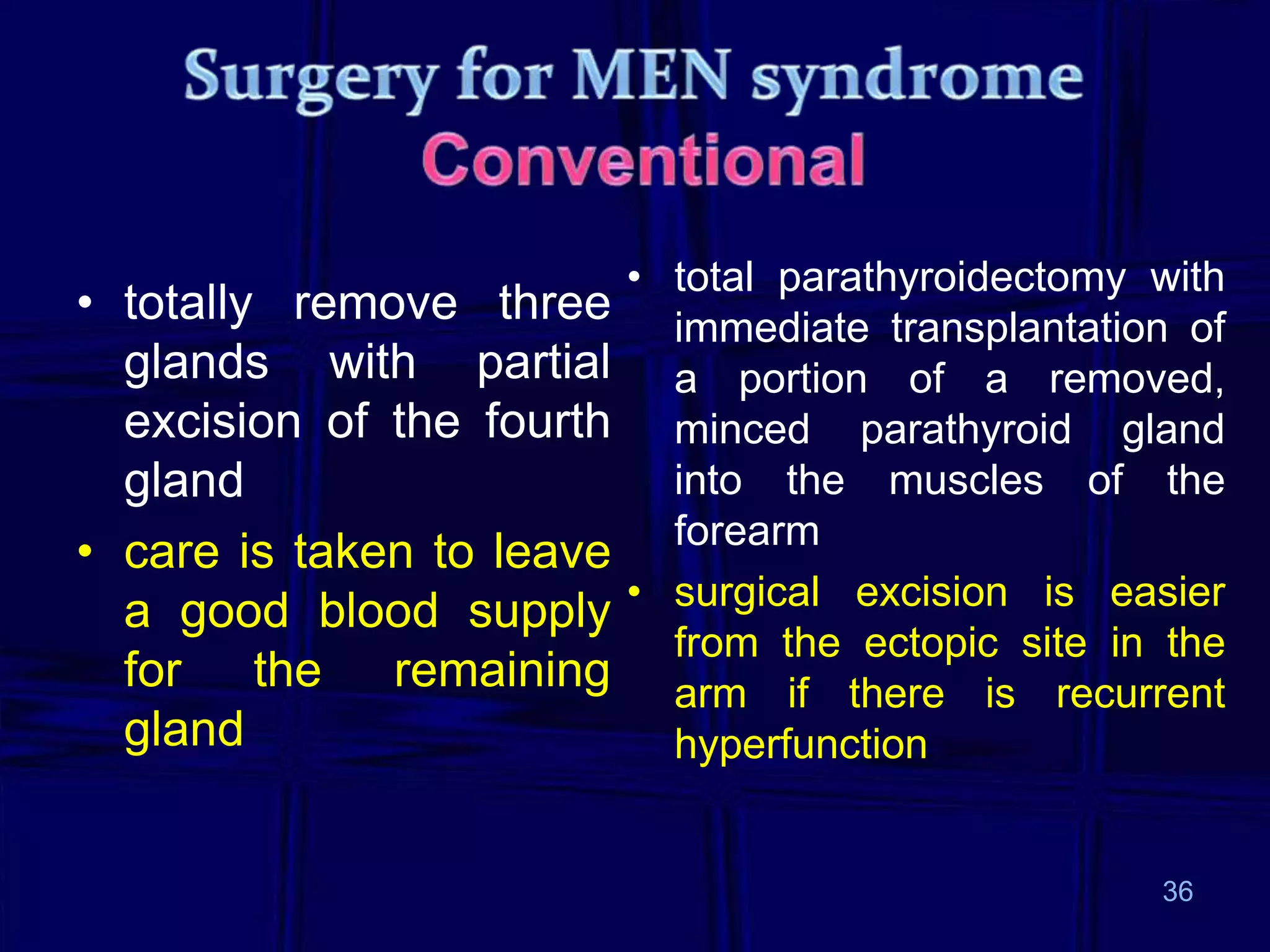
• totally remove three
glands with partial
excision of the fourth
gland
• care is taken to leave
a good blood supply
for the remaining
gland

• total parathyroidectomy with
immediate transplantation of
a portion of a removed,
minced parathyroid gland
into the muscles of the
forearm
• surgical excision is easier
from the ectopic site in the
arm if there is recurrent
hyperfunction

36
 calcium 12.4 mg/dl
(8.4 – 10.4 mg/dl)
 parathyroid adenoma
 M/N= Surgery (MIP)
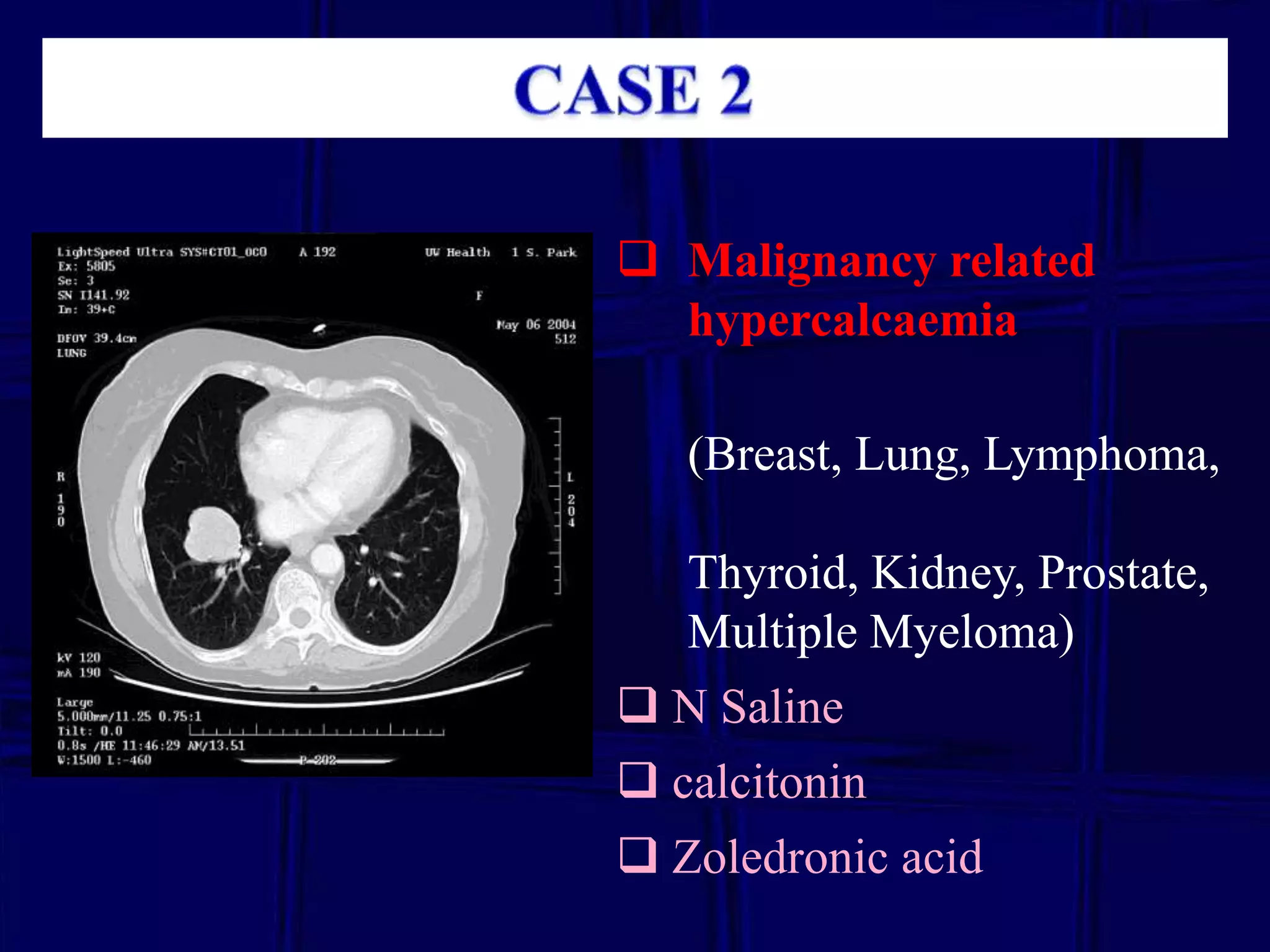
 Malignancy related
hypercalcaemia
(Breast, Lung, Lymphoma,
Thyroid, Kidney, Prostate,
Multiple Myeloma)
 N Saline

 calcitonin
 Zoledronic acid
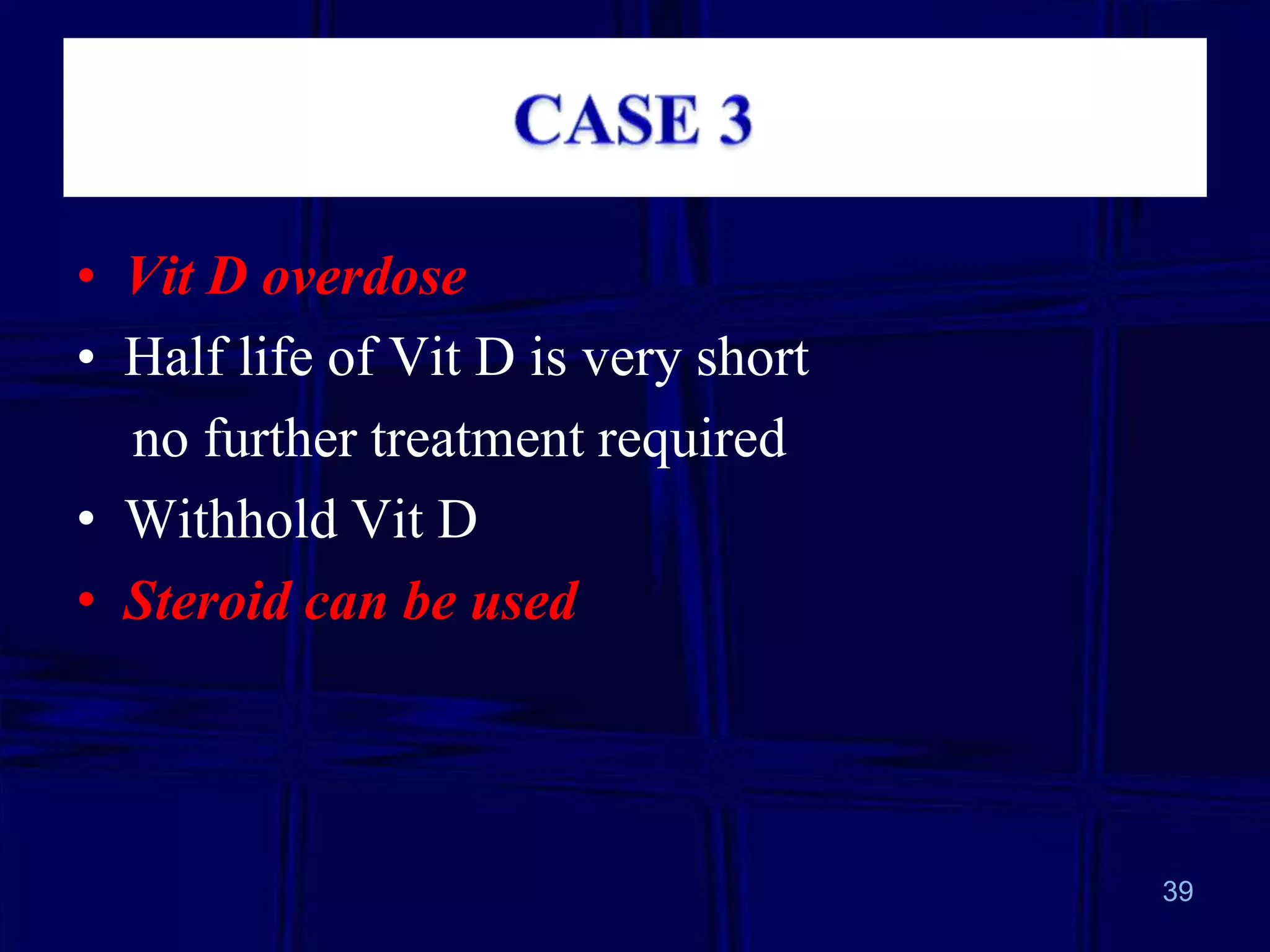
• Vit D overdose
• Half life of Vit D is very short
no further treatment required
• Withhold Vit D
• Steroid can be used

39
•
•
•
•

Acute symptomatic hypercalcaemia
Sarcoidosis (granulomatous disease; DHCC related)
NS
Steroid

40
• Hypercalcemia Associated with Renal Failure
• Secondary hyperparathyroidism
• calcitriol
• Dialysis if life threatening
Secondary hyperparatyroidism
• restriction of dietary phosphate,
• the use of non-absorbable antacids
• careful, selective addition of calcitriol
Tertiary Hyperparatyroidism
• Partial removal of parathyroid gland
42
S
U
M
M
A
R
Y

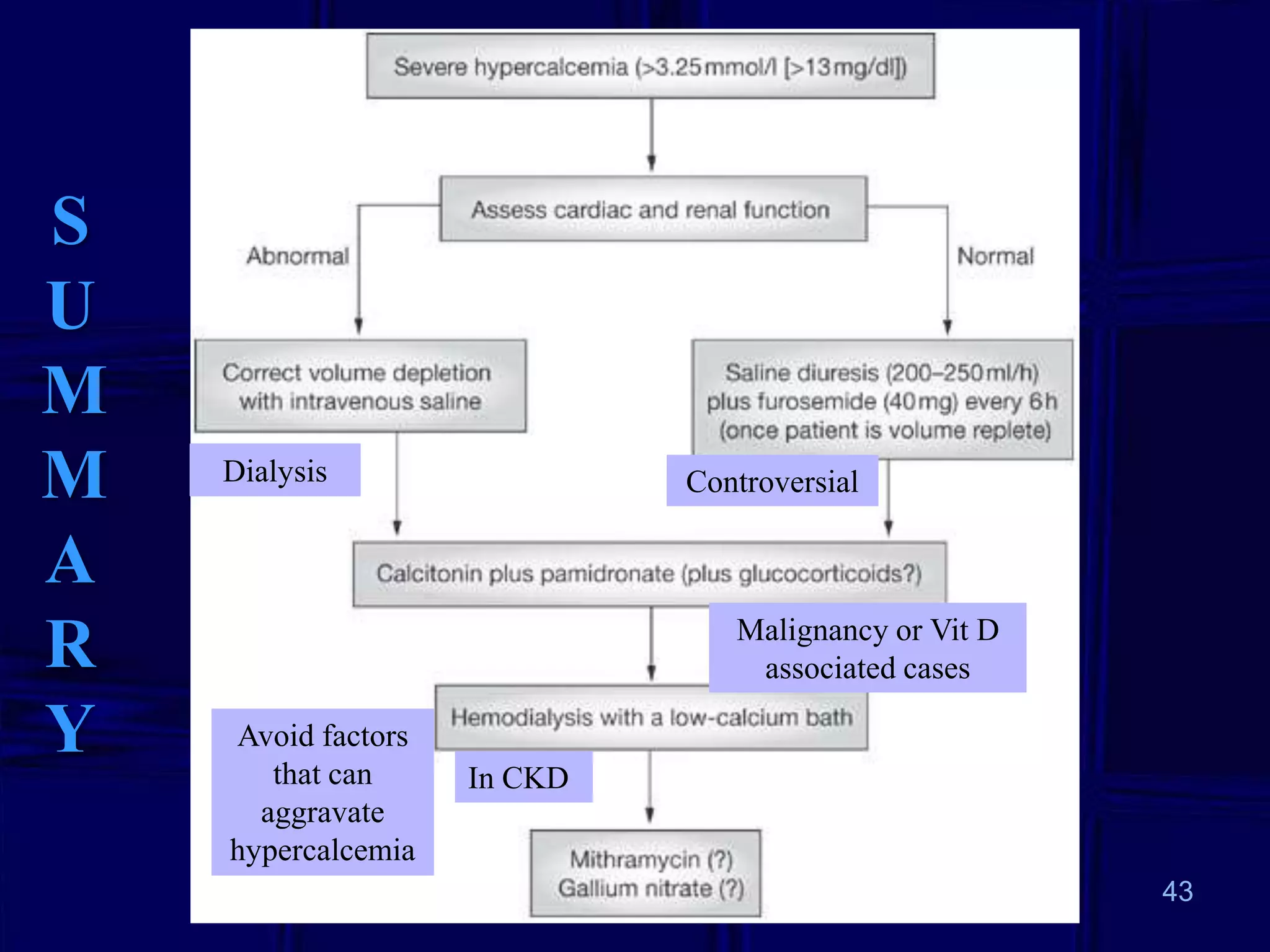
Dialysis

Controversial

Malignancy or Vit D
associated cases
Avoid factors
that can
aggravate
hypercalcemia

In CKD

43
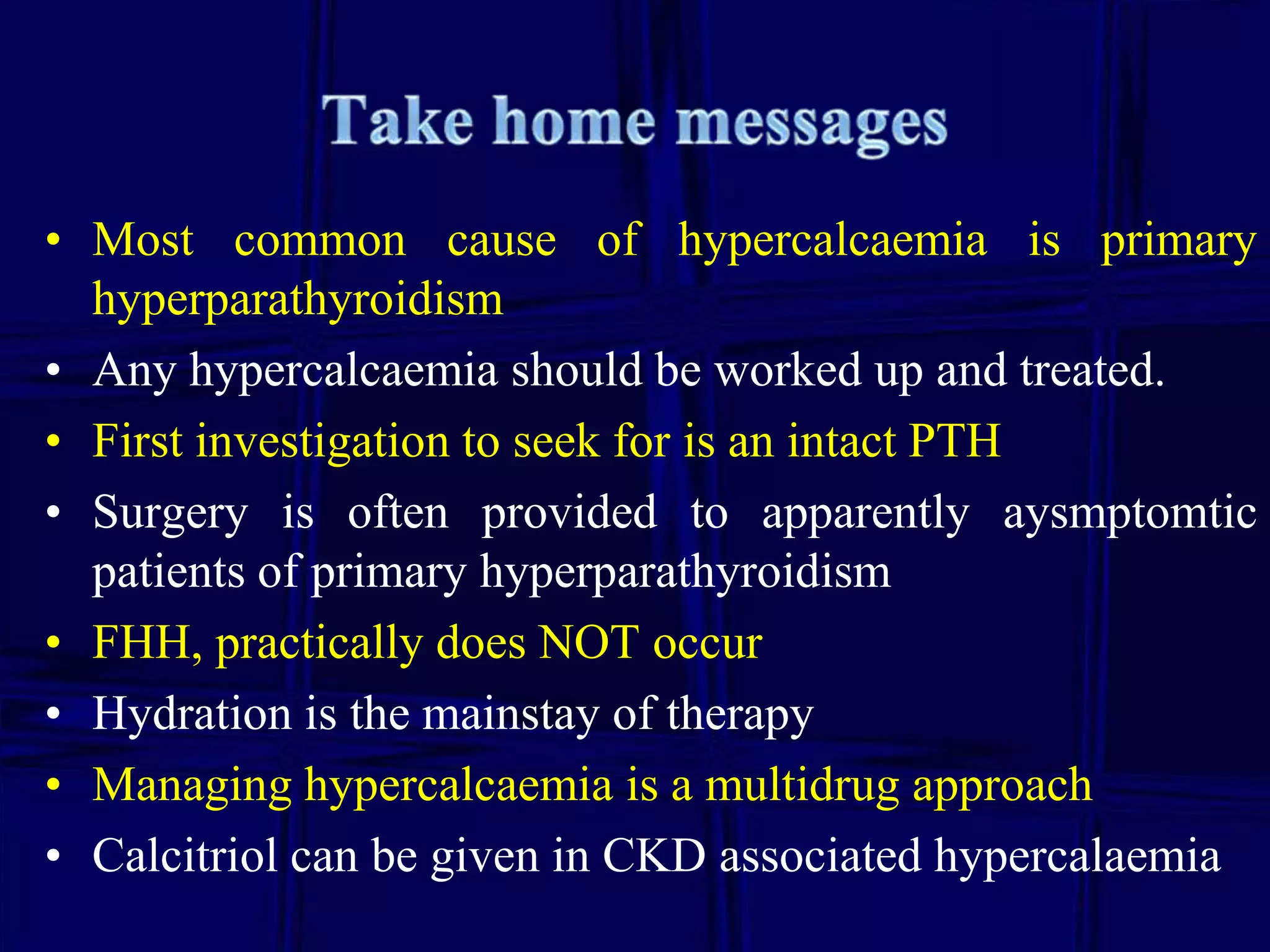
• Most common cause of hypercalcaemia is primary
hyperparathyroidism
• Any hypercalcaemia should be worked up and treated.
• First investigation to seek for is an intact PTH
• Surgery is often provided to apparently aysmptomtic
patients of primary hyperparathyroidism
• FHH, practically does NOT occur
• Hydration is the mainstay of therapy
• Managing hypercalcaemia is a multidrug approach
• Calcitriol can be given in CKD associated hypercalaemia
THANK YOU

ddk3987@gmail.com

45

Managing hypercalcaemia presented on CMC, Kol, 1.10.2013

  • 1.
    Speaker: Dr. DibbendhuKhanra Chairperson: Dr. A.K. Banerjee
  • 2.
    Calcium an unparallel hero most abundant mineral of body  maintenance of strong bones  neuro-mascular action  blood clotting, blood pressure  hormone regulation -most over-the-counter sold drug - 43% Indian women on supplement - prescribed by doctors commonly
  • 3.
    Calciuma sinister indisguise HypercalcaemiaToday’s concern! ..Some cases.. 3
  • 4.
    Mr. K isa 41 year old patient – Mild depression – Behavioral abnormality – Headache – Fatigue – Difficulty concentrating – TSH - 2.06 (0.5 – 4.00) – calcium 12.4 mg/dl (8.4 – 10.4 mg/dl)
  • 5.
     Mrs. C isa 57 year old patient, well  t-score – 1.3 (spine), 2. 8 (femur)  Calcium – 12. 5 (8.4 – 10.4 mg/dl)  weight loss and generalised weakness  Cough and hemoptysis
  • 6.
    • • • • • • • • A 58-year-woman presentedto ER progressive Multiple sclerosis Osteoporosis calcium, 600 mg, 3 times daily 5000-IU cholecalciferol supplement OD tremors Altered sensorium serum calcium 15.2 mg/dL
  • 7.
    • • • • • • 30-year-old female Fever, cough Polyuria,polydypsia, GI upset constipation, confusion, headache CECT chest – hilar lympahedenopathy serum calcium, 13.8 mg/d
  • 8.
    • • • • • 50-year-old male Diabetic for10 years Poorly controlled with OHA HTN, anasarca, anaemia serum calcium 14.8 mg/d
  • 9.
          Calcium metabolism Defining hypercalcaemia Causesof hypercalcaemia Cl/f of hypercalceimia Diagnosis to hypercalcaemia Management
  • 10.
  • 11.
  • 13.
  • 14.
  • 15.
  • 16.
  • 17.
    A = highcalcium levels means primary hyperparathyroidism unless the PTH is near zero B = normocalcemic" hyperparathyroidism. this is the only group that we believe should have a urinary calcium level performed
  • 18.
    It is IMPOSSIBLEto tell the difference between FHH and primary hyperparathyroidism based upon the results of a 24-hour urine test 1. Urinary calcium can be anything (very low to very high) in Pr HyperPTHism. 2. The arbitrary cut off of urinary ca excretion/ 24 hr 100 lacks any rationality. 3. Nor elevated serum ca neither elevated urinary ca has any association with renal stones. 4. Low urinary ca does not always mean FHH. FHH is so rare, that few doctors will ever see it. FHH is diagnosed incorrectly about 95-99% of the time
  • 19.
    Corrected serum calcium= Ionizedcalcium + 0.8(4-serum albumin) calcium is high and PTH is high, d/g is primary hyperparathyroidism. IF calcium Familial is mildly Hypocalciuric raised in background of Hypercalcemia Sestamibi highly elevated N-scan PTH, then urinary ca can be ordered to rule out FHH 19
  • 20.
    Neuropsychiatric complaints Calcium 12.4mg/dl iPTH – 509 (12-72 pg/ml) Thallium subtraction study: Left lower lobe parathyroid adenoma
  • 21.
    Weight loss andgeneralised weakness Calcium – 12. 5 (8.4 – 10.4 mg/dl) iPTH 21 (10 – 65.0 pg/ml) PTHrp - elevated Lung biopsy with IHC: Well differentiated, low grade squamous cell lung carcinoma
  • 22.
    • • • • calcium, cholecalciferol supplement serumcalcium14.6 mg/dL (15.2 mg/dL) iPTH - 4 pg/mL (N12-65 pg/mL 25-OH D level 103 ng/mL (N>30 ng/ml) Vit D overdose 22
  • 23.
    • • • • • CECT chest –hilar lympahedenopathy serum calcium, 13.8 mg/d iPTH - 4 pg/mL (N12-65 pg/mL 1, 25-OH D level elevated Serum ACEase – highly raised Hilar LN Bx – non caseating granulomas Sarcoidosis 23
  • 24.
    • • • • T2DM CKD serum calcium 14.8mg/d iPTH – 209 (12-72 pg/ml) Hypercalcemia Associated with Renal Failure
  • 25.
    Hypercalcemia Associated withRenal Failure Secondary Hyperparathyroidism Hypocalcaemia is the common denominator Reversible (adaptive) growth of parathyroid gland • Resistance to the normal level of PTH • Increased level of FGF23 • Reduction in 1,25(OH)2 vitamin D Tertiary Hyperparathyroidism • Long-standing, inadequately treated chronic renal failure • True clonal outgrowth (irreversible) 25
  • 26.
  • 27.
    Critical - >14 mg % 1 Moderate - 12 to 14 mg % 2 Mild – 10.4 to 11.9 mg % 3 • Aggressive therapy • Start therapy • When symptomatic • When PrHyperPTHism • No therapy • Except PrHyperPTHism Normal – 8.5 to 10.3 mg % Hypercalcaemia should always be treated 27
  • 28.
    - thiazide andlithium - volume depletion - prolonged bed rest or inactivity - high calcium diet (>1000 mg/day) 28
  • 29.
  • 30.
    Dr. Harold Coppisolated calcitonin from salmon sperm
  • 31.
  • 32.
    Treating hypercalcaemia ismultidrug approach In HF, CKD; lowers ca by 1-3 mg/dl Routine use not recommended Do not give bisphosphonates until patient is fully rehydrated contraindicated in patients with cr cl <10 mL/min Caution with NSAIDS, ACE inhibitors, aminoglycosides Calcitonin and hydration provide a rapid reduction, while a bisphosphonate provides a sustained effect
  • 33.
    Monitoring Surgery • Serum calciumlevel  Mildly elevated calcium > 1 mg % above normal  No previous episodes of • Creatinine clearance life threatening hypercalcemia < 60 ml/minute  Normal renal function • Bone density: T score <–2.5  Normal bone status at Any of 3 sites • Age younger than 50 years Serum ca serum creatinine Bone density Significant symptoms – Rx surgery 33
  • 34.
    Minimally Invasive Parathyroidectomy(MIP)  an outpatient procedure  Pre-op localization with Sestamibi Tc scan  cervical block anesthesia  minimal surgical incision  Intra-op PTH level obtained before and 5 mins after removal  If PTH levels fall by greater than 50% operation terminated  IF PTH Levels fall by less than 50%, full neck exploration  clear-cut cost benefit  Accepted in asymptomatic patients  not proper for multiple tumour or large tumours
  • 35.
    • If anenlarged gland is found, a • all four glands be normal gland should be sought. sought • if an intra-operative frozen section biopsy of a normal-sized • most of the total parathyroid tissue second gland confirms its mass be removed. histologic normality, no further exploration, biopsy, or excision is • unnecessary surgery & un-acceptable rate needed. of hypoparathyroidism • recurrence rate of hyperand hypocalcamia. parathyroidism may be high if a second abnormal gland is missed. 35
  • 36.
    • totally removethree glands with partial excision of the fourth gland • care is taken to leave a good blood supply for the remaining gland • total parathyroidectomy with immediate transplantation of a portion of a removed, minced parathyroid gland into the muscles of the forearm • surgical excision is easier from the ectopic site in the arm if there is recurrent hyperfunction 36
  • 37.
     calcium 12.4mg/dl (8.4 – 10.4 mg/dl)  parathyroid adenoma  M/N= Surgery (MIP)
  • 38.
     Malignancy related hypercalcaemia (Breast,Lung, Lymphoma, Thyroid, Kidney, Prostate, Multiple Myeloma)  N Saline  calcitonin  Zoledronic acid
  • 39.
    • Vit Doverdose • Half life of Vit D is very short no further treatment required • Withhold Vit D • Steroid can be used 39
  • 40.
    • • • • Acute symptomatic hypercalcaemia Sarcoidosis(granulomatous disease; DHCC related) NS Steroid 40
  • 41.
    • Hypercalcemia Associatedwith Renal Failure • Secondary hyperparathyroidism • calcitriol
  • 42.
    • Dialysis iflife threatening Secondary hyperparatyroidism • restriction of dietary phosphate, • the use of non-absorbable antacids • careful, selective addition of calcitriol Tertiary Hyperparatyroidism • Partial removal of parathyroid gland 42
  • 43.
    S U M M A R Y Dialysis Controversial Malignancy or VitD associated cases Avoid factors that can aggravate hypercalcemia In CKD 43
  • 44.
    • Most commoncause of hypercalcaemia is primary hyperparathyroidism • Any hypercalcaemia should be worked up and treated. • First investigation to seek for is an intact PTH • Surgery is often provided to apparently aysmptomtic patients of primary hyperparathyroidism • FHH, practically does NOT occur • Hydration is the mainstay of therapy • Managing hypercalcaemia is a multidrug approach • Calcitriol can be given in CKD associated hypercalaemia
  • 45.