
P H Y S I C I A N T R A I N I N G
T H E A L L A R O U N D S O L U T I O N
Perforating Veins;
When and how to
treat?
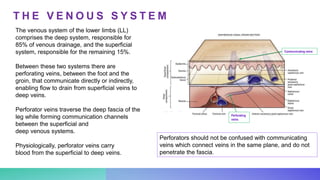
The venous system of the lower limbs (LL)
comprises the deep system, responsible for
85% of venous drainage, and the superficial
system, responsible for the remaining 15%.
Between these two systems there are
perforating veins, between the foot and the
groin, that communicate directly or indirectly,
enabling flow to drain from superficial veins to
deep veins.
Perforator veins traverse the deep fascia of the
leg while forming communication channels
between the superficial and
deep venous systems.
Physiologically, perforator veins carry
blood from the superficial to deep veins.
Communicating veins
Perforating
veins
Perforators should not be confused with communicating
veins which connect veins in the same plane, and do not
penetrate the fascia.
T H E V E N O U S S Y S T E M
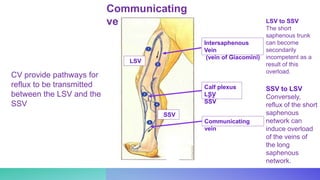
Intersaphenous
Vein
(vein of Giacomini)
Communicating
veins
Calf plexus
LSV
SSV
Communicating
vein
SSV
LSV
CV provide pathways for
reflux to be transmitted
between the LSV and the
SSV
SSV to LSV
Conversely,
reflux of the short
saphenous
network can
induce overload
of the veins of
the long
saphenous
network.
LSV to SSV
The short
saphenous trunk
can become
secondarily
incompetent as a
result of this
overload.
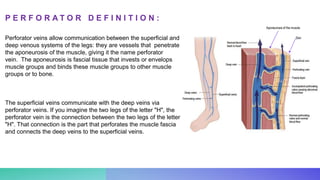
Perforator veins allow communication between the superficial and
deep venous systems of the legs: they are vessels that penetrate
the aponeurosis of the muscle, giving it the name perforator
vein. The aponeurosis is fascial tissue that invests or envelops
muscle groups and binds these muscle groups to other muscle
groups or to bone.
The superficial veins communicate with the deep veins via
perforator veins. If you imagine the two legs of the letter "H", the
perforator vein is the connection between the two legs of the letter
"H". That connection is the part that perforates the muscle fascia
and connects the deep veins to the superficial veins.
P E R F O R A T O R D E F I N I T I O N :
Aponeurosis of the muscle
Skin
P E R F O R A T I N G V E I N S
Gasparis, A., Labropoulos, N., (2011) Perforator Vein Incompetence in CVD Patients, Endovascular Today, p.45-49.
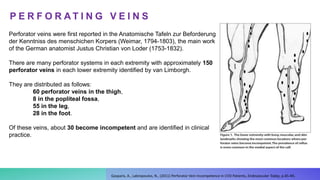
Perforator veins were first reported in the Anatomische Tafeln zur Beforderung
der Kenntniss des menschichen Korpers (Weimar, 1794-1803), the main work
of the German anatomist Justus Christian von Loder (1753-1832).
There are many perforator systems in each extremity with approximately 150
perforator veins in each lower extremity identified by van Limborgh.
They are distributed as follows:
60 perforator veins in the thigh,
8 in the popliteal fossa,
55 in the leg,
28 in the foot.
Of these veins, about 30 become incompetent and are identified in clinical
practice.
Main groups Subgroups
Foot perforators
Dorsal foot PV or
intercapitular veins
Medial foot PV
Lateral foot PV
Plantar foot PV
Ankle perforators
Medial ankle PV
Anterior ankle PV
Lateral ankle PV
Leg perforators
Medial leg PV
Paratibial PV
Posterior tibial PV
Anterior leg PV
Lateral leg PV
Posterior leg PV
Medial gastrocnemius PV
Lateral gastrocnemius PV
Intergemellar PV
Para-achillean PV
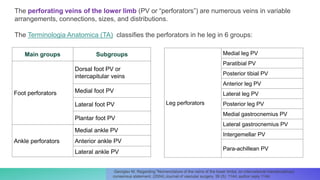
The perforating veins of the lower limb (PV or “perforators”) are numerous veins in variable
arrangements, connections, sizes, and distributions.
The Terminologia Anatomica (TA) classifies the perforators in he leg in 6 groups:
Georgiev M. Regarding "Nomenclature of the veins of the lower limbs: an international interdisciplinary
consensus statement. (2004) Journal of vascular surgery. 39 (5): 1144; author reply 1144.
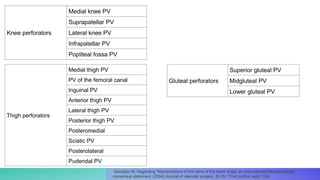
Thigh perforators
Medial thigh PV
PV of the femoral canal
Inguinal PV
Anterior thigh PV
Lateral thigh PV
Posterior thigh PV
Posteromedial
Sciatic PV
Posterolateral
Pudendal PV
Gluteal perforators
Superior gluteal PV
Midgluteal PV
Lower gluteal PV
Knee perforators
Medial knee PV
Suprapatellar PV
Lateral knee PV
Infrapatellar PV
Popliteal fossa PV
Georgiev M. Regarding "Nomenclature of the veins of the lower limbs: an international interdisciplinary
consensus statement. (2004) Journal of vascular surgery. 39 (5): 1144; author reply 1144.
N E W T E R M I N O L O G Y
“Old” term “New” term
Greater or long saphenous vein Great saphenous vein (GSV)
Smaller or short saphenous vein Small saphenous vein (SSV)
Saphenofemoral junction Confluence of the superficial inguinal veins
Giacomini’s vein Intersaphenous vein
Posterior arch vein or Leonardo’s vein Posterior accessory saphenous vein of the leg (PASV BK)
Superficial femoral vein Femoral vein
Cockett perforators (I, II, II) Posterior tibial perforators (lower, middle, upper)
Boyd’s perforator Paratibial perforator (proximal)
Sherman’s perforators Paratibial perforators
‘24 cm’ perforators Paratibial perforators
Hunter’s and Dodd’s perforators Perforators of the femoral canal
May’s or Kuster’s perforators Ankle perforators
Adapted from Mozes G, Gloviczki P. New discoveries in anatomy and new terminology of leg veins: clinical implications. Vasc Endovasc Surg 2004;38:367-74.
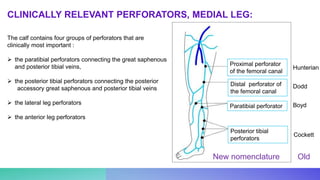
Proximal perforator
of the femoral canal
Distal perforator of
the femoral canal
Paratibial perforator
Posterior tibial
perforators
Old
New nomenclature
CLINICALLY RELEVANT PERFORATORS, MEDIAL LEG:
Hunterian
Dodd
Boyd
Cockett
The calf contains four groups of perforators that are
clinically most important :
 the paratibial perforators connecting the great saphenous
and posterior tibial veins,
 the posterior tibial perforators connecting the posterior
accessory great saphenous and posterior tibial veins
 the lateral leg perforators
 the anterior leg perforators
Adapted from Mozes G, Gloviczki P: Vasc Endovasc Surg 2004;38:367-74.
great
Mendoza et al. (eds.), Duplex Ultrasound of Superfi cial Leg Veins, 19 731-4_2, © Springer-Verlag Berlin Heidelberg
2014]
CLINICALLY RELEVANT PERFORATORS, POSTERIOR LEG:
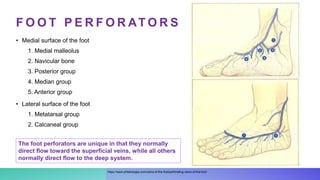
F O O T P E R F O R AT O R S
• Medial surface of the foot
1. Medial malleolus
2. Navicular bone
3. Posterior group
4. Median group
5. Anterior group
• Lateral surface of the foot
1. Metatarsal group
2. Calcaneal group
https://www.phlebologia.com/veins-of-the-foot/perforating-veins-of-the-foot/
The foot perforators are unique in that they normally
direct flow toward the superficial veins, while all others
normally direct flow to the deep system.
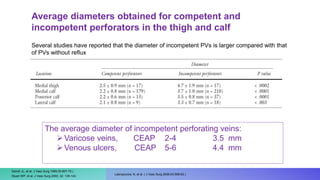
Average diameters obtained for competent and
incompetent perforators in the thigh and calf
Sandri JL, et al. J Vasc Surg 1999;30:867-75.)
The average diameter of incompetent perforating veins:
Varicose veins, CEAP 2-4 3.5 mm
Venous ulcers, CEAP 5-6 4.4 mm
Several studies have reported that the diameter of incompetent PVs is larger compared with that
of PVs without reflux
Labropoulos, N, et al. ( J Vasc Surg 2006;43:558-62.)
Stuart WP, et al. J Vasc Surg 2000, 32: 138-143.
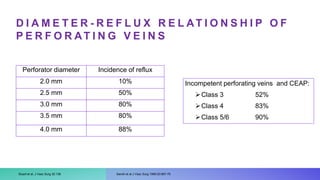
D I A M E T E R - R E F L U X R E L AT I O N S H I P O F
P E R F O R AT I N G V E I N S
Incompetent perforating veins and CEAP:
Class 3 52%
Class 4 83%
Class 5/6 90%
Perforator diameter Incidence of reflux
2.0 mm 10%
2.5 mm 50%
3.0 mm 80%
3.5 mm 80%
4.0 mm 88%
Stuart et al, J Vasc Surg 32:138 Sandri et al J Vasc Surg 1999;30:867-75
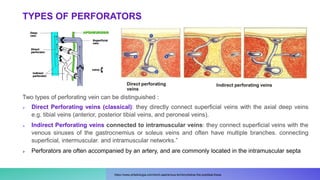
TYPES OF PERFORATORS
Two types of perforating vein can be distinguished :
 Direct Perforating veins (classical): they directly connect superficial veins with the axial deep veins
e.g. tibial veins (anterior, posterior tibial veins, and peroneal veins).
 Indirect Perforating veins connected to intramuscular veins: they connect superficial veins with the
venous sinuses of the gastrocnemius or soleus veins and often have multiple branches. connecting
superficial, intermuscular. and intramuscular networks.”
 Perforators are often accompanied by an artery, and are commonly located in the intramuscular septa
Direct perforating
veins
Indirect perforating veins
https://www.phlebologia.com/short-saphenous-territory/below-the-popliteal-fossa
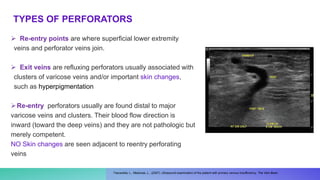
 Re-entry points are where superficial lower extremity
veins and perforator veins join.
 Exit veins are refluxing perforators usually associated with
clusters of varicose veins and/or important skin changes,
such as hyperpigmentation
Re-entry perforators usually are found distal to major
varicose veins and clusters. Their blood flow direction is
inward (toward the deep veins) and they are not pathologic but
merely competent.
NO Skin changes are seen adjacent to reentry perforating
veins
Pascarella, L., Mekenas, L., (2007). Ultrasound examination of the patient with primary venous Insufficiency, The Vein Book.
TYPES OF PERFORATORS
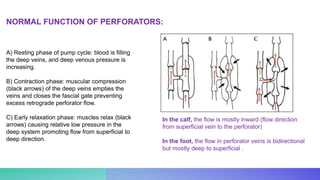
A) Resting phase of pump cycle: blood is filling
the deep veins, and deep venous pressure is
increasing.
B) Contraction phase: muscular compression
(black arrows) of the deep veins empties the
veins and closes the fascial gate preventing
excess retrograde perforator flow.
C) Early relaxation phase: muscles relax (black
arrows) causing relative low pressure in the
deep system promoting flow from superficial to
deep direction.
NORMAL FUNCTION OF PERFORATORS:
In the calf, the flow is mostly inward (flow direction
from superficial vein to the perforator)
In the foot, the flow in perforator veins is bidirectional
but mostly deep to superficial .
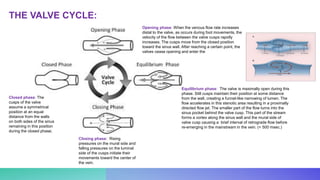
THE VALVE CYCLE:
Opening phase: When the venous flow rate increases
distal to the valve, as occurs during foot movements, the
velocity of the flow between the valve cusps rapidly
increases. The cusps move from the closed position
toward the sinus wall. After reaching a certain point, the
valves cease opening and enter the
Equilibrium phase: The valve is maximally open during this
phase. Still cusps maintain their position at some distance
from the wall, creating a funnel-like narrowing of lumen. The
flow accelerates in this stenotic area resulting in a proximally
directed flow jet. The smaller part of the flow turns into the
sinus pocket behind the valve cusp. This part of the stream
forms a vortex along the sinus wall and the mural side of
valve cusp causing a brief interval of retrograde flow before
re-emerging in the mainstream in the vein. (< 500 msec.)
Closing phase: Rising
pressures on the mural side and
falling pressures on the luminal
side of the cusps initiate their
movements toward the center of
the vein.
Closed phase: The
cusps of the valve
assume a symmetrical
position at an equal
distance from the walls
on both sides of the sinus
remaining in this position
during the closed phase.
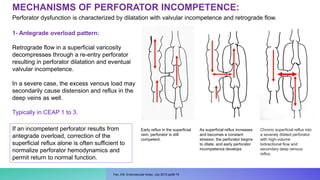
1- Antegrade overload pattern:
Retrograde flow in a superficial varicosity
decompresses through a re-entry perforator
resulting in perforator dilatation and eventual
valvular incompetence.
In a severe case, the excess venous load may
secondarily cause distension and reflux in the
deep veins as well.
Typically in CEAP 1 to 3.
MECHANISMS OF PERFORATOR INCOMPETENCE:
Chronic superficial reflux into
a severely dilated perforator
with high-volume
bidirectional flow and
secondary deep venous
reflux.
Fan, EM. Endovascular today; July 2015 pp68-74
If an incompetent perforator results from
antegrade overload, correction of the
superficial reflux alone is often sufficient to
normalize perforator hemodynamics and
permit return to normal function.
As superficial reflux increases
and becomes a constant
stressor, the perforator begins
to dilate, and early perforator
incompetence develops
Early reflux in the superficial
vein, perforator is still
competent.
Perforator dysfunction is characterized by dilatation with valvular incompetence and retrograde flow.
Complete perforator
incompetence after longstanding
strain, further overload of the
superficial vein, which is now also
severely incompetent.
Retrograde flow from above,
antegrade flow from below, and
retrograde flow from the IPV
combine to create a focal point of
severe superficial venous
hypertension at the junction of
the superficial and perforator
vein.
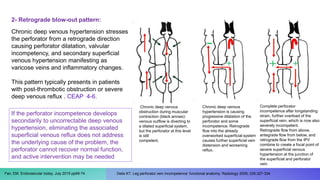
Chronic deep venous hypertension stresses
the perforator from a retrograde direction
causing perforator dilatation, valvular
incompetency, and secondary superficial
venous hypertension manifesting as
varicose veins and inflammatory changes.
This pattern typically presents in patients
with post-thrombotic obstruction or severe
deep venous reflux . CEAP 4-6.
2- Retrograde blow-out pattern:
Fan, EM. Endovascular today; July 2015 pp68-74
If the perforator incompetence develops
secondarily to uncorrectable deep venous
hypertension, eliminating the associated
superficial venous reflux does not address
the underlying cause of the problem, the
perforator cannot recover normal function,
and active intervention may be needed
Delis KT. Leg perforator vein incompetence: functional anatomy. Radiology 2005; 235:327-334
Chronic deep venous
obstruction during muscular
contraction (black arrows):
venous outflow is diverting to
a dilated superficial system,
but the perforator at this level
is still
competent.
Chronic deep venous
hypertension is causing
progressive dilatation of the
perforator and some
incompetence. Retrograde
flow into the already
overworked superficial system
causes further superficial vein
distension and worsening
reflux.
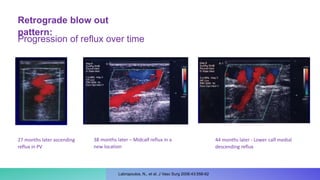
Retrograde blow out
pattern:
27 months later ascending
reflux in PV
44 months later - Lower calf medial
descending reflux
38 months later – Midcalf reflux in a
new location
Progression of reflux over time
Labropoulos, N., et al. J Vasc Surg 2006:43:558-62
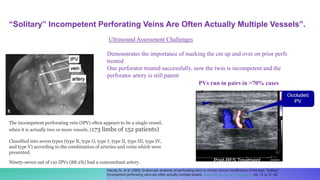
PVs run in pairs in >70% cases
Ultrasound Assessment Challenges
Demonstrates the importance of marking the cm up and over on prior perfs
treated
One perforator treated successfully, now the twin is incompetent and the
perforator artery is still patent
The incompetent perforating vein (IPV) often appears to be a single vessel,
when it is actually two or more vessels. (173 limbs of 152 patients)
Classified into seven types (type N, type O, type I, type II, type III, type IV,
and type V) according to the combination of arteries and veins which were
presented.
Ninety-seven out of 110 IPVs (88.2%) had a concomitant artery.
Haruta, N., et al. (2004). Endoscopic anatomy of perforating veins in chronic venous insufficiency of the legs: “Solitary”
incompetent perforating veins are often actually multiple vessels. International Journal of Angiology vol. 13, p. 31–36.
“Solitary” Incompetent Perforating Veins Are Often Actually Multiple Vessels”.
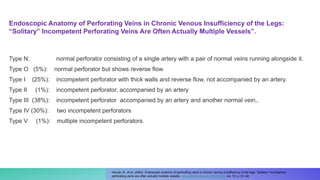
Type N: normal perforator consisting of a single artery with a pair of normal veins running alongside it.
Type O (5%): normal perforator but shows reverse flow.
Type I (25%): incompetent perforator with thick walls and reverse flow, not accompanied by an artery.
Type II (1%): incompetent perforator, accompanied by an artery
Type III (38%): incompetent perforator accompanied by an artery and another normal vein,.
Type IV (30%): two incompetent perforators
Type V (1%): multiple incompetent perforators.
Haruta, N., et al. (2004). Endoscopic anatomy of perforating veins in chronic venous insufficiency of the legs: “Solitary” incompetent
perforating veins are often actually multiple vessels. International Journal of Angiology vol. 13, p. 31–36.
Endoscopic Anatomy of Perforating Veins in Chronic Venous Insufficiency of the Legs:
“Solitary” Incompetent Perforating Veins Are Often Actually Multiple Vessels”.
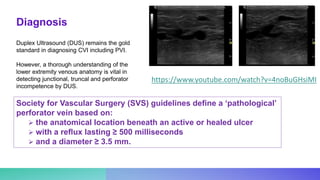
Duplex Ultrasound (DUS) remains the gold
standard in diagnosing CVI including PVI.
However, a thorough understanding of the
lower extremity venous anatomy is vital in
detecting junctional, truncal and perforator
incompetence by DUS.
Society for Vascular Surgery (SVS) guidelines define a ‘pathological’
perforator vein based on:
 the anatomical location beneath an active or healed ulcer
 with a reflux lasting ≥ 500 milliseconds
 and a diameter ≥ 3.5 mm.
https://www.youtube.com/watch?v=4noBuGHsiMI
Diagnosis
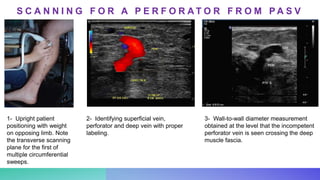
2- Identifying superficial vein,
perforator and deep vein with proper
labeling.
1- Upright patient
positioning with weight
on opposing limb. Note
the transverse scanning
plane for the first of
multiple circumferential
sweeps.
3- Wall-to-wall diameter measurement
obtained at the level that the incompetent
perforator vein is seen crossing the deep
muscle fascia.
S C A N N I N G F O R A P E R F O R A T O R F R O M P A S V
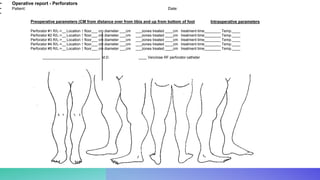
• Operative report - Perforators
• Patient: Date:
•
Preoperative parameters (CM from distance over from tibia and up from bottom of foot Intraoperative parameters
Perforator #1 R/L->__Location ↑ floor___ cm diameter ___cm ___zones treated ____cm treatment time________ Temp.____
Perforator #2 R/L->__Location ↑ floor___ cm diameter ___cm ___zones treated ____cm treatment time________ Temp.____
Perforator #3 R/L->__Location ↑ floor___ cm diameter ___cm ___zones treated ____cm treatment time________ Temp.____
Perforator #4 R/L->__Location ↑ floor___ cm diameter ___cm ___zones treated ____cm treatment time________ Temp.____
Perforator #5 R/L->__Location ↑ floor___ cm diameter ___cm ___zones treated ____cm treatment time________ Temp.____
____________________________, M.D. ____ Venclose RF perforator catheter
1- Historical description and evolution of treatment
 In 1917, Homan described the role of PVI in the development of chronic venous
ulceration and emphasized the importance of surgical disruption of such perforators.
 Almost two decades later, Linton first described the medial fascial incision and
perforator ligation as a means of managing PVI. This technique remained the gold
standard of managing PVI for almost half a century despite the associated
morbidities including ulcer recurrence, wound breakdown and neuropathy.
 However, with the advent of newer less invasive treatment modalities, open surgical
ligation has been largely abandoned after Subfascial Endoscopic Perforator Surgery
was developed and became widely adopted.
Treatment of Perforator Incompetence
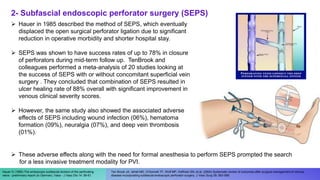
 Hauer in 1985 described the method of SEPS, which eventually
displaced the open surgical perforator ligation due to significant
reduction in operative morbidity and shorter hospital stay.
 SEPS was shown to have success rates of up to 78% in closure
of perforators during mid-term follow up. TenBrook and
colleagues performed a meta-analysis of 20 studies looking at
the success of SEPS with or without concomitant superficial vein
surgery . They concluded that combination of SEPS resulted in
ulcer healing rate of 88% overall with significant improvement in
venous clinical severity scores.
 However, the same study also showed the associated adverse
effects of SEPS including wound infection (06%), hematoma
formation (09%), neuralgia (07%), and deep vein thrombosis
(01%).
2- Subfascial endoscopic perforator surgery (SEPS)
 These adverse effects along with the need for formal anesthesia to perform SEPS prompted the search
for a less invasive treatment modality for PVI.
Ten Brook JA, Iafrati MD, O’Donnell TF, Wolf MP, Hoffman SN, et al. (2004) Systematic review of outcomes after surgical management of venous
disease incorporating subfascial endoscopic perforator surgery. J Vasc Surg 39: 583-589.
Hauer G (1985) The endoscopic subfascial division of the perforating
veins - preliminary report (in German). Vasa - J Vasc Dis 14: 59-61.
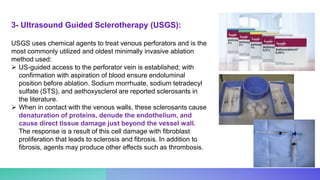
USGS uses chemical agents to treat venous perforators and is the
most commonly utilized and oldest minimally invasive ablation
method used:
 US-guided access to the perforator vein is established; with
confirmation with aspiration of blood ensure endoluminal
position before ablation. Sodium morrhuate, sodium tetradecyl
sulfate (STS), and aethoxysclerol are reported sclerosants in
the literature.
 When in contact with the venous walls, these sclerosants cause
denaturation of proteins, denude the endothelium, and
cause direct tissue damage just beyond the vessel wall.
The response is a result of this cell damage with fibroblast
proliferation that leads to sclerosis and fibrosis. In addition to
fibrosis, agents may produce other effects such as thrombosis.
3- Ultrasound Guided Sclerotherapy (USGS):
Early closure rate 80%
20-month closure rate 70%
Patients with successfully treated incompetent perforator veins also had a
significant improvement in their clinical scores and symptoms, proving the
clinical success of this technique.
These small adjacent perforators can become insufficient after an initial
treatment .
New or recurrent perforator disease is a well-described entity and USGS
can easily be repeated in these situations.
Masuda EM, Kessler DM, Lurie F, et al. The effect of ultrasound-guided sclerotherapy of incompetent perforator veins on venous clinical severity and disability
scores. J Vasc Surg 2006;43:551-6; discussion 556-7. 10.1016/j.jvs.2005.11.038
de Waard MM, der Kinderen DJ. Duplex ultrasonography-guided foam
sclerotherapy of incompetent perforator veins in a patient with bilateral
venous leg ulcers. Dermatol Surg 2005;31:580-3. 10.
Outcomes of USGS:
4- Ultrasound Guided Foam Sclerotherapy (UGFS)
Jia X, Mowatt G, Burr JM, et al. Systematic review of foam sclerotherapy
for varicose veins. Br J Surg 2007;94:925-36. 10.1002/bjs.5891
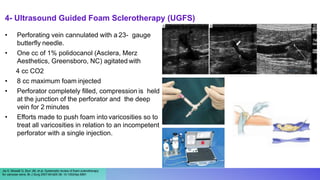
• Perforating vein cannulated with a 23- gauge
butterfly needle.
• One cc of 1% polidocanol (Asclera, Merz
Aesthetics, Greensboro, NC) agitated with
4 cc CO2
• 8 cc maximum foam injected
• Perforator completely filled, compression is held
at the junction of the perforator and the deep
vein for 2 minutes
• Efforts made to push foam into varicosities so to
treat all varicosities in relation to an incompetent
perforator with a single injection.
U G F S - O U T C O M E S
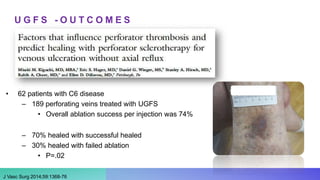
• 62 patients with C6 disease
– 189 perforating veins treated with UGFS
• Overall ablation success per injection was 74%
– 70% healed with successful healed
– 30% healed with failed ablation
• P=.02
J Vasc Surg 2014;59:1368-76
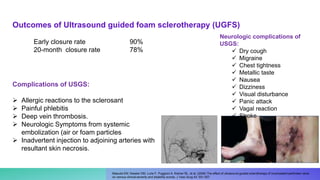
Complications of USGS:
 Allergic reactions to the sclerosant
 Painful phlebitis
 Deep vein thrombosis.
 Neurologic Symptoms from systemic
embolization (air or foam particles
 Inadvertent injection to adjoining arteries with
resultant skin necrosis.
Outcomes of Ultrasound guided foam sclerotherapy (UGFS)
Masuda EM, Kessler DM, Lurie F, Puggioni A, Kistner RL, et al. (2006) The effect of ultrasound-guided sclerotherapy of incompetent perforator veins
on venous clinical severity and disability scores. J Vasc Surg 43: 551-557.
Early closure rate 90%
20-month closure rate 78%
Neurologic complications of
USGS:
 Dry cough
 Migraine
 Chest tightness
 Metallic taste
 Nausea
 Dizziness
 Visual disturbance
 Panic attack
 Vagal reaction
 Stroke
EVTA has been performed for perforators using either Radio-frequency or laser.
The obvious advantage over conventional surgical techniques and SEPS is the non-
requirement for formal anesthesia and the ability to be performed as day case or out-patient
procedure.
The RF or laser energy thermally damages the endothelial lining of venous structures which will
then seal the perforator shut. The perforator will eventually fibrose and remain closed.
The reported closure rates have been as high as 95% .
The reported short and mid-term closure rates have been excellent 92-94%.
5- TRansLuminal occlusion of Perforators. TRLOP
Kuyumcu G, Salazar GM, Prabhakar AM, Ganguli S (2016) Minimally
invasive treatments for perforator vein insufficiency. Cardiovasc Diagn Ther
6: 593-598.
Hager ES, Washington C, Steinmetz A, Wu T, Singh M, et al. (2016) Factors that influence perforator vein closure rates using radiofrequency
ablation, laser ablation, or foam sclerotherapy. J Vasc Surg Venous Lymphat Disord 4: 51-56.
https://www.youtube.com/watch?v=OlyfKYGV9SM
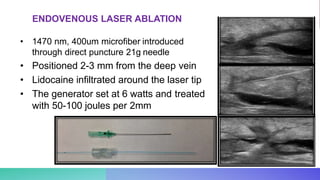
• 1470 nm, 400um microfiber introduced
through direct puncture 21g needle
• Positioned 2-3 mm from the deep vein
• Lidocaine infiltrated around the laser tip
• The generator set at 6 watts and treated
with 50-100 joules per 2mm
ENDOVENOUS LASER ABLATION
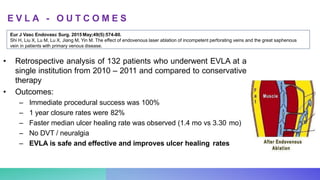
• Retrospective analysis of 132 patients who underwent EVLA at a
single institution from 2010 – 2011 and compared to conservative
therapy
• Outcomes:
– Immediate procedural success was 100%
– 1 year closure rates were 82%
– Faster median ulcer healing rate was observed (1.4 mo vs 3.30 mo)
– No DVT / neuralgia
– EVLA is safe and effective and improves ulcer healing rates
E V L A - O U T C O M E S
Eur J Vasc Endovasc Surg. 2015 May;49(5):574-80.
Shi H, Liu X, Lu M, Lu X, Jiang M, Yin M. The effect of endovenous laser ablation of incompetent perforating veins and the great saphenous
vein in patients with primary venous disease.
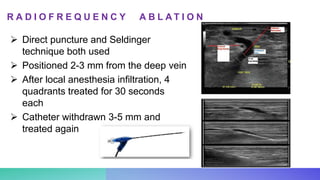
 Direct puncture and Seldinger
technique both used
 Positioned 2-3 mm from the deep vein
 After local anesthesia infiltration, 4
quadrants treated for 30 seconds
each
 Catheter withdrawn 3-5 mm and
treated again
R A D I O F R E Q U E N C Y A B L A T I O N
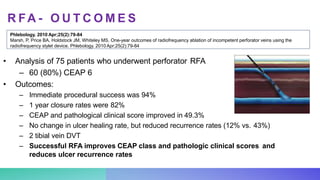
• Analysis of 75 patients who underwent perforator RFA
– 60 (80%) CEAP 6
• Outcomes:
– Immediate procedural success was 94%
– 1 year closure rates were 82%
– CEAP and pathological clinical score improved in 49.3%
– No change in ulcer healing rate, but reduced recurrence rates (12% vs. 43%)
– 2 tibial vein DVT
– Successful RFA improves CEAP class and pathologic clinical scores and
reduces ulcer recurrence rates
R FA - O U T C O M E S
Phlebology. 2010 Apr;25(2):79-84
Marsh, P, Price BA, Holdstock JM, Whiteley MS. One-year outcomes of radiofrequency ablation of incompetent perforator veins using the
radiofrequency stylet device. Phlebology. 2010 Apr;25(2):79-84
WHEN ABLATING A PERFORATOR , IT IS CRUCIAL TO PROTECT:
Skin: Tumescent to keep heating element .05 to 1.0 cm from
the skin to prevent skin burns
Bone: Tumescent to protect bone when perforators are close to
tibia or malleolus
Nerves: Superficial fibular, Deep fibular and peroneal nerves
Arteries: Identifies accompanying arteries that may get affected by
proximity to perforators
Deep Veins: Stay at least two cm away from deep veins to avoid DVT
https://www.semanticscholar.org/paper/Anomalous-intraosseous-venous-drainage%3A-Bone-Ramelet-
Cr%C3%A9bassa/52e90fb0de2d69de470d73a28d73c0bce75e1c9b
1 https://www.semanticscholar.org/paper/Anomalous-intraosseous-venous-drainage%3A-Bone-Ramelet-
Cr%C3%A9bassa/52e90fb0de2d69de470d73a28d73c0bce75e1c9b
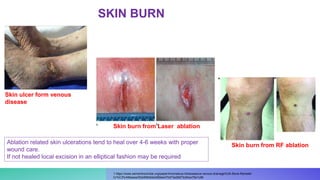
Skin burn from RF ablation
Skin ulcer form venous
disease
Skin burn from Laser ablation
Ablation related skin ulcerations tend to heal over 4-6 weeks with proper
wound care.
If not healed local excision in an elliptical fashion may be required
SKIN BURN
https://www.cambridge.org/core/books/applied-anatomy-for-anaesthesia-and-intensive-care/lower limb/C78BDD2A76B3C8FA8648B6139C951928
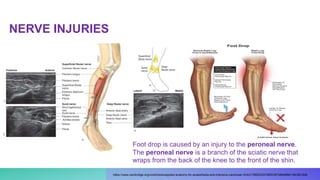
NERVE INJURIES
Foot drop is caused by an injury to the peroneal nerve.
The peroneal nerve is a branch of the sciatic nerve that
wraps from the back of the knee to the front of the shin.
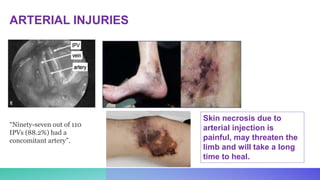
ARTERIAL INJURIES
“Ninety-seven out of 110
IPVs (88.2%) had a
concomitant artery”.
Skin necrosis due to
arterial injection is
painful, may threaten the
limb and will take a long
time to heal.
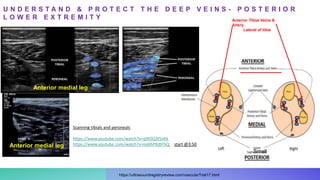
Anterior medial leg
Anterior medial leg
Anterior Tibial Veins &
Artery
Lateral of tibia
Small
Scanning tibials and peroneals
https://www.youtube.com/watch?v=q9lOQ3tSnKk
https://www.youtube.com/watch?v=oo0hPKdtFSQ start @3:50
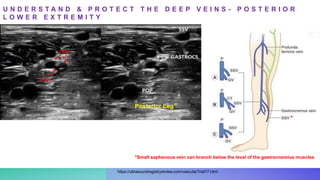
U N D E R S T A N D & P R O T E C T T H E D E E P V E I N S - P O S T E R I O R
L O W E R E X T R E M I T Y
https://ultrasoundregistryreview.com/vascularTrial17.html
U N D E R S T A N D & P R O T E C T T H E D E E P V E I N S - P O S T E R I O R
L O W E R E X T R E M I T Y
Posterior Leg
*Small saphenous vein can branch below the level of the gastrocnemius muscles
*
Artery
Veins
https://ultrasoundregistryreview.com/vascularTrial17.html
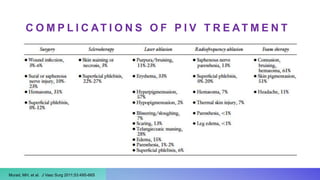
C O M P L I C AT I O N S O F P I V T R E AT M E N T
Murad, MH, et al. J Vasc Surg 2011;53:49S-66S
P O S T O P E R A T I V E C A R E :
Apply compression folded 4x4 over treated perf for pressure
Wrap leg from toes up (starting top of foot to avoid pressure points on
bottom of foot) (Diabetic?)
Recommended 30-40 mmHg gradient compression stocking
Patients instructed to maintain or increase their normal activity levels
O’Hare et al. (2010) found that “compression bandaging for 24 hours,
followed by use of thrombo-embolus deterrent stockings for remainder
14 days, gave results comparable to compression bandaging for 5
days”.
Rescan at 72 hours
https://pt.slideshare.net/dra2lg10/varicose-vein-30092018
O’Hare, J.L., et al., Br J Surg. May 2010:97(5):650-6.
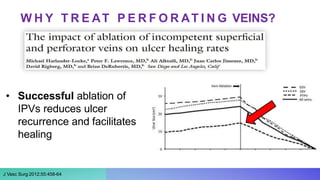
• Successful ablation of
IPVs reduces ulcer
recurrence and facilitates
healing
J Vasc Surg 2012;55:458-64
W H Y T R E AT P E R F O R AT I N G VEINS?
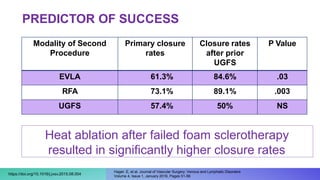
Modality of Second
Procedure
Primary closure
rates
Closure rates
after prior
UGFS
P Value
EVLA 61.3% 84.6% .03
RFA 73.1% 89.1% .003
UGFS 57.4% 50% NS
PREDICTOR OF SUCCESS
Heat ablation after failed foam sclerotherapy
resulted in significantly higher closure rates
https://doi.org/10.1016/j.jvsv.2015.08.004
Hager, E, et al. Journal of Vascular Surgery: Venous and Lymphatic Disorders
Volume 4, Issue 1, January 2016, Pages 51-56
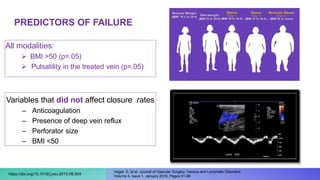
Variables that did not affect closure rates
– Anticoagulation
– Presence of deep vein reflux
– Perforator size
– BMI <50
PREDICTORS OF FAILURE
All modalities:
 BMI >50 (p=.05)
 Pulsatility in the treated vein (p=.05)
https://doi.org/10.1016/j.jvsv.2015.08.004
Hager, E, et al. Journal of Vascular Surgery: Venous and Lymphatic Disorders
Volume 4, Issue 1, January 2016, Pages 51-56
Becoming an expert at treating perforators:
 Clear and thorough understanding of the venous anatomy
 Understanding patterns of reflux in the lower extremities
 Having the right equipment
 Using the proper technique
 Providing after care and not ignoring complications
 Managing expectations at the first visit.
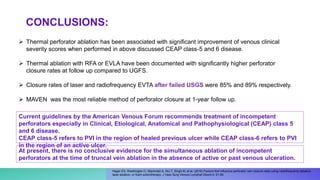
 Thermal perforator ablation has been associated with significant improvement of venous clinical
severity scores when performed in above discussed CEAP class-5 and 6 disease.
 Thermal ablation with RFA or EVLA have been documented with significantly higher perforator
closure rates at follow up compared to UGFS.
 Closure rates of laser and radiofrequency EVTA after failed USGS were 85% and 89% respectively.
 MAVEN was the most reliable method of perforator closure at 1-year follow up.
Hager ES, Washington C, Steinmetz A, Wu T, Singh M, et al. (2016) Factors that influence perforator vein closure rates using radiofrequency ablation,
laser ablation, or foam sclerotherapy. J Vasc Surg Venous Lymphat Disord 4: 51-56.
Current guidelines by the American Venous Forum recommends treatment of incompetent
perforators especially in Clinical, Etiological, Anatomical and Pathophysiological (CEAP) class 5
and 6 disease.
CEAP class-5 refers to PVI in the region of healed previous ulcer while CEAP class-6 refers to PVI
in the region of an active ulcer.
CONCLUSIONS:
At present, there is no conclusive evidence for the simultaneous ablation of incompetent
perforators at the time of truncal vein ablation in the absence of active or past venous ulceration.
T H A N K Y O U !

Perforator physician training arbid

  • 1.
    P H YS I C I A N T R A I N I N G T H E A L L A R O U N D S O L U T I O N Perforating Veins; When and how to treat?
  • 2.
    The venous systemof the lower limbs (LL) comprises the deep system, responsible for 85% of venous drainage, and the superficial system, responsible for the remaining 15%. Between these two systems there are perforating veins, between the foot and the groin, that communicate directly or indirectly, enabling flow to drain from superficial veins to deep veins. Perforator veins traverse the deep fascia of the leg while forming communication channels between the superficial and deep venous systems. Physiologically, perforator veins carry blood from the superficial to deep veins. Communicating veins Perforating veins Perforators should not be confused with communicating veins which connect veins in the same plane, and do not penetrate the fascia. T H E V E N O U S S Y S T E M
  • 3.
    Intersaphenous Vein (vein of Giacomini) Communicating veins Calfplexus LSV SSV Communicating vein SSV LSV CV provide pathways for reflux to be transmitted between the LSV and the SSV SSV to LSV Conversely, reflux of the short saphenous network can induce overload of the veins of the long saphenous network. LSV to SSV The short saphenous trunk can become secondarily incompetent as a result of this overload.
  • 4.
    Perforator veins allowcommunication between the superficial and deep venous systems of the legs: they are vessels that penetrate the aponeurosis of the muscle, giving it the name perforator vein. The aponeurosis is fascial tissue that invests or envelops muscle groups and binds these muscle groups to other muscle groups or to bone. The superficial veins communicate with the deep veins via perforator veins. If you imagine the two legs of the letter "H", the perforator vein is the connection between the two legs of the letter "H". That connection is the part that perforates the muscle fascia and connects the deep veins to the superficial veins. P E R F O R A T O R D E F I N I T I O N : Aponeurosis of the muscle Skin
  • 5.
    P E RF O R A T I N G V E I N S Gasparis, A., Labropoulos, N., (2011) Perforator Vein Incompetence in CVD Patients, Endovascular Today, p.45-49. Perforator veins were first reported in the Anatomische Tafeln zur Beforderung der Kenntniss des menschichen Korpers (Weimar, 1794-1803), the main work of the German anatomist Justus Christian von Loder (1753-1832). There are many perforator systems in each extremity with approximately 150 perforator veins in each lower extremity identified by van Limborgh. They are distributed as follows: 60 perforator veins in the thigh, 8 in the popliteal fossa, 55 in the leg, 28 in the foot. Of these veins, about 30 become incompetent and are identified in clinical practice.
  • 6.
    Main groups Subgroups Footperforators Dorsal foot PV or intercapitular veins Medial foot PV Lateral foot PV Plantar foot PV Ankle perforators Medial ankle PV Anterior ankle PV Lateral ankle PV Leg perforators Medial leg PV Paratibial PV Posterior tibial PV Anterior leg PV Lateral leg PV Posterior leg PV Medial gastrocnemius PV Lateral gastrocnemius PV Intergemellar PV Para-achillean PV The perforating veins of the lower limb (PV or “perforators”) are numerous veins in variable arrangements, connections, sizes, and distributions. The Terminologia Anatomica (TA) classifies the perforators in he leg in 6 groups: Georgiev M. Regarding "Nomenclature of the veins of the lower limbs: an international interdisciplinary consensus statement. (2004) Journal of vascular surgery. 39 (5): 1144; author reply 1144.
  • 7.
    Thigh perforators Medial thighPV PV of the femoral canal Inguinal PV Anterior thigh PV Lateral thigh PV Posterior thigh PV Posteromedial Sciatic PV Posterolateral Pudendal PV Gluteal perforators Superior gluteal PV Midgluteal PV Lower gluteal PV Knee perforators Medial knee PV Suprapatellar PV Lateral knee PV Infrapatellar PV Popliteal fossa PV Georgiev M. Regarding "Nomenclature of the veins of the lower limbs: an international interdisciplinary consensus statement. (2004) Journal of vascular surgery. 39 (5): 1144; author reply 1144.
  • 8.
    N E WT E R M I N O L O G Y “Old” term “New” term Greater or long saphenous vein Great saphenous vein (GSV) Smaller or short saphenous vein Small saphenous vein (SSV) Saphenofemoral junction Confluence of the superficial inguinal veins Giacomini’s vein Intersaphenous vein Posterior arch vein or Leonardo’s vein Posterior accessory saphenous vein of the leg (PASV BK) Superficial femoral vein Femoral vein Cockett perforators (I, II, II) Posterior tibial perforators (lower, middle, upper) Boyd’s perforator Paratibial perforator (proximal) Sherman’s perforators Paratibial perforators ‘24 cm’ perforators Paratibial perforators Hunter’s and Dodd’s perforators Perforators of the femoral canal May’s or Kuster’s perforators Ankle perforators Adapted from Mozes G, Gloviczki P. New discoveries in anatomy and new terminology of leg veins: clinical implications. Vasc Endovasc Surg 2004;38:367-74.
  • 9.
    Proximal perforator of thefemoral canal Distal perforator of the femoral canal Paratibial perforator Posterior tibial perforators Old New nomenclature CLINICALLY RELEVANT PERFORATORS, MEDIAL LEG: Hunterian Dodd Boyd Cockett The calf contains four groups of perforators that are clinically most important :  the paratibial perforators connecting the great saphenous and posterior tibial veins,  the posterior tibial perforators connecting the posterior accessory great saphenous and posterior tibial veins  the lateral leg perforators  the anterior leg perforators
  • 10.
    Adapted from MozesG, Gloviczki P: Vasc Endovasc Surg 2004;38:367-74. great Mendoza et al. (eds.), Duplex Ultrasound of Superfi cial Leg Veins, 19 731-4_2, © Springer-Verlag Berlin Heidelberg 2014] CLINICALLY RELEVANT PERFORATORS, POSTERIOR LEG:
  • 11.
    F O OT P E R F O R AT O R S • Medial surface of the foot 1. Medial malleolus 2. Navicular bone 3. Posterior group 4. Median group 5. Anterior group • Lateral surface of the foot 1. Metatarsal group 2. Calcaneal group https://www.phlebologia.com/veins-of-the-foot/perforating-veins-of-the-foot/ The foot perforators are unique in that they normally direct flow toward the superficial veins, while all others normally direct flow to the deep system.
  • 12.
    Average diameters obtainedfor competent and incompetent perforators in the thigh and calf Sandri JL, et al. J Vasc Surg 1999;30:867-75.) The average diameter of incompetent perforating veins: Varicose veins, CEAP 2-4 3.5 mm Venous ulcers, CEAP 5-6 4.4 mm Several studies have reported that the diameter of incompetent PVs is larger compared with that of PVs without reflux Labropoulos, N, et al. ( J Vasc Surg 2006;43:558-62.) Stuart WP, et al. J Vasc Surg 2000, 32: 138-143.
  • 13.
    D I AM E T E R - R E F L U X R E L AT I O N S H I P O F P E R F O R AT I N G V E I N S Incompetent perforating veins and CEAP: Class 3 52% Class 4 83% Class 5/6 90% Perforator diameter Incidence of reflux 2.0 mm 10% 2.5 mm 50% 3.0 mm 80% 3.5 mm 80% 4.0 mm 88% Stuart et al, J Vasc Surg 32:138 Sandri et al J Vasc Surg 1999;30:867-75
  • 14.
    TYPES OF PERFORATORS Twotypes of perforating vein can be distinguished :  Direct Perforating veins (classical): they directly connect superficial veins with the axial deep veins e.g. tibial veins (anterior, posterior tibial veins, and peroneal veins).  Indirect Perforating veins connected to intramuscular veins: they connect superficial veins with the venous sinuses of the gastrocnemius or soleus veins and often have multiple branches. connecting superficial, intermuscular. and intramuscular networks.”  Perforators are often accompanied by an artery, and are commonly located in the intramuscular septa Direct perforating veins Indirect perforating veins https://www.phlebologia.com/short-saphenous-territory/below-the-popliteal-fossa
  • 15.
     Re-entry pointsare where superficial lower extremity veins and perforator veins join.  Exit veins are refluxing perforators usually associated with clusters of varicose veins and/or important skin changes, such as hyperpigmentation Re-entry perforators usually are found distal to major varicose veins and clusters. Their blood flow direction is inward (toward the deep veins) and they are not pathologic but merely competent. NO Skin changes are seen adjacent to reentry perforating veins Pascarella, L., Mekenas, L., (2007). Ultrasound examination of the patient with primary venous Insufficiency, The Vein Book. TYPES OF PERFORATORS
  • 16.
    A) Resting phaseof pump cycle: blood is filling the deep veins, and deep venous pressure is increasing. B) Contraction phase: muscular compression (black arrows) of the deep veins empties the veins and closes the fascial gate preventing excess retrograde perforator flow. C) Early relaxation phase: muscles relax (black arrows) causing relative low pressure in the deep system promoting flow from superficial to deep direction. NORMAL FUNCTION OF PERFORATORS: In the calf, the flow is mostly inward (flow direction from superficial vein to the perforator) In the foot, the flow in perforator veins is bidirectional but mostly deep to superficial .
  • 17.
    THE VALVE CYCLE: Openingphase: When the venous flow rate increases distal to the valve, as occurs during foot movements, the velocity of the flow between the valve cusps rapidly increases. The cusps move from the closed position toward the sinus wall. After reaching a certain point, the valves cease opening and enter the Equilibrium phase: The valve is maximally open during this phase. Still cusps maintain their position at some distance from the wall, creating a funnel-like narrowing of lumen. The flow accelerates in this stenotic area resulting in a proximally directed flow jet. The smaller part of the flow turns into the sinus pocket behind the valve cusp. This part of the stream forms a vortex along the sinus wall and the mural side of valve cusp causing a brief interval of retrograde flow before re-emerging in the mainstream in the vein. (< 500 msec.) Closing phase: Rising pressures on the mural side and falling pressures on the luminal side of the cusps initiate their movements toward the center of the vein. Closed phase: The cusps of the valve assume a symmetrical position at an equal distance from the walls on both sides of the sinus remaining in this position during the closed phase.
  • 18.
    1- Antegrade overloadpattern: Retrograde flow in a superficial varicosity decompresses through a re-entry perforator resulting in perforator dilatation and eventual valvular incompetence. In a severe case, the excess venous load may secondarily cause distension and reflux in the deep veins as well. Typically in CEAP 1 to 3. MECHANISMS OF PERFORATOR INCOMPETENCE: Chronic superficial reflux into a severely dilated perforator with high-volume bidirectional flow and secondary deep venous reflux. Fan, EM. Endovascular today; July 2015 pp68-74 If an incompetent perforator results from antegrade overload, correction of the superficial reflux alone is often sufficient to normalize perforator hemodynamics and permit return to normal function. As superficial reflux increases and becomes a constant stressor, the perforator begins to dilate, and early perforator incompetence develops Early reflux in the superficial vein, perforator is still competent. Perforator dysfunction is characterized by dilatation with valvular incompetence and retrograde flow.
  • 19.
    Complete perforator incompetence afterlongstanding strain, further overload of the superficial vein, which is now also severely incompetent. Retrograde flow from above, antegrade flow from below, and retrograde flow from the IPV combine to create a focal point of severe superficial venous hypertension at the junction of the superficial and perforator vein. Chronic deep venous hypertension stresses the perforator from a retrograde direction causing perforator dilatation, valvular incompetency, and secondary superficial venous hypertension manifesting as varicose veins and inflammatory changes. This pattern typically presents in patients with post-thrombotic obstruction or severe deep venous reflux . CEAP 4-6. 2- Retrograde blow-out pattern: Fan, EM. Endovascular today; July 2015 pp68-74 If the perforator incompetence develops secondarily to uncorrectable deep venous hypertension, eliminating the associated superficial venous reflux does not address the underlying cause of the problem, the perforator cannot recover normal function, and active intervention may be needed Delis KT. Leg perforator vein incompetence: functional anatomy. Radiology 2005; 235:327-334 Chronic deep venous obstruction during muscular contraction (black arrows): venous outflow is diverting to a dilated superficial system, but the perforator at this level is still competent. Chronic deep venous hypertension is causing progressive dilatation of the perforator and some incompetence. Retrograde flow into the already overworked superficial system causes further superficial vein distension and worsening reflux.
  • 20.
    Retrograde blow out pattern: 27months later ascending reflux in PV 44 months later - Lower calf medial descending reflux 38 months later – Midcalf reflux in a new location Progression of reflux over time Labropoulos, N., et al. J Vasc Surg 2006:43:558-62
  • 21.
    PVs run inpairs in >70% cases Ultrasound Assessment Challenges Demonstrates the importance of marking the cm up and over on prior perfs treated One perforator treated successfully, now the twin is incompetent and the perforator artery is still patent The incompetent perforating vein (IPV) often appears to be a single vessel, when it is actually two or more vessels. (173 limbs of 152 patients) Classified into seven types (type N, type O, type I, type II, type III, type IV, and type V) according to the combination of arteries and veins which were presented. Ninety-seven out of 110 IPVs (88.2%) had a concomitant artery. Haruta, N., et al. (2004). Endoscopic anatomy of perforating veins in chronic venous insufficiency of the legs: “Solitary” incompetent perforating veins are often actually multiple vessels. International Journal of Angiology vol. 13, p. 31–36. “Solitary” Incompetent Perforating Veins Are Often Actually Multiple Vessels”.
  • 22.
    Type N: normalperforator consisting of a single artery with a pair of normal veins running alongside it. Type O (5%): normal perforator but shows reverse flow. Type I (25%): incompetent perforator with thick walls and reverse flow, not accompanied by an artery. Type II (1%): incompetent perforator, accompanied by an artery Type III (38%): incompetent perforator accompanied by an artery and another normal vein,. Type IV (30%): two incompetent perforators Type V (1%): multiple incompetent perforators. Haruta, N., et al. (2004). Endoscopic anatomy of perforating veins in chronic venous insufficiency of the legs: “Solitary” incompetent perforating veins are often actually multiple vessels. International Journal of Angiology vol. 13, p. 31–36. Endoscopic Anatomy of Perforating Veins in Chronic Venous Insufficiency of the Legs: “Solitary” Incompetent Perforating Veins Are Often Actually Multiple Vessels”.
  • 23.
    Duplex Ultrasound (DUS)remains the gold standard in diagnosing CVI including PVI. However, a thorough understanding of the lower extremity venous anatomy is vital in detecting junctional, truncal and perforator incompetence by DUS. Society for Vascular Surgery (SVS) guidelines define a ‘pathological’ perforator vein based on:  the anatomical location beneath an active or healed ulcer  with a reflux lasting ≥ 500 milliseconds  and a diameter ≥ 3.5 mm. https://www.youtube.com/watch?v=4noBuGHsiMI Diagnosis
  • 24.
    2- Identifying superficialvein, perforator and deep vein with proper labeling. 1- Upright patient positioning with weight on opposing limb. Note the transverse scanning plane for the first of multiple circumferential sweeps. 3- Wall-to-wall diameter measurement obtained at the level that the incompetent perforator vein is seen crossing the deep muscle fascia. S C A N N I N G F O R A P E R F O R A T O R F R O M P A S V
  • 25.
    • Operative report- Perforators • Patient: Date: • Preoperative parameters (CM from distance over from tibia and up from bottom of foot Intraoperative parameters Perforator #1 R/L->__Location ↑ floor___ cm diameter ___cm ___zones treated ____cm treatment time________ Temp.____ Perforator #2 R/L->__Location ↑ floor___ cm diameter ___cm ___zones treated ____cm treatment time________ Temp.____ Perforator #3 R/L->__Location ↑ floor___ cm diameter ___cm ___zones treated ____cm treatment time________ Temp.____ Perforator #4 R/L->__Location ↑ floor___ cm diameter ___cm ___zones treated ____cm treatment time________ Temp.____ Perforator #5 R/L->__Location ↑ floor___ cm diameter ___cm ___zones treated ____cm treatment time________ Temp.____ ____________________________, M.D. ____ Venclose RF perforator catheter
  • 26.
    1- Historical descriptionand evolution of treatment  In 1917, Homan described the role of PVI in the development of chronic venous ulceration and emphasized the importance of surgical disruption of such perforators.  Almost two decades later, Linton first described the medial fascial incision and perforator ligation as a means of managing PVI. This technique remained the gold standard of managing PVI for almost half a century despite the associated morbidities including ulcer recurrence, wound breakdown and neuropathy.  However, with the advent of newer less invasive treatment modalities, open surgical ligation has been largely abandoned after Subfascial Endoscopic Perforator Surgery was developed and became widely adopted. Treatment of Perforator Incompetence
  • 27.
     Hauer in1985 described the method of SEPS, which eventually displaced the open surgical perforator ligation due to significant reduction in operative morbidity and shorter hospital stay.  SEPS was shown to have success rates of up to 78% in closure of perforators during mid-term follow up. TenBrook and colleagues performed a meta-analysis of 20 studies looking at the success of SEPS with or without concomitant superficial vein surgery . They concluded that combination of SEPS resulted in ulcer healing rate of 88% overall with significant improvement in venous clinical severity scores.  However, the same study also showed the associated adverse effects of SEPS including wound infection (06%), hematoma formation (09%), neuralgia (07%), and deep vein thrombosis (01%). 2- Subfascial endoscopic perforator surgery (SEPS)  These adverse effects along with the need for formal anesthesia to perform SEPS prompted the search for a less invasive treatment modality for PVI. Ten Brook JA, Iafrati MD, O’Donnell TF, Wolf MP, Hoffman SN, et al. (2004) Systematic review of outcomes after surgical management of venous disease incorporating subfascial endoscopic perforator surgery. J Vasc Surg 39: 583-589. Hauer G (1985) The endoscopic subfascial division of the perforating veins - preliminary report (in German). Vasa - J Vasc Dis 14: 59-61.
  • 28.
    USGS uses chemicalagents to treat venous perforators and is the most commonly utilized and oldest minimally invasive ablation method used:  US-guided access to the perforator vein is established; with confirmation with aspiration of blood ensure endoluminal position before ablation. Sodium morrhuate, sodium tetradecyl sulfate (STS), and aethoxysclerol are reported sclerosants in the literature.  When in contact with the venous walls, these sclerosants cause denaturation of proteins, denude the endothelium, and cause direct tissue damage just beyond the vessel wall. The response is a result of this cell damage with fibroblast proliferation that leads to sclerosis and fibrosis. In addition to fibrosis, agents may produce other effects such as thrombosis. 3- Ultrasound Guided Sclerotherapy (USGS):
  • 29.
    Early closure rate80% 20-month closure rate 70% Patients with successfully treated incompetent perforator veins also had a significant improvement in their clinical scores and symptoms, proving the clinical success of this technique. These small adjacent perforators can become insufficient after an initial treatment . New or recurrent perforator disease is a well-described entity and USGS can easily be repeated in these situations. Masuda EM, Kessler DM, Lurie F, et al. The effect of ultrasound-guided sclerotherapy of incompetent perforator veins on venous clinical severity and disability scores. J Vasc Surg 2006;43:551-6; discussion 556-7. 10.1016/j.jvs.2005.11.038 de Waard MM, der Kinderen DJ. Duplex ultrasonography-guided foam sclerotherapy of incompetent perforator veins in a patient with bilateral venous leg ulcers. Dermatol Surg 2005;31:580-3. 10. Outcomes of USGS:
  • 30.
    4- Ultrasound GuidedFoam Sclerotherapy (UGFS) Jia X, Mowatt G, Burr JM, et al. Systematic review of foam sclerotherapy for varicose veins. Br J Surg 2007;94:925-36. 10.1002/bjs.5891 • Perforating vein cannulated with a 23- gauge butterfly needle. • One cc of 1% polidocanol (Asclera, Merz Aesthetics, Greensboro, NC) agitated with 4 cc CO2 • 8 cc maximum foam injected • Perforator completely filled, compression is held at the junction of the perforator and the deep vein for 2 minutes • Efforts made to push foam into varicosities so to treat all varicosities in relation to an incompetent perforator with a single injection.
  • 31.
    U G FS - O U T C O M E S • 62 patients with C6 disease – 189 perforating veins treated with UGFS • Overall ablation success per injection was 74% – 70% healed with successful healed – 30% healed with failed ablation • P=.02 J Vasc Surg 2014;59:1368-76
  • 32.
    Complications of USGS: Allergic reactions to the sclerosant  Painful phlebitis  Deep vein thrombosis.  Neurologic Symptoms from systemic embolization (air or foam particles  Inadvertent injection to adjoining arteries with resultant skin necrosis. Outcomes of Ultrasound guided foam sclerotherapy (UGFS) Masuda EM, Kessler DM, Lurie F, Puggioni A, Kistner RL, et al. (2006) The effect of ultrasound-guided sclerotherapy of incompetent perforator veins on venous clinical severity and disability scores. J Vasc Surg 43: 551-557. Early closure rate 90% 20-month closure rate 78% Neurologic complications of USGS:  Dry cough  Migraine  Chest tightness  Metallic taste  Nausea  Dizziness  Visual disturbance  Panic attack  Vagal reaction  Stroke
  • 33.
    EVTA has beenperformed for perforators using either Radio-frequency or laser. The obvious advantage over conventional surgical techniques and SEPS is the non- requirement for formal anesthesia and the ability to be performed as day case or out-patient procedure. The RF or laser energy thermally damages the endothelial lining of venous structures which will then seal the perforator shut. The perforator will eventually fibrose and remain closed. The reported closure rates have been as high as 95% . The reported short and mid-term closure rates have been excellent 92-94%. 5- TRansLuminal occlusion of Perforators. TRLOP Kuyumcu G, Salazar GM, Prabhakar AM, Ganguli S (2016) Minimally invasive treatments for perforator vein insufficiency. Cardiovasc Diagn Ther 6: 593-598. Hager ES, Washington C, Steinmetz A, Wu T, Singh M, et al. (2016) Factors that influence perforator vein closure rates using radiofrequency ablation, laser ablation, or foam sclerotherapy. J Vasc Surg Venous Lymphat Disord 4: 51-56. https://www.youtube.com/watch?v=OlyfKYGV9SM
  • 34.
    • 1470 nm,400um microfiber introduced through direct puncture 21g needle • Positioned 2-3 mm from the deep vein • Lidocaine infiltrated around the laser tip • The generator set at 6 watts and treated with 50-100 joules per 2mm ENDOVENOUS LASER ABLATION
  • 35.
    • Retrospective analysisof 132 patients who underwent EVLA at a single institution from 2010 – 2011 and compared to conservative therapy • Outcomes: – Immediate procedural success was 100% – 1 year closure rates were 82% – Faster median ulcer healing rate was observed (1.4 mo vs 3.30 mo) – No DVT / neuralgia – EVLA is safe and effective and improves ulcer healing rates E V L A - O U T C O M E S Eur J Vasc Endovasc Surg. 2015 May;49(5):574-80. Shi H, Liu X, Lu M, Lu X, Jiang M, Yin M. The effect of endovenous laser ablation of incompetent perforating veins and the great saphenous vein in patients with primary venous disease.
  • 36.
     Direct punctureand Seldinger technique both used  Positioned 2-3 mm from the deep vein  After local anesthesia infiltration, 4 quadrants treated for 30 seconds each  Catheter withdrawn 3-5 mm and treated again R A D I O F R E Q U E N C Y A B L A T I O N
  • 37.
    • Analysis of75 patients who underwent perforator RFA – 60 (80%) CEAP 6 • Outcomes: – Immediate procedural success was 94% – 1 year closure rates were 82% – CEAP and pathological clinical score improved in 49.3% – No change in ulcer healing rate, but reduced recurrence rates (12% vs. 43%) – 2 tibial vein DVT – Successful RFA improves CEAP class and pathologic clinical scores and reduces ulcer recurrence rates R FA - O U T C O M E S Phlebology. 2010 Apr;25(2):79-84 Marsh, P, Price BA, Holdstock JM, Whiteley MS. One-year outcomes of radiofrequency ablation of incompetent perforator veins using the radiofrequency stylet device. Phlebology. 2010 Apr;25(2):79-84
  • 38.
    WHEN ABLATING APERFORATOR , IT IS CRUCIAL TO PROTECT: Skin: Tumescent to keep heating element .05 to 1.0 cm from the skin to prevent skin burns Bone: Tumescent to protect bone when perforators are close to tibia or malleolus Nerves: Superficial fibular, Deep fibular and peroneal nerves Arteries: Identifies accompanying arteries that may get affected by proximity to perforators Deep Veins: Stay at least two cm away from deep veins to avoid DVT https://www.semanticscholar.org/paper/Anomalous-intraosseous-venous-drainage%3A-Bone-Ramelet- Cr%C3%A9bassa/52e90fb0de2d69de470d73a28d73c0bce75e1c9b
  • 39.
    1 https://www.semanticscholar.org/paper/Anomalous-intraosseous-venous-drainage%3A-Bone-Ramelet- Cr%C3%A9bassa/52e90fb0de2d69de470d73a28d73c0bce75e1c9b Skin burnfrom RF ablation Skin ulcer form venous disease Skin burn from Laser ablation Ablation related skin ulcerations tend to heal over 4-6 weeks with proper wound care. If not healed local excision in an elliptical fashion may be required SKIN BURN
  • 40.
    https://www.cambridge.org/core/books/applied-anatomy-for-anaesthesia-and-intensive-care/lower limb/C78BDD2A76B3C8FA8648B6139C951928 NERVE INJURIES Footdrop is caused by an injury to the peroneal nerve. The peroneal nerve is a branch of the sciatic nerve that wraps from the back of the knee to the front of the shin.
  • 41.
    ARTERIAL INJURIES “Ninety-seven outof 110 IPVs (88.2%) had a concomitant artery”. Skin necrosis due to arterial injection is painful, may threaten the limb and will take a long time to heal.
  • 42.
    Anterior medial leg Anteriormedial leg Anterior Tibial Veins & Artery Lateral of tibia Small Scanning tibials and peroneals https://www.youtube.com/watch?v=q9lOQ3tSnKk https://www.youtube.com/watch?v=oo0hPKdtFSQ start @3:50 U N D E R S T A N D & P R O T E C T T H E D E E P V E I N S - P O S T E R I O R L O W E R E X T R E M I T Y https://ultrasoundregistryreview.com/vascularTrial17.html
  • 43.
    U N DE R S T A N D & P R O T E C T T H E D E E P V E I N S - P O S T E R I O R L O W E R E X T R E M I T Y Posterior Leg *Small saphenous vein can branch below the level of the gastrocnemius muscles * Artery Veins https://ultrasoundregistryreview.com/vascularTrial17.html
  • 44.
    C O MP L I C AT I O N S O F P I V T R E AT M E N T Murad, MH, et al. J Vasc Surg 2011;53:49S-66S
  • 45.
    P O ST O P E R A T I V E C A R E : Apply compression folded 4x4 over treated perf for pressure Wrap leg from toes up (starting top of foot to avoid pressure points on bottom of foot) (Diabetic?) Recommended 30-40 mmHg gradient compression stocking Patients instructed to maintain or increase their normal activity levels O’Hare et al. (2010) found that “compression bandaging for 24 hours, followed by use of thrombo-embolus deterrent stockings for remainder 14 days, gave results comparable to compression bandaging for 5 days”. Rescan at 72 hours https://pt.slideshare.net/dra2lg10/varicose-vein-30092018 O’Hare, J.L., et al., Br J Surg. May 2010:97(5):650-6.
  • 46.
    • Successful ablationof IPVs reduces ulcer recurrence and facilitates healing J Vasc Surg 2012;55:458-64 W H Y T R E AT P E R F O R AT I N G VEINS?
  • 47.
    Modality of Second Procedure Primaryclosure rates Closure rates after prior UGFS P Value EVLA 61.3% 84.6% .03 RFA 73.1% 89.1% .003 UGFS 57.4% 50% NS PREDICTOR OF SUCCESS Heat ablation after failed foam sclerotherapy resulted in significantly higher closure rates https://doi.org/10.1016/j.jvsv.2015.08.004 Hager, E, et al. Journal of Vascular Surgery: Venous and Lymphatic Disorders Volume 4, Issue 1, January 2016, Pages 51-56
  • 48.
    Variables that didnot affect closure rates – Anticoagulation – Presence of deep vein reflux – Perforator size – BMI <50 PREDICTORS OF FAILURE All modalities:  BMI >50 (p=.05)  Pulsatility in the treated vein (p=.05) https://doi.org/10.1016/j.jvsv.2015.08.004 Hager, E, et al. Journal of Vascular Surgery: Venous and Lymphatic Disorders Volume 4, Issue 1, January 2016, Pages 51-56
  • 49.
    Becoming an expertat treating perforators:  Clear and thorough understanding of the venous anatomy  Understanding patterns of reflux in the lower extremities  Having the right equipment  Using the proper technique  Providing after care and not ignoring complications  Managing expectations at the first visit.
  • 50.
     Thermal perforatorablation has been associated with significant improvement of venous clinical severity scores when performed in above discussed CEAP class-5 and 6 disease.  Thermal ablation with RFA or EVLA have been documented with significantly higher perforator closure rates at follow up compared to UGFS.  Closure rates of laser and radiofrequency EVTA after failed USGS were 85% and 89% respectively.  MAVEN was the most reliable method of perforator closure at 1-year follow up. Hager ES, Washington C, Steinmetz A, Wu T, Singh M, et al. (2016) Factors that influence perforator vein closure rates using radiofrequency ablation, laser ablation, or foam sclerotherapy. J Vasc Surg Venous Lymphat Disord 4: 51-56. Current guidelines by the American Venous Forum recommends treatment of incompetent perforators especially in Clinical, Etiological, Anatomical and Pathophysiological (CEAP) class 5 and 6 disease. CEAP class-5 refers to PVI in the region of healed previous ulcer while CEAP class-6 refers to PVI in the region of an active ulcer. CONCLUSIONS: At present, there is no conclusive evidence for the simultaneous ablation of incompetent perforators at the time of truncal vein ablation in the absence of active or past venous ulceration.
  • 51.
    T H AN K Y O U !