Planning and Decision
Making Process
STRATEGIC MANAGEMENT,
ORGANIZATION GOALS AND PLANS,
PLANNING PROCESS,
MANAGEMENT BY OBJECTIVES (MBO)
SWOT ANALYSIS
Strategic management
Strategic management is defined as the art and science of formulating,
implementing and evaluating cross-functional decisions that enable an
organization to achieve its objectives.
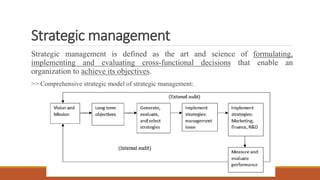
>> Comprehensive strategic model of strategic management:
Strategic management
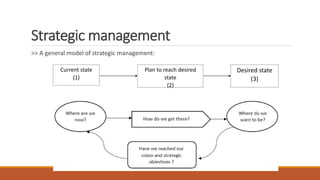
>> A general model of strategic management:
Current state
(1)
Plan to reach desired
state
(2)
Desired state
(3)
Strategic management
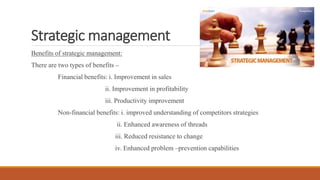
Benefits of strategic management:
There are two types of benefits –
Financial benefits: i. Improvement in sales
ii. Improvement in profitability
iii. Productivity improvement
Non-financial benefits: i. improved understanding of competitors strategies
ii. Enhanced awareness of threads
iii. Reduced resistance to change
iv. Enhanced problem –prevention capabilities
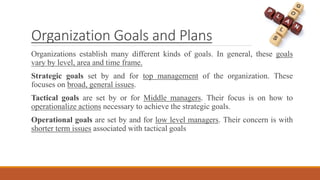
Organization Goals and Plans
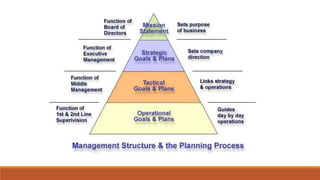
Organizations establish many different kinds of goals. In general, these goals
vary by level, area and time frame.
Strategic goals set by and for top management of the organization. These
focuses on broad, general issues.
Tactical goals are set by or for Middle managers. Their focus is on how to
operationalize actions necessary to achieve the strategic goals.
Operational goals are set by and for low level managers. Their concern is with
shorter term issues associated with tactical goals
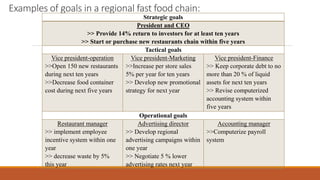
Examples of goals in a regional fast food chain:
Strategic goals
President and CEO
>> Provide 14% return to investors for at least ten years
>> Start or purchase new restaurants chain within five years
Tactical goals
Vice president-operation
>>Open 150 new restaurants
during next ten years
>>Decrease food container
cost during next five years
Vice president-Marketing
>>Increase per store sales
5% per year for ten years
>> Develop new promotional
strategy for next year
Vice president-Finance
>> Keep corporate debt to no
more than 20 % of liquid
assets for next ten years
>> Revise computerized
accounting system within
five years
Operational goals
Restaurant manager
>> implement employee
incentive system within one
year
>> decrease waste by 5%
this year
Advertising director
>> Develop regional
advertising campaigns within
one year
>> Negotiate 5 % lower
advertising rates next year
Accounting manager
>>Computerize payroll
system
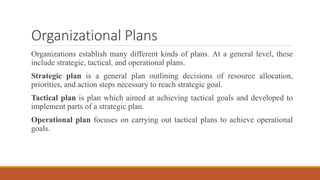
Organizational Plans
Organizations establish many different kinds of plans. At a general level, these
include strategic, tactical, and operational plans.
Strategic plan is a general plan outlining decisions of resource allocation,
priorities, and action steps necessary to reach strategic goal.
Tactical plan is plan which aimed at achieving tactical goals and developed to
implement parts of a strategic plan.
Operational plan focuses on carrying out tactical plans to achieve operational
goals.
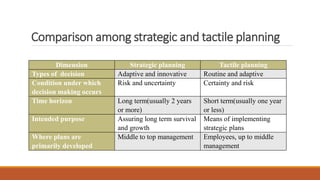
Comparison among strategic and tactile planning
Dimension Strategic planning Tactile planning
Types of decision Adaptive and innovative Routine and adaptive
Condition under which
decision making occurs
Risk and uncertainty Certainty and risk
Time horizon Long term(usually 2 years
or more)
Short term(usually one year
or less)
Intended purpose Assuring long term survival
and growth
Means of implementing
strategic plans
Where plans are
primarily developed
Middle to top management Employees, up to middle
management
Planning process
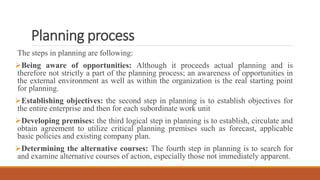
The steps in planning are following:
Being aware of opportunities: Although it proceeds actual planning and is
therefore not strictly a part of the planning process; an awareness of opportunities in
the external environment as well as within the organization is the real starting point
for planning.
Establishing objectives: the second step in planning is to establish objectives for
the entire enterprise and then for each subordinate work unit
Developing premises: the third logical step in planning is to establish, circulate and
obtain agreement to utilize critical planning premises such as forecast, applicable
basic policies and existing company plan.
Determining the alternative courses: The fourth step in planning is to search for
and examine alternative courses of action, especially those not immediately apparent.
Planning process
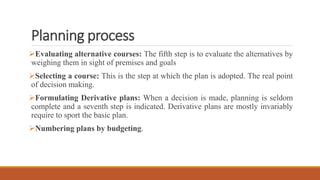
Evaluating alternative courses: The fifth step is to evaluate the alternatives by
weighing them in sight of premises and goals
Selecting a course: This is the step at which the plan is adopted. The real point
of decision making.
Formulating Derivative plans: When a decision is made, planning is seldom
complete and a seventh step is indicated. Derivative plans are mostly invariably
require to sport the basic plan.
Numbering plans by budgeting.
Management by Objectives (MBO)
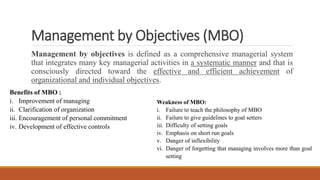
Management by objectives is defined as a comprehensive managerial system
that integrates many key managerial activities in a systematic manner and that is
consciously directed toward the effective and efficient achievement of
organizational and individual objectives.
Benefits of MBO :
i. Improvement of managing
ii. Clarification of organization
iii. Encouragement of personal commitment
iv. Development of effective controls
Weakness of MBO:
i. Failure to teach the philosophy of MBO
ii. Failure to give guidelines to goal setters
iii. Difficulty of setting goals
iv. Emphasis on short run goals
v. Danger of inflexibility
vi. Danger of forgetting that managing involves more than goal
setting
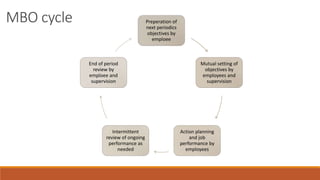
MBO cycle Preperation of
next periodics
objectives by
emploee
Mutual setting of
objectives by
employees and
supervision
Action planning
and job
performance by
employees
Intermittent
review of ongoing
performance as
needed
End of period
review by
emploee and
supervision
SWOT analysis
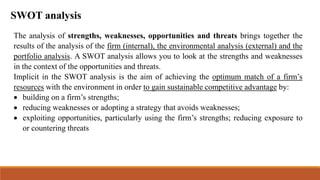
The analysis of strengths, weaknesses, opportunities and threats brings together the
results of the analysis of the firm (internal), the environmental analysis (external) and the
portfolio analysis. A SWOT analysis allows you to look at the strengths and weaknesses
in the context of the opportunities and threats.
Implicit in the SWOT analysis is the aim of achieving the optimum match of a firm’s
resources with the environment in order to gain sustainable competitive advantage by:
 building on a firm’s strengths;
 reducing weaknesses or adopting a strategy that avoids weaknesses;
 exploiting opportunities, particularly using the firm’s strengths; reducing exposure to
or countering threats
SWOT analysis
Strengths and weaknesses
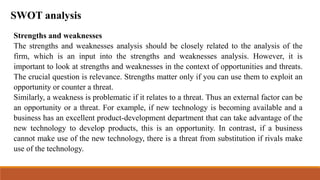
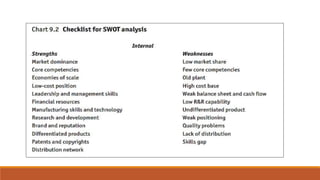
The strengths and weaknesses analysis should be closely related to the analysis of the
firm, which is an input into the strengths and weaknesses analysis. However, it is
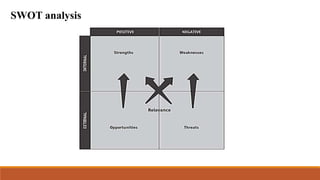
important to look at strengths and weaknesses in the context of opportunities and threats.
The crucial question is relevance. Strengths matter only if you can use them to exploit an
opportunity or counter a threat.
Similarly, a weakness is problematic if it relates to a threat. Thus an external factor can be
an opportunity or a threat. For example, if new technology is becoming available and a
business has an excellent product-development department that can take advantage of the
new technology to develop products, this is an opportunity. In contrast, if a business
cannot make use of the new technology, there is a threat from substitution if rivals make
use of the technology.
SWOT analysis
SWOT analysis
Opportunities and threats
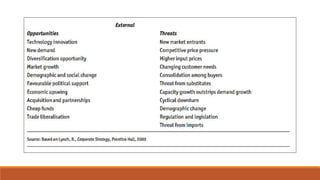
Opportunities and threats should be considered in the context of strengths and
weaknesses. For example, there may a new market opportunity but at present your
business does not have the resources to exploit it. Indeed, you may be preparing a
business plan to raise funds for this purpose. To be successful in this, you must use
resources to acquire the strengths that are necessary to exploit the opportunity.
Any questions?

Planning and Decision Making process

  • 1.
    Planning and Decision MakingProcess STRATEGIC MANAGEMENT, ORGANIZATION GOALS AND PLANS, PLANNING PROCESS, MANAGEMENT BY OBJECTIVES (MBO) SWOT ANALYSIS
  • 2.
    Strategic management Strategic managementis defined as the art and science of formulating, implementing and evaluating cross-functional decisions that enable an organization to achieve its objectives. >> Comprehensive strategic model of strategic management:
  • 3.
    Strategic management >> Ageneral model of strategic management: Current state (1) Plan to reach desired state (2) Desired state (3)
  • 4.
    Strategic management Benefits ofstrategic management: There are two types of benefits – Financial benefits: i. Improvement in sales ii. Improvement in profitability iii. Productivity improvement Non-financial benefits: i. improved understanding of competitors strategies ii. Enhanced awareness of threads iii. Reduced resistance to change iv. Enhanced problem –prevention capabilities
  • 5.
    Organization Goals andPlans Organizations establish many different kinds of goals. In general, these goals vary by level, area and time frame. Strategic goals set by and for top management of the organization. These focuses on broad, general issues. Tactical goals are set by or for Middle managers. Their focus is on how to operationalize actions necessary to achieve the strategic goals. Operational goals are set by and for low level managers. Their concern is with shorter term issues associated with tactical goals
  • 6.
    Examples of goalsin a regional fast food chain: Strategic goals President and CEO >> Provide 14% return to investors for at least ten years >> Start or purchase new restaurants chain within five years Tactical goals Vice president-operation >>Open 150 new restaurants during next ten years >>Decrease food container cost during next five years Vice president-Marketing >>Increase per store sales 5% per year for ten years >> Develop new promotional strategy for next year Vice president-Finance >> Keep corporate debt to no more than 20 % of liquid assets for next ten years >> Revise computerized accounting system within five years Operational goals Restaurant manager >> implement employee incentive system within one year >> decrease waste by 5% this year Advertising director >> Develop regional advertising campaigns within one year >> Negotiate 5 % lower advertising rates next year Accounting manager >>Computerize payroll system
  • 7.
    Organizational Plans Organizations establishmany different kinds of plans. At a general level, these include strategic, tactical, and operational plans. Strategic plan is a general plan outlining decisions of resource allocation, priorities, and action steps necessary to reach strategic goal. Tactical plan is plan which aimed at achieving tactical goals and developed to implement parts of a strategic plan. Operational plan focuses on carrying out tactical plans to achieve operational goals.
  • 9.
    Comparison among strategicand tactile planning Dimension Strategic planning Tactile planning Types of decision Adaptive and innovative Routine and adaptive Condition under which decision making occurs Risk and uncertainty Certainty and risk Time horizon Long term(usually 2 years or more) Short term(usually one year or less) Intended purpose Assuring long term survival and growth Means of implementing strategic plans Where plans are primarily developed Middle to top management Employees, up to middle management
  • 10.
    Planning process The stepsin planning are following: Being aware of opportunities: Although it proceeds actual planning and is therefore not strictly a part of the planning process; an awareness of opportunities in the external environment as well as within the organization is the real starting point for planning. Establishing objectives: the second step in planning is to establish objectives for the entire enterprise and then for each subordinate work unit Developing premises: the third logical step in planning is to establish, circulate and obtain agreement to utilize critical planning premises such as forecast, applicable basic policies and existing company plan. Determining the alternative courses: The fourth step in planning is to search for and examine alternative courses of action, especially those not immediately apparent.
  • 11.
    Planning process Evaluating alternativecourses: The fifth step is to evaluate the alternatives by weighing them in sight of premises and goals Selecting a course: This is the step at which the plan is adopted. The real point of decision making. Formulating Derivative plans: When a decision is made, planning is seldom complete and a seventh step is indicated. Derivative plans are mostly invariably require to sport the basic plan. Numbering plans by budgeting.
  • 12.
    Management by Objectives(MBO) Management by objectives is defined as a comprehensive managerial system that integrates many key managerial activities in a systematic manner and that is consciously directed toward the effective and efficient achievement of organizational and individual objectives. Benefits of MBO : i. Improvement of managing ii. Clarification of organization iii. Encouragement of personal commitment iv. Development of effective controls Weakness of MBO: i. Failure to teach the philosophy of MBO ii. Failure to give guidelines to goal setters iii. Difficulty of setting goals iv. Emphasis on short run goals v. Danger of inflexibility vi. Danger of forgetting that managing involves more than goal setting
  • 13.
    MBO cycle Preperationof next periodics objectives by emploee Mutual setting of objectives by employees and supervision Action planning and job performance by employees Intermittent review of ongoing performance as needed End of period review by emploee and supervision
  • 14.
    SWOT analysis The analysisof strengths, weaknesses, opportunities and threats brings together the results of the analysis of the firm (internal), the environmental analysis (external) and the portfolio analysis. A SWOT analysis allows you to look at the strengths and weaknesses in the context of the opportunities and threats. Implicit in the SWOT analysis is the aim of achieving the optimum match of a firm’s resources with the environment in order to gain sustainable competitive advantage by:  building on a firm’s strengths;  reducing weaknesses or adopting a strategy that avoids weaknesses;  exploiting opportunities, particularly using the firm’s strengths; reducing exposure to or countering threats
  • 15.
    SWOT analysis Strengths andweaknesses The strengths and weaknesses analysis should be closely related to the analysis of the firm, which is an input into the strengths and weaknesses analysis. However, it is important to look at strengths and weaknesses in the context of opportunities and threats. The crucial question is relevance. Strengths matter only if you can use them to exploit an opportunity or counter a threat. Similarly, a weakness is problematic if it relates to a threat. Thus an external factor can be an opportunity or a threat. For example, if new technology is becoming available and a business has an excellent product-development department that can take advantage of the new technology to develop products, this is an opportunity. In contrast, if a business cannot make use of the new technology, there is a threat from substitution if rivals make use of the technology.
  • 16.
  • 17.
    SWOT analysis Opportunities andthreats Opportunities and threats should be considered in the context of strengths and weaknesses. For example, there may a new market opportunity but at present your business does not have the resources to exploit it. Indeed, you may be preparing a business plan to raise funds for this purpose. To be successful in this, you must use resources to acquire the strengths that are necessary to exploit the opportunity.
  • 20.