Management
of first
trimester
miscarriage
Aboubakr Elnashar
Benha university Hospital
Egypt
ABOUBAKR ELNASHAR
CONTENTS
1. DEFINITION
2. PREVENTION
3. VIABLE PREGNANCY
4. NON VIABLE PREGNANCY
5. COMPLICATIONS
6. FOLLOW UP
 SUMMARY AND RECOMMENDATION
ABOUBAKR ELNASHAR
1. DEFINITION
Spontaneous abortion, or miscarriage
Clinically recognized pregnancy loss before 20 w
Expulsion or extraction of an embryo or fetus
weighing 500 g or less.
(WHO)
ABOUBAKR ELNASHAR
2. PREVENTION
Preconceptual and prenatal counseling and care:
most important interventions for prevention of
spontaneous abortion in women with no prior
history of miscarriage.
Use of pharmacologic therapy
estrogen, vitamins
has not been found to be effective.
Most miscarriages are not preventable
{chromosomal abnormalities account for
approximately 50%
ABOUBAKR ELNASHAR
Modifiable etiologies and risk factors for
spontaneous abortion
1. Maternal disease:
diabetes, thyroid disease, thrombophilia:
Preconceptual and prenatal care: routine screening
and optimal disease management for conditions that can
result in miscarriage or other adverse effects to the fetus or
mother during pregnancy.
2. Extremes of maternal weight:
underweight or obese
should be addressed during preconceptual counseling.
Evaluation and management of underlying causes should be
offered.
ABOUBAKR ELNASHAR
3. Uterine structural abnormalities
uterine septum, submucosal leiomyoma, intrauterine
adhesions can be corrected if recognized prior to pregnancy.
4. Exposure to teratogens or infection
Preconceptual and prenatal counseling
should include a review of current
prescription and common over thecounter medications and
other exposures (eg, alcohol, smoking, foods that may be
contaminated by Listeria monocytogenes, radiation) that may
result in spontaneous abortion or congenital anomalies.
ABOUBAKR ELNASHAR
3. VIABLE INTRAUTERINE PREGNANCY
THREATENED MISCRRAIGE
vaginal bleeding has occurred and the cervical os
is closed, but the diagnostic criteria for spontaneous
abortion have not been met.
ABOUBAKR ELNASHAR
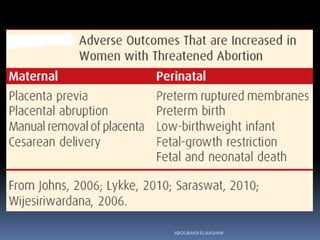
Adverse effects
low likelihood
At 8 w if FH +ve: 90% will not miscarry.
Prognosis
Good:
bleeding light
limited to early pregnancy ≤6 w
Bad:
bleeding is heavy
extends into 2nd T
ABOUBAKR ELNASHAR
ABOUBAKR ELNASHAR
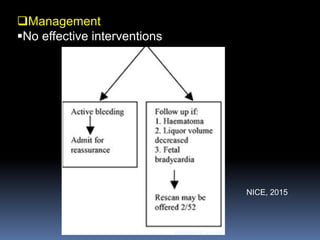
Management
No effective interventions
NICE, 2015
ABOUBAKR ELNASHAR
Progestins
Most promising tt
The rate of spontaneous abortion was statistically
significantly lower with progestin tt compared with
either placebo or no tt
(14 vs 26%; relative risk 0.53, 95% CI 0.350.79).
Progestins were administered either orally or
vaginally, and a subgroup analysis found a
significant decrease in the rate of abortion only for
oral progestins; the analysis of vaginal progestins lacked
sufficient statistical power to detect a difference.
There was no significant increase in congenital anomalies
or pregnancy induced hypertension in the progestin group.
(Cochrane SR, 2011)
ABOUBAKR ELNASHAR
 Oral progestin dydrogesterone , compared with
placebo or supportive care (eg, bed rest)
significant decrease in the rate of miscarriage in
the progestin group (13 vs 24%; odds
ratio [OR] 0.47, 95% CI 0.310.7).
[Carp, 2012 MA].
Limitation:
small number of participants and events
poor methodologic quality of studies
ABOUBAKR ELNASHAR
.
Many miscarriages are caused by genetic
abnormalities in the conceptus. It is unlikely that
progestins could prevent a miscarriage of this
etiology.
The data are insufficient to make a
recommendation for or against progestins for
women with threatened abortion.
ABOUBAKR ELNASHAR
Other medications
HCG
Uterine muscle relaxants: tocolytics, betaagonists
Vitamin supplementation
Chinese herbal medicine
high quality data do not support their use
ABOUBAKR ELNASHAR
Bed rest
commonly recommended
unnecessary and will not affect outcome
RCT: bed rest at home or in the hospital is not
beneficial in preventing fetal loss
[Aleman et al, 2005].
Abstinence from sexual intercourse and physical
exertion
typically advised
no data to support this.
ABOUBAKR ELNASHAR
4. Non-viable pregnancy
Incomplete,
Silent, Delayed, missed, early fetal demise.
•Inevitable abortion
vaginal bleeding, typically accompanied by crampy pelvic
pain, and the cervix is dilated. Products of conception can
often be felt or visualized through the internal cervical os.
●Incomplete abortion
vaginal bleeding and/or pain are present, the cervix is
dilated, and products of conception are found within the
cervical canal on examination.
●Missed abortion
spontaneous abortion in a patient with or without symptoms
and with a ● closed cervical os.
ABOUBAKR ELNASHAR
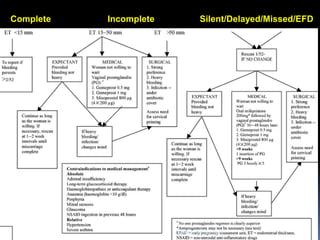
Choosing a treatment method
Surgical (dilation and curettage) or
Medication (misoprostol)
Expectant management.
All have similar efficacy
Choice depends mainly upon patient preference.
[Sotiriadis et al, 2005MA].
ABOUBAKR ELNASHAR
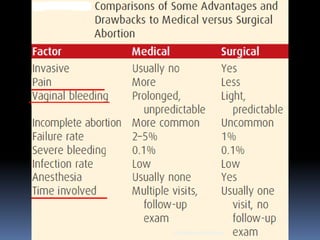
Medical Vs Surgical
 Both are safe and effective approaches for
appropriately selected patients.
 The choice is based upon
1. Patient preference.
Counseling of both is recommended
2. Availability
3. Gestational age:
Medical tt is less successful in the late 1st T
ABOUBAKR ELNASHAR
Surgical management
1. Do not want to wait for a pregnancy to pass
spontaneously or with medication
2. Avoid the experience of pain and bleeding that
accompanies the passage of the products of
conception.
3. Heavy bleeding or intrauterine sepsis in whom
delaying therapy could be harmful.
4. Contraindications to misoprostol
5. Medical co morbidities: controlled method of
uterine evacuation in a hospital setting (eg,
coagulopathy).
ABOUBAKR ELNASHAR
 Expectant or medical
women prefer to avoid surgery and anesthesia.
{concern about risks or may be due to a preference
to pass the pregnancy without instrumentation}
Expectant management
spontaneous miscarriage <14 w
stable vital signs
no evidence of infection.
ABOUBAKR ELNASHAR
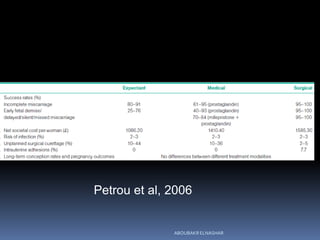
Petrou et al, 2006
ABOUBAKR ELNASHAR
ABOUBAKR ELNASHAR
ABOUBAKR ELNASHAR
Complete Incomplete Silent/Delayed/Missed/EFD
ABOUBAKR ELNASHAR
Alloimmunization prevention
United States and Canada, women with bleeding
during pregnancy who are
Rh(D)negative and unsensitized receive
Rh(D)immune globulin.
Other countries, guidelines vary regarding whether
Rh(D)immune globulin is required for first trimester
spontaneous abortion.
ABOUBAKR ELNASHAR
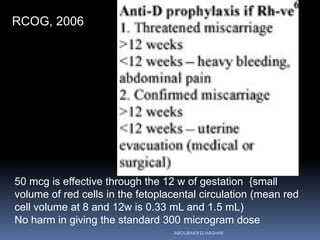
RCOG, 2006
50 mcg is effective through the 12 w of gestation {small
volume of red cells in the fetoplacental circulation (mean red
cell volume at 8 and 12w is 0.33 mL and 1.5 mL)
No harm in giving the standard 300 microgram dose
ABOUBAKR ELNASHAR
Expectant management
Up to 70% of women will choose expectant
management if given the choice.
Most women are willing to wait when appropriately
counseled and prepared for what to expect.
ABOUBAKR ELNASHAR
Success within 2–6 w :
anembryonic pregnancies: 65%
missed abortions: 75%
incomplete miscarriages: 85%
(Butler et al, 2005)
The majority of expulsions occur in the first 2w
ABOUBAKR ELNASHAR
Rates of incomplete abortion:
30% at 2w
10% at 6-8w
If expectant tt is unsuccessful after 4w:
Medical or surgical evacuation.
US follow up:
some routinely to evaluate the uterine cavity
others perform US selectively in patients whose
clinical examination is suggestive of retained products of
conception (eg, cervical os is not closed, active bleeding).
ABOUBAKR ELNASHAR
Prediction of success:
1. An increasing bleeding pattern at inclusion
2. Incomplete miscarriage is more likely to proceed
to expulsion within 2w than a missed abortion.
3. Ultrasound findings:
blood flow within intervillous spaces
4. Biochemical markers:
hCG,
Progesterone
inhibin A and inhibin pro-alpha C RI: significant
differences in those pregnancies that resolve
spontaneously
(Elson et al, 2005)
Other ultrasound parameters such as
endometrial thickness and the presence or absence
of a gestational sac did not add any further ABOUBAKR ELNASHAR
Complications
1. Infection
2. Excessive pain or bleeding:
1% vs 2% for surgical tt
3. If spontaneous expulsion does not occur,
medication or surgical tt can be administered.
ABOUBAKR ELNASHAR
Medical management
Misoprostol advantage: prostaglandin E1 analog
most commonly used
Cheap
not requiring refrigeration
low incidence of side effects
readily available
timing of use can be controlled by the patient.
clinical assessment and subsequent administration
can be safely performed by appropriately trained
non clinician providers
ABOUBAKR ELNASHAR
Route
Vaginal is preferable
1. mean time to expulsion is shorter
2. As effective as oral misoprostol
3. Incidence of diarrhoea and fatigue: lower
ABOUBAKR ELNASHAR
Dose:
Single is preferred
1. Single and repeated doses of oral misoprostol
600 ug (with the dose repeated after 4 hours to a
total of 1 200 ug):
 equally effective
 diarrhoea is less.
(Nguyen et al, 2005)
2. The expulsion rate: higher with a single dose of 600
to 800 mcg given vaginally (70 to 90%)
{local effect of misoprostol on the uterine cervix, the high
drug concentration achieved in uterine tissue, and the
increased bioavailability with vaginal administration].
ABOUBAKR ELNASHAR
How much:
Single-dose vaginal misoprostol 800 μg was more
effective than 400 ug
(55.4% vs 40.2%)
more effective in delayed miscarriage compared with
cases where there was an empty sac
(50.3% vs 40.2%)
A single oral dose of 400 mcg misoprostol:
low rate (13%) of expulsion
same dose given multiple times: expulsion rate of 50
to 70%
ABOUBAKR ELNASHAR
Incomplete abortion
Oral: 600 ug (single dose)
[WHO, 2007]
Vaginal: 800ug
Oral : 400 μg.
ABOUBAKR ELNASHAR
Silent, delayed, missed miscarriage or
early fetal demise
•Vaginal: 800 ug per or
•Sublingual: 600 ug(single dose)
[WHO, 2007]
oral, sublingual or vaginal
400, 600 or 800 g in single or repeated doses
Sublingual: 400 g appears to be a safe, effective
alternative to the oral or vaginal routes.
ABOUBAKR ELNASHAR
Success:
1. Dose.
2. Route
ABOUBAKR ELNASHAR
3. Type of failed pregnancy, but not by the duration
of the pregnancy.
In medically managed patients, complete expulsion occurred in 71% of all
women by day 3 and 84% by day 8.
An anembryonic gestation had a lower success
rate than an embryonic or fetal death (81 vs 88%).
In contrast to induced medical abortion, pregnancy duration
did not affect the rate of successful expulsion in missed,
incomplete, or inevitable abortions
ABOUBAKR ELNASHAR
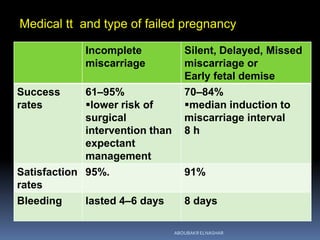
Silent, Delayed, Missed
miscarriage or
Early fetal demise
Incomplete
miscarriage
70–84%
median induction to
miscarriage interval
8 h
61–95%
lower risk of
surgical
intervention than
expectant
management
Success
rates
91%95%.Satisfaction
rates
8 dayslasted 4–6 daysBleeding
Medical tt and type of failed pregnancy
ABOUBAKR ELNASHAR
Surgical evacuation
tt of choice if
endometrial thickness: 50 mm
Bleeding: excessive
vital signs: unstable
infected tissue is present in the uterine cavity:
must be done under antibiotic cover
10% who miscarry fall into these categories.
Certain women will still prefer surgical
evacuation: their choice should be accepted.
ABOUBAKR ELNASHAR
Surgical advantages:
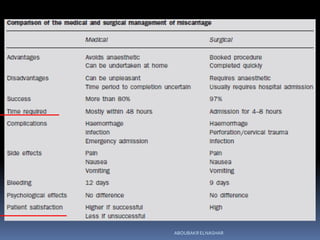
1. Shorter time to completion of tt.
complete evacuation within 48 h is more likely with surgical
than medical and more likely with medical than expectant
[Sotiriadis et al, 2005MA].
2. lowers risk of unplanned hospital admissions and
need for subsequent tt.
(MIST (Miscarriage treatment trial) randomized trial, the only trial to
compare all three treatment strategies: E, M, S
[Trinder et al, 2006])
(49 vs 18 vs 8%).
Further Surgical intervention
(44 vs13 vs 5%)
3. Blood transfusions
(2 vs, 1vs 0%)
ABOUBAKR ELNASHAR
Rare surgical risks
1. Uterine perforation (1%)
2. Cervical tears, intra-abdominal trauma (0.1%)
3. Intrauterine adhesions
4. Haemorrhage,
5. Infection
6. Anaesthetic complications.
ABOUBAKR ELNASHAR
Techniques:
Vacuum aspiration
Recommended for pregnancies up to12 to 14 w
(WHO ,2012)
safe, quick
significant decreased blood loss
less painful than sharp curettage.
uterine perforation, and other morbidity: rare.
Dilation of the cervix, followed by suction
evacuation, and then sharp curettage of the uterus
to check that the uterine cavity is free of remaining
tissue (dilation and curettage, dilation and
evacuation, or evacuation and curettage.
ABOUBAKR ELNASHAR
Analgesia and sedation
should be provided as necessary for the procedure.
typically performed under IV conscious sedation and
a paracervical block.
Prophylactic antibiotics
1 g rectal metronidazole at the time of surgery then
100 mg oral doxycycline twice daily for 7 days.
(RCOG, 2004)
Cervical priming
should be assessed.
(Forna et al, Cochrane SR, 2001)
ABOUBAKR ELNASHAR
US guidance
not required
Value:
guide the placement of the instruments during the
procedure.
visualization of a thin endometrial stripe at the end
of the curettage: the majority of the pregnancy tissue
has been removed.
Hysteroscopic guidance
may be used if there is a uterine septum.
ABOUBAKR ELNASHAR
5. COMPLICATIONS
1. Hemorrhage
Timing:
around the time of the spontaneous passage of
products of conception
during or after surgical uterine evacuation.
Etiology
subinvolution of the placental implantation site
uterine atony
cervical injury, or uterine perforation, with possible
vascular injury.
ABOUBAKR ELNASHAR
TT: of the cause
products of conception: evacuated surgically.
uterine atony: oxytocin, misoprostol
cervical injury or uterine perforation:
Significant hge following a curettage for
spontaneous abortion:
± underlying, not previously recognized
coagulopathy: hypofibrinogenemia, factor deficiency
ABOUBAKR ELNASHAR
2. Uterine perforation
Avoided by
Careful surgical technique.
If high risk of perforation: anatomic alterations,
uterine infection: US guidance.
3. Retained products of conception
Suspected
uterine bleeding that increases in volume or persists
for more than 2w after uterine evacuation.
ABOUBAKR ELNASHAR
4. Endometritis
Mild endometritis:
mild uterine tenderness
empty uterus on US examination
with or without fever:
oral broad spectrum antibiotics.
ABOUBAKR ELNASHAR
5. Miscarriage with infection: Septic abortion
Uncommon in: spontaneous miscarraige
more common in: induced abortion.
Important to recognize S&S
{ life threatening}.
ABOUBAKR ELNASHAR
Management:
1. Stabilize with fluids or blood products.
2.Blood and endometrial cultures
3.Broad spectrum IV antibiotics. as for PID.
 until the patient has improved and afebrile for
48h, followed by
 oral antibiotics to complete a 10-14d
ABOUBAKR ELNASHAR
4. Surgical evacuation
risk of perforation is high:
suction evacuation
a gritty texture obtained with a sharp curette.
Avoid excessive curetting
{intrauterine adhesion formation}.
US guidance
ABOUBAKR ELNASHAR
Indications for further surgery(± hysterectomy)
1. Failure to respond to uterine evacuation and
antibiotics
2. Pelvic abscess
3. Clostridial necrotizing myonecrosis (gas
gangrene).
Discolored, woody appearance of the uterus and
adnexa
crepitation of the pelvic tissue
radiographic evidence of air within the uterine wall
are indications for total hysterectomy and
adnexectomy.
Surgery, if indicated, may be performed by laparoscopy.
ABOUBAKR ELNASHAR
6. FOLLOWUP
I. Confirming complete evacuation
1. Examination of Products of conception
Fetal membranes are readily identifiable and confirm
passage of at least part of an intrauterine pregnancy.
An embryo may or may not be identified.
 Intact gestational sac may be noted.
Placental villi can be difficult to distinguish from organized
clot.
One method is to rinse with water and then float the tissue in
a dish of water, preferably with a good light source underneath.
Villi have a frond like
appearance, which has been described as similar to seaweed
floating in the ocean.
ABOUBAKR ELNASHAR
2. Histopathology
Of all products of conception
Karyotyping is requested for women with three or more pregnancy losses
ABOUBAKR ELNASHAR
3. Ultrasound
Criteria for an empty uterus:
homogeneous intrauterine dimension ≤11 cm in
combined transverse and sagittal planes
[Leung et al, 2006].
Indication of evacuation:
retained tissue with a diameter ≥15 mm .
Using the latter criteria, 5% of women had complications, and 40% required another
intervention (medical or surgical). However, there is also evidence that increased endometrial
thickness is not predictive of morbidity in asymptomatic women (Creinin et al, 2004)
If the ultrasound reveals retained tissue and the patient is asymptomatic or having only
minimal bleeding, we offer the patient surgical evacuation of the uterus or expectant
management for another two weeks.
ABOUBAKR ELNASHAR
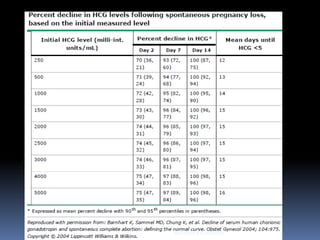
4. hCG testing
return to normal within 2-4 w after a completed
miscarriage
After E, M or S TT: many clinicians measure a
serum hCG level weekly until it is undetectable.
Not common practice after surgical evacuation.
Do not routinely do follow up hCG testing after any
method of evacuation, unless normal menstrual
cycles do not resume within 4-6w.
ABOUBAKR ELNASHAR
If hCG do not return to undetectable level:
retained products of conception
undiagnosed ectopic pregnancy
Undiagnosed gestational trophoblastic disease.
ABOUBAKR ELNASHAR
ABOUBAKR ELNASHAR
II. Postabortion instructions
Maintain pelvic rest
nothing per vagina for 2 w after evacuation or
passage of the products of conception, at which time
coitus and use of tampons may be resumed.
Light vaginal bleeding can persist for a couple of
weeks after miscarraige.
Patients should call their provider if
heavy bleeding
fever
abdominal pain
ABOUBAKR ELNASHAR
Menses typically resume within 6 w.
Although rare, IU adhesions could occur after
surgical evacuation of the uterus. In the severe form,
menses do not resume or are scanty.
ABOUBAKR ELNASHAR
III. Grief counseling
Etiology of the loss
1. known or suspected:
the couple should be informed and counseled about
recurrence risks.
2. Rreversible:
these can be addressed, as appropriate, in a
nonjudgmental way.
ABOUBAKR ELNASHAR
3. cannot be determined:
reassure the woman and her partner that there is no
evidence that routine activities cause miscarriage
sexual intercourse
heavy lifting
bumping her abdomen
stress
dispel myths about miscarriage
The most commonly believed causes of miscarriage:
stress: 76%
lifting a heavy object: 64%
prior IUD use: 28%
prior oral contraceptive: 22%
(Bardos et al, 2015)
ABOUBAKR ELNASHAR
IV. Contraception
Any type of contraception, including placement of
intrauterine contraception, may be started
immediately after miscarriage has been completed
ABOUBAKR ELNASHAR
V. Interval to conception
To postpone for 2-3 months: not advised
{no greater risk of adverse outcome with a shorter
interpregnancy interval
(Goldstein et al, 2004).
In one prospective study (n = 677), the overall rates
of live birth, miscarriage, and other pregnancy
complications after a pregnancy loss among women
with interpregnancy interval of ≤3 months and >3
months were similar}
[Makhlouf et al, 2014].
ABOUBAKR ELNASHAR
246 lectures
3003 members
ABOUBAKR ELNASHAR

Management of first trimester miscarriage

  • 1.
    Management of first trimester miscarriage Aboubakr Elnashar Benhauniversity Hospital Egypt ABOUBAKR ELNASHAR
  • 2.
    CONTENTS 1. DEFINITION 2. PREVENTION 3.VIABLE PREGNANCY 4. NON VIABLE PREGNANCY 5. COMPLICATIONS 6. FOLLOW UP  SUMMARY AND RECOMMENDATION ABOUBAKR ELNASHAR
  • 3.
    1. DEFINITION Spontaneous abortion,or miscarriage Clinically recognized pregnancy loss before 20 w Expulsion or extraction of an embryo or fetus weighing 500 g or less. (WHO) ABOUBAKR ELNASHAR
  • 4.
    2. PREVENTION Preconceptual andprenatal counseling and care: most important interventions for prevention of spontaneous abortion in women with no prior history of miscarriage. Use of pharmacologic therapy estrogen, vitamins has not been found to be effective. Most miscarriages are not preventable {chromosomal abnormalities account for approximately 50% ABOUBAKR ELNASHAR
  • 5.
    Modifiable etiologies andrisk factors for spontaneous abortion 1. Maternal disease: diabetes, thyroid disease, thrombophilia: Preconceptual and prenatal care: routine screening and optimal disease management for conditions that can result in miscarriage or other adverse effects to the fetus or mother during pregnancy. 2. Extremes of maternal weight: underweight or obese should be addressed during preconceptual counseling. Evaluation and management of underlying causes should be offered. ABOUBAKR ELNASHAR
  • 6.
    3. Uterine structuralabnormalities uterine septum, submucosal leiomyoma, intrauterine adhesions can be corrected if recognized prior to pregnancy. 4. Exposure to teratogens or infection Preconceptual and prenatal counseling should include a review of current prescription and common over thecounter medications and other exposures (eg, alcohol, smoking, foods that may be contaminated by Listeria monocytogenes, radiation) that may result in spontaneous abortion or congenital anomalies. ABOUBAKR ELNASHAR
  • 7.
    3. VIABLE INTRAUTERINEPREGNANCY THREATENED MISCRRAIGE vaginal bleeding has occurred and the cervical os is closed, but the diagnostic criteria for spontaneous abortion have not been met. ABOUBAKR ELNASHAR
  • 8.
    Adverse effects low likelihood At8 w if FH +ve: 90% will not miscarry. Prognosis Good: bleeding light limited to early pregnancy ≤6 w Bad: bleeding is heavy extends into 2nd T ABOUBAKR ELNASHAR
  • 9.
  • 10.
  • 11.
    Progestins Most promising tt Therate of spontaneous abortion was statistically significantly lower with progestin tt compared with either placebo or no tt (14 vs 26%; relative risk 0.53, 95% CI 0.350.79). Progestins were administered either orally or vaginally, and a subgroup analysis found a significant decrease in the rate of abortion only for oral progestins; the analysis of vaginal progestins lacked sufficient statistical power to detect a difference. There was no significant increase in congenital anomalies or pregnancy induced hypertension in the progestin group. (Cochrane SR, 2011) ABOUBAKR ELNASHAR
  • 12.
     Oral progestindydrogesterone , compared with placebo or supportive care (eg, bed rest) significant decrease in the rate of miscarriage in the progestin group (13 vs 24%; odds ratio [OR] 0.47, 95% CI 0.310.7). [Carp, 2012 MA]. Limitation: small number of participants and events poor methodologic quality of studies ABOUBAKR ELNASHAR
  • 13.
    . Many miscarriages arecaused by genetic abnormalities in the conceptus. It is unlikely that progestins could prevent a miscarriage of this etiology. The data are insufficient to make a recommendation for or against progestins for women with threatened abortion. ABOUBAKR ELNASHAR
  • 14.
    Other medications HCG Uterine musclerelaxants: tocolytics, betaagonists Vitamin supplementation Chinese herbal medicine high quality data do not support their use ABOUBAKR ELNASHAR
  • 15.
    Bed rest commonly recommended unnecessaryand will not affect outcome RCT: bed rest at home or in the hospital is not beneficial in preventing fetal loss [Aleman et al, 2005]. Abstinence from sexual intercourse and physical exertion typically advised no data to support this. ABOUBAKR ELNASHAR
  • 16.
    4. Non-viable pregnancy Incomplete, Silent,Delayed, missed, early fetal demise. •Inevitable abortion vaginal bleeding, typically accompanied by crampy pelvic pain, and the cervix is dilated. Products of conception can often be felt or visualized through the internal cervical os. ●Incomplete abortion vaginal bleeding and/or pain are present, the cervix is dilated, and products of conception are found within the cervical canal on examination. ●Missed abortion spontaneous abortion in a patient with or without symptoms and with a ● closed cervical os. ABOUBAKR ELNASHAR
  • 17.
    Choosing a treatmentmethod Surgical (dilation and curettage) or Medication (misoprostol) Expectant management. All have similar efficacy Choice depends mainly upon patient preference. [Sotiriadis et al, 2005MA]. ABOUBAKR ELNASHAR
  • 18.
    Medical Vs Surgical Both are safe and effective approaches for appropriately selected patients.  The choice is based upon 1. Patient preference. Counseling of both is recommended 2. Availability 3. Gestational age: Medical tt is less successful in the late 1st T ABOUBAKR ELNASHAR
  • 19.
    Surgical management 1. Donot want to wait for a pregnancy to pass spontaneously or with medication 2. Avoid the experience of pain and bleeding that accompanies the passage of the products of conception. 3. Heavy bleeding or intrauterine sepsis in whom delaying therapy could be harmful. 4. Contraindications to misoprostol 5. Medical co morbidities: controlled method of uterine evacuation in a hospital setting (eg, coagulopathy). ABOUBAKR ELNASHAR
  • 20.
     Expectant ormedical women prefer to avoid surgery and anesthesia. {concern about risks or may be due to a preference to pass the pregnancy without instrumentation} Expectant management spontaneous miscarriage <14 w stable vital signs no evidence of infection. ABOUBAKR ELNASHAR
  • 21.
    Petrou et al,2006 ABOUBAKR ELNASHAR
  • 22.
  • 23.
  • 24.
  • 25.
    Alloimmunization prevention United Statesand Canada, women with bleeding during pregnancy who are Rh(D)negative and unsensitized receive Rh(D)immune globulin. Other countries, guidelines vary regarding whether Rh(D)immune globulin is required for first trimester spontaneous abortion. ABOUBAKR ELNASHAR
  • 26.
    RCOG, 2006 50 mcgis effective through the 12 w of gestation {small volume of red cells in the fetoplacental circulation (mean red cell volume at 8 and 12w is 0.33 mL and 1.5 mL) No harm in giving the standard 300 microgram dose ABOUBAKR ELNASHAR
  • 27.
    Expectant management Up to70% of women will choose expectant management if given the choice. Most women are willing to wait when appropriately counseled and prepared for what to expect. ABOUBAKR ELNASHAR
  • 28.
    Success within 2–6w : anembryonic pregnancies: 65% missed abortions: 75% incomplete miscarriages: 85% (Butler et al, 2005) The majority of expulsions occur in the first 2w ABOUBAKR ELNASHAR
  • 29.
    Rates of incompleteabortion: 30% at 2w 10% at 6-8w If expectant tt is unsuccessful after 4w: Medical or surgical evacuation. US follow up: some routinely to evaluate the uterine cavity others perform US selectively in patients whose clinical examination is suggestive of retained products of conception (eg, cervical os is not closed, active bleeding). ABOUBAKR ELNASHAR
  • 30.
    Prediction of success: 1.An increasing bleeding pattern at inclusion 2. Incomplete miscarriage is more likely to proceed to expulsion within 2w than a missed abortion. 3. Ultrasound findings: blood flow within intervillous spaces 4. Biochemical markers: hCG, Progesterone inhibin A and inhibin pro-alpha C RI: significant differences in those pregnancies that resolve spontaneously (Elson et al, 2005) Other ultrasound parameters such as endometrial thickness and the presence or absence of a gestational sac did not add any further ABOUBAKR ELNASHAR
  • 31.
    Complications 1. Infection 2. Excessivepain or bleeding: 1% vs 2% for surgical tt 3. If spontaneous expulsion does not occur, medication or surgical tt can be administered. ABOUBAKR ELNASHAR
  • 32.
    Medical management Misoprostol advantage:prostaglandin E1 analog most commonly used Cheap not requiring refrigeration low incidence of side effects readily available timing of use can be controlled by the patient. clinical assessment and subsequent administration can be safely performed by appropriately trained non clinician providers ABOUBAKR ELNASHAR
  • 33.
    Route Vaginal is preferable 1.mean time to expulsion is shorter 2. As effective as oral misoprostol 3. Incidence of diarrhoea and fatigue: lower ABOUBAKR ELNASHAR
  • 34.
    Dose: Single is preferred 1.Single and repeated doses of oral misoprostol 600 ug (with the dose repeated after 4 hours to a total of 1 200 ug):  equally effective  diarrhoea is less. (Nguyen et al, 2005) 2. The expulsion rate: higher with a single dose of 600 to 800 mcg given vaginally (70 to 90%) {local effect of misoprostol on the uterine cervix, the high drug concentration achieved in uterine tissue, and the increased bioavailability with vaginal administration]. ABOUBAKR ELNASHAR
  • 35.
    How much: Single-dose vaginalmisoprostol 800 μg was more effective than 400 ug (55.4% vs 40.2%) more effective in delayed miscarriage compared with cases where there was an empty sac (50.3% vs 40.2%) A single oral dose of 400 mcg misoprostol: low rate (13%) of expulsion same dose given multiple times: expulsion rate of 50 to 70% ABOUBAKR ELNASHAR
  • 36.
    Incomplete abortion Oral: 600ug (single dose) [WHO, 2007] Vaginal: 800ug Oral : 400 μg. ABOUBAKR ELNASHAR
  • 37.
    Silent, delayed, missedmiscarriage or early fetal demise •Vaginal: 800 ug per or •Sublingual: 600 ug(single dose) [WHO, 2007] oral, sublingual or vaginal 400, 600 or 800 g in single or repeated doses Sublingual: 400 g appears to be a safe, effective alternative to the oral or vaginal routes. ABOUBAKR ELNASHAR
  • 38.
  • 39.
    3. Type offailed pregnancy, but not by the duration of the pregnancy. In medically managed patients, complete expulsion occurred in 71% of all women by day 3 and 84% by day 8. An anembryonic gestation had a lower success rate than an embryonic or fetal death (81 vs 88%). In contrast to induced medical abortion, pregnancy duration did not affect the rate of successful expulsion in missed, incomplete, or inevitable abortions ABOUBAKR ELNASHAR
  • 40.
    Silent, Delayed, Missed miscarriageor Early fetal demise Incomplete miscarriage 70–84% median induction to miscarriage interval 8 h 61–95% lower risk of surgical intervention than expectant management Success rates 91%95%.Satisfaction rates 8 dayslasted 4–6 daysBleeding Medical tt and type of failed pregnancy ABOUBAKR ELNASHAR
  • 41.
    Surgical evacuation tt ofchoice if endometrial thickness: 50 mm Bleeding: excessive vital signs: unstable infected tissue is present in the uterine cavity: must be done under antibiotic cover 10% who miscarry fall into these categories. Certain women will still prefer surgical evacuation: their choice should be accepted. ABOUBAKR ELNASHAR
  • 42.
    Surgical advantages: 1. Shortertime to completion of tt. complete evacuation within 48 h is more likely with surgical than medical and more likely with medical than expectant [Sotiriadis et al, 2005MA]. 2. lowers risk of unplanned hospital admissions and need for subsequent tt. (MIST (Miscarriage treatment trial) randomized trial, the only trial to compare all three treatment strategies: E, M, S [Trinder et al, 2006]) (49 vs 18 vs 8%). Further Surgical intervention (44 vs13 vs 5%) 3. Blood transfusions (2 vs, 1vs 0%) ABOUBAKR ELNASHAR
  • 43.
    Rare surgical risks 1.Uterine perforation (1%) 2. Cervical tears, intra-abdominal trauma (0.1%) 3. Intrauterine adhesions 4. Haemorrhage, 5. Infection 6. Anaesthetic complications. ABOUBAKR ELNASHAR
  • 44.
    Techniques: Vacuum aspiration Recommended forpregnancies up to12 to 14 w (WHO ,2012) safe, quick significant decreased blood loss less painful than sharp curettage. uterine perforation, and other morbidity: rare. Dilation of the cervix, followed by suction evacuation, and then sharp curettage of the uterus to check that the uterine cavity is free of remaining tissue (dilation and curettage, dilation and evacuation, or evacuation and curettage. ABOUBAKR ELNASHAR
  • 45.
    Analgesia and sedation shouldbe provided as necessary for the procedure. typically performed under IV conscious sedation and a paracervical block. Prophylactic antibiotics 1 g rectal metronidazole at the time of surgery then 100 mg oral doxycycline twice daily for 7 days. (RCOG, 2004) Cervical priming should be assessed. (Forna et al, Cochrane SR, 2001) ABOUBAKR ELNASHAR
  • 46.
    US guidance not required Value: guidethe placement of the instruments during the procedure. visualization of a thin endometrial stripe at the end of the curettage: the majority of the pregnancy tissue has been removed. Hysteroscopic guidance may be used if there is a uterine septum. ABOUBAKR ELNASHAR
  • 47.
    5. COMPLICATIONS 1. Hemorrhage Timing: aroundthe time of the spontaneous passage of products of conception during or after surgical uterine evacuation. Etiology subinvolution of the placental implantation site uterine atony cervical injury, or uterine perforation, with possible vascular injury. ABOUBAKR ELNASHAR
  • 48.
    TT: of thecause products of conception: evacuated surgically. uterine atony: oxytocin, misoprostol cervical injury or uterine perforation: Significant hge following a curettage for spontaneous abortion: ± underlying, not previously recognized coagulopathy: hypofibrinogenemia, factor deficiency ABOUBAKR ELNASHAR
  • 49.
    2. Uterine perforation Avoidedby Careful surgical technique. If high risk of perforation: anatomic alterations, uterine infection: US guidance. 3. Retained products of conception Suspected uterine bleeding that increases in volume or persists for more than 2w after uterine evacuation. ABOUBAKR ELNASHAR
  • 50.
    4. Endometritis Mild endometritis: milduterine tenderness empty uterus on US examination with or without fever: oral broad spectrum antibiotics. ABOUBAKR ELNASHAR
  • 51.
    5. Miscarriage withinfection: Septic abortion Uncommon in: spontaneous miscarraige more common in: induced abortion. Important to recognize S&S { life threatening}. ABOUBAKR ELNASHAR
  • 52.
    Management: 1. Stabilize withfluids or blood products. 2.Blood and endometrial cultures 3.Broad spectrum IV antibiotics. as for PID.  until the patient has improved and afebrile for 48h, followed by  oral antibiotics to complete a 10-14d ABOUBAKR ELNASHAR
  • 53.
    4. Surgical evacuation riskof perforation is high: suction evacuation a gritty texture obtained with a sharp curette. Avoid excessive curetting {intrauterine adhesion formation}. US guidance ABOUBAKR ELNASHAR
  • 54.
    Indications for furthersurgery(± hysterectomy) 1. Failure to respond to uterine evacuation and antibiotics 2. Pelvic abscess 3. Clostridial necrotizing myonecrosis (gas gangrene). Discolored, woody appearance of the uterus and adnexa crepitation of the pelvic tissue radiographic evidence of air within the uterine wall are indications for total hysterectomy and adnexectomy. Surgery, if indicated, may be performed by laparoscopy. ABOUBAKR ELNASHAR
  • 55.
    6. FOLLOWUP I. Confirmingcomplete evacuation 1. Examination of Products of conception Fetal membranes are readily identifiable and confirm passage of at least part of an intrauterine pregnancy. An embryo may or may not be identified.  Intact gestational sac may be noted. Placental villi can be difficult to distinguish from organized clot. One method is to rinse with water and then float the tissue in a dish of water, preferably with a good light source underneath. Villi have a frond like appearance, which has been described as similar to seaweed floating in the ocean. ABOUBAKR ELNASHAR
  • 56.
    2. Histopathology Of allproducts of conception Karyotyping is requested for women with three or more pregnancy losses ABOUBAKR ELNASHAR
  • 57.
    3. Ultrasound Criteria foran empty uterus: homogeneous intrauterine dimension ≤11 cm in combined transverse and sagittal planes [Leung et al, 2006]. Indication of evacuation: retained tissue with a diameter ≥15 mm . Using the latter criteria, 5% of women had complications, and 40% required another intervention (medical or surgical). However, there is also evidence that increased endometrial thickness is not predictive of morbidity in asymptomatic women (Creinin et al, 2004) If the ultrasound reveals retained tissue and the patient is asymptomatic or having only minimal bleeding, we offer the patient surgical evacuation of the uterus or expectant management for another two weeks. ABOUBAKR ELNASHAR
  • 58.
    4. hCG testing returnto normal within 2-4 w after a completed miscarriage After E, M or S TT: many clinicians measure a serum hCG level weekly until it is undetectable. Not common practice after surgical evacuation. Do not routinely do follow up hCG testing after any method of evacuation, unless normal menstrual cycles do not resume within 4-6w. ABOUBAKR ELNASHAR
  • 59.
    If hCG donot return to undetectable level: retained products of conception undiagnosed ectopic pregnancy Undiagnosed gestational trophoblastic disease. ABOUBAKR ELNASHAR
  • 60.
  • 61.
    II. Postabortion instructions Maintainpelvic rest nothing per vagina for 2 w after evacuation or passage of the products of conception, at which time coitus and use of tampons may be resumed. Light vaginal bleeding can persist for a couple of weeks after miscarraige. Patients should call their provider if heavy bleeding fever abdominal pain ABOUBAKR ELNASHAR
  • 62.
    Menses typically resumewithin 6 w. Although rare, IU adhesions could occur after surgical evacuation of the uterus. In the severe form, menses do not resume or are scanty. ABOUBAKR ELNASHAR
  • 63.
    III. Grief counseling Etiologyof the loss 1. known or suspected: the couple should be informed and counseled about recurrence risks. 2. Rreversible: these can be addressed, as appropriate, in a nonjudgmental way. ABOUBAKR ELNASHAR
  • 64.
    3. cannot bedetermined: reassure the woman and her partner that there is no evidence that routine activities cause miscarriage sexual intercourse heavy lifting bumping her abdomen stress dispel myths about miscarriage The most commonly believed causes of miscarriage: stress: 76% lifting a heavy object: 64% prior IUD use: 28% prior oral contraceptive: 22% (Bardos et al, 2015) ABOUBAKR ELNASHAR
  • 65.
    IV. Contraception Any typeof contraception, including placement of intrauterine contraception, may be started immediately after miscarriage has been completed ABOUBAKR ELNASHAR
  • 66.
    V. Interval toconception To postpone for 2-3 months: not advised {no greater risk of adverse outcome with a shorter interpregnancy interval (Goldstein et al, 2004). In one prospective study (n = 677), the overall rates of live birth, miscarriage, and other pregnancy complications after a pregnancy loss among women with interpregnancy interval of ≤3 months and >3 months were similar} [Makhlouf et al, 2014]. ABOUBAKR ELNASHAR
  • 67.