Spontaneous abortion
Definition
• Clinically recognised pregnancy loss before
20th week of gestation
• Expulsion or extraction of an embryo or fetus
weighing 1000gm or less
• Synonymous with miscarriage
• Latin :aboriri: to miscarry
Incidence
• MC early pregnancy complication
• Frequency decreases with increasing
gestational age
• Incidence:8-20%(clinically recognised
pregnancies)
• Women who had a child: 5% incidence of
miscarriage
• 80% spontaneous abortion :< 12 wks
Risk factors
• Advanced maternal age
• Previous spontaneous abortion
• Medications & substances (smoking)
• Mechanisms responsible for abortion: not
apparent
Maternal age
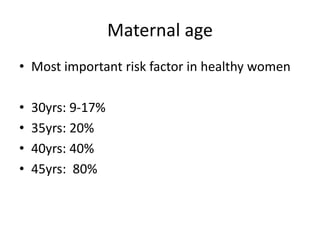
• Most important risk factor in healthy women
• 30yrs: 9-17%
• 35yrs: 20%
• 40yrs: 40%
• 45yrs: 80%
Previous spontaneous abortion
• Previous successful pregnancy: 5% risk
• 1 miscarriage: 20%
• 2 consecutive miscarriages:28%
• ≥3 consecutive miscarriages:43%
Medications or substances
• Heavy smoking(>10 cigarettes/day) :
vasoconstrictive & antimetabolic effects of
tobacco smoke
• Moderate to high alcohol consumption(>3
drinks/week)
• NSAIDS use(acetaminophen) :abnormal
implantation & pregnancy failure due to
antiprostaglandin effect
Other factors
• Low plasma folate levels(≤2.19ng/ml)
• Extremes of maternal weight: prepregnancy
BMI<18.5 OR >25kg/m2
• Maternal fever:100°F(37.8°C)
Etiology
• Fetal
• Maternal
• unexplained
Etiology
• Foetal factors
– Chromosomal abnormalities(50% ),
• aneuplodies ,monosomy X,Triploidy
• Trisomy 16 : mc autosomal trisomy,lethal
• Abnormalities arise de novo
– Congenital anomalies
– Trauma: invasive prenatal diagnostic procedures
Aetiology :Maternal factors
– Maternal endocrinopathies: hypothyroidism,
insulin dependant diabetes
– Congenital or acquired uterine abnormalities:
interfere with implantation & growth
– Maternal diseases: acute maternal infection
(listeria, toxo, parvo B19,rubella,CMV)
– Radiation in therapeutic doses
– Hypercoagulable state(thrombophillias)
Clinical presentation
• Vaginal bleeding
– Scant brown spotting to heavy vaginal bleeding
– Amount /pattern does not predict outcome
– May be accompanied by passage of fetal tissue
• Pelvic pain
– Crampy /dull in character
– Constant/intermittent
• Incidental finding on pelvic ultrasound in
asymptomatic patient
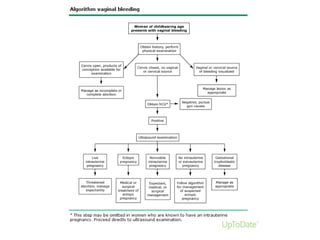
Diagnostic evaluation
• History
– Period of amenorrhea ,LMP/USG
• Physical examination: Complete pelvic
examination:
– Amount of bleeding, dilated cervix
– P/V: uterine size
• Pelvic ultrasound
Pelvic ultrasound
• Most useful test in diagnostic evaluation of
women with suspected spontaneous abortion
• Foetal cardiac activity: most important (5.5-
6wks)
• Foetal heart rate
• Size & contour of G.sac
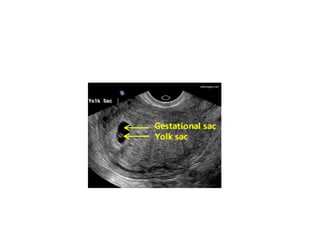
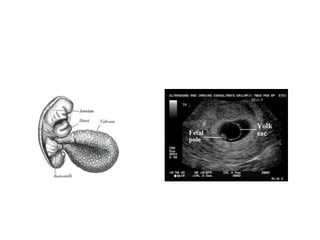
• Presence of yolk sac
• Best evaluated ,transvaginal approach(TVS)
Pelvic USG: criteria for spontaneous
abortion
• Gestational sac ≥ 25mm in mean diameter
that does not contain a yolk sac or embryo
• An embryo with CRL ≥7 mm with no cardiac
activity
If the GS or embryo is smaller than these dimensions:
repeat pelvic USG in 1-2 weeks
Crown rump length (CRL) is an ultrasound
measurement that is used during a pregnancy. The
Differential diagnosis
• Physiologic: placental sign
• Ectopic pregnancy
• Gestational trophoblastic disease
• Cervical/vaginal/uterine pathology
• Physical examination
• Transvaginal sonography(TVS)
• Serial quantitative ßhCG
Lab evaluation
• Human chorionic gonadotropin: serial,
quantitative, useful in inconclusive USG
findings
• ABO ,Rh: need for 50/300µg anti D
• Haemoglobin/hematocrit
• Serum progesterone<5ng/ml(nonviable
pregnancy)
Post diagnostic classification
• Based upon the location of POC (Products of
conception)
• Degree of cervical dilatation(pelvic exam)
• Pelvic ultrasound
• Categorization impacts clinical management
– Threatened
– Inevitable
– Incomplete/complete
– Missed
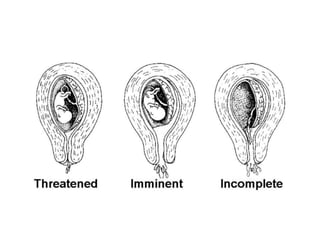
Threatened abortion
• Vaginal bleeding has occurred
• The cervical os is closed
• Diagnostic criteria for spontaneous abortion
has not met
• Managed expectantly: until symptoms resolve
or progresses
Threatened abortion: m/m
• Expectant
• Progestin treatment: most promising, efficacy
not established
• Bed rest
• Avoid vigorous activity
• Avoid heavy lifting
• Avoid sexual intercourse
Threatened abortion :m/m
• Counsel about risk of miscarriage
• Return to hospital in case of additional vaginal
bleeding, pelvic cramping or passage of tissue from
vagina
• Repeat pelvic USG until a viable pregnancy is
confirmed or excluded
• Viable pregnancy, resolved symptoms: prenatal care
• If symptoms continue: monitor for progression to
inevitable, incomplete, or complete abortion
Inevitable abortion
• Vaginal bleeding, typically accompanied by
crampy pelvic pain
• Dilated cervix( internal os)
• Products of conception felt or visualised
through the internal os
Incomplete abortion
• Vaginal bleeding and/or pain present
• Cervix is dilated
• Products of conception partially expelled out
• Uterine size less than period of amenorrhea
Complete abortion
• There is minimal bleeding.
• Pain stops.
• Uterus is hard and much smaller
• The cervix is closed
Missed abortion
• Non viable intrauterine pregnancy
• Cervical os is closed
• POC not expelled
• May notice that symptoms associated with
early pregnancy have abated
Septic abortion
• Tender and painful uterus.
• Offensive vaginal bleeding.
• High temperature.Rapid pulse. .Unstable blood pressure.
• Shock.
Treatment
• Isolation.
• Clinical bacteriological to identify the infectious organisms.
• Administration of antibiotics as doctor orders.
• Intake and output chart should be kept.
• The soiled pads should be properly collected and burned
Management
• Complete evacuation of uterine contents(POC)
• Surgical methods: suction evacuation/suction
curettage/dilation & evacuation
• Medical methods: Misoprostol,mifepristone
• Expectant
• All have similar efficacy
Surgical evacuation
• Performed under IV sedation & paracervical
block
• Prophylactic antibiotics
• Operating room/procedure room
• Potential complications
• Anaesthesia related,
• uterine perforation, cervical trauma,
• infection, intrauterine adhesions
Medical methods
• Misoprostol: drug of choice
• Efficacy depends on dose & route of
administration
• 400mcg vaginally every 4 hours for 4 doses
• Expulsion rate : 50-70%
• Low cost, low incidence of side effects, stable
at room temperature, readily available, timing
of use can be controlled by patient
Choosing the method
• Surgical evacuation : heavy bleeding,
intrauterine sepsis, medical co morbidities,
misoprostol is contraindicated
– Shorter time to completion of treatment
– Lowers risk of unplanned admissions
– Lower need for subsequent treatment
Expectant m/m
• Stable vital signs
• No evidence of infection
• Offered after proper counseling
• If unsuccessful after 4 wks ,surgical evacuation
is needed
Complete abortion
• POC expelled completely from uterus &
cervix
• Cervical os is closed
• Uterus small in size (GA)
• Resolved or minimal vaginal bleeding & pain
• Aim of t/t: ensure that bleeding is not
excessive & all POC have expelled
• Theoretically does not need treatment
Abortion : complications
• Hemorrhage
• Uterine perforation
• Retained products of conception
• Endometritis
• Septic abortion: abortion accompanying
intrauterine infection
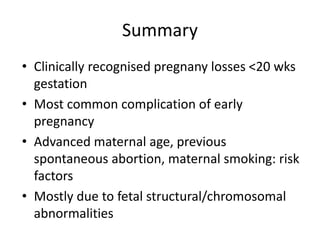
Summary
• Clinically recognised pregnany losses <20 wks
gestation
• Most common complication of early
pregnancy
• Advanced maternal age, previous
spontaneous abortion, maternal smoking: risk
factors
• Mostly due to fetal structural/chromosomal
abnormalities
Summary
• Present with menstrual delay, vaginal
bleeding& pelvic pain
• D/D: uterine or other genital tract bleeding in
viable pregnancy, ectopic,& GTD
• Pelvic examination & pelvic ultrasound: key
elements for diagnosis
• Spontaneous abortion diagnosed based on
USG criteria
• Categorised as threatened/incomplete/missed
Summary
• Preconceptual & prenatal counseling & care
regarding modifiable aetiologies ,risk factors
are most imp intervention
• Normal menstrual cycle resumes in 4-6 weeks
• hCG returns to normal 2-4wks
Prevention of spont.abortion
• Preconception & prenatal counseling
• Routine screening & optimal disease
control(diabetes, thyroid, thrombophilia)
• Correction of uterine structural
anomalies(septum, submucosal myoma,
intrauterine adhesions) prior to pregnancy
• Avoiding exposure to teratogen or infections
• Modifiable risk factors

8 Abortion IMP.pptx physiotherapy gynaec

  • 1.
  • 2.
    Definition • Clinically recognisedpregnancy loss before 20th week of gestation • Expulsion or extraction of an embryo or fetus weighing 1000gm or less • Synonymous with miscarriage • Latin :aboriri: to miscarry
  • 3.
    Incidence • MC earlypregnancy complication • Frequency decreases with increasing gestational age • Incidence:8-20%(clinically recognised pregnancies) • Women who had a child: 5% incidence of miscarriage • 80% spontaneous abortion :< 12 wks
  • 4.
    Risk factors • Advancedmaternal age • Previous spontaneous abortion • Medications & substances (smoking) • Mechanisms responsible for abortion: not apparent
  • 5.
    Maternal age • Mostimportant risk factor in healthy women • 30yrs: 9-17% • 35yrs: 20% • 40yrs: 40% • 45yrs: 80%
  • 6.
    Previous spontaneous abortion •Previous successful pregnancy: 5% risk • 1 miscarriage: 20% • 2 consecutive miscarriages:28% • ≥3 consecutive miscarriages:43%
  • 7.
    Medications or substances •Heavy smoking(>10 cigarettes/day) : vasoconstrictive & antimetabolic effects of tobacco smoke • Moderate to high alcohol consumption(>3 drinks/week) • NSAIDS use(acetaminophen) :abnormal implantation & pregnancy failure due to antiprostaglandin effect
  • 8.
    Other factors • Lowplasma folate levels(≤2.19ng/ml) • Extremes of maternal weight: prepregnancy BMI<18.5 OR >25kg/m2 • Maternal fever:100°F(37.8°C)
  • 9.
  • 10.
    Etiology • Foetal factors –Chromosomal abnormalities(50% ), • aneuplodies ,monosomy X,Triploidy • Trisomy 16 : mc autosomal trisomy,lethal • Abnormalities arise de novo – Congenital anomalies – Trauma: invasive prenatal diagnostic procedures
  • 11.
    Aetiology :Maternal factors –Maternal endocrinopathies: hypothyroidism, insulin dependant diabetes – Congenital or acquired uterine abnormalities: interfere with implantation & growth – Maternal diseases: acute maternal infection (listeria, toxo, parvo B19,rubella,CMV) – Radiation in therapeutic doses – Hypercoagulable state(thrombophillias)
  • 12.
    Clinical presentation • Vaginalbleeding – Scant brown spotting to heavy vaginal bleeding – Amount /pattern does not predict outcome – May be accompanied by passage of fetal tissue • Pelvic pain – Crampy /dull in character – Constant/intermittent • Incidental finding on pelvic ultrasound in asymptomatic patient
  • 13.
    Diagnostic evaluation • History –Period of amenorrhea ,LMP/USG • Physical examination: Complete pelvic examination: – Amount of bleeding, dilated cervix – P/V: uterine size • Pelvic ultrasound
  • 14.
    Pelvic ultrasound • Mostuseful test in diagnostic evaluation of women with suspected spontaneous abortion • Foetal cardiac activity: most important (5.5- 6wks) • Foetal heart rate • Size & contour of G.sac • Presence of yolk sac • Best evaluated ,transvaginal approach(TVS)
  • 15.
    Pelvic USG: criteriafor spontaneous abortion • Gestational sac ≥ 25mm in mean diameter that does not contain a yolk sac or embryo • An embryo with CRL ≥7 mm with no cardiac activity If the GS or embryo is smaller than these dimensions: repeat pelvic USG in 1-2 weeks Crown rump length (CRL) is an ultrasound measurement that is used during a pregnancy. The
  • 18.
    Differential diagnosis • Physiologic:placental sign • Ectopic pregnancy • Gestational trophoblastic disease • Cervical/vaginal/uterine pathology • Physical examination • Transvaginal sonography(TVS) • Serial quantitative ßhCG
  • 19.
    Lab evaluation • Humanchorionic gonadotropin: serial, quantitative, useful in inconclusive USG findings • ABO ,Rh: need for 50/300µg anti D • Haemoglobin/hematocrit • Serum progesterone<5ng/ml(nonviable pregnancy)
  • 20.
    Post diagnostic classification •Based upon the location of POC (Products of conception) • Degree of cervical dilatation(pelvic exam) • Pelvic ultrasound • Categorization impacts clinical management – Threatened – Inevitable – Incomplete/complete – Missed
  • 21.
    Threatened abortion • Vaginalbleeding has occurred • The cervical os is closed • Diagnostic criteria for spontaneous abortion has not met • Managed expectantly: until symptoms resolve or progresses
  • 22.
    Threatened abortion: m/m •Expectant • Progestin treatment: most promising, efficacy not established • Bed rest • Avoid vigorous activity • Avoid heavy lifting • Avoid sexual intercourse
  • 23.
    Threatened abortion :m/m •Counsel about risk of miscarriage • Return to hospital in case of additional vaginal bleeding, pelvic cramping or passage of tissue from vagina • Repeat pelvic USG until a viable pregnancy is confirmed or excluded • Viable pregnancy, resolved symptoms: prenatal care • If symptoms continue: monitor for progression to inevitable, incomplete, or complete abortion
  • 24.
    Inevitable abortion • Vaginalbleeding, typically accompanied by crampy pelvic pain • Dilated cervix( internal os) • Products of conception felt or visualised through the internal os
  • 25.
    Incomplete abortion • Vaginalbleeding and/or pain present • Cervix is dilated • Products of conception partially expelled out • Uterine size less than period of amenorrhea
  • 26.
    Complete abortion • Thereis minimal bleeding. • Pain stops. • Uterus is hard and much smaller • The cervix is closed
  • 27.
    Missed abortion • Nonviable intrauterine pregnancy • Cervical os is closed • POC not expelled • May notice that symptoms associated with early pregnancy have abated
  • 28.
    Septic abortion • Tenderand painful uterus. • Offensive vaginal bleeding. • High temperature.Rapid pulse. .Unstable blood pressure. • Shock. Treatment • Isolation. • Clinical bacteriological to identify the infectious organisms. • Administration of antibiotics as doctor orders. • Intake and output chart should be kept. • The soiled pads should be properly collected and burned
  • 30.
    Management • Complete evacuationof uterine contents(POC) • Surgical methods: suction evacuation/suction curettage/dilation & evacuation • Medical methods: Misoprostol,mifepristone • Expectant • All have similar efficacy
  • 31.
    Surgical evacuation • Performedunder IV sedation & paracervical block • Prophylactic antibiotics • Operating room/procedure room • Potential complications • Anaesthesia related, • uterine perforation, cervical trauma, • infection, intrauterine adhesions
  • 32.
    Medical methods • Misoprostol:drug of choice • Efficacy depends on dose & route of administration • 400mcg vaginally every 4 hours for 4 doses • Expulsion rate : 50-70% • Low cost, low incidence of side effects, stable at room temperature, readily available, timing of use can be controlled by patient
  • 33.
    Choosing the method •Surgical evacuation : heavy bleeding, intrauterine sepsis, medical co morbidities, misoprostol is contraindicated – Shorter time to completion of treatment – Lowers risk of unplanned admissions – Lower need for subsequent treatment
  • 34.
    Expectant m/m • Stablevital signs • No evidence of infection • Offered after proper counseling • If unsuccessful after 4 wks ,surgical evacuation is needed
  • 35.
    Complete abortion • POCexpelled completely from uterus & cervix • Cervical os is closed • Uterus small in size (GA) • Resolved or minimal vaginal bleeding & pain • Aim of t/t: ensure that bleeding is not excessive & all POC have expelled • Theoretically does not need treatment
  • 36.
    Abortion : complications •Hemorrhage • Uterine perforation • Retained products of conception • Endometritis • Septic abortion: abortion accompanying intrauterine infection
  • 38.
    Summary • Clinically recognisedpregnany losses <20 wks gestation • Most common complication of early pregnancy • Advanced maternal age, previous spontaneous abortion, maternal smoking: risk factors • Mostly due to fetal structural/chromosomal abnormalities
  • 39.
    Summary • Present withmenstrual delay, vaginal bleeding& pelvic pain • D/D: uterine or other genital tract bleeding in viable pregnancy, ectopic,& GTD • Pelvic examination & pelvic ultrasound: key elements for diagnosis • Spontaneous abortion diagnosed based on USG criteria • Categorised as threatened/incomplete/missed
  • 40.
    Summary • Preconceptual &prenatal counseling & care regarding modifiable aetiologies ,risk factors are most imp intervention • Normal menstrual cycle resumes in 4-6 weeks • hCG returns to normal 2-4wks
  • 41.
    Prevention of spont.abortion •Preconception & prenatal counseling • Routine screening & optimal disease control(diabetes, thyroid, thrombophilia) • Correction of uterine structural anomalies(septum, submucosal myoma, intrauterine adhesions) prior to pregnancy • Avoiding exposure to teratogen or infections • Modifiable risk factors

Editor's Notes

  • #16 The gestational sac (GS) is the first sign of early pregnancy on ultrasound and can be seen with endovaginal ultrasound at approximately 3-5 weeks gestation when the mean sac diameter (MSD) would approximately measure 2-3 mm in diameter.
  • #17 The yolk sac is a membranous sac attached to an embryo, formed by cells of the hypoblast adjacent to the embryonic disk. The yolk sac is important in early embryonic blood supply, and much of it is incorporated into the primordial gut during the fourth week of development.
  • #21 Products of conception, abbreviated POC, is a medical term used for the tissue derived from the union of an egg and a sperm. It encompasses anembryonic gestation (blighted ovum) which does not have a viable embryo.