+
Introduction of Marketing
research
Asif Jamal
Visiting Lecturer
University Of Sindh, Mirpurkhas Campus
+
“You can dream, create, design and
build the most wonderful place in the
world, but it requires people to make
the dream a reality..! Walt Disney
+
Introduction, Nature & Scope of
Marketing Research
+
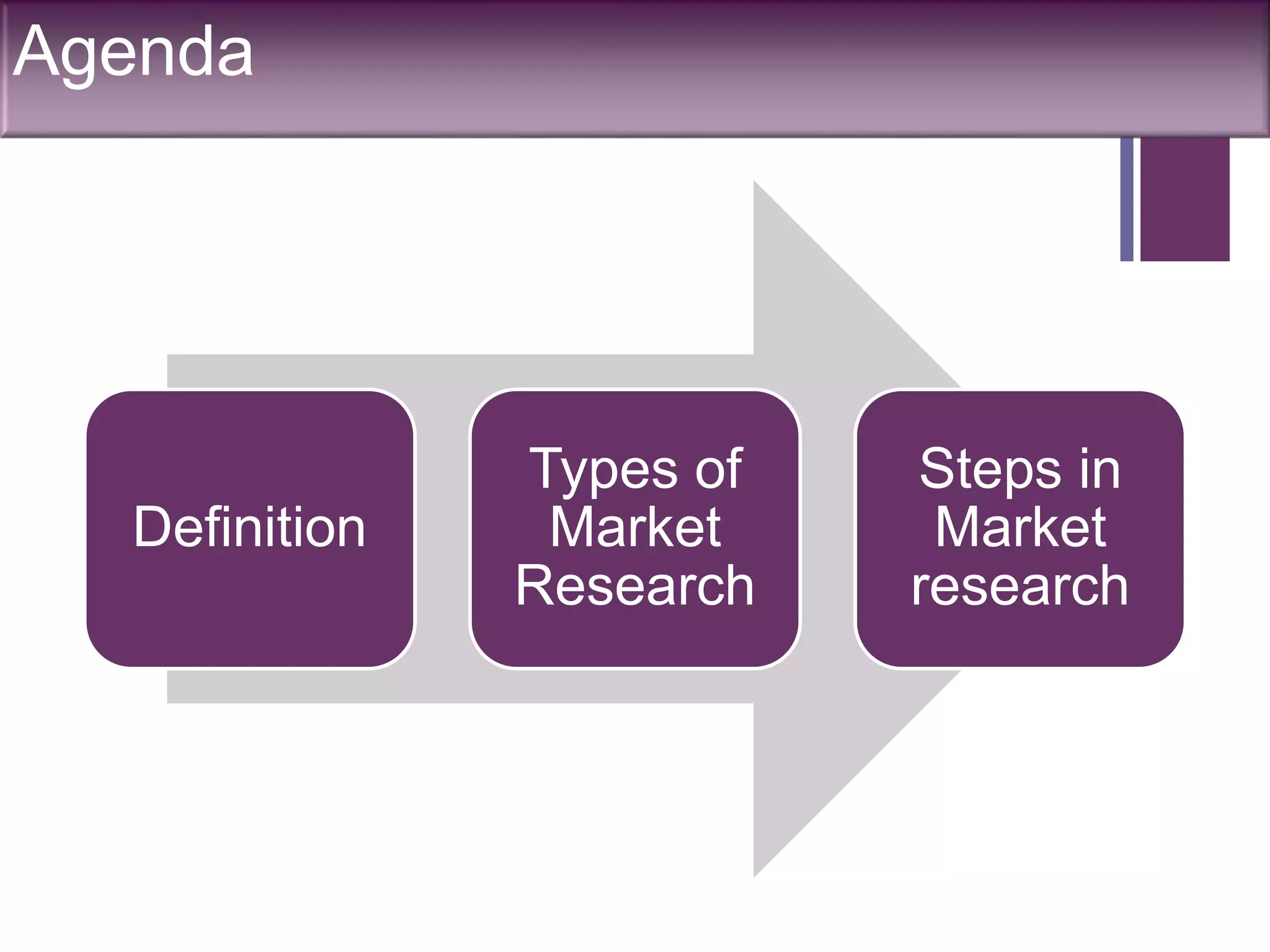
Definition
Types of
Market
Research
Steps in
Market
research
Agenda
+
Definition
Market research, which includes social and opinion
research, is the systematic gathering and interpretation of
information about individuals or organisations using the
statistical and analytical methods and techniques of the
applied sciences to gain insight or support decision making.
The identity of respondents will not be revealed to the user
of the information without explicit consent and no sales
approach will be made to them as a direct result of their
having provided information.
Source – ICC/ESOMAR International Code on Market and Social
Research
+
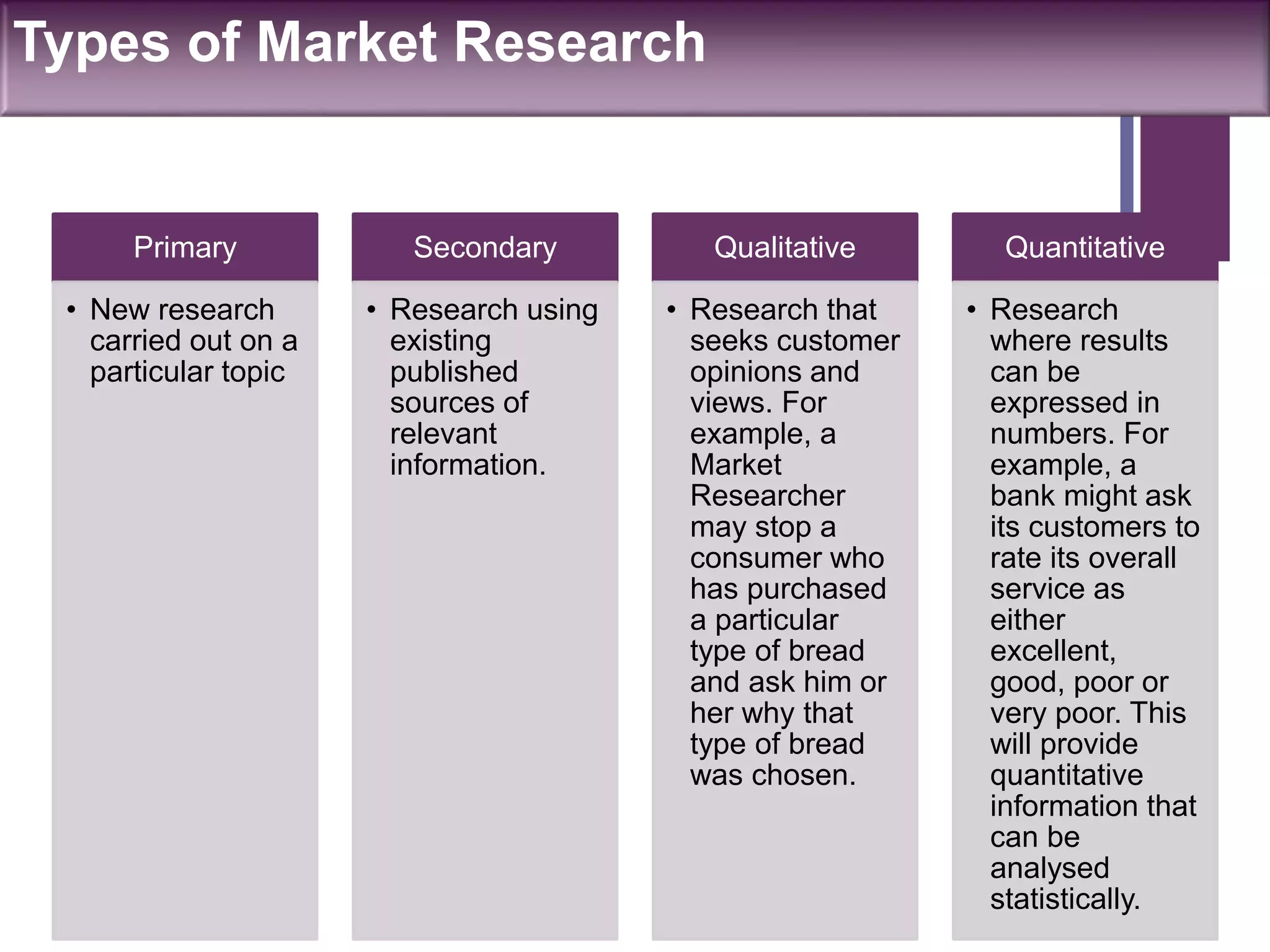
Types of Market Research
Primary
• New research
carried out on a
particular topic
Secondary
• Research using
existing
published
sources of
relevant
information.
Qualitative
• Research that
seeks customer
opinions and
views. For
example, a
Market
Researcher
may stop a
consumer who
has purchased
a particular
type of bread
and ask him or
her why that
type of bread
was chosen.
Quantitative
• Research
where results
can be
expressed in
numbers. For
example, a
bank might ask
its customers to
rate its overall
service as
either
excellent,
good, poor or
very poor. This
will provide
quantitative
information that
can be
analysed
statistically.
+
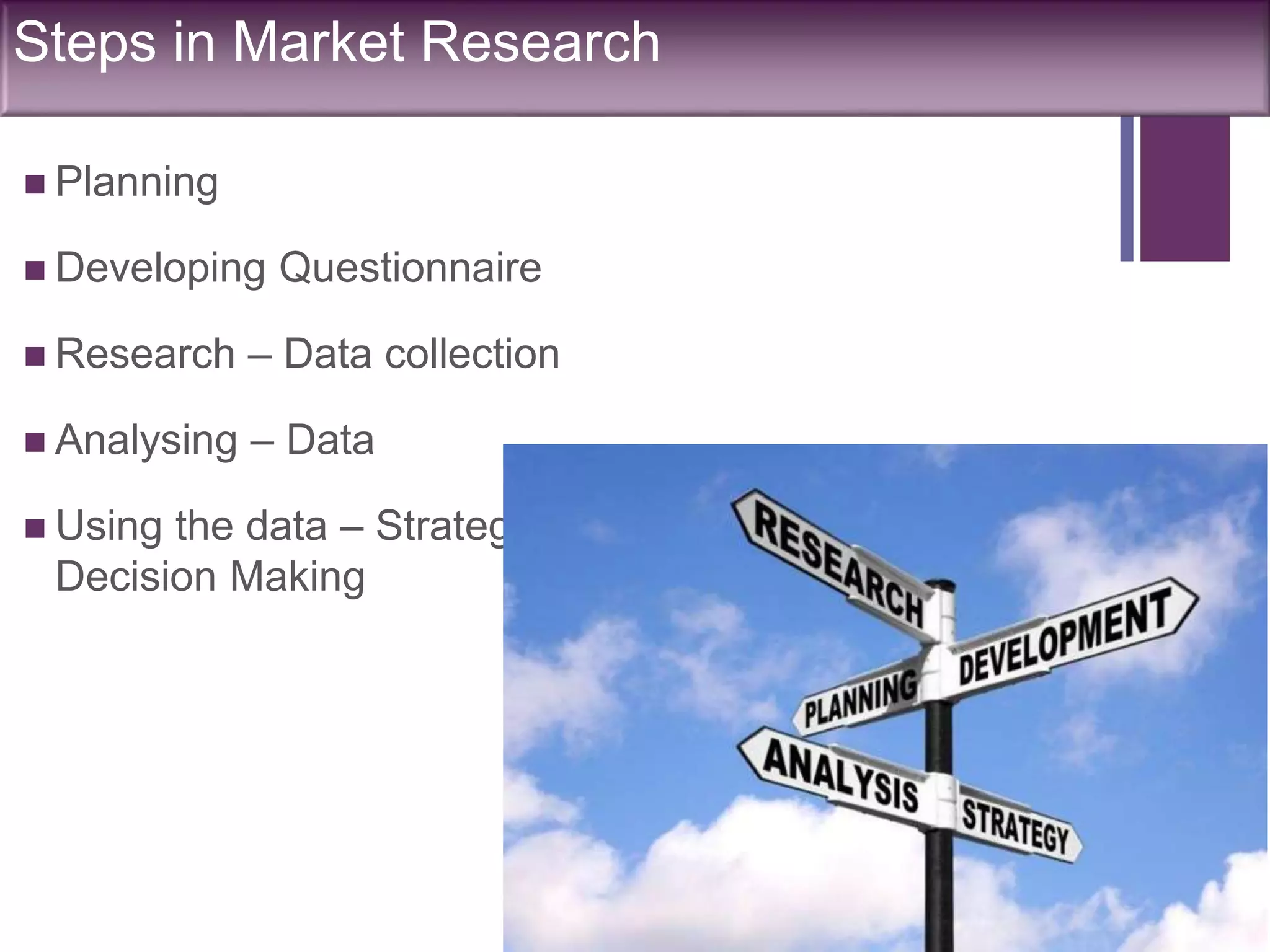
Steps in Market Research
 Planning
 Developing Questionnaire
 Research – Data collection
 Analysing – Data
 Using the data – Strategic
Decision Making
+
Planning – Why What When How
Creating Awareness:
If goal is to create
awareness in the
market about your
product or service, the
research should center
around attitudes,
usage, public relations
and advertising
messages.
Retention:
If goal is to increase
purchases from current
customer base and
enhance customer
loyalty, research
should center around
customer satisfaction
and behavioral
insights.
Acquisition:
If goal is to optimize
marketing message to
acquire more sales,
research should center
around product
concept, usability,
pricing and advertising
testing.
Targeting:
If goal is to determine
which segment of the
population has the
highest return on
investment, research
should center around
brand positioning and
competitive analysis.
+Developing Questionnaire
Design the questionnaire
with the objectives in mind
Ensure majority of the
questions are quantitative.
Quantitative data produces
data that are objective and
can be acted on.
Minimum number of
questions should be
quantifiable to avoid
survey fatigue and
abandonment
Questionnaire should have
relevant questions .
Misleading question will
result in poor irrelevant
data
Avoid questions that are –
Leading
Sensitive
Personal
Offensive
Questions should be –
Simple
Specific
Direct
+
• It is not realistic to think that entire marketing
population can be covered for a survey an
adequate percentage and cross-section of
target consumer is needed.
• If there are variations in the target population
or statistically significant differences are to be
noted between subgroups in the sample, the
sample size should be adjusted for it.
Sample Size
• Choosing the right distribution method to collect
your data is important. Different modes introduce
different forms of bias so carefully consider your
target audience and the best channel for reaching
them. Eg - For instance, if your target audience is
the elderly, social media or internet channels may
not be the best distribution options. Direct mail,
phone or personal interview may be the best
option for reaching this audience.
• Consider other distribution methods such as QR
code or web address on receipts, newsletters and
printed brochures.
Distribution
Method
Research – Data Collection
Perquisite for good data collection
+Analysing the Data
Clean your survey data: Identify and
weed out responses that have
straight-line, Christmas tree, red
herring, and/or outlier patterns that
can taint the results.
Analyze your data: Analyze the data to determine questions
are answered in the format you expected. Unusual trends
could indicate a problem with the question or question type. If
so, you may need to discount the question or run another
study related to the learning objective.
Segment your data: Segment
your data by learning objective so
that you can truly understand the
most significant findings of your
research
Report your results:
Share your findings!
+Make Strategic Business Decisions
Armed with
your market
research data,
you can
confidently
make sound
management
decisions.
Make
Decisions
Meet with your
research
stakeholders to
discuss your
pre-defined
course of
action.
Implement
your action
plan and
measure the
results.
Share
decisions
+
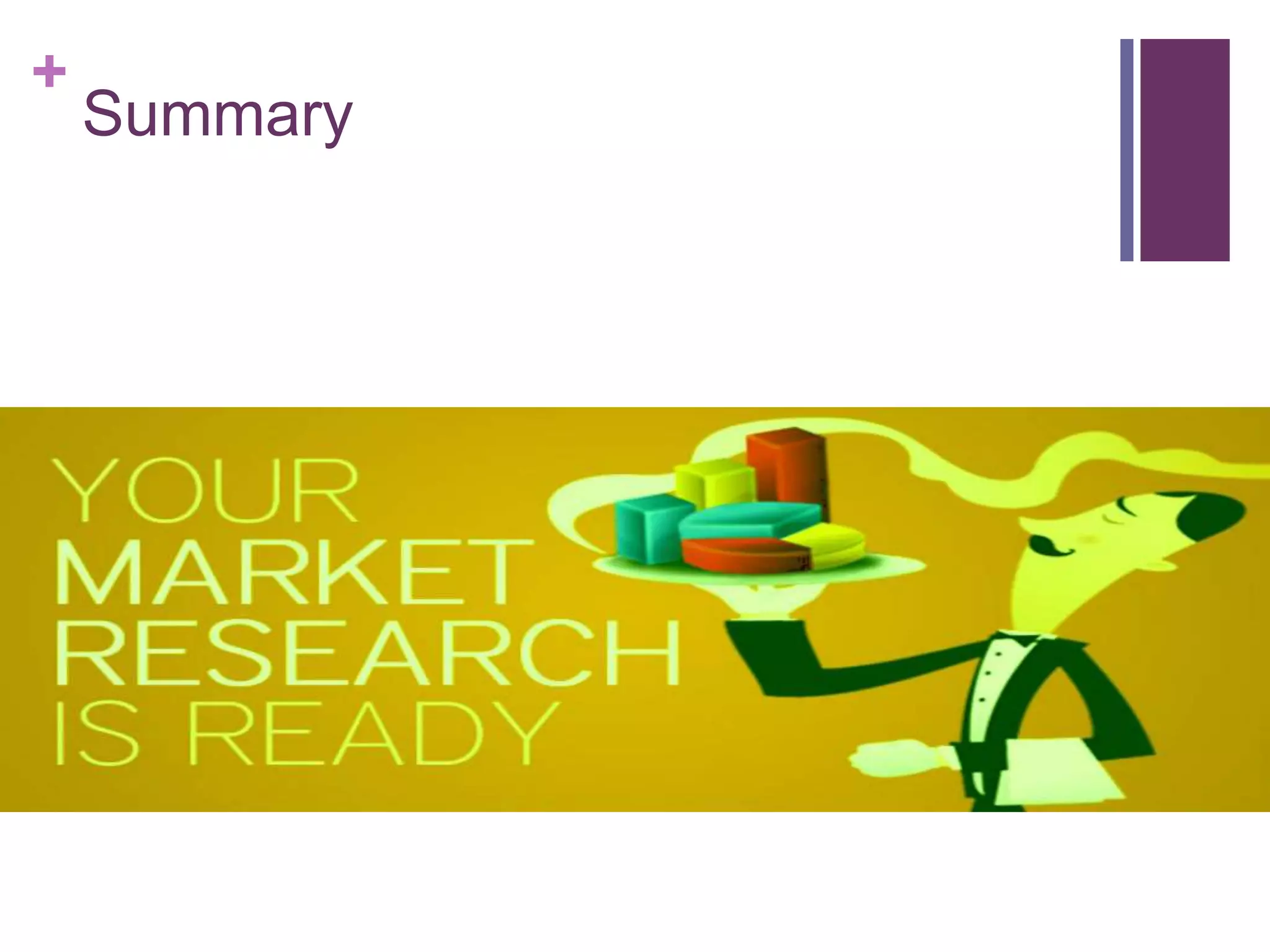
Summary
+
Some Important Aspects
 In order to understand and appreciate Research
Methodology following points must be very clear
 What is Research?
 What is Marketing Research? Why carry out
Marketing Research? How it is different from
Market Research?
 What is Bus Res Methods or Research
Methodology?
 The connection between MR and managerial
decision making.
Res Method _ 1: Dr. Dey
14
+
Some Important Aspects…Contd.
 Is MR applicable in all situation?
 Def of MR.
 Scope of MR
 Scientific & Non-scientific Research:
Distinction between these
 Validity & Reliability
Res Method _ 1: Dr. Dey
15
+
Some Important Aspects…Contd.
 Six difficulties in applying scientific method to
marketing
 Investigator involved in the use of result
 Imprecise measuring devices: How to measure
attitudes? Intentions? Opinions?
 Influence of measurement process on the result
 Time pressure for the result
 Difficulty in using experiments to test hypothesis
 Great complexity of subjects
Res Method _ 1: Dr. Dey
16
+
Some Important Aspects…Contd.
 Research Process: How to conduct a research?
Which steps in which sequence?
 How many types of research
 Qualitative: Exploratory
 Quantitative: Descriptive and Experimental
 What is Research Design
 Sampling Design
 Scaling: Attitude Measurement
 Questionnaire Construction
Res Method _ 1: Dr. Dey
17
+
Res Method _ 1: Dr. Dey
18
Objectives
 Understand Marketing Research (MR)
 Understand relevance of MR for marketing
decisions
 Develop appreciation of MR & its
applications
 Know the procedure of conducting
 Develop familiarity with each step of
procedure
+
Res Method _ 1: Dr. Dey
19
What is Business Research?
 A systematic Inquiry whose objective is to provide
information to solve managerial problems.
+
Res Method _ 1: Dr. Dey
20
Why Study Research?
 Research provides you with the knowledge and skills
needed for the fast-paced decision-making
environment
+
Res Method _ 1: Dr. Dey
21
Different Styles of Research
 Applied Research
 Emphasis on solving practical (specific) problems
 It could be exploring opportunities also
 Rectifying an inventory system that is resulting into lost
sales
 Opportunity to increase stockholder wealth by acquiring
another firm
 Pure Research/Basic Research
 Emphasis on problem solving but of a general nature
(not specific)
 Effect of coupon as against rebate to stimulate demand
+
Res Method _ 1: Dr. Dey
22
What is Good Research?
Following the standards of the scientific
method
 Purpose clearly defined
 Research process detailed
 Research design thoroughly planned
 Limitations frankly revealed
 High ethical standards applied
+
Res Method _ 1: Dr. Dey
23
What is Good Research? (cont.)
Following the standards of the
scientific method (cont.)
Adequate analysis for decision-
maker’s needs
Findings presented unambiguously
Conclusions justified
Researcher’s experience reflected
+
Res Method _ 1: Dr. Dey
24
The Manager-Researcher
Relationship
 Manager’s obligations
 Specify problems
 Provide adequate background information
 Access to company information gatekeepers
 Researcher’s obligations
 Develop a creative research design
 Provide answers to important business
questions
+
Res Method _ 1: Dr. Dey
25
Manager-Researcher Conflicts
Management’s limited exposure to
research
Manager sees researcher as threat to
personal status
Researcher has to consider corporate
culture and political situations
Researcher’s isolation from managers
+
Res Method _ 1: Dr. Dey
26
When Research Should be Avoided
When information cannot be applied to a
critical managerial decision
When managerial decision involves little
risk
When management has insufficient
resources to conduct a study
When the cost of the study outweighs
the level of risk of the decision
+
Res Method _ 1: Dr. Dey
27
Need for MR
 A manager takes decisions
 His responsibility is to reduce risk of failure in
decision making
 Risk arises due to lack of relevant information
 A manager always seeks information to
improve quality of decision making
 Information can be collected through MR
 Hence, MR is an important tool for managerial
decision making
+
Res Method _ 1: Dr. Dey
28
MR & Marketing Decisions
 For Production, Finance, Personnel
 Most of the required info are available within the
organization; Hence easy to collect & analyze
 Formal procedures are used to improve quality :
Stats Methods for QC, PERT & CPM, Queuing Theory,
Optimization Techniques etc
 For Marketing – information mostly exist
outside the organization
 In consumer behaviour, perception, minds
 In competitive moves
 In new government rules & regulations
 In social & political changes
+
Res Method _ 1: Dr. Dey
29
MR & Marketing Decisions
Other problems for collecting
information required for marketing
decisions are
 Being external – collection is cumbersome &
expensive
 Variables are often qualitative & dynamic –
making measurements difficult & inaccurate
 Variables are complex & interact with each
other
+
Res Method _ 1: Dr. Dey
30
Risk of using wrong information
Choice of wrong information may lead
to
 Excessive expenditure
 Decision going astray – Hind Sanitaryware
 Becoming uncompetitive & losing out – S
Kumars Internet centers & Modular Kitchen
 Market may vanish all of a sudden – fashion
garments
+
Res Method _ 1: Dr. Dey
31
Scientific Method: The Essential
Tenets of Science
Direct observation of phenomena
Clearly defined variables, methods, and
procedures
Empirically testable hypotheses
Ability to rule out rival hypotheses
Statistical justification of conclusions
Self-correcting process
+
Res Method _ 1: Dr. Dey
32
Ways to Communicate
 Exposition
 descriptive statements that merely state and do not give
reason
 Argument
 allows us to explain, interpret, defend, challenge, and
explore meaning
 Two types: Deduction & Induction
+
Res Method _ 1: Dr. Dey
33
Important Arguments in
Research
 Deduction is a form of inference that purports to be
conclusive
 Induction draws conclusions from one or more particular
facts
• For suitable examples consult book pages 32 - 34
+
Res Method _ 1: Dr. Dey
34
The Building Blocks of Theory
 Concepts
 Constructs
 Definitions
 Variables
 Propositions and Hypotheses
 Theories
 Models
+
Res Method _ 1: Dr. Dey
35
Understanding Concepts
 A concept is a bundle of meanings or characteristics
associated with certain events, objects, conditions,
situations, and behaviors
 Concepts have been developed over time through
shared usage
+
Res Method _ 1: Dr. Dey
36
Understanding Concepts
The success of research hinges on:
 how clearly we conceptualize
 how well others understand the concepts we use
For customer loyalty use questions that
tap faithfully the Attitude of
participants
Attitudes are abstract, try to measure
them using carefully selected concepts
+
Res Method _ 1: Dr. Dey
37
What is a Construct?
 A construct is an image or idea specifically invented for a
given research and/or theory-building purpose.
 Constructs are required for more abstract concepts –
“Personality”, “Satisfied Customer”
+
Res Method _ 1: Dr. Dey
38
Types of Variables
 Independent
 Dependent
 Moderating
 Extraneous
 Intervening
+
Res Method _ 1: Dr. Dey
39
Independent & Dependent
 Leadership style & Employee performance or
Job satisfaction
 Price of a product & Demand
Independent
 Cause, Stimulus, Predictor, Antecedent
Dependent
 Effect, Response, Criterion, Consequence
Types of Variables
+
Res Method _ 1: Dr. Dey
40
 Moderating
 In each relationship there is one
Independent Variable (IV) & one Dependent
Variable (DV)
 Four day work week (IV) will lead to higher
productivity (DV)
 Moderating variable is a second independent
variable that has significant effect on the
originally stated IV–DV relationship
 Four day work week (IV) will lead to higher
productivity (DV), especially among young workers
(MV)
Types of Variables
+
Res Method _ 1: Dr. Dey
41
 Extraneous
 Infinite number of extraneous variables (EV)
exist that might effect the relationship
 Most of such variables have little or no effect
on the given situation and these may be
ignored
 Others may have highly random occurrence
as to have little impact
 For productivity example: election of a new
mayor, rainy days, bird flu, strike etc
Types of Variables
+
Res Method _ 1: Dr. Dey
42
 Intervening
 Intervening variable (IVV) is defined as a factor which
theoretically effects the observed phenomenon but can not
be seen measured or manipulated
 Its effect can be inferred from the effects on the observed
phenomenon
 Four day work week (IV) will lead to higher productivity
(DV) by increasing job satisfaction (IVV)
Types of Variables
+
Res Method _ 1: Dr. Dey
43
Propositions & Hypotheses
 Proposition
 A statement about concepts that may be judged as TRUE
or FALSE if it refers to observable phenomenon
 Proposition formulated for empirical testing is Hypothesis
 Example
 Infosys employees have higher than average
achievement motivation
+
Res Method _ 1: Dr. Dey
44
The Role of the Hypothesis
 Guides the direction of the study
 Identifies facts that are relevant
 Suggests which form of research design is appropriate
 Provides a framework for organizing the conclusions
that result
+
Res Method _ 1: Dr. Dey
45
Characteristics & Types of a Good
Hypothesis
 A good hypothesis should fulfill three conditions:
 Must be adequate for its purpose
 Must be testable
 Must be better than its rivals
 Hypothesis types
 Descriptive
 Relational: Correlation & Causal
+
Res Method _ 1: Dr. Dey
46
Types of Hypothesis
Descriptive
 Describes the existence, size, form or distribution of
some variables
 Eighty percent of shareholders of HLL favour increasing
the company’s cash dividend
 It can also be stated as research question
 Do shareholders of HLL favour an increased cash
dividend?
 Either form is acceptable, but descriptive
hypothesis format has advantages
 Encourages researcher to crystallize thinking
 Encourages to think about implications of either an
accepted or rejected finding
 Useful for testing statistical significance
+
Res Method _ 1: Dr. Dey
47
 Relational
 Statements that describe the relationship between two
variables with respect to some case
 Foreign (variable) refrigerators are perceived to be of
better quality (variable) by Indian consumers (case)
Types of Hypothesis
+
Res Method _ 1: Dr. Dey
48
 Two types: Correlation & Causal
 Correlation
 Merely states that variables occur together without
implying that one causes the other
 People in Kerela give more importance to education than
people in Punjab
 In an office old employees are more responsive than
young employees
Types of Relational Hypothesis
+
Res Method _ 1: Dr. Dey
49
 Causal (or Explanatory)
 There is an implication that existence of (or a change in)
one causes or leads to a change in the other
 Causal variable is called Independent variable and the
other Dependent variable
 Advertisement causes higher sales
 Increase in income leads to higher savings
Types of Relational Hypothesis
+
Res Method _ 1: Dr. Dey
50
The Value of a Theory
Narrows the range of facts we need to
study
Suggests which research approaches
will yield the greatest meaning
Suggests a data classification system
Summarizes what is known about an
object of study
Predicts further facts that should be
found
+
Res Method _ 1: Dr. Dey
51
Definition of Marketing
Research
American Marketing Association
MR is the systematic gathering, recording and
analyzing of data about problems related to
the marketing of goods & services
Philip Kotler
MR is the systematic design, collection,
analysis & reporting of data & findings
relevant to a specific marketing situation
facing the company
It may be relevant to add the word “continuous” to the
above definitions
+
Res Method _ 1: Dr. Dey
52
Purpose of MR
To improve quality of decision making
process by providing information
To help reduce the risk associated with
managerial decision making
 Risk due to two types of uncertainties:
 About the expected outcome
 About the future environment
To discover opportunity & exploit
profitably
For example : Frooti, Velvette, Mother Dairy, Dhara,
Pan Parag
+
Res Method _ 1: Dr. Dey
53
Scope of MR
 Consumers of products & services
Buyer behaviour, Influencers, Buying habits, Incentives
 Product & product design
Pricing, Sourcing, Physical attributes
 Distribution Channels
Performance, Dealer Satisfaction, Own vs Multi-brand
 Advertising Impact
Image, Positioning, Media Planning, Message Content &
Prioritizing
 Macro Level Phenomenon
Govt spending. Mood of the Industry, State of Economy
+
Res Method _ 1: Dr. Dey
54
MR Procedure
Seven inter-related steps
1.Specifying research objectives
2.Preparing a list of needed information
3.Designing the data collection project
4.Selecting a sample type
5.Determining sample size
6.Organizing & carrying out the field work
7.Analyzing the collected data & report the
findings
+
Res Method _ 1: Dr. Dey
55
The Management-Research
Question Hierarchy
1 Management Dilemma
Measurement Questions
Investigative Questions
Research Questions
Management Questions
Management Decision
2
3
4
5
6
+
Res Method _ 1: Dr. Dey
56
The Management-Research
Question Hierarchy
1 Why are sales declining in south
while sales are booming in all other
regions?
Conduct an employee survey for
outcomes of change in compensation
structure
If compensation scheme is changed,
will good sales persons leave?
How can we improve sales in
south?
Introduce individual incentive? Quota
based incentive? Advertise more?
Management Decision
2
3
4
5
6
+
Res Method _ 1: Dr. Dey
57
Working with the Hierarchy
 Management Dilemma
 The symptom of an actual problem
 Not difficult to identify a dilemma, however choosing one to
focus on may be difficult
 Needs proper prioritizing
+
Res Method _ 1: Dr. Dey
58
Working with the Hierarchy
 Management Question Categories
Choice of purposes or objective
Generation and evaluation of
solutions
Troubleshooting or control
situation
+
Res Method _ 1: Dr. Dey
59
Working with the Hierarchy
 Fine tune the research question
 Examine concepts and constructs
 Break research questions into specific second-and-third-
level questions
 Verify hypotheses with quality tests
 Determine what evidence answers the various questions
and hypothesis
 Set the scope of your study
+
Res Method _ 1: Dr. Dey
60
Working with the Hierarchy
 Investigative Questions
Questions the researcher must
answer to satisfactorily arrive at
a conclusion about the research
question
+
Res Method _ 1: Dr. Dey
61
Working with the Hierarchy
 Measurement Questions
The questions we actually ask to
extract information from
respondents
+
Res Method _ 1: Dr. Dey
62
Other Processes in the
Hierarchy
Exploration
 Recent developments
 Predictions by informed figures about the prospects of the
technology
 Identification of those involved in the area
 Accounts of successful ventures and failures by others in
the field
+
Res Method _ 1: Dr. Dey
63
Research Process Problems
 The Favored Technique Syndrome
 Company Database Strip-Mining
 Unresearchable Questions
 Ill-Defined Management Problems
 Politically Motivated Research
+
Res Method _ 1: Dr. Dey
64
MR Procedure
Seven inter-related steps
1.Specifying research objectives (Problem
Definition)
2.Preparing a list of needed information
3.Designing the data collection project
4.Selecting a sample type
5.Determining sample size
6.Organizing & carrying out the field work
7.Analyzing the collected data & report the
findings
+
Res Method _ 1: Dr. Dey
65
Problem Definition
 Any situation requiring further investigation is
a problem
 Not all problems require fresh MR to be
carried out. Many can be decided upon based
on past data, trend, experience
 Distributor Credit
 Manufacturing out put
 Stocking level
 Problem Definition should be
 Specific – neither too broad nor too narrow
 Target outcome should be precise
 Should be manageable within time & resource
available
Res Method _ 1: Dr. Dey
66
Problem Definition – an example
Incomplete
Problem Definition
Better Problem Definition
1. Product Refrigerator Refrigerator – Ordinary & Frost free
2. Market West Zone West Zone with spl ref to Mumbai, Nashik,
Pune & Nagpur
3. Market
Segment
---- Office & Institutional Sector & NOT
Households
4. Current Mkt
Share
Not available 12% over all
3% in Office & Inst
5. Problem Sales not picking
up at the rate at
which they should
Last year our growth 5%
Industry grew by 25%
6. MR Problem To find out the
reason
To find out the reasons for shortfall in our
growth rate in office & inst segments &
suggest specific strategies followed by Brands
A & B
+
Res Method _ 1: Dr. Dey
67
Research Design
 It spells out how to achieve stated MR objectives
 Consists of
 Data Collection Method
 Specific Research Instruments
 Sampling Plan
+
Res Method _ 1: Dr. Dey
68
Research Design
 Data Collection Method
 Secondary Data
 Primary Data
 Observation
 Survey (Most widely used)
 Experimentation
 Specific Research Instruments
Camera, Tape, People Meter, Tally Sheet, Questionnaire
 Sampling Plan
 Who is to be surveyed? Sampling unit
 How many? Sample size
 How are they to be selected? Sampling Procedure
 How are they to be reached? Sampling Media
+
Res Method _ 1: Dr. Dey
69
Field Work
Involves planning, execution,
supervision & checking for errors
MR must be planned & executed well so
as to complete within resource & time
limits
Progress to be closely monitored to
avoid time & cost overrun
Extensive back checks & spot checks
will improve the quality of MR output
+
Res Method _ 1: Dr. Dey
70
Data Analysis
 Done in two phases
 Classification of raw data
 Quantitative vs Qualitative
 Chronological, Geographical, Demographic
 Summarizing the data
 Frequency distribution, Mean, Median, Mode, Range,
Variance, Standard Deviation
 Data Analysis Methods – Four classes
+
Res Method _ 1: Dr. Dey
71
Data Analysis……….Contd.
Analytical Methods – Four classes:
 Tests of Significance :Sampling Statistics,
Chi Square Analysis & Analysis of Variance
 Explaining Observed difference I: Cross
Tabulation, Correlation & Regression
 Explaining Observed difference II: Linear
Discriminant Analysis & Automatic
Interaction Detector
 Identifying Interdependencies: Cluster,
Factor & Conjoint Analysis
+
Res Method _ 1: Dr. Dey
72
Report Presentation
Report must have following sections
 Executive Summary
 Objectives & Methodology
 Summary, Conclusion, Recommendation
 Sample Characteristics & Basis of selection
 Detailed findings
 Questionnaires & other supporting
documents
+
Res Method _ 1: Dr. Dey
73
Marketing Research
+
Res Method _ 1: Dr. Dey
74
Secondary Research
Secondary Data
Inexpensive
May not be relevant
May be old
+
Res Method _ 1: Dr. Dey
75
Internal Sources
 Company Accounts
 Internal Reports and Analysis
 Stock Analysis
 Retail data - loyalty cards, till data, etc.
+
Res Method _ 1: Dr. Dey
76
External Sources
 Government Statistics
 Trade publications
 Commercial Data – IMRB, Gallup, Mintel, etc.
 Household Expenditure Survey
 Magazine surveys
 Other firms’ research
 Research documents – publications, journals,
etc.
+
Res Method _ 1: Dr. Dey
77
Marketing Research
Advantages of Marketing Research
 Helps focus attention on objectives
 Aids forecasting, planning and strategic
development
 May help to reduce risk of new product
development
 Communicates image, vision, etc.
 Globalisation makes market information
valuable (HSBC adverts!!)
+
Res Method _ 1: Dr. Dey
78
Marketing Research
Disadvantages of Marketing
Research
 Information only as good as the
methodology used
 Can be inaccurate or unreliable
 Results may not be what the business wants
to hear!
 May stifle initiative and ‘gut feeling’
 Always a problem that we may never know
enough to be sure!
+
+
+

Introduction to Market Research

  • 1.
    + Introduction of Marketing research AsifJamal Visiting Lecturer University Of Sindh, Mirpurkhas Campus
  • 2.
    + “You can dream,create, design and build the most wonderful place in the world, but it requires people to make the dream a reality..! Walt Disney
  • 3.
    + Introduction, Nature &Scope of Marketing Research
  • 4.
  • 5.
    + Definition Market research, whichincludes social and opinion research, is the systematic gathering and interpretation of information about individuals or organisations using the statistical and analytical methods and techniques of the applied sciences to gain insight or support decision making. The identity of respondents will not be revealed to the user of the information without explicit consent and no sales approach will be made to them as a direct result of their having provided information. Source – ICC/ESOMAR International Code on Market and Social Research
  • 6.
    + Types of MarketResearch Primary • New research carried out on a particular topic Secondary • Research using existing published sources of relevant information. Qualitative • Research that seeks customer opinions and views. For example, a Market Researcher may stop a consumer who has purchased a particular type of bread and ask him or her why that type of bread was chosen. Quantitative • Research where results can be expressed in numbers. For example, a bank might ask its customers to rate its overall service as either excellent, good, poor or very poor. This will provide quantitative information that can be analysed statistically.
  • 7.
    + Steps in MarketResearch  Planning  Developing Questionnaire  Research – Data collection  Analysing – Data  Using the data – Strategic Decision Making
  • 8.
    + Planning – WhyWhat When How Creating Awareness: If goal is to create awareness in the market about your product or service, the research should center around attitudes, usage, public relations and advertising messages. Retention: If goal is to increase purchases from current customer base and enhance customer loyalty, research should center around customer satisfaction and behavioral insights. Acquisition: If goal is to optimize marketing message to acquire more sales, research should center around product concept, usability, pricing and advertising testing. Targeting: If goal is to determine which segment of the population has the highest return on investment, research should center around brand positioning and competitive analysis.
  • 9.
    +Developing Questionnaire Design thequestionnaire with the objectives in mind Ensure majority of the questions are quantitative. Quantitative data produces data that are objective and can be acted on. Minimum number of questions should be quantifiable to avoid survey fatigue and abandonment Questionnaire should have relevant questions . Misleading question will result in poor irrelevant data Avoid questions that are – Leading Sensitive Personal Offensive Questions should be – Simple Specific Direct
  • 10.
    + • It isnot realistic to think that entire marketing population can be covered for a survey an adequate percentage and cross-section of target consumer is needed. • If there are variations in the target population or statistically significant differences are to be noted between subgroups in the sample, the sample size should be adjusted for it. Sample Size • Choosing the right distribution method to collect your data is important. Different modes introduce different forms of bias so carefully consider your target audience and the best channel for reaching them. Eg - For instance, if your target audience is the elderly, social media or internet channels may not be the best distribution options. Direct mail, phone or personal interview may be the best option for reaching this audience. • Consider other distribution methods such as QR code or web address on receipts, newsletters and printed brochures. Distribution Method Research – Data Collection Perquisite for good data collection
  • 11.
    +Analysing the Data Cleanyour survey data: Identify and weed out responses that have straight-line, Christmas tree, red herring, and/or outlier patterns that can taint the results. Analyze your data: Analyze the data to determine questions are answered in the format you expected. Unusual trends could indicate a problem with the question or question type. If so, you may need to discount the question or run another study related to the learning objective. Segment your data: Segment your data by learning objective so that you can truly understand the most significant findings of your research Report your results: Share your findings!
  • 12.
    +Make Strategic BusinessDecisions Armed with your market research data, you can confidently make sound management decisions. Make Decisions Meet with your research stakeholders to discuss your pre-defined course of action. Implement your action plan and measure the results. Share decisions
  • 13.
  • 14.
    + Some Important Aspects In order to understand and appreciate Research Methodology following points must be very clear  What is Research?  What is Marketing Research? Why carry out Marketing Research? How it is different from Market Research?  What is Bus Res Methods or Research Methodology?  The connection between MR and managerial decision making. Res Method _ 1: Dr. Dey 14
  • 15.
    + Some Important Aspects…Contd. Is MR applicable in all situation?  Def of MR.  Scope of MR  Scientific & Non-scientific Research: Distinction between these  Validity & Reliability Res Method _ 1: Dr. Dey 15
  • 16.
    + Some Important Aspects…Contd. Six difficulties in applying scientific method to marketing  Investigator involved in the use of result  Imprecise measuring devices: How to measure attitudes? Intentions? Opinions?  Influence of measurement process on the result  Time pressure for the result  Difficulty in using experiments to test hypothesis  Great complexity of subjects Res Method _ 1: Dr. Dey 16
  • 17.
    + Some Important Aspects…Contd. Research Process: How to conduct a research? Which steps in which sequence?  How many types of research  Qualitative: Exploratory  Quantitative: Descriptive and Experimental  What is Research Design  Sampling Design  Scaling: Attitude Measurement  Questionnaire Construction Res Method _ 1: Dr. Dey 17
  • 18.
    + Res Method _1: Dr. Dey 18 Objectives  Understand Marketing Research (MR)  Understand relevance of MR for marketing decisions  Develop appreciation of MR & its applications  Know the procedure of conducting  Develop familiarity with each step of procedure
  • 19.
    + Res Method _1: Dr. Dey 19 What is Business Research?  A systematic Inquiry whose objective is to provide information to solve managerial problems.
  • 20.
    + Res Method _1: Dr. Dey 20 Why Study Research?  Research provides you with the knowledge and skills needed for the fast-paced decision-making environment
  • 21.
    + Res Method _1: Dr. Dey 21 Different Styles of Research  Applied Research  Emphasis on solving practical (specific) problems  It could be exploring opportunities also  Rectifying an inventory system that is resulting into lost sales  Opportunity to increase stockholder wealth by acquiring another firm  Pure Research/Basic Research  Emphasis on problem solving but of a general nature (not specific)  Effect of coupon as against rebate to stimulate demand
  • 22.
    + Res Method _1: Dr. Dey 22 What is Good Research? Following the standards of the scientific method  Purpose clearly defined  Research process detailed  Research design thoroughly planned  Limitations frankly revealed  High ethical standards applied
  • 23.
    + Res Method _1: Dr. Dey 23 What is Good Research? (cont.) Following the standards of the scientific method (cont.) Adequate analysis for decision- maker’s needs Findings presented unambiguously Conclusions justified Researcher’s experience reflected
  • 24.
    + Res Method _1: Dr. Dey 24 The Manager-Researcher Relationship  Manager’s obligations  Specify problems  Provide adequate background information  Access to company information gatekeepers  Researcher’s obligations  Develop a creative research design  Provide answers to important business questions
  • 25.
    + Res Method _1: Dr. Dey 25 Manager-Researcher Conflicts Management’s limited exposure to research Manager sees researcher as threat to personal status Researcher has to consider corporate culture and political situations Researcher’s isolation from managers
  • 26.
    + Res Method _1: Dr. Dey 26 When Research Should be Avoided When information cannot be applied to a critical managerial decision When managerial decision involves little risk When management has insufficient resources to conduct a study When the cost of the study outweighs the level of risk of the decision
  • 27.
    + Res Method _1: Dr. Dey 27 Need for MR  A manager takes decisions  His responsibility is to reduce risk of failure in decision making  Risk arises due to lack of relevant information  A manager always seeks information to improve quality of decision making  Information can be collected through MR  Hence, MR is an important tool for managerial decision making
  • 28.
    + Res Method _1: Dr. Dey 28 MR & Marketing Decisions  For Production, Finance, Personnel  Most of the required info are available within the organization; Hence easy to collect & analyze  Formal procedures are used to improve quality : Stats Methods for QC, PERT & CPM, Queuing Theory, Optimization Techniques etc  For Marketing – information mostly exist outside the organization  In consumer behaviour, perception, minds  In competitive moves  In new government rules & regulations  In social & political changes
  • 29.
    + Res Method _1: Dr. Dey 29 MR & Marketing Decisions Other problems for collecting information required for marketing decisions are  Being external – collection is cumbersome & expensive  Variables are often qualitative & dynamic – making measurements difficult & inaccurate  Variables are complex & interact with each other
  • 30.
    + Res Method _1: Dr. Dey 30 Risk of using wrong information Choice of wrong information may lead to  Excessive expenditure  Decision going astray – Hind Sanitaryware  Becoming uncompetitive & losing out – S Kumars Internet centers & Modular Kitchen  Market may vanish all of a sudden – fashion garments
  • 31.
    + Res Method _1: Dr. Dey 31 Scientific Method: The Essential Tenets of Science Direct observation of phenomena Clearly defined variables, methods, and procedures Empirically testable hypotheses Ability to rule out rival hypotheses Statistical justification of conclusions Self-correcting process
  • 32.
    + Res Method _1: Dr. Dey 32 Ways to Communicate  Exposition  descriptive statements that merely state and do not give reason  Argument  allows us to explain, interpret, defend, challenge, and explore meaning  Two types: Deduction & Induction
  • 33.
    + Res Method _1: Dr. Dey 33 Important Arguments in Research  Deduction is a form of inference that purports to be conclusive  Induction draws conclusions from one or more particular facts • For suitable examples consult book pages 32 - 34
  • 34.
    + Res Method _1: Dr. Dey 34 The Building Blocks of Theory  Concepts  Constructs  Definitions  Variables  Propositions and Hypotheses  Theories  Models
  • 35.
    + Res Method _1: Dr. Dey 35 Understanding Concepts  A concept is a bundle of meanings or characteristics associated with certain events, objects, conditions, situations, and behaviors  Concepts have been developed over time through shared usage
  • 36.
    + Res Method _1: Dr. Dey 36 Understanding Concepts The success of research hinges on:  how clearly we conceptualize  how well others understand the concepts we use For customer loyalty use questions that tap faithfully the Attitude of participants Attitudes are abstract, try to measure them using carefully selected concepts
  • 37.
    + Res Method _1: Dr. Dey 37 What is a Construct?  A construct is an image or idea specifically invented for a given research and/or theory-building purpose.  Constructs are required for more abstract concepts – “Personality”, “Satisfied Customer”
  • 38.
    + Res Method _1: Dr. Dey 38 Types of Variables  Independent  Dependent  Moderating  Extraneous  Intervening
  • 39.
    + Res Method _1: Dr. Dey 39 Independent & Dependent  Leadership style & Employee performance or Job satisfaction  Price of a product & Demand Independent  Cause, Stimulus, Predictor, Antecedent Dependent  Effect, Response, Criterion, Consequence Types of Variables
  • 40.
    + Res Method _1: Dr. Dey 40  Moderating  In each relationship there is one Independent Variable (IV) & one Dependent Variable (DV)  Four day work week (IV) will lead to higher productivity (DV)  Moderating variable is a second independent variable that has significant effect on the originally stated IV–DV relationship  Four day work week (IV) will lead to higher productivity (DV), especially among young workers (MV) Types of Variables
  • 41.
    + Res Method _1: Dr. Dey 41  Extraneous  Infinite number of extraneous variables (EV) exist that might effect the relationship  Most of such variables have little or no effect on the given situation and these may be ignored  Others may have highly random occurrence as to have little impact  For productivity example: election of a new mayor, rainy days, bird flu, strike etc Types of Variables
  • 42.
    + Res Method _1: Dr. Dey 42  Intervening  Intervening variable (IVV) is defined as a factor which theoretically effects the observed phenomenon but can not be seen measured or manipulated  Its effect can be inferred from the effects on the observed phenomenon  Four day work week (IV) will lead to higher productivity (DV) by increasing job satisfaction (IVV) Types of Variables
  • 43.
    + Res Method _1: Dr. Dey 43 Propositions & Hypotheses  Proposition  A statement about concepts that may be judged as TRUE or FALSE if it refers to observable phenomenon  Proposition formulated for empirical testing is Hypothesis  Example  Infosys employees have higher than average achievement motivation
  • 44.
    + Res Method _1: Dr. Dey 44 The Role of the Hypothesis  Guides the direction of the study  Identifies facts that are relevant  Suggests which form of research design is appropriate  Provides a framework for organizing the conclusions that result
  • 45.
    + Res Method _1: Dr. Dey 45 Characteristics & Types of a Good Hypothesis  A good hypothesis should fulfill three conditions:  Must be adequate for its purpose  Must be testable  Must be better than its rivals  Hypothesis types  Descriptive  Relational: Correlation & Causal
  • 46.
    + Res Method _1: Dr. Dey 46 Types of Hypothesis Descriptive  Describes the existence, size, form or distribution of some variables  Eighty percent of shareholders of HLL favour increasing the company’s cash dividend  It can also be stated as research question  Do shareholders of HLL favour an increased cash dividend?  Either form is acceptable, but descriptive hypothesis format has advantages  Encourages researcher to crystallize thinking  Encourages to think about implications of either an accepted or rejected finding  Useful for testing statistical significance
  • 47.
    + Res Method _1: Dr. Dey 47  Relational  Statements that describe the relationship between two variables with respect to some case  Foreign (variable) refrigerators are perceived to be of better quality (variable) by Indian consumers (case) Types of Hypothesis
  • 48.
    + Res Method _1: Dr. Dey 48  Two types: Correlation & Causal  Correlation  Merely states that variables occur together without implying that one causes the other  People in Kerela give more importance to education than people in Punjab  In an office old employees are more responsive than young employees Types of Relational Hypothesis
  • 49.
    + Res Method _1: Dr. Dey 49  Causal (or Explanatory)  There is an implication that existence of (or a change in) one causes or leads to a change in the other  Causal variable is called Independent variable and the other Dependent variable  Advertisement causes higher sales  Increase in income leads to higher savings Types of Relational Hypothesis
  • 50.
    + Res Method _1: Dr. Dey 50 The Value of a Theory Narrows the range of facts we need to study Suggests which research approaches will yield the greatest meaning Suggests a data classification system Summarizes what is known about an object of study Predicts further facts that should be found
  • 51.
    + Res Method _1: Dr. Dey 51 Definition of Marketing Research American Marketing Association MR is the systematic gathering, recording and analyzing of data about problems related to the marketing of goods & services Philip Kotler MR is the systematic design, collection, analysis & reporting of data & findings relevant to a specific marketing situation facing the company It may be relevant to add the word “continuous” to the above definitions
  • 52.
    + Res Method _1: Dr. Dey 52 Purpose of MR To improve quality of decision making process by providing information To help reduce the risk associated with managerial decision making  Risk due to two types of uncertainties:  About the expected outcome  About the future environment To discover opportunity & exploit profitably For example : Frooti, Velvette, Mother Dairy, Dhara, Pan Parag
  • 53.
    + Res Method _1: Dr. Dey 53 Scope of MR  Consumers of products & services Buyer behaviour, Influencers, Buying habits, Incentives  Product & product design Pricing, Sourcing, Physical attributes  Distribution Channels Performance, Dealer Satisfaction, Own vs Multi-brand  Advertising Impact Image, Positioning, Media Planning, Message Content & Prioritizing  Macro Level Phenomenon Govt spending. Mood of the Industry, State of Economy
  • 54.
    + Res Method _1: Dr. Dey 54 MR Procedure Seven inter-related steps 1.Specifying research objectives 2.Preparing a list of needed information 3.Designing the data collection project 4.Selecting a sample type 5.Determining sample size 6.Organizing & carrying out the field work 7.Analyzing the collected data & report the findings
  • 55.
    + Res Method _1: Dr. Dey 55 The Management-Research Question Hierarchy 1 Management Dilemma Measurement Questions Investigative Questions Research Questions Management Questions Management Decision 2 3 4 5 6
  • 56.
    + Res Method _1: Dr. Dey 56 The Management-Research Question Hierarchy 1 Why are sales declining in south while sales are booming in all other regions? Conduct an employee survey for outcomes of change in compensation structure If compensation scheme is changed, will good sales persons leave? How can we improve sales in south? Introduce individual incentive? Quota based incentive? Advertise more? Management Decision 2 3 4 5 6
  • 57.
    + Res Method _1: Dr. Dey 57 Working with the Hierarchy  Management Dilemma  The symptom of an actual problem  Not difficult to identify a dilemma, however choosing one to focus on may be difficult  Needs proper prioritizing
  • 58.
    + Res Method _1: Dr. Dey 58 Working with the Hierarchy  Management Question Categories Choice of purposes or objective Generation and evaluation of solutions Troubleshooting or control situation
  • 59.
    + Res Method _1: Dr. Dey 59 Working with the Hierarchy  Fine tune the research question  Examine concepts and constructs  Break research questions into specific second-and-third- level questions  Verify hypotheses with quality tests  Determine what evidence answers the various questions and hypothesis  Set the scope of your study
  • 60.
    + Res Method _1: Dr. Dey 60 Working with the Hierarchy  Investigative Questions Questions the researcher must answer to satisfactorily arrive at a conclusion about the research question
  • 61.
    + Res Method _1: Dr. Dey 61 Working with the Hierarchy  Measurement Questions The questions we actually ask to extract information from respondents
  • 62.
    + Res Method _1: Dr. Dey 62 Other Processes in the Hierarchy Exploration  Recent developments  Predictions by informed figures about the prospects of the technology  Identification of those involved in the area  Accounts of successful ventures and failures by others in the field
  • 63.
    + Res Method _1: Dr. Dey 63 Research Process Problems  The Favored Technique Syndrome  Company Database Strip-Mining  Unresearchable Questions  Ill-Defined Management Problems  Politically Motivated Research
  • 64.
    + Res Method _1: Dr. Dey 64 MR Procedure Seven inter-related steps 1.Specifying research objectives (Problem Definition) 2.Preparing a list of needed information 3.Designing the data collection project 4.Selecting a sample type 5.Determining sample size 6.Organizing & carrying out the field work 7.Analyzing the collected data & report the findings
  • 65.
    + Res Method _1: Dr. Dey 65 Problem Definition  Any situation requiring further investigation is a problem  Not all problems require fresh MR to be carried out. Many can be decided upon based on past data, trend, experience  Distributor Credit  Manufacturing out put  Stocking level  Problem Definition should be  Specific – neither too broad nor too narrow  Target outcome should be precise  Should be manageable within time & resource available
  • 66.
    Res Method _1: Dr. Dey 66 Problem Definition – an example Incomplete Problem Definition Better Problem Definition 1. Product Refrigerator Refrigerator – Ordinary & Frost free 2. Market West Zone West Zone with spl ref to Mumbai, Nashik, Pune & Nagpur 3. Market Segment ---- Office & Institutional Sector & NOT Households 4. Current Mkt Share Not available 12% over all 3% in Office & Inst 5. Problem Sales not picking up at the rate at which they should Last year our growth 5% Industry grew by 25% 6. MR Problem To find out the reason To find out the reasons for shortfall in our growth rate in office & inst segments & suggest specific strategies followed by Brands A & B
  • 67.
    + Res Method _1: Dr. Dey 67 Research Design  It spells out how to achieve stated MR objectives  Consists of  Data Collection Method  Specific Research Instruments  Sampling Plan
  • 68.
    + Res Method _1: Dr. Dey 68 Research Design  Data Collection Method  Secondary Data  Primary Data  Observation  Survey (Most widely used)  Experimentation  Specific Research Instruments Camera, Tape, People Meter, Tally Sheet, Questionnaire  Sampling Plan  Who is to be surveyed? Sampling unit  How many? Sample size  How are they to be selected? Sampling Procedure  How are they to be reached? Sampling Media
  • 69.
    + Res Method _1: Dr. Dey 69 Field Work Involves planning, execution, supervision & checking for errors MR must be planned & executed well so as to complete within resource & time limits Progress to be closely monitored to avoid time & cost overrun Extensive back checks & spot checks will improve the quality of MR output
  • 70.
    + Res Method _1: Dr. Dey 70 Data Analysis  Done in two phases  Classification of raw data  Quantitative vs Qualitative  Chronological, Geographical, Demographic  Summarizing the data  Frequency distribution, Mean, Median, Mode, Range, Variance, Standard Deviation  Data Analysis Methods – Four classes
  • 71.
    + Res Method _1: Dr. Dey 71 Data Analysis……….Contd. Analytical Methods – Four classes:  Tests of Significance :Sampling Statistics, Chi Square Analysis & Analysis of Variance  Explaining Observed difference I: Cross Tabulation, Correlation & Regression  Explaining Observed difference II: Linear Discriminant Analysis & Automatic Interaction Detector  Identifying Interdependencies: Cluster, Factor & Conjoint Analysis
  • 72.
    + Res Method _1: Dr. Dey 72 Report Presentation Report must have following sections  Executive Summary  Objectives & Methodology  Summary, Conclusion, Recommendation  Sample Characteristics & Basis of selection  Detailed findings  Questionnaires & other supporting documents
  • 73.
    + Res Method _1: Dr. Dey 73 Marketing Research
  • 74.
    + Res Method _1: Dr. Dey 74 Secondary Research Secondary Data Inexpensive May not be relevant May be old
  • 75.
    + Res Method _1: Dr. Dey 75 Internal Sources  Company Accounts  Internal Reports and Analysis  Stock Analysis  Retail data - loyalty cards, till data, etc.
  • 76.
    + Res Method _1: Dr. Dey 76 External Sources  Government Statistics  Trade publications  Commercial Data – IMRB, Gallup, Mintel, etc.  Household Expenditure Survey  Magazine surveys  Other firms’ research  Research documents – publications, journals, etc.
  • 77.
    + Res Method _1: Dr. Dey 77 Marketing Research Advantages of Marketing Research  Helps focus attention on objectives  Aids forecasting, planning and strategic development  May help to reduce risk of new product development  Communicates image, vision, etc.  Globalisation makes market information valuable (HSBC adverts!!)
  • 78.
    + Res Method _1: Dr. Dey 78 Marketing Research Disadvantages of Marketing Research  Information only as good as the methodology used  Can be inaccurate or unreliable  Results may not be what the business wants to hear!  May stifle initiative and ‘gut feeling’  Always a problem that we may never know enough to be sure!
  • 79.
  • 80.
  • 81.