ASIF JAMAL	

Lecturer	
  
National	
  University	
  Of	
  Modern	
  Languages	
  
&	
  
Senior	
  HR	
  Manager	
  
Indus	
  Valley	
  Development	
  Society	


3/20/14	
   1	
  
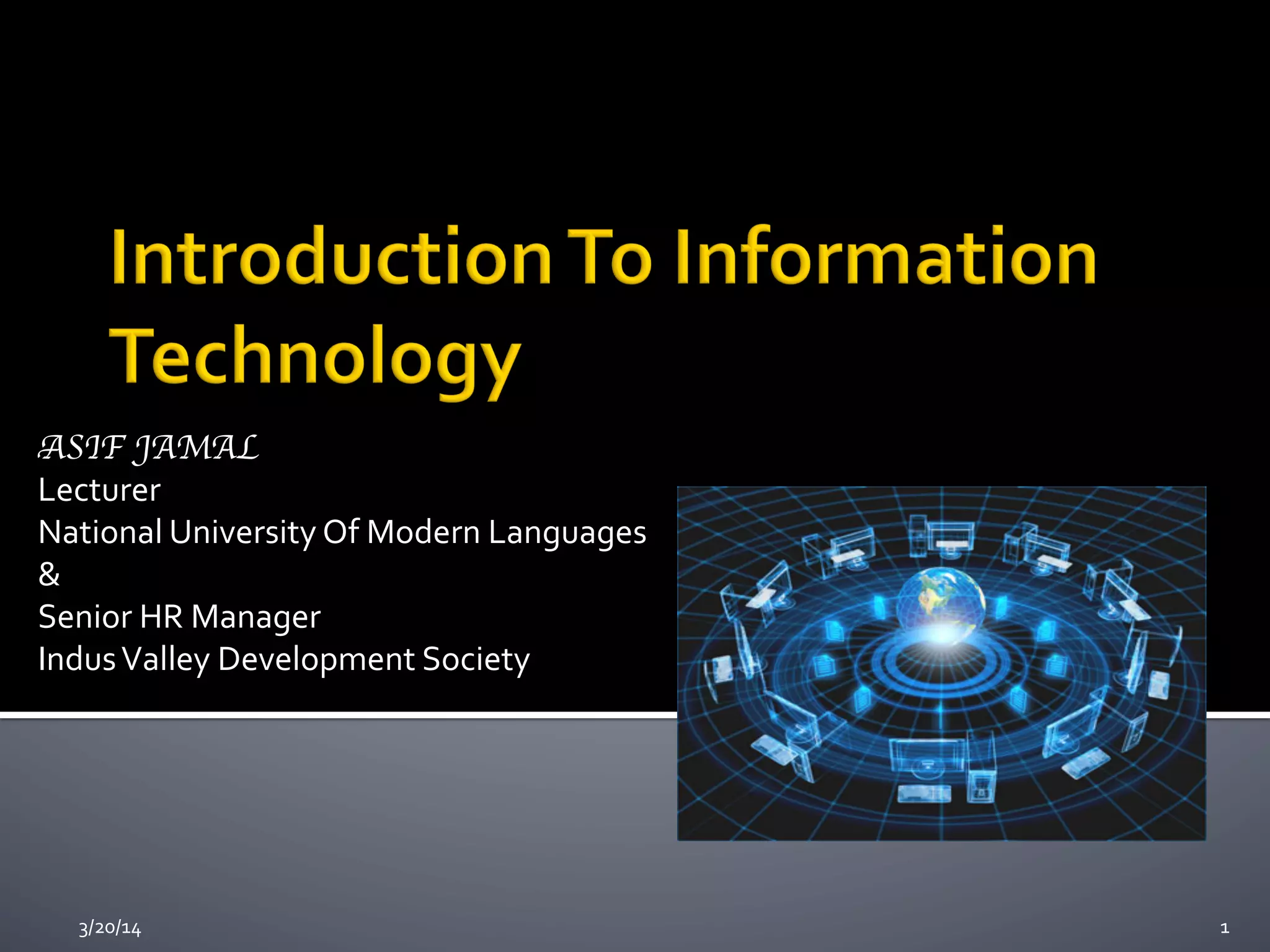
¡  Information	
  technology	
  is	
  the	
  technology	
  
that	
  uses	
  computing	
  with	
  high	
  speed	
  
communication	
  links	
  to	
  spread	
  information	
  
from	
  one	
  place	
  to	
  another.	
  
¡  Computer	
  is	
  a	
  very	
  important	
  component	
  of	
  
information	
  technology	
  
¡  The	
  world	
  has	
  become	
  “global	
  village”	
  due	
  to	
  
advancement	
  in	
  IT.	
  
3/20/14	
   2	
  
¡  An	
  electronic	
  device	
  that	
  is	
  programmed	
  to	
  
accept	
  data,	
  process	
  data	
  into	
  useful	
  
information	
  and	
  store	
  it	
  for	
  later	
  use	
  
¡  Computer	
  consists	
  of	
  hardware	
  and	
  software	
  
¡  Software	
  is	
  a	
  set	
  of	
  instructions	
  that	
  tells	
  a	
  
computer	
  what	
  to	
  do	
  
¡  Hardware	
  is	
  the	
  physical	
  part	
  of	
  a	
  computer	
  
E.g.	
  keyboard	
  ,	
  mouse	
  etc	
  
¡  Relationship	
  between	
  hardware	
  and	
  software	
  
3/20/14	
   3	
  
3/20/14	
   4	
  
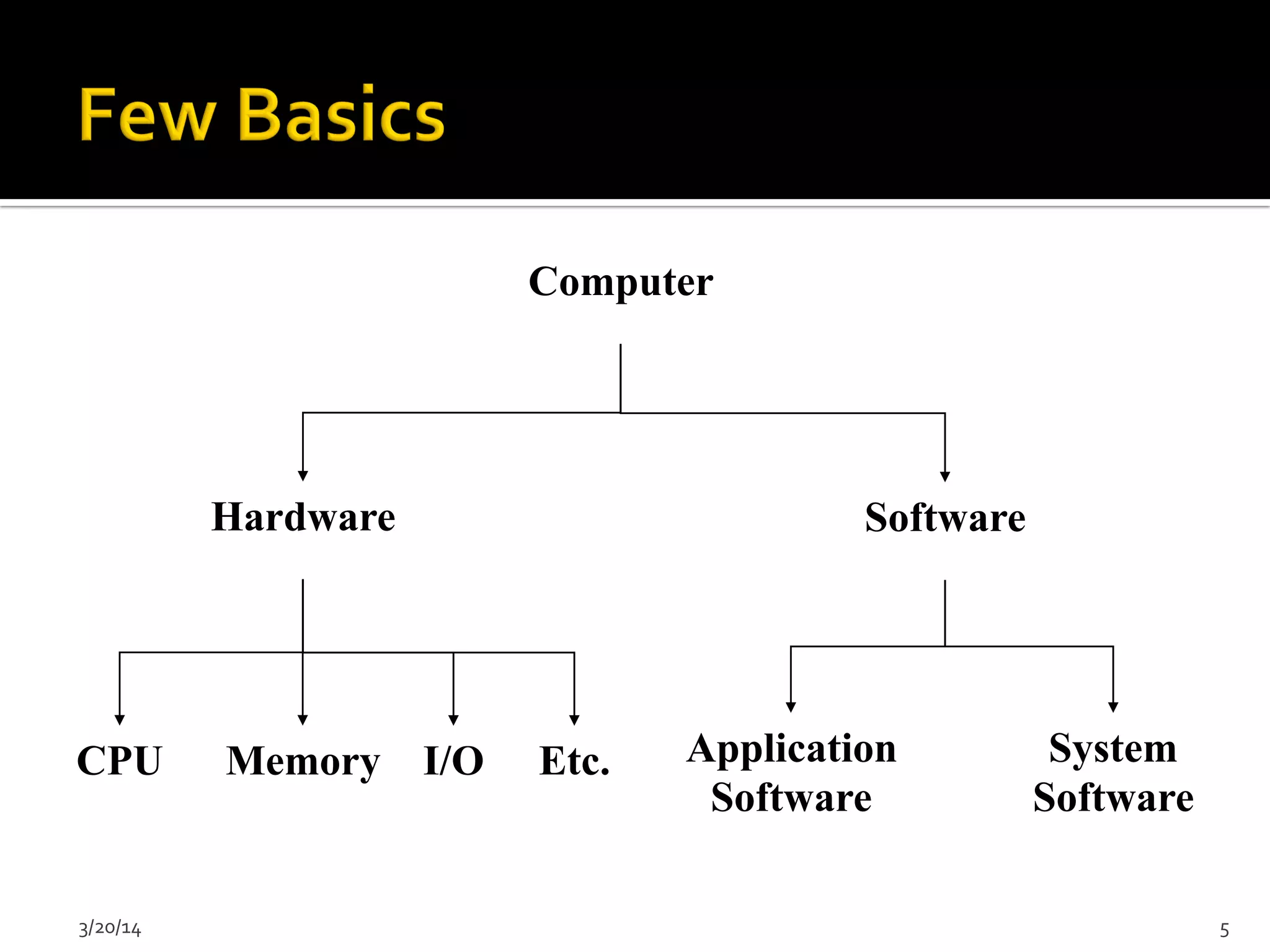
Computer
Hardware Software
Application
Software
System
Software
CPU Memory I/O Etc.
3/20/14	
   5	
  
¡  Analog	
  computers	
  
¡  Digital	
  computers	
  
3/20/14	
   6	
  
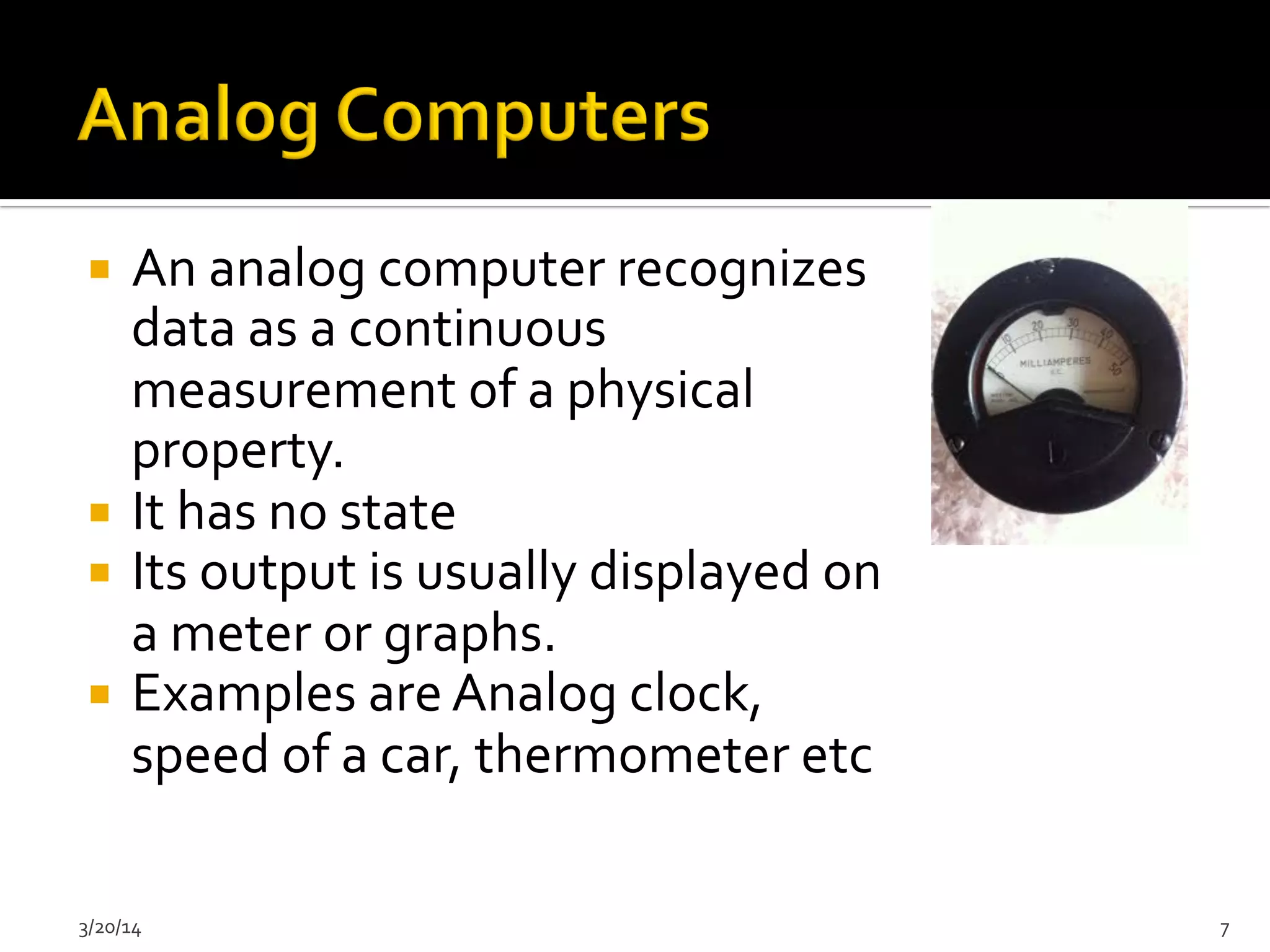
¡  An	
  analog	
  computer	
  recognizes	
  
data	
  as	
  a	
  continuous	
  
measurement	
  of	
  a	
  physical	
  
property.	
  
¡  It	
  has	
  no	
  state	
  
¡  Its	
  output	
  is	
  usually	
  displayed	
  on	
  
a	
  meter	
  or	
  graphs.	
  
¡  Examples	
  are	
  Analog	
  clock,	
  
speed	
  of	
  a	
  car,	
  thermometer	
  etc	
  	
  
3/20/14	
   7	
  
¡  It	
  works	
  with	
  numbers	
  
¡  They	
  breaks	
  all	
  types	
  of	
  information	
  into	
  tiny	
  
units	
  and	
  use	
  numbers	
  to	
  represent	
  those	
  
pieces	
  of	
  information.	
  	
  
¡  Everything	
  is	
  described	
  in	
  two	
  states	
  i.e.	
  
either	
  ON	
  (1)	
  or	
  OFF	
  (0).	
  
¡  They	
  are	
  very	
  fast	
  and	
  	
  have	
  big	
  memory	
  	
  
3/20/14	
   8	
  
The	
  six	
  generations	
  of	
  computers	
  are:	
  
¡  Mechanical	
  era(1623-­‐1900)	
  
¡  First	
  generation	
  electronic	
  
computers(1937-­‐1953)	
  
¡  Second	
  generation	
  (1954-­‐1962)	
  
¡  Third	
  generation	
  (1963-­‐1972)	
  
¡  Forth	
  generation	
  (1972-­‐1984)	
  
¡  Fifth	
  generation	
  (1984-­‐1990)	
  
¡  Sixth	
  generation	
  (1990	
  -­‐	
  present)	
  
3/20/14	
   9	
  
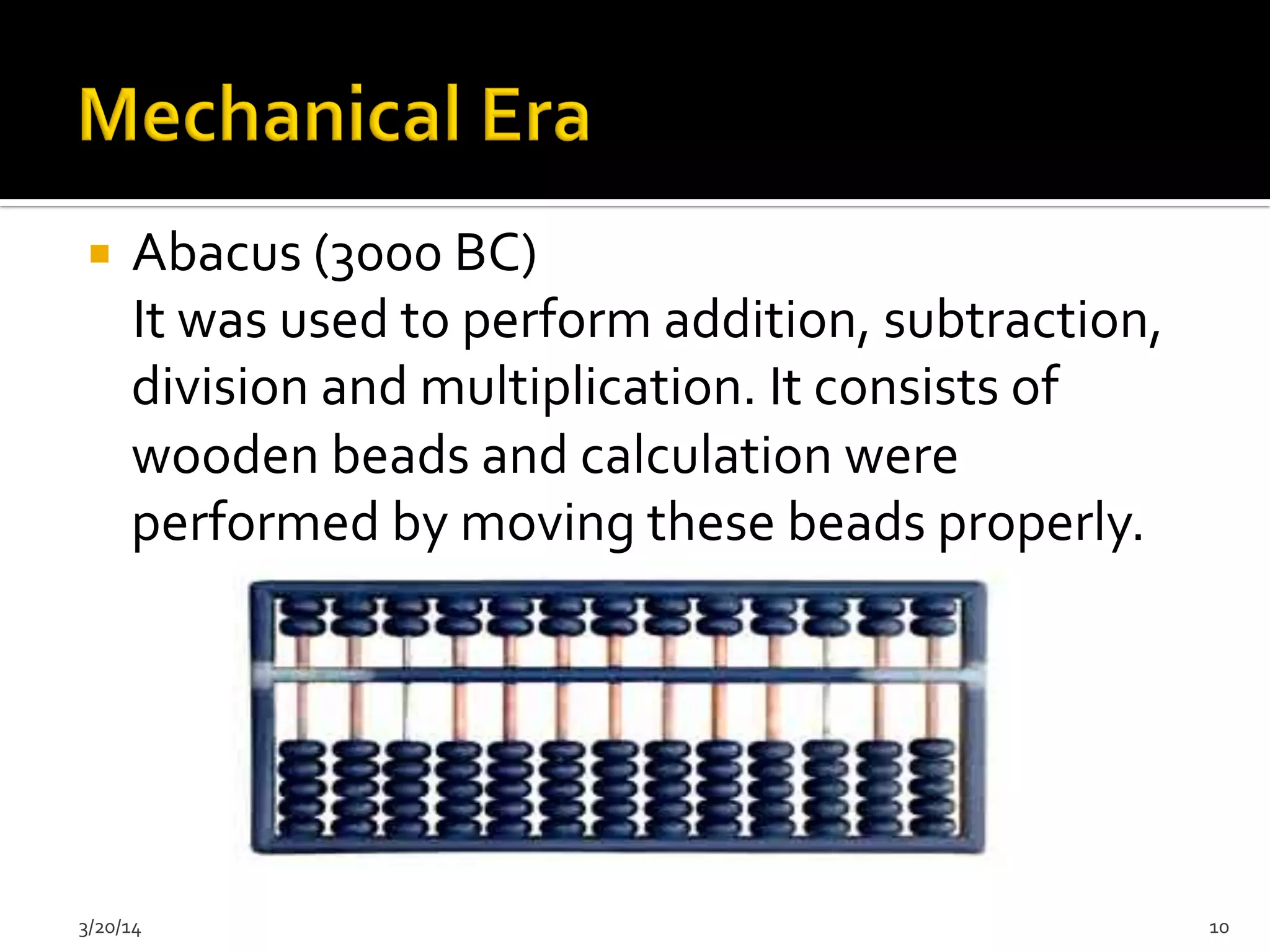
¡  Abacus	
  (3000	
  BC)	


  It	
  was	
  used	
  to	
  perform	
  addition,	
  subtraction,	
  
division	
  and	
  multiplication.	
  It	
  consists	
  of	
  
wooden	
  beads	
  and	
  calculation	
  were	
  
performed	
  by	
  moving	
  these	
  beads	
  properly.	


  3/20/14	
   10	
  
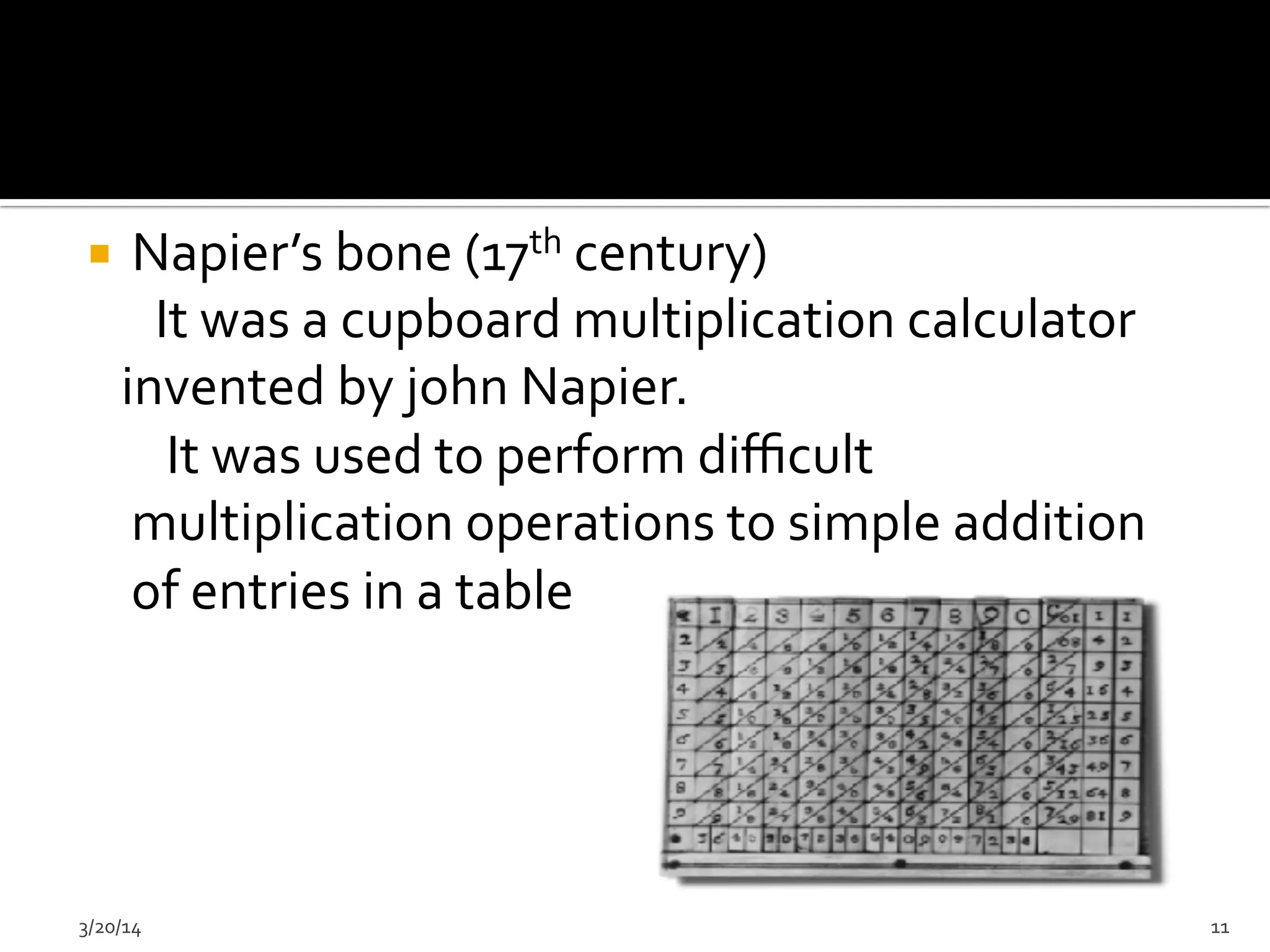
¡  Napier’s	
  bone	
  (17th	
  century)	


  It	
  was	
  a	
  cupboard	
  multiplication	
  calculator	


  invented	
  by	
  john	
  Napier.	


  It	
  was	
  used	
  to	
  perform	
  difficult	
  
multiplication	
  operations	
  to	
  simple	
  addition	
  
of	
  entries	
  in	
  a	
  table	


3/20/14	
   11	
  
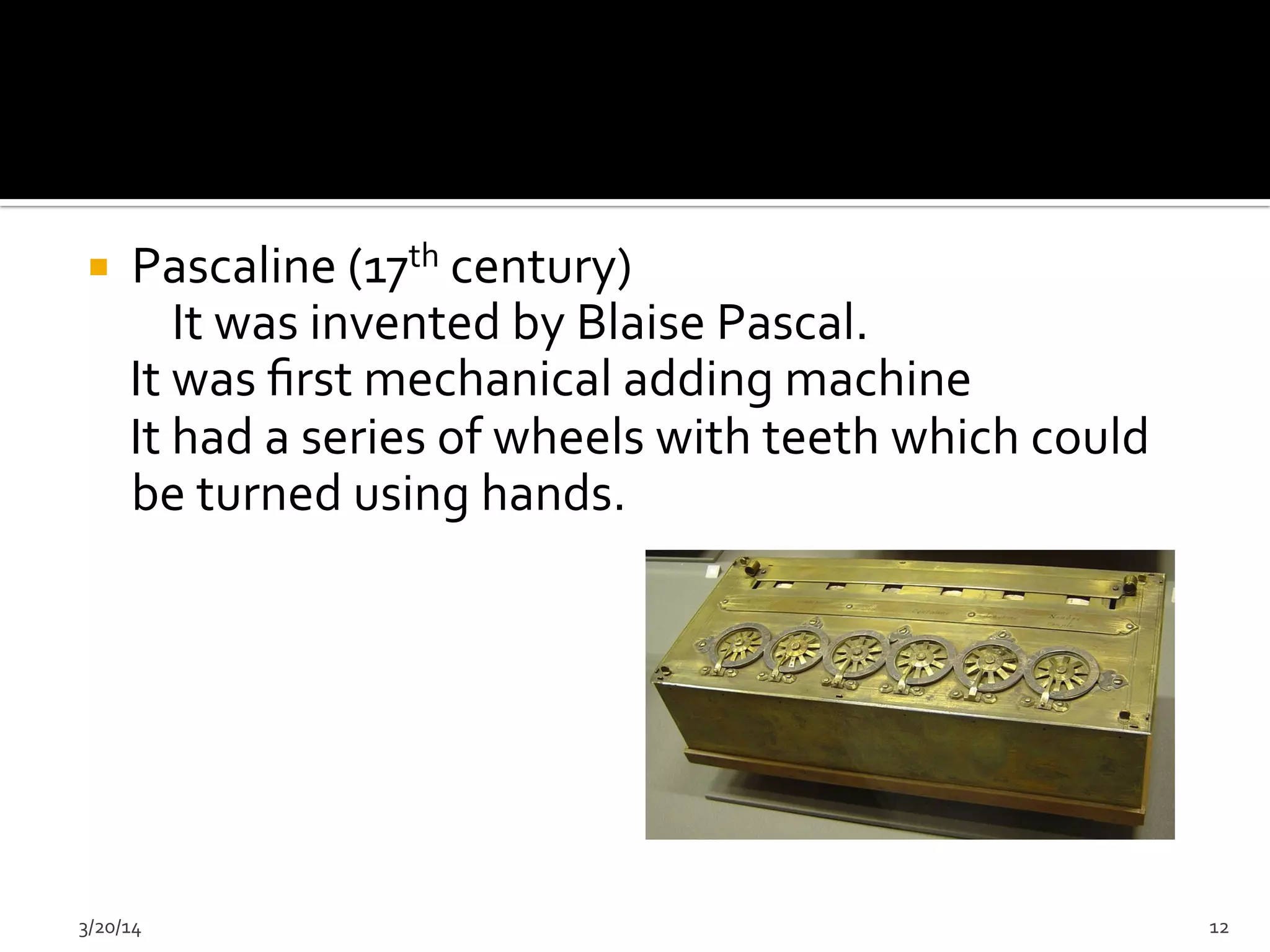
¡  Pascaline	
  (17th	
  century)	


  It	
  was	
  invented	
  by	
  Blaise	
  Pascal.	


  It	
  was	
  first	
  mechanical	
  adding	
  machine	


  It	
  had	
  a	
  series	
  of	
  wheels	
  with	
  teeth	
  which	
  could	


be	
  turned	
  using	
  hands.	
  
3/20/14	
   12	
  
¡  Difference	
  Engine	
  and	
  Analytical	
  Engine(1823	
  
and	
  1833)	


  It	
  was	
  designed	
  by	
  Charles	
  Babbage	
  who	
  
was	
  English	
  mathematician,	
  engineer,	
  
philosopher	
  and	
  inventor.	


  He	
  originated	
  the	
  concept	
  of	
  the	
  
programmable	
  computer.	


  A	
  general	
  purpose	
  computer	
  controlled	
  by	
  a	
  
list	
  of	
  instructions	
  
3/20/14	
   13	
  
¡  Punched	
  cards	
  (1890)	


  They	
  were	
  able	
  to	
  read	
  information	
  that	
  
which	
  have	
  been	
  punched	
  into	
  the	
  cards	
  
automatically	
  
3/20/14	
   14	
  
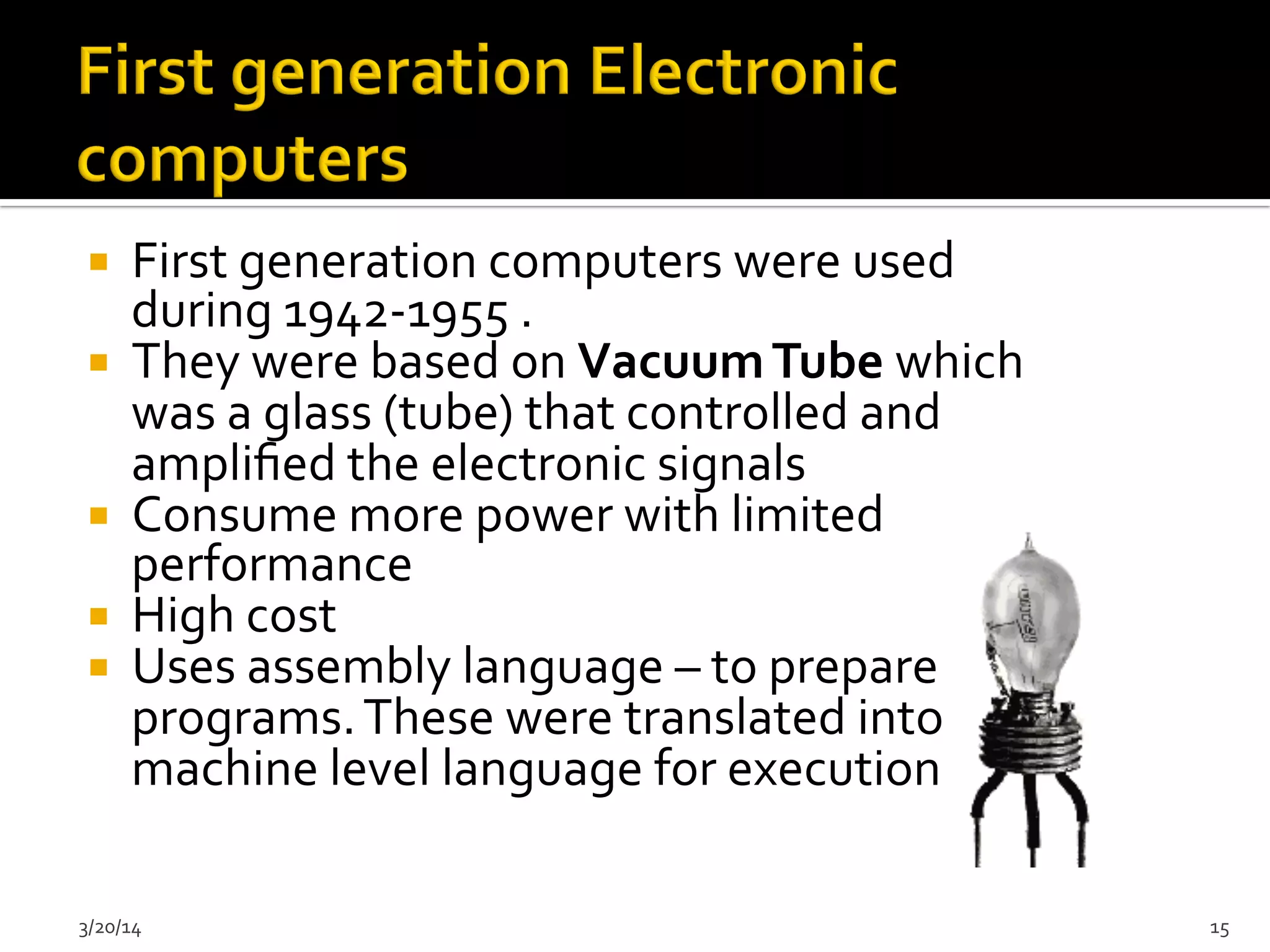
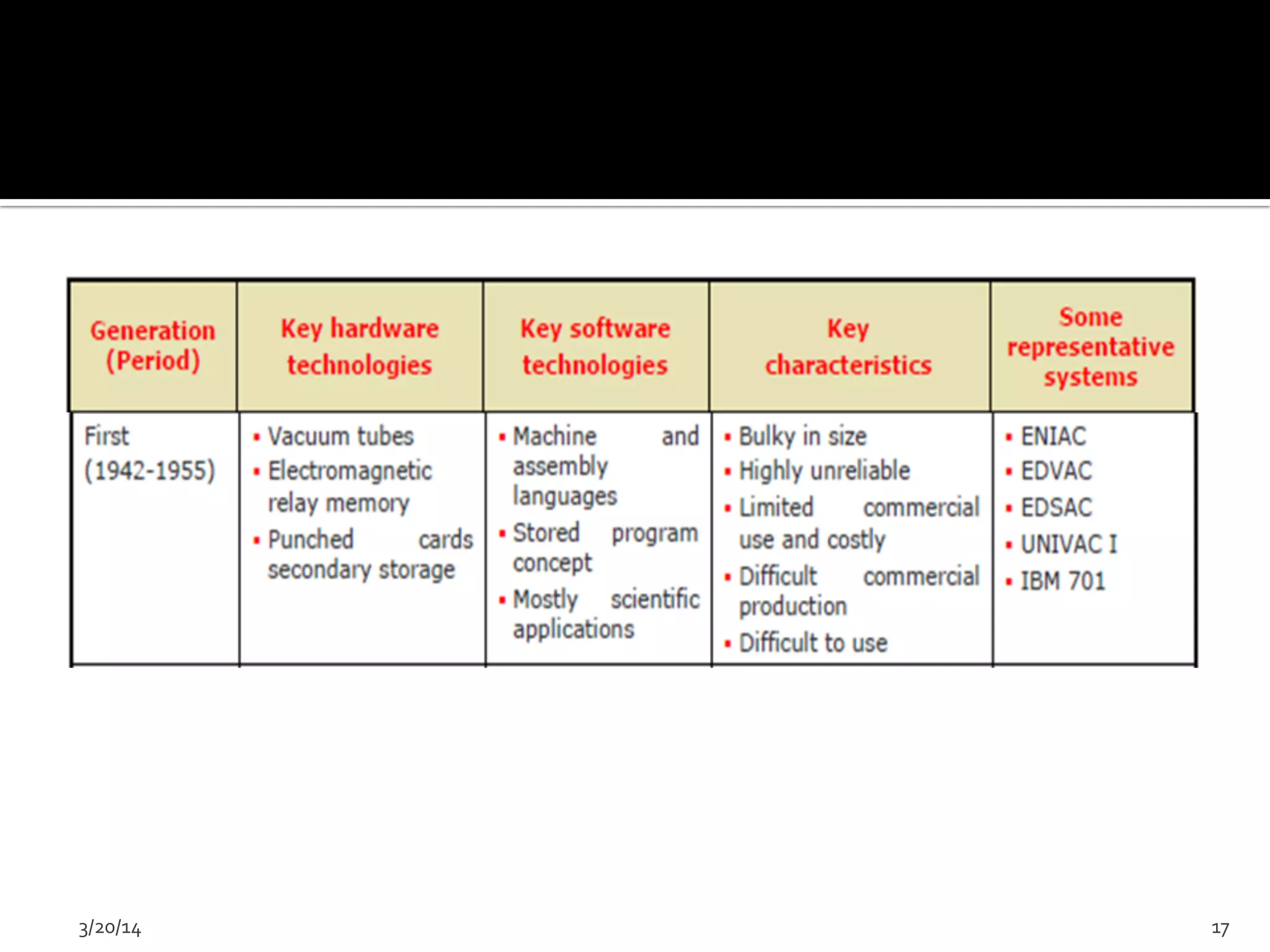
¡  First	
  generation	
  computers	
  were	
  used	
  
during	
  1942-­‐1955	
  .	
  
¡  They	
  were	
  based	
  on	
  Vacuum	
  Tube	
  which	
  
was	
  a	
  glass	
  (tube)	
  that	
  controlled	
  and	
  
amplified	
  the	
  electronic	
  signals	
  	
  
¡  Consume	
  more	
  power	
  with	
  limited	
  
performance	
  	
  
¡  High	
  cost	
  	
  
¡  Uses	
  assembly	
  language	
  –	
  to	
  prepare	
  
programs.	
  These	
  were	
  translated	
  into	
  
machine	
  level	
  language	
  for	
  execution.	
  	
  
3/20/14	
   15	


¡  Fixed	
  point	
  arithmetic	
  was	
  used	
  	
  
¡  100	
  to	
  1000	
  fold	
  increase	
  in	
  speed	
  relative	
  to	
  the	
  
earlier	
  mechanical	
  and	
  relay	
  based	
  
electromechanical	
  technology	
  	
  
¡  Punched	
  cards	
  and	
  paper	
  tape	
  were	
  invented	
  to	
  
feed	
  programs	
  and	
  data	
  and	
  to	
  get	
  results.	
  	
  
¡  Magnetic	
  tape	
  /	
  magnetic	
  drum	
  were	
  used	
  as	
  
secondary	
  memory	
  	
  
¡  Mainly	
  used	
  for	
  scientific	
  computations.	
  	
  
¡  See	
  page	
  #	
  6,	
  Table	
  1A.2	
  
¡  Examples	
  are:	
  UNIVAC,	
  Havard	
  Mark	
  1,	
  ENIAC	
  
etc	


3/20/14	
   16	
  
3/20/14	
   17	
  
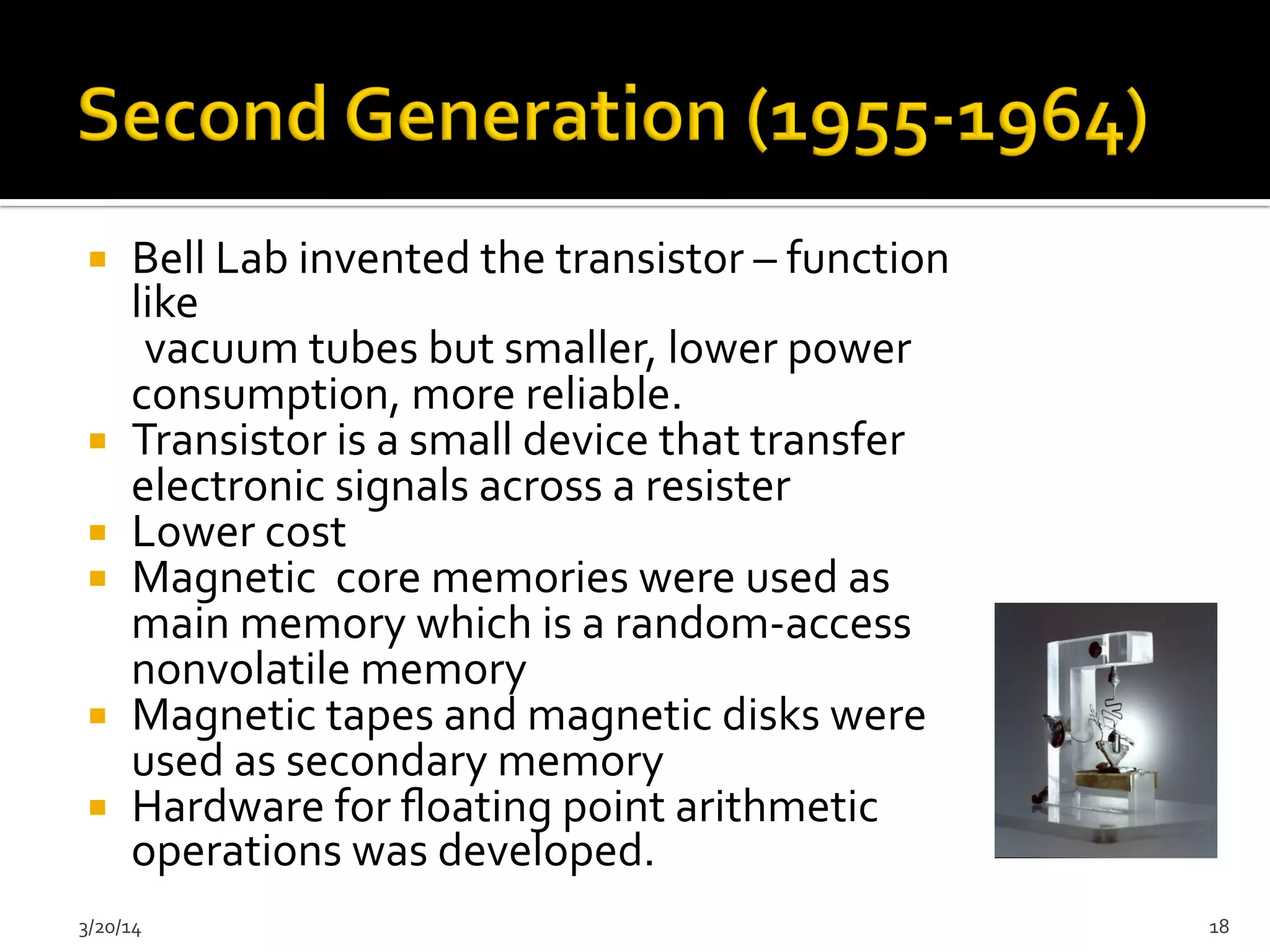
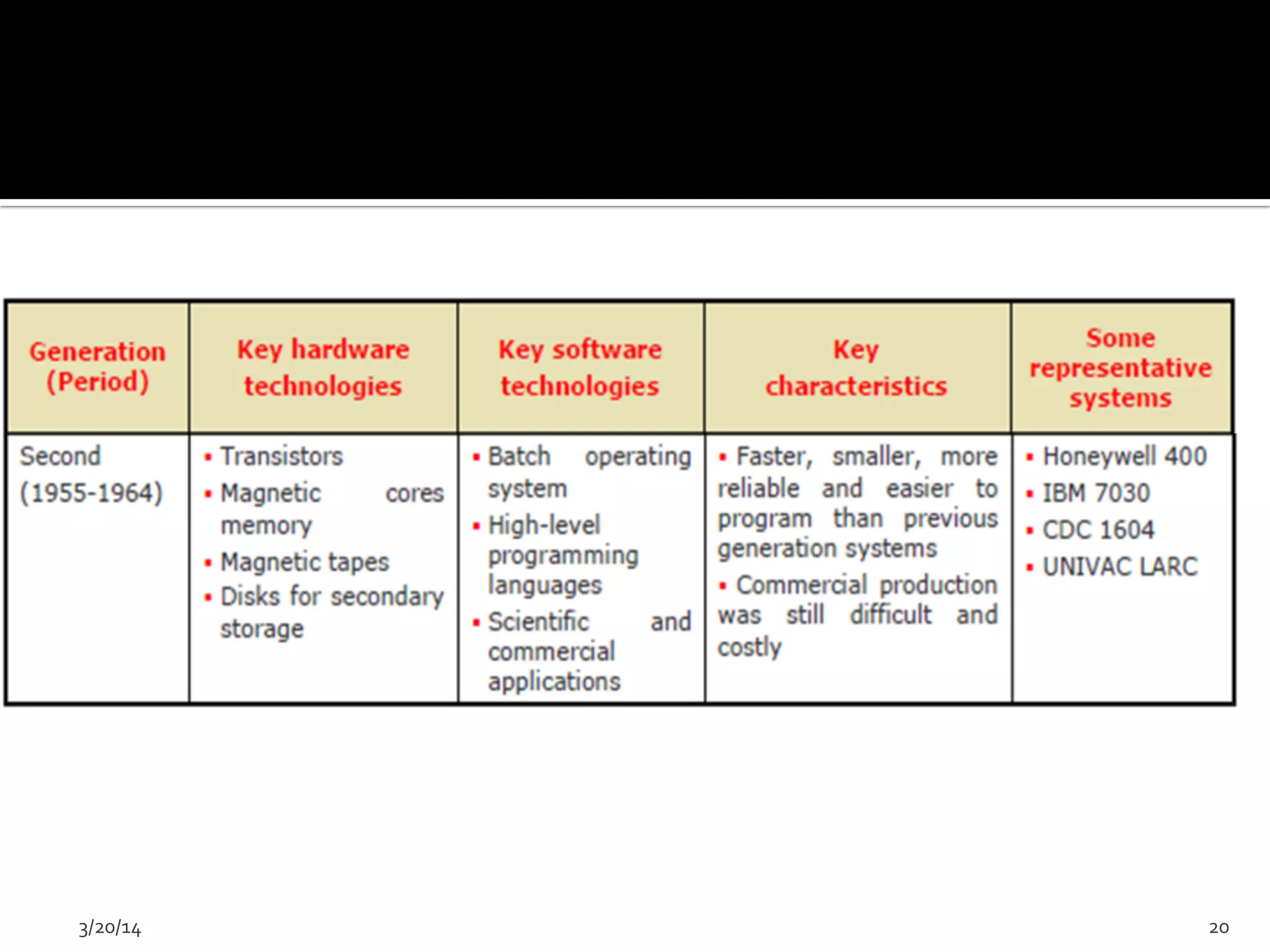
¡  Bell	
  Lab	
  invented	
  the	
  transistor	
  –	
  function	
  
like	


  vacuum	
  tubes	
  but	
  smaller,	
  lower	
  power	
  
consumption,	
  more	
  reliable.	
  
¡  Transistor	
  is	
  a	
  small	
  device	
  that	
  transfer	
  
electronic	
  signals	
  across	
  a	
  resister	
  
¡  Lower	
  cost	
  	
  
¡  Magnetic	
  	
  core	
  memories	
  were	
  used	
  as	
  
main	
  memory	
  which	
  is	
  a	
  random-­‐access	
  
nonvolatile	
  memory	
  	
  
¡  Magnetic	
  tapes	
  and	
  magnetic	
  disks	
  were	
  
used	
  as	
  secondary	
  memory	
  	
  
¡  Hardware	
  for	
  floating	
  point	
  arithmetic	
  
operations	
  was	
  developed.	
  	
  
3/20/14	
   18	
  
¡  Index	
  registers	
  were	
  introduced	
  which	
  increased	
  
flexibility	
  of	
  programming.	
  	
  
¡  High	
  level	
  languages	
  such	
  as	
  FORTRAN,	
  COBOL	
  etc	
  
were	
  used	
  -­‐	
  Compilers	
  were	
  developed	
  to	
  translate	
  
the	
  high-­‐level	
  program	
  into	
  corresponding	
  assembly	
  
language	
  program	
  which	
  was	
  then	
  translated	
  into	
  
machine	
  language.	
  	
  
¡  Separate	
  input-­‐output	
  processors	
  were	
  developed	
  
that	
  could	
  operate	
  in	
  parallel	
  with	
  CPU.	
  	
  
¡  Punched	
  cards	
  continued	
  during	
  this	
  period	
  also.	
  	
  
¡  1000	
  fold	
  increase	
  in	
  speed.	
  	
  
¡  See	
  Page#	
  6	
  ,	
  Table	
  1A.3	
  
¡  Examples	
  are:	
  TRADIC,	
  IBM	
  704,	
  LARC	
  etc	
  
3/20/14	
   19	
  
3/20/14	
   20	
  
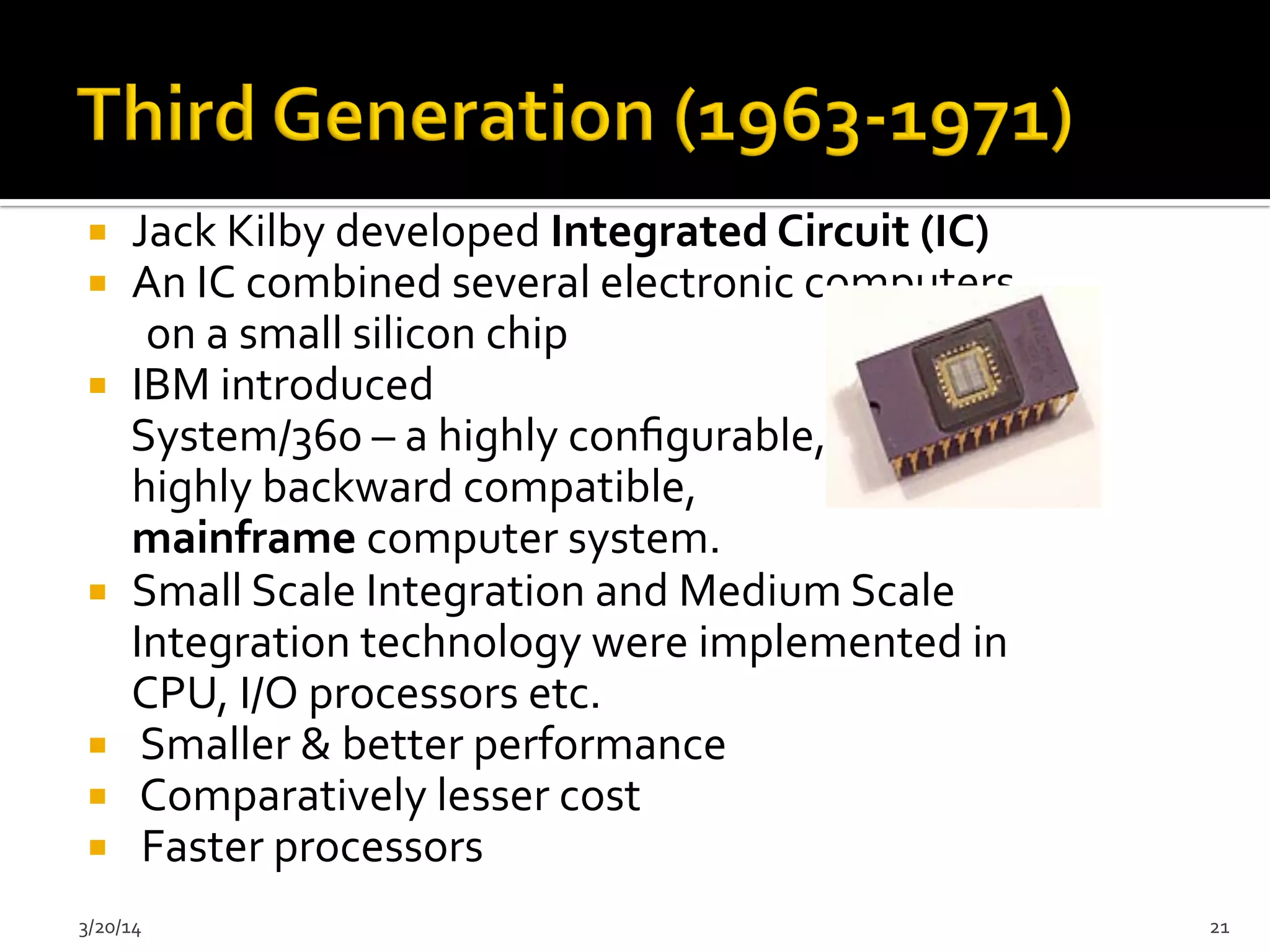
¡  Jack	
  Kilby	
  developed	
  Integrated	
  Circuit	
  (IC)	
  
¡  An	
  IC	
  combined	
  several	
  electronic	
  computers	


  on	
  a	
  small	
  silicon	
  chip	
  
¡  IBM	
  introduced	
  
	
  System/360	
  –	
  a	
  highly	
  configurable,	
  
	
  highly	
  backward	
  compatible,	
  
	
  mainframe	
  computer	
  system.	
  	
  
¡  Small	
  Scale	
  Integration	
  and	
  Medium	
  Scale	
  
Integration	
  technology	
  were	
  implemented	
  in	
  
CPU,	
  I/O	
  processors	
  etc.	
  	
  
¡  	
  Smaller	
  &	
  better	
  performance	
  	
  
¡  	
  Comparatively	
  lesser	
  cost	
  	
  
¡  	
  Faster	
  processors	
  
3/20/14	
   21	
  
¡  	
  In	
  the	
  beginning	
  magnetic	
  core	
  memories	
  
were	
  used.	
  Later	
  they	
  were	
  replaced	
  by	
  
semiconductor	
  memories	
  (RAM	
  &	
  ROM)	
  	
  
¡  Introduced	
  microprogramming	
  	
  
¡  Microprogramming,	
  parallel	
  processing	
  
(pipelining,	
  multiprocessor	
  system	
  etc),	
  
multiprogramming,	
  multi-­‐user	
  system	
  (time	
  
shared	
  system)	
  etc	
  were	
  introduced.	
  	
  
¡  Operating	
  system	
  software	
  were	
  introduced	
  
¡  Cache	
  and	
  virtual	
  memories	
  were	
  introduced	
  	
  
3/20/14	
   22	
  
¡  High	
  level	
  languages	
  were	
  standardized	
  by	
  ANSI	
  
e.g..	
  ANSI	
  FORTRAN,	
  ANSI	
  COBOL	
  etc	
  	
  
¡  Database	
  management,	
  multi-­‐user	
  application,	
  
online	
  systems	
  like	
  closed	
  loop	
  process	
  control,	
  
airline	
  reservation,	
  interactive	
  query	
  systems,	
  
automatic	
  industrial	
  control	
  etc	
  emerged	
  during	
  
this	
  period.	
  	
  
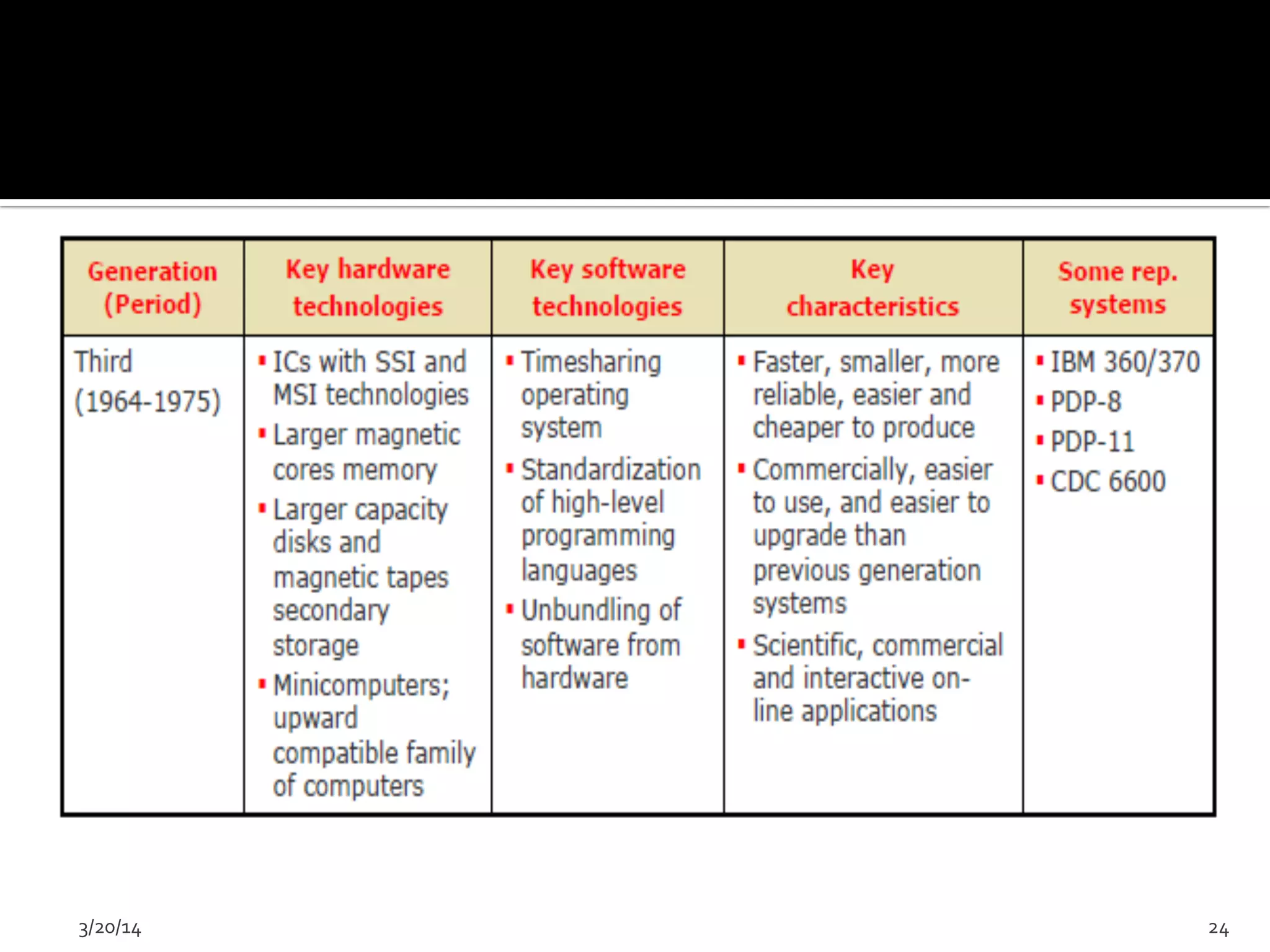
¡  See	
  page	
  #	
  7,	
  Table	
  1A.4	
  
¡  Examples	
  are:	
  INTEL	
  4004,	
  	
  IBM	
  SYSTEM/360	
  
etc	
  
3/20/14	
   23	
  
3/20/14	
   24	
  
¡  Microprocessors	
  were	
  introduced	
  as	
  CPU–	
  
Complete	
  processors	
  and	
  large	
  section	
  of	
  main	
  
memory	
  could	
  be	
  implemented	
  in	
  a	
  single	
  chip	
  	
  
¡  Tens	
  of	
  thousands	
  of	
  transistors	
  can	
  be	
  placed	
  in	
  
a	
  single	
  chip	
  (VLSI	
  design	
  implemented)	
  	
  
¡  	
  CRT	
  screen,	
  laser	
  &	
  ink	
  jet	
  printers,	
  scanners	
  etc	
  
were	
  developed.	
  	
  
¡  Semiconductor	
  memory	
  chips	
  were	
  used	
  as	
  the	
  
main	
  memory.	
  	
  
¡  Secondary	
  memory	
  was	
  composed	
  of	
  hard	
  disks	
  
–	
  Floppy	
  disks	
  &	
  magnetic	
  tapes	
  were	
  used	
  for	
  
backup	
  memory	
  	
  
3/20/14	
   25	
  
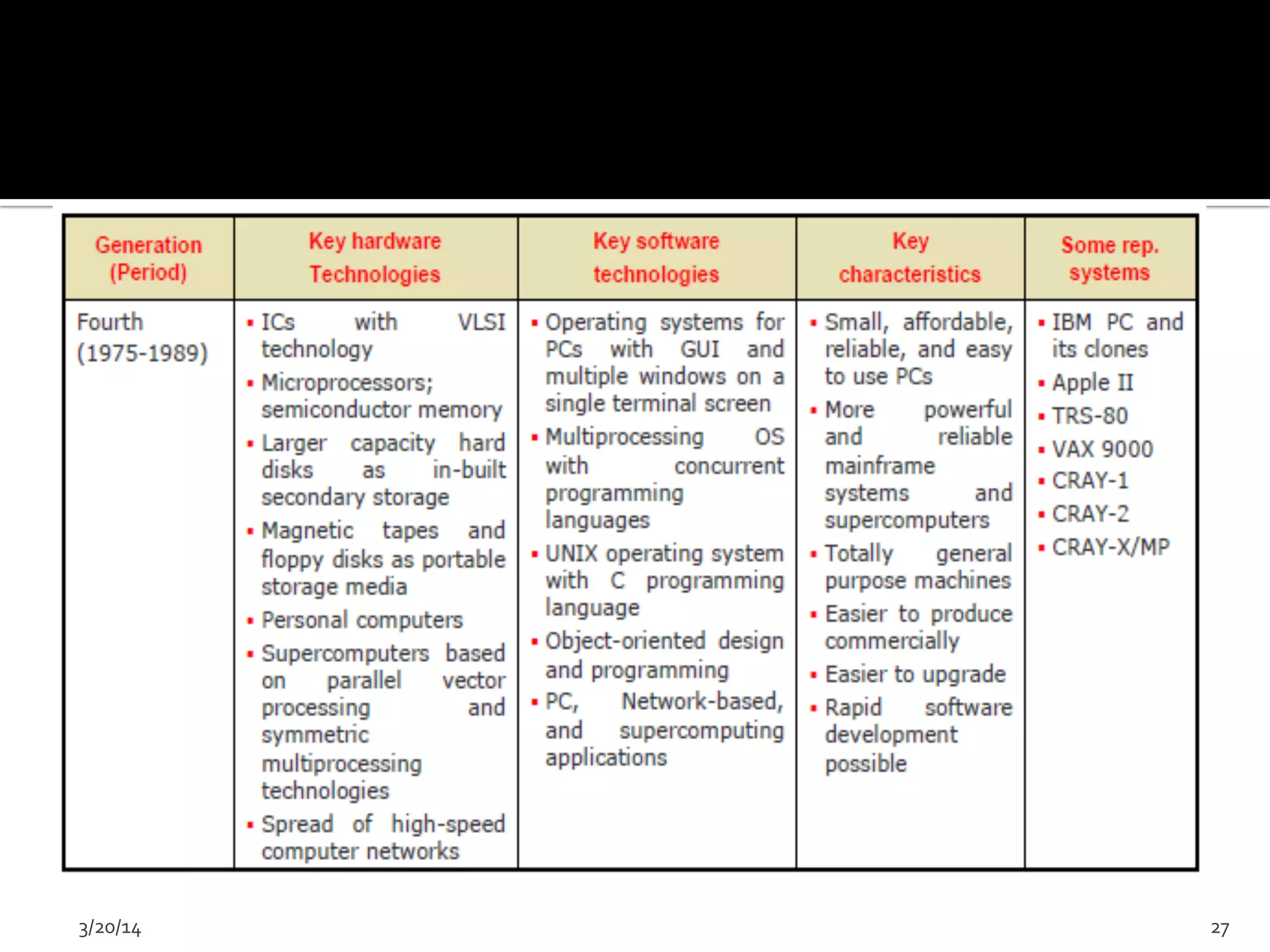
¡  Parallelism,	
  pipelining	
  cache	
  memory	
  and	
  virtual	
  
memory	
  were	
  applied	
  in	
  a	
  better	
  way	
  	
  
¡  LAN	
  and	
  WANS	
  were	
  developed	
  (where	
  desktop	
  
work	
  stations	
  interconnected)	
  	
  
¡  Introduced	
  C	
  language	
  and	
  Unix	
  OS	
  	
  
¡  Introduced	
  Graphical	
  User	
  Interface	
  	
  
¡  Less	
  power	
  consumption	
  	
  
¡  High	
  performance,	
  lower	
  cost	
  and	
  very	
  compact	
  	
  
¡  Much	
  increase	
  in	
  the	
  speed	
  of	
  operation	
  	
  
¡  Examples	
  are	
  Apple	
  Macintosh	
  and	
  IBM	
  PC	
  
¡  See	
  Page	
  #	
  7,	
  Table	
  1A.5	
  	
  
3/20/14	
   26	
  
3/20/14	
   27	
  
¡  Computers	
  based	
  on	
  artificial	
  intelligence	
  are	
  available	
  	
  
¡  	
  Computers	
  use	
  extensive	
  parallel	
  processing,	
  multiple	
  pipelines,	
  
multiple	
  processors	
  etc	
  	
  
¡  Massive	
  parallel	
  machines	
  and	
  extensively	
  distributed	
  system	
  
connected	
  by	
  communication	
  networks	
  fall	
  in	
  this	
  category.	
  	
  
¡  Introduced	
  ULSI	
  (Ultra	
  Large	
  Scale	
  Integration)	
  technology	
  –	
  
Intel’s	
  Pentium	
  4	
  microprocessor	
  contains	
  55	
  million	
  transistors	
  
millions	
  of	
  components	
  on	
  a	
  single	
  IC	
  chip.	
  	
  
¡  Superscalar	
  processors,	
  Vector	
  processors,	
  SIMD	
  processors,	
  32	
  bit	
  
micro	
  controllers	
  and	
  embedded	
  processors,	
  Digital	
  Signal	
  
Processors	
  (DSP)	
  etc	
  have	
  been	
  developed.	
  	
  
¡  Memory	
  chips	
  up	
  to	
  1	
  GB,	
  hard	
  disk	
  drives	
  up	
  to	
  180	
  GB	
  and	
  optical	
  
disks	
  up	
  to	
  27	
  GB	
  are	
  available	
  (still	
  the	
  capacity	
  is	
  increasing)	
  	
  
¡  Object	
  oriented	
  language	
  like	
  JAVA	
  suitable	
  for	
  internet	
  
programming	
  has	
  been	
  developed.	
  	
  
3/20/14	
   28	
  
¡  Portable	
  note	
  book	
  computers	
  introduced	
  	
  
¡  Storage	
  technology	
  advanced	
  –	
  large	
  main	
  
memory	
  and	
  disk	
  storage	
  available	
  	
  
¡  Introduced	
  World	
  Wide	
  Web.	
  (and	
  other	
  
existing	
  applications	
  like	
  e-­‐mail,	
  e	
  Commerce,	
  
Virtual	
  libraries/Classrooms,	
  multimedia	
  
applications	
  etc.)	
  	
  
¡  New	
  operating	
  systems	
  developed	
  –	
  
Windows	
  95/98/XP/…,	
  LINUX,	
  etc.	
  	
  
3/20/14	
   29	
  
¡  Got	
  hot	
  pluggable	
  features	
  –	
  which	
  enable	
  a	
  
failed	
  component	
  to	
  be	
  replaced	
  with	
  a	
  new	
  
one	
  without	
  the	
  need	
  to	
  shutdown	
  the	
  
system,	
  allowing	
  the	
  uptime	
  of	
  the	
  system	
  to	
  
be	
  very	
  high.	
  	
  
¡  The	
  recent	
  development	
  in	
  the	
  application	
  of	
  
internet	
  is	
  the	
  Grid	
  technology	
  which	
  is	
  still	
  in	
  
its	
  upcoming	
  stage.	
  	
  
¡  See	
  Page	
  #	
  8,	
  Table	
  1A.6	
  
3/20/14	
   30	
  
3/20/14	
   31	
  
¡  Some	
  inventions	
  of	
  the	
  time	
  are	
  WWW,	
  	
  
HTML,	
  HTTP,	
  Web	
  TV,	
  java,	
  DVD,	
  iPod,	
  
Youtube	
  etc	
  
¡  See	
  Page	
  #	
  8	
  ,	
  Table	
  1A.7	
  
¡  Examples	
  are:	
  iMac	
  ,	
  Sun	
  ultra	
  workstation	
  
etc	
  	
  
3/20/14	
   32	
  
¡  Input	
  Devices	
  
¡  Output	
  devices	
  
¡  System	
  Unit	
  
¡  Storage	
  devices	
  
¡  Communication	
  devices	
  
3/20/14	
   33	
  
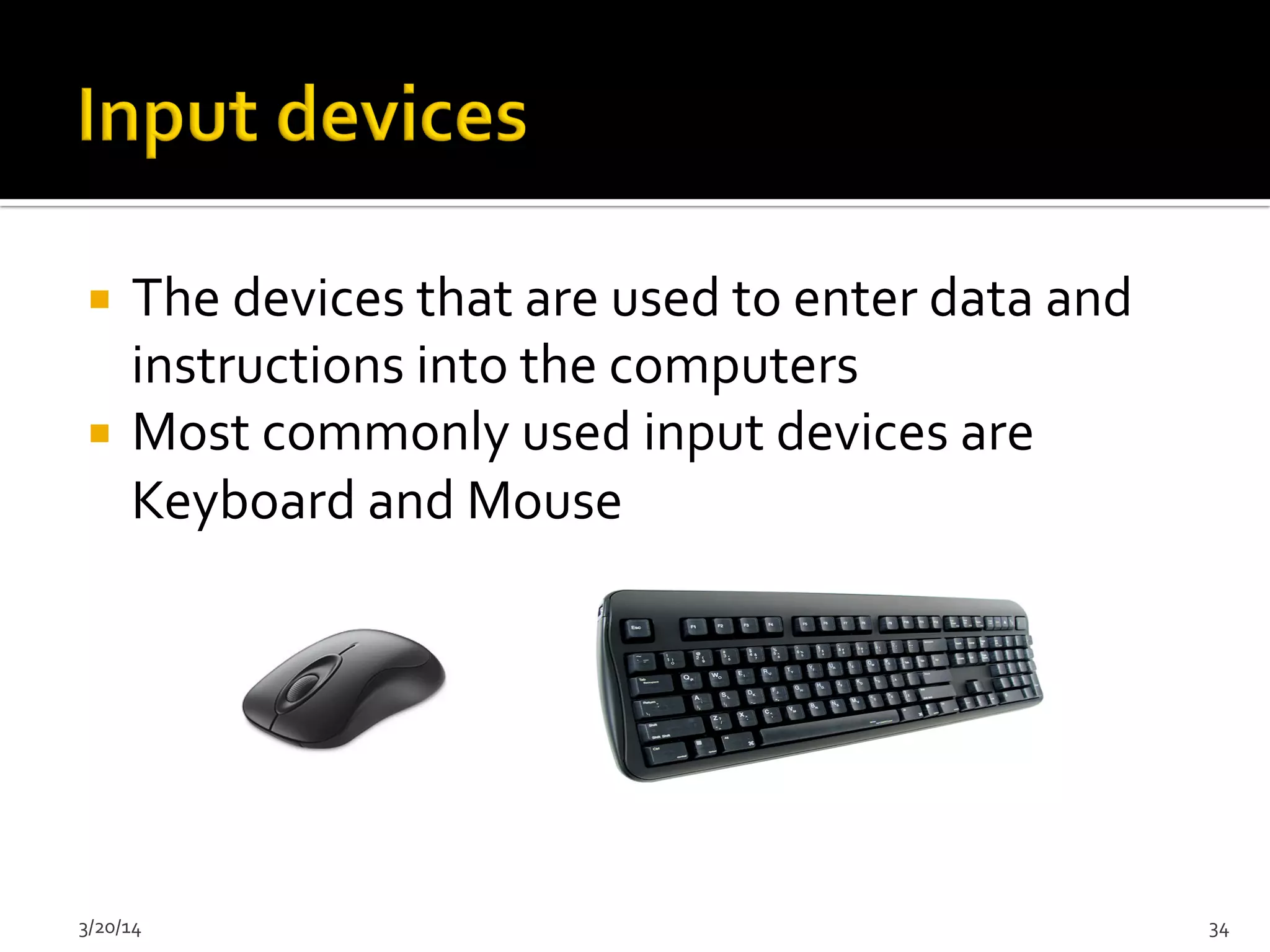
¡  The	
  devices	
  that	
  are	
  used	
  to	
  enter	
  data	
  and	
  
instructions	
  into	
  the	
  computers	
  
¡  Most	
  commonly	
  used	
  input	
  devices	
  are	
  
Keyboard	
  and	
  Mouse	
  
3/20/14	
   34	
  
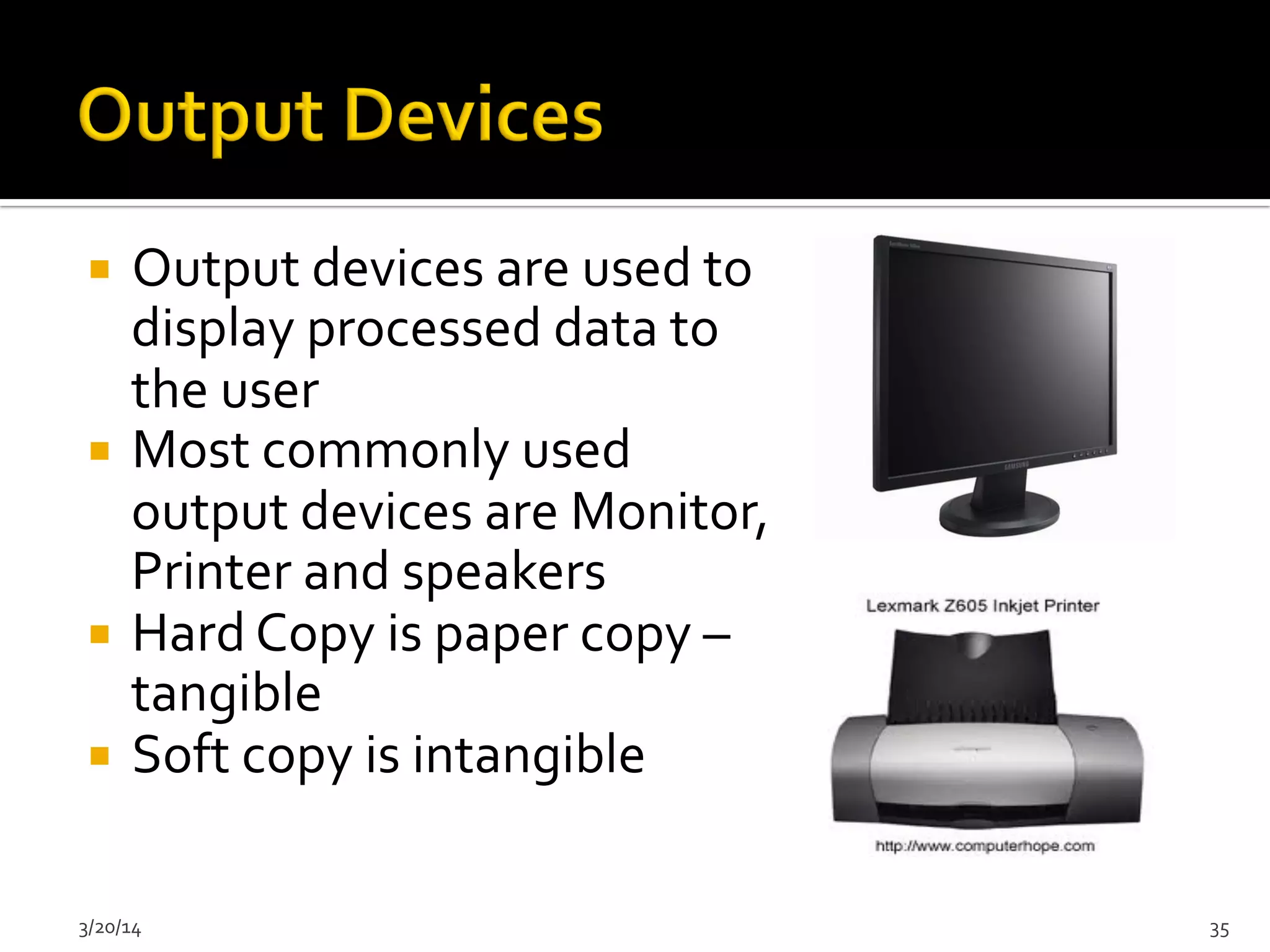
¡  Output	
  devices	
  are	
  used	
  to	
  
display	
  processed	
  data	
  to	
  
the	
  user	
  
¡  Most	
  commonly	
  used	
  
output	
  devices	
  are	
  Monitor,	
  	
  
Printer	
  and	
  speakers	
  
¡  Hard	
  Copy	
  is	
  paper	
  copy	
  –	
  
tangible	
  
¡  Soft	
  copy	
  is	
  intangible	
  
3/20/14	
   35	
  
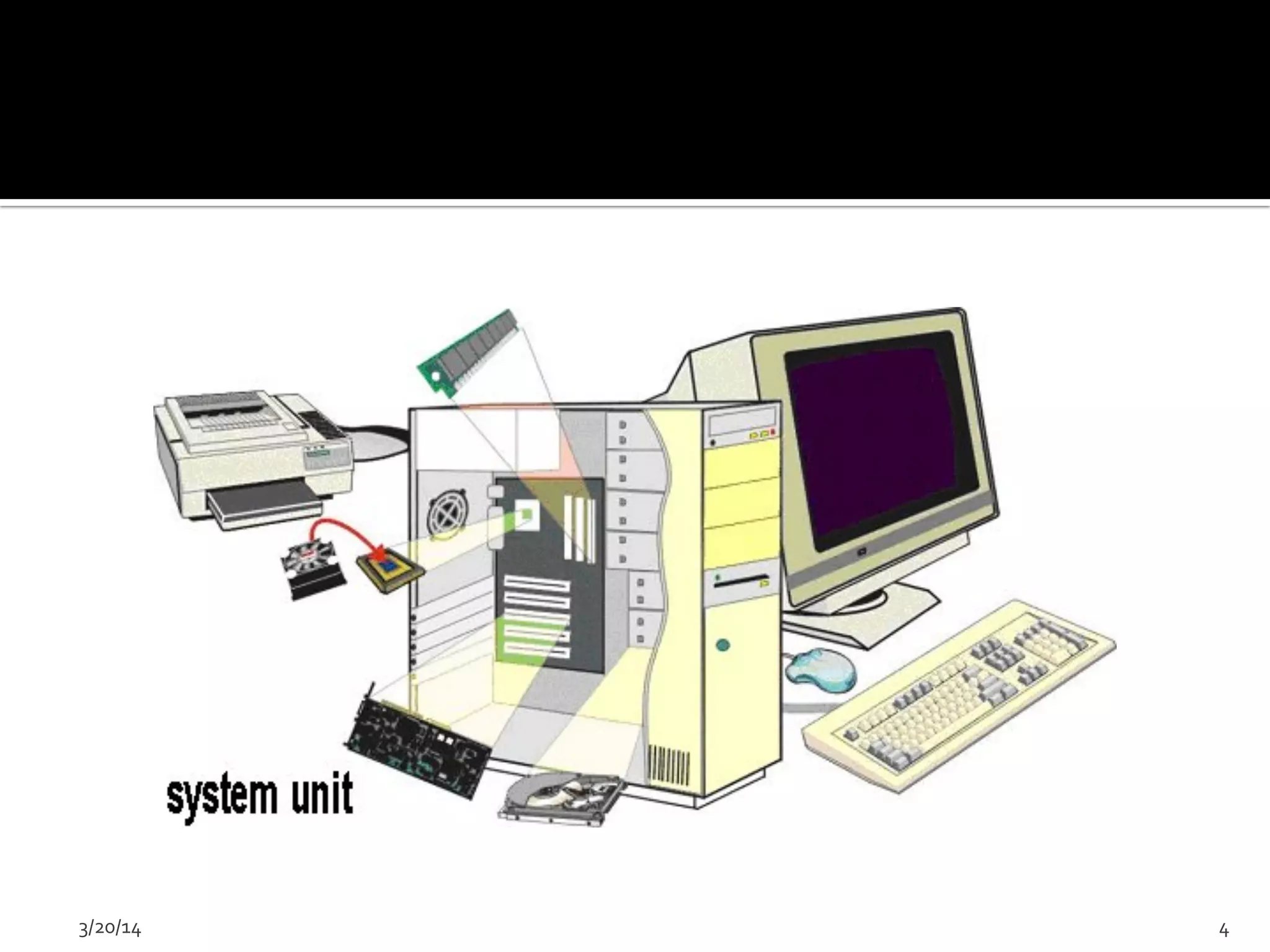
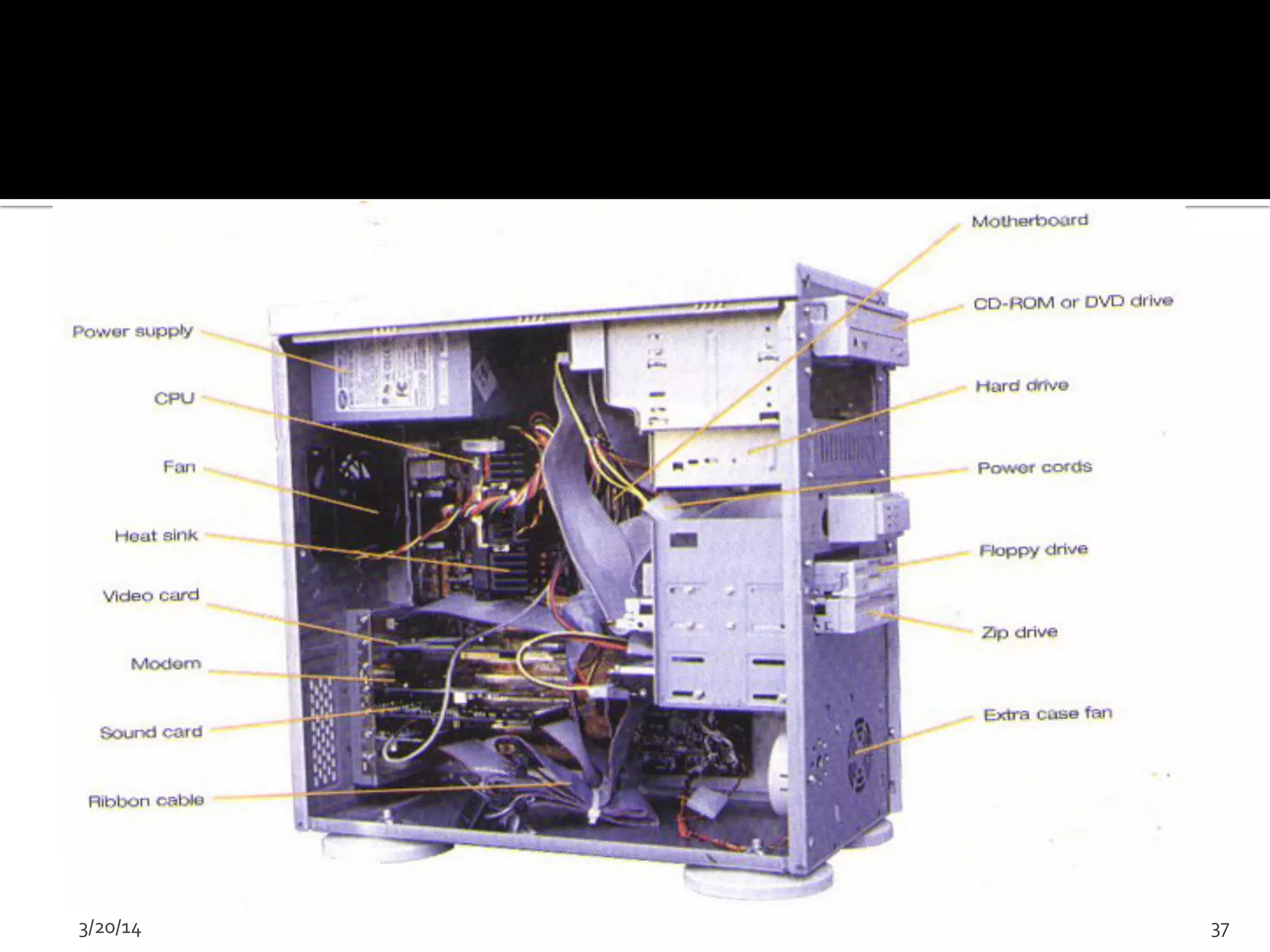
¡  Its	
  a	
  box	
  that	
  contains	
  different	
  
components	
  of	
  a	
  computer	
  system.	
  
¡  All	
  electronic	
  components	
  in	
  the	
  system	
  
unit	
  are	
  connected	
  to	
  motherboard	
  
¡  Important	
  components	
  of	
  system	
  units	
  
are:	


  Central	
  processing	
  Unit(Processor)	


  Memory	
  
3/20/14	
   36	
  
3/20/14	
   37	
  
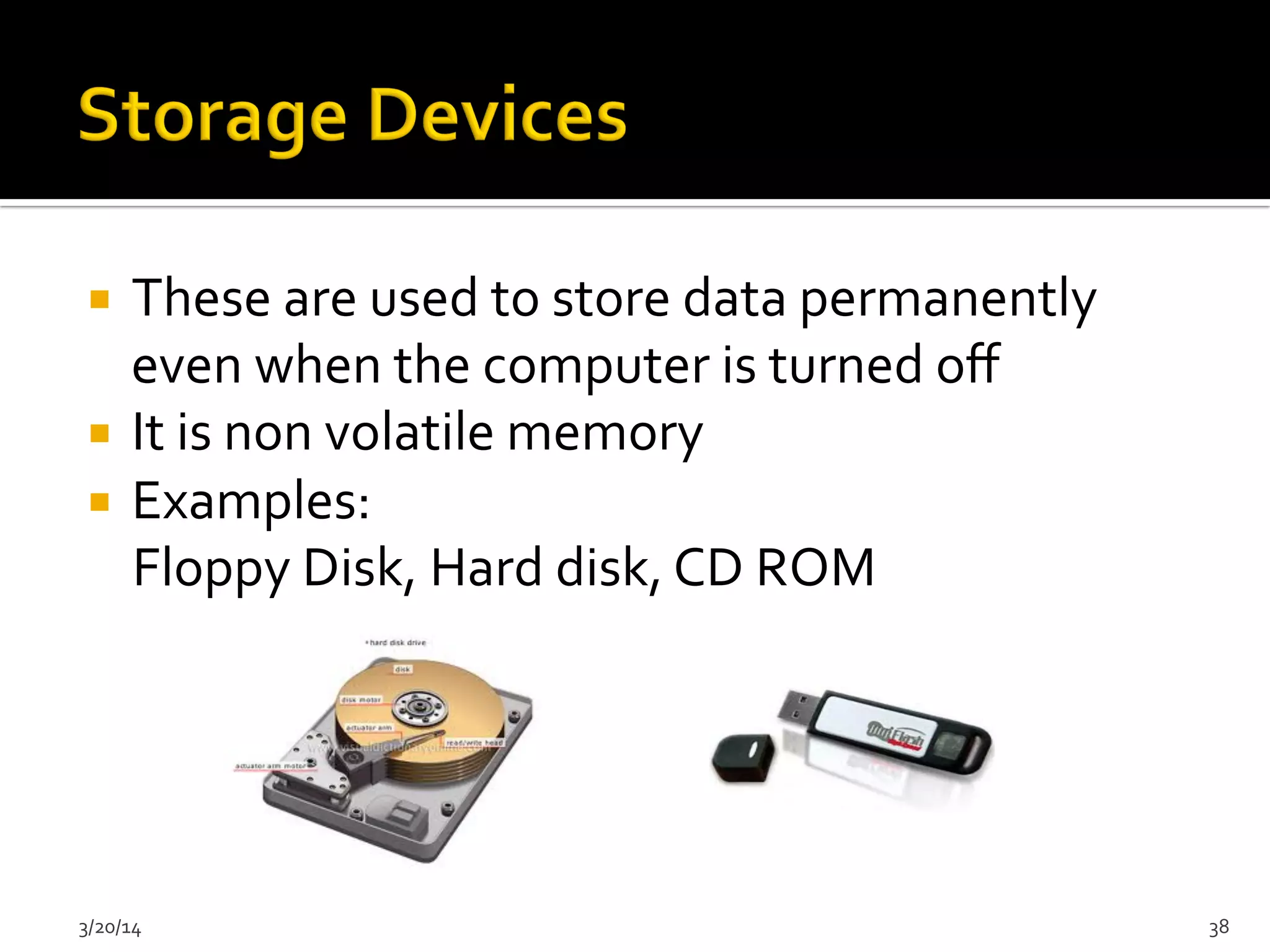
¡  These	
  are	
  used	
  to	
  store	
  data	
  permanently	
  
even	
  when	
  the	
  computer	
  is	
  turned	
  off	
  
¡  It	
  is	
  non	
  volatile	
  memory	
  
¡  Examples:	


  Floppy	
  Disk,	
  Hard	
  disk,	
  CD	
  ROM	
  
3/20/14	
   38	
  
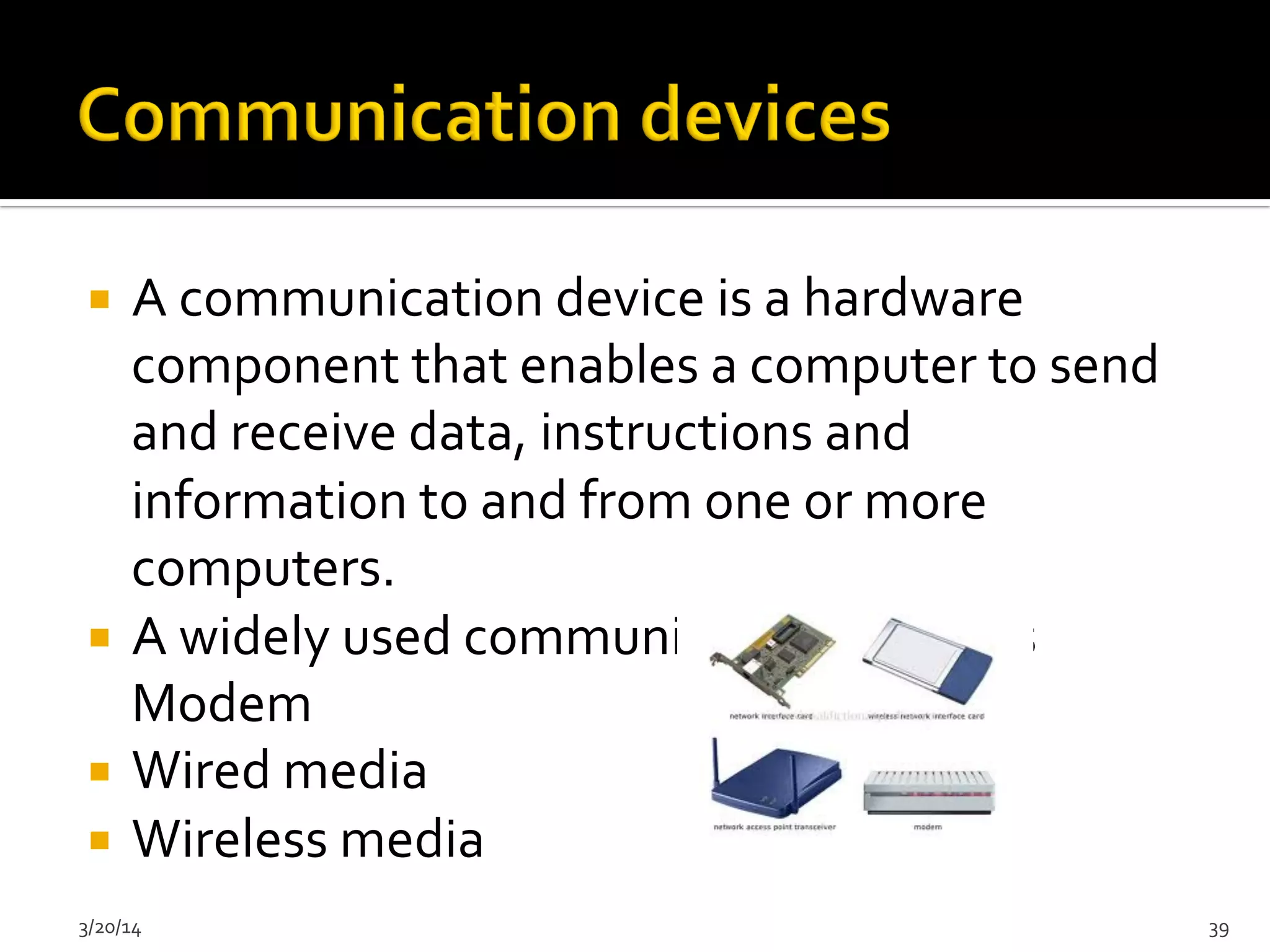
¡  A	
  communication	
  device	
  is	
  a	
  hardware	
  
component	
  that	
  enables	
  a	
  computer	
  to	
  send	
  
and	
  receive	
  data,	
  instructions	
  and	
  
information	
  to	
  and	
  from	
  one	
  or	
  more	
  
computers.	
  
¡  A	
  widely	
  used	
  communication	
  device	
  is	
  
Modem	
  
¡  Wired	
  media	
  
¡  Wireless	
  media	
  	
  
3/20/14	
   39	
  
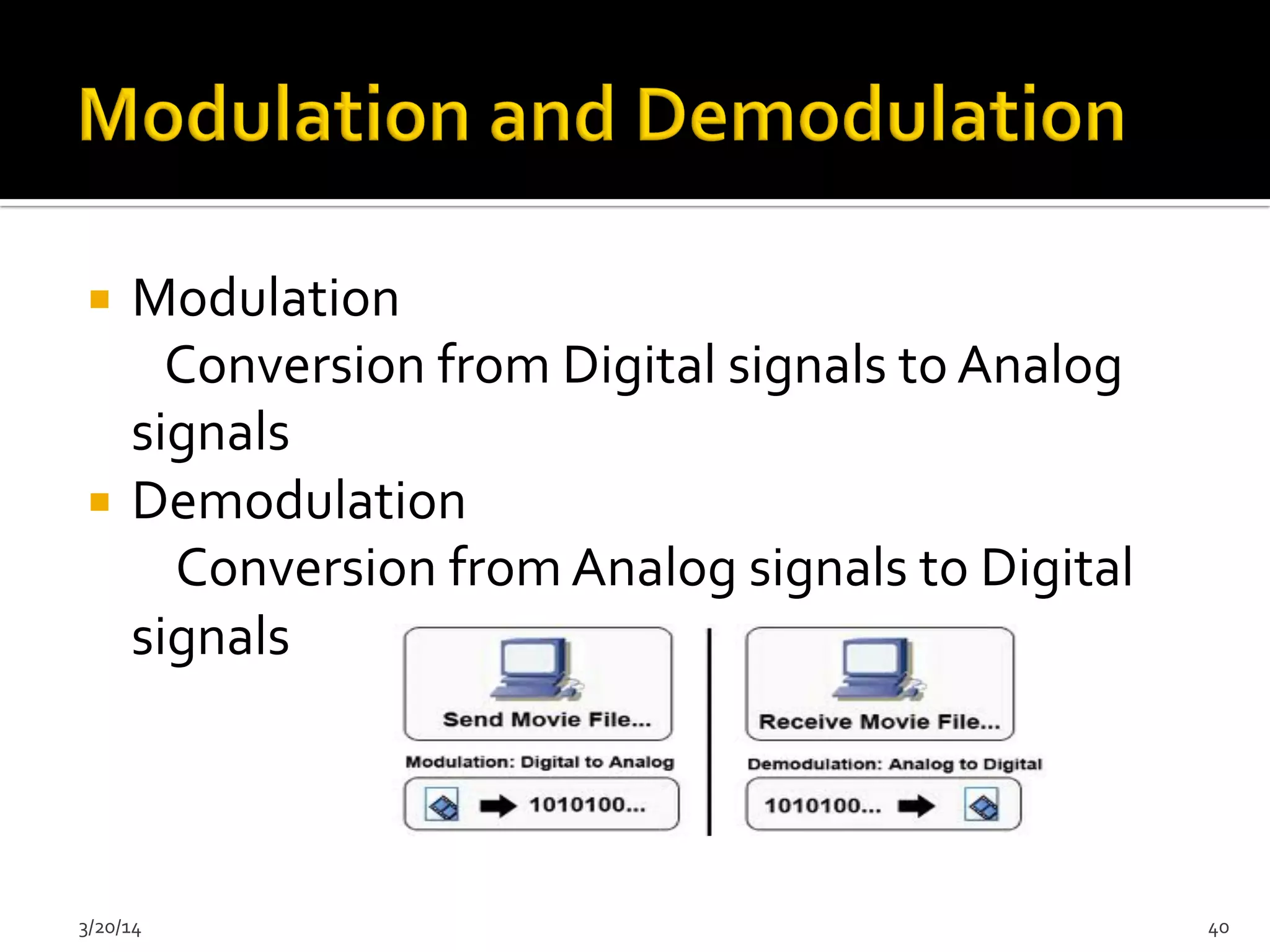
¡  Modulation	


  Conversion	
  from	
  Digital	
  signals	
  to	
  Analog	
  
signals	
  
¡  Demodulation	


  Conversion	
  from	
  Analog	
  signals	
  to	
  Digital	
  
signals	


3/20/14	
   40	
  
¡  Home	
  
¡  Education	
  
¡  Small	
  business	
  	
  
¡  Industry	
  
¡  Government	
  
¡  Health	
  care	
  
¡  Banking	
  
¡  Communication	
  
¡  Police	
  Department	
  
¡  Retail	
  
3/20/14	
   41	
  
¡  Data	


  A	
  collection	
  of	
  raw	
  facts	
  and	
  figures	
  is	
  called	
  
data.	
  It	
  may	
  consist	
  of	
  numbers,	
  characters,	
  
symbols	
  or	
  pictures	
  etc	
  
¡  Information	


  Processed	
  data	
  is	
  called	
  information.	
  It	
  is	
  
more	
  meaningful	
  than	
  data.	
  
3/20/14	
   42	
  
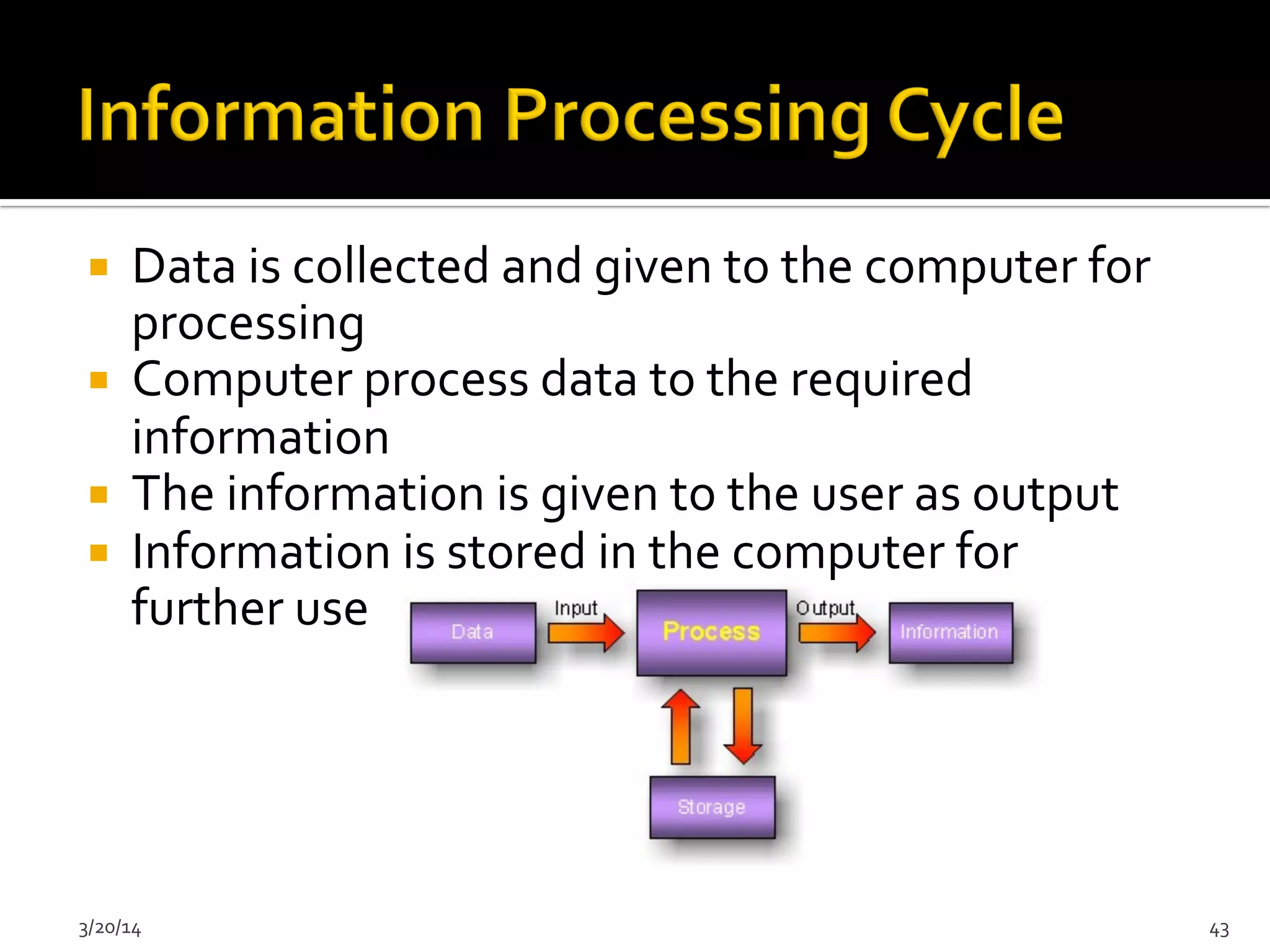
¡  Data	
  is	
  collected	
  and	
  given	
  to	
  the	
  computer	
  for	
  
processing	
  
¡  Computer	
  process	
  data	
  to	
  the	
  required	
  
information	
  
¡  The	
  information	
  is	
  given	
  to	
  the	
  user	
  as	
  output	
  
¡  Information	
  is	
  stored	
  in	
  the	
  computer	
  for	
  
further	
  use	
  
3/20/14	
   43	
  
3/20/14	
   44	
  
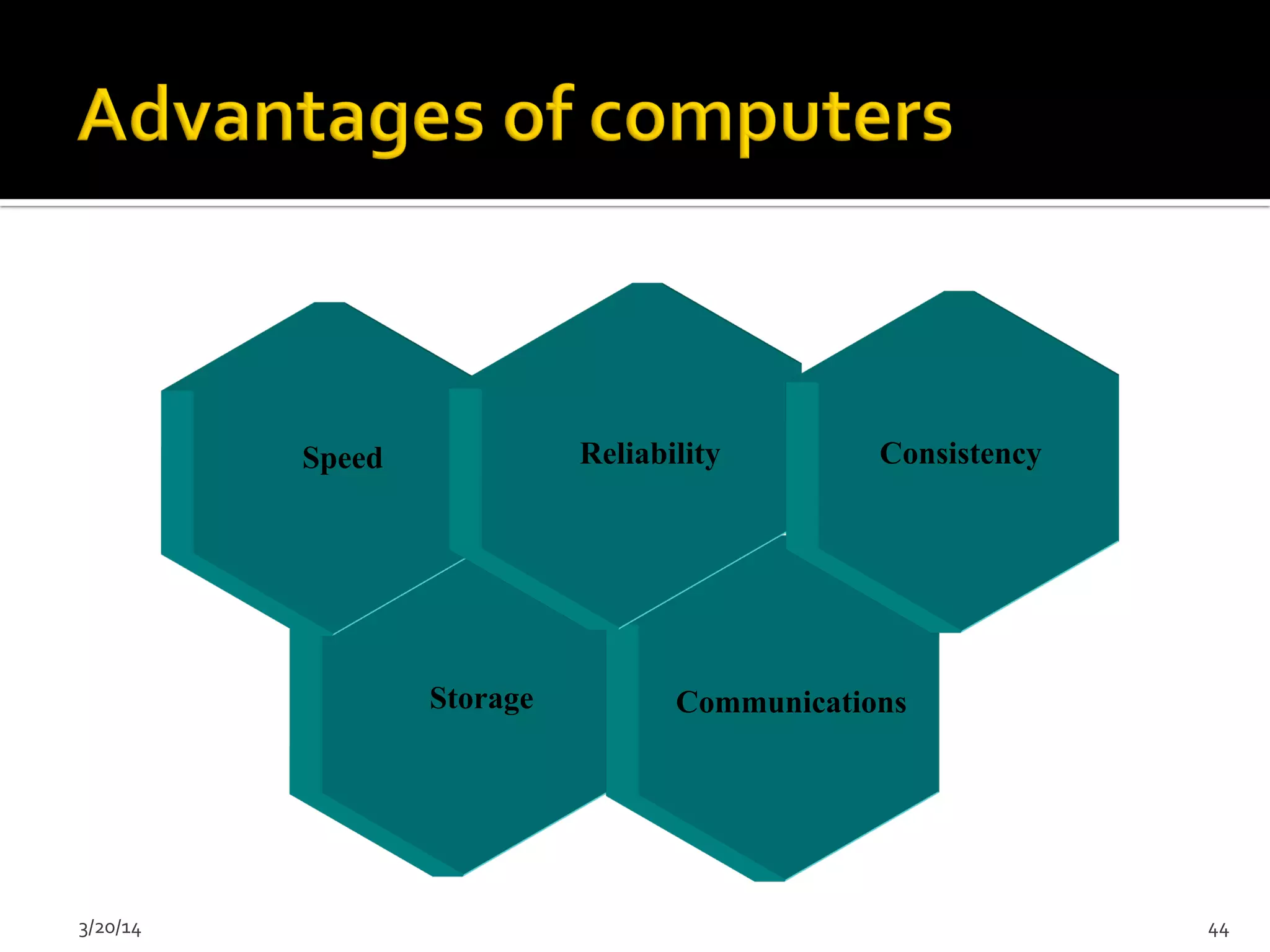
Storage Communications
Speed Reliability Consistency
3/20/14	
   45	
  
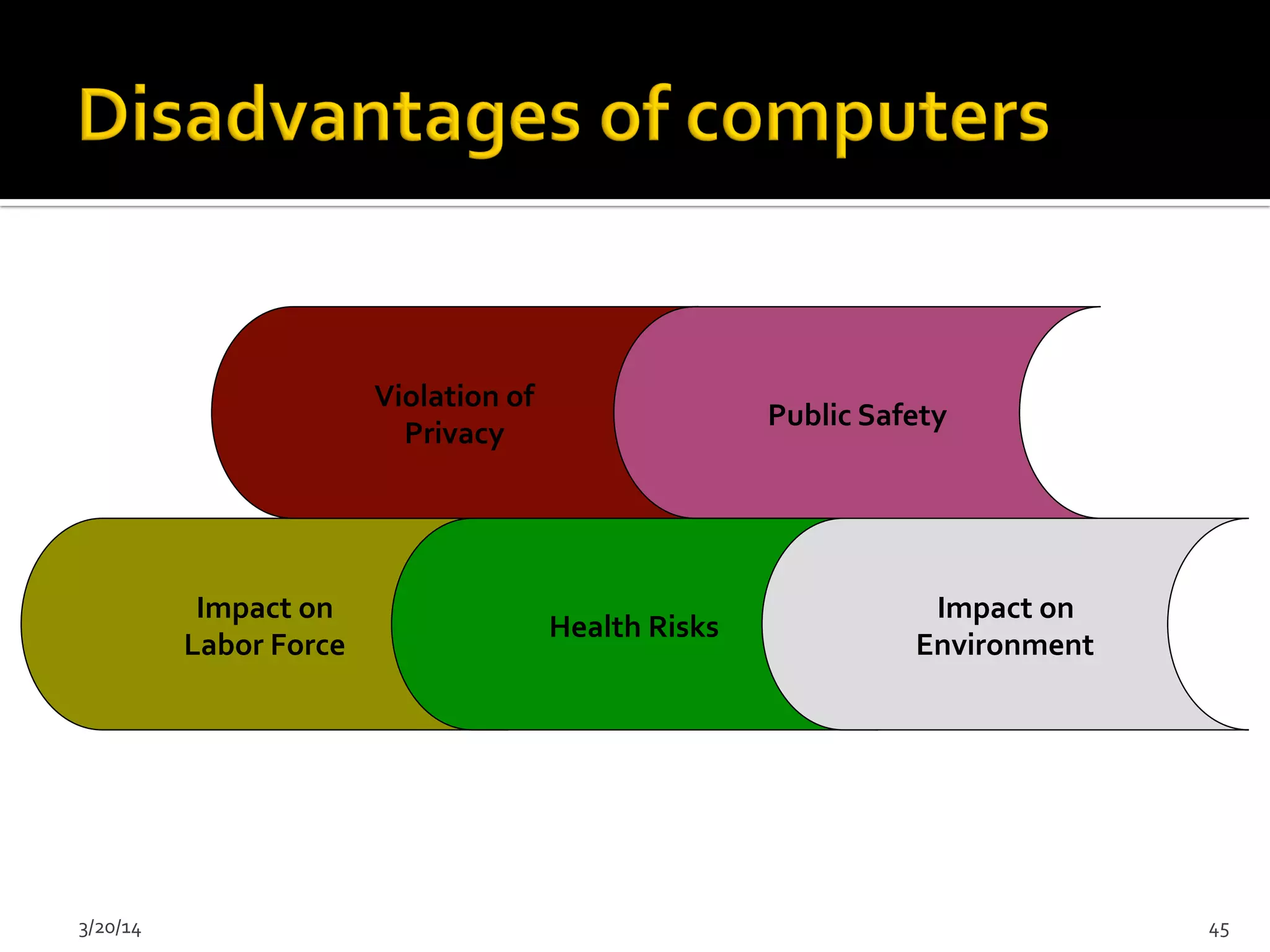
Impact	
  on	
  
Labor	
  Force	
  
Violation	
  of	
  
Privacy	
  
Health	
  Risks	
  
Public	
  Safety	
  
Impact	
  on	
  
Environment	
  

Introduction to information technology

  • 1.
    ASIF JAMAL Lecturer   National  University  Of  Modern  Languages   &   Senior  HR  Manager   Indus  Valley  Development  Society       3/20/14   1  
  • 2.
    ¡  Information  technology  is  the  technology   that  uses  computing  with  high  speed   communication  links  to  spread  information   from  one  place  to  another.   ¡  Computer  is  a  very  important  component  of   information  technology   ¡  The  world  has  become  “global  village”  due  to   advancement  in  IT.   3/20/14   2  
  • 3.
    ¡  An  electronic  device  that  is  programmed  to   accept  data,  process  data  into  useful   information  and  store  it  for  later  use   ¡  Computer  consists  of  hardware  and  software   ¡  Software  is  a  set  of  instructions  that  tells  a   computer  what  to  do   ¡  Hardware  is  the  physical  part  of  a  computer   E.g.  keyboard  ,  mouse  etc   ¡  Relationship  between  hardware  and  software   3/20/14   3  
  • 4.
  • 5.
  • 6.
    ¡  Analog  computers   ¡  Digital  computers   3/20/14   6  
  • 7.
    ¡  An  analog  computer  recognizes   data  as  a  continuous   measurement  of  a  physical   property.   ¡  It  has  no  state   ¡  Its  output  is  usually  displayed  on   a  meter  or  graphs.   ¡  Examples  are  Analog  clock,   speed  of  a  car,  thermometer  etc     3/20/14   7  
  • 8.
    ¡  It  works  with  numbers   ¡  They  breaks  all  types  of  information  into  tiny   units  and  use  numbers  to  represent  those   pieces  of  information.     ¡  Everything  is  described  in  two  states  i.e.   either  ON  (1)  or  OFF  (0).   ¡  They  are  very  fast  and    have  big  memory     3/20/14   8  
  • 9.
    The  six  generations  of  computers  are:   ¡  Mechanical  era(1623-­‐1900)   ¡  First  generation  electronic   computers(1937-­‐1953)   ¡  Second  generation  (1954-­‐1962)   ¡  Third  generation  (1963-­‐1972)   ¡  Forth  generation  (1972-­‐1984)   ¡  Fifth  generation  (1984-­‐1990)   ¡  Sixth  generation  (1990  -­‐  present)   3/20/14   9  
  • 10.
    ¡  Abacus  (3000  BC)          It  was  used  to  perform  addition,  subtraction,   division  and  multiplication.  It  consists  of   wooden  beads  and  calculation  were   performed  by  moving  these  beads  properly.                3/20/14   10  
  • 11.
    ¡  Napier’s  bone  (17th  century)              It  was  a  cupboard  multiplication  calculator        invented  by  john  Napier.                It  was  used  to  perform  difficult   multiplication  operations  to  simple  addition   of  entries  in  a  table                       3/20/14   11  
  • 12.
    ¡  Pascaline  (17th  century)                  It  was  invented  by  Blaise  Pascal.          It  was  first  mechanical  adding  machine          It  had  a  series  of  wheels  with  teeth  which  could           be  turned  using  hands.   3/20/14   12  
  • 13.
    ¡  Difference  Engine  and  Analytical  Engine(1823   and  1833)                      It  was  designed  by  Charles  Babbage  who   was  English  mathematician,  engineer,   philosopher  and  inventor.          He  originated  the  concept  of  the   programmable  computer.          A  general  purpose  computer  controlled  by  a   list  of  instructions   3/20/14   13  
  • 14.
    ¡  Punched  cards  (1890)          They  were  able  to  read  information  that   which  have  been  punched  into  the  cards   automatically   3/20/14   14  
  • 15.
    ¡  First  generation  computers  were  used   during  1942-­‐1955  .   ¡  They  were  based  on  Vacuum  Tube  which   was  a  glass  (tube)  that  controlled  and   amplified  the  electronic  signals     ¡  Consume  more  power  with  limited   performance     ¡  High  cost     ¡  Uses  assembly  language  –  to  prepare   programs.  These  were  translated  into   machine  level  language  for  execution.     3/20/14   15  
  • 16.
        ¡  Fixed  point  arithmetic  was  used     ¡  100  to  1000  fold  increase  in  speed  relative  to  the   earlier  mechanical  and  relay  based   electromechanical  technology     ¡  Punched  cards  and  paper  tape  were  invented  to   feed  programs  and  data  and  to  get  results.     ¡  Magnetic  tape  /  magnetic  drum  were  used  as   secondary  memory     ¡  Mainly  used  for  scientific  computations.     ¡  See  page  #  6,  Table  1A.2   ¡  Examples  are:  UNIVAC,  Havard  Mark  1,  ENIAC   etc     3/20/14   16  
  • 17.
  • 18.
    ¡  Bell  Lab  invented  the  transistor  –  function   like              vacuum  tubes  but  smaller,  lower  power   consumption,  more  reliable.   ¡  Transistor  is  a  small  device  that  transfer   electronic  signals  across  a  resister   ¡  Lower  cost     ¡  Magnetic    core  memories  were  used  as   main  memory  which  is  a  random-­‐access   nonvolatile  memory     ¡  Magnetic  tapes  and  magnetic  disks  were   used  as  secondary  memory     ¡  Hardware  for  floating  point  arithmetic   operations  was  developed.     3/20/14   18  
  • 19.
    ¡  Index  registers  were  introduced  which  increased   flexibility  of  programming.     ¡  High  level  languages  such  as  FORTRAN,  COBOL  etc   were  used  -­‐  Compilers  were  developed  to  translate   the  high-­‐level  program  into  corresponding  assembly   language  program  which  was  then  translated  into   machine  language.     ¡  Separate  input-­‐output  processors  were  developed   that  could  operate  in  parallel  with  CPU.     ¡  Punched  cards  continued  during  this  period  also.     ¡  1000  fold  increase  in  speed.     ¡  See  Page#  6  ,  Table  1A.3   ¡  Examples  are:  TRADIC,  IBM  704,  LARC  etc   3/20/14   19  
  • 20.
  • 21.
    ¡  Jack  Kilby  developed  Integrated  Circuit  (IC)   ¡  An  IC  combined  several  electronic  computers                on  a  small  silicon  chip   ¡  IBM  introduced    System/360  –  a  highly  configurable,    highly  backward  compatible,    mainframe  computer  system.     ¡  Small  Scale  Integration  and  Medium  Scale   Integration  technology  were  implemented  in   CPU,  I/O  processors  etc.     ¡   Smaller  &  better  performance     ¡   Comparatively  lesser  cost     ¡   Faster  processors   3/20/14   21  
  • 22.
    ¡   In  the  beginning  magnetic  core  memories   were  used.  Later  they  were  replaced  by   semiconductor  memories  (RAM  &  ROM)     ¡  Introduced  microprogramming     ¡  Microprogramming,  parallel  processing   (pipelining,  multiprocessor  system  etc),   multiprogramming,  multi-­‐user  system  (time   shared  system)  etc  were  introduced.     ¡  Operating  system  software  were  introduced   ¡  Cache  and  virtual  memories  were  introduced     3/20/14   22  
  • 23.
    ¡  High  level  languages  were  standardized  by  ANSI   e.g..  ANSI  FORTRAN,  ANSI  COBOL  etc     ¡  Database  management,  multi-­‐user  application,   online  systems  like  closed  loop  process  control,   airline  reservation,  interactive  query  systems,   automatic  industrial  control  etc  emerged  during   this  period.     ¡  See  page  #  7,  Table  1A.4   ¡  Examples  are:  INTEL  4004,    IBM  SYSTEM/360   etc   3/20/14   23  
  • 24.
  • 25.
    ¡  Microprocessors  were  introduced  as  CPU–   Complete  processors  and  large  section  of  main   memory  could  be  implemented  in  a  single  chip     ¡  Tens  of  thousands  of  transistors  can  be  placed  in   a  single  chip  (VLSI  design  implemented)     ¡   CRT  screen,  laser  &  ink  jet  printers,  scanners  etc   were  developed.     ¡  Semiconductor  memory  chips  were  used  as  the   main  memory.     ¡  Secondary  memory  was  composed  of  hard  disks   –  Floppy  disks  &  magnetic  tapes  were  used  for   backup  memory     3/20/14   25  
  • 26.
    ¡  Parallelism,  pipelining  cache  memory  and  virtual   memory  were  applied  in  a  better  way     ¡  LAN  and  WANS  were  developed  (where  desktop   work  stations  interconnected)     ¡  Introduced  C  language  and  Unix  OS     ¡  Introduced  Graphical  User  Interface     ¡  Less  power  consumption     ¡  High  performance,  lower  cost  and  very  compact     ¡  Much  increase  in  the  speed  of  operation     ¡  Examples  are  Apple  Macintosh  and  IBM  PC   ¡  See  Page  #  7,  Table  1A.5     3/20/14   26  
  • 27.
  • 28.
    ¡  Computers  based  on  artificial  intelligence  are  available     ¡   Computers  use  extensive  parallel  processing,  multiple  pipelines,   multiple  processors  etc     ¡  Massive  parallel  machines  and  extensively  distributed  system   connected  by  communication  networks  fall  in  this  category.     ¡  Introduced  ULSI  (Ultra  Large  Scale  Integration)  technology  –   Intel’s  Pentium  4  microprocessor  contains  55  million  transistors   millions  of  components  on  a  single  IC  chip.     ¡  Superscalar  processors,  Vector  processors,  SIMD  processors,  32  bit   micro  controllers  and  embedded  processors,  Digital  Signal   Processors  (DSP)  etc  have  been  developed.     ¡  Memory  chips  up  to  1  GB,  hard  disk  drives  up  to  180  GB  and  optical   disks  up  to  27  GB  are  available  (still  the  capacity  is  increasing)     ¡  Object  oriented  language  like  JAVA  suitable  for  internet   programming  has  been  developed.     3/20/14   28  
  • 29.
    ¡  Portable  note  book  computers  introduced     ¡  Storage  technology  advanced  –  large  main   memory  and  disk  storage  available     ¡  Introduced  World  Wide  Web.  (and  other   existing  applications  like  e-­‐mail,  e  Commerce,   Virtual  libraries/Classrooms,  multimedia   applications  etc.)     ¡  New  operating  systems  developed  –   Windows  95/98/XP/…,  LINUX,  etc.     3/20/14   29  
  • 30.
    ¡  Got  hot  pluggable  features  –  which  enable  a   failed  component  to  be  replaced  with  a  new   one  without  the  need  to  shutdown  the   system,  allowing  the  uptime  of  the  system  to   be  very  high.     ¡  The  recent  development  in  the  application  of   internet  is  the  Grid  technology  which  is  still  in   its  upcoming  stage.     ¡  See  Page  #  8,  Table  1A.6   3/20/14   30  
  • 31.
  • 32.
    ¡  Some  inventions  of  the  time  are  WWW,     HTML,  HTTP,  Web  TV,  java,  DVD,  iPod,   Youtube  etc   ¡  See  Page  #  8  ,  Table  1A.7   ¡  Examples  are:  iMac  ,  Sun  ultra  workstation   etc     3/20/14   32  
  • 33.
    ¡  Input  Devices   ¡  Output  devices   ¡  System  Unit   ¡  Storage  devices   ¡  Communication  devices   3/20/14   33  
  • 34.
    ¡  The  devices  that  are  used  to  enter  data  and   instructions  into  the  computers   ¡  Most  commonly  used  input  devices  are   Keyboard  and  Mouse   3/20/14   34  
  • 35.
    ¡  Output  devices  are  used  to   display  processed  data  to   the  user   ¡  Most  commonly  used   output  devices  are  Monitor,     Printer  and  speakers   ¡  Hard  Copy  is  paper  copy  –   tangible   ¡  Soft  copy  is  intangible   3/20/14   35  
  • 36.
    ¡  Its  a  box  that  contains  different   components  of  a  computer  system.   ¡  All  electronic  components  in  the  system   unit  are  connected  to  motherboard   ¡  Important  components  of  system  units   are:                Central  processing  Unit(Processor)                Memory   3/20/14   36  
  • 37.
  • 38.
    ¡  These  are  used  to  store  data  permanently   even  when  the  computer  is  turned  off   ¡  It  is  non  volatile  memory   ¡  Examples:          Floppy  Disk,  Hard  disk,  CD  ROM   3/20/14   38  
  • 39.
    ¡  A  communication  device  is  a  hardware   component  that  enables  a  computer  to  send   and  receive  data,  instructions  and   information  to  and  from  one  or  more   computers.   ¡  A  widely  used  communication  device  is   Modem   ¡  Wired  media   ¡  Wireless  media     3/20/14   39  
  • 40.
    ¡  Modulation                Conversion  from  Digital  signals  to  Analog   signals   ¡  Demodulation                  Conversion  from  Analog  signals  to  Digital   signals     3/20/14   40  
  • 41.
    ¡  Home   ¡ Education   ¡  Small  business     ¡  Industry   ¡  Government   ¡  Health  care   ¡  Banking   ¡  Communication   ¡  Police  Department   ¡  Retail   3/20/14   41  
  • 42.
    ¡  Data              A  collection  of  raw  facts  and  figures  is  called   data.  It  may  consist  of  numbers,  characters,   symbols  or  pictures  etc   ¡  Information              Processed  data  is  called  information.  It  is   more  meaningful  than  data.   3/20/14   42  
  • 43.
    ¡  Data  is  collected  and  given  to  the  computer  for   processing   ¡  Computer  process  data  to  the  required   information   ¡  The  information  is  given  to  the  user  as  output   ¡  Information  is  stored  in  the  computer  for   further  use   3/20/14   43  
  • 44.
    3/20/14   44   Storage Communications Speed Reliability Consistency
  • 45.
    3/20/14   45   Impact  on   Labor  Force   Violation  of   Privacy   Health  Risks   Public  Safety   Impact  on   Environment