Islamic
Finance
ASIF JAMAL
Visiting Lecturer
University of Sindh
@ Mirpurkhas Campus.
The Principles of Islamic Finance
Islamic Banking (IB)
Definition:
Islamic banking can be defined as: a form of
modern banking based on Islamic legal concepts
using risk- sharing as its main method excluding
financing based on fixed pre- determined return.
The purpose of the Islamic
financial system:
The purpose of the Islamic financial system
is, as with conventional finance, to mobilize
global resources to promote and sustain
global and regional development.
Islamic Finance taps the vast pool of savings
held by Muslims, and puts these savings to
productive use for the benefit of Islamic and
other societies.
Can Economy and Religion mix
 The practice of religion is between the person and his God in
forms of pray or meditations, and in daily life such as marriage,
funerary service, public service and charities
 Economic systems are manmade system to regulate and
reform trade:
 Throw history economic systems have taken a form of trying and
testing of what to produce? How to produce? Who gets what is
produced?
 Efficacy, growth, liberty and equality are objectives to achieve in
good economic systems
 In capitalist economic system production carried out to maximize
profit, while in socialist systems labour and jobs is the goal
5 05/11/2013
Islam
 The five pillars of Islam:
1. Shahadat (profession of faith)
2. Salat (prayer)
3. Zakat (giving of alms)
4. Sawm Ramadan (fasting during the month of Ramadan)
5. Hajj (pilgrimage to Mecca for those who are able
physically and financially)
05/11/2013
6
Shari'ah law
Justice, fairness and morality
 Are values which underpin both the entire Islamic way of
life.
 Shariah gives guidance as to what is, and what is not,
acceptable behaviour in all areas of a Muslim’s life
 Shari'ah is developed by Shari'ah scholars (Known as Schools
of thoughts, Safaai, Hanafi, Hanbali, Malki, Sheaat ,etc. ) over
1000 years ago (over 400 years after Islam)
 The recent Scholars known as Shari'ah advisors or Shari’ah
board has studied Fiqh Al-Muaamlat able to explain Shari'ah
law for recent business dealings.
 The principal base of the Shari’ah Law is:
the permissibility, the prohibition is exceptional
705/11/2013
7
What is Islamic Finance?
 Islamic Banks Started in 1974 in Egypt with the first Islamic
Bank “Nasser social bank” followed by Islamic development
bank in 1975, now there are over 600 Islamic Banks globally
 Islamic Banks started as interest free bank to help the small
entrepreneurs to start business, the costs of managing the bank
charged the stack holder as expanses
 The framework of an Islamic financial system is based on
elements of Shari'ah(Islamic Law) which prohibit Riba (Usury)
and Gharar (Deception) and permit Risk sharing
 The fundamental concept is that the money has no inherent
value and should be used as a measure of worth
 Shari’ah compliant investment are structured on the exchange
of ownership in tangible assets or services with money acting
as the payment mechanism to effect the transfer of ownership
8 05/11/2013
Shari’ah Law
 Recent Islamic scholars who from time to time re-
examine the Shari'ah principals have structured new
financial instruments
 Those instruments must comply with principals of The
of Shari'ah law
 Ethics of the Shari’ah Law originate from:
 The Qur'an
 The Sunnah,
 Ijmaa - consensus among the jurists,
 Qiyyas – analogy
 Ijtihad - reasoning
05/11/2013
9
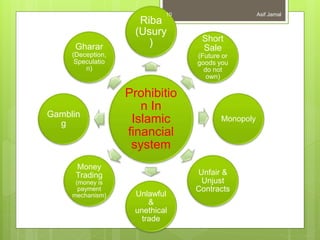
Prohibitio
n In
Islamic
financial
system
Riba
(Usury
) Short
Sale
(Future or
goods you
do not
own)
Monopoly
Unfair &
Unjust
Contracts
Unlawful
&
unethical
trade
Money
Trading
(money is
payment
mechanism)
Gamblin
g
Gharar
(Deception,
Speculatio
n)
10 Asif Jamal
Prohibitions
In Islamic financial system
 Prohibition of Unfairness & Unjust
 Prohibition of Riba (usury)
 Prohibition of Gharar (Deception & Speculation)
 Prohibition of Gambling
 Prohibition of Monopolies
 Prohibition of Short Sales
 Prohibition in money trading (Money is a medium not a
commodity)
 Prohibition of Dealing in Unlawful or Unethical Goods or
Services
11
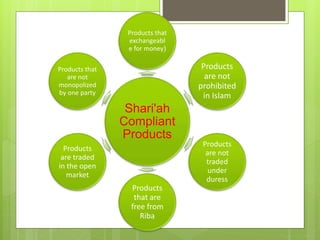
Shari'ah
Compliant
Products
Products that
exchangeabl
e for money)
Products
are not
prohibited
in Islam
Products
are not
traded
under
duress
Products
that are
free from
Riba
Products
are traded
in the open
market
Products that
are not
monopolized
by one party
 Islam has given an immense importance to trade
 The nobility of this profession is obvious from the
fact that it was the chosen profession of prophet
Muhammad (PBUH).
Musharakah
 Definition:
 A Musharakah is a joint venture where by all
partners (BANK /CLIENT) participate in providing
the financial resources for the business. the Client
to start and/or
 operate a business or industry, or undertake any
other type of business venture.
 The bank and the Client agree to manage the
business enterprise according to
 the terms of the agreement.
Basic Principles Of
Musharakah:
 Financing through Musharakah means participation in the business.
 An investor/financier must share the loss incurred by the
business to
the extent of his financing.
 The partners are at liberty to determine, with mutual consent, the
Ratio of profit allocated to each one of them, which may differ from
the ratio of investment.
 The loss suffered by each partner must be exactly in the
proportion of
his investment.
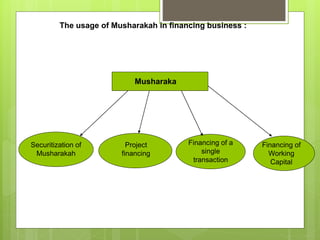
The usage of Musharakah in financing business :
Project
financing
Financing of a
single
transaction
Securitization of
Musharakah
Financing of
Working
Capital
Musharaka
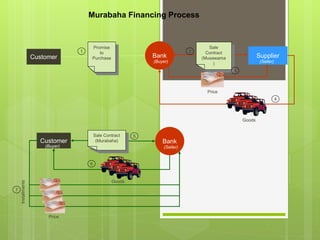
Murabaha
 Definition:
 Murabaha is a sale contract between the
Bank as seller of goods and Client as purchaser, based
on the disclosure of initial price to client. Bank purchases
Goods on spot at the request of the Client, and then sells
same to him on credit at a mutually agreed marked-up
price.
Murabaha Financing Process
Customer Bank
1
Supplier
Price
Goods
Promise
to
Purchase
Sale
Contract
(Musawama
)
2
3
4
Customer Bank
Goods
Sale Contract
(Murabaha)
Installments
5
6
7
(Buyer) (Seller)
(Buyer) (Seller)
Price
Assignment
 Read out the banking system of different
banks which are presently working on Islamic
Account

Islamic finance

  • 1.
  • 2.
    The Principles ofIslamic Finance Islamic Banking (IB) Definition: Islamic banking can be defined as: a form of modern banking based on Islamic legal concepts using risk- sharing as its main method excluding financing based on fixed pre- determined return.
  • 3.
    The purpose ofthe Islamic financial system: The purpose of the Islamic financial system is, as with conventional finance, to mobilize global resources to promote and sustain global and regional development.
  • 4.
    Islamic Finance tapsthe vast pool of savings held by Muslims, and puts these savings to productive use for the benefit of Islamic and other societies.
  • 5.
    Can Economy andReligion mix  The practice of religion is between the person and his God in forms of pray or meditations, and in daily life such as marriage, funerary service, public service and charities  Economic systems are manmade system to regulate and reform trade:  Throw history economic systems have taken a form of trying and testing of what to produce? How to produce? Who gets what is produced?  Efficacy, growth, liberty and equality are objectives to achieve in good economic systems  In capitalist economic system production carried out to maximize profit, while in socialist systems labour and jobs is the goal 5 05/11/2013
  • 6.
    Islam  The fivepillars of Islam: 1. Shahadat (profession of faith) 2. Salat (prayer) 3. Zakat (giving of alms) 4. Sawm Ramadan (fasting during the month of Ramadan) 5. Hajj (pilgrimage to Mecca for those who are able physically and financially) 05/11/2013 6
  • 7.
    Shari'ah law Justice, fairnessand morality  Are values which underpin both the entire Islamic way of life.  Shariah gives guidance as to what is, and what is not, acceptable behaviour in all areas of a Muslim’s life  Shari'ah is developed by Shari'ah scholars (Known as Schools of thoughts, Safaai, Hanafi, Hanbali, Malki, Sheaat ,etc. ) over 1000 years ago (over 400 years after Islam)  The recent Scholars known as Shari'ah advisors or Shari’ah board has studied Fiqh Al-Muaamlat able to explain Shari'ah law for recent business dealings.  The principal base of the Shari’ah Law is: the permissibility, the prohibition is exceptional 705/11/2013 7
  • 8.
    What is IslamicFinance?  Islamic Banks Started in 1974 in Egypt with the first Islamic Bank “Nasser social bank” followed by Islamic development bank in 1975, now there are over 600 Islamic Banks globally  Islamic Banks started as interest free bank to help the small entrepreneurs to start business, the costs of managing the bank charged the stack holder as expanses  The framework of an Islamic financial system is based on elements of Shari'ah(Islamic Law) which prohibit Riba (Usury) and Gharar (Deception) and permit Risk sharing  The fundamental concept is that the money has no inherent value and should be used as a measure of worth  Shari’ah compliant investment are structured on the exchange of ownership in tangible assets or services with money acting as the payment mechanism to effect the transfer of ownership 8 05/11/2013
  • 9.
    Shari’ah Law  RecentIslamic scholars who from time to time re- examine the Shari'ah principals have structured new financial instruments  Those instruments must comply with principals of The of Shari'ah law  Ethics of the Shari’ah Law originate from:  The Qur'an  The Sunnah,  Ijmaa - consensus among the jurists,  Qiyyas – analogy  Ijtihad - reasoning 05/11/2013 9
  • 10.
    Prohibitio n In Islamic financial system Riba (Usury ) Short Sale (Futureor goods you do not own) Monopoly Unfair & Unjust Contracts Unlawful & unethical trade Money Trading (money is payment mechanism) Gamblin g Gharar (Deception, Speculatio n) 10 Asif Jamal
  • 11.
    Prohibitions In Islamic financialsystem  Prohibition of Unfairness & Unjust  Prohibition of Riba (usury)  Prohibition of Gharar (Deception & Speculation)  Prohibition of Gambling  Prohibition of Monopolies  Prohibition of Short Sales  Prohibition in money trading (Money is a medium not a commodity)  Prohibition of Dealing in Unlawful or Unethical Goods or Services 11
  • 12.
    Shari'ah Compliant Products Products that exchangeabl e formoney) Products are not prohibited in Islam Products are not traded under duress Products that are free from Riba Products are traded in the open market Products that are not monopolized by one party
  • 13.
     Islam hasgiven an immense importance to trade  The nobility of this profession is obvious from the fact that it was the chosen profession of prophet Muhammad (PBUH).
  • 14.
    Musharakah  Definition:  AMusharakah is a joint venture where by all partners (BANK /CLIENT) participate in providing the financial resources for the business. the Client to start and/or  operate a business or industry, or undertake any other type of business venture.  The bank and the Client agree to manage the business enterprise according to  the terms of the agreement.
  • 15.
    Basic Principles Of Musharakah: Financing through Musharakah means participation in the business.  An investor/financier must share the loss incurred by the business to the extent of his financing.  The partners are at liberty to determine, with mutual consent, the Ratio of profit allocated to each one of them, which may differ from the ratio of investment.  The loss suffered by each partner must be exactly in the proportion of his investment.
  • 16.
    The usage ofMusharakah in financing business : Project financing Financing of a single transaction Securitization of Musharakah Financing of Working Capital Musharaka
  • 17.
    Murabaha  Definition:  Murabahais a sale contract between the Bank as seller of goods and Client as purchaser, based on the disclosure of initial price to client. Bank purchases Goods on spot at the request of the Client, and then sells same to him on credit at a mutually agreed marked-up price.
  • 18.
    Murabaha Financing Process CustomerBank 1 Supplier Price Goods Promise to Purchase Sale Contract (Musawama ) 2 3 4 Customer Bank Goods Sale Contract (Murabaha) Installments 5 6 7 (Buyer) (Seller) (Buyer) (Seller) Price
  • 19.
    Assignment  Read outthe banking system of different banks which are presently working on Islamic Account